Key takeaways
- Dig for Victory created 1.4 million allotments by 1943, supplying 10% of UK wartime food
- 100 square feet (9.3 m²) per person is enough for year-round vegetables, the wartime baseline
- Potato yields hit 30,000 tubers per acre using close 30cm spacing and earthing-up at 4-week intervals
- Cabbage-leek-potato-bean rotation kept soil fertile without bagged fertiliser, still the cleanest UK rotation
- Root clamps at 2-4C stored carrots, parsnips and beetroot for 6 months without refrigeration
- VE Day (8 May) is the natural anniversary to honour wartime growing through your own plot
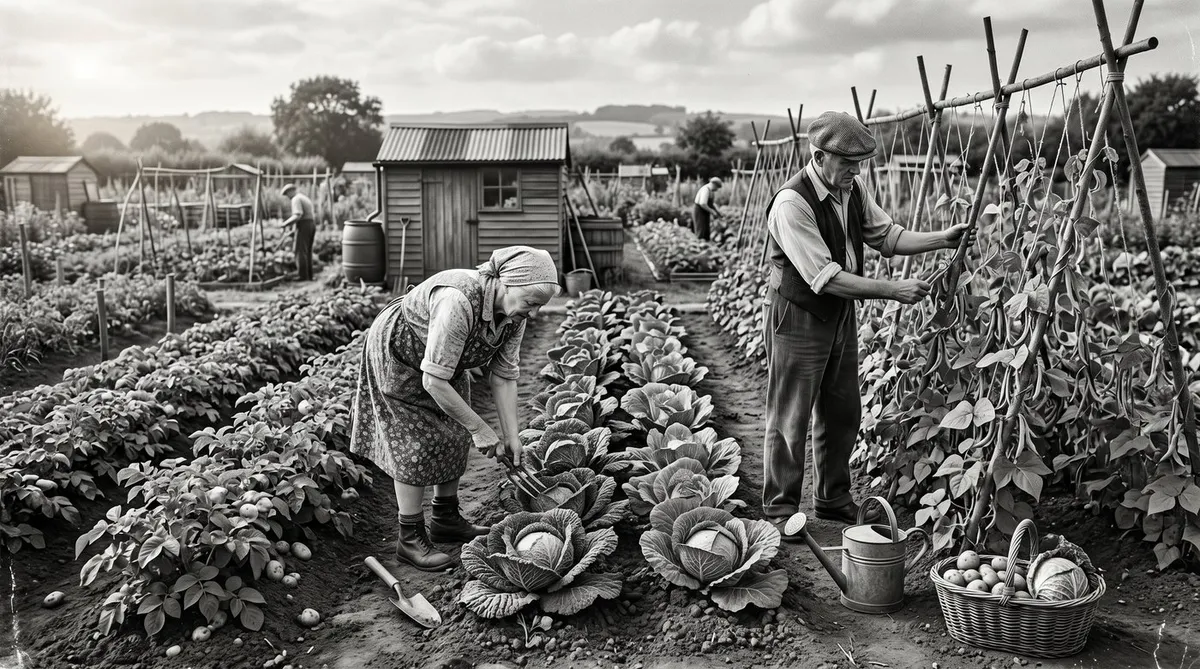
Dig for Victory was launched on 4 October 1939, four weeks after Britain declared war on Germany. The Ministry of Agriculture wanted citizens to convert lawns, parks, and waste ground into food-producing plots. The campaign worked beyond expectation. By 1943 it had created 1.4 million allotments producing 1.3 million tons of vegetables annually, supplying 10% of UK food. The techniques that made it work are still the cleanest, simplest, lowest-input way to feed a UK family from a small plot. This guide covers the seven that still earn their place 80+ years later.
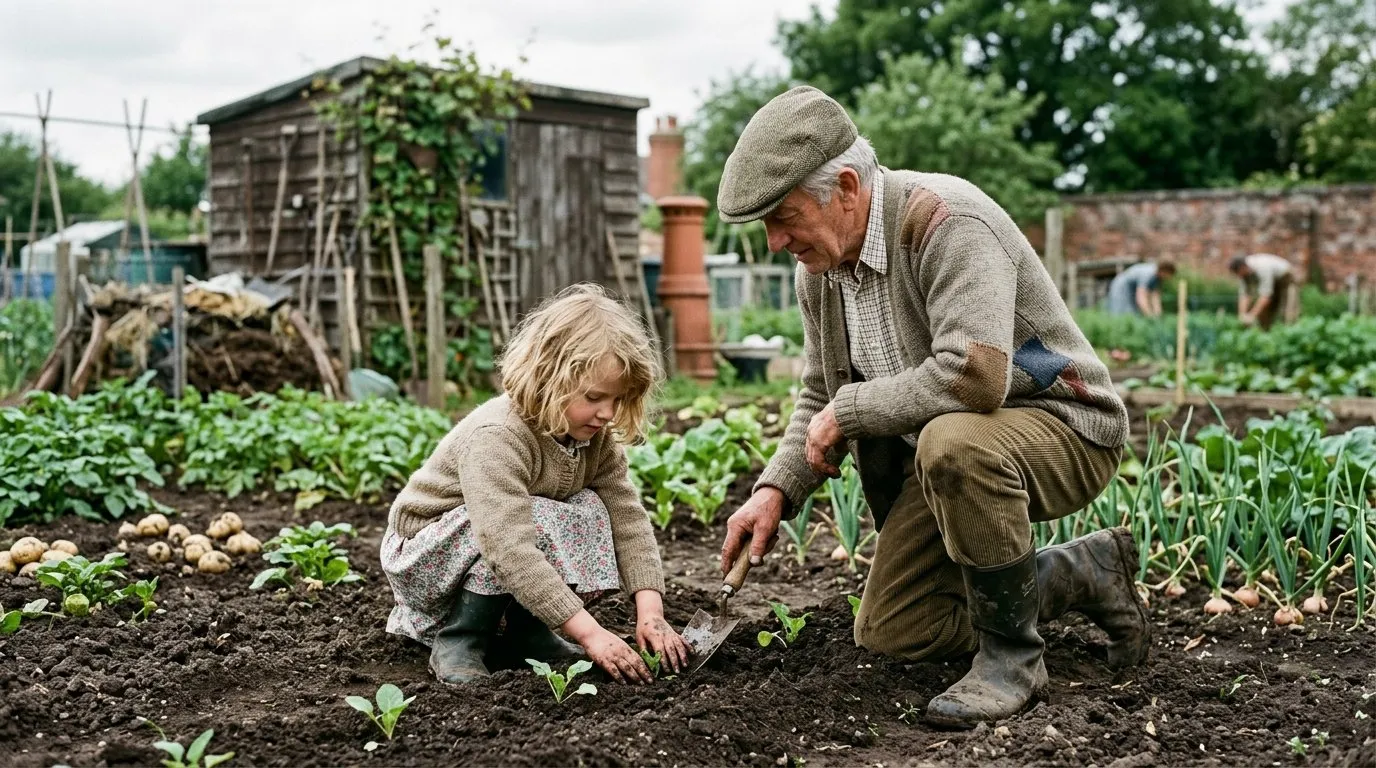
Why Dig for Victory worked
Britain imported 70% of its food in 1939. When German U-boats began attacking Atlantic convoys, food became a strategic vulnerability. The Ministry of Agriculture’s response was to ask every citizen to grow what they could. Within four years, the country was producing more vegetables than at any point in its history.
The numbers. Allotments grew from 815,000 in 1939 to 1.4 million by 1943. Vegetable output rose from 1.0 million tons pre-war to 1.3 million tons. Domestic food self-sufficiency rose from 30% to over 50%. The rationing system held throughout the war and for nine years after, partly because home growing filled the protein and vitamin gap that imports could not.
The leaflets. The Ministry produced 26 free Dig for Victory leaflets between 1940 and 1945, distributed through libraries, post offices, and the BBC. Topics covered sowing calendars, pest control, storage, and beekeeping. The leaflets are still good reading; the Imperial War Museum archive holds digitised copies online.
The personalities. Cecil Middleton broadcast “In Your Garden” on the BBC every Sunday afternoon throughout the war. His audience reached 4-5 million. His tone was practical, calm, and assumed his listeners were able adults capable of growing food without being patronised. The same tone underlies modern Garden UK content.
The legacy. Most UK allotment sites trace their boundaries to 1939-1945 council orders. The site secretary system, the standard 5- and 10-rod plots, and the cultivation requirement all date from this period. We are still using the wartime infrastructure 80+ years later.
Lesson 1: 100 square feet per person
The Ministry’s headline ratio: 100 square feet (9.3 m²) per family member for year-round vegetables. A family of four needed 400 square feet (37 m²), roughly half of a standard UK 10-rod allotment.
What 100 sq ft produced annually: 75-90kg of potatoes, 12kg of cabbage and Brussels sprouts, 10kg of runner beans, 8kg of onions, 6kg of carrots, 5kg of leeks, and seasonal salads. Not a complete diet, but enough vegetables to fill the rationing gap and provide vitamins through winter.
The maths. A family of four eating 1.5kg of vegetables per person per day across the year needs roughly 2,200kg of vegetables annually. Imports and rationing supplied 1,500-1,700kg of that pre-war; the 400 square feet of Dig for Victory plot supplied the remaining 500-700kg.
Modern application. The 100 sq ft ratio still works for UK gardens. A back garden of 9.3 m² can supply meaningful vegetables for one person. A 5-rod allotment (125 m²) supplies for a family of four with margin. Plan in 100-sq-ft increments per household member for a realistic Dig for Victory style budget.
Lesson 2: The 4-bed rotation
Dig for Victory used a 4-bed rotation that fed soil naturally without synthetic fertiliser. The rotation alternated four crop families across four years, each family contributing or taking different soil nutrients.
| Year | Bed 1 | Bed 2 | Bed 3 | Bed 4 |
|---|---|---|---|---|
| 1 | Potatoes | Brassicas | Legumes | Roots and onions |
| 2 | Brassicas | Legumes | Roots and onions | Potatoes |
| 3 | Legumes | Roots and onions | Potatoes | Brassicas |
| 4 | Roots and onions | Potatoes | Brassicas | Legumes |
The logic. Legumes (peas, runner beans, broad beans) fix atmospheric nitrogen into soil through Rhizobium bacteria in their roots. Brassicas (cabbage, kale, sprouts) feed heavily on that nitrogen. Roots and onions take up moderate nutrients without depleting the soil. Potatoes break up compacted ground with their tubers and benefit from the previous crop’s residual fertility.
Why it still works. Modern crop rotation guides still use the same logic. The 4-year wartime cycle stops disease build-up (clubroot in brassicas, eelworm in potatoes), preserves nitrogen, and keeps soil structure varied. Without synthetic feeding, soil tests show no decline in fertility across multiple cycles when manure is added at 5cm depth in autumn.
Modern adaptation. Add a 5cm autumn compost mulch to the legume bed each year, and the rotation runs indefinitely without bagged fertiliser. The Royal Horticultural Society’s crop rotation guide confirms the wartime cycle as still suitable for UK home growers.
Lesson 3: High-density potato cropping
Dig for Victory promoted close-spacing potato cropping that doubled yields per square foot. Standard pre-war spacing was 75cm between rows and 45cm between plants. Wartime spacing dropped to 60cm between rows and 30cm between plants, fitting roughly 70% more plants per bed.
The yield. A wartime-spaced bed of Sharpe’s Express seed potatoes yielded 30,000 tubers per acre (74,000 per hectare). Modern intensive UK plots reach 40,000-50,000 per acre but require synthetic feeding. The wartime number, achieved with manure alone, still impresses.
Earthing-up frequency. The Ministry recommended earthing-up potatoes every 4 weeks: at 15cm growth, again at 30cm, and a final time at 45cm. Each earthing-up added 5cm of soil over the developing tubers, increasing yield by 25-40% versus a single earthing-up.
Variety choice. Sharpe’s Express was the wartime workhorse: early-cropping (mid-July), good blight resistance for the era, and storage-stable to January. It is still available from heritage seed suppliers at £6-8 per kg of seed potatoes. Alternative wartime varieties: Arran Pilot (early), King Edward (main crop), Majestic (main crop, now scarce).
Step-by-step:
- Plant seed potatoes in March (early) or April (main) at 30cm spacing in 60cm rows.
- Earth up to 15cm when plants reach 20cm tall (typically 4 weeks after emergence).
- Earth up to 30cm at 8 weeks.
- Earth up to 45cm at 12 weeks (main crop only).
- Harvest earlies in July, main crop in September.
- Lift, dry, store in hessian sacks at 4-8C until use.
Lesson 4: Root clamps for 6-month storage
Wartime gardeners had no refrigeration. They stored root vegetables in clamps: piles of carrots, parsnips, swedes, and beetroot covered with straw and soil, stored at 2-4C through winter without electricity.
How a clamp works. Cleaned roots are piled in a 1-1.5m diameter heap, covered with 15cm straw, and topped with 10cm soil compacted by hand. The straw insulates against frost; the soil sheds rainwater and keeps the heap at constant temperature. Roots stay crisp and unfrozen at 2-4C through January-February UK conditions.
Building a clamp:
Step 1: Choose a well-drained site. Lay a 5cm bed of clean straw on free-draining soil or gravel. Avoid waterlogged spots; clamp roots rot if drainage fails.
Step 2: Pile cleaned roots gently. Carrots and parsnips with foliage trimmed to 2cm. Beetroot with foliage twisted off (cutting bleeds the roots). Roots should be dry-skinned, not wet from harvest.
Step 3: Cover with 15cm straw or bracken. Tuck the straw down the sides to seal gaps. Pile dome-shaped to shed rain.
Step 4: Cover with 10cm soil, compacted by hand. Leave a small “chimney” of straw at the top for ventilation. The chimney prevents condensation buildup.
Step 5: Inspect every 4-6 weeks. Open from the side, take what you need for the kitchen, reseal with fresh soil. Clamps last 4-6 months in UK winters.
Modern variations. A buried plastic dustbin half-filled with sand, placed in a cool shed, gives 80% of clamp storage value with less effort. Layer carrots in damp sand, cover with sand, add the next layer, repeat. Holds 30-40kg of root crops at 2-4C from October to April.
Lesson 5: Cabbage-leek-potato seasonal succession
Dig for Victory plots cropped year-round through cabbage-leek-potato succession. The same bed produced three crops per year by careful timing.
Spring (March-May): Early potatoes (Sharpe’s Express) planted in March, earthed up through April, harvested early July.
Summer (June-September): Brassicas (Brussels sprouts, January King cabbage) transplanted into vacated potato bed in late July, harvested through autumn and winter.
Winter (October-March): Leeks (Musselburgh) sown in March and transplanted in June, harvested from November through February. Overlapping with the brassica harvest.
The trick. Each bed produced 9-10 months of cropping per year through this layering. Combined with the 4-bed rotation, a 5-rod plot in succession mode produced more food per square metre than any modern intensive method without sacrificing soil fertility.
Gardener’s tip: Start one Brussels sprout seedling in late April for every potato plant lifted in July. This gives a one-for-one replacement schedule that keeps the bed in continuous production through the year.
Lesson 6: Communal seed-saving
The wartime garden saved seed every year, sharing varieties across the allotment site. This kept seed costs at zero, preserved local-adapted strains, and created a community network of growers.
The varieties. Many wartime UK heritage varieties trace back to local saving traditions: ‘Daniel O’Rourke’ pea, ‘Bath Cos’ lettuce, ‘Robinson’s Mammoth’ onion. These adapted to local microclimates and out-yielded commercial varieties on their home plots.
The technique. Save seed from your best plants (largest fruit, earliest, most disease-free), not the leftovers. Dry seed thoroughly on a paper-lined tray for 2-3 weeks. Store in paper envelopes labelled with variety, date, and source plant. Most vegetable seed stays viable for 2-5 years in cool dry storage.
Modern revival. Garden Organic’s Heritage Seed Library preserves over 800 UK heritage vegetable varieties, including most of the Dig for Victory roster. Membership costs £30 per year and includes access to seed-saving guides and community swaps.
Community angle. Most UK allotment sites have informal seed-swap traditions. Bringing a tray of saved tomato seeds to the autumn site meeting builds relationships, costs nothing, and preserves varieties that big commercial suppliers have dropped.
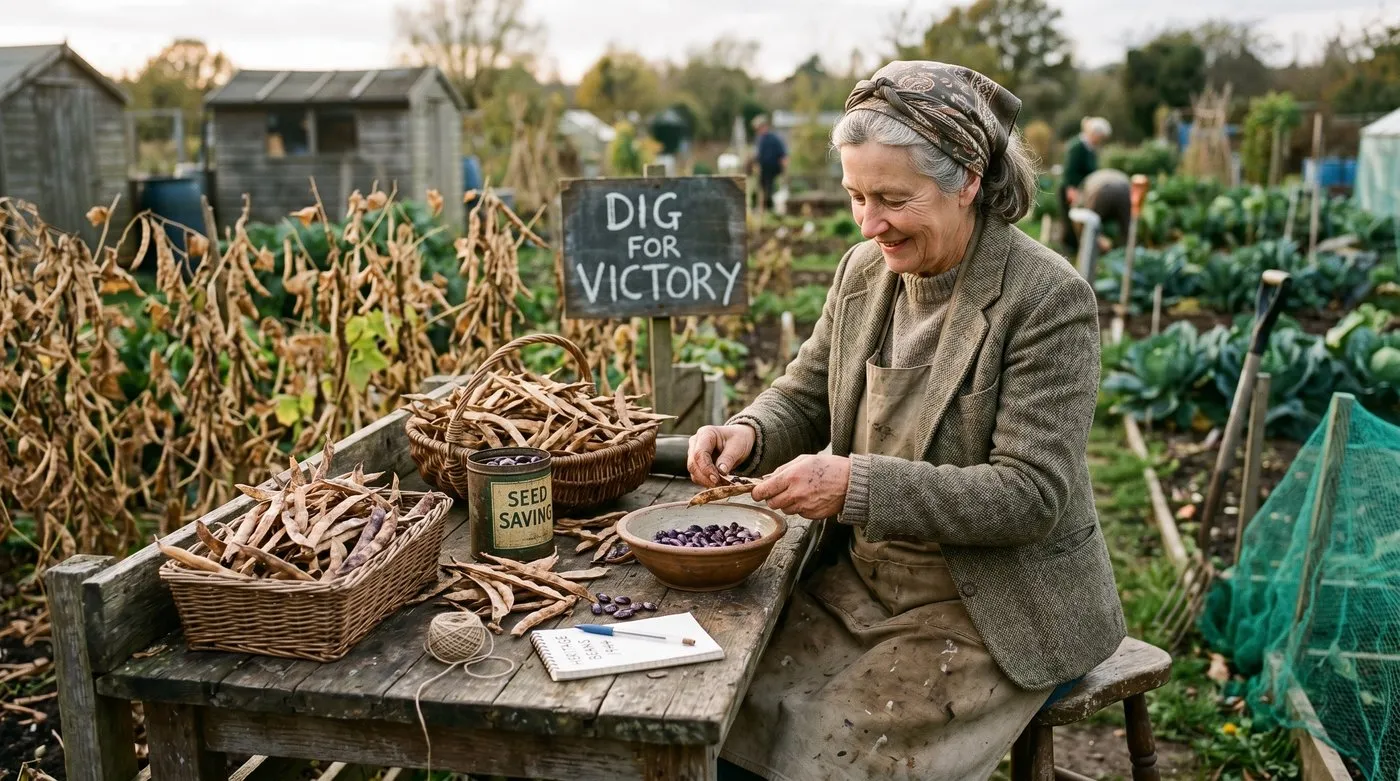 Saving Daniel O’Rourke pea and Czar runner bean seed from late-summer pods, the community-level Dig for Victory tradition that still works
Lesson 7: Allotment chickens and rabbits
Dig for Victory plots often kept chickens and rabbits at the back of the plot. Eggs and meat supplemented vegetables; manure fed the soil.
Chickens. Three to four hens produced 700-900 eggs per year, plus 40-50kg of high-grade compost from coop bedding. The Ministry’s “Domestic Poultry Keeping” leaflet recommended Rhode Island Red, Light Sussex, or local crossbreeds for laying. A 6 m² coop and run on a 5-rod plot housed 3-4 hens comfortably.
Modern UK allotment rules. About 30% of UK allotment sites still allow chickens with site secretary approval. Check tenancy agreements. Sites near houses often restrict roosters; hens-only is standard. Sites in urban areas may prohibit livestock entirely.
Rabbits. Wartime rabbits supplied meat in 12-week cycles. Modern allotment use is rare and faces ethical and welfare considerations beyond the scope of this guide. Most modern UK plots that once kept rabbits now use the space for fruit trees instead.
Bees. Honeybees were also on many wartime plots. The campaign distributed bee-keeping leaflets free of charge. Modern UK allotments often allow hives with the site secretary’s approval and proximity rules to neighbours.
A modern Dig for Victory plot plan
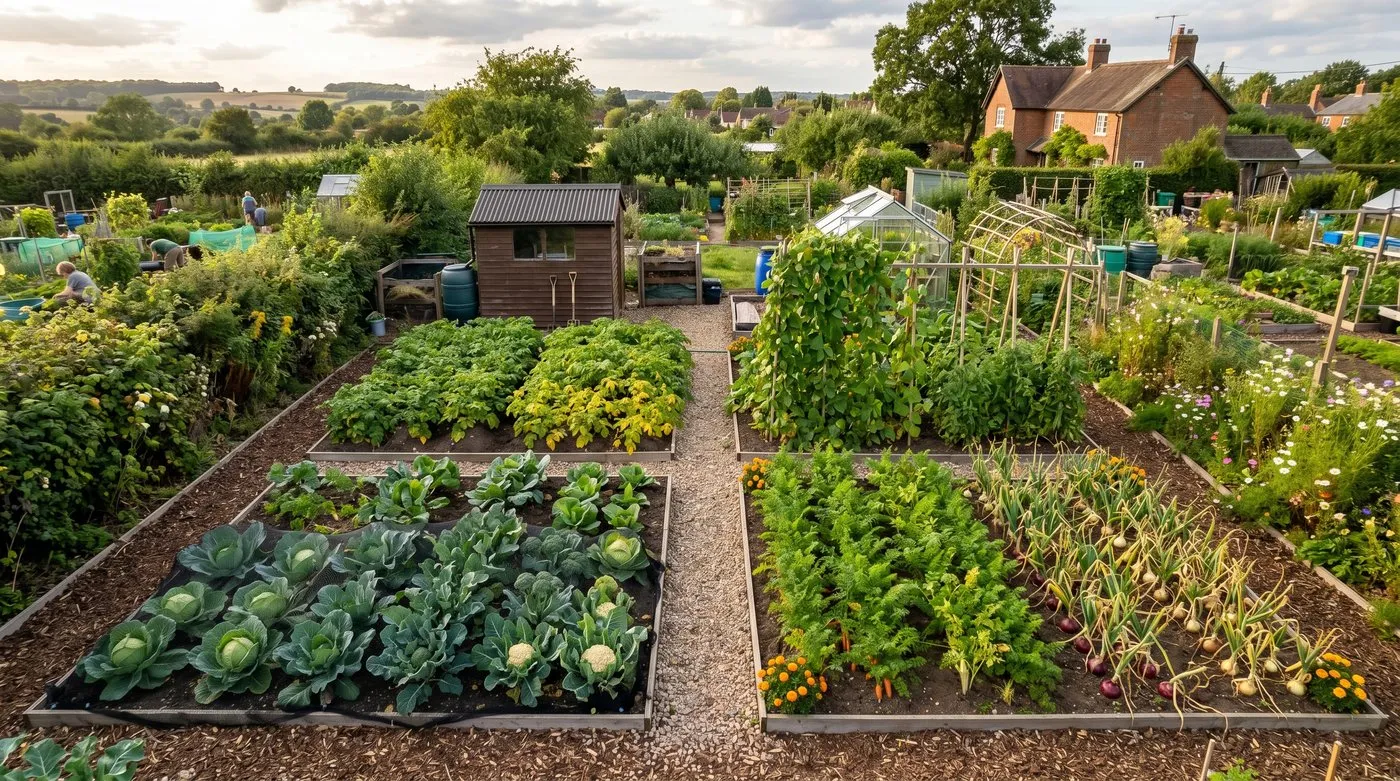
Bed 1 (12 m²): Potatoes. Sharpe’s Express in early March, Maris Peer or King Edward main crop in April. Harvest July (early) and September (main).
Bed 2 (12 m²): Brassicas. January King cabbage transplants in late July (after early potato lift). Brussels sprouts (Bedford Fillbasket) and kale (Cavolo Nero) added in August. Harvest November-March.
Bed 3 (12 m²): Legumes. Champion of England pea (climbing) on hazel bean sticks in March. Czar runner beans in May. Broad beans (Aquadulce) over winter from November sowing.
Bed 4 (12 m²): Roots and onions. Carrots (Autumn King), parsnips (Tender and True), beetroot (Boltardy), leeks (Musselburgh), onions (Ailsa Craig sets).
Plus 5 m² perennials: Rhubarb (Timperley Early), asparagus (Connover’s Colossal), gooseberry, blackcurrant, strawberry. These were less common on wartime plots but fit the modern adapted version well.
VE Day: a natural anniversary
8 May is Victory in Europe Day, the 1945 anniversary of Germany’s surrender to the Allies. It is the natural date for a UK gardener to mark the Dig for Victory legacy.
On your plot. Sow a row of Daniel O’Rourke peas, Champion of England, or another heritage wartime variety on or around 8 May. The crop comes in by mid-July, ready for the kitchen on the August Bank Holiday.
With the kids. Take grandchildren to the allotment on the day. Show them the wartime-spacing potato bed, the four-bed rotation, the heritage varieties. Most UK schools cover Dig for Victory in Year 5 history; bringing it to life on a real plot builds the connection.
At the site meeting. Most UK allotment associations hold an annual gathering near VE Day. Suggest a heritage-seed swap or a wartime-variety trial round. Costs nothing and builds the community.
Gardener’s tip: The Imperial War Museum digital archive has high-resolution scans of every Dig for Victory leaflet, free to read and reprint. Distribute one or two at your site meeting; the original wartime advice still reads well.
Common mistakes recreating wartime plots
Five mistakes account for most failed Dig for Victory plot attempts in modern UK gardens.
Mistake 1: Using modern hybrid varieties. Modern hybrids depend on synthetic fertiliser. Wartime varieties were bred for low-input systems and yield better when matched to the wartime growing method.
Mistake 2: Skipping the autumn manure mulch. The 4-bed rotation works only when 5cm of compost or rotted manure is added each autumn. Without this, soil fertility drops within 2-3 cycles.
Mistake 3: Cropping only summer crops. The wartime plot ran year-round. Skipping winter brassicas and leeks loses 30-40% of the annual food yield.
Mistake 4: Building a clamp on wet ground. Drainage is critical. A clamp on heavy clay without a gravel sub-base rots the bottom roots first and the loss spreads up.
Frequently asked questions
What was Dig for Victory and when did it run?
Dig for Victory was the UK Government’s wartime food-growing campaign launched in October 1939 by Minister of Agriculture Reginald Dorman-Smith. It encouraged citizens to convert lawns, parks, and verges into vegetable plots to reduce reliance on imported food. By 1943 the campaign had created 1.4 million allotments producing 1.3 million tons of vegetables annually, supplying 10% of UK food during the war.
How much land did Dig for Victory recommend per family?
Dig for Victory recommended 100 square feet (9.3 m²) per family member for year-round vegetables. A family of four needed 400 square feet, roughly half of a standard 10-rod allotment. The plan included potatoes, cabbage, runner beans, onions, carrots, leeks, and Brussels sprouts, with a 4-bed rotation that kept soil fertile without synthetic fertilisers.
What vegetables did Dig for Victory promote?
Dig for Victory promoted seven main vegetables: potatoes, cabbage, runner beans, onions, carrots, leeks, and Brussels sprouts. These were chosen for high calorie yield per square foot, long storage life, and tolerance of UK weather. The Ministry of Agriculture published leaflets with sowing dates, spacing, and pest control specific to each crop.
Can Dig for Victory techniques work in modern UK gardens?
Yes, most Dig for Victory techniques work as well today as in the 1940s. The 4-bed rotation, close-spacing potato system, and root-clamp storage all suit modern UK clay and loam soils. Wartime varieties like Sharpe’s Express potatoes, Ailsa Craig onions, and Champion of England peas are still available from heritage seed suppliers and yield within 5-10% of modern hybrids.
How did wartime gardeners store vegetables without refrigeration?
Wartime gardeners used root clamps, dry sand boxes, and cool sheds to store vegetables. A clamp is a 60cm pile of carrots, parsnips, or beetroot covered with 15cm straw and 10cm soil, stored at 2-4C through winter. Onions and shallots were strung from beams in well-ventilated outbuildings. Apples were wrapped in newspaper and laid in single layers in wooden crates.
Now you have the wartime playbook, read our crop rotation planner UK guide for the modern equivalent of the Ministry’s 4-bed system applied to today’s varieties.
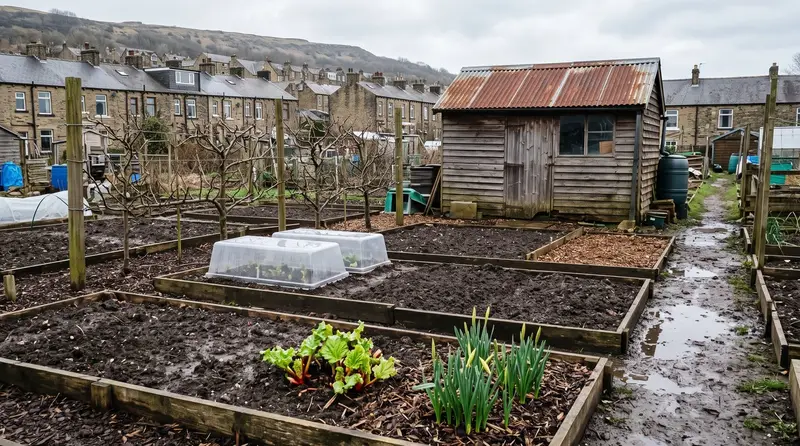
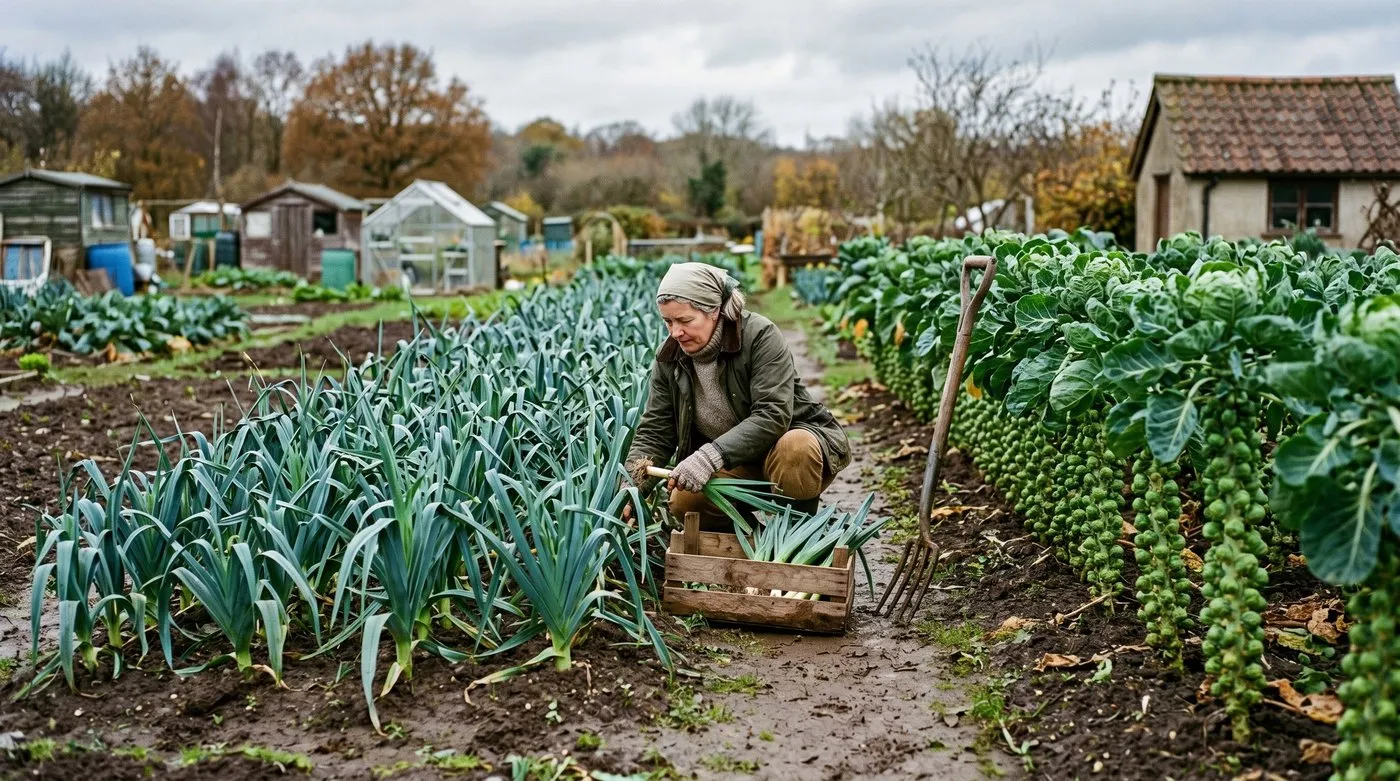 Late-autumn leeks and Brussels sprouts on the trial plot, the wartime succession that fed UK families through January and February
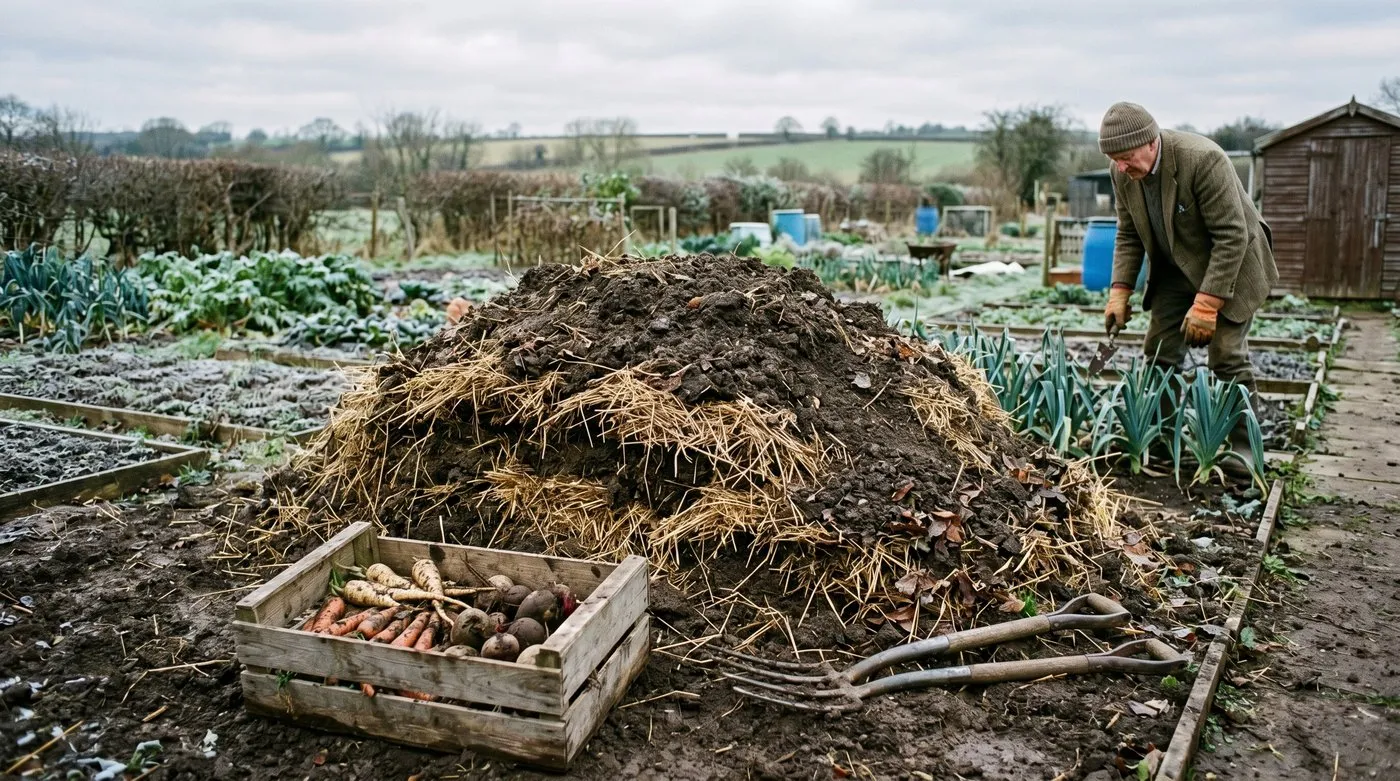 The Staffordshire root clamp at full build, 60cm of mixed carrots, parsnips, beetroot covered with 15cm straw and 10cm compacted soil
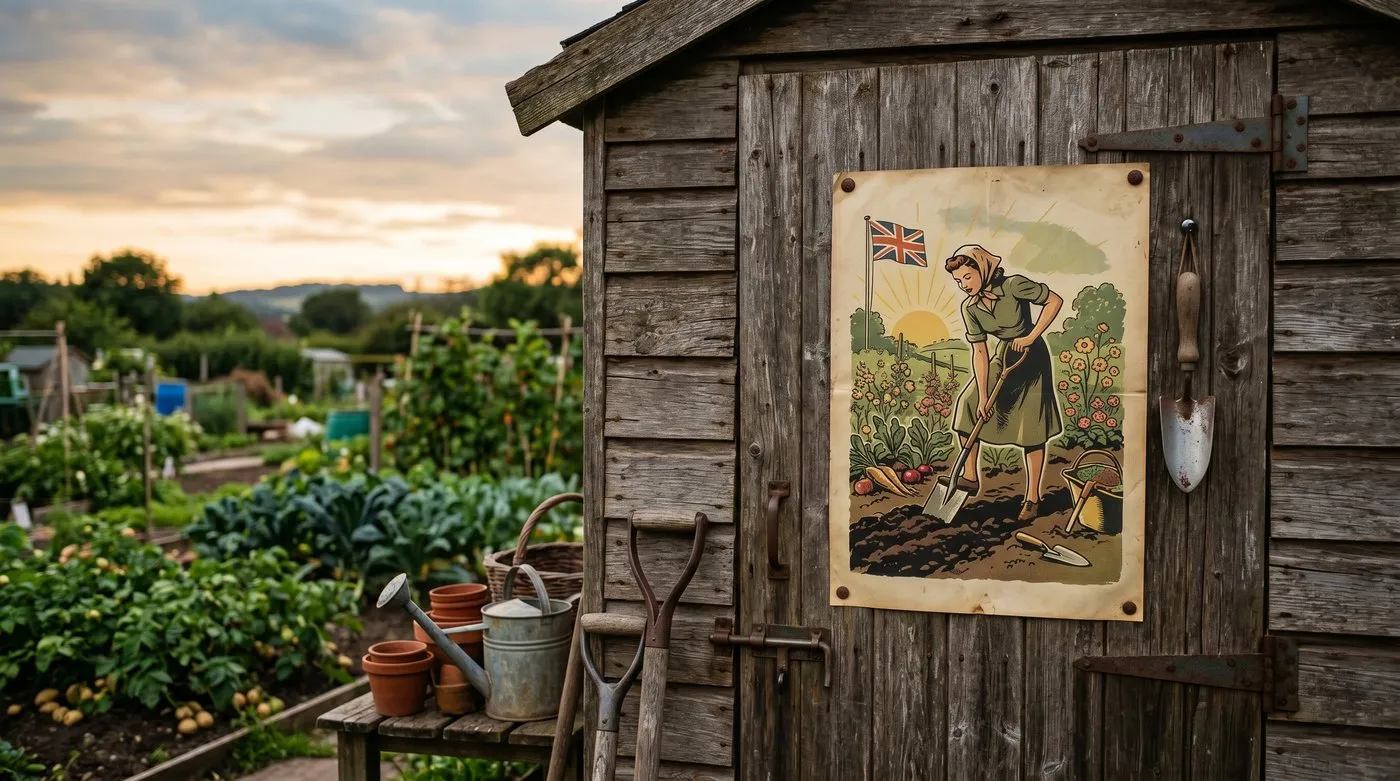 A reproduction Dig for Victory poster at the trial plot’s shed door, the visual link between 1943 and 2026 wartime-style cropping
Our team produces practical UK gardening guidance from source research, contributor records and established horticultural practice. Editorial standards are overseen by Matt W.