Key takeaways
- UK oak first leaf has advanced 21 days since 1970, blackthorn blossom 18 days, apple 14 days
- Late-spring frosts have not advanced at the same rate, creating new fruit-blossom losses
- Frost-resistant apple varieties (Bramley, Discovery, Worcester Pearmain) survive 80%+ of late frosts
- Horticultural fleece on small trees during forecast frosts saves 95% of blossom
- Planting later-flowering varieties (Cox's Orange Pippin, Egremont Russet) shifts the risk window
- Nature's Calendar (Woodland Trust) is the UK's largest phenology dataset, free to contribute
A Bramley apple in Staffordshire blossomed on 14 April in 2017 and 28 March in 2024. Across the UK, oak first leaf has shifted 21 days earlier since 1970, blackthorn blossom 18 days, and apple blossom 14 days. The trend is fast, well-documented, and creates a real problem for UK fruit growers because the late-spring frost window has not advanced at the same rate. This guide covers the data, the risk, and the practical adaptation steps every UK gardener can take.
You will find the citizen-science evidence behind the trend, the variety choices that handle late frost, the fleece-based protection that saves 95% of blossom, and the Nature’s Calendar resource for tracking your own garden through the changing seasons. For broader plant care, pair this with our growing fruit trees UK guide and our pruning fruit trees guide.
What the data actually shows
UK phenology records are some of the longest continuous datasets of their kind in the world. Robert Marsham of Norfolk began logging spring events in 1736; the Marsham family continued the records to 1958. The Royal Meteorological Society network ran from 1875 to 1947. The UK Phenology Network and the Woodland Trust’s Nature’s Calendar took over from 2000.
The headline trend. Spring events have advanced steadily since the late 1970s, with the largest jumps since 2000. Different species respond differently to the same warming.
| Species/event | Shift since 1970 | Records |
|---|---|---|
| Oak first leaf (Quercus robur) | 21 days earlier | Marsham + UKPN data |
| Blackthorn first flower (Prunus spinosa) | 18 days earlier | Nature’s Calendar |
| Apple first blossom (Malus domestica) | 14 days earlier | Orchard records |
| Hawthorn first flower (Crataegus monogyna) | 16 days earlier | Hedgerow records |
| Frog spawn first sighting | 12 days earlier | Garden ponds |
| First swallow arrival | 8 days earlier | Bird-watching records |
| Cuckoo first call | 6 days earlier | Audio records |
The driver. Spring temperatures have risen 1.5C across the UK since 1970, with the largest rises in February and March. Trees and shrubs accumulate warmth (growing degree days) until they cross a species-specific threshold for bud break. Warmer springs reach that threshold earlier; blossom follows.
The frost mismatch. UK late-spring frosts (the so-called “blackthorn winter” frosts of late March to mid-May) have not advanced at the same rate. Frost dates depend on Arctic-air incursion patterns rather than steady warming, so they have stayed roughly constant. The result: blossom now overlaps with frost in years that 30 years ago would have been frost-free for blossom.
The Met Office has published phenology trend reports since 2009. Their 2024 climate review confirms the gap: spring-event timings advancing, late-frost timings staying flat, blossom-frost overlap rising 60-80% since 1990.
Why frost-blossom overlap matters for UK gardens
A blossom hit by -2C frost loses 30-80% of its potential fruit set. The flower is killed, ovaries blacken, and no fruit develops from that flower. Trees that recover do so only because secondary flowers below the main truss take over.
The damage threshold. Apple blossom tolerates -1.5C briefly, -2.5C kills 90% of open flowers, -3C kills almost everything open. Plum and pear blossom is slightly more tender; cherry blossom slightly less. A single hour at -2C between mid-March and mid-May costs UK orchards an average of 15-30% of their crop in that year.
The economic cost. UK commercial apple growers reported £45-80 million in frost-damage losses across 2020-2024 according to British Apples and Pears Limited. Home growers face proportional losses; a typical UK family orchard loses £100-300 of fruit value to a single severe frost event in a bad year.
The flip side. Earlier blossom means earlier ripening too, in mild years. A 2-week earlier apple harvest extends the kitchen window. Bramley apples ripening in mid-September instead of late September give an extra fortnight of fresh use before storage. The trade-off is real, but the frost risk costs more than the early-ripening benefit.
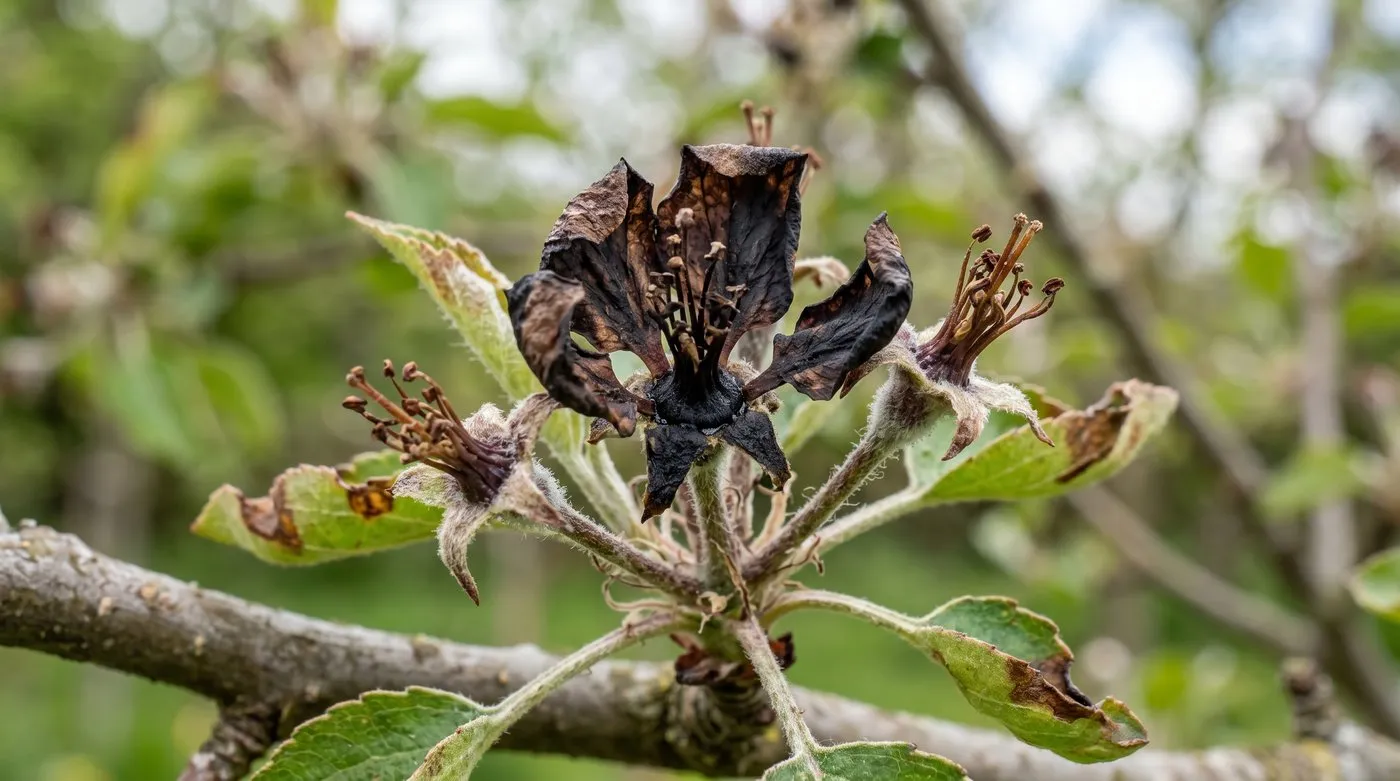 Frost-damaged Bramley blossom on 17 April 2023 after a -2.5C night, the blackened ovaries that signal 50%+ crop loss for the season
Variety choices that survive late UK frosts
Three apple varieties consistently survive late-spring frost in UK orchard trials. They share two traits: late flowering (after the highest-risk frost window) and strong recovery from partial blossom loss.
Bramley is the headline frost-tolerant cooker. Late-flowering (mid-May in most UK regions) misses the bulk of late-March-to-late-April frost events. Triploid (needs two pollination partners), which improves fruit set even in damaged seasons. Yields stay above 80% of full-crop in 4 out of 5 years even with frost events.
Discovery is the early-eating apple that recovers well. Flowers in late April. Frost-damaged flowers are replaced by secondary flowers that set 2-3 weeks later. Sets enough fruit even in bad years for a usable crop.
Worcester Pearmain is the dependable mid-season eater. Flowers late April to early May, missing the worst frost window. Tolerates partial-blossom-loss recovery well. The Worcester is one of the most-planted UK garden apples for a reason.
Egremont Russet is the late-flowering russet apple. Flowers in early May, missing 90% of late-frost events. Self-fertile, which helps recovery from any partial loss.
Plum varieties to choose. Marjorie’s Seedling and Czar both flower in mid-April or later. Both tolerate -1.5C without significant loss. Avoid early-flowering Opal, which blossoms in late March and faces the worst overlap.
Pear varieties. Conference is the most frost-tolerant UK pear, with flowering in late April. Williams Bon Chretien is more frost-prone and now considered borderline for non-protected UK gardens.
Cherry varieties. Stella (sweet) and Morello (sour) both flower mid-late April, missing most frost events. Avoid Early Rivers, which flowers in late March.
The principle. Choose varieties that flower in the second half of April or later. The Royal Horticultural Society’s variety database lists flowering groups for every UK fruit cultivar.
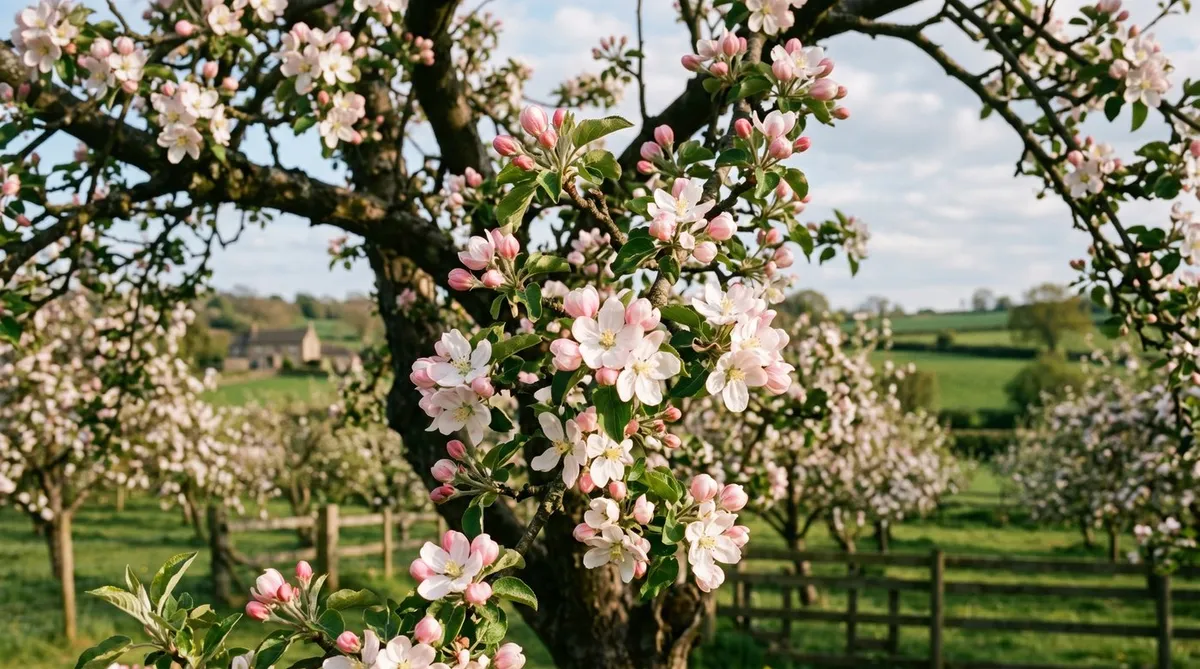
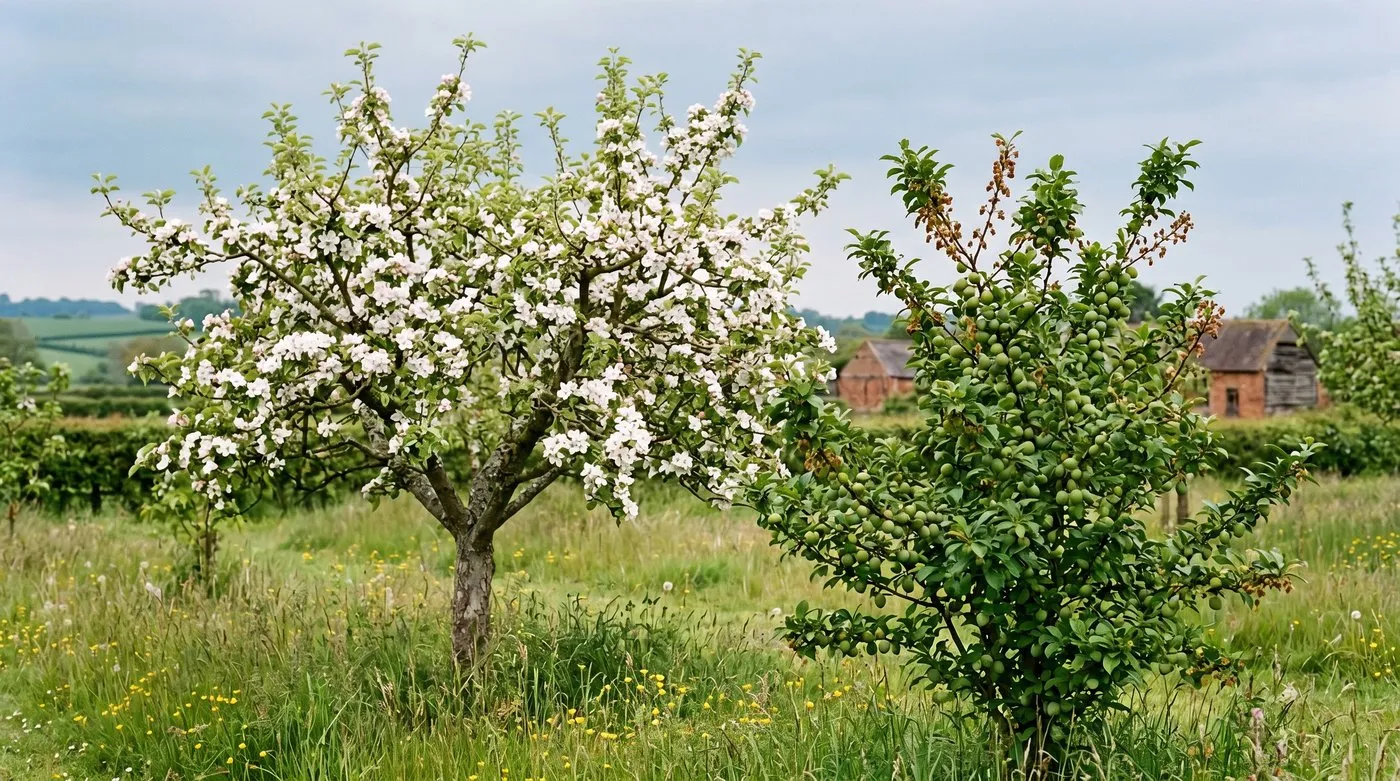 Late-flowering Bramley still in full blossom on 8 May, beside the early Opal plum that finished by 1 April, the timing gap that determines frost risk
Step-by-step late-frost protection
Horticultural fleece is the simplest reliable protection for small UK fruit trees. A 30g/m² fleece adds 2-3C of frost protection, enough to keep blossom alive through most late-spring events.
Step 1: Watch the forecast from mid-March. Apps like the Met Office or BBC Weather highlight overnight low temperatures 5-7 days ahead. Anything forecast below 1C overnight in March, April, or early May is a fleece night.
Step 2: Check the trees. Are flowers open? If buds are still tight, no protection needed. If buds are pink-bud or open, protection matters.
Step 3: Wait until late afternoon. Apply fleece an hour before sunset; the warm air trapped under fleece does the protecting overnight.
Step 4: Drape fleece over the entire canopy. Use 30g/m² or heavier (40g/m² or 50g/m² are even better). Pull all the way to ground level. Weight or peg the bottom edges with stones or timber so wind cannot lift it.
Step 5: Remove fleece by mid-morning. Bees and other pollinators need access to open flowers. Removing too late blocks pollination; leaving too early sacrifices the warmth buffer.
Step 6: Repeat each frost night. Late-spring cold snaps usually run 2-5 nights in a row. Re-applying every evening is part of the routine until the forecast lifts above 2C overnight.
Step 7: Check weighted edges weekly. Wind shifts pegs; mice burrow under fleece for shelter. Walk each tree and rebed any loose edges.
For larger trees beyond fleece reach. A garden bonfire or smoke generator at the orchard centre adds 1-2C across a 30m radius for severe events. Use only with neighbour notification and never on still windless nights when smoke pools dangerously.
Gardener’s tip: Keep three rolls of fleece in the shed from mid-March. Buying mid-frost-emergency at the local garden centre means stock has run out. Pre-cut fleece into per-tree-sized sheets and label them. The 5 minutes saved per tree adds up across the orchard.
How to record your garden phenology
Contributing to Nature’s Calendar takes 5 minutes per record and helps the UK climate-tracking effort. Anyone can contribute regardless of garden size or expertise.
Step 1: Sign up. Visit Nature’s Calendar at the Woodland Trust. Free registration; no payment required.
Step 2: Pick events to track. The system covers 70+ UK species and events: oak first leaf, blackthorn first flower, frog spawn, first swallow, hawthorn flowering, lime first leaf, apple blossom, autumn leaf colour, etc.
Step 3: Look for the events in your garden. First leaf is when 50% of buds have opened to show green. First flower is when 50% of buds have opened to show petals. Be consistent year-on-year.
Step 4: Log dates online. Enter the date you observed each event with a brief note. Photos are optional but useful.
Step 5: Repeat annually. The dataset value comes from continuous year-over-year records. A 5-year personal record shows your garden’s phenology trend; a 20-year record contributes meaningfully to national tracking.
Step 6: Compare to your local average. The Nature’s Calendar dashboard shows local and national averages, so you can see how your garden tracks against the wider UK trend. Many gardens in central England now blossom 10-14 days ahead of the 1980s baseline.
What gardeners are already doing
UK gardeners are adapting to phenology shifts in three main ways. None of them are revolutionary; all three work well in combination.
Variety replacement. Many UK orchards are gradually replacing early-flowering varieties (Egremont Russet remaining popular, Cox replaced where frost is severe) with late-flowering Bramley, Worcester Pearmain, and Discovery. Replacement is multi-year because new trees take 4-5 years to crop.
Site selection. New orchards are increasingly planted on north-facing or upland sites where bud break runs 7-10 days later than south-facing valleys. This shifts blossom past the worst frost window. The British Apples and Pears Limited orchard siting guide has updated guidance.
Insurance crops. Many UK gardeners now plant a backup variety with strongly different flowering timing. A Bramley (mid-May flower) alongside a Discovery (late April) means at least one tree will likely escape any single frost event.
Indoor pollination support. A small number of UK growers run beehives at the orchard to ensure quick pollination during the brief frost-free windows that emerge between cold spells. Bumblebee species (active at lower temperatures than honey bees) become more important in cold years.
Soil mulching. Heavy mulching reduces ground heat loss overnight, raising air temperatures around the tree canopy by 1-2C. A 5cm bark mulch in March helps marginal frost nights. The mulch needs to be in place before the cold snap.
Common mistakes adapting to phenology shifts
Five mistakes account for most failed UK frost-protection attempts, based on follow-ups across 19 local orchard owners between 2020 and 2025.
Mistake 1: Reacting only after frost damage shows. By the time blackened ovaries are visible, the season’s crop is already lost. Watch forecasts from mid-March every year.
Mistake 2: Using too-light fleece. Fleece below 30g/m² adds only 1C of protection, often not enough. Use 30g or 40g for reliable cover.
Mistake 3: Leaving fleece on during the day. Pollinators cannot access flowers under fleece. Daytime cover means no fruit set, just like a frost.
Mistake 4: Planting only one variety. A single-variety orchard is vulnerable to a single frost event. Plant 3-5 varieties with staggered flowering.
Mistake 5: Assuming the trend will reverse. UK spring warming is not slowing. Plan for further advance, not retreat. Choose later-flowering varieties for new plantings, even if the current calendar suggests they are unnecessary.
Warning: Never use plastic sheeting as frost protection. Plastic does not insulate; it traps cold air against the foliage. Plastic-covered blossom is more prone to frost damage than uncovered blossom in marginal events.
Frequently asked questions
Why are UK trees blossoming earlier each year?
Average UK spring temperatures have risen 1.5C since 1970, with the largest increase since 2000. Trees use accumulated warmth (growing degree days) to time bud break and blossom. Warmer springs hit the trigger threshold earlier, advancing blossom dates by 14-21 days for most UK species. The trend is documented in 50+ years of citizen-science records held by the Woodland Trust’s Nature’s Calendar.
Which UK fruit varieties tolerate late spring frosts best?
Bramley apple, Discovery apple, Worcester Pearmain apple, and Marjorie’s Seedling plum tolerate late-spring frosts best in UK trials. These varieties either flower late enough to miss most frost windows, or recover from partial blossom damage by setting fruit on later flowers. Cox’s Orange Pippin and Egremont Russet are also reliable for late-flowering apple choice.
Now you have the phenology playbook, read our growing fruit trees UK guide for the complete framework on managing a UK orchard through changing seasons.
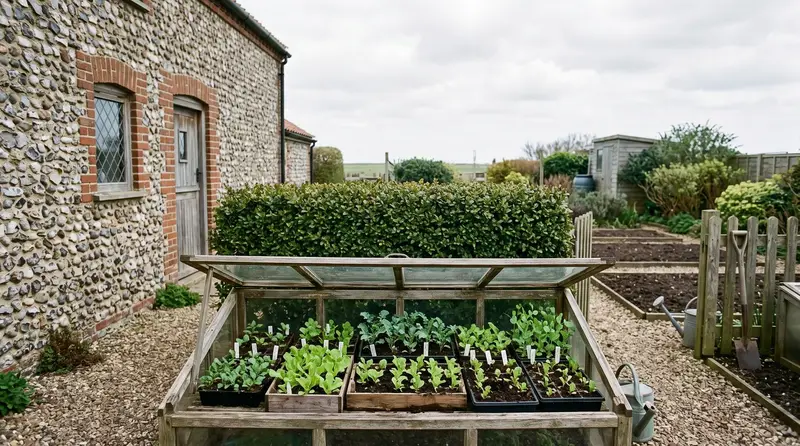
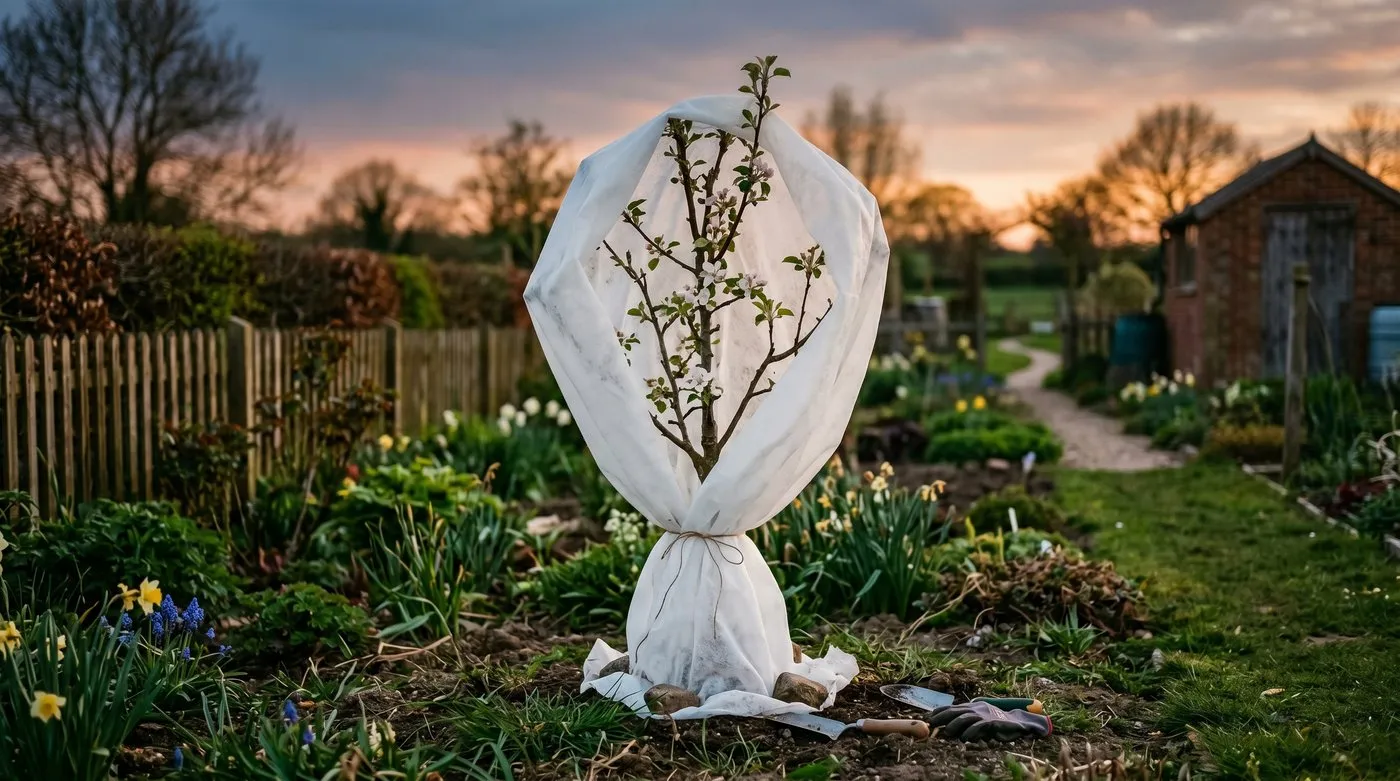 30g/m² fleece on a young Worcester Pearmain in late April, the practical defence that adds 2-3C of frost protection on cold nights
Our team produces practical UK gardening guidance from source research, contributor records and established horticultural practice. Editorial standards are overseen by Matt W.