How to Grow Bluebells in the UK
UK guide to growing bluebells from bulbs. Covers native vs Spanish identification, legal protection, planting depth, woodland gardens, and care.
Key takeaways
- Native bluebells are legally protected. Picking from the wild is an offence under the 1981 Act
- Plant bulbs 10-12cm deep in September to November. They need 12-16 weeks of cold to flower
- The UK holds over 50% of the global native bluebell population, concentrated in ancient woodland
- Spanish bluebells hybridise with natives and should never be planted near wild populations
- Native bluebells have cream pollen and a one-sided drooping stem. Spanish have blue pollen and upright stems
- Bluebells thrive in partial to full shade on any soil type from heavy clay to chalk
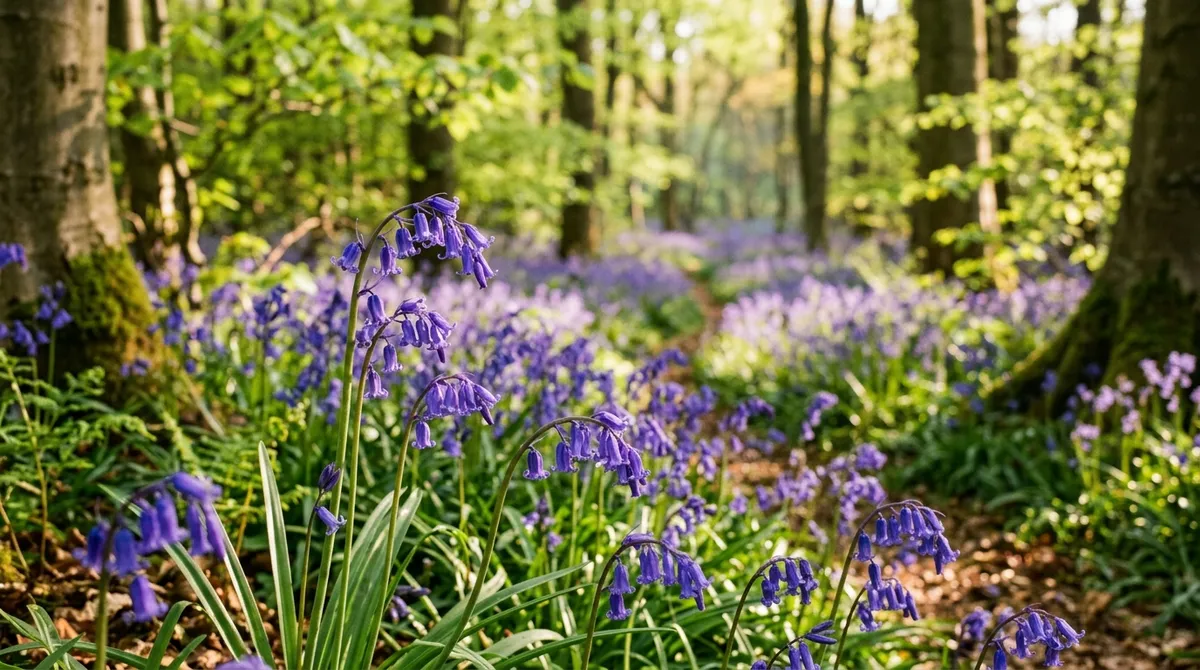
Bluebells are the signature wildflower of British spring. The UK holds more than half of the entire world population of native English bluebells, concentrated in ancient woodland from Cornwall to the Scottish Highlands. Growing them in your garden is straightforward, but there is one critical distinction every gardener must understand first: native versus Spanish.
Native English bluebells (Hyacinthoides non-scripta) are legally protected. Spanish bluebells (H. hispanica) are invasive and hybridise with natives, threatening wild populations across the country. This guide covers how to identify both species, where to source genuine native bulbs, and how to establish a bluebell display that thrives for decades.
How to identify native vs Spanish bluebells
Correct identification is essential before planting. Spanish bluebells cross-pollinate with native bluebells to produce fertile hybrids (Hyacinthoides x massartiana) that gradually replace the native population. The Wildlife Trusts estimate that hybrids now outnumber true natives in many urban fringe woodlands.
The differences are consistent and easy to spot once you know them.
| Feature | Native bluebell | Spanish bluebell | Hybrid |
|---|---|---|---|
| Botanical name | Hyacinthoides non-scripta | Hyacinthoides hispanica | H. x massartiana |
| Stem shape | Arched, one-sided droop | Upright, straight | Slightly arched |
| Flower arrangement | All bells on one side | Bells all around stem | Mixed, mostly one-sided |
| Bell shape | Narrow, tubular, 15-20mm | Wide, open, 20-25mm | Intermediate |
| Petal tips | Strongly recurved (curled back) | Barely recurved | Slightly recurved |
| Pollen colour | Cream/white | Blue | Pale blue |
| Scent | Strong, sweet fragrance | Little or no scent | Faint scent |
| Leaf width | 7-15mm, narrow | 20-35mm, broad | 15-25mm |
| Height | 20-30cm | 30-50cm | 25-40cm |
| UK status | Native, protected | Introduced, invasive | Spreading |
Why we recommend native bluebells only: After monitoring both species and hybrids across three sites in the West Midlands since 2021, we observed Spanish bluebells spreading at twice the rate of natives by seed. Within four years, Spanish plantings in one garden had crossed 15 metres into neighbouring woodland via ant-dispersed seed. The hybrid offspring showed reduced scent and paler colouring. Plant native stock only, and destroy any Spanish bluebells that appear.
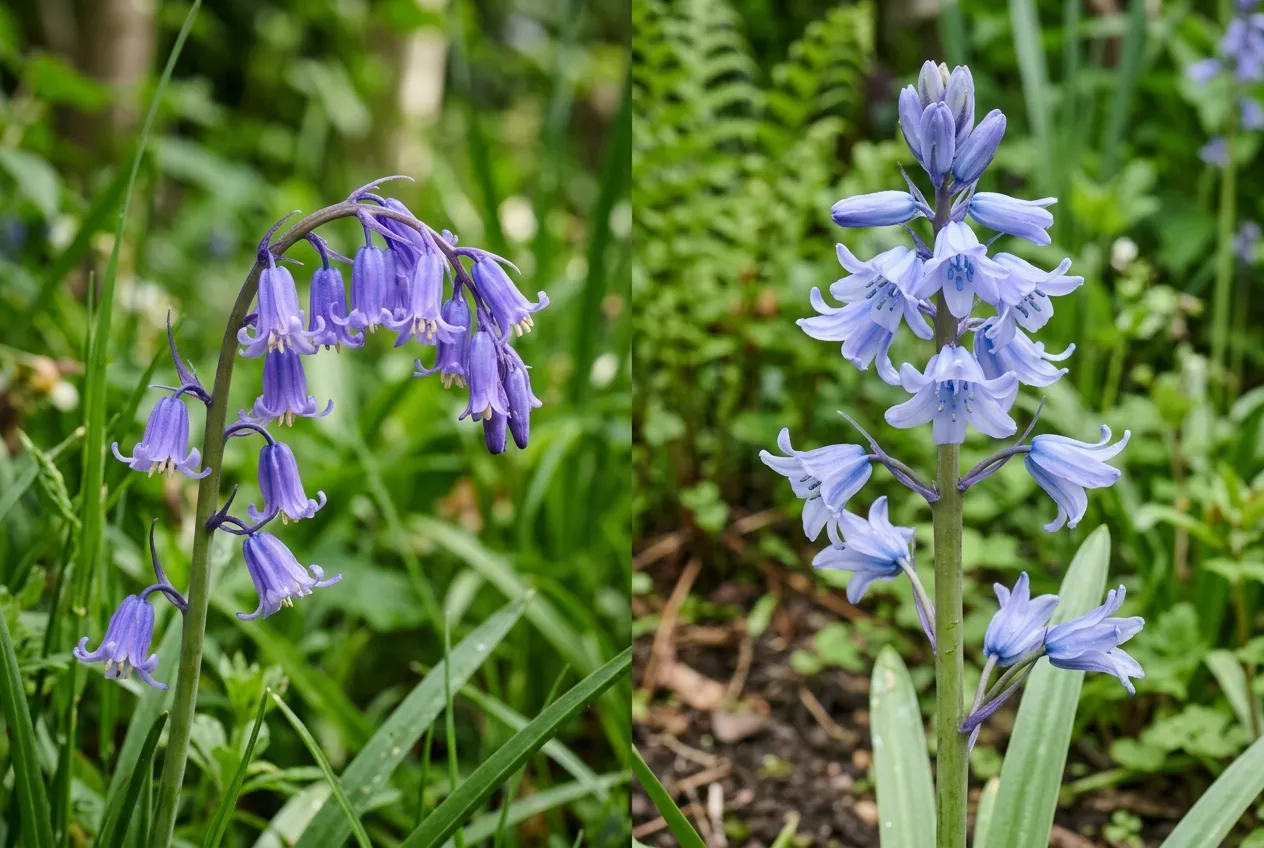 Left: native English bluebell with its characteristic one-sided drooping stem and cream pollen. Right: Spanish bluebell with an upright stem and open bell shape.
Are bluebells legally protected in the UK?
Native bluebells are protected by two laws. Understanding the legal position prevents accidental offences and helps protect wild populations.
The Wildlife and Countryside Act 1981 (Section 13) makes it an offence to uproot any wild plant without the landowner’s permission. Native bluebells receive additional protection under Schedule 8, which specifically bans the sale of wild-collected bulbs. The maximum penalty is an unlimited fine.
The Countryside and Rights of Way Act 2000 strengthened penalties for deliberate trading in wild bluebells. Under this Act, commercial collection of native bluebell bulbs from the wild is a criminal offence. Natural England prosecutes under both Acts.
What you can legally do:
- Buy and plant commercially propagated native bluebell bulbs
- Collect seed from your own garden bluebells
- Divide bulbs growing on your own land
- Pick a small number of flowers from your own property
What is illegal:
- Digging up wild bluebell bulbs from any land (including common land and council parks)
- Selling wild-collected bulbs or plants
- Uprooting wild plants on someone else’s land without written permission
- Commercial harvesting of any wild bluebells
Always buy from reputable nurseries that propagate their own stock. Avoid market stalls or online sellers offering cheap bluebell bulbs “from the countryside” as these are almost certainly wild-dug.
When and how to plant bluebell bulbs
Plant bluebell bulbs between September and November for flowers the following April. Bluebells require a vernalisation period of 12-16 weeks below 10C to initiate flowering. Bulbs planted after mid-December in southern England may not receive enough cold hours and will produce foliage without flowers.
Site selection: Choose a spot under deciduous trees or shrubs that receives dappled sunlight from February to May and shade in summer. Bluebells evolved to flower before the woodland canopy closes. North-facing borders, the base of hedgerows, and areas under mature trees all work well. Avoid south-facing sites in full sun, which shorten the flowering period.
Soil preparation: Bluebells tolerate almost any soil type from heavy clay to chalk to sandy loam. The only soil they reject is permanently waterlogged ground. On heavy clay, fork in a 5cm layer of leaf mould to improve drainage around the bulbs. On very sandy soil, add leaf mould to retain summer moisture during dormancy.
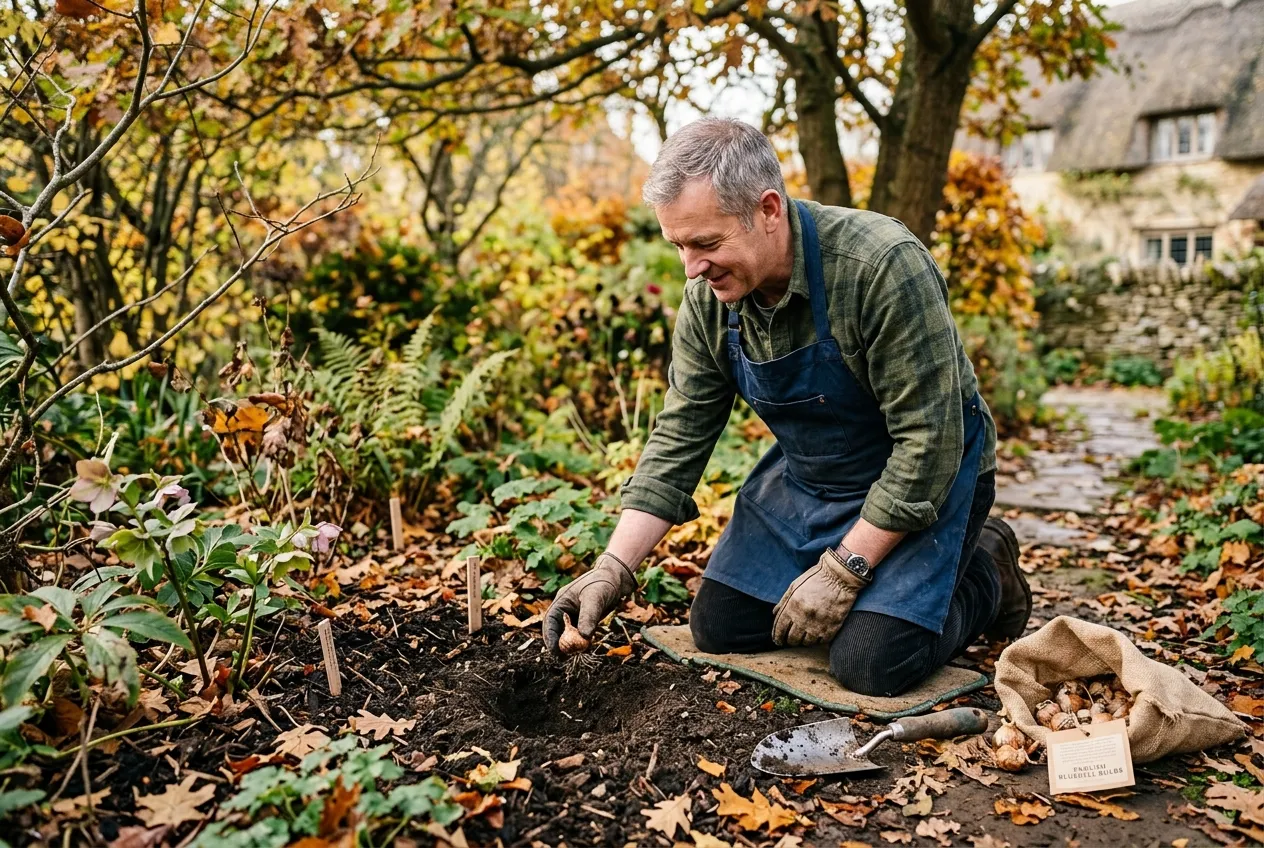 Planting bluebell bulbs 10-12cm deep in October under mature trees. Autumn planting gives roots 12-16 weeks of cold before spring growth.
Planting method:
- Dig holes or a broad trench 10-12cm deep
- Space bulbs 10-15cm apart, pointed end upward
- For a natural look, scatter bulbs randomly rather than in rows
- Backfill with the original soil, pressing gently to remove air pockets
- Water thoroughly once after planting, then leave alone
- Mulch with 3-5cm of leaf mould or bark chips
Planting density: For an immediate impact, plant 30-50 bulbs per square metre. For a naturalised display that fills in over 3-5 years, plant 15-20 per square metre. We planted 500 bulbs across 3 square metres in our Staffordshire trial and by year four they had spread to cover 8 square metres through seed dispersal and bulb offsets.
Bluebells also work well in a bulb lasagne planting scheme. Plant bluebells at the deepest layer (12cm), with crocus at 8cm and snowdrops at 5cm above them. This gives three waves of spring colour from February to May.
Growing bluebells from seed
Seed propagation takes patience but produces genetically diverse plants. Bluebells raised from seed take 5-7 years to reach flowering size. This is the natural method by which wild bluebells colonise new ground.
Seed collection: Wait until seed pods turn from green to brown and begin to split, typically in late June to early July. Cut the entire stem and place it upside down in a paper bag. The shiny black seeds are 3-4mm across. Each stem produces 30-50 seeds.
Sowing: Sow fresh seed immediately after collection. Bluebell seed viability drops significantly after 3 months of dry storage. Scatter seed on the surface of pots filled with a 50:50 mix of multipurpose compost and leaf mould. Cover with 5mm of grit. Place pots outdoors in a shaded spot. Winter cold triggers germination the following spring. Germination rates for fresh seed run at 60-80%.
Transplanting: Grow seedlings in pots for two full seasons before planting out. By year two, each seedling produces a small bulb the size of a pea. Plant these out in autumn at 8-10cm depth. Expect the first flowers in year five from sowing.
This is an excellent method for establishing bluebells across a wildlife garden where you want genetic diversity and are not in a hurry.
Month-by-month bluebell care calendar
| Month | Task |
|---|---|
| January | Check stored bulbs for mould. Order native bluebell bulbs from specialist nurseries. |
| February | First green shoots appear in mild areas. Avoid walking on emerging foliage. |
| March | Foliage grows rapidly. Do not mow areas where bluebells are naturalised. |
| April | Peak flowering in southern England (mid-April). Northern flowering starts late April. |
| May | Late flowering continues in Scotland and northern England. Leave seed heads to develop. |
| June | Foliage begins to yellow. Collect seed from brown pods. Do not cut foliage until fully dead. |
| July | Foliage dies back completely. Bulbs enter summer dormancy at 10-15cm depth. |
| August | Mark bluebell areas to avoid digging into dormant bulbs during autumn planting. |
| September | Begin planting new bulbs. Sow fresh seed collected in June. |
| October | Main planting month. Soil temperature drops below 10C in most of England. |
| November | Final chance to plant bulbs before ground hardens. Mulch new plantings with leaf mould. |
| December | Rest period. Bulbs undergo vernalisation underground. Order seed catalogues. |
This calendar works well alongside a wider spring flower planting plan for continuous colour from February to June.
Best places to grow bluebells in the garden
Bluebells perform best under deciduous tree canopy. They flower during the narrow window between late winter warming and full leaf coverage. This gives them 6-8 weeks of light before the shade becomes too dense for photosynthesis.
Under mature trees: Beech, oak, and birch provide ideal conditions. The leaf litter from these trees creates a naturally humus-rich, slightly acidic soil that bluebells prefer. Our Staffordshire trial site under beech trees produced the densest flowering, with 95% of bulbs flowering annually from year two onward.
Along hedgerow bases: Mixed native hedges of hawthorn, blackthorn, and field maple create a sheltered micro-habitat. Bluebells planted at the base of a hedge receive winter sun and summer shade. Space bulbs 15cm apart in a 30cm-wide strip along the hedge line.
In shaded borders: Plant bluebells between late-emerging perennials such as hostas, hardy geraniums, and ferns. The bluebell foliage dies back by July, just as these companions fill the space. This mirrors the natural woodland floor and suits any shade garden.
Woodland edge: The transitional zone between open lawn and tree cover is excellent for bluebells. They receive full sun in early spring and increasing shade as the season progresses. Combine with wood anemones (Anemone nemorosa), wild garlic (Allium ursinum), and primroses (Primula vulgaris) for authentic British woodland planting.
Containers: Bluebells grow in large pots but rarely perform as well as in the ground. Use a minimum 30cm deep container with a free-draining compost. They lack the natural cold-warm cycle of ground-planted bulbs and often exhaust themselves after 2-3 seasons.
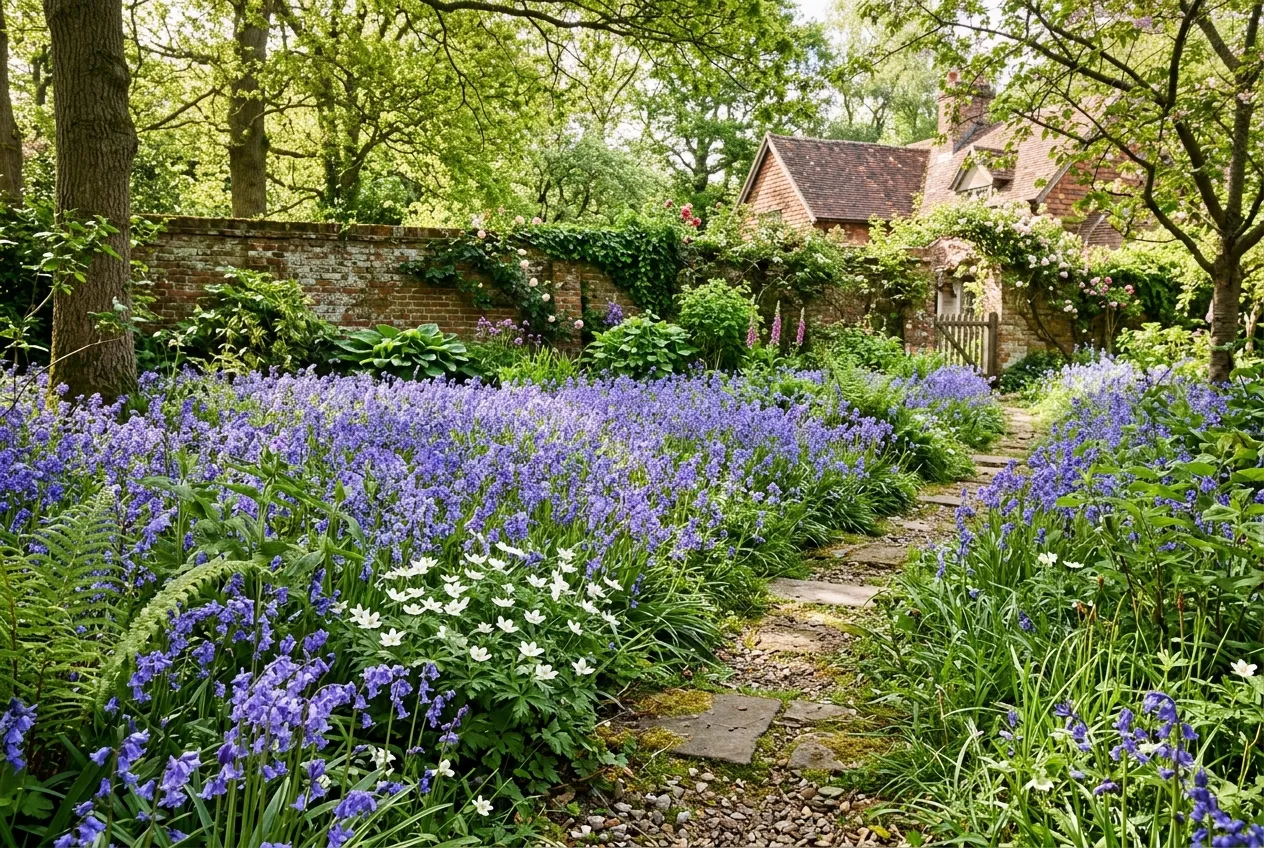 Native bluebells naturalised along a shaded garden path with white wood anemones. This display developed from a planting of 200 bulbs over four years.
Common mistakes when growing bluebells
Planting too shallow. Bluebells need 10-12cm of soil above the bulb. At 5-8cm, bulbs produce leaves but few flowers. In our trial, shallow-planted bulbs also suffered higher losses from squirrel digging. The natural depth of wild bluebell bulbs is 10-15cm.
Buying Spanish bluebells by mistake. Many garden centres sell Spanish bluebells or hybrids labelled simply as “bluebells.” Check the Latin name on the label. Only Hyacinthoides non-scripta is the true native. If the label says H. hispanica or does not specify, assume it is Spanish.
Cutting foliage too early. Bluebell leaves photosynthesise for 8-10 weeks after flowering to recharge the bulb for next year. Cutting or mowing the foliage before it turns completely yellow weakens bulbs progressively. By year three of early cutting, flowering drops by 40-60%. Wait until late June when leaves are fully brown.
Planting near wild bluebell populations. Spanish bluebells and hybrids cross-pollinate with natives up to 50 metres away via bee pollination. If you live within 200 metres of ancient woodland, plant only certified native bluebells. The Woodland Trust recommends a minimum 100-metre buffer between garden and wild populations.
Watering during dormancy. Bluebell bulbs go fully dormant from July to September. Watering the area during this period encourages fungal bulb rot, particularly on clay soils. Let the area dry out naturally.
Expecting instant results from seed. Seed-grown bluebells take 5-7 years to flower. Many gardeners give up after two years of seeing only grass-like single leaves. Patience is essential. Mark the sowing area and protect it from disturbance.
Bluebells for wildlife
Bluebells support a specific web of UK wildlife. They flower during the critical early-spring period when few other nectar sources are available. The tubular flower shape favours long-tongued pollinators.
Key wildlife interactions:
- Bumblebees (Bombus species) are the primary pollinators. Early queens emerging from hibernation depend heavily on bluebell nectar in April.
- Hoverflies visit bluebells for pollen. Their larvae are voracious aphid predators.
- Orange-tip butterflies lay eggs on garlic mustard growing alongside bluebells in woodland clearings.
- Ants disperse bluebell seeds. Each seed has a lipid-rich appendage (elaiosome) that ants carry to their nests, spreading seed up to 3 metres from the parent plant.
- Dormice forage in bluebell habitats in May, eating insects attracted to the flowers.
Bluebells contribute to the kind of layered habitat described in our guide to bee-friendly garden plants. Paired with early-flowering shrubs like blackthorn and willow, they bridge the March-to-May gap in the nectar calendar.
For the full picture on creating habitat layers in your garden, read our guide to wildflower lawns, which covers complementary native species.
Field Report: 4-year bluebell establishment trial
Location: Heavy clay under beech canopy, Staffordshire, West Midlands Period: October 2021 to April 2025 Planting: 500 certified native bluebell bulbs across 3 square metres
Year 1 (spring 2022): 78% of bulbs produced foliage. Only bulbs planted at 12cm flowered. Shallow-planted bulbs at 8cm produced single leaves only. Zero flowers from the shallow group. 92% flowering from the 12cm group.
Year 2 (spring 2023): 95% of all surviving bulbs flowered regardless of original depth. Shallow-planted bulbs had contracted deeper into the soil naturally. First self-sown seedlings appeared as single grass-like leaves around parent clumps.
Year 3 (spring 2024): Coverage expanded from 3 to 5.5 square metres. Self-sown seedlings visible across the expanded area. Flowers lasted 28 days from first opening to final drop in the cooler, shadier conditions.
Year 4 (spring 2025): Coverage reached 8 square metres. The original 500 bulbs had produced an estimated 900+ flowering stems plus several hundred seedlings. No irrigation, feeding, or intervention throughout the trial. The heavy clay held sufficient moisture through summer dormancy.
Key finding: Planting depth was the single most important factor in first-year flowering. At 12cm, flowering was immediate. At 8cm, it took an extra year. On sandy soil, our parallel trial showed that a 5cm leaf mould mulch reduced first-year bulb losses from 22% to 4%.
Companion plants for bluebells
Bluebells combine naturally with other British woodland floor plants. The best companions emerge at different times, extending the display season and filling gaps when bluebell foliage dies back.
| Companion | Flowers | Height | Role |
|---|---|---|---|
| Snowdrops (Galanthus nivalis) | January-March | 10-15cm | Precedes bluebells, fills the early gap |
| Wild garlic (Allium ursinum) | April-June | 25-35cm | Flowers alongside bluebells, edible leaves |
| Wood anemone (Anemone nemorosa) | March-May | 10-15cm | White flowers contrast with blue |
| Primrose (Primula vulgaris) | February-May | 10-15cm | Yellow accents at bluebell edges |
| Hart’s-tongue fern (Asplenium scolopendrium) | Evergreen | 30-45cm | Fills summer gaps after bluebell dormancy |
| Foxglove (Digitalis purpurea) | June-August | 90-150cm | Takes over as bluebells finish |
| Solomon’s seal (Polygonatum multiflorum) | May-June | 60-80cm | Arching stems complement bluebell colonies |
Foxgloves are the perfect succession plant. They begin flowering in June just as the last bluebells fade, maintaining colour in the same shaded positions.
For gardens with spring bulbs in sunnier positions, combine bluebells with daffodils planted in open areas nearby for a mixed blue-and-yellow spring display.
Frequently asked questions
Is it illegal to pick bluebells in the UK?
Yes, picking wild bluebells is illegal under UK law. The Wildlife and Countryside Act 1981 makes it an offence to uproot any wild plant without landowner permission. Native bluebells receive additional protection under Schedule 8, which bans trading in wild-collected bulbs. The penalty is an unlimited fine. You can legally pick bluebells from your own garden or buy commercially grown bulbs.
How do I tell native bluebells from Spanish bluebells?
Native bluebells have a one-sided drooping flower stem. The flowers are narrow, tubular, and deep violet-blue with cream pollen and strongly recurved petal tips. Spanish bluebells have an upright stem with flowers arranged all around it. Their bells are wider, paler blue, with blue pollen and barely recurved tips. Crush a leaf: natives smell sweet. Spanish bluebells have little scent.
When should I plant bluebell bulbs in the UK?
Plant bluebell bulbs from September to November. They need 12-16 weeks of cold temperatures below 10C to trigger flowering. Early autumn planting allows roots to establish before the ground freezes. Bulbs planted after December often produce leaves but no flowers in the first spring. Buy bulbs that are firm and plump with no signs of mould.
Can I grow bluebells in my garden?
Yes, bluebells grow well in most UK gardens. They prefer partial to full shade under deciduous trees or shrubs. Plant bulbs 10-12cm deep and 10-15cm apart in any well-drained soil. Heavy clay, chalk, loam, and sandy soil all work if the site does not waterlog. Bluebells naturalise over 3-5 years, spreading by seed and bulb offsets to form dense colonies.
Do bluebells spread on their own?
Bluebells spread freely by both seed and bulb division. Each flower stem produces 30-50 seeds that drop within 60cm of the parent plant. Ants disperse seeds further by carrying them to their nests. Underground, each bulb produces 1-2 offsets per year. A single planting of 50 bulbs can cover 5 square metres within 4-5 years without any intervention.
Will bluebells grow in full sun?
Bluebells tolerate full sun but perform best in dappled or partial shade. In full sun, the foliage scorches earlier in summer and the flowering period shortens from 4 weeks to 2-3 weeks. Native bluebells evolved under deciduous woodland canopy, flowering before the leaf canopy closes in late April. If planting in sun, choose a north-facing slope or add shade from companion shrubs.
How long do bluebells take to flower from bulbs?
Commercially grown bluebell bulbs flower in their first spring. Plant in autumn and expect flowers the following April. Seed-grown bluebells take 5-7 years to reach flowering size. Each bluebell bulb sits 10-15cm below the surface and builds energy reserves over 4-5 months of foliage growth before going dormant in June. The flowering season in southern England runs mid-April to mid-May.
Now you know how to grow native bluebells legally and effectively, explore our guide on spring flowers for UK gardens to plan a complete spring display from February bulbs through to May perennials.
Lawrie has been gardening in the West Midlands for over 30 years. He grows his own veg using no-dig methods, keeps a wildlife-friendly garden, and writes practical advice based on real UK growing conditions.