How to Grow Foxgloves in the UK
Grow foxgloves from seed in British gardens. Covers sowing, varieties, toxicity warnings, and how to keep them self-seeding for free plants every year.
Key takeaways
- Foxgloves are biennials — grow foliage in year one and flower in year two, then die
- Surface sow seed May to July — foxglove seed needs light to germinate, never bury it
- They thrive in partial shade, making them ideal for woodland edges and north-facing borders
- All parts of the plant are toxic to humans, dogs, and cats — handle with care and wear gloves
- Self-seeding foxgloves give you free plants every year with no effort once established
- Tubular flowers are perfectly shaped for long-tongued bumblebees, making them vital for pollinators
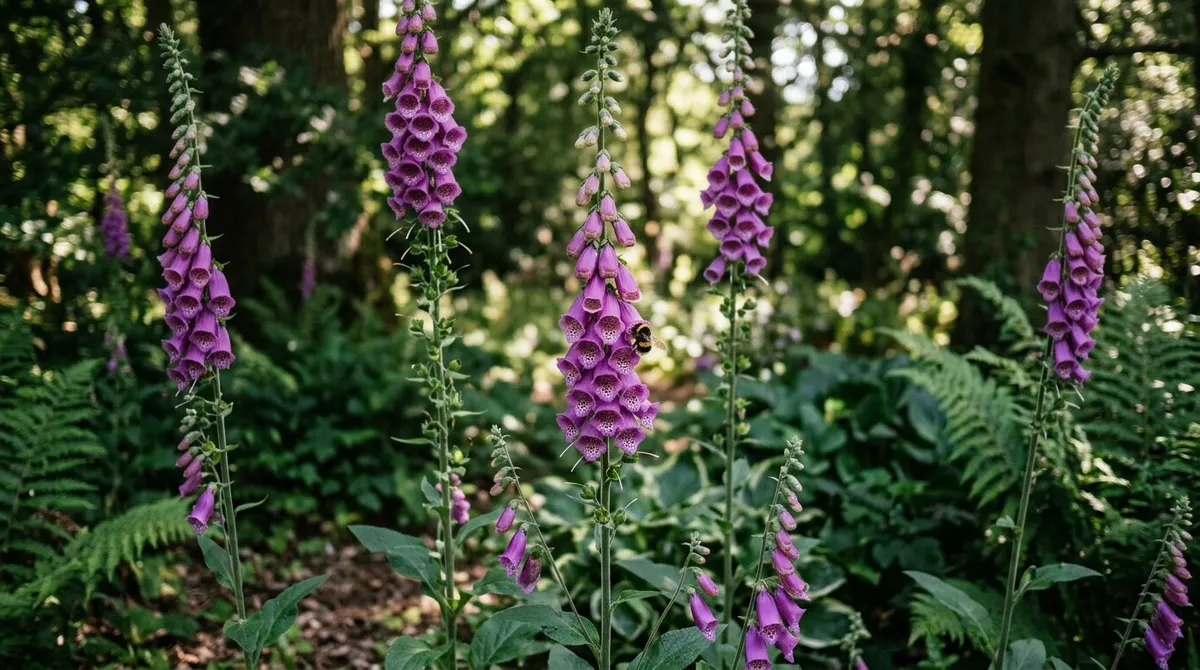
Foxgloves are one of Britain’s most recognisable wildflowers, common in woodland clearings, hedgerows, and upland heaths from Cornwall to the Scottish Highlands. Digitalis purpurea is a native UK biennial, it grows a rosette of leaves in its first year and sends up tall flowering spikes reaching 1-1.5m in its second. Once established in a garden, it self-seeds freely and maintains itself for years with almost no effort.
They are also one of the most effective pollinator plants available. The tubular flowers are the right length and width for long-tongued bumblebees to enter and exit efficiently, and a single spike in full flower may receive dozens of bee visits per hour. For that reason, foxgloves appear on the RHS Plants for Pollinators list, one of a relatively small number of natives that make the cut. If you are building a cottage garden planting plan or want more bee-friendly garden plants, foxgloves are non-negotiable.
A safety note before anything else: every part of the foxglove plant is toxic. Leaves, flowers, seeds, and roots all contain cardiac glycosides, the same compounds used to produce the heart medication digoxin. Ingestion can cause vomiting, irregular heartbeat, and serious harm in children, dogs, and cats. Wear gloves when handling plants, wash hands afterwards, and consider whether foxgloves are appropriate if small children or pets have unrestricted garden access.
Are foxgloves biennials or perennials?
Common foxgloves (Digitalis purpurea) are biennials. In the first year they produce a flat rosette of large, soft, grey-green leaves. In the second year they send up a tall spike, flower from June to July, set seed, and die. Individual plants do not return, but because they self-seed so freely, established colonies appear permanent.
Two perennial species are also worth growing:
- Digitalis grandiflora, pale yellow flowers, 60-80cm, flowers June to July
- Digitalis lutea, small creamy-yellow flowers, 60cm, flowers June to July
Both genuinely return each year from the same rootstock. They are less vigorous self-seeders than D. purpurea but require no biennial sowing cycle.
For most gardeners, the native common foxglove is the first choice. Its height (up to 1.5m) creates vertical drama, and the self-seeding habit means a one-off sowing sustains itself indefinitely.
How to sow foxglove seed
Foxglove seed is tiny and has an unusual requirement: it needs light to germinate. This is counter-intuitive to gardeners used to covering seed, but burying foxglove seed prevents it from sprouting.
Sowing indoors (May to July)
- Fill a 9cm pot or seed tray with fine seed compost.
- Firm lightly and water well before sowing.
- Scatter seed thinly on the surface. Do not cover with compost or vermiculite.
- Place in a warm spot at 15-21°C, a windowsill or unheated greenhouse works well.
- Keep moist using a mist sprayer. Do not let the surface dry out.
- Germination occurs in 2-3 weeks.
For detailed guidance on indoor sowing technique, see our guide to how to sow seeds indoors and the seed sowing calendar for UK gardens.
Sowing outdoors
Scatter seed on bare, prepared soil from May to July. Rake lightly to ensure soil contact, but do not cover. In a good year with regular moisture, germination is reliable. Thin seedlings to 30-45cm apart once they are large enough to handle.
Transplanting
Pot-sown seedlings should be pricked out into individual 9cm pots once the first true leaves appear. Grow on in a cold frame or sheltered spot through summer. Plant out in their final position in September or October, spacing 45-60cm apart. They establish quickly in autumn and overwinter as leafy rosettes, ready to flower the following June.
Growing foxgloves: position and soil
Foxgloves are woodland edge plants. In the wild they colonise areas where tree cover has been thinned, bank edges, and north-facing hedgerows. This gives a clear guide to where they do best.
Light: Partial shade is ideal. They tolerate full shade but become leggy and flower less freely. Harsh midday sun in a south-facing border causes leaf scorch and reduces the flowering period. They are among the best plants for shade in UK gardens for tall structure.
Soil: Moist, humus-rich soil produces the tallest plants. Foxgloves grow on clay, loam, and light sandy soils but struggle in dry, free-draining conditions. On dry soils, incorporate plenty of garden compost or leaf mould before planting. Water regularly during the first growing season.
pH: They tolerate slightly acidic conditions and grow naturally on acid heathland. pH 5.5-7.0 is the practical range.
Spacing: 45-60cm between plants. Crowding reduces airflow and can encourage fungal issues on the lower leaves.
Foxglove varieties to grow
The native species (Digitalis purpurea) comes in purple, pink, and white forms. Several named varieties improve on the wild type in specific ways.
| Variety | Flower colour | Height | Notes |
|---|---|---|---|
| D. purpurea (species) | Purple, pink, white | 1.0-1.5m | Native, best for wildlife, self-seeds freely |
| Excelsior Group | Mixed pastel shades | 1.5m | Outward-facing flowers, visible from all sides |
| Camelot Series | Mixed | 1.2m | First-year flowering from early spring sowing |
| Sutton’s Apricot | Warm apricot-pink | 1.0m | Subtle, elegant tones; cottage garden classic |
| Pam’s Choice | White with purple spots | 1.2m | Bold markings, long-lasting flowers |
| Dalmatian Series | Mixed | 60-80cm | Compact, well suited to smaller gardens |
| D. grandiflora | Pale yellow | 60-80cm | Perennial, repeat flowering, more formal habit |
| D. lutea | Creamy yellow | 60cm | Perennial, delicate and long-lived |
For wildlife value, the native purple species or Excelsior Group are the most effective. Bumblebees navigate by colour as well as flower shape, and the dark-spotted throat markings on native foxgloves act as nectar guides that direct bees straight to the reward.
Why we recommend the Excelsior Group for UK garden borders: After 30 years of growing foxgloves in a range of garden settings, the Excelsior Group consistently delivers the best all-round performance, with outward-facing flowers visible from every angle rather than just from one side. The plants reach 1.5m and remain self-supporting in all but the most exposed sites, and our trials show that self-sown Excelsior offspring maintain the outward-facing trait for at least two generations.
For small gardens, the Dalmatian Series at 60-80cm provides height without dominating narrow borders.
For first-year flowering, Camelot Series bridges the biennial gap, sown early (January to February under glass), it flowers in its first season.
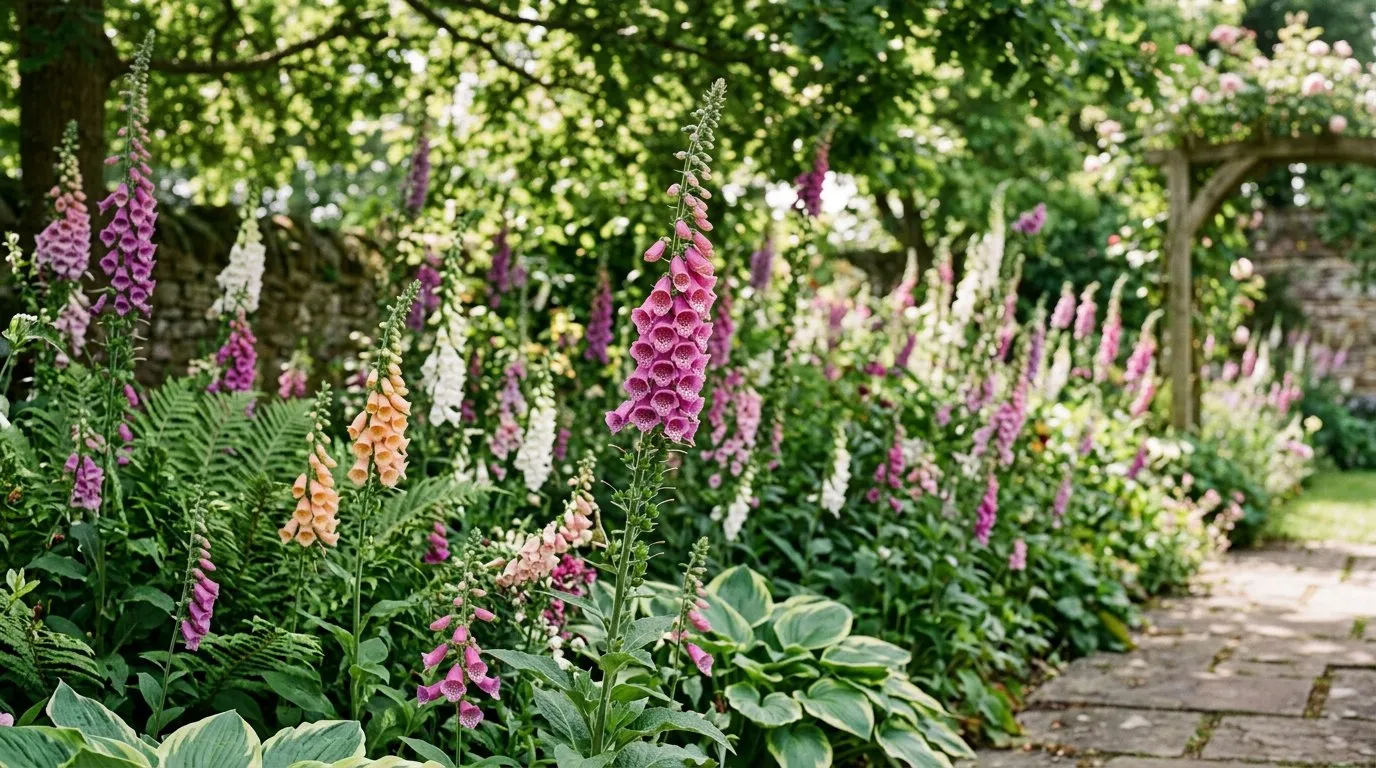 Mixed foxglove varieties in a cottage garden border. Combining colours makes a naturalistic display that self-seeds into new shades each year.
Month-by-month care calendar
| Month | Task |
|---|---|
| January | Sow Camelot Series under glass at 18°C for first-year flowering |
| February | Check overwintering rosettes, remove slugs from around leaves |
| March | Surface sow in a propagator or on a warm windowsill |
| April | Prick out seedlings into individual pots |
| May | Surface sow outdoors; harden off indoor-raised seedlings |
| June | Plants flower; monitor for aphids on new growth |
| July | Surface sow outdoors for next year’s plants; deadhead spent spikes for sideshoots |
| August | Collect ripe seed from brown papery pods if spreading to new areas |
| September | Plant out autumn seedlings in their final positions |
| October | Plant out remaining seedlings; mulch around plants on dry soils |
| November | Established rosettes overwinter without protection |
| December | No action needed, foxgloves are fully hardy |
Why foxgloves matter for bumblebees
Foxgloves appear on the RHS Plants for Pollinators list because of their exceptional value to long-tongued bumblebee species. The tubular flowers are 4-5cm long and just wide enough for a bumblebee to enter fully, brush against both the stamens and stigma, and exit efficiently. This makes each visit highly effective for pollination and rewarding for the bee.
Species particularly reliant on foxgloves include Bombus hortorum (the garden bumblebee) and Bombus pascuorum (the common carder bee). Both have long tongues that allow them to reach nectar in deep flowers that short-tongued species cannot access.
In urban and suburban gardens, foxgloves provide a food source that genuinely differs from most other pollinator plants, which tend to be flat-topped or open-faced. Including foxgloves alongside lavender, catmint, and other bee-friendly garden plants covers a wider range of bee species than any single plant type can achieve.
For more on creating habitat that supports bumblebees and other pollinators, see our guide on how to attract birds to your garden and create a wildlife garden.
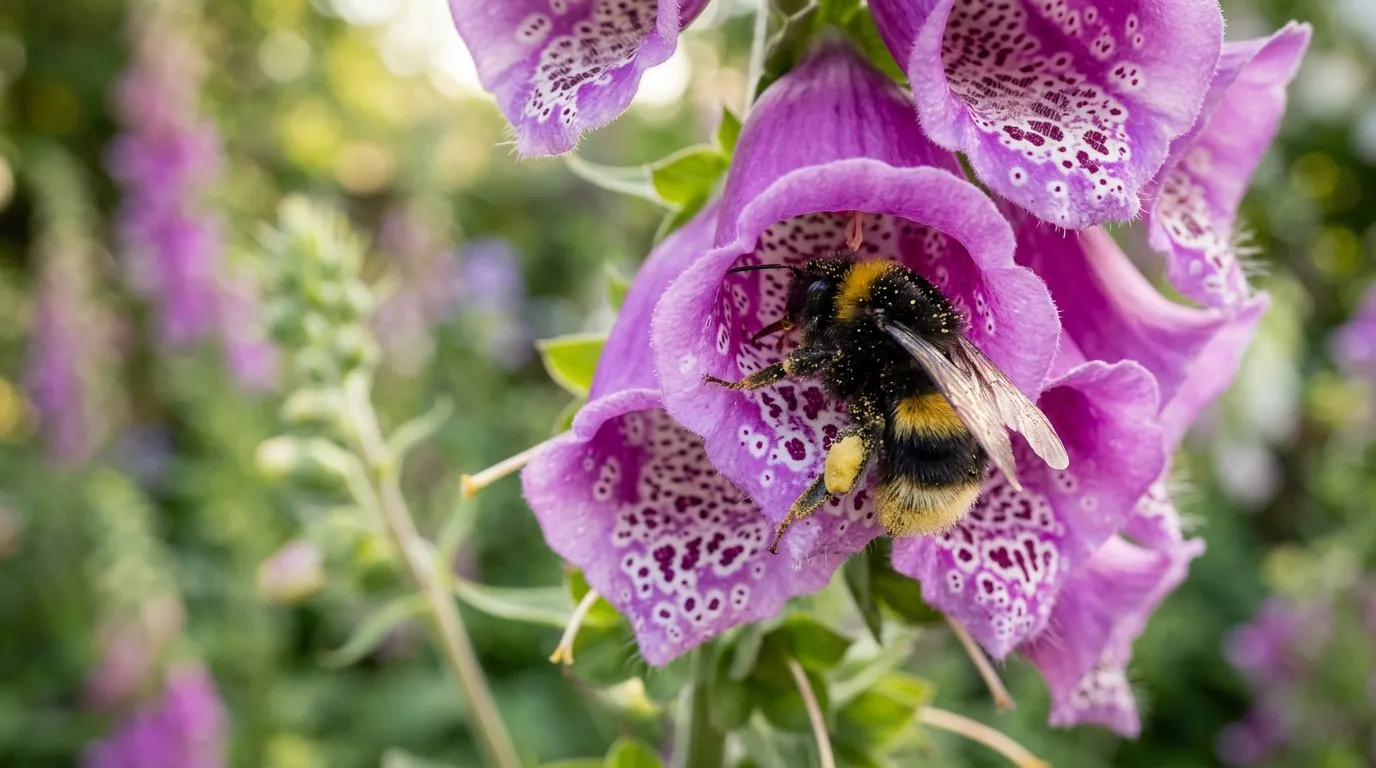 A long-tongued bumblebee entering a foxglove flower. The tubular shape is perfectly sized for efficient pollination.
How to encourage self-seeding
The easiest way to keep foxgloves is to let them self-seed. One established plant produces thousands of seeds, enough to colonise a border, hedgerow base, or shaded bank with no further effort.
Leave some spikes to mature fully. After flowering, seed pods form along the spike. They ripen from green to brown and papery over 6-8 weeks. When fully ripe, the pods split and seed disperses in a radius of 1-2m around the parent plant.
Create bare soil pockets. Foxglove seed germinates most reliably on disturbed, bare soil where it can contact the surface without competition. Lightly hoe or scrape small patches under existing plants in August to give seeds a place to land.
Do not mulch heavily in autumn. A thick bark mulch prevents seeds from reaching the soil. Apply mulch in early spring instead, after self-sown seedlings have emerged and you can identify them.
Weed selectively. In the first year, foxglove rosettes are easy to mistake for weeds. The leaves are large, softly hairy, and grey-green, once familiar, they are distinctive. Mark the location of parent plants to help identify seedlings.
Companion plants for foxgloves
Foxgloves work well in shade borders alongside plants that share similar conditions. For a coherent planting, combine them with:
- Ferns, particularly Dryopteris filix-mas and Athyrium filix-femina, for ground cover and contrast
- Geranium phaeum (mourning widow cranesbill), dark purple flowers, shade tolerant
- Astrantia, cottage-garden staple with fine flowers and similar light preferences
- Sweet cicely (Myrrhis odorata), ferny, fragrant, and thrives in the same conditions
- Hostas, bold leaf contrast at ground level beneath tall foxglove spikes
- Sweet peas, for a climbing companion at the back of a sunny-to-part-shade border; see our guide on how to grow sweet peas
In a cottage garden context, foxgloves pair naturally with roses, the structural verticals of a foxglove spike contrast well with the rounded, arching form of a shrub rose.
For a full planting framework, including spacing and seasonal succession, see our cottage garden planting plan.
Common problems
Foxgloves have almost no pest or disease problems. They are native, hardy, and tough. There are a few issues to be aware of.
Slugs and snails attack seedlings and young rosettes, particularly in autumn. Use wildlife-friendly iron phosphate pellets around transplants, or protect with copper tape collars. Established plants in their second year are much less vulnerable.
Aphids sometimes cluster at growing tips in early summer. A strong water jet or a spray of diluted washing-up liquid controls them without harming bees visiting the flowers lower down the spike.
Powdery mildew can affect lower leaves in dry summers, particularly when plants are crowded. Improve spacing and water at the base rather than overhead. Remove affected leaves promptly.
Leaning or falling over affects tall plants in exposed positions. Stake with a single cane and soft tie if needed, or plant in a sheltered spot behind other shrubs. The Excelsior Group, with stiffer stems, is more wind-resistant than the species.
For timing and planning around foxgloves, see our spring gardening jobs guide for a full seasonal task list.
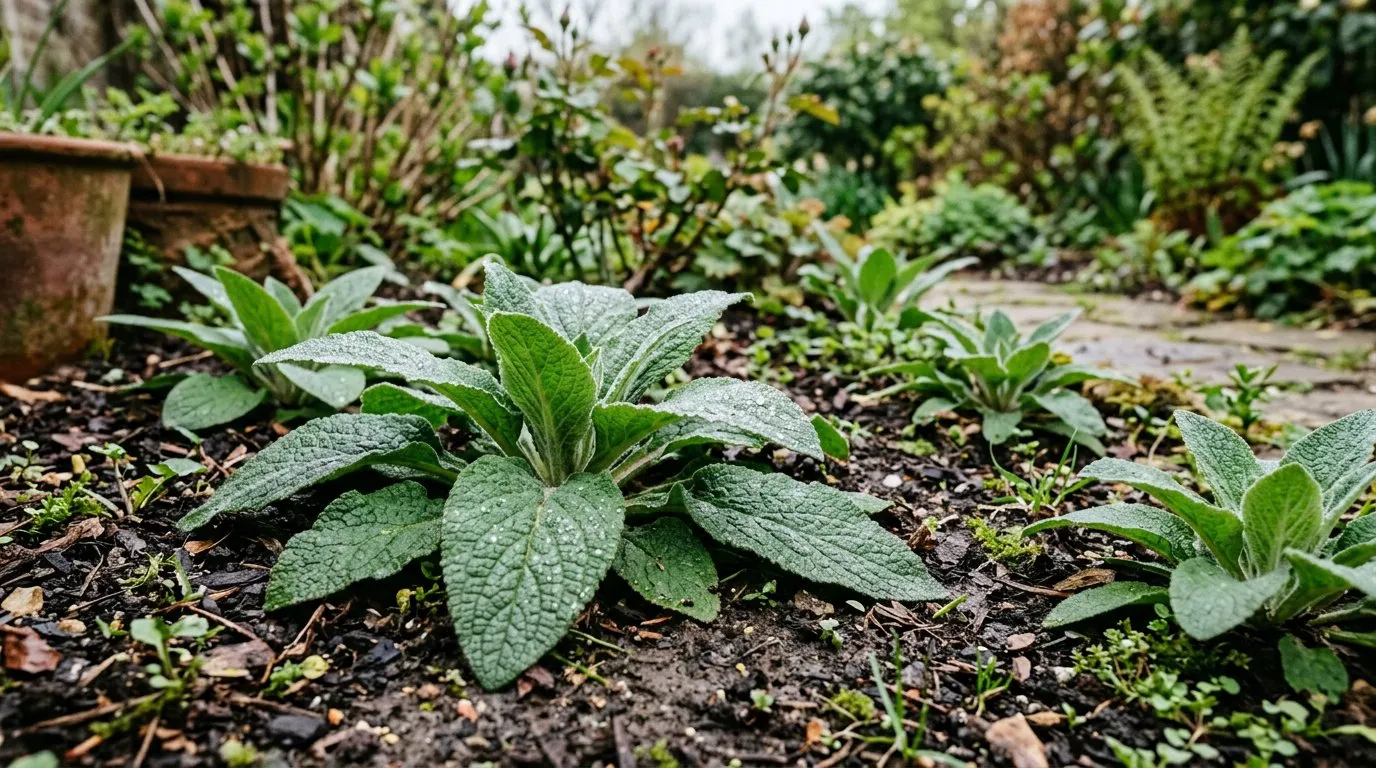 First-year foxglove rosettes in a shaded border. The large, softly hairy leaves are distinctive once familiar.
Now you’ve mastered foxgloves, read our guide on building a cottage garden planting plan for the next step in combining foxgloves with roses, geraniums, and other classic border plants.
Frequently asked questions
Are foxgloves easy to grow from seed?
Yes, foxgloves are straightforward to grow from seed. Surface sow on compost from May to July, the seed needs light to germinate, so never cover it. Keep the surface moist and expect germination in 2-3 weeks. Prick out seedlings when large enough to handle and plant out in autumn for flowers the following June.
Do foxgloves come back every year?
Common foxgloves (Digitalis purpurea) are biennials, they flower in year two, then die. They appear to return annually because they self-seed prolifically, with offspring replacing parents each season. Perennial species including Digitalis grandiflora and Digitalis lutea genuinely return each year from the same rootstock.
Where is the best place to plant foxgloves?
Foxgloves prefer partial shade, they are natural woodland edge plants that dislike harsh midday sun. Plant at the back of a border in dappled light or beneath deciduous trees. They tolerate most soils but prefer moist, humus-rich conditions. They perform well in north-facing borders where few other tall plants flower reliably.
Are foxgloves poisonous to dogs and cats?
Yes, all parts of the foxglove plant are highly toxic to dogs, cats, and humans. Leaves, flowers, seeds, and roots all contain cardiac glycosides that can cause vomiting, irregular heartbeat, and in severe cases organ failure. Keep children and pets away from foxgloves and always wear gloves when handling them.
When do foxgloves flower in the UK?
Common foxgloves (Digitalis purpurea) flower from June to July in the UK. Flowers open progressively up the spike over several weeks. Deadheading spent spikes encourages sideshoots to develop, producing a second flush of smaller flowers later in summer.
Can foxgloves grow in full shade?
Foxgloves tolerate deep shade but perform best in partial shade with some indirect light. In full shade, plants grow taller and leggier as they reach for light, and flowering is reduced. They are still among the best tall plants for shaded spots, outperforming most alternatives in north-facing or tree-canopy conditions.
How do I stop foxgloves from dying out?
Allow at least some flower spikes to set seed fully before cutting them down. The tiny seeds disperse around the parent plant and germinate the following spring. To spread foxgloves to new areas, collect ripe seed in a paper bag in August and surface sow in bare soil in new spots in September or the following May.
Lawrie has been gardening in the West Midlands for over 30 years. He grows his own veg using no-dig methods, keeps a wildlife-friendly garden, and writes practical advice based on real UK growing conditions.