Best Spring Flowers for UK Gardens
Best spring flowers UK gardens can grow: 20+ species from tulips and daffodils to cherry blossom and magnolia, with a month-by-month UK flowering calendar.
Key takeaways
- 20+ species cover the full spring window from February to late May without a single bare week
- Tulips need 12-14 weeks of soil below 9C — plant by early November for late April and May flowers
- Cherry blossom peaks for 10-14 days: choose late-flowering cultivars (Prunus 'Kanzan') to extend into May
- Magnolia blooms are destroyed by late frosts — shelter from north and east winds is non-negotiable
- Primroses and hellebores fill shaded spots from February to May where bulbs and sun-lovers cannot grow
Spring flowers transform UK gardens from bare soil to vivid colour across 14 weeks, starting with the first crocuses in February and finishing with late tulips in May. The difference between a garden that looks full from February onwards and one that only wakes up in April is almost always the same: the full range of spring-flowering plant types was never planted together.
Bulbs alone are not enough. Nor are shrubs. The gardens with the longest, most satisfying spring season combine all four categories — bulbs, perennials, shrubs, and trees — so that something is always opening as something else fades. This guide covers 20+ species across the complete spring season, with a month-by-month calendar, a full comparison table, and practical planting combinations for different situations.
For the earlier part of the season — snowdrops, winter aconites, and the first February flowers — see our companion guide to early spring flowers for UK gardens.
Spring flowers by month: February to May
February: the transition month
February is the bridge between winter and spring. Days lengthen past 10 hours in southern England by mid-month, triggering the first true spring responses. Soil at 5cm depth climbs from 3C to 6C through the month. This temperature rise unlocks the first wave of spring flowers.
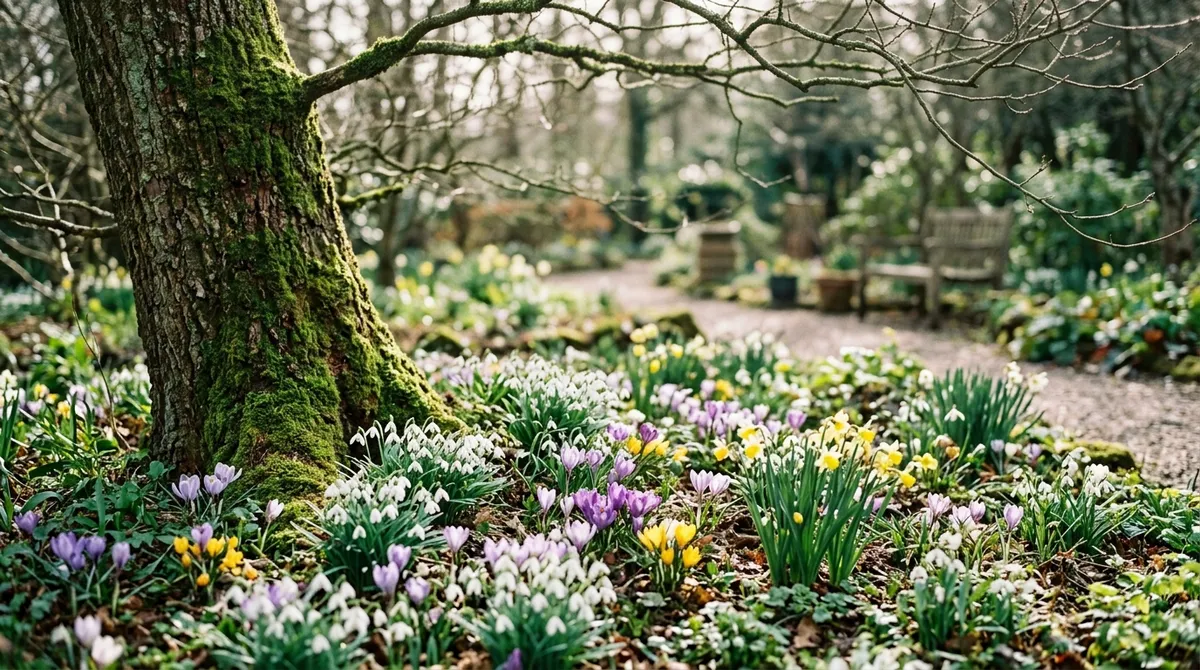
Crocuses open from mid-February in the south as soil reaches 3-5C. They are the most important early nectar source for queen bumblebees emerging from hibernation. A patch of 200 Crocus tommasinianus corms — planted the previous October at 8cm depth — produces a carpet of purple from mid-February that lasts three weeks. Plant in lawn or under deciduous trees for the most natural effect. More on when to plant spring bulbs in our timing guide.
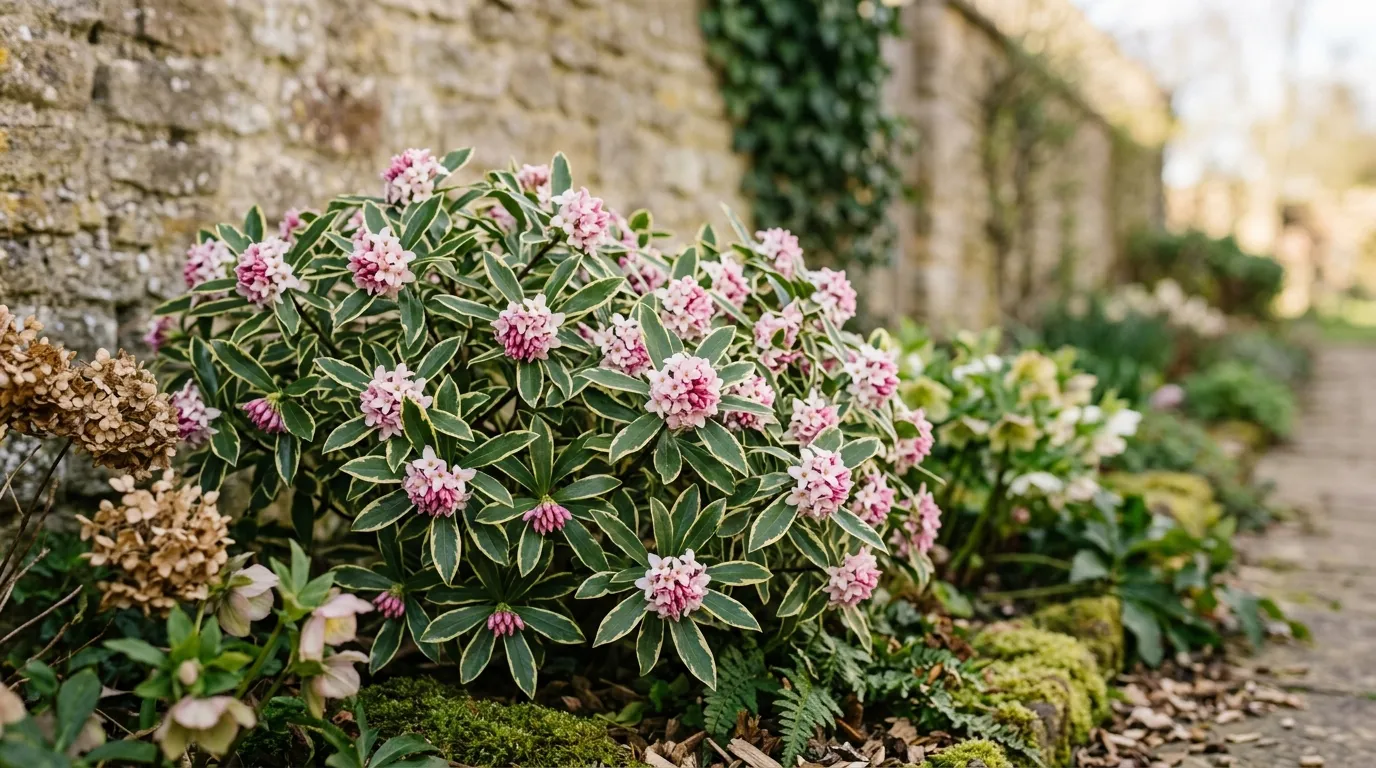
Hellebores (Helleborus x hybridus) are in full flower through February, producing 30-50 flowers per plant in colours from white through pink, plum, and near-black. They thrive in full shade and heavy clay — the two conditions most problematic for other spring plants. Our hellebore care guide covers variety selection and slug control for the critical early months.
Primroses (Primula vulgaris) start flowering in late February in sheltered spots. Pale yellow flowers on 10-15cm stems naturalise along hedgerow edges and in dappled shade. They combine beautifully with the blue flowers of pulmonaria to create a classic early-spring woodland palette. See our primrose growing guide for propagation and division advice.
Camellias begin their long season in February on acid soil. The earliest cultivars — including Camellia japonica ‘Adolphe Audusson’ (blood red) — are already opening where soil pH is below 6.5. Camellias need shelter from east-facing positions where morning sun thaws frozen buds too fast, causing brown petal scorch. Our camellia care guide covers acid soil requirements, feeding, and container growing.
March: shrubs and early daffodils
March is the month when the garden shifts decisively from winter to spring. Soil temperatures at 10cm reach 7-9C. Early daffodils hit their peak. Forsythia covers bare stems in yellow. Cherry trees begin to bud.
Daffodils are at their most reliable in March. Early varieties such as ‘February Gold’ (25cm, mid-March in the south) and ‘Tete-a-Tete’ (15cm, excellent in containers) have been flowering for three weeks already. Mid-season varieties — ‘Carlton’, ‘Ice Follies’, ‘Jetfire’ — peak in mid-March across the Midlands. Plant bulbs at 15cm depth in September or October. They naturalise permanently in grass and borders, multiplying each year without intervention. Our daffodil growing guide covers the best UK varieties by flowering week.
Forsythia (Forsythia x intermedia) is the most visible shrub of early spring, its bare stems covered in dense yellow flowers from March to early April before the leaves appear. It reaches 3m tall and wide, tolerates any soil including heavy clay, and grows in sun or partial shade. The key rule: prune forsythia immediately after flowering by cutting flowered stems back to a strong bud. Pruning at any other time removes next year’s flower buds. For a full range of shrub options, see our guide to best flowering shrubs for UK gardens.
Magnolia opens in March and April, delivering the most dramatic individual flower of the spring season. The goblet blooms of Magnolia x soulangeana reach 15-20cm across in shades of pink, purple-white, and cream. They need acid to neutral soil (pH 5.5-7.0) and shelter from north and east winds. Magnolia blooms are highly frost-susceptible: a late frost in March can destroy the entire season’s flowers in 24 hours. Our magnolia growing guide explains how to choose a sheltered planting position.
Muscari (grape hyacinths) produce dense cobalt-blue spikes from late March to April at 15-20cm tall. Plant at 8cm depth in October in any soil type, including heavy clay and chalk. They spread vigorously by offsets: 100 bulbs become 400-600 within four years. The blue flower spikes pair brilliantly with yellow daffodils for a classic spring colour combination.
April: peak spring
April is the centrepiece of the UK spring. Soil temperatures stabilise above 10C. Days exceed 13 hours. The entire garden moves at once.
Tulips dominate April in the sunniest spots. Mid-season varieties flower from late March to mid-April. Late-season varieties carry the display into May. Tulips need 12-14 weeks of soil below 9C — plant by early November for the best results. They are the most diverse spring bulb in colour, form, and height: from 20cm Greigii tulips in late March to 70cm Parrot tulips in early May. Our tulip growing guide covers the key varieties by timing, depth, and disease prevention.
Cherry blossom (Prunus) peaks in April. The display lasts just 10-14 days at its best — one of the most intense but brief spectacles in the British garden calendar. Early cultivars (Prunus x yedoensis) flower in late March. Mid-season (Prunus ‘Kanzan’, the most widely planted in UK streets and gardens) peaks in late April with dense double pink flowers. Late-season cultivars extend into May. A single mature cherry at 5-8m provides more spring visual impact than any other tree.
Camellia x williamsii ‘Donation’ — the most popular UK camellia — reaches its peak flowering in April, producing semi-double clear pink flowers in abundance. Unlike japonica types, x williamsii cultivars drop spent flowers cleanly rather than letting them brown on the bush.
Bleeding heart (Lamprocapnos spectabilis) produces arching sprays of heart-shaped pink and white pendants in April and May at 60-90cm tall. It thrives in partial shade and moist, humus-rich soil — ideal under deciduous trees where tulips would struggle. It goes fully dormant by June, so plant neighbouring perennials to fill the space.
May: late spring and the tulip finale
May extends the spring season with the most showy plants of the entire period. Late tulips peak in early May. Alliums send up their giant purple spheres.
Late tulips (Parrot, Viridiflora, and Single Late groups) flower from late April to mid-May. ‘Queen of Night’ (near-black, 60cm) is the most striking late tulip for UK gardens. ‘Estella Rijnveld’ (red and white parrot form, 55cm) is the most flamboyant. Both need planting at 15-20cm depth in late October to early November to reduce tulip fire (Botrytis tulipae) risk in warm soil.
Alliums open in May and bridge the gap between spring and early summer. Allium hollandicum ‘Purple Sensation’ (90cm, deep violet spheres) and Allium cristophii (45cm, star-shaped silvery spheres) both flower in May. Plant bulbs at 10cm depth in October. Their seedheads remain ornamental through summer and into autumn, extending the season further.
Wisteria (Wisteria sinensis) covers south and west-facing walls in May with cascading racemes of lilac flowers up to 30cm long. It requires heavy annual pruning: cut new shoots to five leaves in August, then cut the same shoots back to two or three buds in February. Without this two-cut system, wisteria produces fewer flowers each year.
Aquilegia (granny’s bonnet) flowers in May in shades of blue, purple, pink, red, and white. Self-seeds freely in moist borders and tolerates partial shade. A naturalistic cottage-garden plant that works well between tulips and alliums, filling the gaps as tulip foliage dies back.
The RHS spring planting guide covers the full range of spring-flowering bulbs, including RHS Award of Garden Merit varieties for each category.
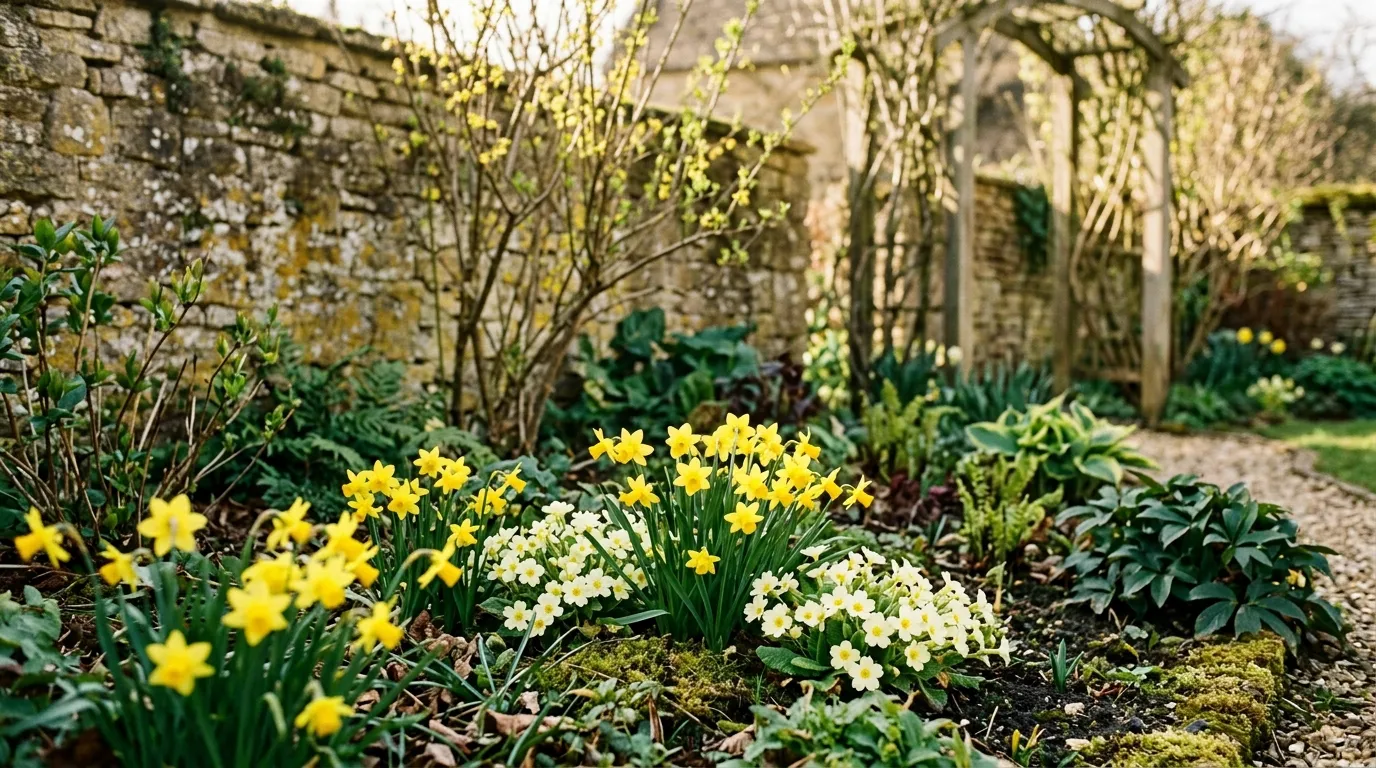
Mid-season daffodils and early tulips flowering together in a UK border in April — the peak of the spring display.
Spring flowers calendar: February to May
This table shows when each species typically flowers in southern England. Northern regions run 2-3 weeks later.
| Plant | Type | Flowering months | Colour | Height |
|---|---|---|---|---|
| Helleborus x hybridus | Perennial | February–April | White, pink, plum, near-black | 45-60cm |
| Primrose (Primula vulgaris) | Perennial | February–May | Pale yellow | 10-15cm |
| Crocus | Bulb | February–March | Purple, yellow, white | 8-12cm |
| Camellia (early) | Shrub | February–April | White, pink, red | 2-3m |
| Muscari | Bulb | March–April | Blue, white | 15-20cm |
| Early daffodils | Bulb | February–March | Yellow, orange | 15-25cm |
| Forsythia | Shrub | March–April | Yellow | 2-3m |
| Mid-season daffodils | Bulb | March–April | Yellow, white, bicolour | 30-45cm |
| Magnolia stellata | Tree/shrub | March–April | White, pale pink | 2-3m |
| Magnolia x soulangeana | Tree | April | Pink, white, purple | 4-6m |
| Early tulips (Greigii, Kaufmanniana) | Bulb | March–April | All colours | 20-35cm |
| Cherry blossom (early) | Tree | Late March–early April | White, pale pink | 5-8m |
| Camellia x williamsii | Shrub | March–May | Pink, white | 2-3m |
| Mid-season tulips | Bulb | April | All colours | 40-55cm |
| Cherry blossom ‘Kanzan’ | Tree | Late April | Deep pink (double) | 6-8m |
| Bleeding heart | Perennial | April–May | Pink and white | 60-90cm |
| Aquilegia | Perennial | May–June | All colours | 50-80cm |
| Late tulips (Parrot, Single Late) | Bulb | Late April–May | All colours | 50-70cm |
| Allium hollandicum | Bulb | May–June | Purple | 90cm |
| Wisteria sinensis | Climber | May | Lilac, white | 10-15m |
Planting combinations for different situations
Different gardens need different approaches. The right combination depends on soil type, aspect, and the depth of shade.
| Situation | Best plants | Flowering period |
|---|---|---|
| Sunny south-facing border | Tulips, late daffodils, muscari, alliums, forsythia | March–May |
| Shaded north-facing border | Hellebores, primroses, pulmonaria, lily-of-the-valley | February–May |
| Under deciduous trees | Crocuses, primroses, bluebells, pulmonaria | February–May |
| Small courtyard | Container tulips, ‘Tete-a-Tete’ daffodils, camellia in pot | February–May |
| Acid woodland garden | Camellia, magnolia, rhododendron, primroses | March–May |
| Wildlife-focused border | Crocuses, primroses, pulmonaria, aquilegia, alliums | February–June |
| Cottage garden | Tulips, aquilegia, bleeding heart, primroses, alliums | March–June |
Spring bulbs: what to plant and when
Daffodils
Daffodils are the most reliable spring bulb for UK conditions. They naturalise in borders and grass, multiply each year, and are unattractive to squirrels (unlike tulips, which are regularly dug up). Plant at 15cm depth from September to October. The larger the bulb, the more flowers per stem: choose bulbs 14cm circumference or larger for the fullest displays.
Early varieties flower from February to March. Mid-season varieties flower in March and April. Late varieties extend into May. For a complete variety guide with flowering weeks and heights, see our daffodil growing guide.
Tulips
Tulips are the most diverse and visually dramatic spring bulb. They come in every colour except true blue, in heights from 20cm to 70cm, with flower forms ranging from single cups to fringed parrots to lily-shaped goblets. They need 12-14 weeks of soil below 9C — plant in late October to early November at 15-20cm depth. This deep planting reduces exposure to Botrytis tulipae (tulip fire), a fungal disease that blackens and distorts flowers.
Hybrid tulips decline in vigour after 2-3 years in most UK gardens. Lift bulbs in June, store dry until October, and replant each year for consistent displays. Species tulips (Tulipa sylvestris, T. tarda, T. saxatilis) naturalise permanently in well-drained soil. For the full range of varieties and care instructions, see our tulip growing guide.
The bulb lasagne method
The bulb lasagne technique layers three types of bulbs in the same hole at different depths, creating three sequential waves of flowers from a single planting.
For a spring-focused lasagne covering March to May:
- Dig a hole 25cm deep and 30cm wide
- Place 5 late tulip bulbs at 20cm depth, spaced 10cm apart
- Cover with 3cm of soil
- Place 7 mid-season tulips or late daffodils at 15cm depth
- Cover with 3cm of soil
- Place 10 muscari bulbs at 8cm depth, spaced 5cm apart
- Cover with soil and firm gently
This single hole flowers from mid-March (muscari) through late March to April (mid-season tulips or daffodils) to late April and May (late tulips). Add three primrose plants at ground level between holes for February and March foliage before the bulbs emerge.
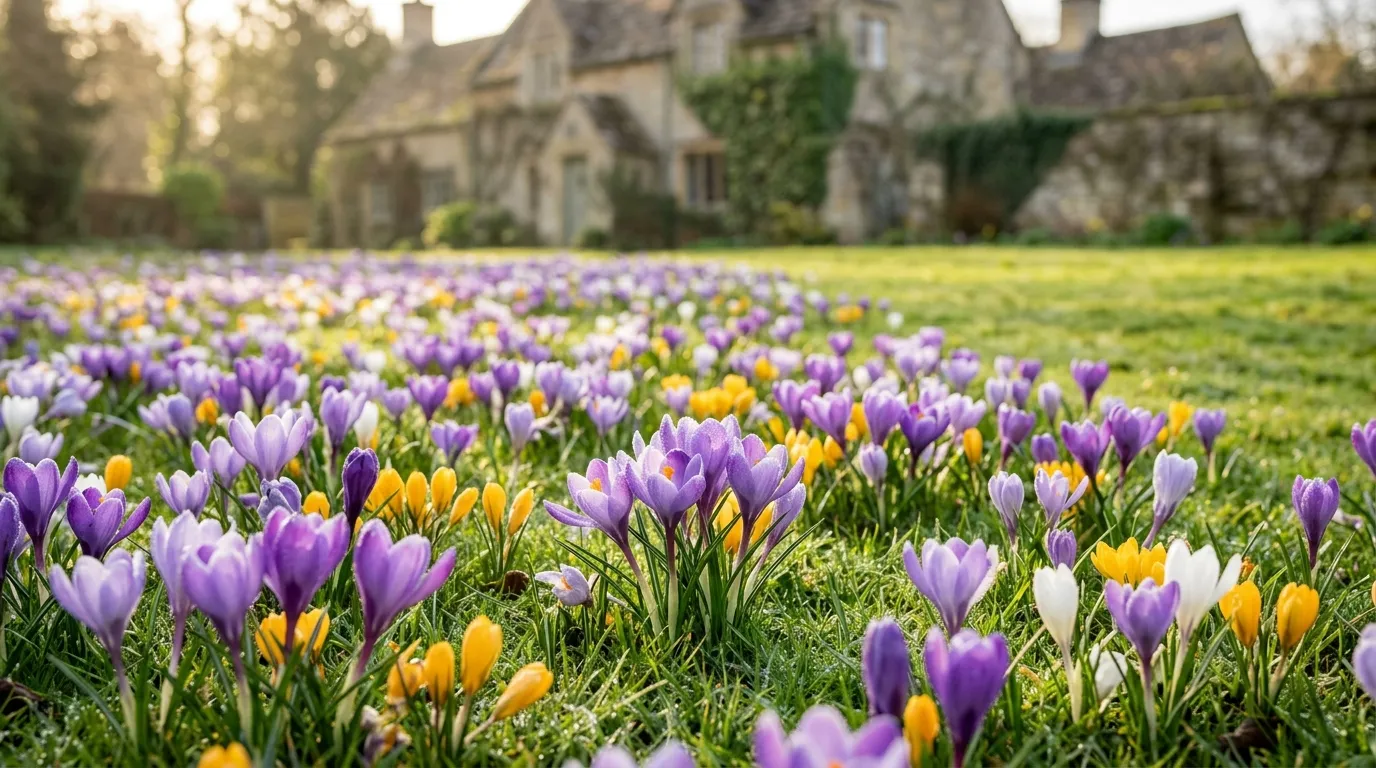
Crocus tommasinianus naturalised in a lawn — the earliest reliable spring colour from mid-February.
Spring-flowering shrubs and trees
Forsythia
Forsythia announces spring more loudly than any other shrub. Bare stems turn entirely yellow from March to April before a single leaf appears. Forsythia x intermedia ‘Lynwood Variety’ has the largest, most vivid flowers. ‘Fiesta’ is a more compact form at 1.5m, suitable for smaller gardens.
Forsythia flowers on the previous year’s wood. Prune immediately after flowering by cutting flowered stems back to a strong bud. Never prune in winter — you remove next year’s flowers. On established plants, cut one in three of the oldest stems to ground level each year to keep the plant flowering on young wood.
Magnolia
Magnolias are the most architecturally impressive spring-flowering trees and shrubs in the UK. The flowers open before the leaves, making them the focal point of the entire garden for two to three weeks in March and April.
Magnolia stellata (star magnolia) is the best choice for small gardens: multi-stemmed, reaching 2-3m in 20 years, covered in white star-shaped flowers in March and April. Magnolia x soulangeana reaches 6m and produces large goblet flowers in pink, white, or purple. Both need acid to neutral soil and wind shelter. Magnolia buds are frost-susceptible: a single night at -4C when buds are open can destroy the entire season’s flowers. Plant on a west or south-facing slope where cold air drains away. Our magnolia growing guide covers site selection and frost protection in detail.
Camellias
Camellias provide some of the longest-lasting spring flowers of any shrub, beginning in February and continuing to May depending on variety. They need acid soil (pH 4.5-6.5) and consistent moisture. In gardens without naturally acid soil, grow in large containers of ericaceous compost.
Camellia x williamsii ‘Donation’ (semi-double clear pink) and ‘J.C. Williams’ (single pink) are the best choices for UK gardens: both are AGM-awarded, flower prolifically, and drop spent blooms cleanly. Water camellias with rainwater rather than tap water in hard-water areas to prevent soil alkalisation. Our camellia care guide covers feeding, container growing, and variety selection in full.
Cherry blossom
Cherry blossom is the most anticipated spectacle of the British spring. The peak display lasts only 10-14 days, but few sights in UK horticulture match a mature Prunus ‘Kanzan’ in full April bloom.
For an extended blossom season, plant varieties from different flowering groups:
- Early (late March): Prunus x yedoensis — white, single flowers, 8m tall
- Mid-season (early April): Prunus ‘Accolade’ — semi-double pale pink, 8m tall
- Late (late April to May): Prunus ‘Kanzan’ — double deep pink, 6-8m tall; Prunus ‘Ukon’ — semi-double pale yellow-white, 8m tall
All cherry trees need full sun and well-drained soil. Avoid pruning in winter or autumn when silver leaf fungus (Chondrostereum purpureum) is active. The Gardeners’ World guide to ornamental cherries gives a comprehensive variety rundown with RHS ratings.
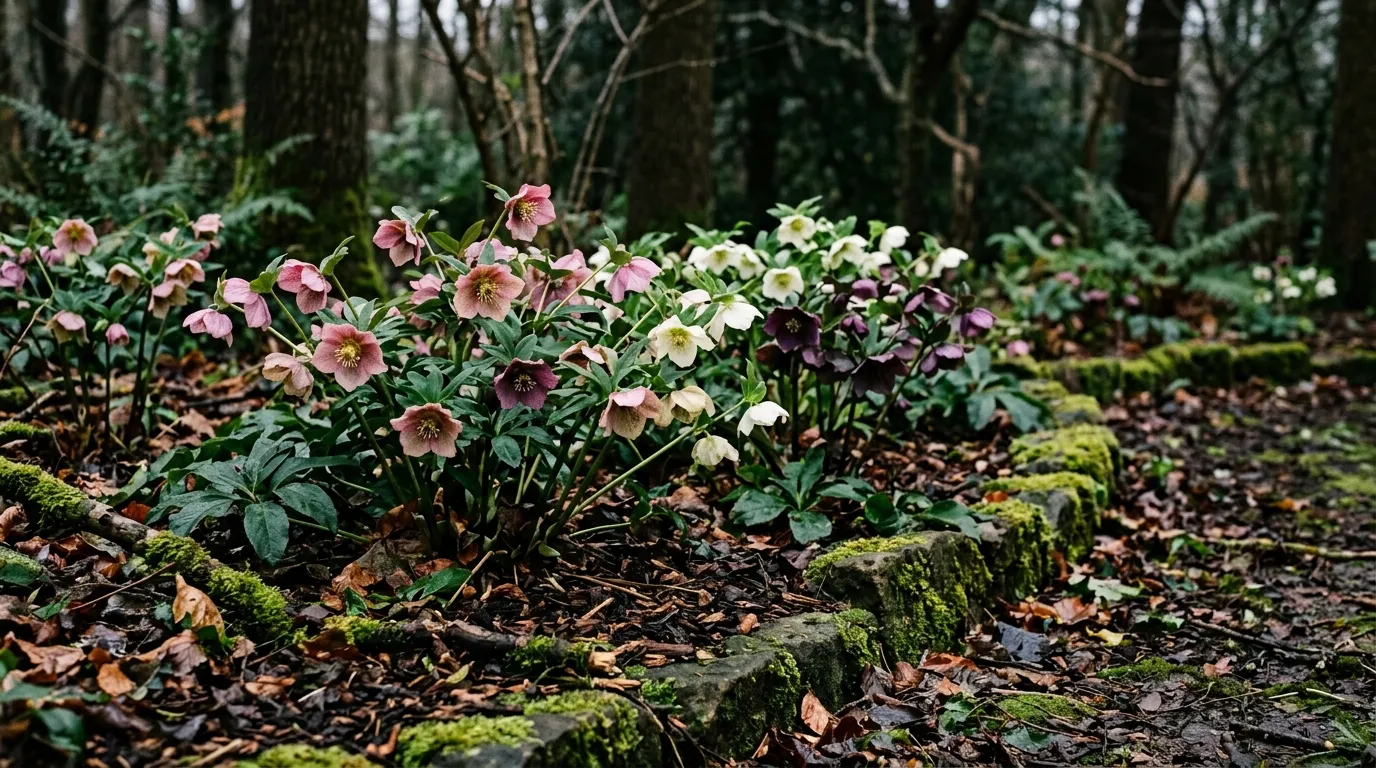
Hellebores thrive in full shade where most spring flowers struggle — producing 30-50 blooms per plant from January through April.
Dealing with late frosts
Late frosts are the greatest risk to spring flowers in the UK. The average last frost date ranges from late March on the south coast to late May in the Scottish Highlands. Frost pockets — low-lying areas where cold air pools — can experience frosts a month after the surrounding garden.
Most vulnerable plants: Magnolia buds (destroyed below -2C when open), early camellia flowers, tulip stems emerging above ground, and the shoot tips of tender perennials.
Protection methods:
- Drape fleece over emerging tulip shoots on forecast frost nights
- Site magnolias and camellias on slight slopes where cold air drains away
- Choose late-flowering cultivars to miss the worst frost window
- Use south or west-facing walls, which radiate heat at night and reduce frost severity by 2-3C
Bulbs (tulips, daffodils, muscari) are largely frost-hardy at the stem and leaf stage. The damage occurs when tulip shoots emerge early and a hard frost (-5C or below) splits the stem tissue. Deep planting (15-20cm) delays emergence, reducing frost risk.
Wildlife value of spring flowers
Spring flowers are critical habitat for UK pollinators. Queen bumblebees emerge from hibernation in February and March with almost no energy reserves. Without nectar within 24-48 hours, they die. A garden that only opens in April provides no help at all.
Crocuses (February-March) are the most important early nectar source for bumblebees in urban gardens. Primroses (February-May) support early butterflies including brimstones and orange-tips. Hellebores attract early mining bees and hoverflies. Cherry blossom and fruit tree blossom in April is critical for honey bees and solitary bees building nest provisions. Alliums in May attract a wide range of solitary bee species.
Toxicity note: Several popular spring plants are toxic to pets and humans. Tulips and daffodils are toxic to dogs, cats, and horses if ingested — especially the bulbs. Bluebells and hellebores are also toxic. Note which plants are where if you have pets or small children, and avoid allowing access to freshly planted bulb areas.
Common mistakes with spring planting
Planting tulips too early
Tulip bulbs planted before mid-October sit in warm soil (above 12C) for weeks, encouraging Botrytis tulipae (tulip fire) infection. The disease blackens leaves and flowers and spreads through the soil. Wait until late October when soil cools below 12C. In mild areas, wait until early November. See our tulip growing guide for region-specific timing.
Choosing only one flowering period
A garden planted with only March daffodils looks spectacular for four weeks, then has nothing until summer. Mix early, mid, and late-season varieties across all plant types to extend the display across 14 weeks. The month-by-month calendar above shows exactly where the gaps appear and which plants fill them.
Planting magnolias in frost pockets
Magnolia blooms open before leaves protect them. A -2C frost on open flowers causes irreversible browning within hours. Before planting, check that the site is not a frost pocket — low-lying, sheltered from wind, slow to warm in the morning. If the site is borderline, choose Magnolia stellata over M. x soulangeana: stellata flowers two weeks later, missing the worst late-frost window in most UK regions.
Removing tulip and daffodil foliage too soon
Bulb foliage photosynthesises for six weeks after flowering, rebuilding the bulb’s energy reserves for the following year. Removing or tying up foliage before it yellows naturally causes progressively weaker flowers over 2-3 years. Daffodil foliage must stay until late June. Tulip foliage until early July. Plant low-growing perennials (sedums, hardy geraniums) in front of bulbs to hide the dying foliage without cutting it.
Ignoring shade
Many gardeners assume spring flowers need full sun. Hellebores, primroses, pulmonaria, and lily-of-the-valley all prefer partial to full shade. The most underused spring habitat in UK gardens is the ground under deciduous trees, which receives winter sun through bare branches and summer shade from the canopy. Plant these woodland species in that space — few other plants will compete with them there.
Frequently asked questions
What are the best spring flowers for a UK garden?
Tulips, daffodils, and cherry blossom are the most impactful spring flowers for UK gardens. Tulips peak in April and May in dozens of colours from 20cm to 70cm tall. Daffodils flower from February to April and naturalise in borders and grass. Cherry blossom (Prunus cultivars) provides height and structure. Add forsythia for March yellow, magnolia for April and May, and camellias for shaded spots with acid soil. Combine all six and you cover February to late May with no bare periods.
What spring flowers bloom in February and March in the UK?
Crocuses, primroses, hellebores, and forsythia are the most reliable February-March flowers. Crocuses open from mid-February in the south when soil reaches 3-5C. Hellebores (Helleborus x hybridus) produce 30-50 blooms per plant from January through April in shade. Primroses flower from late February in dappled shade. Forsythia covers bare stems in yellow from March. Camellias add pink or white blooms from February to May on acid soil.
When should I plant spring bulbs in the UK?
Plant spring bulbs between September and early November. Daffodils go in first (September-October) at 15cm depth. Tulips go in last (late October to early November) at 15-20cm depth to reduce tulip fire disease. Crocuses and muscari plant in October at 8-10cm. Planting too early (before September) exposes tulips to fungal disease in warm soil. Planting too late (after November) shortens the vernalisation period and delays or prevents flowering.
Which spring flowers grow in shade in the UK?
Hellebores, primroses, and camellias are the best spring flowers for shaded UK gardens. Hellebores thrive in full shade, producing flowers from January to April. Primroses prefer dappled shade and moist soil, flowering from February to May. Camellias need shelter from morning sun to protect frosted buds. Pulmonaria and lily-of-the-valley also flower in April and May in shade. All five tolerate north-facing borders.
How do I get continuous spring colour from February to May?
Layer four plant types with overlapping flowering periods. Start with early bulbs (crocuses, early daffodils) for February-March. Add mid-season bulbs (late daffodils, mid-season tulips) for March-April. Plant late-season tulips for April-May. Use flowering shrubs (forsythia in March, magnolia in April) for height. Include perennials (hellebores and primroses) for shaded gaps. This four-layer approach gives continuous colour for 14 weeks without bare periods.
Do tulips come back every year in UK gardens?
Species tulips reliably come back for 5-7 years. Hybrid tulips (the tall, showy varieties) decline after 2-3 years in most UK gardens. To get annual tulip displays from hybrids, treat them as annuals: lift bulbs in June after foliage dies back, store dry until October, replant at 15-20cm. Species tulips (Tulipa sylvestris, T. tarda) naturalise permanently in well-drained sunny spots and need no lifting.
What is the best magnolia for a UK garden?
Magnolia stellata is the best magnolia for small UK gardens, reaching just 2-3m in 20 years with white star-shaped flowers in March and April. Magnolia x soulangeana suits larger gardens, reaching 6m with pink and white goblet flowers in April. Both need acid to neutral soil (pH 5.5-7.0) and shelter from north and east winds. Avoid east-facing positions where morning sun thaws frosted buds too quickly, causing brown petal damage.
Related reading
- Early spring flowers for UK gardens — snowdrops, crocuses, and the first flowers from January to March
- When to plant spring bulbs in the UK — month-by-month bulb planting calendar for all regions
- How to grow tulips in the UK — variety guide, planting depth, and tulip fire prevention
- How to grow daffodils in the UK — naturalising in grass, variety selection, and aftercare
- Bulb lasagne planting for year-round colour — step-by-step layered bulb planting technique
Lawrie has been gardening in the West Midlands for over 30 years. He grows his own veg using no-dig methods, keeps a wildlife-friendly garden, and writes practical advice based on real UK growing conditions.