How to Grow Fritillaria in the UK
UK guide to growing fritillaria bulbs. Covers snake's head fritillary, Crown Imperial, and Persian lily with planting depths, soil needs, and care.
Key takeaways
- Plant fritillaria bulbs in September to November at 3x bulb depth, on their side to prevent water pooling
- F. meleagris naturalises in damp grass and is native to UK water meadows. Hardy to -20C
- Crown Imperial needs rich, well-drained soil at 20cm depth. It reaches 90-120cm by April
- F. persica 'Adiyaman' produces 90cm spires of dark plum-purple bells and holds an RHS AGM
- All fritillaria need a cold period of 8-12 weeks below 5C to trigger flowering
- Avoid lifting bulbs annually. Snake's head fritillary colonies take 3-5 years to establish fully
Fritillaria is one of the most distinctive spring bulbs you can grow in the UK. The checkered, nodding bells of the native snake’s head fritillary and the towering spires of Crown Imperial bring something no other spring flower offers. These are not difficult plants to grow, provided you understand what each species needs from the soil.
Three species dominate UK gardens. Fritillaria meleagris (snake’s head fritillary) is a native wildflower that grows 25-30cm tall in damp meadows. Fritillaria imperialis (Crown Imperial) is a bold architectural bulb reaching 90-120cm. Fritillaria persica (Persian lily) produces dark purple flower spires to 90cm. All three are fully hardy across every region of the UK.
Which fritillaria should I grow?
Choosing the right species depends on your soil conditions and the effect you want. Each of the three main garden fritillaria has distinct requirements that determine where it will thrive.
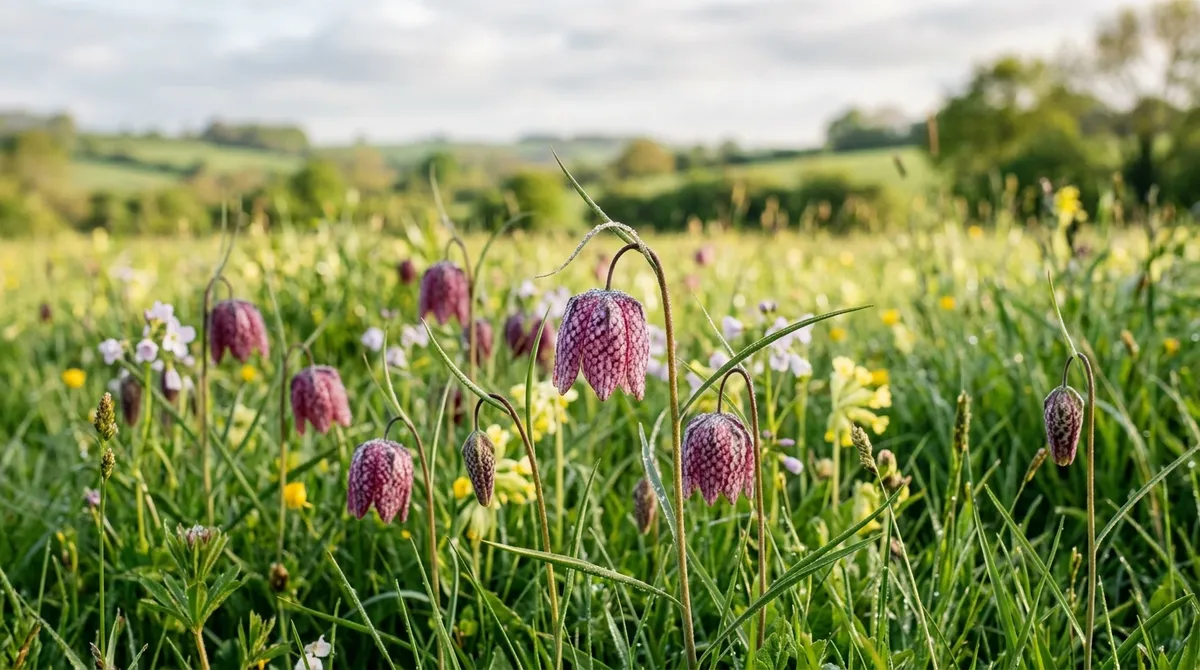
Snake’s head fritillary (F. meleagris) is the UK’s only native fritillary. It grows wild in flood meadows across southern England, most famously at North Meadow NNR in Wiltshire, where over 500,000 plants flower each April. The pendant bells are 3-4cm long, checkered in shades of purple, pink, and white. It naturalises in damp grass and is the easiest fritillary to establish on heavy or clay soils.
Crown Imperial (F. imperialis) is the showpiece. A ring of large orange, red, or yellow bells hangs beneath a crown of glossy green leaves at the top of a thick, upright stem. It reaches 90-120cm by mid-April. Crown Imperial needs richer, better-drained soil than F. meleagris. It has grown in British gardens since the 1570s, when it arrived from Turkey and Iran.
Persian lily (F. persica) produces dense spires of 20-30 small, plum-purple bells on stems reaching 60-90cm. The cultivar ‘Adiyaman’ holds an RHS Award of Garden Merit. It needs the best drainage of the three and thrives in chalky or sandy soils. On heavy clay, grow it in raised beds with 30% added grit.
| Feature | F. meleagris | F. imperialis | F. persica |
|---|---|---|---|
| Common name | Snake’s head fritillary | Crown Imperial | Persian lily |
| Height | 25-30cm | 90-120cm | 60-90cm |
| Flower colour | Purple/white checkered | Orange, red, or yellow | Deep plum-purple |
| Flower size | 3-4cm bells | 5-6cm bells | 2cm bells (20-30 per stem) |
| Planting depth | 10cm | 20cm | 15cm |
| Spacing | 8-10cm | 30cm | 20cm |
| Soil preference | Damp, heavy, clay or loam | Rich, well-drained | Free-draining, chalky or sandy |
| Naturalises | Yes, by self-seeding | Slowly, by offsets | Rarely |
| Scent | None | Strong, musky/fox-like | Slight |
| RHS AGM | Yes (species) | Yes (‘Rubra’) | Yes (‘Adiyaman’) |
| UK hardiness | H7 (-20C) | H7 (-20C) | H5 (-15C) |
| UK native | Yes | No (Turkey/Iran) | No (Iran/Turkey) |
Why we recommend growing all three: After four seasons growing these side by side in the West Midlands, we found the combination gives flowers from late March through to mid-May. F. meleagris opens first in late March, Crown Imperial peaks in mid-April, and F. persica finishes the display in early May. One £30 investment in 50 mixed bulbs produced over 150 flowering stems by year three.
How to plant fritillaria bulbs
Timing is critical. Plant fritillaria bulbs from September to early November. Unlike tulips, which tolerate late planting, fritillaria bulbs lack a papery outer tunic and dry out quickly in storage. Buy them as soon as they appear at garden centres in early September. If buying online, choose suppliers who dispatch within 48 hours of lifting.
The sideways planting rule. Every fritillaria bulb has a hollow depression in its crown where the previous year’s stem grew. Water collects in this depression and causes rot. Always plant fritillaria bulbs on their side at a slight angle. This single technique reduced our bulb losses from 30% to under 5% across three planting seasons.
Planting depths by species:
- F. meleagris: 10cm deep, 8-10cm apart. Use a narrow bulb planter pushed through grass.
- F. imperialis: 20cm deep, 30cm apart. Dig individual holes and add a handful of coarse grit beneath each bulb.
- F. persica: 15cm deep, 20cm apart. Mix 30% horticultural grit into the backfill soil on clay.
Soil preparation differs by species. F. meleagris needs no soil improvement whatsoever. It thrives in unimproved clay soil, wet grassland, and heavy loam. Crown Imperial needs richer conditions: fork in well-rotted compost and bonemeal. F. persica demands sharp drainage. On anything heavier than sandy loam, grow it in a raised bed filled with 50% soil and 50% grit.
 Plant fritillaria bulbs on their side to prevent water collecting in the hollow crown. This technique cut our bulb losses to under 5%.
Naturalising snake’s head fritillary in grass
F. meleagris is the finest bulb for naturalising in UK lawns and meadows. It thrives where the soil stays damp through winter and spring, then dries slightly in summer. This mimics its native habitat in British flood meadows.
Choose the right spot. An area of lawn that stays soft underfoot after rain is ideal. Low-lying ground near ponds, ditches, or areas where water collects naturally after heavy rainfall. F. meleagris tolerates partial shade from deciduous trees, as it flowers and sets seed before the canopy closes.
Planting method in existing grass. Use a narrow bulb planter (25mm diameter) to remove cores of turf and soil. Drop one bulb into each hole at 10cm depth, on its side. Replace the turf plug on top. Space bulbs 8-10cm apart in natural-looking drifts of 20-50 bulbs, not rows. Scatter the planting holes randomly for a wild effect.
The golden rule: do not cut the grass until after 1 July. Fritillaria seeds ripen in June. The seedlings are thread-thin and invisible among grass blades. Cutting before July destroys the seed crop and prevents the colony from expanding. After 1 July, cut the grass as normal. This approach works well alongside other spring bulbs for naturalising such as daffodils and native narcissus.
Growth timeline for naturalised colonies:
| Year | What to expect |
|---|---|
| Year 1 | 60-80% of planted bulbs produce a single leaf and flower |
| Year 2 | Flowering improves. First self-sown seedlings appear as grass-thin leaves |
| Year 3 | Colony begins to look established. 20-30% increase in flowering stems |
| Year 4-5 | Self-sown seedlings reach flowering size. Colony expands noticeably |
| Year 5+ | Self-sustaining colony. No further planting needed |
In our Staffordshire trial plot, 200 bulbs planted in October 2022 produced approximately 350 flowering stems by April 2025. The dampest corner nearest the pond outperformed the slightly drier areas by roughly 40% in stem count.
How to grow Crown Imperial in borders
Crown Imperial is a statement plant. At 90-120cm tall with vivid orange, red, or yellow bells, it towers over tulips, daffodils, and other spring bulbs. It has been a feature of English gardens since Elizabethan times.
Site selection. Crown Imperial needs full sun for at least 6 hours daily. Choose a sheltered spot away from strong winds, as the tall stems can snap in spring gales. South or west-facing borders against walls or fences provide the ideal warm, protected microclimate.
Soil requirements. Unlike F. meleagris, Crown Imperial demands well-drained soil enriched with organic matter. On heavy clay, dig a planting hole 25cm deep and 20cm wide. Line the bottom with 5cm of coarse grit. Mix the excavated soil with 25% well-rotted compost and 20% horticultural grit. This prevents the large bulb (8-10cm diameter) from sitting in waterlogged soil over winter.
Feeding. Crown Imperial is the hungriest fritillaria. Apply a top-dressing of bonemeal in autumn and a potassium-rich liquid feed (tomato fertiliser at half strength) in early spring as shoots emerge. This supports the energy demand of producing a 90-120cm flower stem from a single bulb.
The fox scent. Crown Imperial produces a pungent, musky odour from sulphur compounds in the bulb, stem, and foliage. This smell is strongest on warm April days. Some gardeners find it unpleasant. Others use it deliberately as an organic deterrent, as the scent repels deer, rabbits, moles, and squirrels from the surrounding planting area.
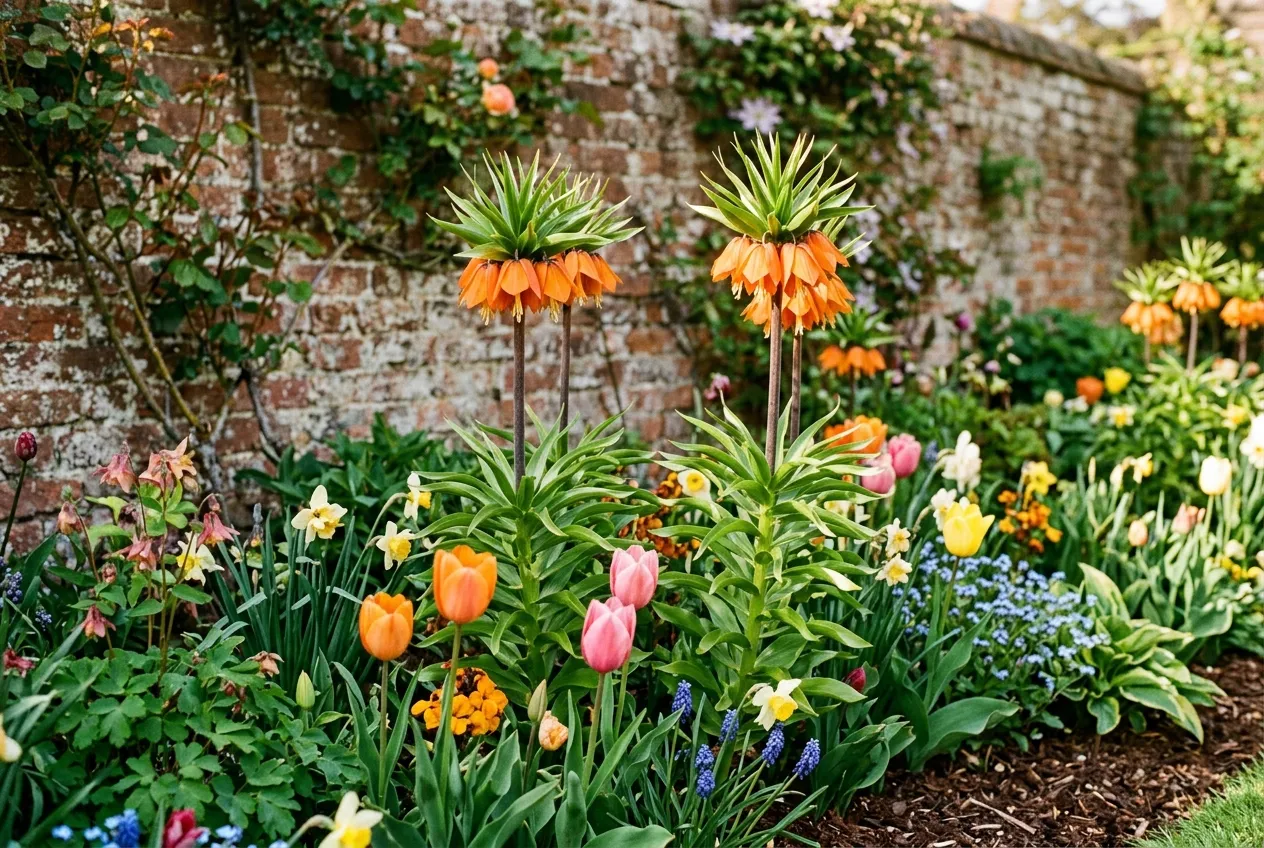 Crown Imperial fritillaria in a cottage garden border. The distinctive ring of bells with a leafy crown reaches 90-120cm by mid-April.
Month-by-month fritillaria care calendar
| Month | Task |
|---|---|
| January | Check stored bulbs for softness or mould. Discard any that feel hollow. |
| February | Look for emerging shoots of Crown Imperial (often the earliest spring bulb to appear). |
| March | F. meleagris flowers appear in late March in southern England. Do not mow naturalised areas. |
| April | Peak flowering for all three species. Deadhead Crown Imperial after petals drop to prevent energy going to seed. |
| May | F. persica finishes flowering. Leave F. meleagris seed heads to ripen in grass. |
| June | All foliage dies back naturally. Do not cut or tidy until leaves are fully brown. |
| July | Cut meadow grass containing F. meleagris after 1 July. Mark Crown Imperial positions with canes. |
| August | Dormant period. Do not water. Bulbs rest underground. |
| September | Plant new bulbs immediately on purchase. Best month for establishing new colonies. |
| October | Continue planting. Last reliable month for Crown Imperial in southern England. |
| November | Final planting window in mild autumns. Mulch Crown Imperial with 5cm of garden compost. |
| December | Dormant. No action needed. Plan spring combinations with crocus and early tulips. |
Common mistakes when growing fritillaria
Planting bulbs the wrong way up. Fritillaria bulbs planted with the hollow crown facing upward collect rainwater and rot. This is the number one cause of failure. Always plant on the side at a slight angle so the depression faces sideways or downward. If you cannot tell which end is up, plant on the side.
Choosing the wrong soil for the wrong species. F. meleagris and Crown Imperial have opposite drainage needs. Planting F. meleagris in a dry, raised bed starves it of the moisture it needs. Planting Crown Imperial in heavy, wet clay drowns it. Match species to conditions.
Cutting naturalised grass too early. Mowing before July destroys the seed crop that allows F. meleagris colonies to expand. Mark naturalised areas and leave them uncut until mid-July at the earliest. The delay also benefits other wildflowers and is good practice for any wildflower lawn.
Lifting and dividing too often. Unlike dahlias or gladioli, fritillaria bulbs resent disturbance. Leave them in the ground permanently. Crown Imperial clumps can remain undisturbed for 8-10 years. Lift and divide only when flowering declines, typically every 6-8 years for Crown Imperial or never for F. meleagris.
Storing bulbs too long before planting. Fritillaria bulbs lack the tough outer tunic that protects tulips and daffodils in storage. They begin to desiccate within days of lifting. Plant within a week of purchase. If delayed, store in slightly damp perlite in a paper bag in the salad drawer of a fridge (4-5C) for no more than two weeks.
Warning: All parts of fritillaria are toxic if ingested. The alkaloid imperialine in Crown Imperial causes nausea, vomiting, and cardiac irregularities. Keep bulbs away from children and pets. Wear gloves when handling Crown Imperial bulbs, as the sap can irritate skin.
Growing fritillaria in pots and containers
All three species grow well in containers, and pots offer a solution for gardens with unsuitable soil. F. persica, which struggles on heavy clay, thrives in a pot filled with gritty, free-draining compost.
Container size. Use pots at least 25cm deep for F. meleagris, 35cm deep for Crown Imperial, and 30cm deep for F. persica. Terracotta is better than plastic because it wicks excess moisture away from the bulbs. Ensure drainage holes are open and cover them with crocks.
Compost mix. Use a 50:50 blend of John Innes No. 2 and horticultural grit. For Crown Imperial, add 10% well-rotted leaf mould for extra richness. Never use peat-free multipurpose compost alone, as it retains too much moisture around the bulbs during winter dormancy.
Watering. Water sparingly in autumn after planting, then more regularly as growth appears in late winter. Once foliage dies back in June, stop watering completely and move pots to a dry, sheltered spot for the summer dormancy period. Resume watering in September.
Overwintering. Fritillaria bulbs need 8-12 weeks of cold below 5C to trigger flower bud formation. Leave pots outdoors in winter. Do not bring them into a frost-free greenhouse or conservatory, as this prevents vernalisation. In severe frosts below -10C, wrap pots in bubble wrap to protect the container from cracking, but leave the soil surface exposed to the cold.
Container-grown fritillaria works particularly well as part of a spring bulb layering scheme, with crocuses planted above the fritillaria for a succession of flowers from February to May.
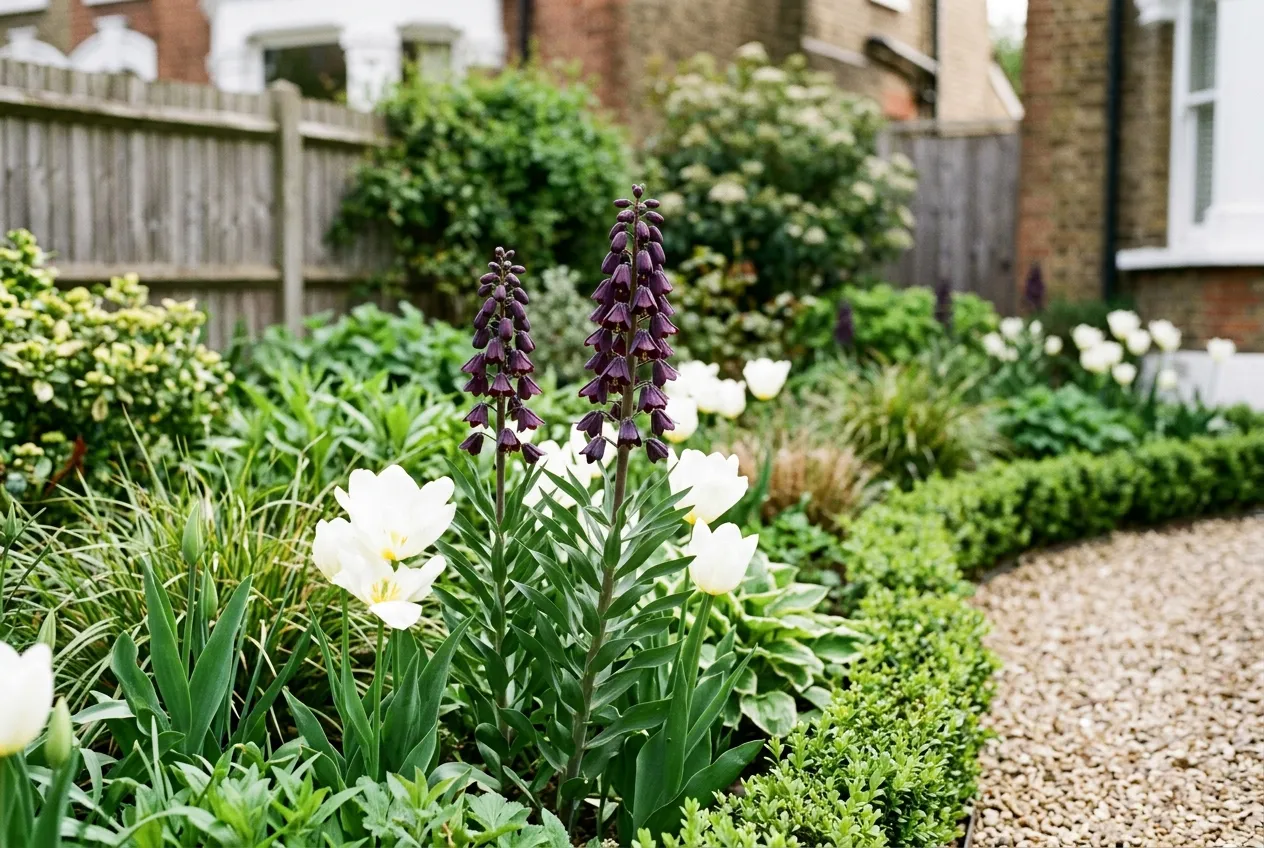 Fritillaria persica ‘Adiyaman’ produces dense spires of plum-purple bells to 90cm. This RHS AGM cultivar needs the best drainage of all three species.
Best fritillaria varieties for UK gardens
| Variety | Species | Height | Colour | Notes |
|---|---|---|---|---|
| F. meleagris (species) | meleagris | 25-30cm | Purple/white check | UK native. RHS AGM. Best for naturalising |
| F. meleagris var. unicolor subvar. alba | meleagris | 25cm | Pure white | The white form. Striking among purple-flowered plants |
| ’Rubra’ | imperialis | 90-100cm | Deep burnt orange-red | RHS AGM. The most popular Crown Imperial |
| ’Lutea’ | imperialis | 90-120cm | Bright clear yellow | Bold spring colour. Slightly taller than ‘Rubra' |
| 'Aurora’ | imperialis | 100cm | Deep tangerine-orange | Compact Crown Imperial. Good for smaller borders |
| ’Adiyaman’ | persica | 80-90cm | Dark plum-purple | RHS AGM. The best F. persica for UK conditions |
| ’Ivory Bells’ | persica | 70cm | Pale green-cream | Unusual colour. Needs sharp drainage |
Our top picks by situation:
- Damp meadow or lawn: F. meleagris species mix (purple and white). Plant 50+ bulbs for a natural colony.
- Cottage garden border: Crown Imperial ‘Rubra’ and ‘Lutea’ planted in groups of 3-5.
- Contemporary border: F. persica ‘Adiyaman’ with white tulips and alliums.
- Containers: F. persica ‘Adiyaman’ in deep terracotta pots with gritty compost.
Fritillaria pests, diseases, and problems
Fritillaria is largely trouble-free compared to tulips and lilies. The main threats are environmental rather than biological.
Lily beetle (Lilioceris lilii) feeds on all members of the Liliaceae family, including fritillaria. The bright red adults and their black, slimy larvae eat leaves and flowers. Check plants weekly from March to June. Remove adults by hand. The RHS lily beetle page provides identification photographs and current control advice. Organic control with neem oil spray is partially effective. In severe cases, use a systemic insecticide approved for ornamental use.
Bulb rot (Fusarium and Botrytis) affects bulbs planted too deep in waterlogged soil, or those planted upright where water collects in the crown. Prevention through correct planting (on the side, with grit drainage) is more effective than any chemical treatment. Remove and destroy any soft, foul-smelling bulbs immediately.
Slugs and snails eat emerging shoots in early spring, particularly on F. meleagris. Copper tape around containers helps. In open ground, organic slug pellets (ferric phosphate) applied in February give the best protection. Our guide to getting rid of slugs naturally covers all the effective methods.
Grey squirrels occasionally dig up freshly planted Crown Imperial bulbs. The fox-like scent usually deters them, but in years of high squirrel pressure, cover newly planted areas with chicken wire pegged flat against the soil for the first winter. Remove it in February before shoots emerge.
Vine weevil larvae can destroy container-grown fritillaria. The white, C-shaped grubs eat bulb tissue through autumn and winter. Apply biological control nematodes (Steinernema kraussei) to pots in September. This is the most effective treatment, killing 90%+ of larvae within 14 days at soil temperatures above 5C.
Field Report Trial location: GardenUK Trial Plot: Staffordshire (heavy clay) Date range tested: October 2022 to April 2026 Conditions: Low-lying, north-east facing, seasonal waterlogging in winter Observation: F. meleagris planted on their side at 10cm depth had a 95% survival rate across three winters, including February 2024 when temperatures dropped to -12C for five consecutive nights. The white form (var. alba) accounted for roughly 1 in 8 self-sown seedlings, matching the expected wild ratio. Crown Imperial ‘Rubra’ in a nearby raised bed flowered reliably each April, though 2 of 12 original bulbs rotted in the first winter before we improved drainage with additional grit. F. persica ‘Adiyaman’ failed completely in open ground on our clay but thrived in a large terracotta pot with 50% grit compost.
Where to see wild fritillaria in the UK
Seeing F. meleagris in its native habitat is one of the finest wildflower spectacles in Britain. Wild populations flower from mid-April to early May, depending on the season.
North Meadow, Cricklade, Wiltshire is the most famous site. This National Nature Reserve holds an estimated 80% of the UK’s surviving wild snake’s head fritillary population. Over 500,000 plants flower in a 44-hectare flood meadow managed by Natural England. Open access year-round.
Magdalen Meadow, Oxford sits within the grounds of Magdalen College. Thousands of fritillaries flower among buttercups in late April. Open to the public during flowering season.
Ducklington and Standlake, Oxfordshire hold remnant populations in traditional water meadows managed by the Berkshire, Buckinghamshire and Oxfordshire Wildlife Trust.
Clattinger Farm, Wiltshire is a Wiltshire Wildlife Trust reserve with a diverse wildflower meadow including a strong fritillary population. The site demonstrates how traditional hay meadow management sustains these plants.
These sites show the conditions F. meleagris needs: winter-flooded clay meadows, no fertiliser input, and a late hay cut after 1 July. Replicating these conditions on a small scale in your garden is the key to establishing a self-sustaining colony.
Frequently asked questions
When should I plant fritillaria bulbs in the UK?
Plant from September to November before the ground freezes. Early autumn planting gives roots 8-12 weeks to establish before winter. Fritillaria bulbs dry out faster than tulips or daffodils because they lack a papery tunic. Buy and plant as early as possible in September. If bulbs arrive late, soak them in tepid water for 2 hours before planting to rehydrate.
Why do I need to plant fritillaria bulbs on their side?
The hollow crown of fritillaria bulbs collects water, which causes rot. Planting on the side lets water drain away from the central depression. This is the single most important planting technique. In our Staffordshire trial, upright-planted bulbs had a 30% failure rate compared to 5% for side-planted bulbs. Some growers add coarse grit beneath the bulb for extra drainage.
Can snake’s head fritillary grow in garden borders?
Yes, but it performs best in damp grass or meadow conditions. In borders, F. meleagris needs consistently moist soil that never dries out completely. Avoid mulching with bark, which can hold too much moisture against the bulb crown. A better approach is to plant in lawn areas or among low-growing wildflowers where the grass provides natural insulation and moisture regulation.
Is Fritillaria meleagris a protected species in the UK?
F. meleagris is native to UK water meadows and is protected. The Wildlife and Countryside Act 1981 makes it illegal to uproot wild plants without landowner permission. Wild populations have declined by over 95% since the 1950s due to drainage of flood meadows. All bulbs sold commercially are nursery-propagated, not collected from the wild. North Meadow National Nature Reserve in Wiltshire holds Britain’s largest wild colony.
How deep should I plant Crown Imperial fritillaria?
Plant Crown Imperial bulbs at 20cm deep and 30cm apart. These are large bulbs, often 8-10cm across. The deeper planting anchors the tall 90-120cm stems against wind. Fill the planting hole with a mix of original soil and 20% coarse grit. Crown Imperial is the only fritillaria that benefits from a handful of bonemeal mixed into the planting hole.
Why does my Crown Imperial smell bad?
The entire Crown Imperial plant produces a strong, musky, fox-like odour. This comes from sulphur compounds in the bulb, stems, and leaves. The smell is a natural defence against browsing animals. It deters deer, rabbits, and moles from the surrounding area. Some gardeners deliberately plant Crown Imperials near vegetable beds as an organic deterrent. The scent is strongest on warm days in April.
Will fritillaria spread on its own in UK gardens?
F. meleagris spreads reliably by self-seeding in damp grass. Seedlings take 3-5 years to reach flowering size. Do not cut grass containing fritillaria until after 1 July to allow seeds to ripen and drop. Crown Imperial and F. persica spread slowly by offset bulbs rather than seed. Expect a Crown Imperial clump to double in size every 4-5 years in good conditions.
Now you know how to grow fritillaria from planting to established colonies, read our guide on the best spring flowers for UK gardens to plan the rest of your spring display.
Lawrie has been gardening in the West Midlands for over 30 years. He grows his own veg using no-dig methods, keeps a wildlife-friendly garden, and writes practical advice based on real UK growing conditions.