How to Grow Alliums in the UK
Plant ornamental alliums October-November in full sun, 3x bulb depth. Hardy to -15°C, flowers May-July, seedheads last all winter. Expert UK growing guide.
Key takeaways
- Plant allium bulbs October to November, at a depth three times the bulb's diameter
- Full sun and well-drained soil are essential — alliums rot in waterlogged ground
- Hardy to -15°C, so no lifting or winter protection is needed in UK gardens
- Flowers appear May to July depending on variety, with seedheads lasting through winter
- Plant among low perennials to hide the leaves, which die back while the plant is still in flower
- Bulbs naturalise and multiply over years, improving the display without any effort
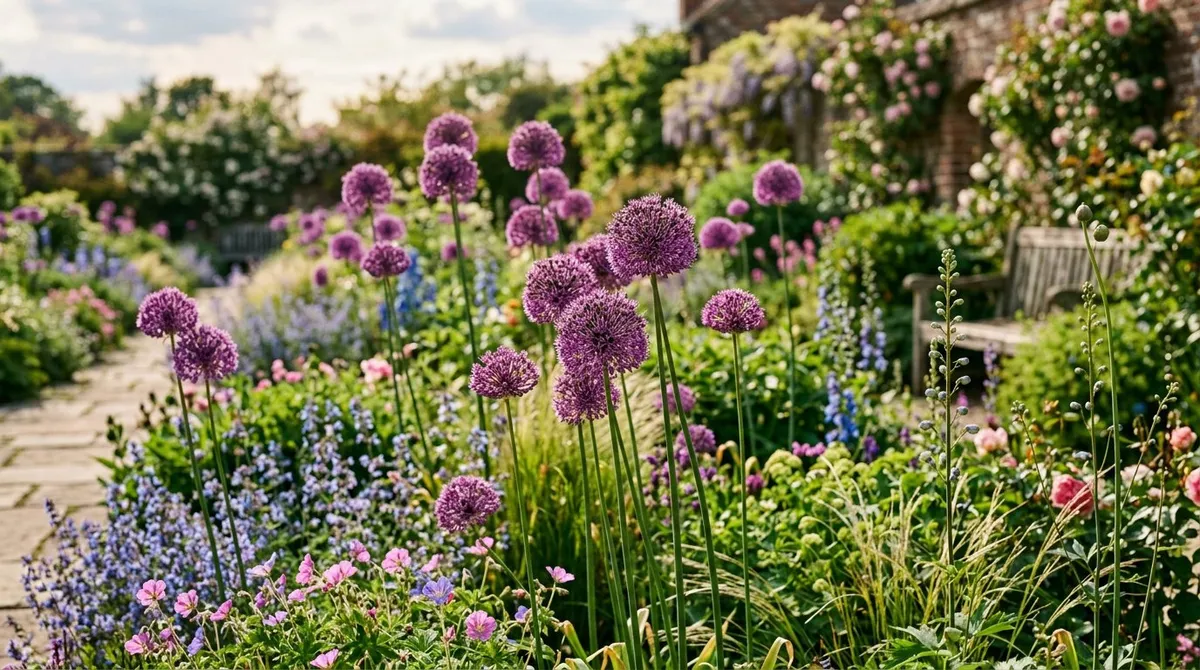
Ornamental alliums are one of the most reliable and architecturally striking bulbs you can plant in a UK garden. Unlike their edible cousins, onions, garlic, chives, these are grown purely for their flowers: perfect spheres in shades of purple, white, and pink that stand tall above the border from May into July. They look particularly strong when paired with other spring bulbs. If you already grow tulips or daffodils, alliums extend your colour season into early summer without any extra effort.
What makes alliums exceptional is how little they ask in return. Plant them once in autumn, leave them alone, and they come back stronger every year. The bulbs are hardy to -15°C, naturalise freely, and resist slugs, rabbits, and most pests. Even the faded seedheads earn their keep, standing through autumn and winter as elegant skeletal structures. This guide covers everything you need: choosing varieties, timing, planting depth, dealing with dying foliage, and where alliums work hardest in the garden. See our guide on when to plant spring bulbs in the UK for the full autumn planting calendar.
Which allium varieties are best for UK gardens?
The ornamental allium family is large, but a handful of varieties dominate UK gardens for good reason. Here are the most reliable performers.
Purple Sensation is the most widely grown ornamental allium in Britain. It reaches 90cm with deep violet-purple globes around 8cm across, flowering in late May. It holds the RHS Award of Garden Merit and naturalises well. This is the variety to choose if you want maximum impact with minimum fuss.
Globemaster produces the largest flower heads of any reliably hardy allium, up to 20cm across on stems reaching 1m tall. It flowers in June, later than most, extending the season. Like Purple Sensation, it carries the RHS Award of Garden Merit. The heads are deep violet-purple and look spectacular among blue and silver-leaved plants.
Allium christophii (Persian onion) grows just 50cm tall but carries enormous starry flower heads up to 20cm across. The individual florets are silver-purple and the dried seedheads are the finest of any allium for winter interest, holding their shape well into January. Excellent for the front of a border.
Allium sphaerocephalon (drumstick allium) is the garden designer’s favourite for meadow planting and naturalistic borders. The egg-shaped heads, around 5cm, open deep burgundy-purple in late June and July. At 60cm, they thread elegantly through grasses and perennials. The latest-flowering hardy allium, bridging the gap into high summer.
Allium giganteum is the tallest ornamental allium, with stems reaching 1.5m topped by 10cm bright purple globes in June. Spectacular in large borders and at the back of beds. Plant in groups of five or seven for impact.
Mount Everest is the best white allium for UK conditions. It grows to 1m with clean white 8cm globes in late May and early June. Excellent with blue delphiniums or as a neutral contrast in mixed plantings.
Ornamental allium variety comparison
| Variety | Height | Flower head | Colour | Flowering time | Best use |
|---|---|---|---|---|---|
| Purple Sensation | 90cm | 8cm | Deep violet | Late May | Borders, pots |
| Globemaster | 1m | 20cm | Violet-purple | June | Feature plant, borders |
| A. christophii | 50cm | 20cm | Silver-purple | May–June | Front of border, drying |
| A. sphaerocephalon | 60cm | 5cm (oval) | Burgundy | June–July | Meadow, threading through grass |
| A. giganteum | 1.5m | 10cm | Bright purple | June | Back of large border |
| Mount Everest | 1m | 8cm | White | Late May–June | Mixed borders, contrast |
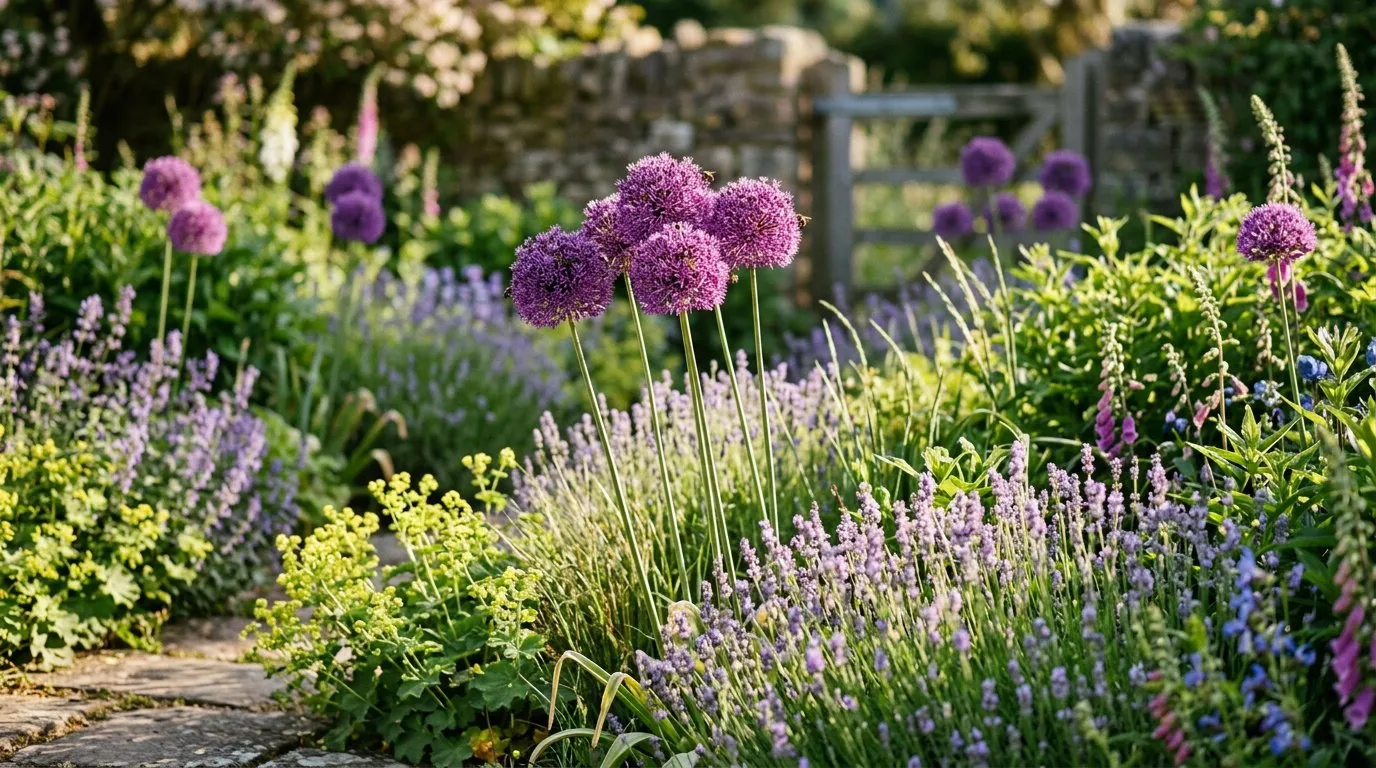
Allium Purple Sensation flowering alongside lavender in a cottage garden border, the most widely grown ornamental allium in Britain.
When to plant allium bulbs
Plant allium bulbs from mid-October to November. This is the same window as tulips and most other autumn bulbs. The soil needs to be workable, not waterlogged, not frozen, and ideally still has some warmth left to encourage root establishment before winter shuts things down.
Unlike tulips, there is no disease reason to delay allium planting. Plant them as soon as bulbs arrive in October and they will establish well. November planting works too. Avoid leaving bulbs in a shed beyond the end of November; they begin to deteriorate without soil moisture.
For a sequence of flowering that runs from May through July, mix your varieties deliberately. Plant Purple Sensation and A. christophii for May colour, Globemaster and A. giganteum for June, and finish with A. sphaerocephalon for late June into July. This gives you ten weeks of allium flowers from a single planting session in autumn. Our spring gardening jobs guide includes reminders for what to do in the garden as your alliums start to emerge.
Allium month-by-month growing calendar
| Month | Task |
|---|---|
| September | Buy bulbs early, best varieties sell out quickly |
| October | Plant bulbs at 3x depth in free-draining soil, full sun |
| November | Finish planting; apply light mulch on very cold sites |
| December–February | No action needed; bulbs dormant underground |
| March | First shoots emerge; check for slug damage on very early varieties |
| April | Stems extend rapidly; stake A. giganteum in exposed positions |
| May | Purple Sensation and A. christophii flower; deadhead if seeds unwanted |
| June | Globemaster and A. giganteum flower; A. sphaerocephalon opens |
| July | A. sphaerocephalon at peak; leave seedheads on all varieties |
| August | Foliage fully died back; mark clump positions if planning to divide |
| September | Divide and replant congested clumps if needed; order fresh bulbs |
How to plant allium bulbs correctly
Alliums have three firm requirements: full sun, well-drained soil, and correct planting depth. Everything else, soil type, fertility, spacing, is secondary.
Depth: Plant at a depth three times the diameter of the bulb. A standard Purple Sensation bulb is roughly 5cm across, so plant it 15cm deep measured from the base. Larger bulbs like Globemaster (8-10cm diameter) go in at 24-30cm deep. This depth anchors tall stems and protects bulbs from the worst frosts.
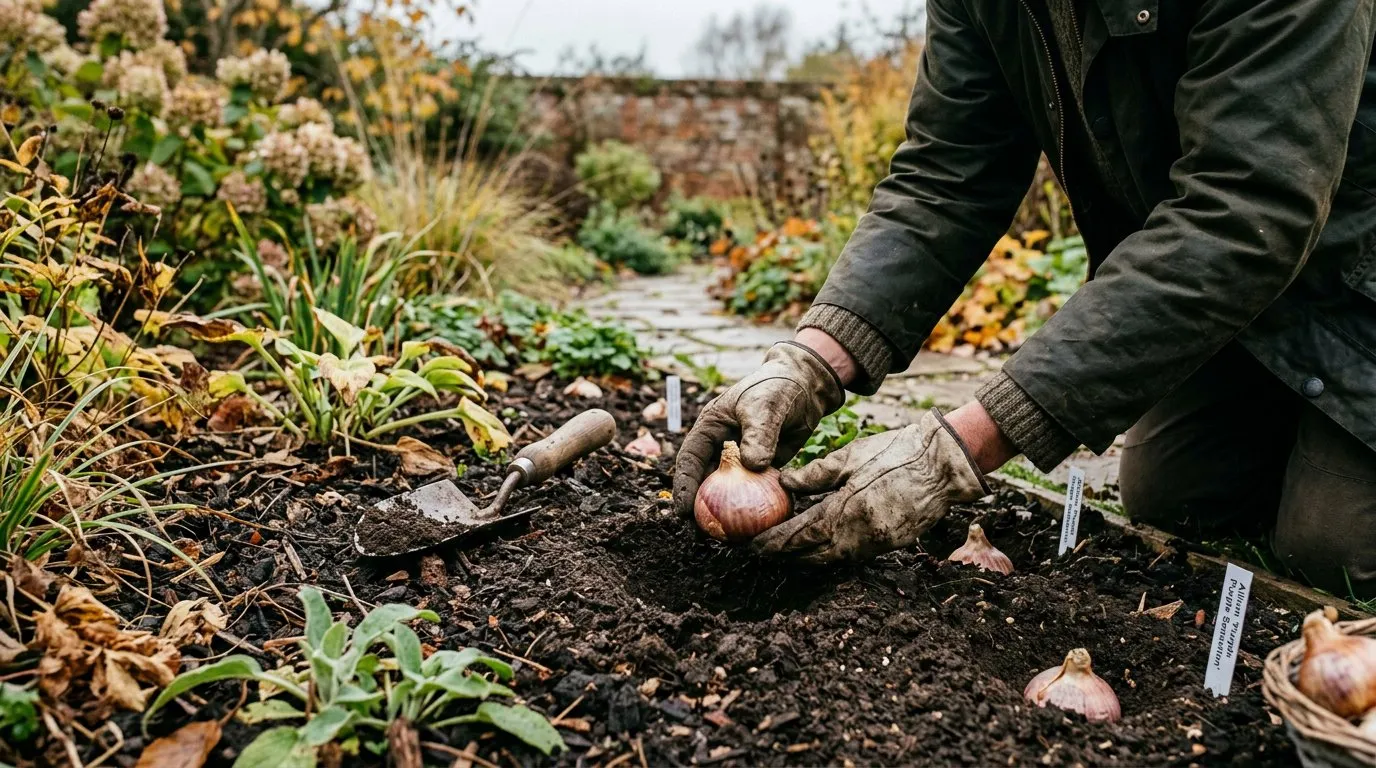
Planting allium bulbs in October, set each bulb at a depth three times its diameter in well-drained soil.
Spacing: Space bulbs 15-20cm apart for a naturalistic, drifted effect. Closer spacing of 10cm works for block plantings but bulbs will need dividing sooner. Avoid planting in straight rows; odd-numbered irregular groups of five, seven, or nine look far more natural.
Drainage: Alliums rot in waterlogged soil. If your ground holds water over winter, plant in raised beds or add a generous handful of grit to each planting hole. On heavy clay, planting on a slight slope helps water drain away from bulbs.
Companions: The biggest challenge with alliums is their foliage. Leaves emerge in spring looking attractive, but start to yellow and die back as the flower stalk extends, while the plant is still technically in bloom. The solution is to plant alliums among low perennials that grow to fill the base: catmint (Nepeta), hardy geraniums, Salvia nemorosa, or low ornamental grasses all work. By the time allium foliage looks untidy in May and June, neighbouring plants have grown to cover it. This also works well as part of a cottage garden planting plan.
Alliums also support beneficial insects. Their flowers provide accessible pollen and nectar for bumblebees and hoverflies, making them a natural complement to other bee-friendly garden plants.
Why we recommend Purple Sensation as the first allium for any UK garden: After 30 years of trialling ornamental bulbs across different soil types and climates, Purple Sensation consistently outperforms every other allium variety for reliability and impact. It returns and multiplies every year without any lifting or intervention, and by the fifth year a group of five bulbs expands to 20 or more. The 8cm heads hold up in wind and rain better than the larger but more fragile Globemaster.
How to care for alliums after planting
Once planted, alliums need almost nothing.
Watering: Water once after planting to settle the soil. After that, established allium bulbs in open ground rarely need watering unless you are in an unusually dry spell in spring. The Royal Horticultural Society confirms that overwatering is a more common cause of allium failure than drought.
Feeding: On poor soils, a light application of balanced granular fertiliser in spring as leaves emerge improves flower size. On reasonable garden soil, no feeding is required. Never feed with high-nitrogen fertiliser, it produces lush foliage at the expense of flowers.
Deadheading: Optional. Removing spent flowers before seeds set prevents self-seeding (some varieties seed prolifically) and encourages bulbs to put energy into building the daughter bulbs that expand your clump. If you want seedheads for winter interest or drying, and the seedheads of A. christophii and Globemaster are worth keeping, leave everything in place.
Lifting: Do not lift alliums. They are fully hardy, need no winter protection in the UK, and actively benefit from being left undisturbed. Bulbs multiply naturally over three to five years, turning a group of five bulbs into a clump of twenty or more. Divide congested clumps in September if flowering quality drops.
Alliums as seedheads and winter structure
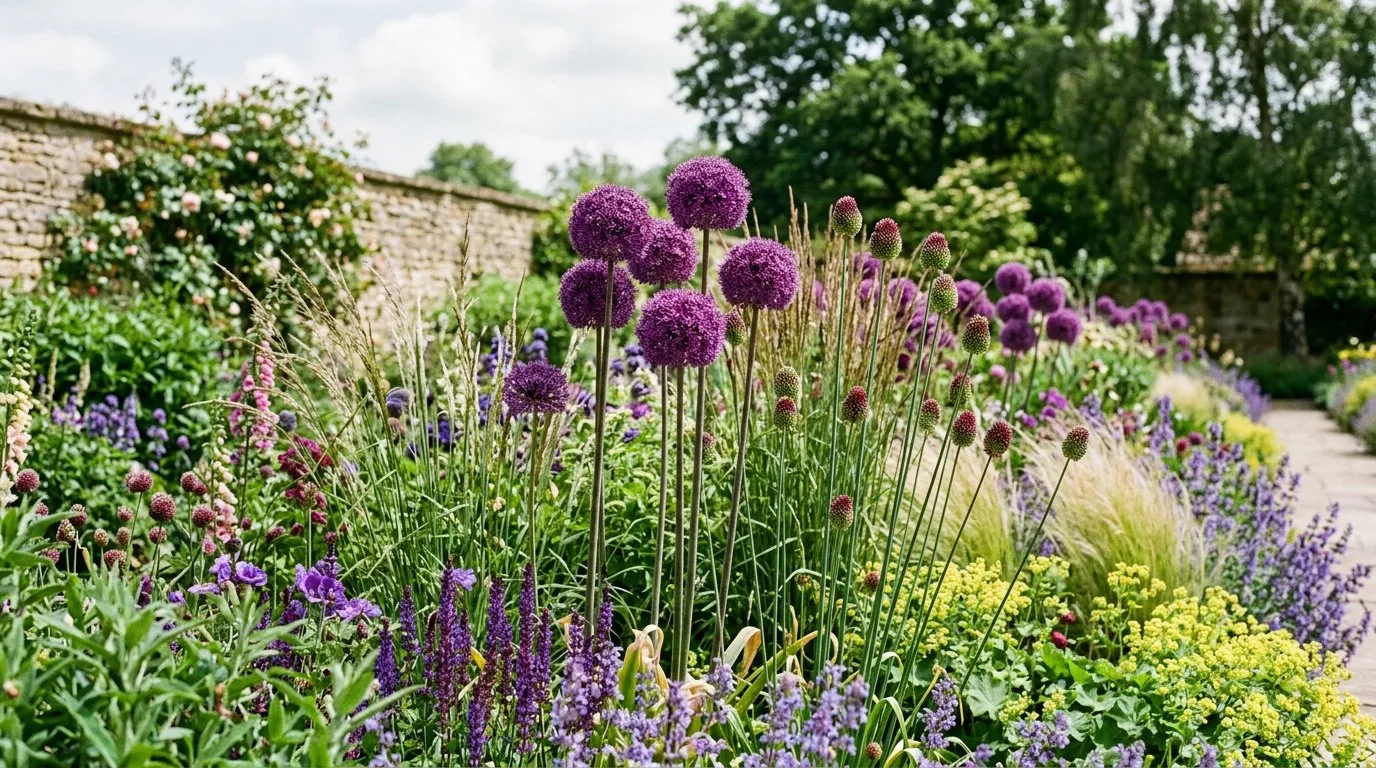
Tall allium Globemaster globes and drumstick allium heads threading through ornamental grasses and perennials in a mixed UK border.
Alliums are unusual among border bulbs in offering genuine year-round value. After flowering, the spherical seedheads dry in place on their stems, turning from green to a warm parchment-brown as summer progresses. On A. christophii, individual seed capsules swell into attractive star-shaped structures. Globemaster heads retain their globe shape well into November.
Leave seedheads standing. They catch frost and low winter light, and they provide seed for finches and other small birds. In a well-designed border, allium skeletons create structure after the main flowering season ends. Cut them down in early March, just before new growth starts, or leave them in place and let the new season’s shoots push through the base.
For more on attracting wildlife through your planting choices, see our guide to companion planting, which covers which combinations work best for pollinators and pest control together.
What can go wrong with alliums?
Alliums have very few problems. They are genuinely one of the most trouble-free bulbs you can grow in the UK.
Bulb rot is the main failure point, and it is almost always caused by waterlogged soil. If bulbs fail to appear in spring, dig down and check, rotted bulbs will be soft and dark. The fix is better drainage: add grit, raise the bed, or move to a sunnier, better-draining position.
Allium leaf miner is a relatively new pest in UK gardens, more common in the north of England. The fly lays eggs in the leaves in spring, with maggots tunnelling through the foliage. Ornamental alliums are less severely affected than edible crops like leeks and onions, but damage can be disfiguring. Cover emerging plants with insect mesh in March if you have had problems.
White rot (Stromatinia cepivora) is a soil-borne fungal disease that can persist for 20 years. If you grow edible alliums (onions, garlic, leeks) and have had white rot problems, avoid planting ornamental alliums in the same area. Our guide to growing onions covers white rot identification and management for edible crops.
Self-seeding can be prolific with some varieties, particularly A. sphaerocephalon and A. christophii. Seedlings take three to five years to reach flowering size. If you do not want them spreading, deadhead before seeds ripen.
Now you’ve mastered alliums, read our guide on when to plant spring bulbs in the UK for the complete autumn planting calendar covering all bulbs in one place.
Frequently asked questions
When should I plant allium bulbs in the UK?
Plant allium bulbs from October to November, before the first hard frosts. This gives roots time to establish before winter. October planting is ideal in most of the UK. In mild southern areas, November works equally well. Avoid planting when the ground is waterlogged or frozen.
How deep should I plant allium bulbs?
Plant allium bulbs at a depth three times the bulb’s diameter. A 5cm bulb goes in at 15cm deep; a 7cm bulb at 21cm. Deeper planting helps bulbs stay anchored, tall varieties like A. giganteum (1.5m) fall over if planted too shallow. Always measure from the base of the hole to the top of the bulb.
Do alliums come back every year?
Yes, alliums are reliably perennial in UK gardens. Bulbs are hardy to -15°C and need no lifting. Most varieties naturalise freely, with daughter bulbs forming each year so the clump gradually expands. Purple Sensation and Christophii are particularly good at multiplying. Leave bulbs undisturbed for the best long-term displays.
Why do allium leaves die back while the plant is still flowering?
Allium leaves start to yellow and die back as the flower stalks extend, this is normal and not a sign of disease. The plant directs all its energy into the flower head. To hide untidy foliage, plant alliums among mid-height perennials such as catmint, hardy geraniums, or salvia, which fill in around the base as flowering begins.
Can I grow alliums in pots?
Yes, compact varieties such as Allium sphaerocephalon and A. christophii grow well in pots. Use a pot at least 30cm deep with drainage holes and a mix of two parts multipurpose compost to one part grit. Plant bulbs 15cm deep, water once after planting, and move to a sunny spot in spring. Feed with a liquid potassium-rich fertiliser as buds form.
Which alliums are best for cutting and drying?
Allium christophii, Globemaster, and Purple Sensation all make excellent cut flowers, lasting 1-2 weeks in a vase. For dried seedheads, cut stems when the seed capsules are fully formed but still green-brown. Hang upside down in a dry, airy shed for two to three weeks. Dried allium heads keep their shape for 12 months or more.
Do alliums attract pollinators?
Alliums are among the best pollinator plants in the summer garden. The flower heads attract bumblebees, honeybees, hoverflies, and butterflies. Varieties flowering in June and July, such as Allium sphaerocephalon, are especially valuable because they bridge the gap between spring and summer flowers when other food sources are scarcer.
Related articles:
Lawrie has been gardening in the West Midlands for over 30 years. He grows his own veg using no-dig methods, keeps a wildlife-friendly garden, and writes practical advice based on real UK growing conditions.