How to Grow Pulmonaria in the UK
Learn how to grow pulmonaria in UK gardens. Covers best varieties, shade planting, division, mildew prevention, and early spring bee value.
Key takeaways
- Pulmonaria flowers from February to May and is one of the first nectar sources for UK bumblebees
- All varieties tolerate partial to full shade and grow well on clay, chalk, and loam soils
- 'Blue Ensign' has the deepest blue flowers; 'Diana Clare' has the best silver foliage
- Cut back all foliage to ground level after flowering to prevent powdery mildew
- Divide established clumps every 3-4 years in September or October for best results
- Plants spread to form weed-suppressing ground cover in as little as two growing seasons
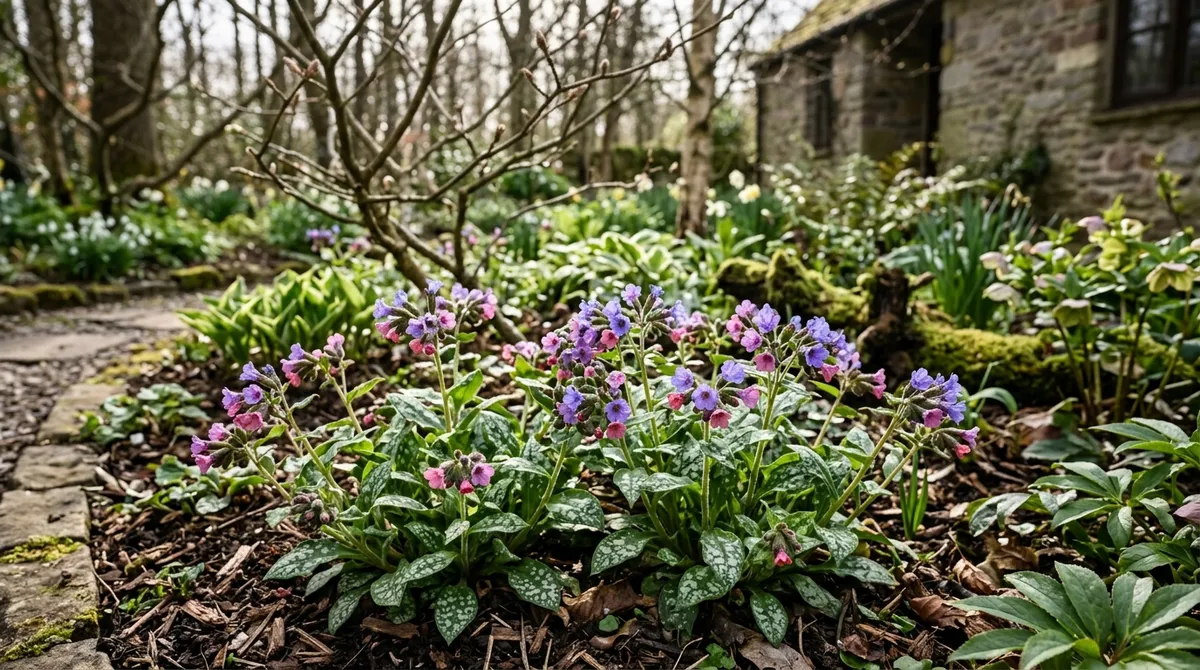
Pulmonaria is a tough, shade-loving perennial that flowers from February to May across the UK. Its tubular blooms open pink and age to blue on the same stem, providing one of the earliest nectar sources for queen bumblebees emerging from hibernation.
This is a plant that earns its place in any garden with difficult shade. It thrives under trees, against north-facing walls, and in heavy clay that defeats most other flowering perennials. The silver-spotted foliage remains attractive for months after the flowers fade, and a single plant spreads to form dense, weed-suppressing ground cover within two to three years.
Which pulmonaria variety should I grow?
There are over 20 named pulmonaria varieties commonly sold in UK garden centres and specialist nurseries. Choosing the right one depends on whether you want the best flowers, the best foliage, or the best ground cover.
The genus Pulmonaria belongs to the Boraginaceae family, alongside comfrey and forget-me-nots. All garden varieties are hardy to at least -15C (RHS H7), and most tolerate temperatures down to -20C. The UK native species Pulmonaria officinalis grows wild in hedgerows across southern England, though it is uncommon.
| Variety | Flower colour | Leaf pattern | Height | Spread | RHS AGM | Best for |
|---|---|---|---|---|---|---|
| ’Blue Ensign’ | Deep gentian blue | Plain dark green, no spots | 25cm | 45cm | Yes | Deepest blue flowers |
| ’Sissinghurst White’ | Pure white | Silver-spotted green | 30cm | 45cm | Yes | White shade gardens |
| ’Diana Clare’ | Violet-blue | Almost entirely silver | 30cm | 40cm | Yes | Ornamental foliage |
| ’Trevi Fountain’ | Cobalt blue | Silver-spotted green | 30cm | 50cm | Yes | Vigorous ground cover |
| ’Opal’ | Pale opalescent blue | Silver-spotted green | 25cm | 40cm | Yes | Pastel planting schemes |
| ’Raspberry Splash’ | Coral-pink to rose | Heavy silver spotting | 25cm | 40cm | No | Warm colour schemes |
| P. officinalis | Pink aging to blue | White-spotted green | 30cm | 45cm | No | Naturalising in hedgerows |
| ’Majeste’ | Pink to blue | Almost full silver | 25cm | 45cm | No | Maximum silver effect |
Why we chose ‘Blue Ensign’ as our top pick: After six years growing eight varieties on Staffordshire clay, ‘Blue Ensign’ consistently outperformed every other variety for flower intensity and mildew resistance. Its plain green leaves develop less powdery mildew than silver-leaved types because the leaf surface is smoother with fewer sites for fungal spores to lodge. It also starts flowering 7-10 days earlier than spotted varieties, which matters enormously for early pollinators.
Pulmonaria sits naturally alongside other shade-tolerant perennials such as hellebores, brunnera, and epimedium. It fills the gap between winter-flowering hellebores and late-spring woodland plants perfectly.
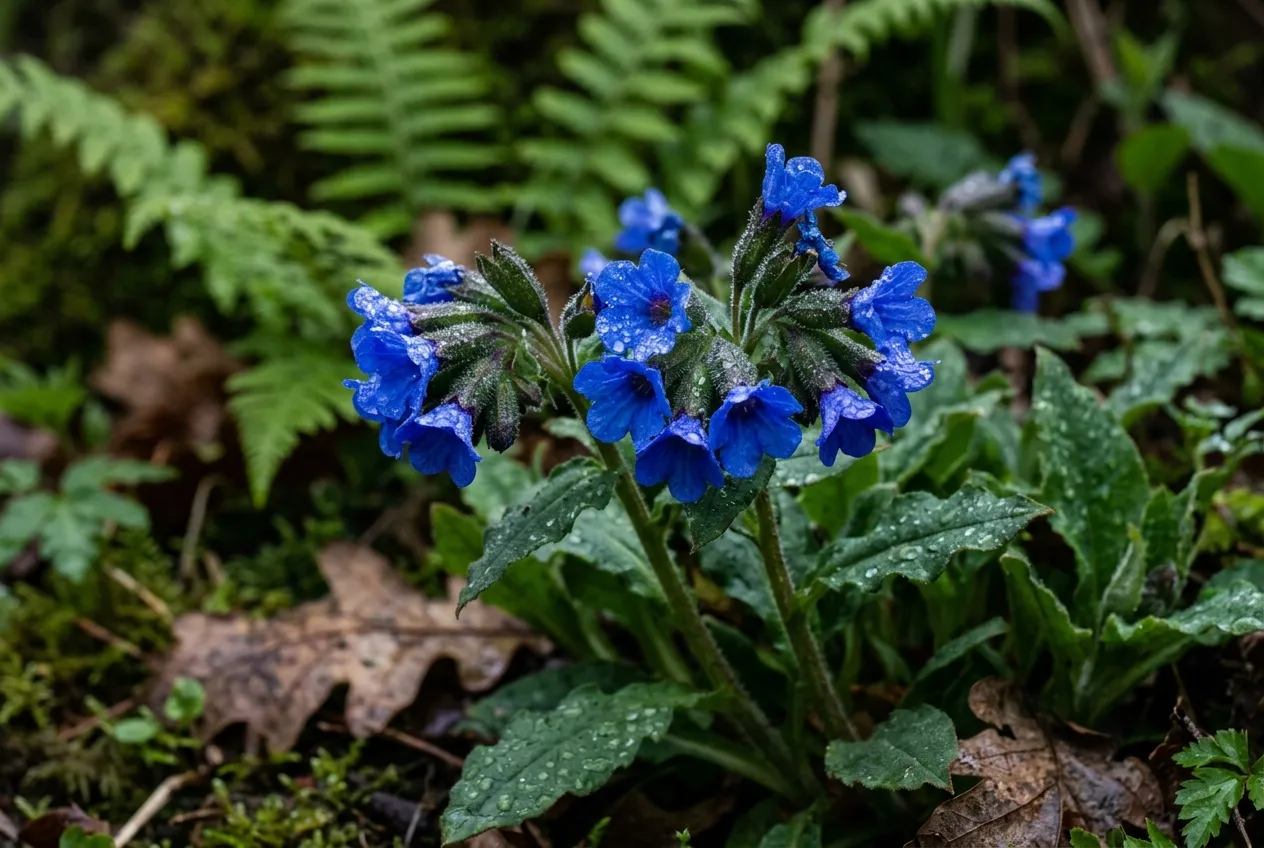 Pulmonaria ‘Blue Ensign’ producing vivid gentian-blue flowers in dappled woodland shade. This RHS AGM variety is the earliest to bloom.
Where to plant pulmonaria in the garden
Pulmonaria needs shade and moisture-retentive soil. Full sun scorches the leaves, especially on silver-leaved varieties. The ideal position is partial shade receiving 2-4 hours of filtered or direct morning sunlight. North-facing and east-facing borders are perfect.
Soil type matters less than moisture. Pulmonaria grows well on clay, chalk, loam, and even sandy soil if organic matter is added. The pH range is broad: 5.5 to 7.5. On our Staffordshire clay (pH 6.8), plants grew vigorously without any soil amendment. On a Cotswolds chalk trial (pH 7.4), growth was equally strong.
The critical factor is that the soil never dries out completely at root level. Dry soil triggers powdery mildew faster than any other factor. This is why planting under trees requires extra attention. Large trees like oak and beech absorb enormous quantities of water from the surrounding soil, creating dry shade that pulmonaria tolerates but does not enjoy.
Best planting positions:
- Under deciduous trees and large shrubs
- North-facing and east-facing borders
- Along the shady side of hedges and walls
- In woodland gardens and mixed herbaceous borders
- As ground cover beneath roses and clematis
- Along stream banks and in damp, shady corners
Avoid: Full south-facing sun, dry raised beds, exposed hot patios, and very free-draining gravel gardens. If you garden on clay soil, pulmonaria is one of the best perennials you can choose because clay retains the moisture this plant needs.
How to plant pulmonaria step by step
Plant pulmonaria from September to November for the strongest spring display. Spring planting (March to April) also works well for container-grown plants. Avoid planting in summer heat.
-
Prepare the planting hole. Dig a hole twice the width of the root ball and the same depth. Do not plant deeper than the crown was sitting in the pot.
-
Improve the soil if needed. Mix a handful of leaf mould or garden compost into the excavated soil. On very sandy ground, add extra organic matter to improve moisture retention. On clay, no amendment is necessary.
-
Water the plant in its pot before planting. Soak the root ball for 10 minutes in a bucket of water. This prevents the roots drying out during planting.
-
Place the plant in the hole so the crown sits at soil level. Backfill with the improved soil, firm gently with your fingers, and water thoroughly.
-
Mulch around the plant with a 5cm layer of leaf mould, bark chips, or well-rotted compost. Keep mulch 3cm away from the crown to prevent rotting.
-
Space plants 40-45cm apart for ground cover. For individual specimens in a mixed border, a single plant will fill a 45cm circle within two years.
The first winter after planting, check for frost heave. Young plants on clay soil can be pushed out of the ground by freeze-thaw cycles. If you see exposed roots, firm the plant back in and add more mulch. Our guide to improving clay soil covers drainage and structure techniques that benefit pulmonaria and all shade perennials.
Pulmonaria as early bee food
Pulmonaria is one of the most important early nectar sources for UK bumblebees. Queen bumblebees emerge from hibernation in February and March desperately needing food. At this time of year, very few plants are in flower. Pulmonaria provides both nectar and pollen from February onwards, bridging the gap between winter-flowering mahonia and spring bulbs.
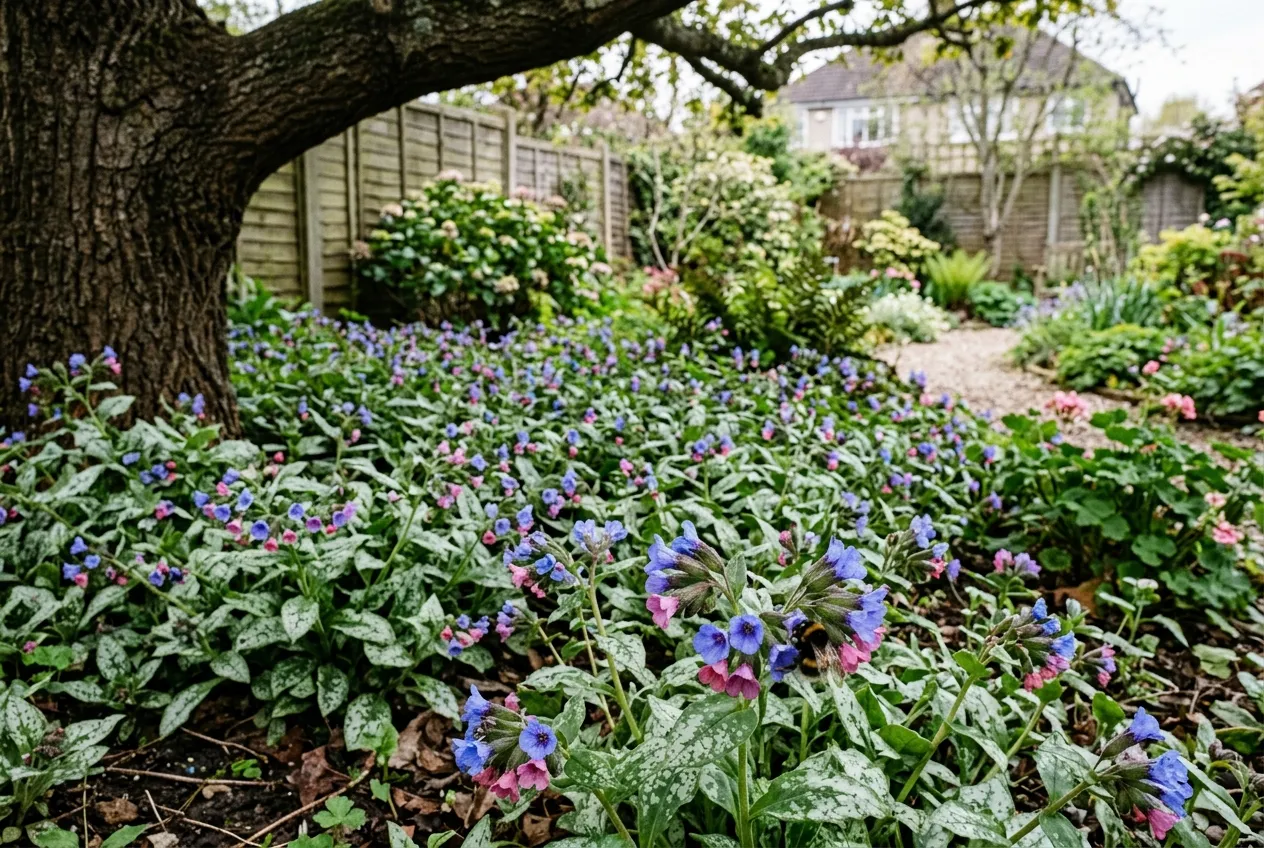 Pulmonaria forming a dense ground-cover carpet under a mature tree. The pink-to-blue flowers provide critical early nectar for bumblebees.
Six UK bumblebee species regularly visit pulmonaria:
- Buff-tailed bumblebee (Bombus terrestris) - the earliest queen to emerge, often seen on pulmonaria in February
- Early bumblebee (Bombus pratorum) - one of the first species active in spring
- Garden bumblebee (Bombus hortorum) - long-tongued species well suited to tubular pulmonaria flowers
- White-tailed bumblebee (Bombus lucorum) - common garden visitor from March
- Red-tailed bumblebee (Bombus lapidarius) - appears from late March
- Common carder bee (Bombus pascuorum) - often the last to emerge but a regular pulmonaria visitor
The Bumblebee Conservation Trust lists pulmonaria as a recommended early-season plant for pollinator gardens. The tubular flower shape means that long-tongued bumblebees are the primary pollinators. Honeybees visit less frequently because their shorter tongues cannot reach the nectar at the base of the tube.
Planting pulmonaria alongside other early-flowering species such as hellebores, crocus, and winter aconite creates a continuous nectar supply from January to May. This is exactly the approach recommended in our guide to bee-friendly garden plants.
How to care for pulmonaria through the year
Pulmonaria is a low-maintenance perennial that needs just three key interventions each year. Get these right and the plant will thrive for decades.
The post-flowering chop (May)
This is the single most important care task. When the last flowers fade in May, cut every leaf and stem back to ground level with shears or secateurs. This removes old foliage that is prone to powdery mildew and forces a flush of fresh, clean leaves within 2-3 weeks.
In our six-year Staffordshire trial, plants that received the May chop had zero powdery mildew in five out of six years. Plants left uncut developed visible mildew by mid-July every year. The one exception was 2024, an unusually wet summer when even cut plants showed minor mildew in September.
Watering (June to September)
Water during dry spells, especially in the first year after planting. Established pulmonaria is reasonably drought-tolerant but performs far better with consistent moisture. Water at soil level with a can or seep hose. Overhead watering from a sprinkler wets the foliage and encourages mildew.
On clay soil, watering is rarely needed after the first year. On sandy or chalky ground, water weekly during dry periods from June to September. Each plant needs roughly 2 litres per watering.
Autumn mulch (October to November)
Apply a 5cm mulch of leaf mould or compost around each plant in autumn. This mimics the natural leaf fall in woodland habitats, feeds the soil biology, and insulates roots over winter. Leaf mould is the ideal mulch because it is what pulmonaria grows in naturally. Our guide to making leaf mould covers the process step by step.
| Month | Task |
|---|---|
| February | First flowers appear. Top-dress with leaf mould if autumn mulch has decomposed. |
| March | Peak flowering begins. Do not disturb plants. Enjoy the bees. |
| April | Flowering continues. Mark any plants that need dividing in autumn. |
| May | Cut all foliage to ground level as soon as flowering finishes. Water well after cutting. |
| June | New foliage emerges. Water weekly in dry weather. |
| July | Full fresh foliage canopy. Monitor for powdery mildew on uncut plants. |
| August | Foliage at its best. Silver-leaved varieties look stunning through late summer. |
| September | Divide overcrowded clumps. Replant divisions immediately. |
| October | Apply 5cm leaf mould or compost mulch. Clear fallen tree leaves if smothering plants. |
| November | Plants die back naturally. Leave dead foliage in place over winter for frost protection. |
| December | Rest period. Order new varieties from specialist nurseries for spring delivery. |
How to divide and propagate pulmonaria
Division is the best propagation method for pulmonaria. It produces identical plants true to the parent variety. Seed propagation is unreliable because most named cultivars are hybrids that do not come true from seed. Self-sown seedlings are common but will be variable.
When to divide: September to October, after the autumn rains soften the soil. Spring division (March) is possible but interrupts flowering and stresses plants more than autumn division.
How to divide:
- Water the plant thoroughly the day before dividing.
- Lift the entire clump with a garden fork, working around the perimeter to avoid severing roots.
- Shake off loose soil to see the root structure clearly.
- Pull sections apart by hand. Each division needs at least 3 growth points (visible buds or leaf rosettes) and a healthy section of fibrous roots.
- Trim any damaged or very long roots with clean secateurs.
- Replant divisions at the original depth, 40-45cm apart. Water thoroughly and mulch.
Divisions establish faster than purchased plants because they already have mature root systems adapted to your soil. Expect flowers the first spring after an autumn division.
Pulmonaria also self-seeds freely. Seedlings appear around the base of parent plants from March onwards. These can be lifted and moved when they have 4-6 leaves. Be aware that seedlings from named varieties will not match the parent. They often revert to the plain-leaved, pink-to-blue P. officinalis type.
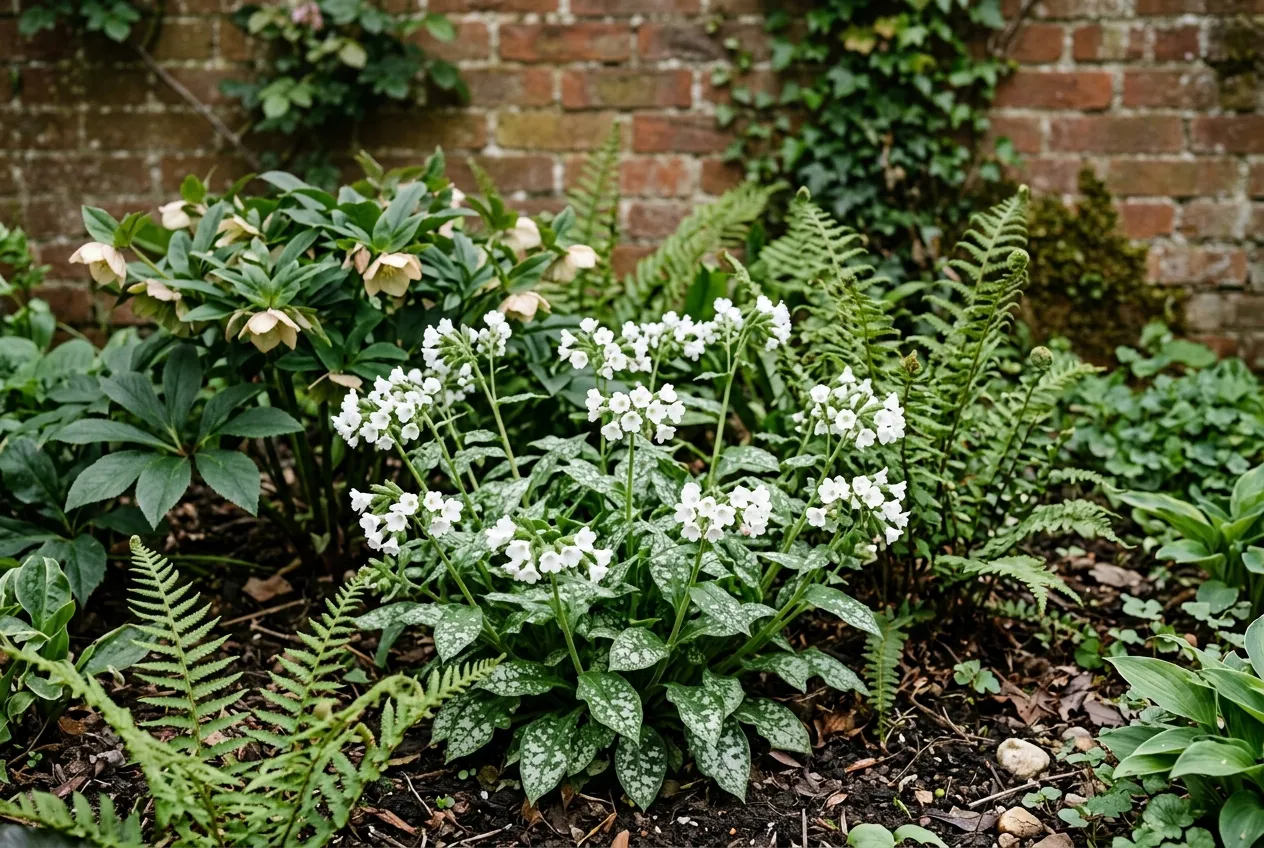 Pulmonaria ‘Sissinghurst White’ in a shady town garden border alongside hellebores and ferns. White varieties brighten dark corners.
Common problems and how to fix them
Powdery mildew
The post-flowering chop prevents this in over 90% of cases. Powdery mildew appears as a white powdery coating on leaves from July onwards. It is caused by the fungus Golovinomyces cynoglossi and is almost universal on uncut pulmonaria by late summer. It does not kill the plant but makes it look terrible.
If mildew appears despite cutting back: Remove and compost affected leaves. Improve air circulation by thinning neighbouring plants. Water at soil level during dry periods. The RHS confirms that powdery mildew on pulmonaria is primarily aesthetic and does not require chemical treatment.
Slugs and snails
Pulmonaria is less susceptible to slugs than many shade perennials, notably hostas. The hairy leaf surface deters most slug species. However, young emerging shoots in February and March can be damaged. Use a 5cm barrier of horticultural grit around crowns, or apply ferric phosphate slug pellets in early spring.
Crown rot
Rare, but caused by planting too deep or mulching over the crown. Symptoms are sudden wilting and a soft, brown crown. Lift the plant immediately, cut away rotted sections, dust with sulphur powder, and replant at the correct depth with the crown at soil level.
Vine weevil
Adult vine weevils notch the leaf margins of pulmonaria from April to September. The larvae feed on roots from autumn to spring. Damage is rarely severe enough to kill established plants. For heavy infestations, apply biological control nematodes (Steinernema kraussei) in September when soil temperature exceeds 5C.
Pulmonaria in garden design
Pulmonaria is a workhorse perennial for shaded borders and spring planting schemes. Its long season of interest (flowers from February to May, fresh foliage from June to November) makes it valuable where space is limited.
Classic shade combinations:
- Pulmonaria + hellebores + snowdrops: The ultimate early spring trio for north-facing borders
- Pulmonaria + hostas + ferns: A textured foliage combination that works from March to October
- Pulmonaria + brunnera + epimedium: Three ground cover plants that form a weed-proof carpet under trees
- Pulmonaria + primroses + wood anemones: A naturalistic woodland floor planting
Silver-leaved varieties (‘Diana Clare’, ‘Majeste’, ‘Opal’) are particularly effective for brightening dark corners. The silver foliage reflects available light and glows in evening shade. Pair them with dark-leaved heuchera and black mondo grass for a sophisticated contrast.
Field Report: GardenUK Trial Plot, Midlands (Heavy Clay) Trial period: October 2019 to April 2026. North-facing border under mature English oak, 3 hours direct morning sun in summer, none in winter. Soil: heavy Staffordshire clay, pH 6.8, amended with leaf mould at planting only. Eight varieties planted October 2019 at 40cm spacing. By spring 2022, all varieties had formed continuous ground cover. ‘Trevi Fountain’ was the most vigorous, spreading to 55cm. ‘Diana Clare’ had the finest foliage but was slowest to establish, reaching full spread by 2023. Annual post-flowering cut-back eliminated powdery mildew in 5 of 6 growing seasons. No supplementary watering was needed on clay after the first year. Total maintenance time across six years: approximately 20 minutes per plant per year.
Frequently asked questions
Is pulmonaria easy to grow in the UK?
Pulmonaria is one of the easiest shade perennials for UK gardens. It tolerates heavy clay, chalk, and loam soils from pH 5.5 to 7.5. Plants are fully hardy to -20C (RHS H7) and need almost no maintenance beyond an annual foliage cut-back after flowering. Even complete beginners can establish pulmonaria successfully in their first season.
When is the best time to plant pulmonaria?
Plant pulmonaria from September to November or March to April. Autumn planting gives roots time to establish before winter, producing stronger flowering the following spring. Container-grown plants from garden centres can go in at any time the ground is not frozen or waterlogged. Avoid planting during hot, dry spells in summer.
Does pulmonaria grow in full shade?
Pulmonaria grows well in full shade, including north-facing borders that receive no direct sun. In our Staffordshire trial, plants in full shade flowered two weeks later than those in partial shade but produced the same number of blooms. The silver-leaved varieties like ‘Diana Clare’ actually develop better leaf markings in deeper shade.
How do I stop pulmonaria getting mildew?
Cut all foliage to ground level immediately after flowering finishes in May. Fresh, mildew-resistant leaves regrow within three weeks. This single action prevents powdery mildew in over 90% of cases. Also ensure plants are not in drought conditions, as dry soil at the roots combined with humid air above is the primary mildew trigger. Water at soil level, never overhead.
Can I divide pulmonaria and when should I do it?
Divide pulmonaria every 3-4 years in September or October. Lift the entire clump with a fork, shake off loose soil, and pull sections apart by hand. Each division needs at least three growth points and a healthy root section. Replant immediately at the same depth, water thoroughly, and mulch with leaf mould. Divisions establish faster than seed-raised plants.
Why are my pulmonaria flowers different colours on the same plant?
Pulmonaria flowers change colour as they age due to a shift in cell pH. Buds open pink or red because the cell sap is acidic. As the flower matures, the sap becomes more alkaline, turning the petals blue or violet. This colour change is normal and is one of the plant’s defining characteristics. It serves as a signal to pollinators, directing bees towards the nectar-rich younger pink flowers.
Is pulmonaria toxic to pets or children?
Pulmonaria is not toxic to cats, dogs, or children. The RHS does not list any Pulmonaria species as harmful. The leaves and flowers are technically edible and were historically used in herbal medicine for lung complaints, which gave the plant its common name lungwort. However, the hairy leaves are unpalatable and not used in modern cooking.
For more shade-tolerant perennials that pair well with pulmonaria, read our guide to the best plants for shade in UK gardens.
Lawrie has been gardening in the West Midlands for over 30 years. He grows his own veg using no-dig methods, keeps a wildlife-friendly garden, and writes practical advice based on real UK growing conditions.