How to Prune Fruit Trees UK
UK guide to pruning fruit trees by type and season. Covers apple, pear, plum, cherry, and fig with timing, tools, and techniques from 10 years' experience.
Key takeaways
- Prune apples and pears November to February when dormant, never in spring when sap is rising
- Prune plums, cherries, and damsons June to August only, as winter cuts risk fatal silver leaf disease
- Remove dead, diseased, and damaged wood (the 3 Ds) from any fruit tree at any time of year
- Shape young trees into an open goblet in the first 3 years for good airflow and light
- Renovate neglected trees gradually over 3 years, never removing more than one-third in a single season
- Sterilise secateurs with methylated spirit between cuts on diseased branches
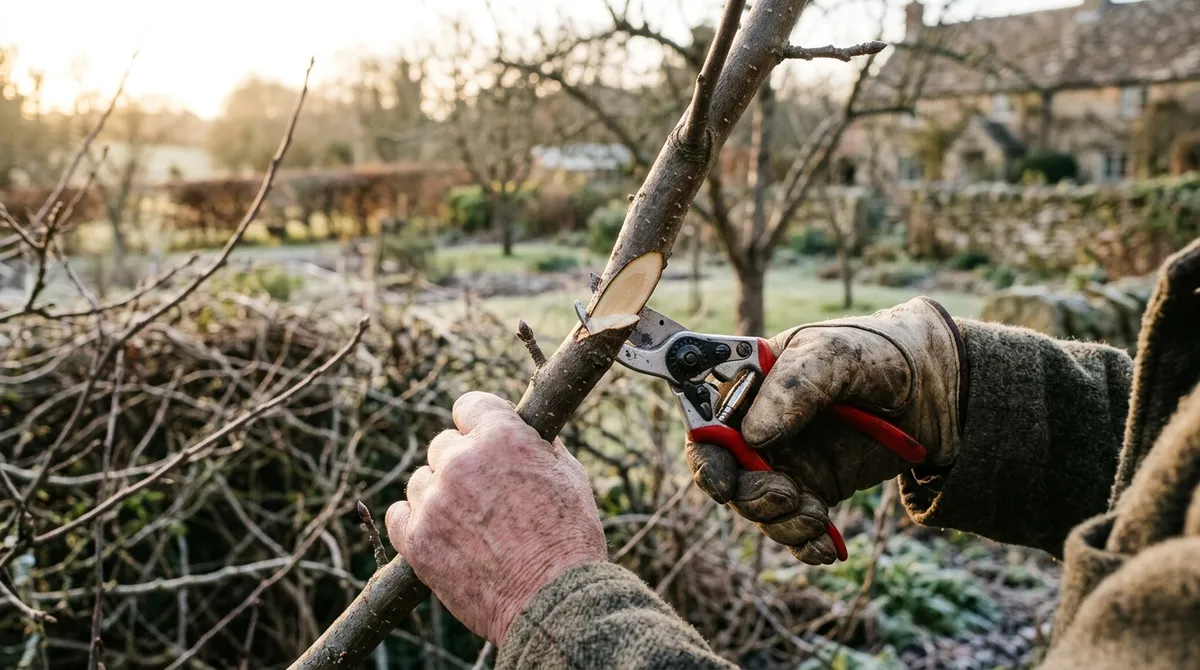
Learning to prune fruit trees correctly is the single most useful skill for any UK fruit grower. A well-pruned tree produces larger fruit, suffers fewer diseases, and crops reliably year after year. A neglected tree becomes a tangled mass of crossing branches, shaded out in the centre and prone to fungal infections.
The critical rule is timing. Get it wrong and you invite disease or remove next season’s fruit buds. Apple and pear trees are pruned in winter. Plum, cherry, and damson trees must only be pruned in summer. Fig trees wait for spring. This guide covers every major fruit tree type grown in the UK, with specific timing, technique, and the common mistakes that damage otherwise healthy trees.
-->A dormant apple tree with leaves fallen, showing the branch framework clearly for winter pruning.
When to prune apple and pear trees
Apple and pear trees (pome fruit) are pruned from November to February while fully dormant. At this time of year you can see the entire branch structure without leaves obscuring the framework. The tree is resting, so pruning wounds heal over the following spring without excessive sap bleeding.
Never prune apples or pears in March or April. Rising sap bleeds from fresh cuts, weakening the tree and attracting disease. Autumn pruning before leaf fall is also risky because the wound-healing response is slowing down.
For apple trees, winter pruning is the main annual task. Spur-bearing varieties (Cox, Bramley, Gala, Egremont Russet) respond well to shortening lateral shoots to 2-3 buds, which builds compact fruiting spurs over successive years. Tip-bearing varieties (Worcester Pearmain, Blenheim Orange, Irish Peach) carry fruit at the ends of one-year-old shoots and need a different approach. Leave the tips intact and use renewal pruning: remove a proportion of older fruited wood each winter to encourage fresh replacement growth.
Pear trees follow the same timing and principles. Conference, Concorde, and Doyenne du Comice are all spur-bearing and respond well to spur pruning in winter.
How to prune plum, cherry, and damson trees
Stone fruit must only be pruned between June and August. This is non-negotiable. The fungus Chondrostereum purpureum, which causes silver leaf disease, releases spores from September through to May. Fresh pruning cuts made during this window are an open invitation for infection. Silver leaf kills branches progressively and can destroy an entire tree within a few years. There is no chemical cure.
Plum trees benefit from light pruning in midsummer. Remove dead wood, crossing branches, and anything growing into the centre of the tree. Victoria plums are particularly prone to silver leaf if pruned at the wrong time. The RHS silver leaf guide provides further detail on identification and prevention.
Cherry trees follow identical summer pruning rules. Sweet cherries on Gisela 5 rootstock can be kept to 3-4m with annual summer pruning. Sour cherries (Morello) fruit on the previous year’s wood, so renewal-prune after harvest by cutting fruited branches back to a younger replacement shoot.
Damsons and gages are treated the same as plums. Keep summer pruning minimal on these smaller trees. Often, removing dead and crossing wood is sufficient.
-->Summer pruning a cherry tree in July. Stone fruit must never be pruned in winter due to silver leaf disease risk.
When to prune fig trees
Fig trees are pruned in spring, after the last hard frost has passed. In most of the UK, this means late April to early May. Figs are not fully hardy and young growth is vulnerable to frost damage. Pruning too early exposes fresh cuts and new buds to late cold snaps.
Remove any frost-damaged tips, crossing branches, and wood growing towards the centre. Figs fruit on the previous year’s growth, so preserve one-year-old shoots and remove older unproductive wood. In colder regions, the small embryo figs that form in autumn (about the size of a pea) overwinter on branch tips and ripen the following summer. Larger figs that failed to ripen in autumn should be picked off, as they will not develop further and waste the tree’s energy.
Fan-trained figs against a south-facing wall are the most reliable producers in the UK. Prune in spring to maintain the fan shape, tying in new shoots to fill gaps and removing any branches growing directly outwards from the wall.
Formative pruning for young trees
The first three years of a fruit tree’s life set the framework for decades of cropping. Formative pruning creates an open goblet (vase) shape that allows light and air into the centre of the tree. This reduces fungal disease, improves fruit colour, and makes picking easier.
Year one (planting year). After planting a maiden whip (a single unbranched stem), cut the main stem to about 75cm above ground in winter. This encourages 3-5 strong side branches to form just below the cut during the following spring and summer.
Year two. Select 3-4 well-spaced branches as your primary framework. These should radiate evenly around the trunk, spaced about 10-15cm apart vertically, with none directly above another. Remove all other side branches. Shorten the chosen branches by one-third, cutting to an outward-facing bud.
Year three. The framework is now established. Allow secondary branches to develop from the primary arms. Remove any branches growing into the centre or crossing other branches. From this point, switch to the maintenance pruning for the tree’s fruit type (winter for pome, summer for stone fruit).
For trained forms like espaliers and cordons, formative pruning follows a different pattern. Espalier arms are trained horizontally along wires, with a new tier added each winter until the desired height is reached.
Renovation pruning for neglected trees
Old, neglected fruit trees are worth saving. A 40-year-old apple tree that has not been pruned for a decade can be brought back into productive fruiting with renovation pruning spread over three years. Attempting to do it in one go causes a mass of water shoots (vigorous, vertical, non-fruiting growth) and can shock-kill an old tree.
Year one. Remove all dead, diseased, and badly damaged wood. Then remove up to one-third of the remaining living canopy, targeting branches that cross, rub, grow vertically through the centre, or hang down to ground level. Make all cuts to a side branch or main trunk. Never leave stubs.
Year two. Remove another one-third of the unwanted wood, focusing on overcrowded areas and opening the centre further. Some water shoots will have appeared from the year one cuts. Remove the weakest, but keep any that fill gaps in the framework.
Year three. Fine-tune the shape. By now the tree should have an open, balanced canopy with light reaching all parts. Begin normal maintenance pruning. Apply a high-potash feed (such as sulphate of potash at 35g per square metre) around the root zone in late winter to encourage fruiting rather than leafy growth.
For advice on feeding fruit trees during recovery, a balanced approach with potash and a mulch of well-rotted manure gives the best results.
Espalier and cordon pruning
Trained fruit trees need two prunes per year. The summer prune in late July to August is the most important, as it controls vigour and builds fruiting spurs close to the main framework. The winter prune tidies up secondary growth.
Summer prune (late July to August). Shorten all new side shoots growing from the main arms or trunk to three leaves above the basal cluster (the rosette of leaves at the base of the current year’s growth). This diverts the tree’s energy from vegetative growth into fruit bud formation. Leave the leader tip unpruned until the espalier or cordon reaches its desired height.
Winter prune (December to February). Any secondary shoots that have grown from the summer-pruned stubs are shortened to one bud. This builds the short, stubby fruiting spurs that carry the crop. Remove any shoots growing forwards or backwards from the flat plane of the trained form.
Cordons are single-stemmed trees planted at a 45-degree angle and are the most space-efficient trained form. They suit small gardens and can be planted 75cm apart, allowing a collection of varieties in a short run of fence or wall.
-->An espalier apple tree trained on horizontal wires. Summer pruning builds fruiting spurs close to the arms.
Fruit tree pruning comparison table
| Fruit type | When to prune | Method | Key disease risk | Notes |
|---|---|---|---|---|
| Apple (spur-bearing) | November to February | Shorten laterals to 2-3 buds | Canker, scab | Most common type: Cox, Bramley, Gala |
| Apple (tip-bearing) | November to February | Renewal: remove oldest fruited wood | Canker, scab | Worcester Pearmain, Blenheim Orange |
| Pear | November to February | Spur prune, same as apple | Canker, fire blight | Conference, Concorde, Comice |
| Plum | June to August only | Light thinning, remove 3 Ds | Silver leaf (fatal) | Victoria, Marjorie’s Seedling |
| Cherry (sweet) | June to August only | Thin overcrowded branches | Silver leaf, bacterial canker | Stella, Sunburst on Gisela 5 |
| Cherry (sour) | After harvest (Aug) | Renewal prune fruited wood | Silver leaf, bacterial canker | Morello, fruits on previous year’s wood |
| Damson and gage | June to August only | Minimal: remove 3 Ds and crossing | Silver leaf | Merryweather, Cambridge Gage |
| Fig | Late April to May | Remove frost damage, thin | Coral spot | Fan-train on south-facing wall |
| Espalier/cordon | Summer (Jul-Aug) + winter | Summer: laterals to 3 leaves. Winter: to 1 bud | Canker, scab | Two prunes per year essential |
Month-by-month pruning calendar
January. Main winter pruning season for apples and pears. Good visibility with no leaves. Ground may be frozen, so wait for a mild spell if you need a ladder on soft ground.
February. Continue winter pruning of apples and pears. Final chance before sap starts rising in March. Remove any branches showing signs of canker and burn the prunings.
March. Stop pruning apples and pears. Sap is rising. Any cuts now will bleed heavily. Check winter-pruned trees for missed crossing branches.
April. Prune fig trees once the risk of hard frost has passed. Remove frost-damaged tips and thin overcrowded growth.
May. Leave all fruit trees alone. Blossom is setting fruit. Disturbing trees now risks knocking off developing fruitlets.
June. Start summer pruning of plums, cherries, and damsons. Remove the 3 Ds (dead, diseased, damaged) and crossing branches. Keep cuts minimal.
July. Continue stone fruit pruning. Begin summer pruning of espaliers and cordons in the last week of July. Shorten laterals to three leaves above the basal cluster.
August. Complete all stone fruit and trained tree pruning. Prune sour cherries after harvest. Last chance for summer pruning before autumn.
September. No pruning. Silver leaf spores become active again. Do not cut any fruit tree from now until late November (stone fruit) or throughout winter (stone fruit still off-limits).
October. Rake up fallen leaves to reduce scab and canker overwintering on the ground. Plan your winter pruning by marking problem branches with chalk or ribbon.
November. Winter pruning season opens for apples and pears. Start with the easiest, most visible cuts. Check the RHS pruning guide for variety-specific advice.
December. Continue apple and pear pruning throughout the month. Ideal time to tackle renovation of neglected trees.
Tools you need for pruning fruit trees
Sharp tools make clean cuts that heal quickly. Blunt tools crush tissue, leaving ragged wounds that invite infection. Three tools cover almost every pruning job on fruit trees.
Bypass secateurs handle branches up to about 15mm in diameter. Choose a quality pair with a replaceable blade and a sap groove. Felco 2 and Niwaki GR Pro are both excellent and last decades with blade replacements. For a full guide to choosing and maintaining secateurs, see our best secateurs guide.
Loppers bridge the gap between secateurs and a saw, cutting branches from 15mm to 40mm. Bypass loppers (not anvil) give cleaner cuts. Geared or ratchet models reduce the effort needed for thicker wood. Telescopic handles extend your reach into the canopy.
Pruning saw handles anything thicker than 40mm. A curved pull-cut saw (such as the Silky Zubat or Bahco 396-LAP) cuts on the pull stroke, making overhead work easier and safer. Always cut in three stages for heavy branches: undercut first, then top cut further out, then clean the stub back to the collar.
Sterilise all tools between trees, and always between cuts on diseased wood. Wipe blades with a cloth soaked in methylated spirit. A small bottle in your pocket keeps the workflow uninterrupted. For detailed maintenance advice, our guide to sharpening garden tools covers angles, stones, and technique.
The 3 Ds: dead, diseased, and damaged wood
Removing the 3 Ds is the foundation of all fruit tree pruning and can be done at any time of year, on any type of fruit tree. Dead and diseased wood left on the tree harbours fungal spores that spread to healthy branches.
Dead wood is easy to identify. It has no buds, the bark is loose or missing, and it snaps rather than bending. Cut back to healthy, living wood where you can see green cambium beneath the bark.
Diseased wood includes branches with canker (sunken, cracked bark with concentric rings), coral spot (pink/orange pustules), and silver leaf (silvery sheen on leaves, brown stain in cut cross-section). Cut at least 15cm below any visible disease into clean, white wood. Burn all diseased prunings rather than composting them.
Damaged wood includes storm-broken branches, crossing branches that rub and create wounds, and any branch split by the weight of a heavy fruit crop. Clean up ragged breaks with a sharp saw, cutting back to a side branch or the branch collar on the trunk.
Common pruning mistakes to avoid
Topping. Cutting the top off a fruit tree to reduce height causes a dense thicket of water shoots at the cut point. The tree responds to topping by producing twice as many vertical shoots, all competing for light. Within two years the tree is taller and denser than before. Instead, reduce height gradually by cutting leaders back to a well-placed side branch.
Flush cuts. Cutting a branch flush with the trunk removes the branch collar, which is the slightly swollen ring of tissue at the base of the branch. The collar contains the tree’s wound-healing cells. Without it, the cut cannot form callus tissue and remains an open wound for years. Always cut just outside the collar.
Winter pruning stone fruit. This is the most damaging mistake in UK fruit growing. Every year, gardeners prune plum and cherry trees in winter because that is when they prune everything else. Silver leaf infection from a winter cut can kill a mature plum tree within 3-5 years. The only safe period for stone fruit is June to August.
Removing too much at once. Never remove more than one-third of a tree’s canopy in a single year. Over-pruning triggers a stress response: masses of water shoots, delayed fruiting for 2-3 seasons, and increased vulnerability to disease. Spread heavy work across multiple years.
Ignoring water shoots. The thin, whippy, vertical shoots that appear after heavy pruning are water shoots. Left alone they become a tangle of weak, shaded wood. Remove most of them in summer, but keep any that fill genuine gaps in the framework and train them outwards by tying to neighbouring branches.
-->Always cut just above an outward-facing bud at a 45-degree angle sloping away from the bud. This directs new growth outwards.
Spur pruning vs renewal pruning explained
Understanding whether your tree fruits on spurs or tips determines which pruning method to use. Getting this wrong means cutting away the wood that would have carried next year’s crop.
Spur-bearing trees produce fruit on short, knobbly spurs that develop on two-year-old and older wood. Most apple and pear varieties are spur-bearing: Cox, Bramley, Gala, Egremont Russet, Conference, Concorde. Spur prune these by shortening lateral (side) shoots to 2-3 buds each winter. Over successive years, this builds clusters of fruit buds close to the main branches. Thin congested spur systems by removing the weakest spurs when they become overcrowded.
Tip-bearing trees fruit at the ends of one-year-old shoots. Varieties include Worcester Pearmain, Blenheim Orange, Irish Peach, and Cornish Gilliflower. If you spur-prune a tip-bearing tree, you cut off all the fruit buds. Instead, use renewal pruning: each winter, remove a proportion of the oldest shoots that have already fruited, cutting back to a younger replacement shoot. Leave the tips of current-year growth intact.
Some varieties are partial tip-bearers, fruiting on both spurs and tips. Discovery and Bramley produce some fruit at the tips. Treat these as spur-bearers but leave some one-year-old shoot tips uncut.
If you are unsure whether your tree is spur or tip-bearing, check how grafting affects fruiting habit. The scion variety determines the bearing type, not the rootstock.
How to make the correct pruning cut
Every cut should be clean, positioned correctly, and angled to shed rainwater away from the bud or branch collar. Three types of cut cover every situation.
Heading cut (to a bud). Used when shortening a branch. Cut 5mm above an outward-facing bud at a 45-degree angle sloping away from the bud. This directs new growth outwards and away from the centre of the tree. Cutting too close damages the bud. Cutting too far away leaves a stub that dies back and invites infection.
Thinning cut (to a branch). Used when removing one branch at its junction with another. Cut just outside the branch bark ridge (the raised line of bark in the branch crotch) and the branch collar (the slight swelling at the base). This preserves the tree’s healing tissue while removing the unwanted branch cleanly.
Three-cut method (for heavy branches). Prevents bark tearing when removing large branches. Cut 1: undercut one-third through the branch, 30cm out from the trunk. Cut 2: saw from the top, 5cm further out, until the branch falls. Cut 3: remove the remaining stub by cutting just outside the branch collar.
Pruning fruit trees in small gardens
Small gardens demand compact trees, and compact trees need consistent annual pruning to stay productive. Dwarf fruit trees on dwarfing rootstocks (M27 and M9 for apples, Quince C for pears, Pixy for plums, Gisela 5 for cherries) produce full-size fruit on trees that stay under 2.5m.
Cordon apple and pear trees planted 75cm apart along a fence or wall give the highest yield per square metre of any fruit growing system. Summer prune cordons in August by shortening laterals to three leaves. Winter prune secondary growth to one bud. A 3m fence holds four cordon trees producing four different varieties for cross-pollination.
Fan-trained plums, cherries, and figs suit south and west-facing walls. The wall provides shelter, reflected warmth, and a support structure for tying in branches. Summer prune fans by pinching out unwanted shoots and tying in those needed to fill the framework. For a broader look at growing fruit trees in limited space, our pillar guide covers variety selection and spacing.
Frequently asked questions
When should I prune apple trees in the UK?
Prune apple trees between November and February. The tree is dormant during this period, so pruning causes minimal stress and allows you to see the branch structure clearly without leaves. Avoid pruning in March and April when sap is rising, as cuts bleed heavily and heal slowly. Trained forms like cordons and espaliers get a second summer prune in late August.
Why should I never prune plum trees in winter?
Winter pruning exposes plum trees to silver leaf disease. The fungus Chondrostereum purpureum enters through fresh cuts and is most active from September to May. Infected branches develop a silvery sheen on the leaves and eventually die back. Prune plums only between June and August when the tree can heal wounds quickly and fungal spore counts are lowest.
How do I prune a neglected fruit tree?
Spread renovation over three years. In year one, remove all dead, diseased, and crossing branches plus up to one-third of the remaining canopy. In year two, remove another third of overcrowded branches. In year three, fine-tune the shape. Removing too much in one go triggers a mass of weak water shoots and can kill an old tree.
What is the difference between spur pruning and renewal pruning?
Spur pruning shortens side shoots to 2-3 buds. It suits most apple varieties including Cox, Bramley, and Gala. Renewal pruning removes a proportion of older fruited wood each year to encourage fresh replacement shoots. Tip-bearing varieties like Worcester Pearmain and Blenheim Orange need renewal pruning because they fruit at the ends of shoots.
Should I seal pruning cuts on fruit trees?
No, wound sealants are no longer recommended. Research shows they trap moisture beneath the seal and encourage fungal decay. A clean cut at the correct angle heals naturally as the tree forms callus tissue. Focus on sharp tools, correct angles, and sterilising blades between diseased branches.
How do I prune an espalier apple tree?
Espaliers need two prunes per year. In summer (late July to August), shorten new side shoots growing from the main arms to three leaves above the basal cluster. In winter, shorten secondary growth from those summer-pruned shoots to one bud. This builds short fruiting spurs along the arms. Remove any shoots growing forwards or backwards from the flat plane.
What tools do I need for pruning fruit trees?
You need three tools for most fruit trees. Bypass secateurs handle branches up to 15mm diameter. Loppers cut from 15mm to 40mm. A curved pruning saw handles anything thicker. Keep all blades sharp and sterilise with methylated spirit between diseased trees. A step ladder or tripod ladder is essential for standard and half-standard trees.
Lawrie has been gardening in the West Midlands for over 30 years. He grows his own veg using no-dig methods, keeps a wildlife-friendly garden, and writes practical advice based on real UK growing conditions.