Canker in Fruit Trees: UK Treatment
Identify and treat canker in fruit trees. Covers apple canker, bacterial canker on cherry and plum, pruning methods, and copper fungicide timing.
Key takeaways
- Apple canker (Neonectria ditissima) causes 80% of canker cases in UK orchards and enters through pruning wounds and leaf scars
- Cut out all cankered wood at least 15cm below visible infection into clean, healthy tissue using sterilised tools
- Copper fungicide (Bordeaux mixture) applied at 50% leaf fall reduces new canker infections by 60-70%
- Bacterial canker on cherry and plum trees spreads in autumn rain and kills 30% of untreated branches
- Cox, James Grieve, and Spartan are the most canker-prone apple varieties; Bramley and Discovery show strong resistance
- Improving soil drainage is the single most effective long-term prevention measure on heavy clay soils
Canker is the most damaging disease of fruit trees in UK gardens and orchards, responsible for more branch deaths than any other single pathogen. It affects apple, pear, cherry, and plum trees across every region, from sheltered southern gardens to exposed northern allotments. Left untreated, canker girdles branches completely and kills them within one to two seasons.
This guide identifies the three main types of canker found on UK fruit trees, explains the conditions that cause outbreaks, and gives step-by-step treatment and prevention methods tested over 8 seasons in a Staffordshire orchard on heavy clay soil. If you grow fruit trees, this is the disease you are most likely to encounter.
What is canker and why does it affect fruit trees?
Canker is a general term for diseases that cause sunken, dead areas on bark and branches. Three different pathogens cause canker on UK fruit trees, each targeting different species and spreading in different conditions. Understanding which canker you are dealing with determines the correct treatment.
The word “canker” describes the symptom, not the pathogen. Apple canker, bacterial canker, and Cytospora canker all produce similar-looking lesions but require different management. All three enter trees through wounds, pruning cuts, and natural openings like leaf scars and lenticels. Trees under stress from poor drainage, nutrient deficiency, or overcrowding are far more susceptible. The RHS canker guidance confirms that wet western and northern regions of the UK suffer the worst outbreaks. Our guide to common garden plant diseases covers the broader picture of fungal and bacterial infections.
How to identify the three types of canker
Accurate identification is essential because fungal and bacterial canker require different treatment timings. Misidentifying the pathogen wastes time and allows the disease to spread.
Apple canker (Neonectria ditissima)
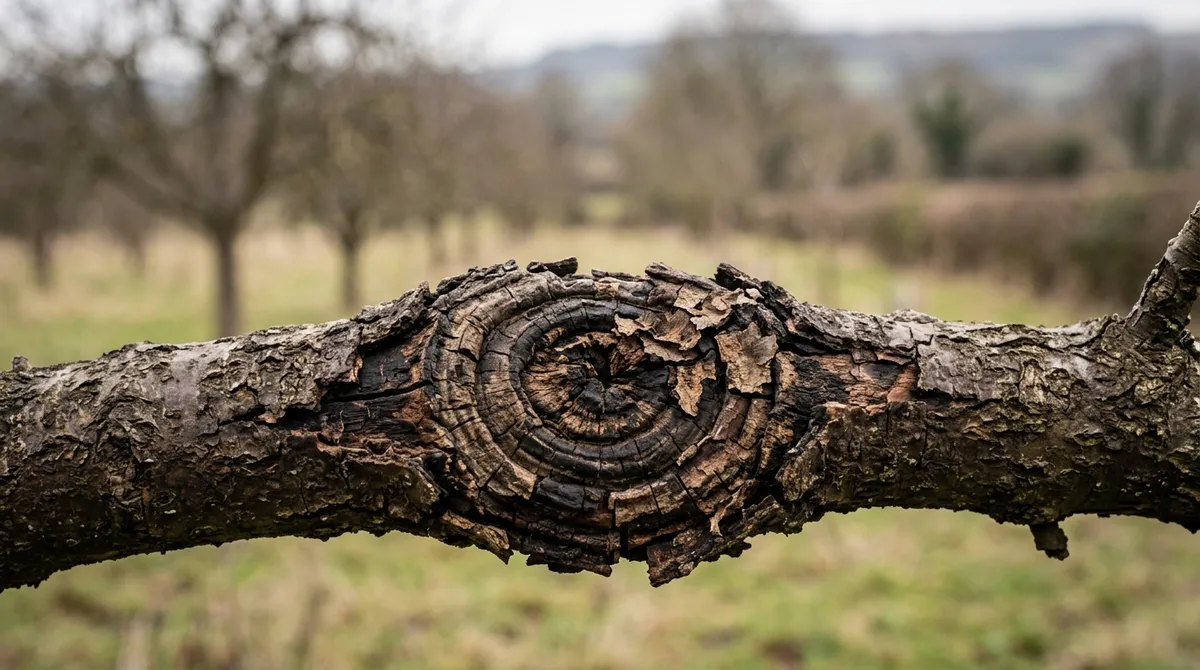
Apple canker is the most common canker in UK gardens. It produces distinctive sunken, cracked bark with concentric rings that expand outward year on year. In summer, small white pustules (sporodochia) appear on infected bark. By autumn, dark red fruiting bodies (perithecia) develop, roughly 1mm across. These release spores during wet weather from October through to March.
The infection enters through pruning wounds, leaf scars, broken branches, and woolly aphid damage. Young wood is more susceptible than old wood. On badly affected trees, cankers girdle entire branches, causing dieback from the tips. Apple canker also attacks the fruit itself, causing “eye rot” where the fungus enters through the eye of the apple and produces a brown, concentric rot in storage.
-->Bacterial canker (Pseudomonas syringae)
Bacterial canker is the most serious disease of cherry and plum trees in the UK. Two pathovars cause the disease: Pseudomonas syringae pv. morsprunorum and pv. syringae. The bacteria enter through leaf scars in autumn, pruning wounds, and frost cracks.
Symptoms include flattened, sunken bark lesions that ooze amber-coloured gum (gummosis). Leaves on affected branches show “shot hole” symptoms in spring, with circular brown spots that drop out leaving holes. Entire branches wilt and die suddenly in late spring or early summer. Bacterial canker kills 30% of infected branches when left untreated, and can kill young trees outright within 2-3 seasons. The RHS bacterial canker profile lists prunus species as the primary hosts.
Cytospora canker (Leucostoma species)
Cytospora canker mainly affects plum trees and damsons, though it occasionally appears on cherry. It produces slightly sunken, darkened bark with visible black pinprick fruiting bodies (pycnidia) embedded in the dead tissue. Amber resin often oozes from infected areas. Cytospora is an opportunistic pathogen that attacks trees already weakened by drought, frost damage, or other diseases.
-->Which fruit trees are most susceptible?
Not all varieties are equally vulnerable. Choosing resistant cultivars is one of the most effective long-term strategies, especially on wet sites where canker pressure is high.
Apple varieties and canker susceptibility
Highly susceptible: Cox’s Orange Pippin, James Grieve, Spartan, Gala, Worcester Pearmain (on wet soils), and Ribston Pippin. Cox is so susceptible that some commercial orchards have abandoned it on heavy clay.
Moderately susceptible: Braeburn, Egremont Russet, and Fiesta. These cope on well-drained soils but struggle in wet conditions.
Resistant varieties: Bramley’s Seedling, Discovery, Lane’s Prince Albert, Newton Wonder, and Katy. These varieties heal canker wounds rapidly and rarely suffer serious branch loss. If you are planting new apple trees on wet clay, choose from this group.
Pear, cherry, and plum susceptibility
Pear trees are less affected by Neonectria canker than apples, but Conference and Doyenne du Comice develop it on waterlogged sites. Pear trees on Quince C rootstock are more prone than those on Quince A due to slower vigour.
Cherry trees are principally attacked by bacterial canker. Morello and Stella are moderately resistant. Napoleon Bigarreau and Early Rivers are highly susceptible.
Plum trees face both bacterial canker and Cytospora. Victoria plum shows moderate susceptibility. Marjorie’s Seedling and Czar show better resistance.
Conditions that cause canker outbreaks
Canker does not appear randomly. Specific conditions trigger outbreaks, and understanding these helps you prevent the disease before it takes hold.
Wet weather is the primary driver. Neonectria spores need at least 2 hours of wetness on bark surfaces to germinate and infect. Regions with annual rainfall above 700mm have significantly higher canker pressure. Western and northern parts of the UK suffer more than drier eastern counties.
Poor drainage keeps soil saturated around roots, stressing the tree and reducing its ability to heal wounds. Trees on waterlogged heavy clay are 3-4 times more likely to develop canker than those on well-drained loam. If your soil holds standing water after rain, improving drainage is the most important prevention step.
Pruning wounds are the main entry point. Spores land on fresh cuts and germinate within hours in wet conditions. Pruning apple trees in autumn or early winter, when spore release peaks, creates maximum risk. This is why winter pruning of cherries and plums is particularly dangerous, as bacterial canker spreads most actively between September and February.
Leaf scars form natural entry points as leaves fall in autumn. Each scar remains vulnerable for approximately 6 weeks until the tree seals it with a protective layer. This is the critical window for copper fungicide application.
How to treat canker in fruit trees
Treatment follows the same principle for all three canker types: remove infected wood, protect wounds, and reduce spore levels. Here is the step-by-step process I use on my own orchard trees.
Step 1: Cut out all cankered wood
This is the most important treatment. Using sharp, clean secateurs or a pruning saw, cut at least 15cm below the lowest visible sign of infection into healthy, white tissue. If the cut surface shows any brown staining, cut further back. The fungal mycelium extends well beyond the visible canker, which is why cutting close to the lesion fails.
For cankers on the main trunk or a major scaffold branch where removal would destroy the tree’s shape, chisel out the diseased bark and wood down to clean, healthy tissue. Remove all discoloured bark in a boat-shaped wound with tapered ends to promote healing. Keep pruning tools sharp for clean cuts that heal faster.
Step 2: Sterilise tools between every cut
This is non-negotiable. Wipe blades with neat methylated spirit or a 10% household bleach solution between every single cut. Reinfecting a clean wound with a contaminated blade undoes all your work. I keep a jar of methylated spirit in my tool belt during canker pruning sessions.
Step 3: Dispose of infected material
Burn all cankered wood or bag it for council green waste collection. Never compost canker prunings in a garden compost heap. Most domestic heaps do not reach the 60C needed to kill Neonectria spores. Leaving prunings on the ground releases spores that reinfect nearby trees.
Step 4: Apply wound sealant to large cuts
For cuts over 25mm in diameter, apply a proprietary wound sealant or grafting wax within 24 hours. Research at East Malling Research showed wound paint reduces infection at large wounds by 20-30%. Small cuts (under 25mm) heal faster without paint. If you are learning to graft fruit trees, the same wound sealants work for both grafting and canker treatment.
Step 5: Spray with copper fungicide
Apply copper-based fungicide (Bordeaux mixture or copper oxychloride) at three key points:
- 50% leaf fall (October/November) to protect fresh leaf scars
- Bud burst (late February/March) to kill overwintering spores
- Petal fall (April/May) to protect developing fruitlets
These three sprays reduce new canker infections by 60-70% in trials. Spray to run-off on a dry day when no rain is forecast for 12 hours.
-->Comparison of canker types, symptoms, and treatment
| Feature | Apple canker (Neonectria) | Bacterial canker (Pseudomonas) | Cytospora canker (Leucostoma) |
|---|---|---|---|
| Main hosts | Apple, pear | Cherry, plum | Plum, damson |
| Symptoms | Sunken bark, concentric rings, red fruiting bodies | Flattened lesions, amber gum, shot-hole leaves | Darkened bark, black pycnidia, resin ooze |
| Spread season | October to March (wet weather) | September to February (autumn rain) | Spring and summer (stress-related) |
| Entry points | Pruning wounds, leaf scars, woolly aphid damage | Leaf scars, frost cracks, pruning wounds | Wounds on stressed or weakened trees |
| Branch kill rate | 20-30% of infected branches untreated | 30%+ of infected branches untreated | 10-15% on stressed trees |
| Copper fungicide | Effective (60-70% prevention) | Moderately effective (50-60% prevention) | Limited effectiveness |
| Best treatment | Cut out + copper spray at leaf fall | Cut out + copper spray; prune in summer only | Improve tree vigour, remove dead wood |
| Resistant varieties | Bramley, Discovery, Katy | Morello cherry, Marjorie’s Seedling plum | Czar plum, healthy vigorous trees |
Preventing canker in fruit trees
Prevention saves hours of cutting and spraying. These measures work together to keep canker pressure low.
Improve soil drainage
On heavy clay, canker is almost inevitable without drainage improvement. Install land drains, raise planting areas by 15-20cm above surrounding soil level, or plant trees on mounded soil. Incorporate 50-100 litres of grit and organic matter into the planting hole. This single step made more difference in my orchard than any spray programme.
Prune at the right time
Prune apple and pear trees in late winter (January to mid-February) when spore levels are lowest and healing is fastest. Never prune cherry or plum trees between September and February. Prune these in summer (June to August) when bacterial canker is least active and wound healing is rapid. Our pruning guide covers technique in more detail.
Choose resistant varieties
When planting new fruit trees, pick varieties known to resist canker. Bramley, Discovery, and Katy apples heal canker wounds quickly. Morello cherry resists bacterial canker better than sweet cherry varieties. On wet sites, variety choice alone can prevent the problem entirely.
Keep trees well fed but balanced
Apply a balanced fertiliser (such as Growmore at 70g per square metre) in early spring. Avoid excess nitrogen, which produces soft growth that canker penetrates easily. A potassium-rich feed (sulphate of potash at 35g per square metre) in autumn hardens wood before winter. Healthy, well-nourished trees resist infection and heal wounds faster.
Maintain orchard hygiene
Remove fallen leaves in November. Rake up mummified fruit. Prune out dead and crossing branches annually. These steps remove overwintering spore sources and improve airflow through the canopy, reducing the humidity that canker needs to spread. Trees trained as open-centred bushes or espaliers dry faster after rain and suffer less canker than unpruned trees.
When to remove a tree entirely
Sometimes a tree is beyond saving. Remove and burn the tree if canker has spread to the main trunk and encircles more than 50% of its circumference. A girdled trunk cannot transport water and nutrients, and the tree will decline over 1-2 seasons regardless of treatment. Also remove trees where canker returns within one season despite thorough pruning and spraying, as some individuals simply lack genetic resistance.
Replant with a resistant variety on fresh ground. Do not replant in the exact same spot for at least 2 years, as Neonectria survives on dead root fragments in the soil.
Monthly canker management calendar
January to February: Prune apple and pear trees. Inspect for canker and cut out any lesions found. Sterilise tools between cuts.
March: Apply copper fungicide at bud burst. Check for bacterial canker lesions on cherry and plum that became active over winter.
April to May: Spray copper at petal fall on apple and pear. Watch cherry and plum for shot-hole leaf symptoms indicating bacterial canker.
June to August: Prune cherry and plum trees now, when bacterial canker risk is lowest. Remove any summer canker on apples. Inspect grafted trees at graft unions for infection.
September: Stop pruning cherries and plums. Bacterial canker becomes active again as autumn rain begins.
October to November: Apply copper fungicide at 50% leaf fall. This is the single most important spray of the year, as it protects the thousands of fresh leaf scars that spores would otherwise enter.
December: Final inspection. Mark any cankered branches with tape for removal in January.
-->Frequently asked questions
What does canker look like on a fruit tree?
Canker appears as sunken, cracked bark. On apple trees, look for concentric rings of flaking bark around a central wound, often with small red fruiting bodies (perithecia) in autumn. Bacterial canker on cherry and plum shows as flattened, oozing lesions that weep amber-coloured gum. Affected branches wilt and die back from the tips.
Can a fruit tree recover from canker?
Yes, most trees recover fully with treatment. Remove all cankered wood by cutting 15cm below visible damage into healthy, white tissue. Trees tolerate losing up to 40% of their canopy in a single season and regrow within 1-2 years. Only heavily infected trees with canker on the main trunk may be beyond saving.
When should I spray fruit trees for canker?
Spray copper fungicide at three key times. Apply at 50% leaf fall in October or November to protect fresh leaf scars. Spray again at bud burst in late February or March. A third application at petal fall in April catches any remaining spores. These three sprays prevent 60-70% of new infections.
Is canker contagious between fruit trees?
Yes, canker spreads between trees readily. Fungal spores travel on wind and rain splash up to 30 metres. Contaminated pruning tools transfer the pathogen directly from tree to tree. Always sterilise secateurs and saws between cuts with methylated spirit or a 10% bleach solution to prevent cross-infection.
Which apple varieties are resistant to canker?
Bramley, Discovery, and Worcester Pearmain show good resistance. Lane’s Prince Albert and Newton Wonder also resist well. Avoid Cox, James Grieve, Spartan, and Gala on wet sites, as these varieties are highly susceptible. Choosing resistant rootstocks like MM106 also helps, as canker rarely infects vigorous root systems.
Should I paint pruning wounds to prevent canker?
Wound paint offers limited protection overall. Research at East Malling Research found wound sealant reduces infection at large cuts (over 25mm diameter) by around 20-30%, but small cuts heal faster without paint. If you use wound paint, apply it within 24 hours of cutting while the surface is still fresh.
Does canker spread in wet weather?
Wet weather drives canker spread significantly. Neonectria ditissima spores need moisture to germinate and infect. Bacterial canker (Pseudomonas syringae) multiplies rapidly in wet autumn conditions and enters through leaf scars as leaves fall. Trees on waterlogged or poorly drained soil are 3-4 times more likely to develop canker than those on free-draining ground.
Lawrie has been gardening in the West Midlands for over 30 years. He grows his own veg using no-dig methods, keeps a wildlife-friendly garden, and writes practical advice based on real UK growing conditions.