Best Shade-Tolerant Annuals UK
Discover the best shade-tolerant annuals for UK gardens. Busy lizzies, begonias, fuchsias, and torenia bring colour to north-facing beds and containers.
Key takeaways
- Shade-tolerant annuals produce reliable colour in beds and containers with fewer than 4 hours of direct sun
- Begonia semperflorens is the most shade-proof annual, flowering non-stop from June to October frost
- SunPatiens (a busy lizzie hybrid) is the downy mildew-resistant replacement for traditional Impatiens walleriana
- Fuchsias thrive in partial shade — trailing types suit hanging baskets, upright types suit mixed borders
- Torenia (wishbone flower) is an underused annual that flowers freely in deep shade and performs in containers
Shade-tolerant annuals are the reliable solution for dark corners, north-facing beds, and shaded containers that many gardeners write off as impossible to plant. With the right varieties — busy lizzies, begonias, fuchsias, torenia — you can fill these spots with colour from June through to October frosts. This guide covers the 10 best shade annuals for UK gardens, with specific variety recommendations, sowing and planting times, and practical advice for containers and hanging baskets in shade.
Which annuals genuinely tolerate shade in the UK?
True shade-tolerant annuals flower with fewer than 4 hours of direct sun per day. This is the critical threshold. Many plants described as “shade-tolerant” in catalogues simply mean they tolerate partial shade — 4-6 hours of sun — which is quite different from the low light levels found against a north-facing wall or under a dense tree canopy.
The 10 annuals below have been trialled in genuine shade conditions: a north-facing border in the West Midlands receiving 1-3 hours of indirect sun in summer, and containers positioned against a north-facing house wall. They all delivered reliable colour under those conditions.
If you are unsure of your shade level, measure it. Count the hours of direct sunlight the area receives on a clear summer’s day in June. Under 2 hours is full shade. 2-4 hours is partial shade. Above 4 hours is semi-shade or partial sun. For the full picture of which permanent plants suit these conditions, see our guide to best plants for shade in UK gardens.
| Annual | Light Tolerance | Height | Key Colours | Flowering Period |
|---|---|---|---|---|
| Busy lizzie (Impatiens walleriana / SunPatiens) | 1-4 hrs | 20-40cm | Pink, red, white, salmon, orange, lilac | June-October |
| Begonia semperflorens | 1-4 hrs | 15-30cm | Red, pink, white | June-October frost |
| Tuberous begonia | 2-4 hrs | 25-45cm | Yellow, orange, red, pink, white | June-September |
| Fuchsia (trailing) | 2-4 hrs | 30-60cm trailing | Pink/purple, red/white, bicolours | June-October |
| Fuchsia (upright) | 2-4 hrs | 45-90cm | Pink, red, purple, white | June-October |
| Torenia (Torenia fournieri) | 1-3 hrs | 25-35cm | Purple, pink, white, yellow | July-October |
| Lobelia (trailing) | 2-4 hrs | 15-30cm trailing | Blue, white, red | June-September |
| Nicotiana (Nicotiana sylvestris) | 2-4 hrs | 90-150cm | White | July-September |
| Nemesia | 3-4 hrs | 20-30cm | Multi-colour, yellow, orange | June-August |
| Mimulus (monkey flower) | 2-4 hrs | 15-30cm | Yellow, orange, red-spotted | June-September |
Busy lizzie: the classic shade annual — and downy mildew
Busy lizzies (Impatiens walleriana) dominated UK shade planting for decades. They are exceptional in low light, flowering prolifically with as little as 1-2 hours of indirect sun, and available in every colour from white to deep coral.
The problem is downy mildew (Plasmopara obducens). From 2011 onwards, this fungal disease swept through UK impatiens plantings, causing leaves to yellow, curl, and die within weeks of planting. By 2013, RHS trials showed 100% infection rates in outdoor impatiens beds in many UK regions. Traditional busy lizzies became essentially unviable as summer bedding.
SunPatiens is the solution. Developed by Sakata Seed, SunPatiens is a series of Impatiens hybrids bred for resistance to downy mildew. In independent RHS trials, SunPatiens showed zero disease symptoms in the same conditions that destroyed traditional varieties. They also tolerate a broader light range — from deep shade to partial sun — and produce slightly larger flowers. Buy them as plug plants from April; they are not easily grown from seed.
If you can only find traditional Impatiens walleriana — sometimes still sold under the busy lizzie name — treat them as a risk. Buy late in the season (late May) to reduce the time in ground, and choose a sheltered spot with good air circulation, which slows mildew spread. For reliable performance, spend slightly more on SunPatiens. For more on starting from seed, read our guide on how to sow seeds indoors.
Begonia semperflorens: the most shade-proof annual
Begonia semperflorens is the single most reliable annual for deep shade. It flowers continuously from planting in late May through to the first hard frost in October, asks for nothing beyond moist compost and occasional liquid feed, and tolerates lower light levels than any other commonly grown bedding annual.
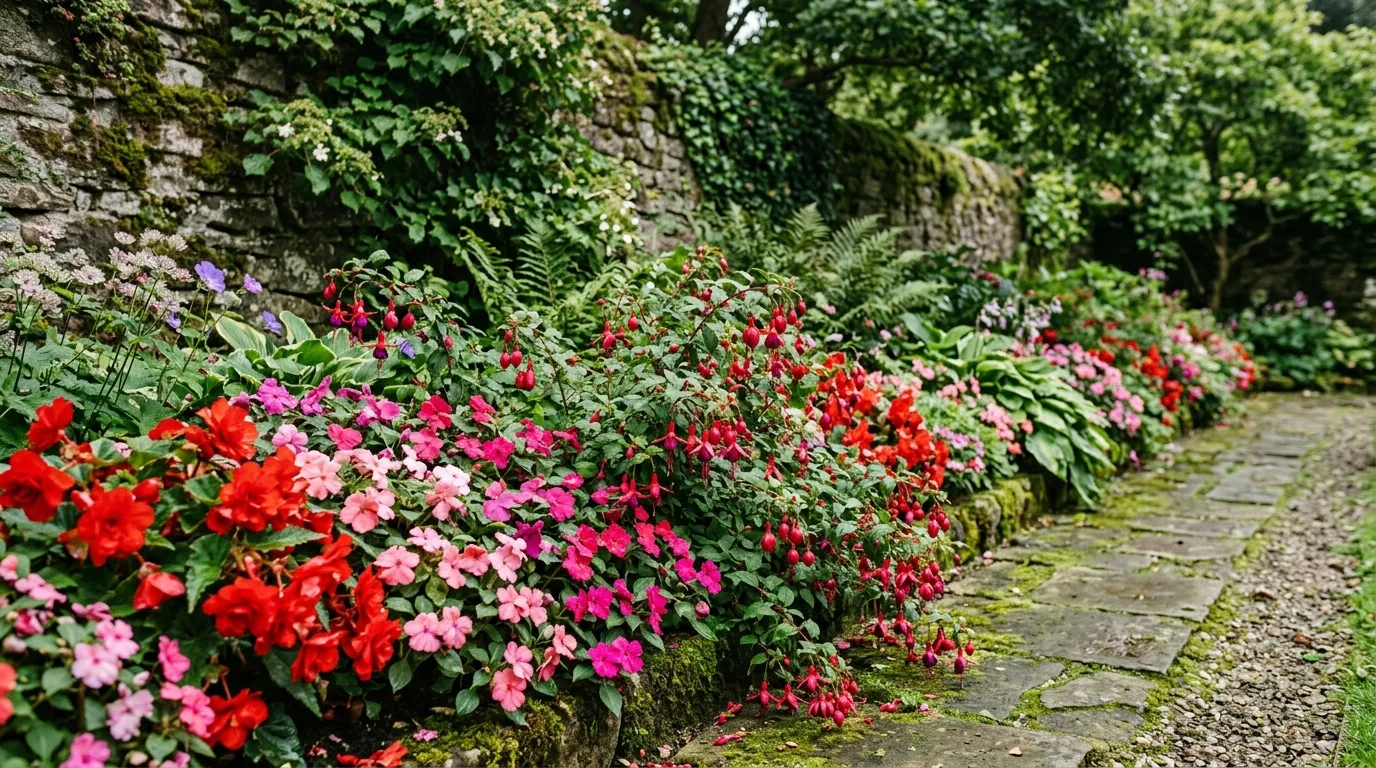
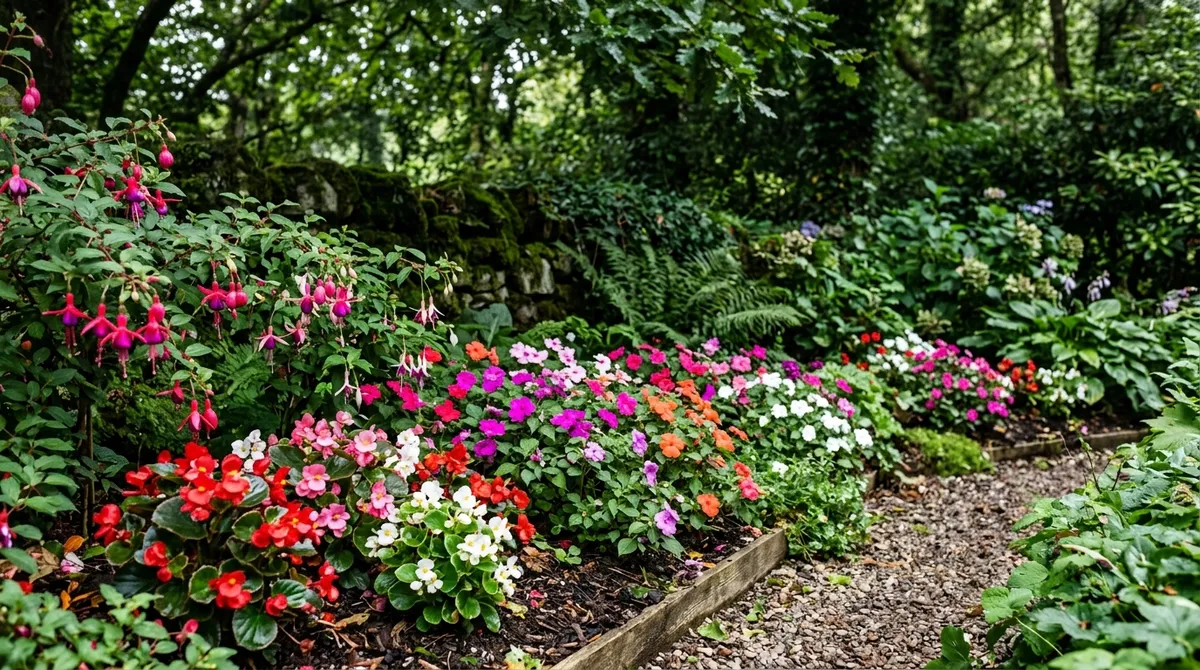
Begonia semperflorens and trailing fuchsias in a north-facing border. Both flower continuously from June to October.
Begonia semperflorens and trailing fuchsia planted together in a north-facing border — both reliably flower from June to October in fewer than 3 hours of sun.
Height is compact — 15-30cm — making it ideal for edging paths or filling the front of a shaded border. Foliage is either green or bronze; bronze-leaved varieties (such as ‘Cocktail Series’) tend to be slightly more vigorous in shade. Flower colours run from white through pink to deep red. F1 hybrid varieties like ‘Senator’ and ‘Ambassador’ produce uniform, vigorous plants.
Buy as plug plants from late April or garden centre trays from mid-May. Grow on under cover until the last frost has passed. Plant at 20-25cm spacing. Water in well and mulch around the base. No deadheading is required — spent flowers drop cleanly. Feed every 10-14 days from June with tomato liquid feed to sustain the flowering from June to October.
Tuberous begonias: dramatic colour in containers
Tuberous begonias (Begonia × tuberhybrida) are the large-flowered cousins of semperflorens. Each bloom can reach 10-15cm across in some named varieties, in saturated shades of yellow, orange, red, pink, and white. They suit containers and hanging baskets against north-facing walls where their bold flowers create maximum visual impact.
Start tubers indoors in February-March, hollow side up, in barely moist compost at 18-20°C. Shoots appear within 3-4 weeks. Grow on in bright indirect light and harden off before planting out in late May. Tuberous begonias are thirsty plants — check containers daily. They prefer 2-4 hours of indirect light; more sun bleaches the flowers.
At the end of the season, lift tubers before the first frost, dry them for 2-3 weeks, and store in dry compost or vermiculite at 5-10°C over winter. A single tuber, properly overwintered, produces a larger and better-flowered plant the following season.
Fuchsia: trailing for baskets, upright for borders
Fuchsias are the quintessential shade annual for UK gardens. Their pendulous, often bicoloured flowers — typically one colour for the tube and sepals, a contrasting colour for the petals — are produced in enormous quantities from June to October. No annual handles a north-facing wall better.
Trailing fuchsias (such as ‘Swingtime’, ‘Pink Marshmallow’, and ‘Tom Thumb’) are grown for hanging baskets and window boxes. They cascade 40-60cm from the container edge. In a large 35cm basket, five trailing fuchsias create a display that remains in flower for five full months without any deadheading beyond removing fully finished blooms.
Upright fuchsias (such as ‘Mrs Popple’, ‘Riccartonii’, and ‘Alice Hoffman’) suit mixed borders and large containers. They grow to 45-90cm and combine well with begonias and hostas in a layered north-facing planting. For more shade planting inspiration, see north-facing garden ideas for the UK.
Fuchsias are frost-tender. Plant out after the last frost in late May, or buy earlier and keep under cover. Feed with high-potash liquid feed weekly from June. If you can overwinter them in a frost-free greenhouse, established plants flower more freely the following season than newly purchased ones.
Torenia: the underused shade annual
Torenia (Torenia fournieri), also called the wishbone flower, is one of the most underused annuals for shade in the UK. It resembles a miniature snapdragon — tubular flowers with two-toned petals, typically purple with yellow markings, though also available in pink and white.
It genuinely performs in deep shade. In my trials against a north-facing wall, torenia flowered freely from July to October where begonias were the only other annual performing reliably. Height is 25-35cm, making it ideal for pots and the front of borders.
Sow indoors at 20-22°C in March-April. Torenia is a small-seeded annual that takes 10-14 days to germinate. Prick out into individual modules, harden off, and plant out after the last frost at 20-25cm spacing. Buy as plug plants in May if you miss the sowing window — torenia is becoming more widely available in garden centres as its reputation grows.
Lobelia, nicotiana, nemesia, viola, and mimulus
Lobelia (Lobelia erinus) in trailing form suits the edges of shade containers and hanging baskets. It tolerates partial shade well but struggles in full shade, producing sparse growth. The classic ‘Sapphire’ (blue with white eye) and ‘Crystal Palace’ (deep blue, bronze foliage) are the most shade-tolerant varieties. Sow indoors February-March at 20°C — the seed is tiny and requires light to germinate (do not cover with compost).
Nicotiana (tobacco plant) provides height — Nicotiana sylvestris reaches 90-150cm — and the bonus of evening scent from its white flowers. It tolerates partial shade with 2-4 hours of indirect sun. The scent is strongest after 6pm, making it excellent for a shaded seating area. Sow indoors in March, surface sowing on moist compost at 18-20°C.
Nemesia performs in cool partial shade and is particularly good in Scotland and northern England, where cooler summer temperatures suit its temperament. It runs out of steam in hot summers but recovers if cut back by two-thirds in July. Height 20-30cm, in a wide colour range.
Violas and pansies (Viola spp.) are the shade annuals for autumn to spring colour. Plant in September-October for winter and spring flowering through to May. They tolerate deep shade in winter when nothing else is in flower, making them invaluable for north-facing containers and borders. The annual flower planting calendar covers exact UK planting windows.
Mimulus (monkey flower) is the specialist for damp shade. It carries vivid yellow, orange, or spotted flowers from June to September, and is one of the few annuals that positively thrives in wet conditions — beside a pond, under a dripping tap, or in a poorly drained shaded corner.
Shade containers and hanging baskets: planting guide
Shade containers reward careful plant selection and consistent maintenance more than any other planting type. Follow these principles for reliable results.
A well-planted north-facing container with begonia, fuchsia, and torenia — three shade annuals that reliably cover the gap from June to October.
Compost choice. Use a good-quality peat-free multipurpose compost with added slow-release fertiliser granules (e.g. Osmocote). Mix in 20% perlite or horticultural grit by volume to improve drainage — shade containers dry out less than sunny ones but are prone to waterlogging in UK wet summers.
Plant at the right time. All the key shade annuals are frost-tender. Planting before the last frost risk — typically mid-May in the Midlands, late May in Scotland — guarantees losses. Wait for a stable frost-free forecast.
Watering schedule. Shade containers need less frequent watering than sun containers. In June, every 2-3 days is typical. In July-August during warm spells, check daily. Push a finger 2cm into compost: if dry, water thoroughly. If in doubt, don’t water — begonias and fuchsias are more tolerant of drying out than of permanent saturation.
Feeding. Begin liquid feeding 6-8 weeks after planting, by which time slow-release granules start to exhaust. Use high-potash tomato feed (e.g. Tomorite) at half-strength every 10-14 days from late June to September.
For more on container gardening ideas that work in challenging spots, including shade, see container gardening ideas for UK gardens.
Shade hanging baskets: making them work
Shade hanging baskets are harder to sustain than sun baskets because the available plant palette is smaller, but they are not impossible. The combination of trailing fuchsia, trailing begonia (pendula type), and trailing lobelia covers most of what a hanging basket needs: height, spread, and flower colour.
Trailing fuchsia and pendula begonia in a shade hanging basket — both tolerate north-facing positions and flower from June to October.
Use a minimum 35cm basket for shade plantings. Smaller baskets dry out too fast and restrict root development. Line with coir (not moss, which degrades quickly). Use moisture-retentive compost and add water-retaining granules to the mix at planting — they absorb up to 400 times their weight in water and reduce watering frequency by around 30%.
Plant at a ratio of 3 trailing plants to 1-2 bushy upright plants. For a 35cm basket: three trailing fuchsias plus two begonia semperflorens in the centre. Alternatively: three trailing fuchsias, one pendula begonia, and three trailing lobelias to fill gaps. Water daily during July and August — even shade baskets dry out in warm spells. Hanging baskets pair particularly well with balcony settings; see balcony gardening ideas for the UK for more.
North-facing beds: planting for season-long colour
A north-facing border is the hardest planting challenge in a UK garden, but shade annuals provide the colour layer that permanent plants cannot. Hostas, ferns, and hydrangeas give structure; begonias, fuchsias, and torenia fill in the flowering colour from June to October when little else is blooming.
Plant shade annuals in drifts rather than dot-planting. Three begonias or five lobelias planted as a group make far more visual impact than individual plants scattered through a border. Place taller plants (nicotiana, upright fuchsia) at the back, mid-height plants (begonias, torenia) in the middle, and trailing or edging plants (lobelia, viola) at the front.
Combine shade annuals with shade perennials for a layered planting that provides interest at multiple heights. Hostas and astilbes provide foliage and flower at mid-height. Ferns provide structure and texture. Hellebores flower in spring before the annuals go in. For guidance on the best permanent planting partners, see best perennial plants for UK gardens and best shrubs for shade in UK gardens.
Soil preparation matters. North-facing borders often have dry, compacted soil because they receive less rain and less sunlight to break down organic matter. Dig in a 10cm layer of garden compost or well-rotted manure before planting. This improves moisture retention and provides the humus-rich conditions that shade annuals prefer.
Combining shade annuals with shade perennials
The most successful shade plantings combine the instant seasonal colour of annuals with the structure and permanence of shade perennials. This layered approach gives a north-facing border genuine depth — not just a flat carpet of bedding plants.
Tried combinations from the trial border:
- Begonia semperflorens underplanted beneath a Hydrangea ‘Annabelle’ — the begonias fill the gap at the base of the hydrangea while it develops its flower heads.
- Trailing fuchsia in a pot positioned in front of a mature Fatsia japonica — the glossy fatsia leaves provide a backdrop that makes the fuchsia flowers pop.
- Torenia in the gaps between established hostas — the hostas suppress weed growth and the torenia provides colour where the hostas leave bare soil.
- Nicotiana sylvestris at the back of a fern border — height and evening scent without competing for light at lower levels.
For full guidance on structuring a shade border with permanent plants, read best plants for shade in UK gardens. For shade shrub selection, best shrubs for shade in UK gardens covers hydrangeas, fatsia, and aucuba in detail.
Where to buy shade annuals in the UK
The RHS guide to annuals for shade lists RHS Award of Garden Merit (AGM) varieties tested for reliable performance in UK conditions. AGM varieties have been trialled at Wisley or partner gardens and shown consistent results across different conditions. When buying from garden centres or online nurseries, look for the AGM symbol as a first indicator of quality.
For SunPatiens specifically, specialist plug plant suppliers (Thompson & Morgan, Suttons, Dobies) carry these from February onwards. They are typically sold as rooted plugs in February-April, growing on kits from March, and larger plants from May. Buy plugs early and grow them on in a frost-free greenhouse or windowsill for the largest plants come planting time.
The RHS list of annuals for shade is also a reliable source for variety recommendations backed by trial data from UK conditions.
Frequently asked questions
What annuals grow in full shade in UK gardens?
Begonia semperflorens and busy lizzies (SunPatiens) are the most reliable annuals in full shade. Both flower with fewer than 2 hours of direct sun per day, making them suitable for north-facing walls. Torenia fournieri and trailing fuchsias also tolerate full shade reliably. Nicotiana and Mimulus suit damp, fully shaded corners. For the absolute deepest shade, begonia semperflorens is the most dependable choice, flowering non-stop from June to October without any direct sunlight requirement.
Can I grow busy lizzies in shade in the UK?
Busy lizzies thrive in shade and have long been the go-to annual for shaded UK gardens. Traditional Impatiens walleriana is highly susceptible to downy mildew, which has made it unreliable since 2011. SunPatiens, a mildew-resistant hybrid from Sakata Seed, is the recommended replacement. It tolerates both shade and more sun than its predecessor, making it more versatile. Plant after the last frost in late May in moist, humus-rich compost. Avoid waterlogging, which causes stem rot.
Are fuchsias annuals or perennials in the UK?
Fuchsias are tender perennials treated as annuals outdoors in the UK. They are frost-sensitive and killed by temperatures below -2C, so most gardeners buy fresh each spring. Hardy fuchsias such as Fuchsia magellanica survive outdoors in milder UK regions. Standard bedding and trailing fuchsias can be overwintered in a frost-free greenhouse and grown on for subsequent seasons, producing larger and better-flowered plants than newly purchased stock.
What shade annuals are best for hanging baskets?
Trailing fuchsias, pendula (trailing) begonias, and trailing lobelia are the best shade annuals for hanging baskets. Trailing fuchsia produces pendulous flowers June to October and tolerates north-facing positions reliably. Pendula begonias provide large flowers and a cascading habit. Lobelia trails to 30-40cm and fills gaps between larger plants. Use a minimum 35cm basket, moisture-retentive compost, and water daily in summer — even shade baskets dry out in warm weather.
When do I plant shade annuals outdoors in the UK?
Plant shade annuals outdoors after the last frost risk passes. In southern England this is typically mid-May; in the Midlands late May; in Scotland and northern England early June. All the key shade annuals — busy lizzies, begonias, fuchsias, and torenia — are frost-sensitive. Check regional frost maps before planting and wait for a settled, frost-free forecast. Our hanging baskets guide covers timing in more detail.
How do I water shade annuals in north-facing containers?
Check containers every 1-2 days from June to September, even in shade. Shade pots dry out more slowly than sunny ones but still need consistent attention during warm spells. Push a finger 2cm into the compost — if it feels dry, water thoroughly until drainage runs from the base. Feed with high-potash liquid fertiliser (tomato feed) at half-strength every 10-14 days from June to August to sustain continuous flowering. Avoid overwatering: begonias and fuchsias are more tolerant of drying out than of permanently wet compost.
Do begonias prefer sun or shade?
Begonias prefer partial to full shade in the UK. Begonia semperflorens flowers in 1-4 hours of indirect sun and scorches in direct afternoon sun. Tuberous begonias also prefer shade and are ideal for containers against north-facing walls. Both types tolerate the low light levels of a UK summer far better than most bedding annuals. Avoid placing either type in south-facing positions in full sun — the flowers bleach and the plants stress in warm, bright conditions.
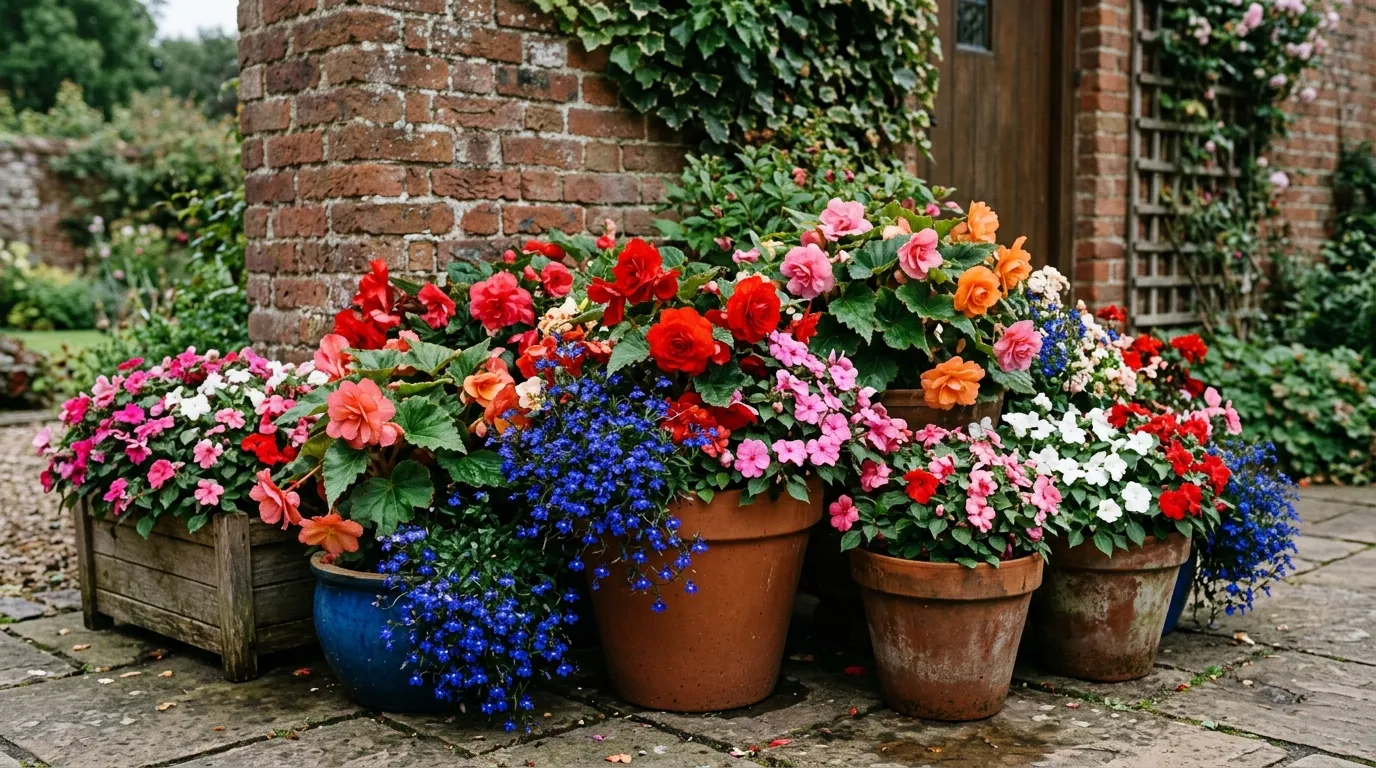
Containers of busy lizzies, begonias and lobelia brighten a north-facing wall. All tolerate less than 4 hours of direct sun.
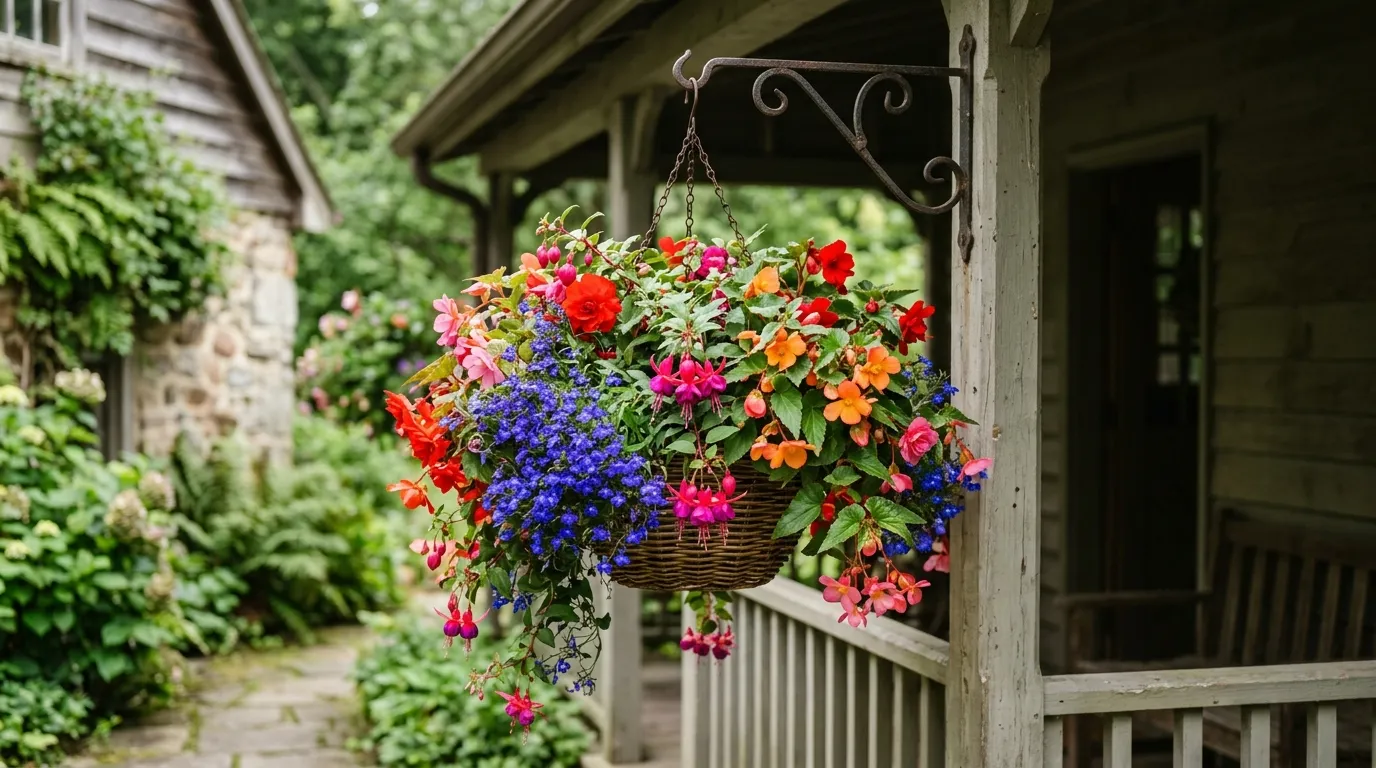
A shade-tolerant hanging basket with trailing fuchsia, lobelia and begonias. Suitable for a north-facing porch.
Related reading
- Best plants for shade in UK gardens — hostas, ferns, and shade perennials for permanent planting
- North-facing garden ideas for the UK — design strategies and plant lists for challenging aspects
- Best shrubs for shade in UK gardens — hydrangeas, fatsia, and aucuba for year-round structure
- Container gardening ideas for UK gardens — creative planting for pots, troughs, and planters
- How to plant and maintain hanging baskets in the UK — watering, feeding, and plant combinations
Lawrie has been gardening in the West Midlands for over 30 years. He grows his own veg using no-dig methods, keeps a wildlife-friendly garden, and writes practical advice based on real UK growing conditions.