Container Gardening Ideas for the UK
Best container gardening ideas for UK gardens, patios and balconies. Pot sizes, compost mixes, plant combinations and year-round displays from 10 years.
Key takeaways
- Minimum 30cm pot diameter for most plants - anything smaller dries out too fast in UK summers
- Terracotta pots must be frost-proof rated or they crack in UK winters (check the label)
- Use 70% multipurpose compost, 20% John Innes No.3 and 10% perlite for the best all-round mix
- A three-season rotation (spring bulbs, summer bedding, winter evergreens) gives year-round colour
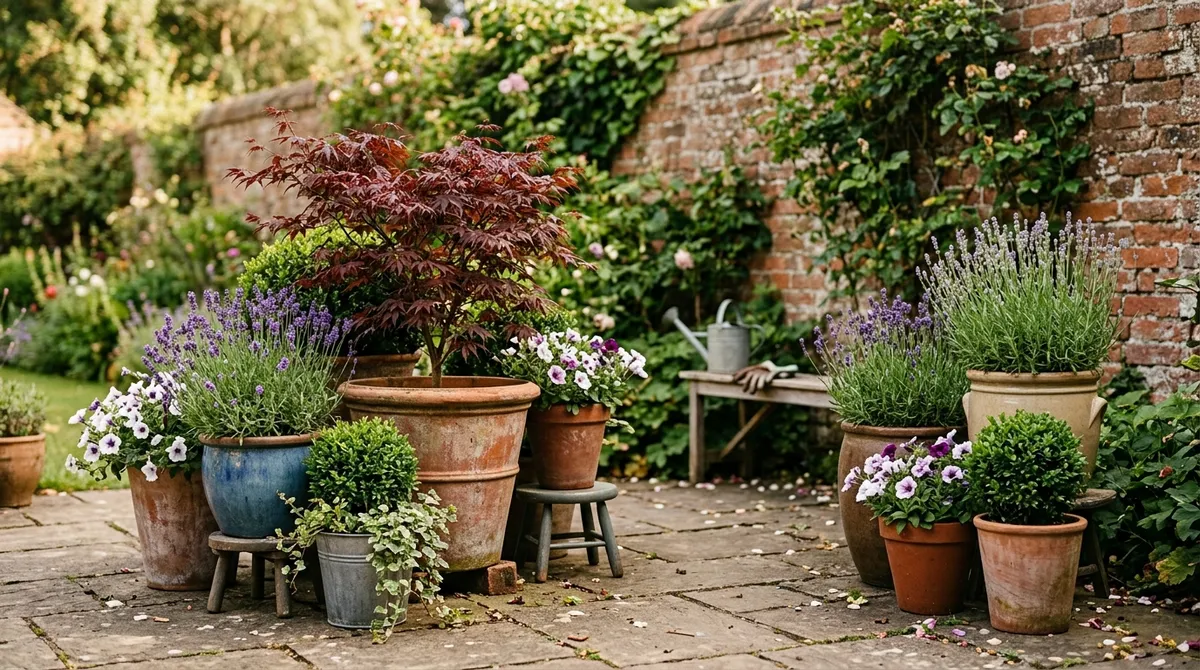
- Group odd numbers of pots (3, 5, 7) at different heights for the most natural-looking display
Container gardening is the most versatile way to garden in the UK. Every outdoor space works, from a narrow balcony to a wide country patio. Pots go where borders cannot: on concrete, decking, gravel and even flat roofs.
The flexibility comes with one catch. Plants in containers depend entirely on you for water, nutrients and root space. Get the fundamentals right and containers reward you with colour and structure year-round. Get them wrong and you are throwing money away every summer.
This guide covers the ideas, plant combinations and techniques I have refined over 10 years of container gardening in the West Midlands.
Choosing containers: material and size
The container itself affects plant performance more than most people realise. Material determines weight, insulation, moisture retention and frost survival. Size determines how often you water and how large plants can grow.
Material comparison
| Material | Weight | Frost hardy | Insulation | Moisture | Cost (40cm) | Best for |
|---|---|---|---|---|---|---|
| Terracotta (frost-proof) | Heavy | Yes | Good | Porous (dries faster) | 25-60 pounds | Traditional, herbs, Mediterranean |
| Glazed ceramic | Heavy | Usually | Good | Non-porous | 30-80 pounds | Statement pieces, Japanese maple |
| Fibreglass | Light | Yes | Poor | Non-porous | 20-50 pounds | Balconies, roof terraces |
| Galvanised metal | Medium | Yes | Poor | Non-porous | 15-40 pounds | Modern, industrial style |
| Wooden (hardwood) | Heavy | Yes | Good | Semi-porous | 30-100 pounds | Raised beds, vegetable growing |
| Plastic | Very light | Yes | Poor | Non-porous | 5-15 pounds | Budget, lightweight situations |
Weight matters for stability. A 50cm terracotta pot filled with wet compost weighs 30-40kg. This is an advantage on an exposed patio (wind will not topple it) but a problem on a balcony with weight limits. For balcony gardens, use fibreglass or plastic with a heavy compost mix at the base.
Frost hardiness is non-negotiable in the UK. Standard terracotta (not frost-proof) absorbs water through the porous walls. When this water freezes, it expands and shatters the pot. I lost 6 pots in the 2018 Beast from the East before switching to frost-proof terracotta exclusively.
Size guide
The minimum useful pot size is 30cm diameter. Below this, compost volume is too low to buffer temperature swings or retain moisture through a summer day.
- 30cm pots: Herbs, annual bedding, small grasses, alpines
- 40cm pots: Lavender, box, heuchera, hostas, small shrubs
- 50cm+ pots: Japanese maple, hydrangea, agapanthus, dwarf fruit trees
- Trough planters (60cm+): Mixed plantings, herb gardens, seasonal displays
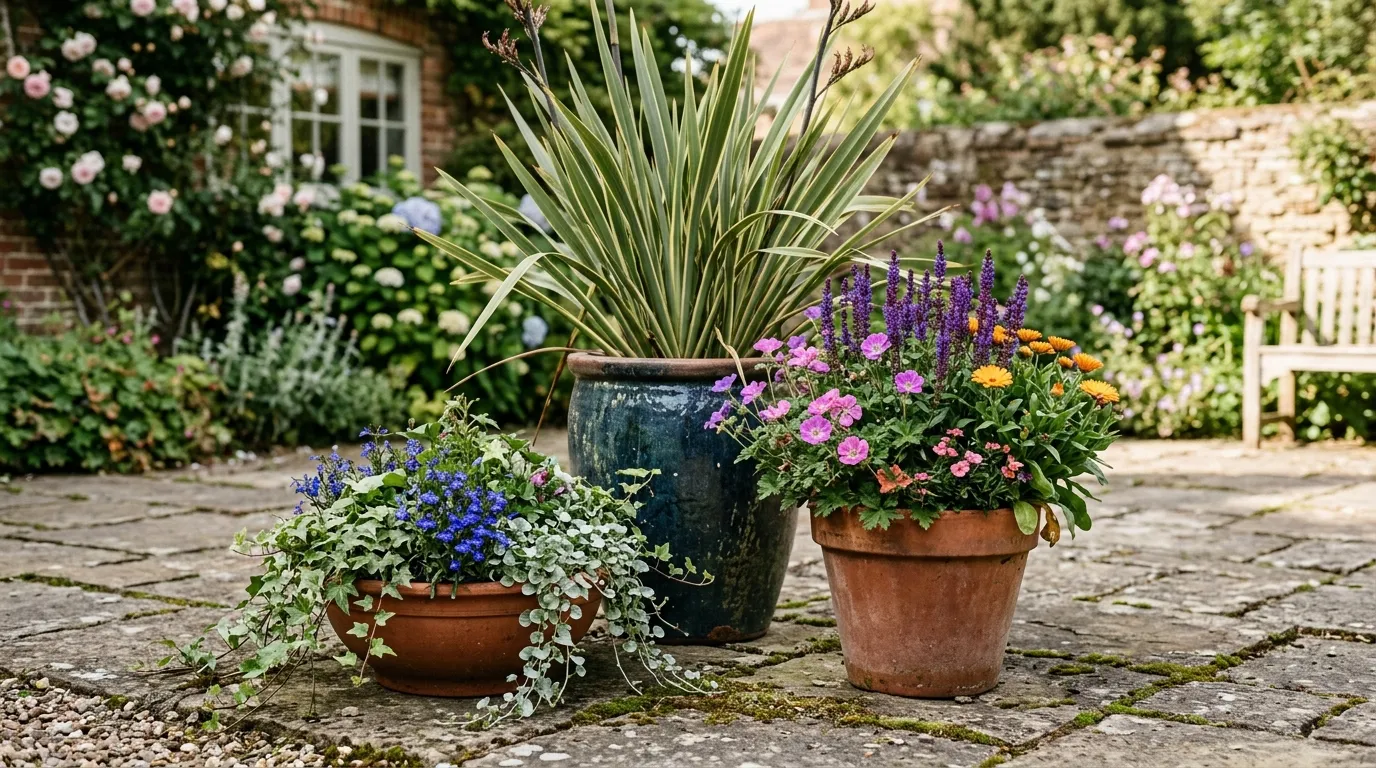
Containers grouped in threes at different heights. The tallest pot is at the back with trailing plants softening the edges of the front pots.
The best compost mix for containers
This is the mix I use for all permanent container plantings:
- 70% multipurpose compost (peat-free works well)
- 20% John Innes No.3 (adds weight, slow-release nutrients and structure)
- 10% perlite (prevents compaction, improves drainage)
Add slow-release fertiliser (Osmocote or similar) at the manufacturer’s rate and water retention crystals at 3g per litre.
For Mediterranean plants (lavender, rosemary, cistus), increase perlite to 20% and reduce multipurpose compost to 60%. These plants need sharper drainage and resent sitting in wet compost through a UK winter.
For acid-loving plants (rhododendrons, camellias, blueberries), substitute ericaceous compost for the multipurpose element. The John Innes element provides stability while the ericaceous compost maintains the low pH these plants need.
Container ideas by garden style
Cottage garden containers
Use weathered terracotta filled with roses, lavender, sweet peas and trailing aubrieta. Group pots asymmetrically around a door or along a path edge. Add herbs like thyme and sage for scent and texture. For the best rose varieties for pots and the right compost mix, see our guide to growing roses in containers.
Modern minimalist containers
Tall, narrow fibreglass or metal planters in black, grey or white. Plant with architectural specimens: box balls, grasses (Hakonechloa or miscanthus), or single-species displays of agapanthus. Line them along a wall or terrace edge for clean, structured impact.
Edible container garden
Grow vegetables in containers using deep pots (40cm minimum). Tomatoes, chilli peppers, salad leaves, herbs and strawberries all perform well. Use a south-facing wall for maximum warmth and light.
Shade-tolerant containers
Hostas, ferns, hellebores, heuchera and hydrangeas thrive in shady positions. Use glazed or plastic pots (terracotta dries too fast in shade where air circulation is often poor). Add trailing ivy for evergreen structure.
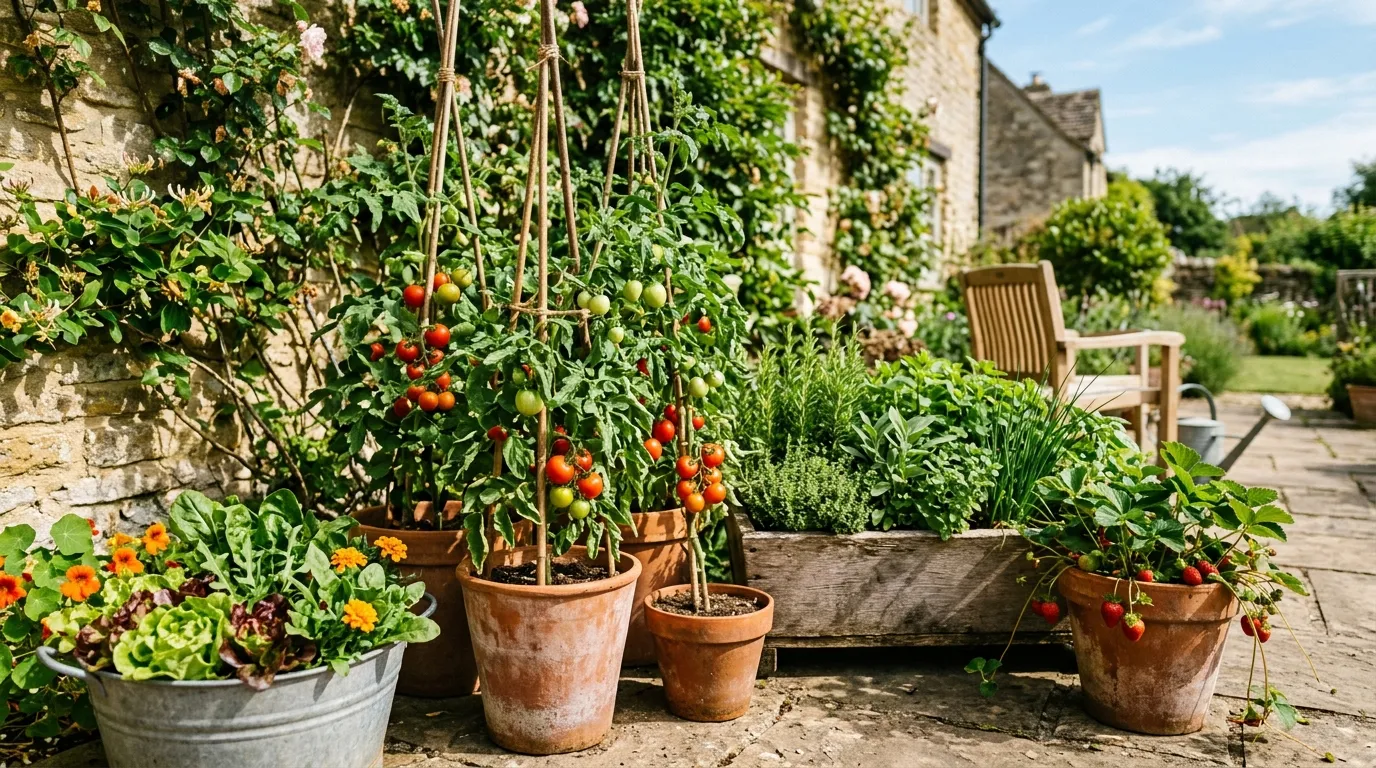
An edible container garden on a south-facing patio. Tomatoes, herbs and salad leaves in a mix of terracotta and wooden containers.
Year-round container planting plan
The key to continuous colour is a three-season rotation. Use permanent structural plants as anchors and change the seasonal underplanting three times a year.
Permanent structural plants (stay year-round)
Box (Buxus), Japanese maple (Acer palmatum), bay tree, olive (in mild areas), evergreen grasses, phormium. These provide the backbone of the display through winter.
Spring display (plant October, display February to May)
Tulips, daffodils, hyacinths, primroses, polyanthus, forget-me-nots. Use bulb lasagne planting (layers of bulbs at different depths) for a succession of colour from February to May.
Summer display (plant mid-May, display June to October)
Trailing petunias, geraniums, lobelia, fuchsia, verbena, osteospermum. Replace spring bedding after the last frost with summer plants for five months of continuous flowering.
Winter display (plant October, display November to February)
Cyclamen, winter pansies, heather, skimmia berries, ornamental cabbage, trailing ivy. These tolerate frost and keep the patio colourful through the darkest months.
| Season | Plant in | Display period | Key plants | Feeding |
|---|---|---|---|---|
| Spring | October | Feb to May | Tulips, daffodils, primroses | None needed |
| Summer | Mid-May | June to October | Petunias, geraniums, fuchsia | Weekly high-potash |
| Winter | October | Nov to February | Cyclamen, pansies, heather | None needed |
Arranging containers for maximum impact
The arrangement matters as much as the planting. A random scattering of pots looks cluttered. A deliberate grouping looks designed.
Rule of odds: Group in 3s, 5s or 7s. Odd numbers create more natural, pleasing compositions than even numbers.
Three heights: Every group needs at least three different heights. Place the tallest pot at the back (or centre for island groups), medium pots in the middle and low pots or saucers at the front.
Repeat elements: Use the same plant or pot colour in at least two locations across the patio. This creates rhythm and ties the display together.
Leave space: Containers need breathing room. Overcrowded pots compete for light and air. Leave 10-15cm between pots for air circulation and visual clarity.
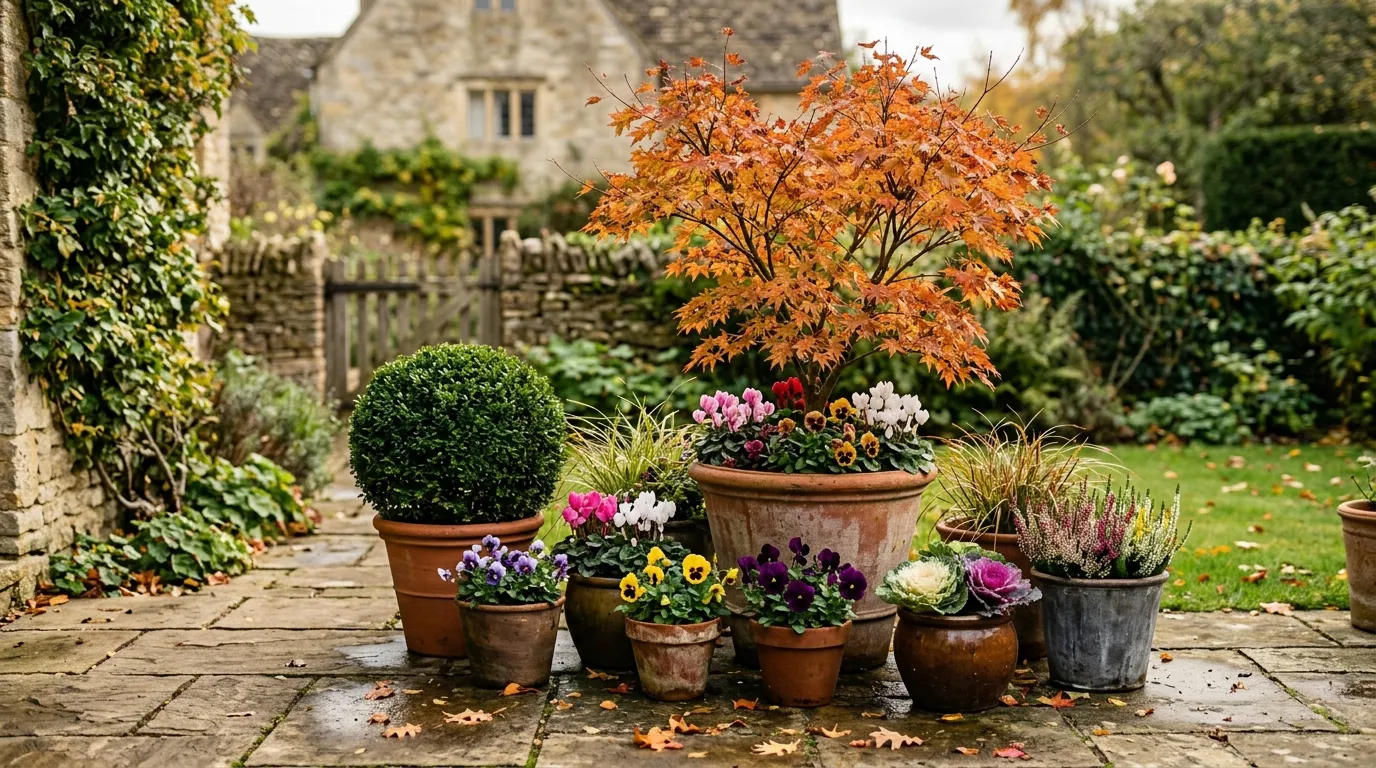
A year-round container display using permanent structural plants (box, Japanese maple) with seasonal underplanting changed three times a year.
Watering and feeding containers
Summer watering: Check daily. Water until it flows from the drainage holes. Early morning is best as it reduces evaporation losses. Evening watering is acceptable but can encourage slugs. During heatwaves above 25C, large pots may need watering twice daily.
Winter watering: Overwatering kills more container plants in winter than cold does. Water only when the top 3cm of compost is dry. Raise pots on feet to prevent waterlogging.
Feeding schedule: Start feeding in April with a balanced liquid fertiliser (such as Maxicrop) every two weeks. Switch to a high-potash feed (tomato food) from June for flowering plants. Stop feeding in September. Permanent plants benefit from fresh slow-release fertiliser in March each year.
Common container gardening mistakes
Too-small pots. The number one mistake. Small pots dry out fast, overheat in summer and freeze solid in winter. Go bigger than you think you need.
No drainage. Every pot must have drainage holes. No exceptions. Standing water rots roots within days, even for moisture-loving plants.
Wrong compost. Garden soil compacts into a brick in containers. Pure multipurpose compost shrinks away from pot walls when dry. Use the blended mix described above.
Forgetting to feed. Container plants exhaust the nutrients in their compost within 6-8 weeks. Without regular feeding, growth stalls and flowering stops. Slow-release granules plus weekly liquid feed in summer covers all bases.
Related reading
Lawrie has been gardening in the West Midlands for over 30 years. He grows his own veg using no-dig methods, keeps a wildlife-friendly garden, and writes practical advice based on real UK growing conditions.