Key takeaways
- Capsid bug damage shows as pinprick holes on young foliage that tear open as leaves expand
- Common green capsid is the worst UK species, with two generations per year on apple and currant
- Sticky barrier bands may help intercept capsids moving up woody stems
- Capsid hides on the underside of leaves and drops to the ground when disturbed
- Damage is cosmetic on most plants but ruins dahlia, chrysanthemum, and fuchsia show blooms
You will find the lifecycle stages that affect treatment timing, plus monitoring, hand-picking, barrier and spray options. For broader pest management, pair this with our aphid control guide and our biological pest control overview.
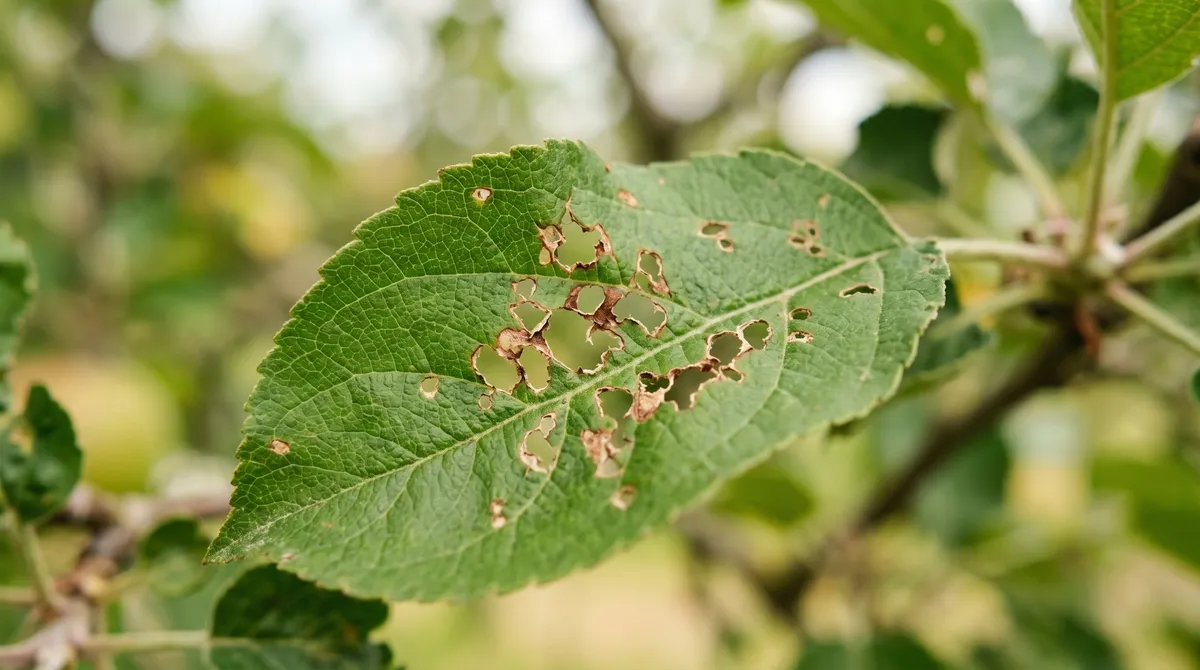
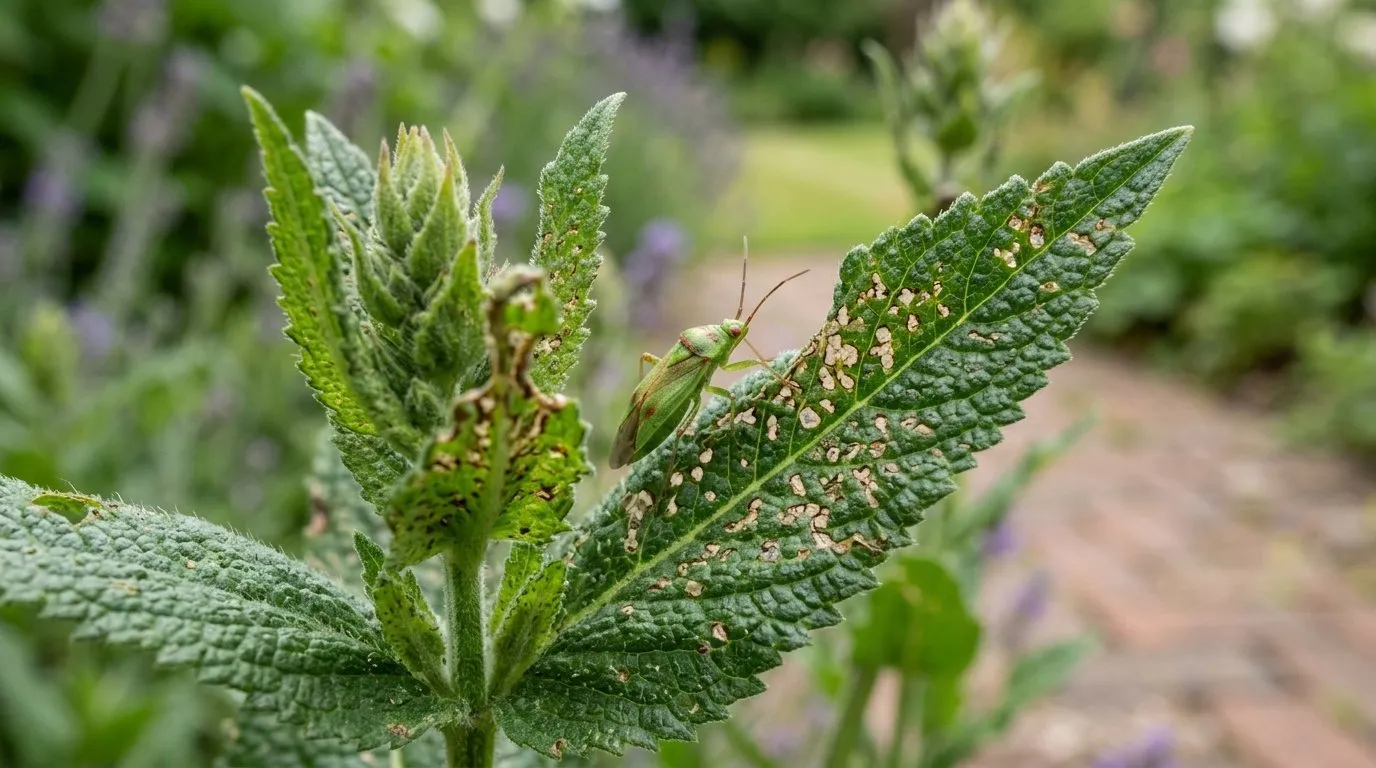 Common green capsid damage on a Bramley apple leaf in mid-May, the small early holes have torn open as the leaf expanded
How to identify capsid bug damage
Capsid bug damage is the most distinctive ragged-hole pattern in UK gardens. The pinprick holes start at 1mm across and expand to 5-10mm as the leaf grows. Each hole has a brown or yellow margin where capsid saliva has killed surrounding cells.
The damage appears first on the youngest, most tender leaves at shoot tips. As leaves age and toughen, capsids move to fresh growth higher up. By July, lower leaves are tattered while upper leaves show fresh damage.
On apple and pear, look for tattered leaves and distorted fruitlets in May and June. Damaged fruitlets develop corky bumps where capsid feeding has scarred the skin. By harvest, affected apples carry russet patches that downgrade dessert apples to cookers.
On dahlia and chrysanthemum, look for distorted buds that fail to open or open with petals that are notched or partly green. Capsid feeding on flower buds destroys petal cells before the bud opens, leaving permanent disfigurement. A single capsid can ruin a show dahlia in one feeding session.
On currants and gooseberries, look for tattered new shoots and sticky leaf surfaces. Capsids on currants overwinter in bud scales and emerge in late April, giving them a 2-3 week head start on most other UK garden pests.
On fuchsia, salvia, and most herbaceous plants, look for ragged holes on the youngest tip leaves and brown blotches at flower buds.
The pest itself is rarely seen in the act. Adults and nymphs drop to the ground when disturbed and run for cover under leaf litter. Identification usually relies on the damage signature alone.
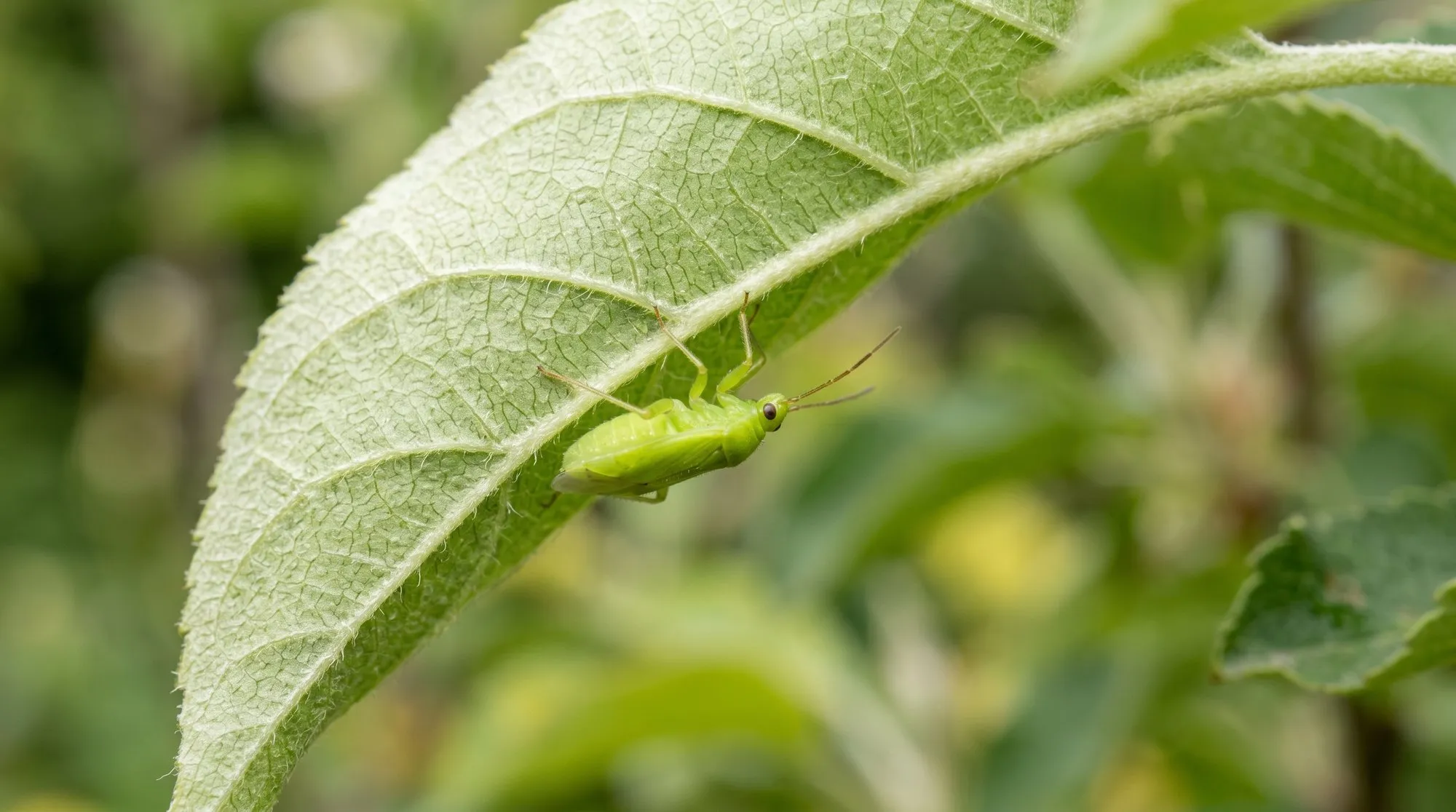 Common green capsid nymph on a fresh apple leaf in late May, the bright green wingless form before adult moult
The four UK capsid species
Four capsid species cause significant damage in UK gardens, with the common green capsid (Lygocoris pabulinus) responsible for over 70% of identified damage. The other three species target specific plant groups and rarely overlap with apple or dahlia.
Common green capsid (Lygocoris pabulinus) is the dominant species. Adults are 6-7mm long, bright green with brown wing tips. Nymphs are bright lime-green and wingless. Two generations per year, with peaks in mid-May and mid-July. Hosts include apple, pear, currant, dahlia, chrysanthemum, fuchsia, salvia, hydrangea, and over 100 herbaceous plants.
Apple capsid (Plesiocoris rugicollis) is a specialist pest of apple, pear, and hawthorn. Adults are 5-6mm long with reddish-brown forewings. One generation per year. Damage closely resembles common green capsid but is concentrated on apple shoots in May.
Bishop bug (Eurydema oleracea) targets brassicas and is sometimes confused with capsid. Adults are 7-8mm long, black with red markings. Less of a UK problem than continental Europe but found in southern English gardens.
Bryant’s mirid (Heterotoma planicornis) is a small woodland species that occasionally moves to garden plants. Adults are 4-5mm long, brown-black with distinctive paddle-shaped antennae. Causes minor damage on rose and oak.
For UK home gardeners, the practical answer is to assume Lygocoris pabulinus unless evidence points elsewhere. The control methods below work for all four species.
Lifecycle and treatment timing
The capsid lifecycle runs through three stages over 6-8 weeks per generation, with two generations per UK season. Treatment timing matters enormously because adults are mobile and hard to control, while nymphs are stationary feeders that yield to spray.
Egg stage runs from late September to mid-April. Females lay eggs into bud scales, twigs, and herbaceous stems. Eggs overwinter and hatch when soil temperatures reach 9C, usually mid-April in southern UK and late April in the north.
Nymph stage lasts 4-5 weeks. Nymphs pass through five instars, each lasting roughly a week. They feed continuously and cause the bulk of visible damage. Nymphs cannot fly and are vulnerable to contact spray and barrier methods.
Adult stage lasts 3-4 weeks. Adults mate and lay the next generation of eggs. They are highly mobile, jumping or flying when disturbed, and rarely sit still long enough for spray contact.
The two-generation pattern creates two damage peaks per season. First peak in mid-May from overwintered eggs. Second peak in mid-July from spring-laid eggs. The second generation is usually larger and more damaging because warm summer weather speeds up nymph development.
The critical timing mistake is treating only when damage appears. Damage shows up 7-14 days after capsid feeding begins, by which time many nymphs have already moulted to adults. Effective control treats during the nymph stage in early May and early July.
| Lifecycle stage | UK timing | Effective treatment |
|---|---|---|
| Overwintering eggs | Sep-Apr | Bud-scale prune, egg-mass removal |
| First-generation nymphs | Late Apr to early Jun | Pyrethrum dusk spray, sticky bands, hand-pick |
| First-generation adults | Mid Jun to early Jul | Limited control, focus on next nymphs |
| Second-generation nymphs | Mid Jul to late Aug | Pyrethrum dusk spray, hand-pick |
| Second-generation adults | Sep | Lay overwintering eggs, no useful control |
Four treatments ranked by effectiveness
Treatment 1: An authorised contact insecticide. Use a product currently authorised for the plant and pest, following the label exactly. Avoid spraying open flowers or active pollinators. Target the leaf undersides where nymphs shelter and never exceed the stated dose or frequency.
Treatment 2: Sticky barrier bands. A horticultural sticky band around a woody stem may intercept insects moving up from low cover. Follow the product instructions and check it regularly. This is less useful on herbaceous plants or where adult capsids fly into the canopy.
Treatment 3: Hand-picking with white card. Place white card under the plant in early morning and tap the foliage gently. Capsids that drop are easier to see against the card. Repeat checks through the growing season if fresh damage appears.
Treatment 4: Habitat management. Remove dense weeds around badly affected plants and clear heavily infested debris. Keep enough varied habitat elsewhere for predators and beneficial insects. Tidying alone will not eliminate capsids.
| Treatment | Role | Best for |
|---|---|---|
| Authorised contact insecticide | Last resort when non-chemical methods are insufficient | Plants and pests listed on the product label |
| Sticky barrier bands | Intercepts some insects moving up woody stems | Currant, cordon apple and gooseberry |
| Hand-pick with white card | Monitoring and removal without pesticide | Dahlia, fuchsia and show plants |
| Habitat management | Reduces shelter around badly affected plants | Longer-term population management |
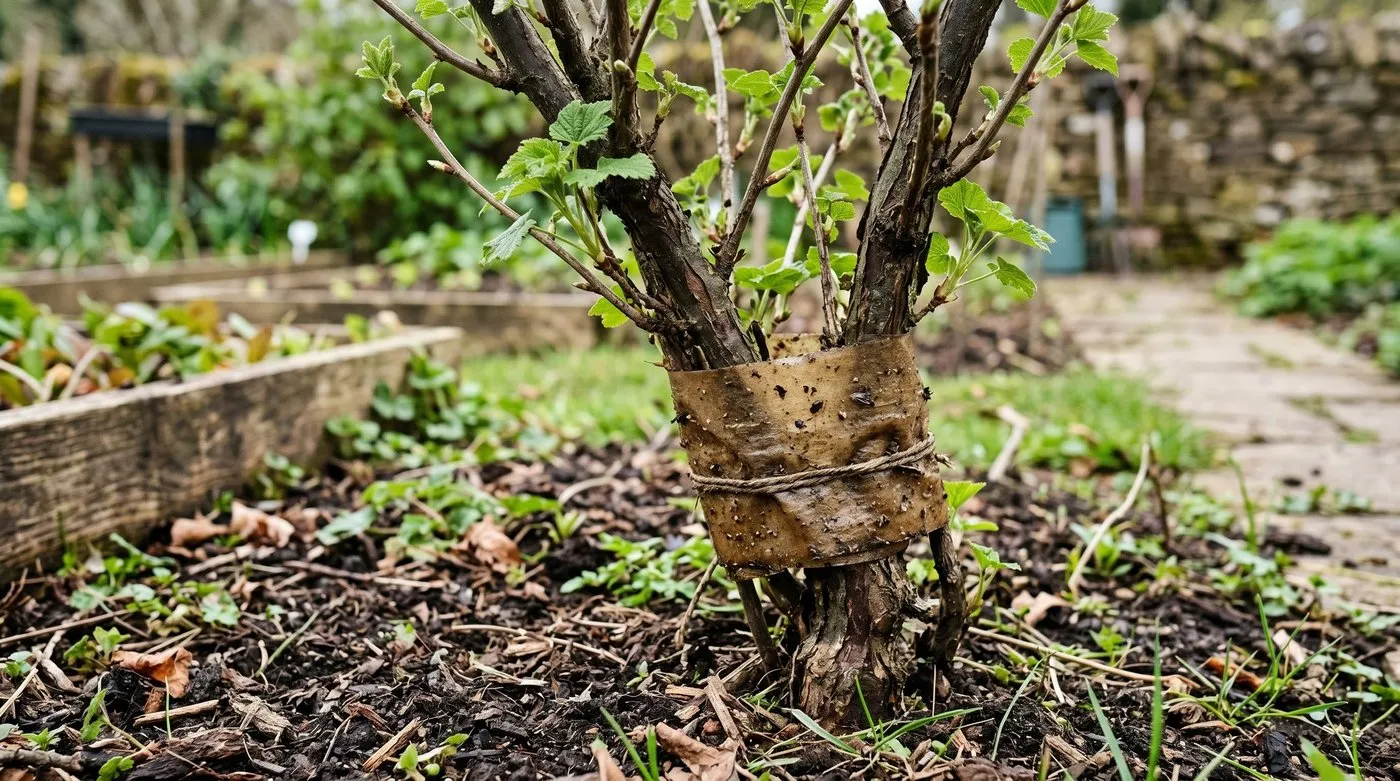 A horticultural sticky band on a redcurrant stem, used as one part of capsid monitoring and management
Step-by-step pyrethrum spray method
Pesticide approvals and label uses can change. Check the current product label before use and choose only a treatment authorised for the plant and pest. Avoid spraying flowers and active pollinators.
Step 1: Check the label and weather conditions. Do not spray in wind or before rain. Follow any temperature, timing and protective-equipment instructions on the product.
Step 2: Mix only at the manufacturer’s stated dilution. Use a clean sprayer that has never held weedkiller.
Step 3: Target the leaf undersides if the label permits. Capsid nymphs often shelter on young growth and beneath leaves.
Step 4: Wet the leaves to runoff. Continue spraying each leaf until droplets begin to form and run. Stop just before drops fall to the soil.
Step 5: Avoid active pollinators. Follow the product’s time-of-day instructions and never spray open flowers visited by bees.
Step 6: Repeat only if the label allows it. Recheck the plant first and stay within the stated application interval and maximum number of treatments.
Step 7: Treat again in early July for the second generation. Match the second peak with the same two-application schedule.
Gardener’s tip: Combine pyrethrum spray with a wetting agent (a few drops of organic liquid soap per litre) on dahlia and chrysanthemum leaves, where the waxy surface otherwise repels droplets. Avoid wetting agents on apple foliage where they can scorch in sunlight.
Common mistakes when treating capsid bug
Five common mistakes can make capsid treatment less effective or increase risks to other insects.
Mistake 1: Spraying in daylight. Pyrethrum kills bees and beneficial insects on contact. Daytime spraying creates a 6-hour window where pollinators are at risk. Always spray at dusk and never in full sunlight.
Mistake 2: Treating after damage shows. Visible damage appears 7-14 days after feeding begins. By then most nymphs have moulted to mobile adults that are hard to spray. Watch for nymphs directly and spray before damage appears.
Mistake 3: Ignoring the leaf undersides. Capsid nymphs often shelter beneath leaves and around young shoots. Inspect these areas before deciding whether treatment is needed.
Mistake 4: Reaching for a broad-spectrum insecticide first. Start with monitoring and non-chemical controls. If a pesticide is necessary, use only a currently authorised product according to its label.
Mistake 5: Stopping after the first treatment. Capsids have two generations per UK season. A single May spray leaves the July generation untouched, which then lays the overwintering eggs for next year. Always plan for two-generation control.
Warning: Never spray pyrethrum on flowering apple or fruit blossom in daylight. Even at dusk, pyrethrum can affect early-emerging bees on warm spring nights. Defer apple-tree spray until after blossom drop, around mid-May in most UK regions.
Frequently asked questions
What does capsid bug damage look like?
Capsid bug damage shows as small pinprick holes on young foliage that expand into ragged tears as the leaf grows. The holes have brown or yellow margins where saliva has killed surrounding cells. Apple leaves show 2-3mm holes; dahlia and chrysanthemum buds show distorted petals or fail to open at all.
When do capsid bugs damage plants in the UK?
Capsid bug nymphs cause damage from late April to early September in UK gardens. Peaks in mid-May and mid-July as the two generations emerge. The first-generation nymphs target apple and currant. The second generation moves to herbaceous plants including dahlia, chrysanthemum, fuchsia, and salvia. Eggs overwinter in bud scales.
What is the difference between capsid bug and aphid damage?
Capsid damage is dry, ragged holes on young leaves; aphid damage is sticky honeydew, sooty mould, and curled leaves with no holes. Capsid bugs jump or drop when disturbed; aphids stay still in colonies. Capsid nymphs are 3-5mm long and bright green; aphids are 1-3mm and form clustered colonies of dozens or hundreds.
Now you have the capsid bug playbook, read our guide on growing dahlias UK for the variety choices that suffer least from late-summer capsid damage.
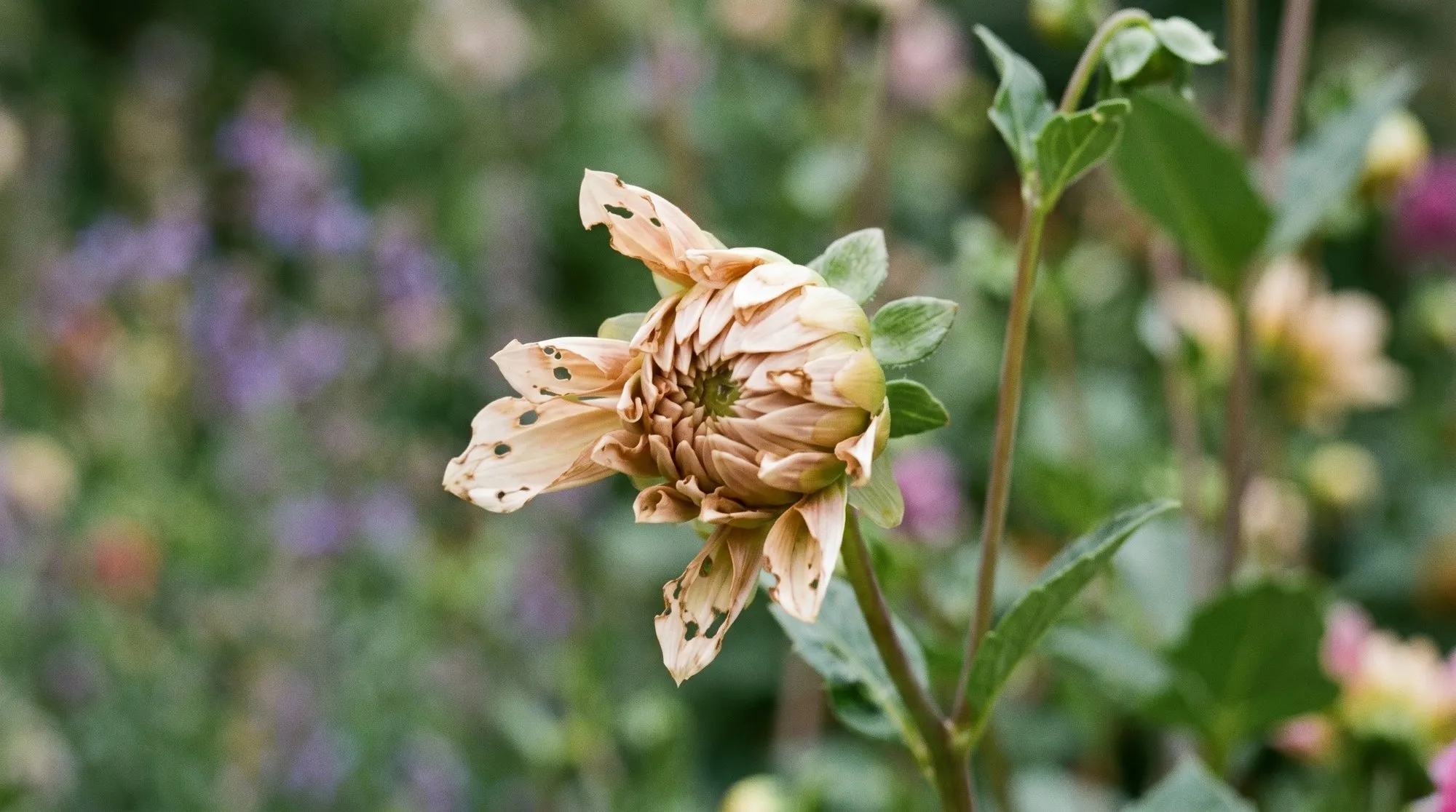 Capsid damage on a Cafe au Lait dahlia bud, the notched petals reveal where second-generation nymphs fed before opening
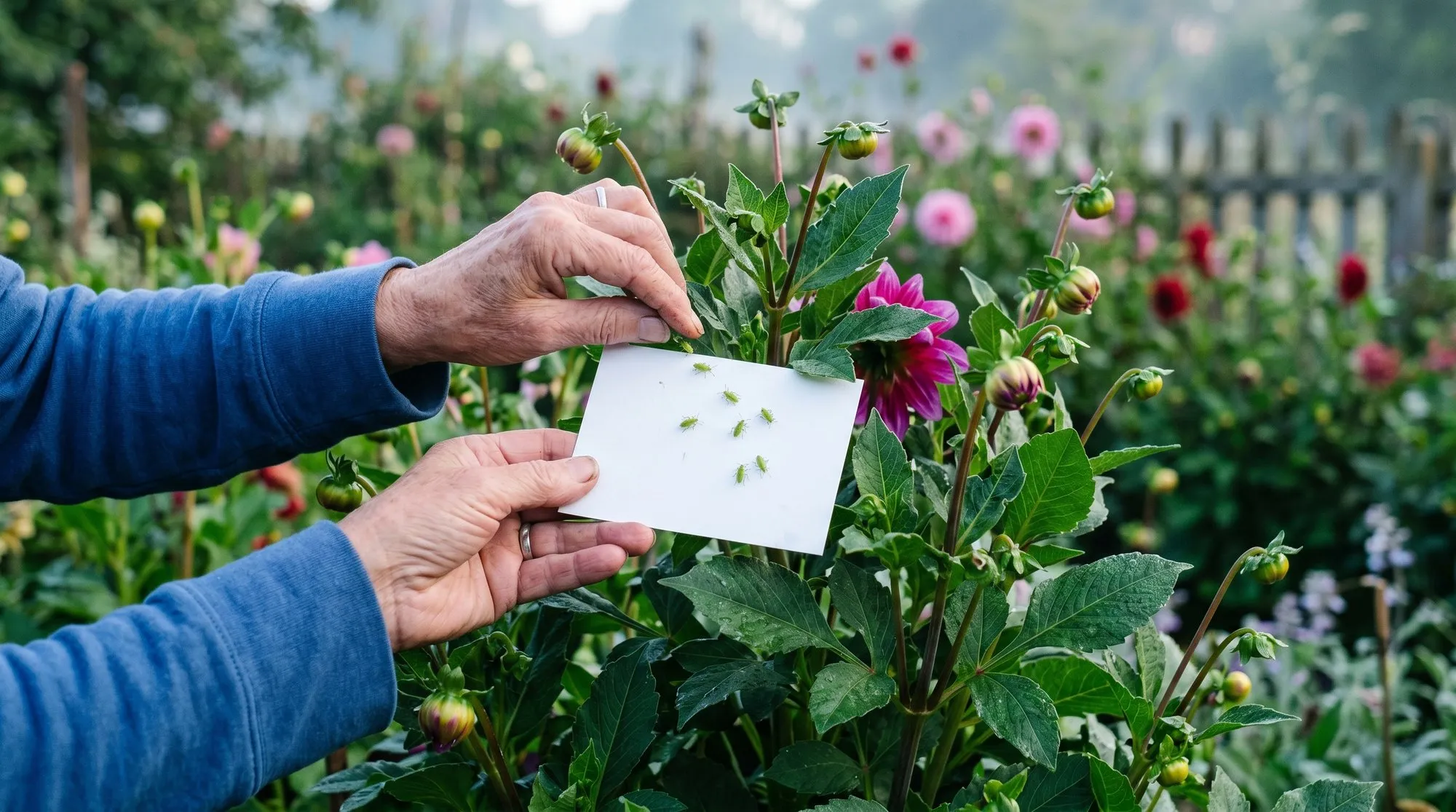 The white-card method on a dahlia clump in early morning, capsid nymphs drop and become visible against the white background
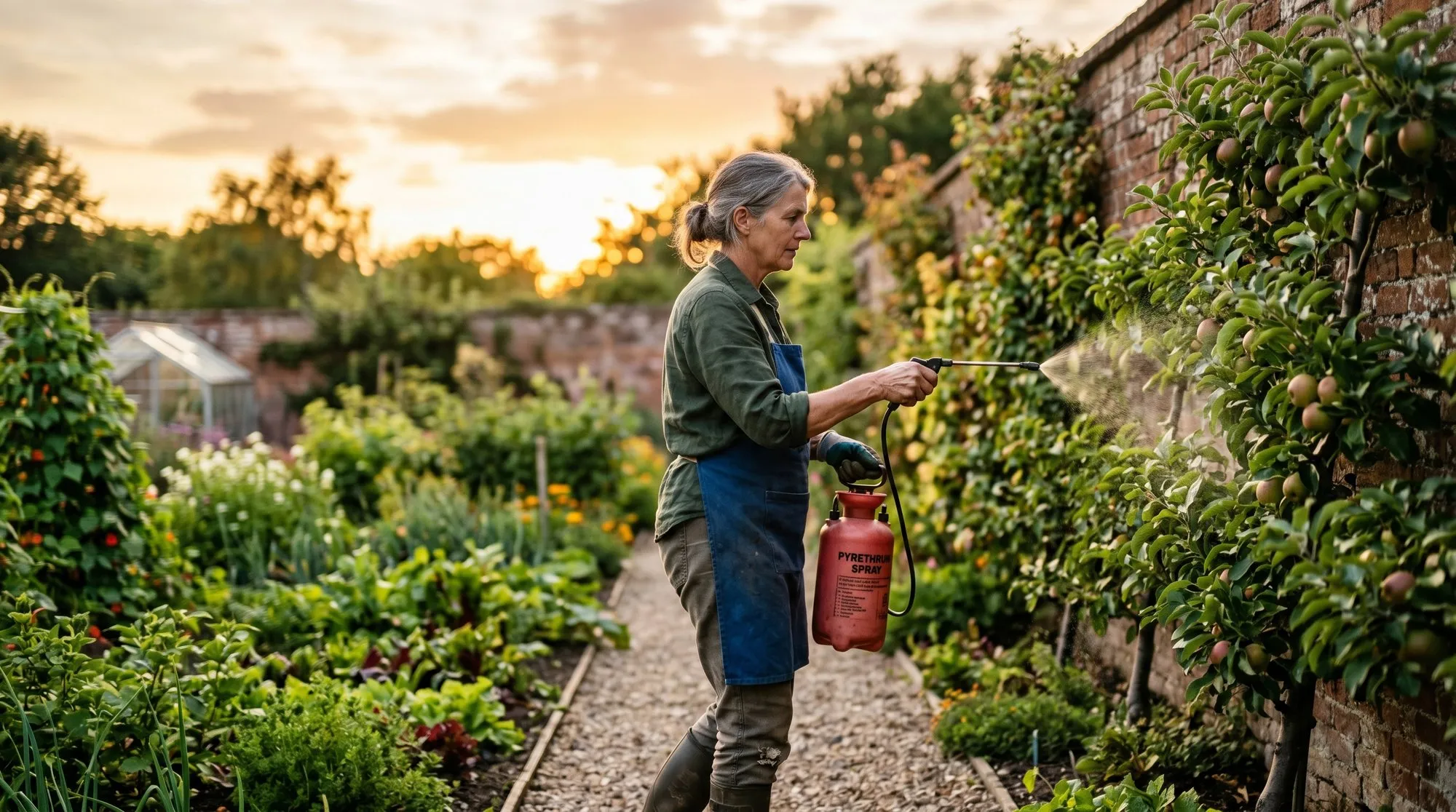 A carefully directed spray on apple cordons; always follow the current product label and avoid active pollinators
Our team produces practical UK gardening guidance from source research, contributor records and established horticultural practice. Editorial standards are overseen by Matt W.