Key takeaways
- Most UK pears need two compatible cultivars for cross-pollination - Conference is partially self-fertile
- Conference is the safest first pear for any UK garden - reliable, partially self-fertile, scab-resistant
- Doyenne du Comice is the dessert benchmark but needs warmth and a pollinator (group 4)
- Plant bare-root in November-March for the best establishment and lowest cost
- Quince A rootstock gives a 4-5m tree; Quince C gives a 3-4m tree for smaller gardens
- Espalier-trained pears against a sunny wall fruit better than free-standing trees in cool UK regions
- Pick most pears slightly under-ripe and finish them indoors for the best eating quality
For broader UK fruit-growing context, our how to grow fruit trees UK guide covers planting, training, and pruning across all the common species.
What separates a good UK pear from a bad one
Before the variety list, the four decisions that affect every pear choice.
Pollination group. Pears flower at slightly different times. Group 1 is earliest, group 5 latest. Trees flowering in the same group, or one group apart, cross-pollinate well. Trees more than two groups apart may not flower at the same time and produce no fruit. Most UK pears are in groups 3 and 4 - this is where most varieties cross-pollinate easily.
Self-fertility. A few cultivars set some fruit without a pollinator. Conference and Concorde are the two most reliable self-fertile pears. Even these crop heavier with a pollinator nearby, but they will produce useable fruit alone. Every other major UK pear needs a compatible second tree.
Rootstock. The variety determines the fruit; the rootstock determines the size. Quince A produces a vigorous tree to 4-5m. Quince C is more dwarfing, giving a 3-4m tree. Pyrus (true pear) rootstocks are extra-vigorous, only suitable for orchards. For most gardens, Quince C is the right choice.
Disease resistance. UK pears suffer from canker (Nectria galligena), pear scab (Venturia pirina), and rust (Gymnosporangium fuscum). Variety choice makes a meaningful difference. Conference and Concorde resist most UK conditions; Williams Bon Chretien is more susceptible.
Get these four right and you are most of the way to a productive tree. Get them wrong and the variety chosen barely matters.
The 12 cultivars worth growing
Ranked roughly by reliability for UK conditions, with the workhorse varieties first.
1. Conference (pollination group 3)
The single most-planted pear in the UK and the right choice for most gardens. Long, slightly elongated, russeted golden-brown skin with crisp flesh that softens when ripe. Pick in mid-September, eat October-November. Stores 6-8 weeks in cool conditions.
Why it wins: Partially self-fertile (sets some fruit alone). Reliably crops on heavy clay. Resists scab and canker better than most cultivars. Ripens at a useful time before the first frosts. Decent flavour - not the best dessert pear but good enough.
Pollinator partners: Williams Bon Chretien, Beth, Onward (all group 3). Concorde (group 4) also works. Many UK gardens have a Conference and a Williams as a pair.
Drawbacks: Not the sweetest. Crops heavily and benefits from thinning to one fruit per cluster in mid-July.
2. Concorde (pollination group 4)
A modern UK-bred cultivar (released by East Malling Research in 1977). Cross of Conference and Doyenne du Comice. Combines the reliability of Conference with the better dessert quality of Comice.
Why it wins: Partially self-fertile. Excellent flavour, soft buttery flesh. More productive than Conference on a per-tree basis. Resistant to most UK pear problems.
Pollinator partners: Conference, Williams (both group 3), Doyenne du Comice (group 4).
Drawbacks: Slightly later picking (early October) and shorter storage than Conference.
3. Doyenne du Comice (pollination group 4)
Often called the queen of dessert pears. Round, golden-yellow skin with red blush on the sun side, melting buttery flesh, intense pear flavour. The benchmark dessert pear. Pick early October, eat October-November.
Why it wins: Best eating quality of any common UK pear. Heavy cropper when conditions are right. Works as an espalier on a south-facing wall.
Pollinator partners: Concorde (group 4), Glou Morceau (group 4), Onward (group 3).
Drawbacks: Susceptible to scab. Needs a warm summer to fruit well - struggles in cool, wet northern UK gardens. Less reliable than Conference. Not self-fertile.
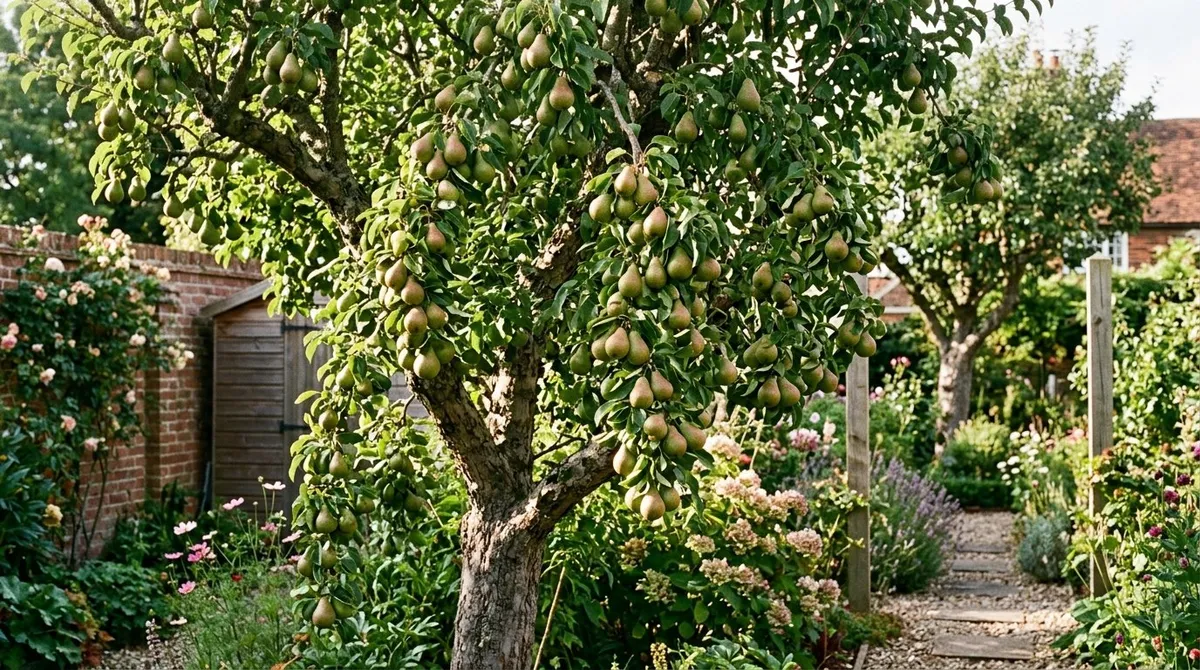
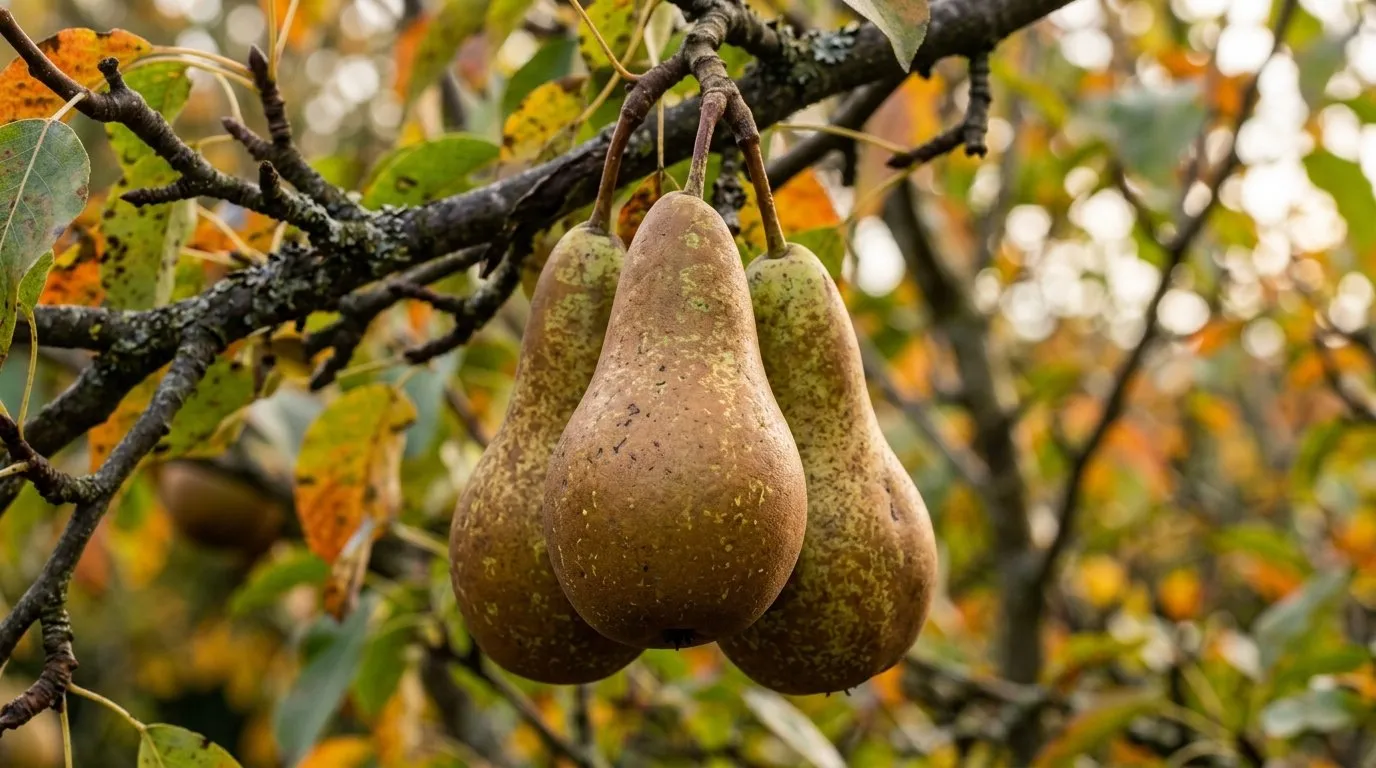 Conference is the most-planted UK pear and the most reliable single tree for any garden. Long slightly elongated bottle-shape with russeted golden-brown skin. Crops on heavy clay, resists most UK pear diseases, and is partially self-fertile - it produces a usable crop alone but heavier with a pollinator nearby.
4. Williams Bon Chretien (pollination group 3)
Also sold as Bartlett in North America. Classic green-yellow pear shape, smooth skin turning yellow when ripe. Sweet juicy flesh. Pick mid-August (the earliest reliable UK pear). Eat within 2 weeks of picking.
Why it wins: Earliest UK harvest by 3-4 weeks. Pollinates Conference and Concorde. Good flavour. Wide availability.
5. Beth (pollination group 3)
UK-bred (East Malling, 1938). Small to medium, pale yellow skin, sweet white flesh. Pick early September.
Why it wins: Very reliable cropper. Ripens evenly. Good for small gardens on Quince C. Resistant to scab.
Drawbacks: Smaller fruit than Conference. Less flavour than Doyenne du Comice. A workhorse but not a star.
6. Onward (pollination group 3)
Cross of Doyenne du Comice and Laxton’s Superb. Round-conical shape, pale yellow with reddish flush, sweet melting flesh that approaches Comice quality.
Why it wins: Better disease resistance than Comice with similar eating quality. Heavy cropper. Good UK garden choice.
Drawbacks: Less commonly stocked by garden centres than Conference or Comice. Order from a specialist fruit nursery like Blackmoor Nurseries or Ashridge Trees.
7. Glou Morceau (pollination group 4)
Old Belgian cultivar (1759). Greenish-yellow skin, melting flesh, late season. Pick mid-October, eat November-January. The pear that fills the winter dessert gap.
Why it wins: Stores longer than any other dessert pear (8-12 weeks in a cool outhouse). Excellent flavour after storage.
Drawbacks: Needs a warm sunny site. Susceptible to scab. Best as an espalier against a south-facing wall.
8. Beurre Hardy (pollination group 4)
French cultivar (1830). Large, conical, russeted skin, soft pink-tinged flesh with rose-water flavour. Pick late September, eat October.
Why it wins: Strong tree growth - good for tougher sites. Heavy cropper once established. Distinctive flavour.
Drawbacks: Slow to come into bearing (year 5-6). Needs space - vigorous on Quince A.
9. Joséphine de Malines (pollination group 5)
Belgian cultivar (1830). Greenish-yellow with russet, melting flesh, intense aromatic flavour. The latest-ripening UK pear. Pick late October, eat December-February.
Why it wins: Latest available pear. Stores 8-10 weeks. Beautiful flavour after storage.
Drawbacks: Pollination group 5 - needs another late-flowering pear nearby. Limited cultivar choice for partners.
10. Catillac (pollination group 4)
A culinary pear, not a dessert pear. Large, hard, green-skinned, very firm flesh that needs cooking. Pick late October, store until January, then poach or bake.
Why it wins: Only widely-grown UK culinary pear. Stunning when poached - turns deep red. Stores for months.
Drawbacks: Cannot be eaten raw. Needs cooking to be palatable. Niche choice for households that bake or poach often.
11. Beth (already covered) and Invincible (pollination group 3)
Invincible is a modern Italian cultivar with extreme self-fertility - the only true self-fertile pear available in the UK. Two crops per year (June flowers and September flowers, both producing fruit). A novelty for tiny gardens.
Why it wins: Genuinely self-fertile. Works as a single-tree garden choice without a partner.
Drawbacks: Flavour is decent but not outstanding. Limited UK availability. Better choice if you genuinely cannot fit a second tree.
12. Family pear (multi-grafted)
Not a single variety - a single tree with 2-4 compatible cultivars grafted onto one rootstock. Common combinations: Conference + Williams + Doyenne du Comice on a Quince A or C rootstock. Solves the pollination problem in one tree.
Why it wins: Three pear varieties in a 4m x 4m garden space. Each branch crops separately. Pollination is automatic.
Drawbacks: Vigorous branches dominate weaker ones - you must prune to balance. Sometimes one variety takes over and the others die back. Inconsistent quality from each branch. Not as long-lived as a single-variety tree.
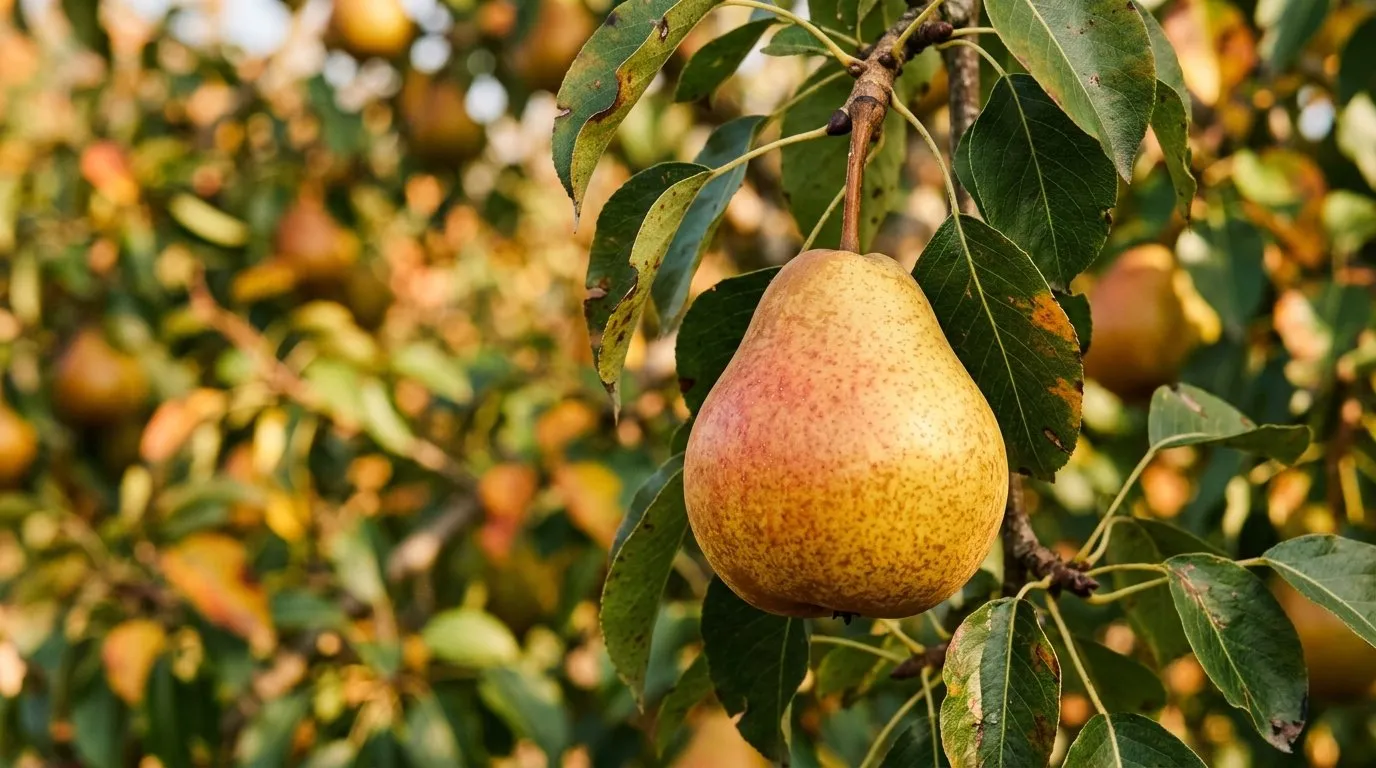 Doyenne du Comice is the benchmark dessert pear - melting buttery flesh, intense pear flavour, golden skin with red blush. Best as an espalier on a south-facing wall in cooler UK regions. Needs warmth and a group 4 pollinator like Concorde or Glou Morceau.
How to choose pollination partners
Two compatible pears within 50 metres of each other will cross-pollinate. Use this matrix to pick partners.
| Variety | Group | Best partners |
|---|---|---|
| Conference | 3 | Williams, Beth, Onward, Concorde, Doyenne du Comice |
| Concorde | 4 | Conference, Doyenne du Comice, Williams, Onward |
| Doyenne du Comice | 4 | Concorde, Glou Morceau, Onward, Conference |
| Williams Bon Chretien | 3 | Conference, Beth, Concorde |
| Beth | 3 | Conference, Williams, Concorde |
| Onward | 3 | Conference, Concorde, Doyenne du Comice |
| Glou Morceau | 4 | Concorde, Beurre Hardy, Doyenne du Comice |
| Beurre Hardy | 4 | Concorde, Glou Morceau, Doyenne du Comice |
| Joséphine de Malines | 5 | Catillac, late-flowering local cultivars |
| Catillac | 4 | Beurre Hardy, Concorde, Doyenne du Comice |
| Invincible | self-fertile | (alone, or any group 2-4) |
The best pair for most UK gardens: Conference + Concorde. Both partly self-fertile, both reliable, both resist disease, both give good flavour, and they pollinate each other plus most other common cultivars.
For a small garden where one tree is the limit: Conference alone. Crops 5-15kg per year on Quince C without a partner. Heavier with one nearby, but still productive solo.
For a connoisseur garden with space for three trees: Conference + Doyenne du Comice + Glou Morceau. Reliability + best dessert quality + late storage.
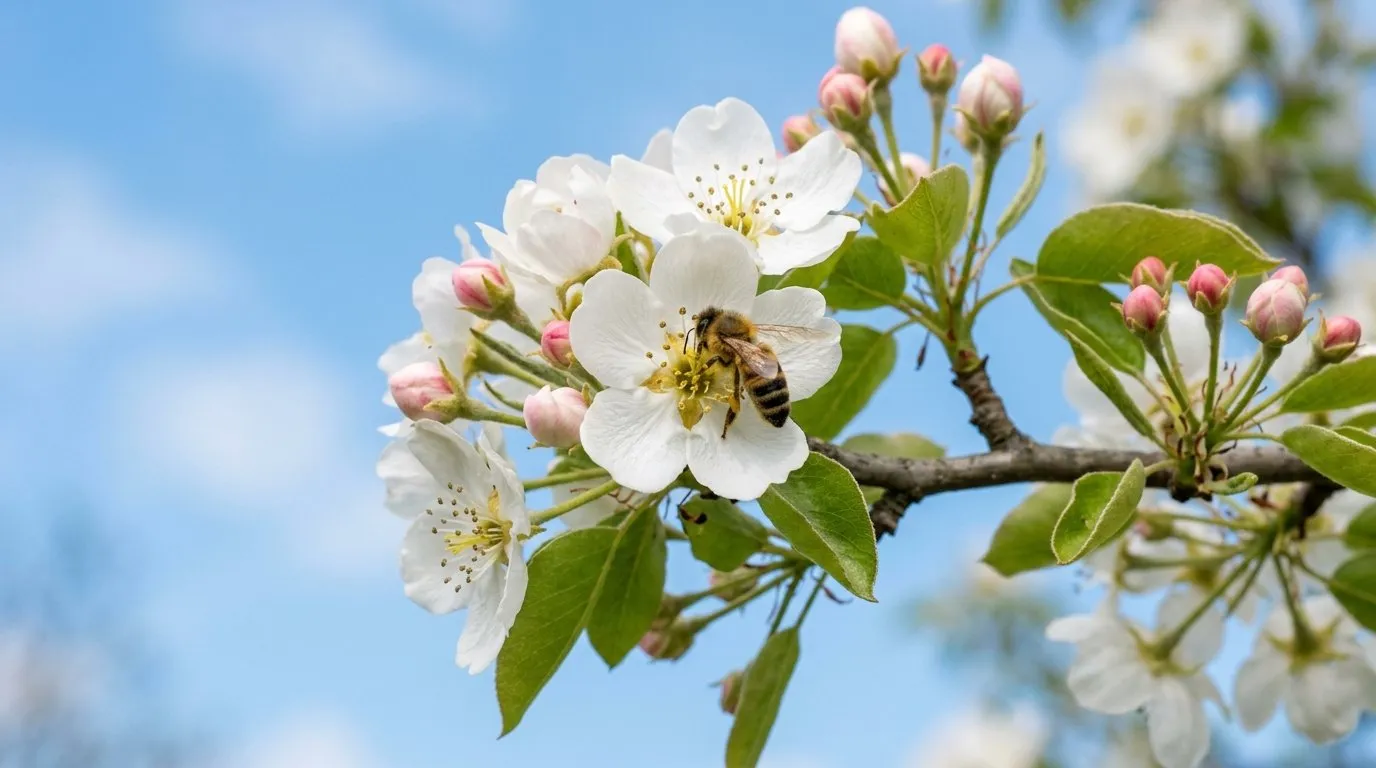 Pear blossom in April. Cross-pollination is essential for most cultivars - bees move pollen between compatible varieties flowering at the same time. Group 3 and group 4 cultivars are the easiest to pair because they overlap their flowering by 2-3 weeks.
Rootstocks: getting the size right
Rootstock determines the eventual size of the tree.
| Rootstock | Mature height | Spacing | Best for |
|---|---|---|---|
| Quince A (semi-vigorous) | 4-5m | 4m | Standard garden trees, mature gardens |
| Quince C (semi-dwarfing) | 3-4m | 3m | Small gardens, espaliers, fans |
| Quince Eline (dwarfing) | 2.5-3m | 2.5m | Patio pots, very small spaces |
| Pyrodwarf | 4-5m | 4m | Heavier UK clay soils where Quince struggles |
| Pyrus (seedling) | 6-9m | 6m | Orchards only - too big for most gardens |
For most UK gardens, Quince C is the right answer. The tree fits in a domestic garden, fruits earlier than Quince A (year 3 versus year 5), and is easy to prune from the ground.
For tougher UK clay sites, Pyrodwarf outperforms Quince but is harder to source. Order from specialist nurseries.
For walls and trained forms (espalier, fan, cordon, stepover), Quince C is standard. The dwarfing effect means the trained shape stays in scale with a domestic wall.
For a guide to fan-trained fruit trees, see our how to fan train a fruit tree UK guide.
Espalier and trained forms
Pears espalier-train better than almost any other UK fruit. The wood is supple, fruiting spurs form readily, and the long lifespan rewards the investment.
Espalier: Horizontal tiers (usually 3-5) trained against a wall or freestanding post-and-wire support. Each tier is around 40-50cm above the next. Total height 1.6-2.5m. Spread 3-4m. Fruits in year 3-4. Best against a south or west-facing wall in the UK.
Fan: Multiple branches radiating from a central point against a wall. Suits a wall 1.8m+ tall. Productive but more pruning-intensive than espalier.
Cordon: Single stem at 45 degrees, supported by wire and stakes. Fruits along the entire length. Plant 60-75cm apart - 6-8 cordons fit in a 5-metre row. Best for collecting many varieties in a small space.
Stepover: Single horizontal cordon at 50cm height, used as low edging along a path. Crops well, looks beautiful, takes up almost no width. Best in small gardens.
A trained pear in your first decade of growing requires winter and summer pruning to establish the framework. Year three onwards needs less work. Pruning is straightforward - cut back current-season shoots to 5 leaves in summer, then back to 3 buds in winter to form fruiting spurs.
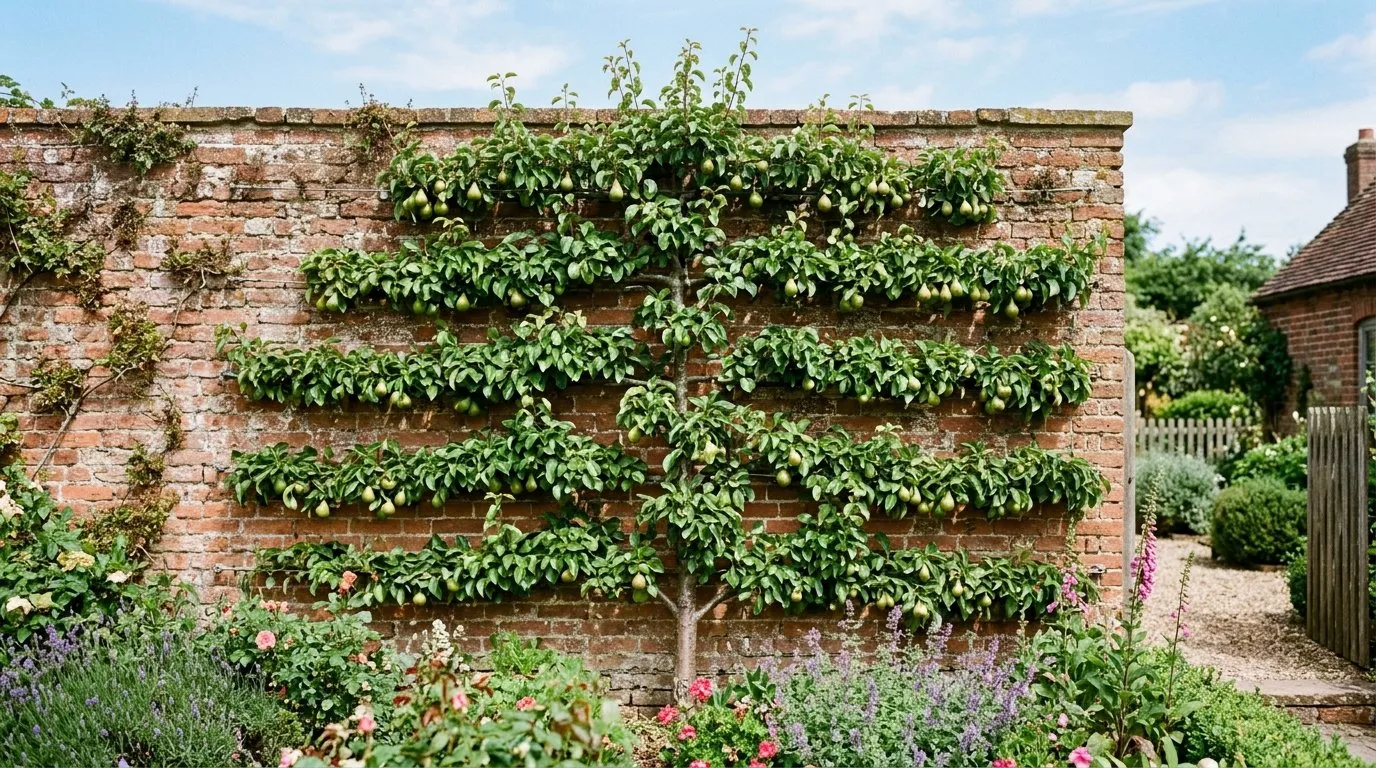 Espalier pears against a south-facing wall fruit better than free-standing trees in cool UK regions. The wall stores warmth, ripens fruit, and protects flowers from late frosts. A 3-tier espalier suits walls 1.6m+ tall and produces 5-15kg of fruit per year once established.
Planting: bare-root versus container
Bare-root is cheaper and establishes faster. Trees are dug up at the nursery in autumn, sold in their dormant state from November to early March, and arrive with bare roots wrapped in damp packing.
- Cost: £15-25 per tree
- Available: November-March only
- Establishment: faster (roots make direct soil contact)
- Sourcing: specialist fruit nurseries (Blackmoor, Ashridge, Trees Direct, Frank P Matthews)
Container trees are pricier and available year-round but slower to establish.
- Cost: £30-50 per tree
- Available: year-round
- Establishment: slower (roots restricted in pot)
- Sourcing: most garden centres, specialist nurseries
For most UK gardens, order bare-root from a specialist nursery in October for November delivery. Specialist nurseries hold the broader cultivar choice - garden centres typically stock only Conference and Williams.
Planting:
- Dig a hole 60cm x 60cm and 30-40cm deep. Loosen soil at the bottom.
- Add a forkful of well-rotted compost. Mix with native soil.
- Place the tree at the original soil mark on the trunk (visible as a dark line).
- Backfill with native soil - no fertiliser, no peat.
- Stake at 45 degrees against the prevailing wind, attaching with a soft tree tie.
- Water in well even if the soil is damp.
- Mulch 5cm deep with woodchip or compost, leaving 5cm clear of the trunk.
For a 1m staking guide and tree-tie installation, see Royal Horticultural Society planting guide.
Pruning: when, what, why
Pears need less pruning than apples but benefit from yearly attention. The basics:
Year 1 (first winter): Cut the central leader back by one-third to a strong outward bud. Remove any dead, damaged, or crossing branches. No fruit thinning needed.
Year 2 (second winter): Establish 4-5 main scaffold branches at 50-60cm spacing up the trunk. Shorten last year’s growth on each by one-third.
Year 3 onwards: Light annual winter pruning. Remove dead, diseased, or crossing branches. Thin out crowded shoots in the centre to maintain airflow. Cut back vertical “water shoots” close to the trunk.
Summer pruning (espaliers and cordons only): Cut current-season side shoots back to 5 leaves in late July to encourage fruiting spurs.
Avoid: Heavy summer pruning of free-standing trees (encourages too much vegetative growth). Pruning during damp weather (encourages canker).
A typical 6-year-old Conference on Quince C in a UK garden needs 30 minutes of pruning per winter. Older neglected trees take an afternoon to bring back.
Diseases that kill UK pears
Three diseases account for most UK pear tree losses.
Pear canker (Nectria galligena). Sunken patches of dead bark, sometimes with red fruiting bodies in winter. Spreads from infected wood through pruning cuts. Cut out infected branches 15cm below the visible damage. Burn the prunings - never compost. Disinfect tools between cuts. Cultivars resistant: Conference, Concorde. Susceptible: Williams Bon Chretien.
Pear scab (Venturia pirina). Olive-green spots on leaves and dark scabbed patches on fruit. Worse in damp summers. Rake up and burn fallen leaves in autumn. Cultivars resistant: Conference, Beth, Concorde. Susceptible: Doyenne du Comice, Williams.
Pear rust (Gymnosporangium fuscum). Bright orange spots on upper leaf surfaces in summer, with brown growths on the underside. Spreads via juniper trees within 1km. Remove juniper neighbours if practical. Affects most cultivars equally. Treatment: rake and burn fallen leaves; serious cases may need fungicide.
For broader pear-pest issues including pear midge, pear leaf blister mite, and the codling moth, the RHS pear problem guide covers identification and control. If young fruitlets blacken and drop in early summer, read our guide to controlling pear midge in Conference pears.
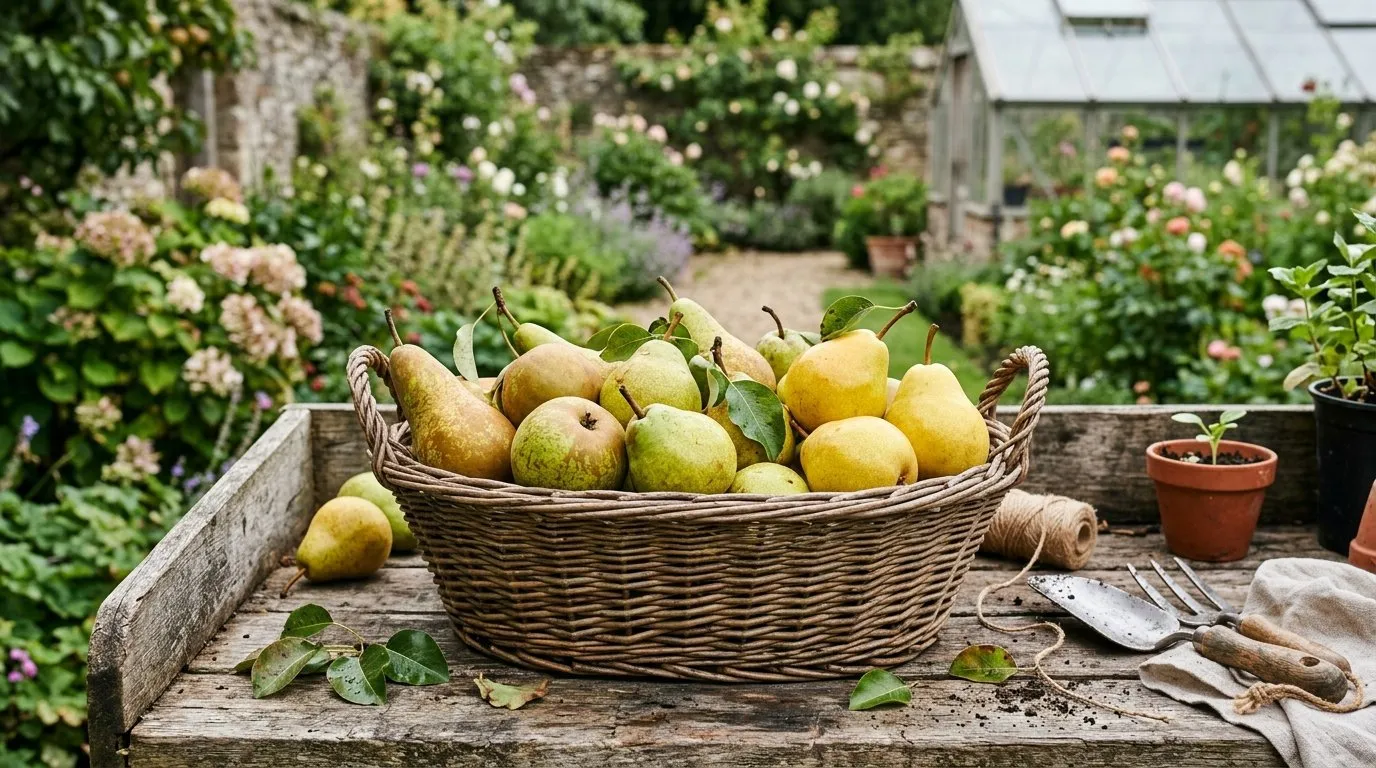 A productive UK garden tree gives 15-30kg of pears per year by year five. Pick most varieties slightly under-ripe (firm to the touch, with a slight give at the stem end) and finish them indoors at 16-18°C for the best eating quality. Doyenne du Comice in particular benefits from this approach.
Picking, storing, and eating
Pears are different from apples - they should be picked under-ripe and finished indoors.
The pick test: Cup the pear in your palm and lift gently to horizontal. If it comes away from the spur cleanly with the stem attached, it is ready. If you have to pull, leave it another week.
Pick under-ripe. Most varieties go from rock-hard to over-soft in days if left on the tree. Pick when slightly firm with a tiny give at the stem end.
Finish indoors at 16-18°C. Spread fruit on trays or in a fruit bowl. Check daily. Most varieties are ready 7-14 days after picking.
Storage temperatures: 0-4°C in a cool outhouse, garage, or fridge. Wrap individual fruits in newspaper to slow ripening. Conference stores 6-8 weeks; Glou Morceau and Joséphine de Malines store 8-12 weeks.
Variety-specific storage:
| Variety | Pick | Eat | Storage |
|---|---|---|---|
| Williams | mid-August | August-Sept | 1-2 weeks |
| Beth | early September | September | 2-3 weeks |
| Conference | mid-September | October-November | 6-8 weeks |
| Concorde | late September | October-November | 6 weeks |
| Doyenne du Comice | early October | October-November | 4-6 weeks |
| Beurre Hardy | late September | October | 3-4 weeks |
| Onward | mid-September | September-October | 4 weeks |
| Glou Morceau | mid-October | November-January | 8-12 weeks |
| Catillac (cooking) | late October | November-March | 16+ weeks |
| Joséphine de Malines | late October | December-February | 8-10 weeks |
A staggered planting (Williams + Conference + Glou Morceau) gives picking from August through October and eating into January. Three trees in a garden cover almost the full UK pear season.
Quick checklist
Before ordering your first pear tree:
- Site has 6+ hours of summer sun ✓
- Soil is workable (not waterlogged or compacted) ✓
- Pollination partner identified within 50m ✓
- Rootstock chosen (Quince C for most gardens) ✓
- Variety chosen (Conference for first tree) ✓
- Order placed with specialist nursery for bare-root delivery ✓
- Stake and tree tie ready ✓
- Mulch (compost or woodchip) ready ✓
Done in October for November delivery, your first pear tree is in the ground before the first frosts. By year three you have a crop. By year five you have a working garden tree producing 5-15kg of fruit a year, and an outlook on annual food production that supermarkets cannot match.
For the wider fruit-tree picture, our how to grow fruit trees UK guide covers the broader category.
Related articles
Our team produces practical UK gardening guidance from source research, contributor records and established horticultural practice. Editorial standards are overseen by Matt W.