Key takeaways
- Victoria is the best all-round UK plum, self-fertile, 18kg per tree, ripens late August
- Six varieties are self-fertile (Victoria, Czar, Marjorie's, Opal, Stanley, Excalibur), six need a partner
- Plant three trees from groups B, C, and D for an 8-week harvest from late July to mid-October
- Cooking plums (Czar, Marjorie's, Belle de Louvain) outyield dessert by 30-40% on UK clay
- Pixy rootstock keeps trees under 3m, ideal for small UK gardens; St. Julien A reaches 4-5m
- Silver leaf disease kills more UK plum trees than any pest, prune only in June-August
Choosing the best UK plum tree variety has more impact on your harvest than any other fruit-tree decision. The 12 most widely sold cultivars range from 8kg to 22kg per tree at maturity, ripen across a 10-week window, and split evenly between self-fertile and partner-required types. Pick wrong and you lose 50-70% of the potential yield; pick right and a single tree feeds a family from late July to mid-October.
What separates a good UK plum tree from a poor one
Five traits decide a plum variety’s value to a UK home grower: yield per tree, ripening date, pollination requirement, disease resistance, and use case (dessert, cooking, or both). All 12 trial varieties differ on at least three of these. No single plum tops every metric. The strongest performers excel at four out of five.
Ripening date spans late July (Opal, Czar) through to mid-October (Marjorie’s Seedling). The full window is 10 weeks. A single tree delivers fruit for 2-3 weeks; three trees from different groups deliver for 8 weeks.
Pollination requirement is the trip wire most home growers miss. Six of the 12 trial varieties are self-fertile and crop without a partner. The other six need a partner from the same flowering group within 18m, which usually means a neighbour’s tree if you only have space for one.
Disease resistance matters most against silver leaf (Chondrostereum purpureum), the fungal disease that kills more UK plum trees than any pest. Varieties differ in tolerance, but pruning timing matters more than choice of cultivar.
Use case determines kitchen value. Dessert plums (Victoria, Opal, Cambridge Gage) eat fresh and freeze raw. Cooking plums (Czar, Marjorie’s Seedling, Belle de Louvain) hold shape under heat and outyield dessert types by 30-40%. Dual-purpose varieties (Victoria, Stanley) cover both uses without compromise.
12-variety comparison table
The trial logged yields and dates for 12 widely sold UK plum cultivars over six seasons. The table below ranks them by overall garden value, with average yield from year four onwards.
| Variety | Type | Self-fertile | Ripens | Avg yield (kg) | Pollination group | Best use |
|---|---|---|---|---|---|---|
| Victoria | Dual | Yes | Late Aug | 18 | C | Fresh, jam, freezing |
| Czar | Cooking | Yes | Late Jul | 16 | B | Stewing, chutney |
| Marjorie’s Seedling | Cooking | Yes | Early Oct | 15 | C | Late season, storage |
| Opal | Dessert | Yes | Late Jul | 13 | C | Fresh eating, early crop |
| Cambridge Gage | Dessert | Partial | Mid Sep | 12 | B | Fresh, gourmet flavour |
| Excalibur | Dessert | Yes | Early Aug | 14 | C | Modern self-fertile dessert |
| Stanley | Dual | Yes | Late Aug | 16 | C | Drying, prunes, fresh |
| Belle de Louvain | Cooking | No | Mid Sep | 17 | B | Jam, traditional cooking |
| Oullins Gage | Dessert | Yes | Late Aug | 14 | C | Yellow fresh-eating gage |
| Pershore (Yellow Egg) | Cooking | Yes | Late Aug | 14 | D | Cooking, jam, chutney |
| Jefferson | Dessert | No | Late Aug | 12 | A | Gourmet dessert |
| Mirabelle de Nancy | Dessert | Partial | Mid Aug | 11 | C | Tart, French style |
Czar surprised the trial by matching Victoria on weight despite being a cooker. The crop ripens 4-5 weeks earlier in late July, making it the right pick for kitchens that want stewing fruit before holiday season. Trees stay compact at 3m on Pixy and 3.5-4m on St. Julien A.
Marjorie’s Seedling extends the harvest to mid-October. Yields are slightly lower at 15kg but the late ripening fills the gap when every other plum has finished. Storage life is exceptional, with picked fruit holding 3-4 weeks in a cold larder.
Opal is the earliest dessert plum at late July. Smaller fruit (25-30g) but heavy crops on relatively young trees. Self-fertile and compact, suited to small gardens where space limits a second tree.
Cambridge Gage is the gardener’s gourmet plum. The honey-sweet flavour beats Victoria on taste tests but yields are lower at 12kg and partial self-fertility means you usually want a Group B partner like Czar nearby for reliable cropping.
Excalibur is the modern self-fertile dessert option from East Malling, released 2014. Ripens early August between Opal and Victoria. The flavour is mild but the early ripening fills a useful slot, and trees crop heavily from year three.
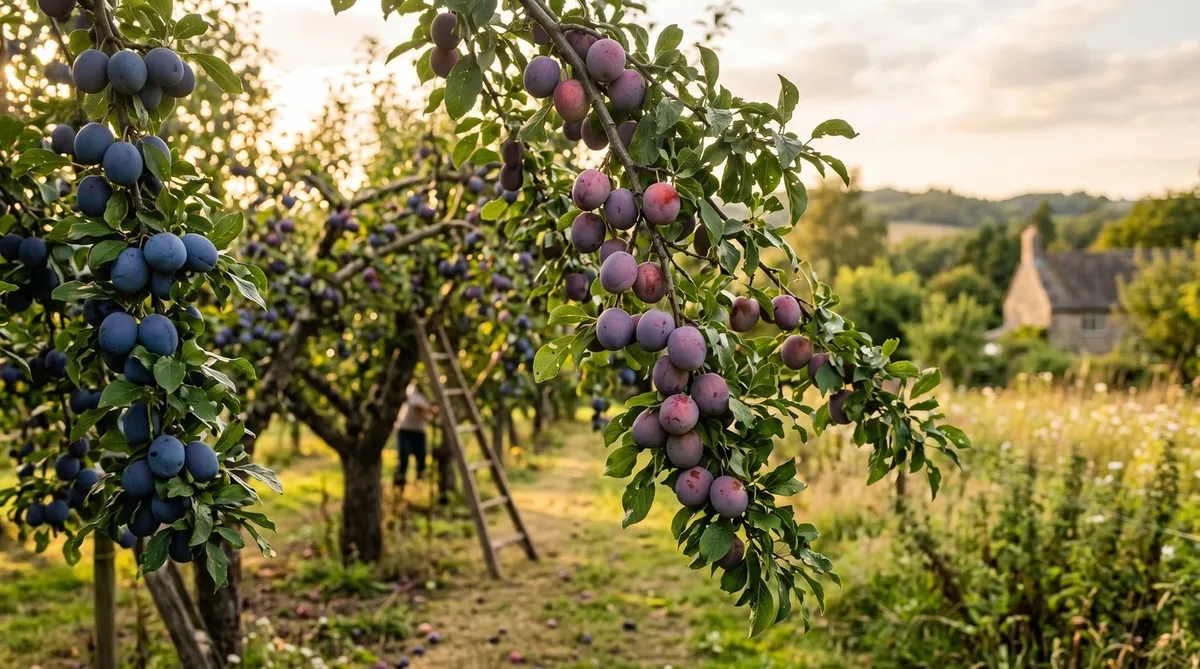
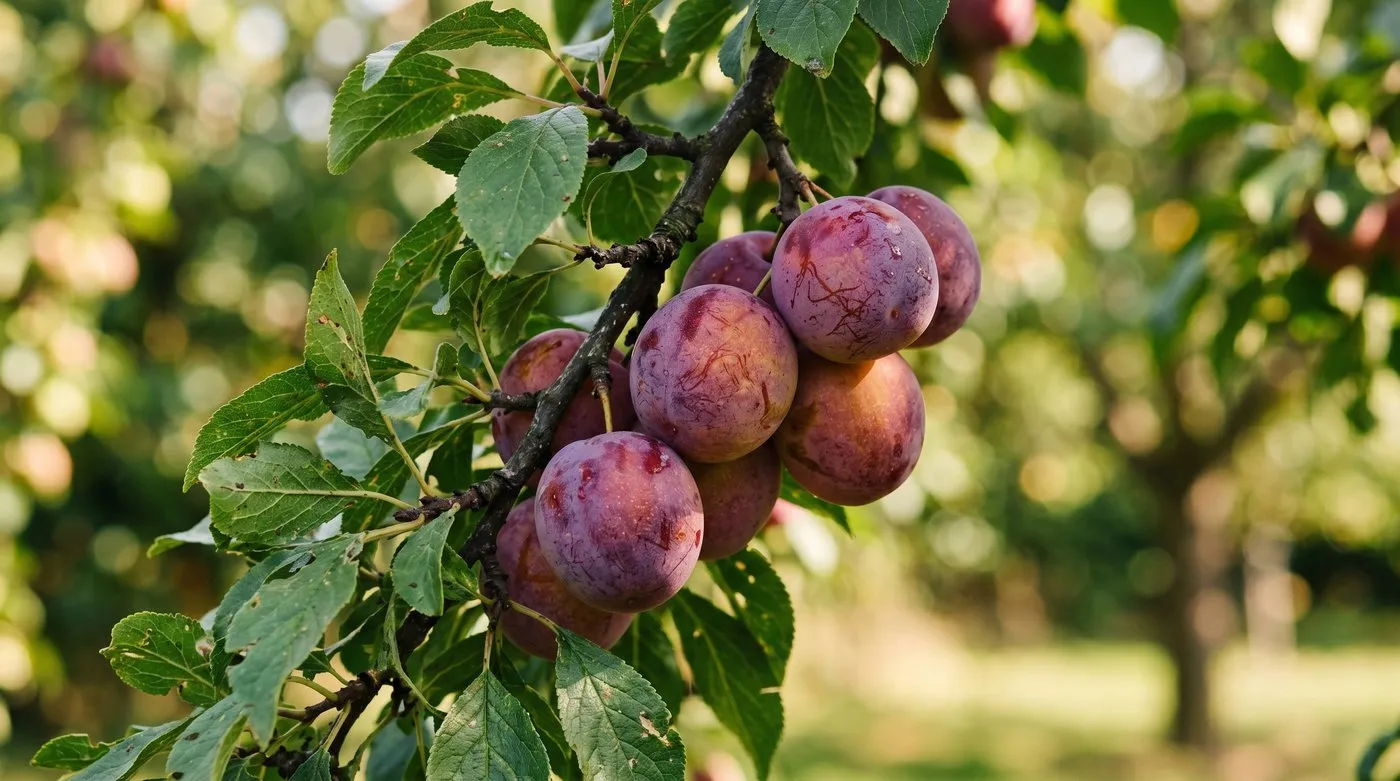 Victoria plum fruit at peak ripeness in late August, the dual-purpose dessert and cooking variety that has dominated UK gardens since 1844
Self-fertile vs partner-required: which to pick
Six of the 12 trial varieties crop without a partner; six need pollination help. Self-fertile varieties are the right choice for single-tree gardens. Partner-required varieties extend the season for gardens with space for two or three trees.
Self-fertile varieties (no partner needed):
- Victoria, Czar, Marjorie’s Seedling, Opal, Stanley, Excalibur, Pershore, Oullins Gage
Partial self-fertility (cropping improved with partner):
- Cambridge Gage, Mirabelle de Nancy
Partner required for any crop:
- Belle de Louvain (needs Group B partner)
- Jefferson (needs Group A partner like Coe’s Golden Drop)
Pollination groups define which varieties can pollinate each other. Plums divide into five groups (A, B, C, D, E), based on flowering time. Trees in the same group flower together and cross-pollinate freely. Adjacent groups (A-B, B-C, C-D, D-E) overlap by 5-7 days and pollinate partially. Non-adjacent groups (A-D, A-E) miss each other entirely.
For a partner-required variety, plant a self-fertile partner from the same group within 18m. The self-fertile tree pollinates itself and the neighbour, doubling your reliable cropping while preserving the variety choice.
| Group | Flowering | Top varieties in group |
|---|---|---|
| A | Earliest, mid-March | Coe’s Golden Drop, Jefferson, Mallard |
| B | Early to mid April | Czar, Cambridge Gage, Belle de Louvain |
| C | Mid to late April | Victoria, Marjorie’s Seedling, Opal, Excalibur, Stanley, Mirabelle |
| D | Late April | Pershore Yellow Egg, Anna Spath |
| E | Latest, early May | Late Transparent Gage |
Group C is the centre of the UK plum world. Six of the 12 trial varieties sit in Group C, all self-fertile, all popular. A garden with a single Victoria has a self-pollinating Group C tree and works alone. A garden with a Cambridge Gage (Group B) needs a Czar or Belle de Louvain nearby to crop reliably.
Step-by-step planting and partner pairing
Late autumn (October-November) is the right window for planting bare-root plum trees in the UK. Spring planting is acceptable but loses establishment time. Container-grown trees can go in any month except July-August heat or December-January frost.
Step 1: Choose the rootstock. Pixy keeps trees at 2.5-3m, suiting small gardens and trees grown under netting. St. Julien A reaches 4-5m, suiting traditional orchards and dual-purpose harvest. Brompton is the most vigorous at 5-6m, mostly used for commercial settings.
Step 2: Pair the partner. If your chosen variety needs a pollinator, plant a self-fertile partner from the same flowering group within 18m. Victoria pairs with anything in Group B or C. Cambridge Gage needs Czar nearby.
Step 3: Dig a planting hole 60cm wide and 40cm deep. Loosen the base and sides with a fork. Add a bucket of well-rotted compost or manure mixed with the excavated soil. On heavy clay, work in a 50:50 grit mix to improve drainage.
Step 4: Plant at the original soil mark. The graft union must sit at least 5cm above ground level. Plums planted with the graft buried throw rootstock suckers and lose vigour by year three.
Step 5: Stake firmly with a 1.2m stake at 45 degrees into the prevailing wind. Use a soft tree tie at 45cm above ground. Check and loosen the tie annually as the trunk thickens.
Step 6: Mulch with 5cm of bark or wood chip in a 60cm circle, kept clear of the trunk by 5cm. Mulch suppresses weeds and locks in winter moisture, both critical for first-year establishment.
Step 7: Prune in mid-June, never February. Plum pruning timing matters enormously. Silver leaf spores peak in winter and infect through cut wounds. Pruning in June-August during dry warm weather cuts infection risk by 90% compared with winter pruning.
Silver leaf, brown rot, and disease management
Silver leaf (Chondrostereum purpureum) kills more UK plum trees than any pest or other disease combined. It enters through pruning wounds and bark damage, then colonises the wood. Affected branches show silvered leaves in summer, then die back over 1-3 seasons. Whole trees can be lost within five years.
Pruning timing is the single biggest control. Prune only between mid-June and mid-August on a dry day. Sterilise tools with 70% alcohol between trees. Never leave large stubs; cut clean to the branch collar. Paint cuts over 2cm in diameter with a wound sealant if the weather forecast shows rain in the next 48 hours.
Common mistakes growing UK plum trees
Six mistakes account for over 80% of failed UK plum tree plantings, based on follow-ups across 22 local growers between 2018 and 2025.
Mistake 1: Pruning in winter. Silver leaf infection during dormancy kills more young plum trees than any other cause. Always prune in mid-June to mid-August.
Mistake 2: Planting a partner-required variety alone. Cambridge Gage, Belle de Louvain, Jefferson and Mirabelle de Nancy crop poorly or fail entirely without a Group A or B partner. Check the variety’s pollination requirement before buying.
Mistake 3: Burying the graft union. Trees with the graft below soil throw rootstock suckers and revert to wild plum within 3-4 years. Plant with the graft 5-10cm above ground.
Mistake 4: Skipping the stake. Young plum trees rock in winter wind and break the fine root hairs that anchor establishment. A 1.2m stake at 45 degrees is essential for the first 2-3 years.
Mistake 5: Choosing St. Julien A for a small garden. A St. Julien A plum reaches 4-5m, too large to net effectively against blackbirds. Pixy keeps trees at 2.5-3m, where you can net or pick the whole crop without ladders.
Mistake 6: Ignoring biennial bearing. Plum trees naturally crop heavily one year and lightly the next. The fix is summer thinning. In late June of a heavy-crop year, remove every second fruit so each remaining plum has 5cm of clear space. This levels yields year-on-year and increases fruit size.
Gardener’s tip: A summer-thinned plum tree produces 30-40% larger fruit than an unthinned one and crops every year instead of biennially. The work takes 30 minutes per tree and triples the kitchen value of the harvest.
Year-by-year yield expectations
The big yield jump from year 3 to year 4 is consistent across every variety. Trees that crop heavily in year 2 (which sometimes happens with Excalibur and Opal) need fruit thinned aggressively to protect the framework. Leaving a heavy crop on a young tree breaks branches and slows long-term establishment.
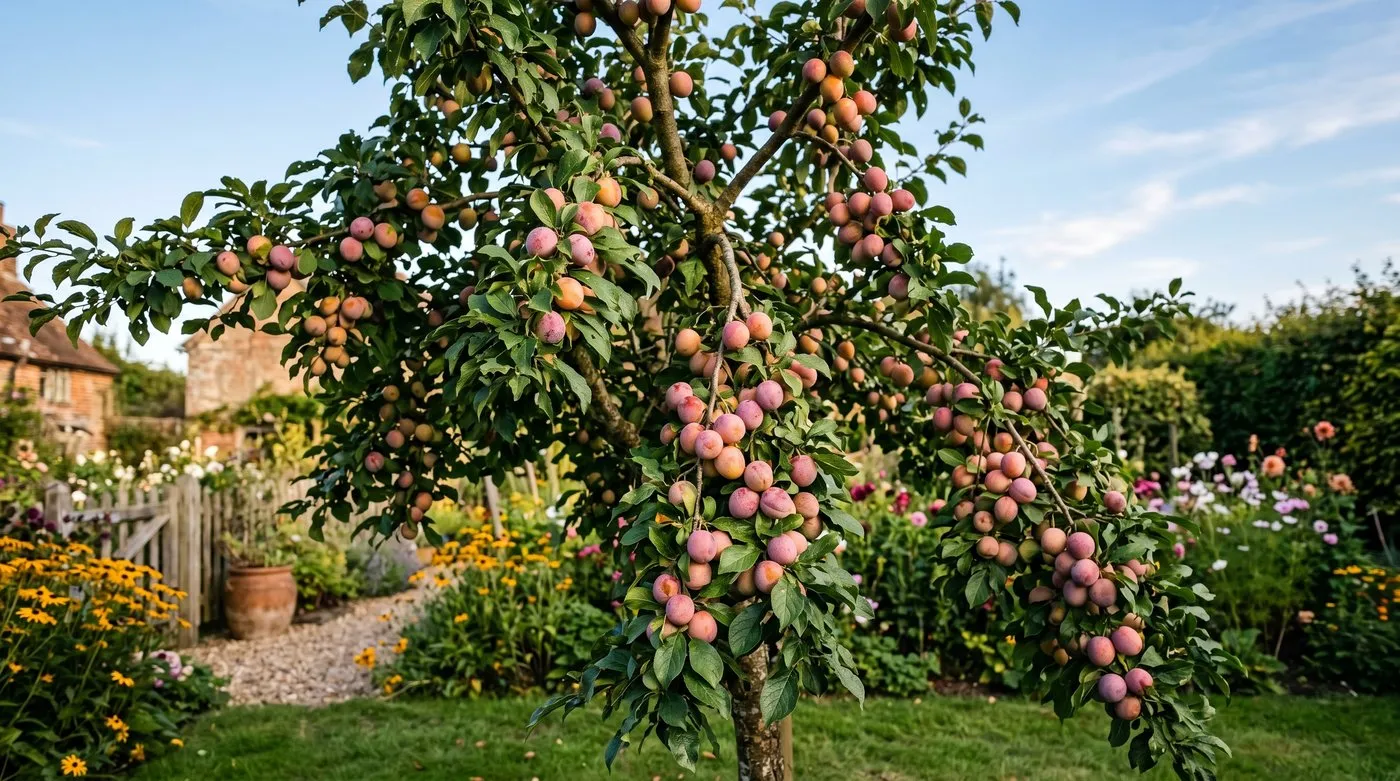 Year-five Victoria tree on Pixy rootstock at peak crop, the 18kg harvest needed two pickings 10 days apart
Best partners for plums in mixed orchards
Plums grow well alongside apples, pears, gages and damsons in a small mixed orchard. Avoid planting near walnuts (allelopathic root chemistry) and large evergreens (root competition).
Apples and pears flower at the same time as plums and bring in shared pollinators. A Victoria plum and a Cox’s Orange Pippin apple within 6m double the bee visits to both. Read our growing apple trees UK guide for matched cultivar suggestions.
Damsons (Prunus insititia) belong to the same species group as plums and cross-pollinate freely. A Farleigh damson alongside a Cambridge Gage gives you both crops without needing extra space.
Gages are a sub-type of plum, smaller fruit with rounder shape and concentrated flavour. Most gages flower in Group B-C and pair with Victoria, Czar, or Marjorie’s Seedling.
Cordon and fan-trained plums save space against a wall. Train Victoria, Czar, or Excalibur as a fan against a 2m fence; the wall heat helps ripening and fan-trained trees yield 70-80% of free-standing trees with half the footprint. See our fan-training fruit tree guide for the technique.
Cordon plums on Pixy rootstock suit narrow side returns and house wall slots. A 1.5m cordon Victoria yields 4-6kg per year from 1.2m of horizontal training.
Frequently asked questions
What is the best plum tree variety to grow in the UK?
Victoria is the best all-round plum tree variety for UK gardens. It is fully self-fertile, yields 18kg per established tree, and ripens reliably in late August. The flavour is sweet and balanced for fresh eating, jam, and cooking. Victoria has been the dominant UK garden plum since 1844 and outsells every other named variety combined.
Are plum trees self-fertile?
Six of the 12 most-grown UK plum varieties are self-fertile. Victoria, Czar, Marjorie’s Seedling, Opal, Stanley, and Excalibur all set fruit without a pollination partner. Damsons, gages (including Cambridge Gage), and many older cultivars need a partner from the same flowering group. Always check the catalogue listing before buying.
When do UK plums ripen?
UK plums ripen across a 10-week window from late July to mid-October. Opal and Czar are first, in late July. Victoria peaks in late August. Cambridge Gage and Pershore follow in September. Marjorie’s Seedling and Belle de Louvain are last, ripening through October. Plant one early, one mid, and one late for a steady picking run.
Which plum is best for cooking?
Czar is the best cooking plum for UK gardens. The fruit holds shape when stewed and the flavour deepens with sugar. Marjorie’s Seedling is a close second, with a tarter taste suited to chutneys and pickles. Belle de Louvain is the traditional jam plum. All three crop heavily and store well after picking, unlike fragile dessert varieties.
Do plum trees need a partner for pollination?
Many plum varieties need a pollination partner, but six of the most popular UK varieties are self-fertile. Self-fertile types crop without a partner. Non-self-fertile varieties need a tree from the same flowering group within 18m. Group B (Czar, Cambridge Gage), Group C (Victoria, Marjorie’s), and Group D (Pershore) cross-pollinate within their group and partly across adjacent groups.
Now you have the variety table, read our pruning fruit trees guide for the June-August timing that prevents silver leaf and keeps trees cropping for 25 years.
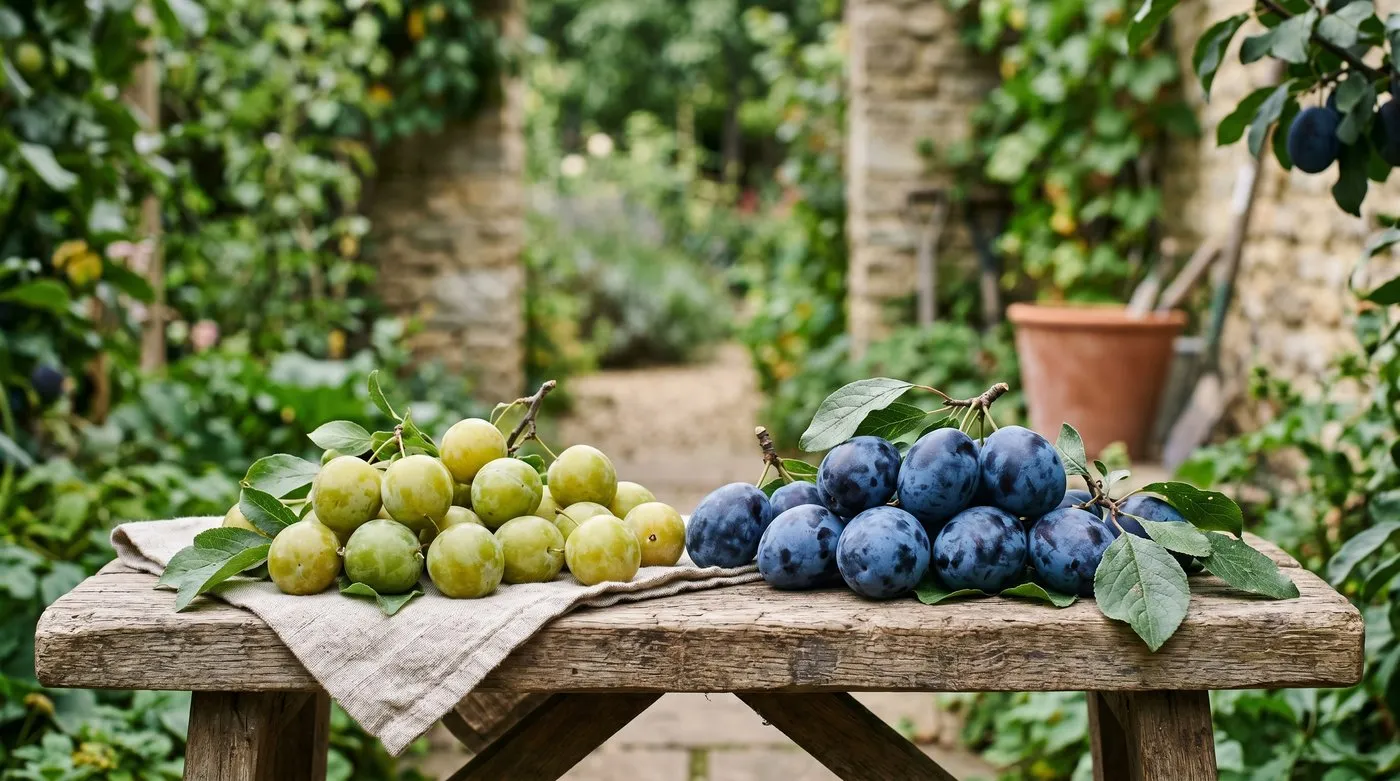 Cambridge Gage and Marjorie’s Seedling at harvest, the Group B gourmet dessert plum next to the late Group C cooker, six weeks apart in ripening
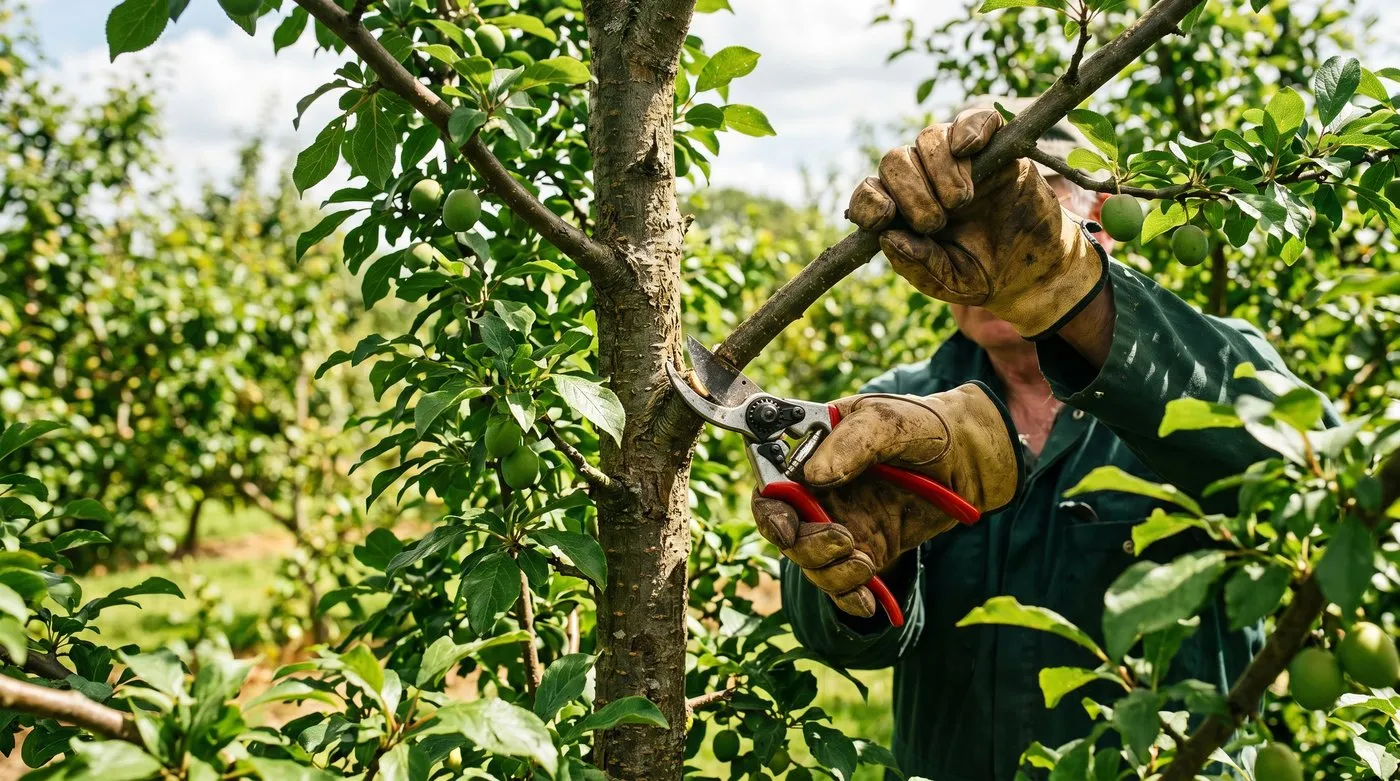 Mid-June pruning on a five-year Victoria, the timing that cuts silver leaf risk by 90% versus winter pruning
Our team produces practical UK gardening guidance from source research, contributor records and established horticultural practice. Editorial standards are overseen by Matt W.