Key takeaways
- Fan training suits stone fruit: peach, nectarine, cherry, plum, and apricot thrive against warm walls
- A south-facing wall is essential for peach and nectarine; north walls suit only Morello cherry
- The framework takes 3 years to build using the initial V-cut method on a maiden whip
- Summer pruning prevents silver leaf disease, which enters through winter wounds on stone fruit
- Horizontal wires at 15cm intervals hold the fan ribs in position with soft twine ties
- A mature fan-trained peach produces 8-15kg of fruit per year from a 3.6m wall span
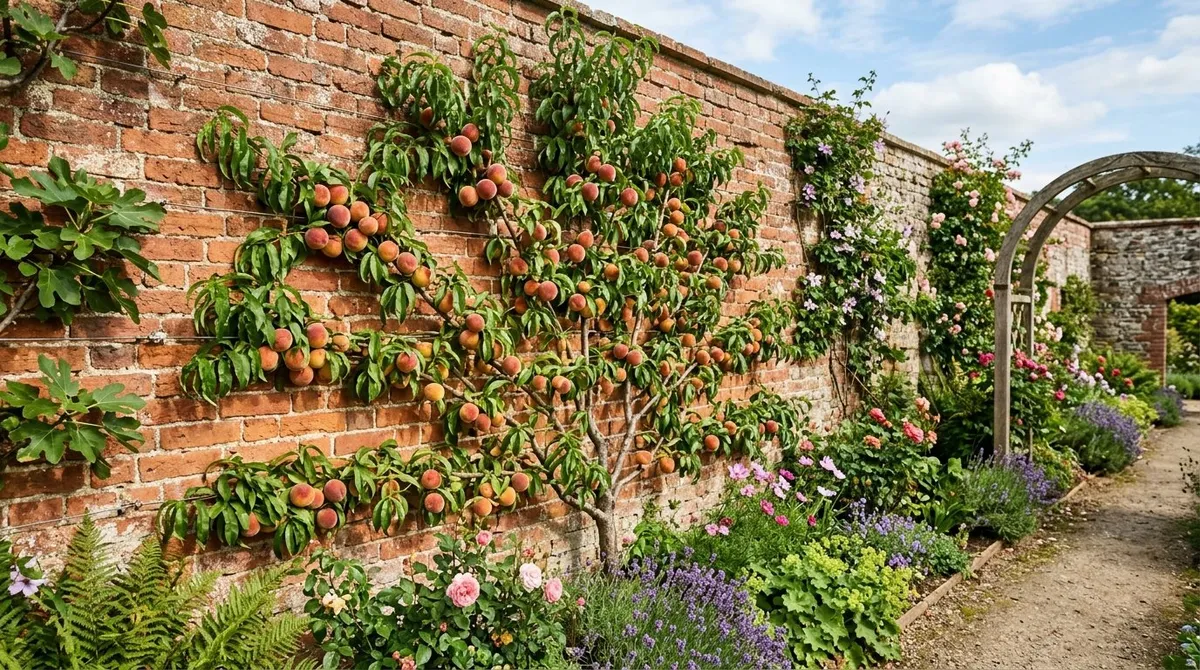
Fan training grows stone fruit flat against a wall in a pattern of radiating branches, like the ribs of an open fan. It is the best way to grow peaches, nectarines, cherries, plums, and apricots in the British climate. The warm microclimate against a south-facing wall gives these Mediterranean and Asian fruits the extra heat they need to ripen properly in UK summers.
This method is different from espalier. Espalier uses horizontal tiers and suits apples and pears. Fan training uses branches at wide 45-degree angles and suits stone fruit. If you are growing apples or pears, our espalier training guide covers the correct method.
Which fruit trees are best for fan training in the UK?
Not every fruit suits fan training. The method works best with stone fruit that produces fruit along the length of one-year-old shoots. Pome fruit like apples and pears fruit on short spurs along older wood, which suits the horizontal structure of an espalier instead.
The six best fruits for fan training
| Fruit | Best Variety | Wall Aspect | Spacing | Years to First Crop | Yield per Tree |
|---|---|---|---|---|---|
| Peach | Peregrine | South or SW | 3.6m | 3 | 8-15kg |
| Nectarine | Lord Napier | South or SW | 3.6m | 3 | 6-12kg |
| Cherry (sweet) | Stella | South or West | 3.6m | 4 | 10-15kg |
| Cherry (acid) | Morello | North or East | 3.6m | 3 | 8-12kg |
| Plum | Victoria | South or West | 3.6m | 3 | 10-20kg |
| Apricot | Moorpark | South | 3.6m | 3-4 | 5-10kg |
Peregrine peach is the most reliable outdoor variety in Britain. It ripens in August and tolerates the variable UK summer better than most peach cultivars. Our full peach growing guide covers varieties, rootstocks, and peach leaf curl prevention.
Morello cherry is unique in this list. It is the only fan-trained fruit that thrives on a north-facing wall. It flowers later than sweet cherries, avoiding most frost damage, and its acid fruit is well suited to cooking and preserving.
Why does wall aspect matter for fan-trained fruit?
A south-facing brick or stone wall absorbs solar energy during the day and releases it slowly after dark. This makes a microclimate 2-3 degrees Celsius warmer than the open garden. For peaches and nectarines, that extra warmth is the difference between ripe fruit and hard, flavourless stones.
Matching fruit to wall direction
South-facing walls suit peach, nectarine, apricot, and sweet cherry. The reflected heat ripens fruit fully and reduces the risk of brown rot caused by damp conditions. West-facing walls work for plums and sweet cherries in most of England. East-facing walls are risky because morning sun thaws frozen spring blossom too rapidly, killing the flowers.
North-facing walls receive no direct sun for much of the day. Only Morello cherry succeeds here. It flowers late enough to avoid frost damage and ripens its acid fruit without strong sun. Our guide to growing cherry trees covers both sweet and acid types in detail. For apricots, a south-facing sheltered position is non-negotiable in the UK. Our apricot growing guide explains site selection and the Moorpark variety.
How do I set up wires for fan training?
The wire framework is permanent and must be installed before planting the tree. Use 2mm galvanised wire stretched horizontally at 15cm intervals from 40cm above ground level to the top of the wall. This closer spacing (compared to 45cm for espaliers) accommodates the fan’s radiating branch pattern.
Materials and method
Fix vine eyes into the wall mortar joints at 1.8m intervals along each wire run. Thread the wire through the eyes and tension it with a straining bolt at one end. The wire should sit 10-15cm away from the wall surface to allow air circulation behind the branches. Good airflow reduces fungal disease, which is critical for peaches.
You need 12-15 horizontal wires for a wall 2.4m tall. Each wire supports one or more fan ribs tied with soft garden twine. Replace twine annually, it rots and tightens as branches thicken, which can girdle the bark. Use figure-of-eight ties that cushion the branch against the wire.
How do I train a fan in year one?
Start with a maiden whip, an unbranched one-year-old tree on the correct rootstock. For peaches and nectarines, St Julien A is the standard semi-vigorous rootstock. For cherries, use Gisela 5 for restricted growth. For plums, Pixy gives a compact tree suited to wall training.
The initial V-cut
Plant the maiden whip 20-25cm from the wall base in November. In February of the first spring, cut the main stem at 40-50cm above the graft union, just above two strong opposite buds or side shoots. These two shoots become the first pair of ribs, angled at roughly 45 degrees to each side.
Tie each shoot to a bamboo cane angled at 45 degrees and secured to the horizontal wires. Let both shoots grow unchecked through the first summer. Remove any other side shoots that appear on the main stem. By autumn, you should have two strong branches each 60-90cm long, forming a V shape.
What pruning is needed in years two and three?
Year two builds the framework outward. In February, shorten each of the two main ribs by about one-third, cutting to an outward-facing bud. This stimulates side shoots that will become the secondary ribs of the fan.
Year two summer work
As new shoots grow from the shortened ribs, select 3-4 well-spaced shoots on the upper side of each rib and 3-4 on the lower side. Tie these to canes at evenly spaced angles. Remove any shoots growing directly toward the wall or directly outward. By the end of year two, you should have 8-12 ribs radiating from the centre.
Year three completion
Repeat the process: shorten the outermost ribs by one-third in late February, and train new growth into the remaining gaps. By the end of year three, the wall should be covered with an even fan of branches at roughly equal spacing. The framework is now complete. All future pruning is maintenance rather than formative.
How do I summer prune a mature fan-trained tree?
Summer pruning is where fan training differs most from other forms. Stone fruit must never be pruned in winter because silver leaf disease enters through dormant-season wounds. All pruning happens between June and August, when cuts heal within days. Our fruit tree pruning guide covers the principles in detail.
The replacement shoot method
Peaches and nectarines fruit on shoots that grew the previous summer. After a shoot has fruited, it will not fruit again. The system relies on training a replacement shoot from the base of each fruiting branch every year.
In early June, select one new shoot growing from the base of each fruiting branch. Tie it to the wires. This shoot will carry next year’s fruit. After harvest in August, cut the fruited branch back to the replacement shoot. Remove any shoots growing straight out from the wall face.
Plums, cherries, and apricots also fruit on one-year-old wood but produce fruit buds on older wood too. Pruning is lighter, thin overcrowded shoots in July and remove any dead or crossing branches. For plum-specific advice, see our plum growing guide.
Why is silver leaf disease the biggest risk?
Silver leaf (Chondrostereum purpureum) is a fungal disease that enters through pruning cuts. Spores are airborne from September to May. Infected branches show a silvery sheen on leaves, followed by die-back. Severe infection kills entire trees.
Stopping silver leaf
The single most important rule: never prune stone fruit between September and April. Summer cuts heal within 7-10 days, sealing out spores before autumn. Use clean, sharp secateurs and loppers. Sterilise blades between trees with methylated spirit. Remove and burn any branch showing silver leaf symptoms immediately, do not compost diseased wood.
Paint large pruning wounds (over 2cm diameter) with a wound sealant containing trichoderma, a beneficial fungus that outcompetes silver leaf spores. This is the only situation where wound paint is justified in fruit tree care. For other common fruit tree diseases, see our guide to canker treatment.
Do I need to hand-pollinate fan-trained peaches?
Yes. Peach and nectarine trees flower in March, when temperatures are too low for most pollinating insects to fly. Without human intervention, fruit set is unreliable in most UK gardens.
How to hand-pollinate
Use a soft artist’s paintbrush, a rabbit-tail brush, or a cotton wool ball on a stick. On a dry, sunny morning, gently dab the centre of each open flower, transferring pollen from the stamens of one flower to the stigma of another. Work systematically along each branch. Repeat daily while flowers are open, which is typically 10-14 days.
Protect blossom from frost with horticultural fleece draped over the framework at night. Remove the fleece each morning so insects can access any flowers. Even in poor springs, hand pollination typically achieves 30-50% fruit set, which is more than enough for a heavy crop after thinning.
What rootstock should I choose for a fan-trained tree?
Rootstock controls the final size and vigour of the tree. A wall-trained fan needs a semi-dwarfing or semi-vigorous rootstock that fills the available space without outgrowing it. Our guide to dwarf fruit trees covers rootstock selection in more detail.
Rootstock guide for fan training
| Fruit | Rootstock | Final Height | Wall Span | Vigour |
|---|---|---|---|---|
| Peach/nectarine | St Julien A | 2.5-3m | 3.6m | Semi-vigorous |
| Sweet cherry | Gisela 5 | 2-2.5m | 3m | Semi-dwarfing |
| Acid cherry | Gisela 5 | 2-2.5m | 3m | Semi-dwarfing |
| Plum | Pixy | 2-2.5m | 3m | Dwarfing |
| Plum | St Julien A | 2.5-3.5m | 3.6m | Semi-vigorous |
| Apricot | St Julien A | 2.5-3m | 3.6m | Semi-vigorous |
St Julien A is the workhorse rootstock for fan training. It provides enough vigour to fill a 3.6m wall span while remaining manageable with annual summer pruning. Pixy restricts plum growth to smaller walls but can struggle on poor or dry soil. The RHS rootstock guide provides additional detail on compatibility and vigour.
What ongoing care does a fan-trained tree need?
Beyond summer pruning, fan-trained trees need feeding, watering, and fruit thinning to produce quality crops year after year. Wall-trained trees are more exposed to drought because wall foundations and overhanging eaves shed rainwater away from the root zone.
Annual care calendar
Water deeply once a week from May to September, applying 20 litres per session at the base. Mulch with 5-8cm of well-rotted compost in March, keeping it 10cm clear of the trunk. Feed in February with a balanced general fertiliser (Growmore at 70g per square metre) and again with a high-potash liquid feed (tomato feed) fortnightly from June to August during fruit development.
Thin peach and nectarine fruitlets in early June, leaving one fruit per 15-20cm of branch. This prevents the tree exhausting itself and produces larger, better-flavoured fruit. Plums self-thin to some extent but benefit from removing damaged or overcrowded fruitlets. For the full seasonal pruning schedule, see our year-round pruning calendar.
Frequently asked questions
What is the difference between fan training and espalier?
Fan training grows branches at 45-degree angles from a short trunk; espalier uses horizontal tiers. Fan training suits stone fruit (peach, cherry, plum) because they fruit on young wood along the branch length. Espalier suits apples and pears because they fruit on short spurs along older horizontal branches. The two methods are not interchangeable.
Can I fan train an apple tree?
Apples are better trained as espaliers or cordons, not fans. Apple trees fruit on short spurs that develop on older wood, which suits the rigid horizontal structure of an espalier. Fan training works for stone fruit because they produce fruit along one-year-old shoots. You can fan an apple, but yields will be lower than with an espalier.
Which wall aspect is best for a fan-trained peach?
A south or south-west facing wall is essential for peaches in the UK. The wall absorbs heat during the day and releases it at night, creating a microclimate 2-3 degrees warmer than open ground. West-facing walls work in southern England. North-facing walls are too cold for peaches but suit Morello cherry.
When should I prune a fan-trained cherry tree?
Prune cherries in summer only, between June and August. Silver leaf disease (Chondrostereum purpureum) enters through pruning wounds in the dormant season. Summer pruning allows cuts to heal quickly while the tree is actively growing. Never prune stone fruit between September and April.
How much space does a fan-trained fruit tree need?
A mature fan needs a wall span of 3-3.6m wide and 2-2.4m tall. This accommodates 8-12 main ribs plus side shoots. Smaller walls suit a half-fan trained to one side only. The tree needs the full wall area by year 3-4 of training.
Do I need to hand-pollinate a fan-trained peach?
Yes, peaches flower in March when few pollinating insects are active. Use a soft paintbrush or cotton wool ball to dab pollen from flower to flower on dry, sunny days. Do this daily while flowers are open. Without hand pollination, fruit set is typically poor in the UK climate.
How long before a fan-trained tree produces fruit?
Expect the first small crop in year 3 and full cropping from year 4-5. Peach and nectarine fruit on one-year-old wood, so new growth made in summer carries fruit the following year. Plums and cherries may produce a few fruits in year 2 on maiden laterals.
Our team produces practical UK gardening guidance from source research, contributor records and established horticultural practice. Editorial standards are overseen by Matt W.