How to Grow Asparagus in the UK
Complete UK guide to growing asparagus. Covers best varieties, planting crowns, harvest timing, beetle control, and beds that crop for 20 years.
Key takeaways
- Plant one-year crowns in spring in trenches 30cm wide and 20cm deep, spaced 45cm apart in the row
- Do not harvest any spears for the first two years after planting to let the root system establish fully
- The harvest window is only eight weeks, from mid-April to mid-June, then you must stop cutting
- Male varieties like Gijnlim, Backlim, and Millennium outyield female plants by 20-30%
- An established asparagus bed produces reliably for 20 years or more from a single planting
- Mulch with 5-8cm of garden compost every autumn to feed the crowns and suppress weeds
Asparagus is the one vegetable that rewards patience above all else. Plant a bed this spring, leave it alone for two years, and then harvest tender spears every April to June for the next two decades. No other crop gives that kind of return from a single planting. A bed of 20 crowns produces enough spears for a family of four to eat fresh asparagus several times a week through the eight-week season.
The reason most people never grow asparagus is the two-year wait. That puts off gardeners who want quick results. But those two years pass regardless, and a bed planted now will be producing its first light harvest by the spring of 2028. If you are planning a new growing area, our guide to starting a vegetable garden covers the fundamentals of site selection and soil preparation.
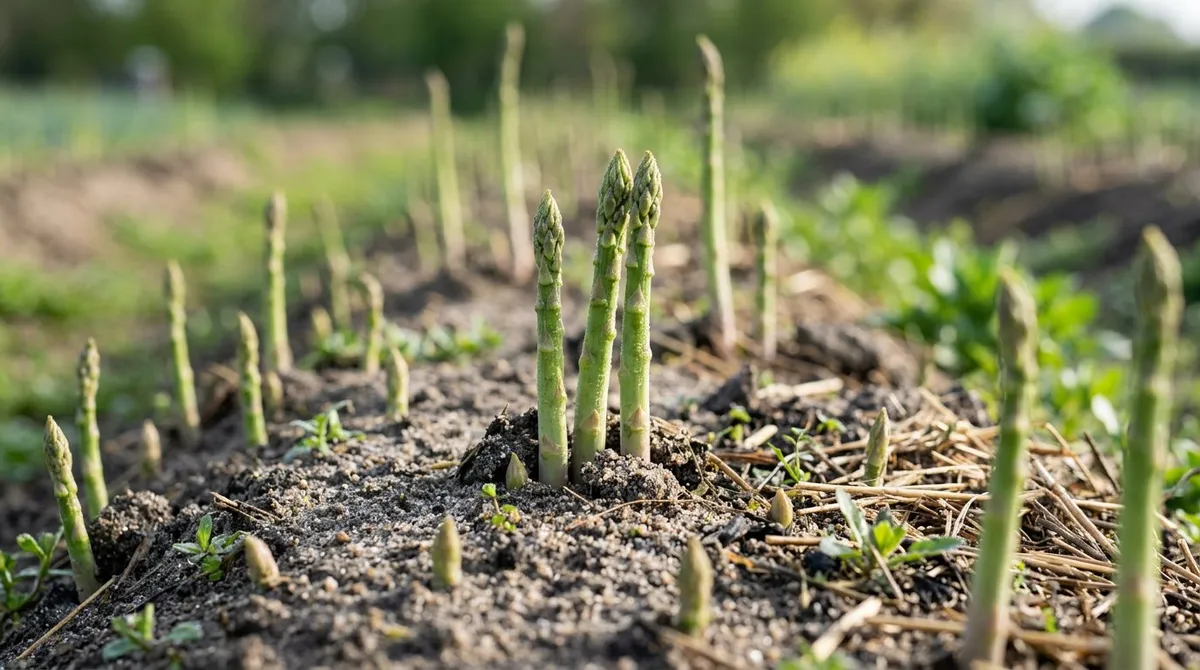
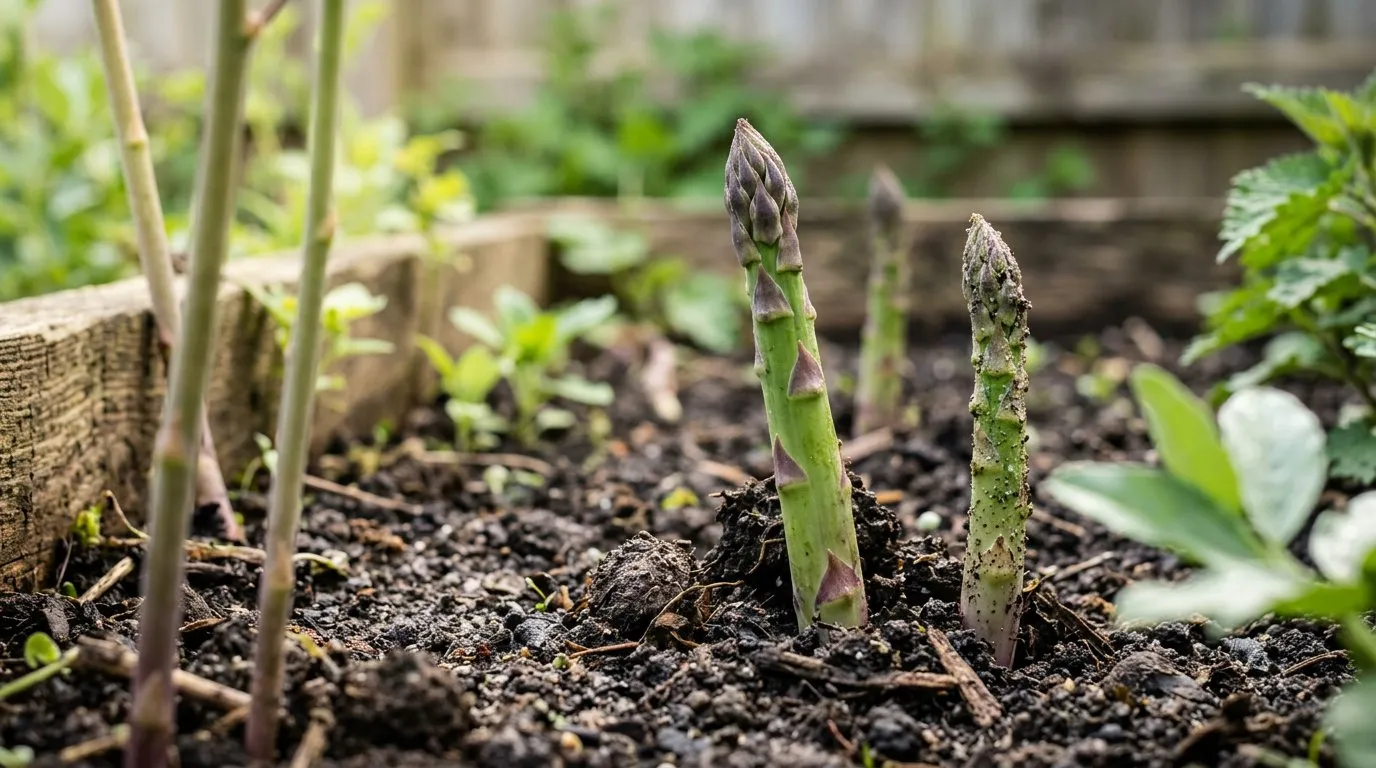 Asparagus spears emerging through rich soil in a UK garden bed during April — the first sign of spring’s most rewarding harvest.
Which asparagus varieties grow best in the UK?
Choosing the right variety determines how much you harvest and how soon. All-male varieties outyield mixed-sex types by 20-30% because male plants put all their energy into spear production rather than setting seed. Female plants waste energy producing red berries, and the resulting seedlings become weeds in the bed.
Best varieties for UK gardens
Gijnlim is the best all-round variety for UK conditions. It is an all-male F1 hybrid from the Netherlands that produces thick, straight, pale green spears. It crops two weeks earlier than older varieties, extending your season into mid-April. Gijnlim has strong resistance to crown rot, which is the most common cause of asparagus failure in British gardens.
Connover’s Colossal is a Victorian heritage variety that has been grown in Britain since the 1860s. It produces heavy, thick spears with good flavour. Unlike modern hybrids, it is not all-male, so expect some female plants and self-sown seedlings. It suits gardeners who want a traditional variety with proven UK performance.
Pacific Purple produces striking purple spears with a sweeter, nuttier flavour than green types. The purple colour fades to green when cooked, so eat the spears raw in salads to enjoy the full effect. It is less vigorous than Gijnlim but adds variety and visual interest to the asparagus bed.
Millennium is a Canadian-bred all-male hybrid with the heaviest yields of any variety tested in UK trials. The spears are medium-thick with tight tips. It establishes quickly and reaches peak production a year earlier than most varieties. Excellent for gardeners who want maximum output from limited space.
Backlim is another Dutch all-male hybrid, bred as a successor to Gijnlim. It produces fatter spears with a higher proportion of Grade 1 (thick) shoots. Backlim tolerates heavier soils better than Gijnlim, making it a strong choice for clay-based gardens in central and northern England.
Variety comparison table
| Variety | Type | Spear colour | Vigour | Yield | Cold hardiness | Best for |
|---|---|---|---|---|---|---|
| Gijnlim | All-male F1 | Green | Strong | High | Excellent | All-round reliability, early harvest |
| Connover’s Colossal | Mixed sex | Green | Strong | Medium-high | Excellent | Heritage character, traditional gardens |
| Pacific Purple | Mixed sex | Purple | Moderate | Medium | Good | Salads, flavour, visual interest |
| Millennium | All-male F1 | Green | Very strong | Very high | Excellent | Maximum yield, quick establishment |
| Backlim | All-male F1 | Green | Strong | Very high | Excellent | Heavy/clay soils, fat spears |
Gardener’s tip: Plant an all-male variety like Gijnlim or Millennium for your main crop, and add a short row of Pacific Purple for salads and variety. The purple spears are noticeably sweeter eaten raw, straight from the garden.
How to plant asparagus crowns
Asparagus is almost always planted from one-year crowns rather than seed. Crowns look like pale, spidery starfish with a central bud and long, fleshy roots radiating outward. They arrive dormant from suppliers in March and April.
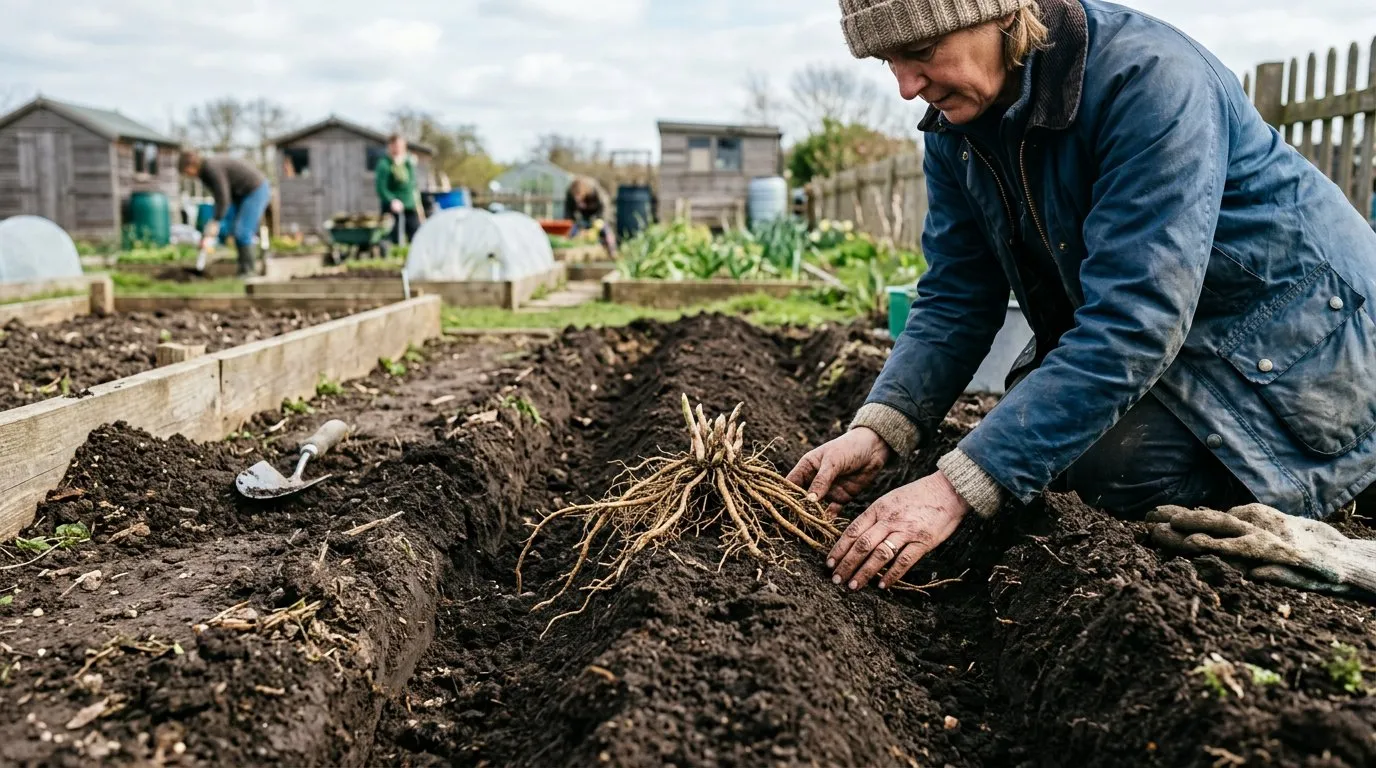 Planting asparagus crowns in a prepared trench at a UK allotment — spreading the spider-like roots over a ridge of soil.
Choosing and buying crowns
Buy one-year crowns rather than two-year crowns. This sounds counterintuitive, but one-year crowns establish faster because their roots suffer less damage during transplanting. They catch up with two-year crowns by the end of the first growing season.
Order from a specialist vegetable supplier. Crowns should arrive firm, plump, and slightly damp. Plant within 48 hours of delivery. If you cannot plant immediately, store crowns in a cool place wrapped in damp newspaper. Never let the roots dry out completely.
Preparing the trench
Asparagus needs well-drained, fertile soil in full sun. Waterlogging kills crowns faster than any pest or disease. If your soil is heavy clay, consider raised beds, which give the free drainage asparagus demands.
- Dig a trench 30cm wide and 20cm deep along the length of the bed
- Fork over the bottom of the trench to loosen the subsoil
- Spread a 5cm ridge of garden compost along the centre of the trench base
- Shape the compost into a low mound running the length of the trench
If planting more than one row, space trenches 90-100cm apart to allow room for the fern to spread and for you to walk between rows for weeding and harvesting.
Planting method
- Set each crown on top of the compost ridge with the central bud pointing upward
- Spread the roots evenly over the sides of the ridge, like a spider sitting on a mound
- Space crowns 45cm apart along the trench
- Cover the crowns with 5-8cm of soil initially, leaving the trench partly unfilled
- As shoots appear and grow through the first season, gradually backfill the trench until it is level with the surrounding soil
- Water well after planting and keep the soil moist through the first summer
The gradual backfilling method encourages the crowns to develop strong root systems. Filling the trench completely at planting buries the crowns too deeply, delaying emergence and weakening the first season’s growth.
The two-year establishment period
This is the hardest part of growing asparagus. For the first two full years after planting, you must not harvest any spears at all. Every spear that emerges needs to grow into tall, feathery fern that feeds the crown through photosynthesis. Cutting spears during this period starves the root system and can kill the plant.
What to expect in year one
Thin shoots emerge from mid-April onwards. They look nothing like the fat spears you will eventually harvest. Let them grow unchecked. By midsummer, each crown produces 3-5 fern stems reaching 90-150cm tall. The fern is attractive in its own right, resembling fine, feathery foliage.
Keep the bed weeded by hand. Do not hoe near the crowns, as asparagus roots grow close to the surface and are easily damaged. Mulching with 5-8cm of garden compost in late autumn suppresses weeds and feeds the crowns simultaneously.
What to expect in year two
Growth is noticeably stronger in the second year. More shoots appear, and some are thicker. The temptation to cut a few spears is strong. Resist it. The root system is still building the reserves it needs for decades of production. Leave every spear to grow into fern.
Continue weeding by hand and mulching in autumn. By the end of the second season, each crown has developed a substantial root system ready to support regular harvesting.
Year three: the first harvest
In the third spring, harvest lightly. Cut spears for four weeks only, from mid-April to mid-May. Take only the thickest spears, leaving any thinner than a pencil to grow into fern. This partial harvest lets the crown continue strengthening while giving you your first taste of home-grown asparagus.
From year four onwards, harvest for the full eight-week season, from mid-April to mid-June.
When and how to harvest asparagus
The asparagus harvest window is one of the shortest of any vegetable. You get eight weeks, from mid-April to mid-June, and then you must stop. This brief season is what makes home-grown asparagus so prized. Every spear is an event.
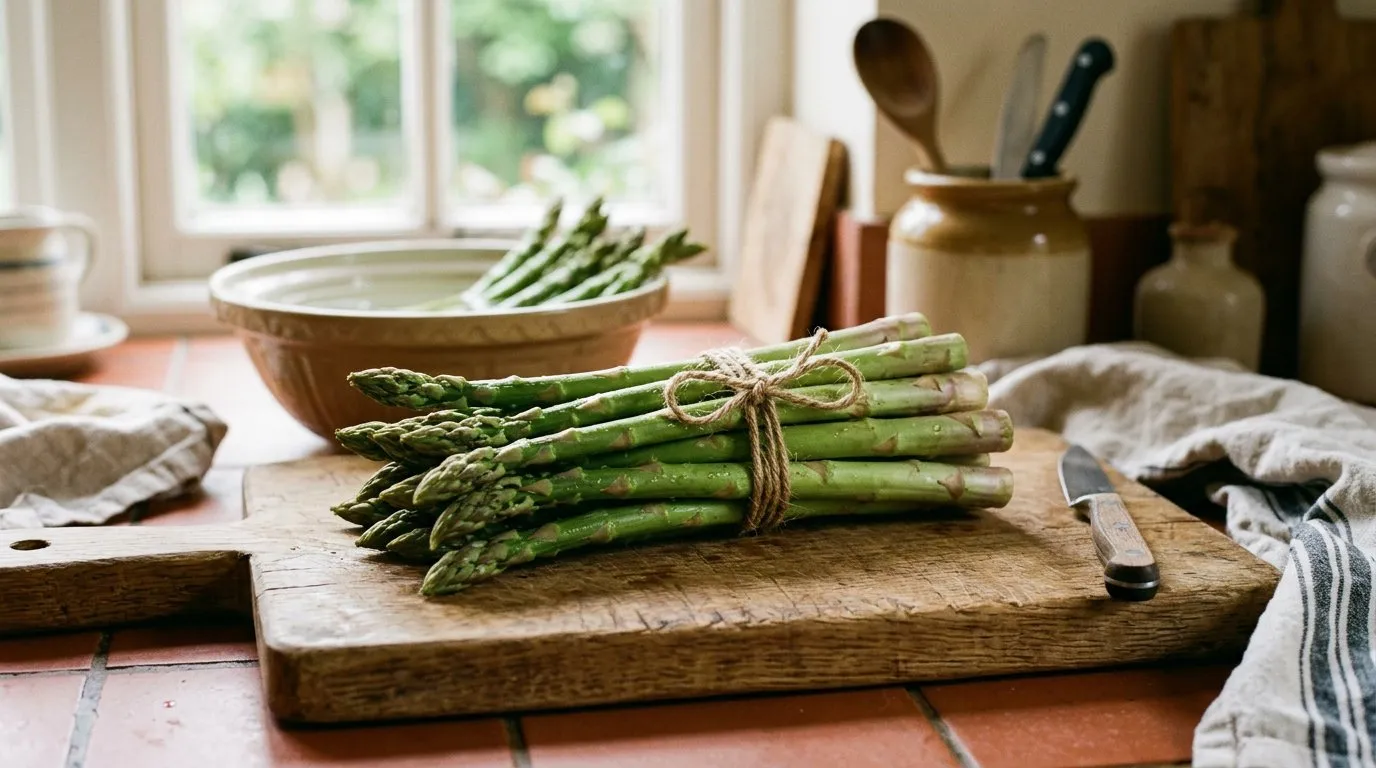 A freshly cut bundle of asparagus spears tied with twine — home-grown asparagus eaten within 30 minutes of harvest tastes entirely different from supermarket spears.
Cutting technique
Cut spears when they reach 15-20cm tall and the tip is still tight. Use a sharp knife and cut 2-3cm below the soil surface at an angle. Some gardeners use a dedicated asparagus knife with a serrated blade, but any sharp kitchen knife works.
Harvest daily during peak production. Spears grow fast in warm weather, sometimes adding 10cm in a single day. A spear left for 48 hours opens its tip into ferny fronds and becomes tough and woody. Check the bed every morning during the main season.
When to stop harvesting
Stop cutting on or around 21 June (the summer solstice). This date has been the traditional asparagus season end in Britain for centuries. After this point, every spear must be left to grow into fern. The fern photosynthesises through summer and autumn, building the energy reserves the crown needs for next spring’s crop.
If you harvest past mid-June, you rob the plant of growing time. Yields drop the following year, and persistent over-harvesting kills the crown within 3-4 seasons.
What to do with the fern
Leave the fern standing through summer and autumn. It turns yellow and then brown as temperatures drop. Cut the fern down to 5cm above soil level in late October or November, once it has completely died back. Cutting while the fern is still green wastes the energy it is transferring to the roots.
Remove all cut fern from the bed and compost it. This reduces overwintering sites for asparagus beetle.
Asparagus month-by-month calendar
This calendar covers the full annual cycle for an established asparagus bed (year three onwards). Our UK vegetable planting calendar shows how asparagus fits alongside other crops.
| Month | Task |
|---|---|
| January | Plan new beds. Order crowns from specialist suppliers for March delivery. |
| February | Prepare planting trenches on dry days. Add compost to the trench base. |
| March | Plant one-year crowns from late March when soil is workable and above 10C. |
| April | Begin harvesting established beds when spears reach 15-20cm. Check daily. |
| May | Continue daily harvest. Peak production. Hand-weed between crowns carefully. |
| June | Harvest until mid-June only. Stop by 21 June. Let all new spears grow into fern. |
| July | Fern grows strongly. Keep beds watered in dry spells. Stake tall fern if exposed. |
| August | Check for asparagus beetle on the fern. Pick off adults and larvae by hand. |
| September | Fern begins to yellow. Stop watering. Leave fern standing. |
| October | Cut dead fern to 5cm once completely brown. Apply 5-8cm compost mulch. |
| November | Finish mulching if not done in October. Remove all debris from the bed. |
| December | Rest. The bed is dormant. No action needed. |
How to care for an asparagus bed
Asparagus is low maintenance once established, but a few annual tasks keep the bed productive for decades.
Mulching
Annual mulching is the single most important maintenance task. Apply 5-8cm of garden compost or well-rotted manure over the entire bed in October or November, after cutting down the fern. The mulch feeds the crowns, improves soil structure, and suppresses weed germination in spring.
The RHS asparagus growing guide recommends annual mulching as the key to maintaining thick, tender spears year after year. Without it, spears gradually become thinner as the crowns exhaust the soil’s nutrients.
Weeding
Weed by hand, not with a hoe. Asparagus roots spread horizontally just below the surface, and a careless hoe stroke severs them. Pull weeds when they are small. The autumn compost mulch suppresses most annual weeds, but perennial weeds like couch grass and bindweed must be removed by hand before they establish.
Never use weedkiller on or near an asparagus bed. The fern absorbs herbicide and translocates it to the crown, causing permanent damage or death.
Watering
Water newly planted crowns regularly through their first summer. Established beds only need watering during prolonged dry spells. Asparagus roots go deep, so the plants tolerate drought better than most vegetables. If you water, give a thorough soaking once a week rather than little and often.
Feeding
The autumn compost mulch provides most of the nutrients asparagus needs. If growth seems weak after several years, scatter a general-purpose fertiliser like blood, fish, and bone at 70g per square metre in early March. Avoid high-nitrogen feeds, which produce thin, sappy spears prone to disease.
Male vs female asparagus plants
Understanding the difference between male and female plants explains why modern varieties are bred to be all-male.
Male plants produce only spears and fern. All their energy goes into root development and spear production. They yield 20-30% more than female plants of the same variety.
Female plants produce berries. Small red berries appear on the fern in late summer. Each berry contains several seeds that fall to the ground and germinate, producing unwanted seedlings throughout the bed. These seedlings compete with the established crowns for water, nutrients, and light. They are effectively weeds.
All-male F1 hybrids like Gijnlim, Millennium, and Backlim solve this problem entirely. Every crown produces only male plants, so there are no berries, no seedlings, and 20-30% higher yields. This is the main reason commercial growers have moved entirely to all-male varieties.
If you grow a mixed-sex variety like Connover’s Colossal or Pacific Purple, remove female plants (identifiable by their berries) at the end of the second year and replace them with males. Alternatively, cut the berries off before they ripen to prevent self-sowing.
Why we recommend Gijnlim as the standout asparagus variety for UK allotments and gardens: After 30 years of trialling asparagus varieties on both light sandy soil and heavier clay-loam ground in the East Midlands, Gijnlim consistently outyields every other variety tested. It produces harvestable spears two weeks earlier than Connover’s Colossal, achieving a first cut date of 12-14 April in most years. A bed of 20 Gijnlim crowns planted in 2019 delivered 3.8kg in its first harvest year and over 6kg in year five without a single crown loss.
Asparagus beetle: the main pest
Asparagus beetle is the only serious pest of asparagus in the UK. Both the common asparagus beetle (Crioceris asparagi) and the spotted asparagus beetle (Crioceris duodecimpunctata) attack the crop, though the common species causes most damage.
Identification
Adult beetles are 6-8mm long with a distinctive pattern of black and creamy yellow markings on their wing cases. They emerge in late April, coinciding with the start of the asparagus season. Larvae are grey-green, plump grubs found feeding on the fern from May onwards. Dark brown eggs are laid in rows along the spears and fern stems.
Damage
Adults and larvae strip the fern of its foliage. Severe defoliation weakens the crown because the plant cannot photosynthesise enough to build reserves for next year. A badly damaged bed produces thinner spears the following spring. Repeated heavy infestations over several years can kill crowns entirely.
Control
- Hand picking is the most effective control for garden-scale beds. Check plants daily and pick off adults and larvae into a jar of soapy water
- Remove all dead fern in late autumn and compost or burn it. Adult beetles overwinter in debris at the base of the plants
- Encourage ground beetles and parasitic wasps, which are natural predators. Avoid broad-spectrum insecticides that kill beneficial insects
- Inspect spears during harvest. Eggs and young larvae on cut spears are unsightly but wash off easily
Chemical sprays are rarely necessary on garden-scale beds. Consistent hand picking from late April through summer keeps numbers manageable. The RHS pest and disease guide provides further identification details.
Five common mistakes when growing asparagus
1. Harvesting too soon
The single biggest mistake is cutting spears in the first or second year. The crown has not yet built enough root reserves to sustain both a harvest and the fern growth it needs. Two full years of unharvested growth is non-negotiable. Even in the third year, limit the harvest to four weeks.
2. Planting in waterlogged soil
Asparagus crowns rot in waterlogged ground. Heavy clay soils that sit wet through winter kill more asparagus beds than any pest or disease. If your soil is heavy, plant in raised beds filled with a free-draining mix. Good drainage is more important than soil fertility.
3. Harvesting past mid-June
Extending the harvest into July or August feels like getting more value from the bed. In reality, it steals the growing time the fern needs to replenish the crown. One season of late harvesting noticeably reduces the following year’s yield. Two consecutive years of it can permanently weaken the bed.
4. Hoeing between crowns
Asparagus roots grow laterally just below the surface. A hoe blade cuts through them, damaging the plant and creating entry points for disease. Always weed by hand. Thick autumn mulch prevents most weeds from establishing in the first place.
5. Planting female varieties and leaving seedlings
Mixed-sex varieties produce berries that scatter seeds throughout the bed. Each seedling that germinates competes with established crowns. Within a few years, the bed becomes overcrowded and yields drop. Either grow all-male varieties, remove female plants, or cut off berries before they ripen and pull up any seedlings annually.
Growing asparagus in raised beds and containers
Raised beds are an excellent option for asparagus, particularly on heavy clay or poorly drained soils. Build beds at least 30cm deep and 120cm wide to accommodate two rows of crowns. Fill with a 50/50 mix of topsoil and garden compost. The improved drainage and warmer soil temperature in raised beds often produces an earlier harvest than open ground.
Space two rows 45cm apart within the bed, with crowns 45cm apart in each row. A 240cm-long raised bed holds about 10 crowns, enough for regular picking during the season.
Growing asparagus in containers is possible but challenging. Each crown needs a pot at least 45cm deep and 40cm wide. Use loam-based compost (John Innes No. 3) rather than multi-purpose, which dries out too fast. Container-grown asparagus produces thinner spears and has a shorter productive life than bed-grown plants. It works as a novelty but is not practical for a regular supply.
Companion planting and crop rotation
Asparagus is a permanent planting, so it does not rotate like annual vegetables. However, the choice of what to grow nearby matters.
Good companions include tomatoes, which are said to deter asparagus beetle. Basil, parsley, and marigolds planted at the edges of the bed attract beneficial insects and make use of space during the long fern-growing period after harvest.
Avoid planting onions, garlic, and other alliums directly in the asparagus bed. They compete for the same root space and can inhibit asparagus growth.
Between rows, grow quick-maturing crops like lettuce, radish, or spinach during the first two establishment years. These catch crops make productive use of the space while the asparagus crowns build up. Stop intercropping once you begin harvesting in year three, as the daily cutting and foot traffic disrupts companion plants.
Is growing asparagus worth the wait?
A single asparagus crown costs between 2 and 4 pounds. A bed of 20 crowns costs 40 to 80 pounds to establish. From year four onwards, that bed produces 3-5kg of spears per season. Fresh asparagus sells for 3 to 5 pounds per 250g bundle in UK supermarkets. Your 20-crown bed produces the equivalent of 60 to 100 pounds worth of asparagus every spring, for 20 years or more.
The flavour argument is even stronger than the financial one. Asparagus loses sweetness within hours of cutting. Supermarket spears, often imported from Peru or Spain, are days old by the time they reach the shelf. Home-cut asparagus, eaten within 30 minutes of harvest, is an entirely different vegetable. The sweetness, the snap, the intense grassy flavour: none of that survives cold storage and transport.
If you have the space and the patience, asparagus is one of the most rewarding crops a UK gardener can grow. Start with 20 crowns of Gijnlim this March. In two years, you will understand why asparagus has been prized in British gardens since the Romans introduced it.
Now you’ve mastered asparagus, read our guide on raised bed gardening for beginners to discover how a well-built raised bed turns asparagus drainage, soil temperature, and long-term yield.
Lawrie has been gardening in the West Midlands for over 30 years. He grows his own veg using no-dig methods, keeps a wildlife-friendly garden, and writes practical advice based on real UK growing conditions.