How to Grow Broccoli and Calabrese in the UK
Practical guide to growing broccoli and calabrese in UK gardens. Covers varieties, sowing, transplanting, netting, clubroot, and side shoots.
Key takeaways
- Calabrese matures in 12-16 weeks for summer harvest, while purple sprouting broccoli takes up to 12 months for winter and spring harvest
- Ironman F1 and Marathon F1 are the most reliable calabrese varieties for UK gardens, producing heads of 15-20cm
- Early Purple Sprouting crops from late February, filling the hungry gap when few other fresh vegetables are available
- Firm planting is critical for all broccoli types, as loose plants rock in the wind and produce small, poor-quality heads
- Netting with 7mm mesh is essential to protect against pigeons and cabbage white butterfly caterpillars
- After cutting the main calabrese head, side shoots continue producing for 4-6 weeks if harvested every 3-4 days
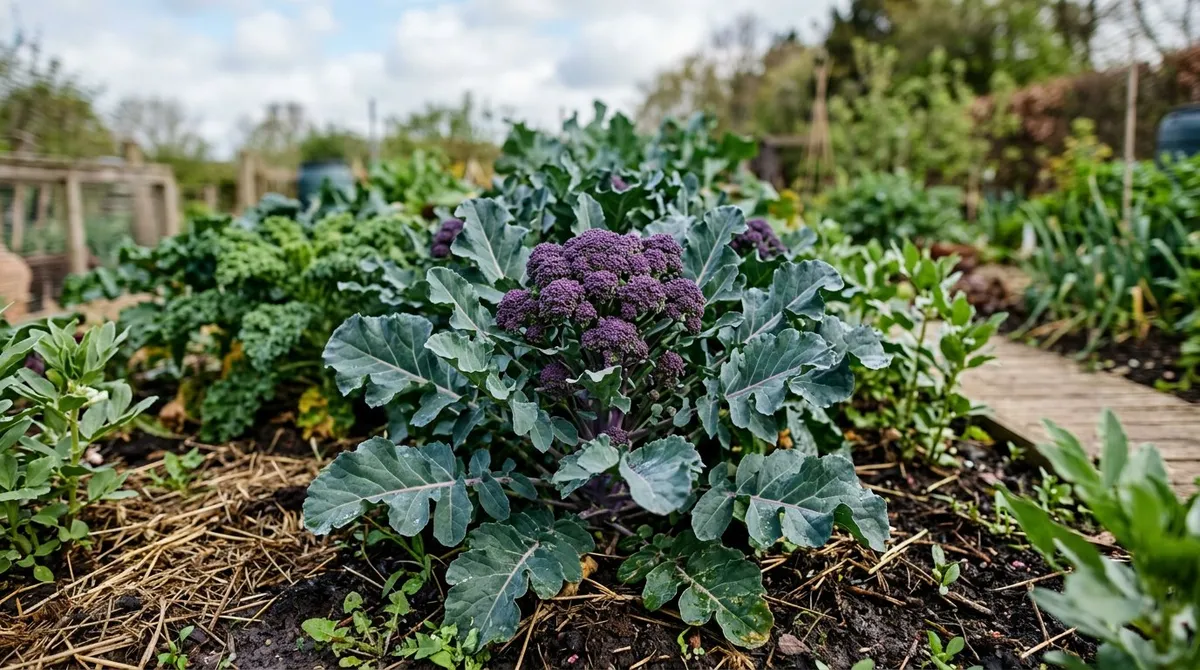
Broccoli is one of the most rewarding brassicas for UK gardens. It delivers two distinct crops depending on the type you grow. Calabrese produces large green heads in summer, ready in as little as 12 weeks from transplanting. Purple sprouting broccoli occupies the ground for up to 12 months but fills the hungry gap from February to April, when almost nothing else is producing fresh food.
Both types grow well across the UK, from Cornwall to the Scottish Highlands. They tolerate cold, shrug off frost, and produce generous harvests in return for firm planting, decent soil, and protection from pigeons. If you are starting a vegetable garden for the first time, calabrese is a rewarding early crop. Purple sprouting broccoli is the plant that makes experienced growers feel smug in March, when everyone else is buying imported greens.
What is the difference between broccoli and calabrese?
The names cause endless confusion. What supermarkets sell as “broccoli” is actually calabrese (Brassica oleracea var. italica). It forms a single large green head on a thick stem and is harvested in summer and early autumn.
Sprouting broccoli (usually purple, sometimes white) is the traditional British type. Instead of one big head, it produces dozens of smaller florets on long stems over many weeks. Purple sprouting broccoli crops from late February through April, right when the vegetable garden is at its barest.
The growing approach differs too. Calabrese is a quick crop, sown in spring and harvested the same summer. Sprouting broccoli is sown in spring but not harvested until the following year. Understanding this distinction matters because it affects spacing, timing, and how long each plant occupies valuable ground.
Tenderstem broccoli (a trademarked cross between calabrese and Chinese kale) sits somewhere between the two. It produces slender, long-stemmed florets over several weeks during summer. It needs similar care to calabrese but is slightly more demanding of warm conditions.
Best broccoli and calabrese varieties for UK gardens
Choosing the right variety determines when you harvest and how much you get. UK conditions suit both calabrese and sprouting broccoli extremely well.
Calabrese varieties
- Ironman F1 - the benchmark variety for UK growers. Dense, domed, blue-green heads up to 20cm across. Excellent disease resistance. Reliable in cool summers. Produces good side shoots after the main head is cut.
- Marathon F1 - similar quality to Ironman with slightly later maturity. Outstanding heat tolerance for warmer southern gardens. Heads stay tight longer before bolting.
- Green Magic F1 - early maturing with uniform, medium-sized heads. Crops well in spring and autumn sowings. Good choice for succession planting.
- Belstar F1 - organic growers’ favourite with strong natural disease resistance. Medium-large heads with fine bead. Performs well without chemical inputs.
- Tenderstem (Inspiration F1) - produces slender stems with small florets over 6-8 weeks. Harvest from July to September. Needs richer soil and warmer conditions than standard calabrese.
Purple sprouting broccoli varieties
- Early Purple Sprouting - the most widely grown variety. Crops from late February in southern England. Heavy yields of deep purple florets. Hardy to minus 12C.
- Red Arrow - improved early variety with more uniform cropping. Slightly earlier than Early Purple Sprouting, often starting in mid-February. Good side shoot production.
- Claret - late-season variety cropping from March to May, extending the harvest after early types finish. Very hardy. Large, well-flavoured spears.
- White Star - white sprouting broccoli with a milder, more delicate flavour. Crops March to April. Less hardy than purple types, so best in sheltered gardens.
- Mendocino F1 - a modern early purple sprouting that crops from January in mild areas. Bred for commercial growing but available to home gardeners. Uniform spears.
Broccoli and calabrese variety comparison
| Variety | Type | Sow | Harvest | Weeks to harvest | Head/spear size | Hardiness | Best for |
|---|---|---|---|---|---|---|---|
| Ironman F1 | Calabrese | Mar-Apr | Jul-Sep | 12-14 | 15-20cm head | Moderate | Reliable main crop |
| Marathon F1 | Calabrese | Mar-May | Jul-Oct | 14-16 | 15-18cm head | Moderate | Warm areas, late crop |
| Green Magic F1 | Calabrese | Mar-Jun | Jul-Oct | 10-12 | 12-15cm head | Moderate | Succession sowing |
| Belstar F1 | Calabrese | Apr-May | Aug-Sep | 12-14 | 14-18cm head | Moderate | Organic growing |
| Tenderstem | Calabrese/hybrid | Apr-May | Jul-Sep | 12-16 | Slim stems 15-20cm | Low | Fine dining, stir-fry |
| Early Purple Sprouting | Sprouting | Apr-May | Feb-Apr (next year) | 40-48 | 10-15cm spears | Very hardy (-12C) | Hungry gap harvest |
| Red Arrow | Sprouting | Apr-May | Feb-Mar (next year) | 38-44 | 10-15cm spears | Very hardy | Earliest sprouting crop |
| Claret | Sprouting | Apr-May | Mar-May (next year) | 44-52 | 12-18cm spears | Very hardy | Extended late harvest |
| White Star | Sprouting | Apr-May | Mar-Apr (next year) | 42-48 | 10-15cm spears | Hardy | Mild flavour |
Gardener’s tip: Grow both types. Ironman F1 or Green Magic for summer eating and Early Purple Sprouting for the hungry gap gives you home-grown broccoli for eight months of the year.
How to sow broccoli and calabrese
Both types start the same way. Sow indoors in modules for the strongest, healthiest plants.
Sowing calabrese (March to June)
Sow calabrese seeds 1.5cm deep in module trays filled with peat-free seed compost. Use one seed per cell to avoid root disturbance later. Germination takes 5-10 days at 15-20C. A windowsill, unheated greenhouse, or cold frame all work well.
Calabrese dislikes root disturbance. This is the single most important thing to know. Sow in modules or small pots, never in open seed trays where roots tangle. Transplant before plants become pot-bound, ideally when they have 4-6 true leaves at about 4-5 weeks old.
For a continuous supply, sow seeds indoors every 3 weeks from March to early June. This staggers the harvest from July through to October. Later sowings in May and June avoid the worst of the cabbage white butterfly season, which peaks in July and August.
Sowing purple sprouting broccoli (April to May)
Sow purple sprouting broccoli in April or May using the same method. There is no benefit to earlier sowing because the plants need a long, slow growing season to develop properly before winter. Rushing them with early heat produces leggy, weak plants.
Seedlings are ready to transplant about 5-6 weeks after sowing, when they stand 10-15cm tall with sturdy stems. Unlike calabrese, sprouting broccoli tolerates a nursery bed if space is tight. Sow in a dedicated row outdoors and transplant to final positions in June or July.
Transplanting and spacing
Getting the planting right makes the difference between tight, heavy heads and disappointing, loose ones.
When to transplant
Move calabrese seedlings to their final positions 4-5 weeks after sowing, or when they have 4-6 true leaves. In most of the UK, this means transplanting from late April (early sowings under cover) through to July (late succession sowings).
Transplant purple sprouting broccoli in June or July. The plants need their final positions before they grow too large for the modules.
Spacing
Calabrese: space plants 30-45cm apart in rows 45-60cm apart. Closer spacing (30cm) produces smaller heads but more of them. Wider spacing (45cm) gives larger main heads and better side shoot production.
Purple sprouting broccoli: space plants 60cm apart in rows 75cm apart. These are big plants. By midwinter, a healthy purple sprouting broccoli plant stands 60-90cm tall and 50-60cm wide. Cramming them together restricts airflow and invites fungal disease.
Firm planting is critical
Press the soil firmly around the stem at planting. This matters more for broccoli than almost any other vegetable. Loose plants rock in the wind, which damages fine root hairs and weakens the plant’s anchor. The result is small heads, poor growth, and plants that blow over in winter storms.
After planting, tug a leaf gently. If the plant lifts, it is too loose. Press the soil down again with your knuckles or the handle of a trowel. Check plants regularly, especially after heavy rain or strong wind, and re-firm as needed.
Water transplants thoroughly at planting and keep the soil moist for the first two weeks while roots establish. After that, broccoli is reasonably drought-tolerant, though consistent watering produces better heads.
If you grow in raised beds, the loose, well-drained compost makes firm planting even more important. Consider earthing up the stems slightly as plants grow to provide extra stability.
Feeding and ongoing care
Broccoli and calabrese are hungry plants. They need fertile soil and regular feeding to produce well.
Soil preparation
Dig in plenty of well-rotted compost or farmyard manure the autumn before planting. Broccoli needs nitrogen-rich soil. If you follow a crop rotation, brassicas traditionally follow legumes (peas and beans), which leave nitrogen-fixing nodules in the soil.
Lime the bed in winter if your soil pH is below 6.5. Brassicas prefer slightly alkaline soil (pH 6.5-7.5), and raising the pH also helps prevent clubroot.
Feeding schedule
Apply a balanced granular fertiliser (such as Growmore at 70g per square metre) before transplanting. Top-dress with nitrogen-rich feed (blood, fish and bone or pelleted chicken manure) 4-6 weeks after planting, when plants enter their main growth phase.
For calabrese, stop feeding once heads start to form. Excess nitrogen at this stage produces soft, leafy growth instead of tight florets.
Purple sprouting broccoli benefits from a second top-dressing in early autumn to fuel its growth through winter. A final feed in late January as the plant starts producing spears boosts the crop.
Watering
Water regularly during dry spells, aiming for 2.5cm per week. Irregular watering causes calabrese heads to develop unevenly or bolt prematurely. Mulch around plants with compost or straw to retain moisture and suppress weeds. Check our UK vegetable planting calendar for watering guidance throughout the season.
Protecting broccoli from pests
Brassicas attract more pests than almost any other vegetable family. Three cause the most damage to broccoli: pigeons, cabbage white butterfly caterpillars, and cabbage root fly.
Netting against pigeons and butterflies
Netting is non-negotiable. Pigeons strip brassica leaves to the stem within hours if given the chance. Cabbage white butterfly caterpillars eat holes through leaves and burrow into developing heads.
Cover plants with 7mm mesh netting immediately after transplanting. Support the net on hoops or a frame to keep it above the plants. Netting that rests on the leaves allows butterflies to lay eggs through the mesh.
Remove the net briefly to weed and feed, then replace it. Keep it in place from transplanting until harvest. The small cabbage white butterfly can squeeze through larger mesh, so 7mm or finer is essential.
Brassica collars for cabbage root fly
Cabbage root fly lays eggs at the base of brassica stems. The larvae burrow down and feed on the roots, causing plants to wilt and die. The adult fly is small and inconspicuous. You rarely notice the damage until the plant collapses.
Fit a brassica collar around each stem at planting. These are flat discs (10-15cm diameter) of carpet underlay, cardboard, or purpose-made felt that sit flush against the soil surface. They prevent the fly from reaching the soil beside the stem to lay eggs.
Cut a slit to the centre of a 15cm square of material, slip it around the stem, and press it flat against the soil. Commercial collars cost a few pence each and last the season. Homemade versions from cardboard work but degrade in wet weather.
Caterpillar patrol
Even with netting, check the undersides of leaves weekly. The small cabbage white butterfly (Pieris rapae) is sneaky and sometimes finds gaps. Look for clusters of yellow eggs and squash them before they hatch. Hand-pick any caterpillars you find. Green caterpillars are the small white; yellow-and-black striped caterpillars are the large white (Pieris brassicae).
Biological control with Bacillus thuringiensis (Bt) spray is effective and organic-approved. It kills caterpillars without harming bees or other beneficial insects. Apply it as soon as you spot damage.
Stopping clubroot
Clubroot (Plasmodiophora brassicae) is the most serious disease of brassicas. It distorts roots into swollen, club-shaped masses that cannot absorb water or nutrients. Infected plants wilt in warm weather, grow poorly, and eventually die. Once clubroot is in the soil, it persists for up to 20 years.
How to avoid clubroot
- Raise soil pH to 7.0-7.5 by applying garden lime in autumn. Clubroot thrives in acidic soil below pH 6.5. Test your soil pH annually if you grow brassicas regularly.
- Start plants in clean compost. Sow in fresh, shop-bought compost and grow in modules until transplanting. This gives plants a strong, healthy root system before they enter potentially contaminated ground.
- Transplant with the rootball intact. Do not bare-root transplant. A large rootball of clean compost gives plants a buffer zone of uncontaminated growing medium.
- Practise strict crop rotation. Grow brassicas in the same bed only once every four years. This reduces the build-up of clubroot spores. Our guide to starting a vegetable garden covers rotation planning.
- Improve drainage. Clubroot spreads fastest in wet, waterlogged soil. Add organic matter to improve structure and avoid compacting the soil.
- Never compost infected roots. Burn them or dispose of them in household waste. The spores survive composting.
The Royal Horticultural Society recommends growing clubroot-resistant calabrese varieties like Monclano F1 in gardens with a history of the disease.
Month-by-month broccoli growing calendar
| Month | Calabrese | Purple sprouting broccoli |
|---|---|---|
| January | Order seeds from catalogues | Feed overwintering plants. Re-firm any plants loosened by frost. Check stakes and ties |
| February | Prepare beds. Add lime if pH below 6.5 | Begin harvesting Early Purple Sprouting and Red Arrow in mild areas. Pick every 3-4 days |
| March | Sow first batch indoors in modules | Continue harvesting. Peak season for early varieties. Sow new plants for next year’s crop |
| April | Sow second batch. Transplant March sowings outdoors under fleece | Harvest continues. Sow new plants in modules for next year |
| May | Sow third batch. Transplant April sowings. Net against butterflies | Final harvests of Claret and late varieties. Sow new plants. Clear finished plants |
| June | Transplant May sowings. Feed with nitrogen. Water in dry spells | Transplant new plants to final positions. Water well. Fit brassica collars |
| July | Begin harvesting early varieties. Continue succession sowing. Main butterfly season | Transplant last batch. Stake plants in exposed sites. Net against pigeons |
| August | Main harvest period. Cut main heads. Pick side shoots every 3-4 days | Plants growing steadily. Keep watered. Remove yellowing lower leaves |
| September | Late harvest from June sowings. Clear spent plants. Add to compost | Earth up stems for wind stability. Check netting |
| October | Season finished. Dig over cleared ground | Apply autumn top-dressing of blood, fish and bone. Check stakes before winter gales |
| November | Plan next year’s varieties. Order seeds | Remove fallen leaves from around plants. Watch for pigeon damage |
| December | Rest. Read seed catalogues | Plants dormant. Protect from heavy snow by brushing it off to prevent breakage |
How to harvest calabrese and sprouting broccoli
Knowing when and how to cut makes a big difference to the total crop you get from each plant.
Harvesting calabrese
Cut the main head when it is tight, firm, and 15-20cm across. The individual flower buds should be tightly closed. If yellow flowers start showing, you have left it too long. Cut the stem 10-15cm below the head with a sharp knife. Harvest in the morning when heads are coolest.
Leave the plant in the ground after cutting the main head. Side shoots develop from the leaf joints over the next 4-6 weeks. These produce smaller florets of 10-12cm that are just as good to eat. Pick side shoots every 3-4 days to keep the plant producing new ones. A well-grown Ironman F1 can yield 6-8 additional side shoot harvests after the main head.
Harvesting purple sprouting broccoli
Cut individual spears when they are 10-15cm long with tight buds. Snap or cut them where they join the main stem. Start with the central spear and work outward as side spears develop.
Pick every 3-4 days during the cropping season. Regular picking stimulates more side shoots. A single plant can produce harvestable spears for 6-8 weeks from February through to April.
Do not strip all the leaves. The plant needs foliage to fuel spear production. Remove only yellowing or damaged lower leaves.
After harvest
Pull up finished calabrese plants in autumn and add them to the compost heap, provided they are disease-free. Purple sprouting broccoli finishes in April or May. Pull up spent plants and compost the stems (chop them first, as thick stems decompose slowly).
Do not leave brassica roots in the ground longer than necessary. Rotting roots harbour pests and diseases that affect next year’s brassica crops.
Five common mistakes when growing broccoli
1. Planting too loosely
The most frequent cause of poor broccoli. Plants that wobble in the wind never develop properly. Press the soil firmly around the stem at planting and check regularly. If you can wiggle the stem, firm it again.
2. Forgetting to net
Unprotected broccoli is a free lunch for pigeons and cabbage white butterflies. Net plants from day one. By the time you notice caterpillar damage, the crop is already ruined.
3. Harvesting too late
Calabrese heads go from perfect to flowering in just a few days during warm weather. Check plants daily in summer. Cut heads while buds are still tightly closed, even if the head seems small. A slightly small head is far better than a bolted one.
4. Crowding purple sprouting broccoli
These plants grow large. Spacing them less than 60cm apart restricts airflow, encourages disease, and reduces the number of spears each plant produces. Give them room.
5. Ignoring clubroot prevention
Clubroot is much easier to prevent than to cure. Lime the soil, use clean compost, rotate crops, and never bring in plants from untrusted sources. Once clubroot infects your soil, growing any brassica becomes difficult for two decades.
Growing broccoli in containers
Both calabrese and sprouting broccoli can be grown in large containers, though calabrese is the better choice for pots.
Choose a container at least 45cm wide and 40cm deep per plant. Fill with loam-based compost (John Innes No. 3 mixed with multipurpose compost). The weight of loam-based compost provides stability, which matters because broccoli plants act as a sail in the wind.
Feed container-grown plants weekly with a balanced liquid fertiliser during the growing season. Water daily in summer. The large leaves lose moisture rapidly.
Compact calabrese varieties like Green Magic F1 suit containers best. Purple sprouting broccoli is possible but demanding. The plants grow very tall and top-heavy over winter, making containers unstable in strong winds. Stake firmly and position against a wall for shelter.
Companion planting for broccoli
Certain plants grown alongside broccoli help deter pests or improve growth.
Beneficial companions:
- Onions and garlic mask the scent of brassicas, confusing cabbage white butterflies and cabbage root fly
- French marigolds (Tagetes patula) deter whitefly and attract hoverflies that eat aphids
- Dill and chamomile attract parasitic wasps that prey on caterpillars
- Nasturtiums act as a trap crop, drawing aphids and caterpillars away from broccoli
Plants to avoid nearby:
- Strawberries compete for nutrients and attract slugs close to your brassicas
- Other brassicas in adjacent rows concentrate pests and diseases in one area. Spread your brassica crops across different beds
Companion planting is not a substitute for netting, but it adds a useful extra layer of protection. The Garden Organic website has further guidance on companion planting research and practice.
Why we recommend Ironman F1 for UK calabrese: After 30 years of growing brassicas in British conditions, Ironman F1 consistently delivers the tightest, heaviest heads of any variety we have trialled. In a poor summer with a cold June, Ironman plants held firm while other varieties bolted or produced loose florets. The side shoots after the main head are particularly generous, giving up to eight additional harvests over four to six weeks.
Storing and preserving broccoli
Fresh calabrese keeps for 3-5 days in the fridge. Stand the stems in a jar of water and cover the heads loosely with a damp cloth to extend freshness.
Freezing is the best long-term preservation method. Cut florets to a uniform size (roughly 3-4cm across), blanch in boiling water for 2 minutes, then plunge into ice water. Drain, pat dry, and freeze flat on a tray before transferring to freezer bags. Frozen broccoli keeps for up to 12 months.
Purple sprouting broccoli freezes well using the same method. Blanch spears for 1-2 minutes depending on thickness. The colour darkens slightly after blanching but the flavour stays excellent.
Avoid storing broccoli near apples, pears, or bananas. These fruits release ethylene gas, which causes broccoli florets to yellow and deteriorate rapidly.
Now you’ve mastered broccoli, read our guide on growing cauliflower in the UK for the next brassica challenge.
Frequently asked questions
What is the difference between broccoli and calabrese?
Calabrese produces one large green head in summer; sprouting broccoli produces many small florets over weeks in late winter and spring. Calabrese is the green broccoli you see in supermarkets, ready 12-16 weeks from transplanting. Purple sprouting broccoli takes up to 12 months but fills the hungry gap when almost nothing else is cropping. They need different timing and spacing but share the same pest and soil requirements.
When should I sow calabrese in the UK?
Sow calabrese indoors from March to April in modules. Seeds germinate in 5-10 days at 15-20C. Transplant to final positions 4-5 weeks later when seedlings have 4-6 true leaves. Succession sow every 3 weeks from March to June for a continuous harvest from July to October. Later sowings avoid peak butterfly season.
When should I sow purple sprouting broccoli?
Sow purple sprouting broccoli in April or May. Start seeds in modules indoors and transplant to final positions in June or July, spacing plants 60cm apart. Growth is slow through summer and autumn, with harvest from February to April the following year. The long growing season means each plant occupies the ground for nearly 12 months.
Why are my broccoli heads small and loose?
Loose planting is the most common cause of small, poor-quality heads. Plants that rock in the wind develop weak root systems and fail to produce tight heads. Firm the soil around stems at planting and re-check after rain or wind. Lack of nitrogen, overcrowding, and drought also reduce head size.
How do I protect broccoli from cabbage white butterflies?
Cover plants with 7mm mesh netting immediately after transplanting. Support the net on hoops so it does not rest on the leaves, which allows butterflies to lay eggs through the mesh. Check undersides of leaves weekly for yellow egg clusters and remove them by hand. Keep netting in place from transplanting through to harvest.
How do I prevent clubroot in broccoli?
Raise soil pH above 7.0 with garden lime and rotate brassicas on a 4-year cycle. Start plants in clean compost, transplant with the rootball intact, and improve soil drainage. Clubroot spores survive in soil for up to 20 years, so prevention is far easier than cure. Never compost infected roots.
How do I harvest calabrese to get side shoots?
Cut the main head at 15cm across, then leave the plant to produce side shoots for 4-6 weeks. Use a sharp knife and cut 10-15cm below the head. Side shoots develop from leaf joints and reach a harvestable size of 10-12cm within a week or two. Pick every 3-4 days to stimulate continued production.
Lawrie has been gardening in the West Midlands for over 30 years. He grows his own veg using no-dig methods, keeps a wildlife-friendly garden, and writes practical advice based on real UK growing conditions.