How to Grow Brussels Sprouts in the UK
Practical guide to growing Brussels sprouts in UK gardens. Covers varieties, sowing, firm planting, staking, pest control, and frost harvesting.
Key takeaways
- Sow indoors from February to April and transplant into final positions from May to June for a November to March harvest
- Firm planting is the single most important factor because loose plants produce loose, open sprouts that lack flavour
- Stake tall plants from August onwards as mature stems reach 60-90cm and catch the wind like a sail
- Net against pigeons from the day you transplant because brassicas are their favourite target in every UK garden
- Remove the growing tip in September to redirect energy into swelling all sprouts evenly along the stem
- Harvest from the bottom of the stem upward, snapping off sprouts when they reach 2-3cm across and feel firm and tight
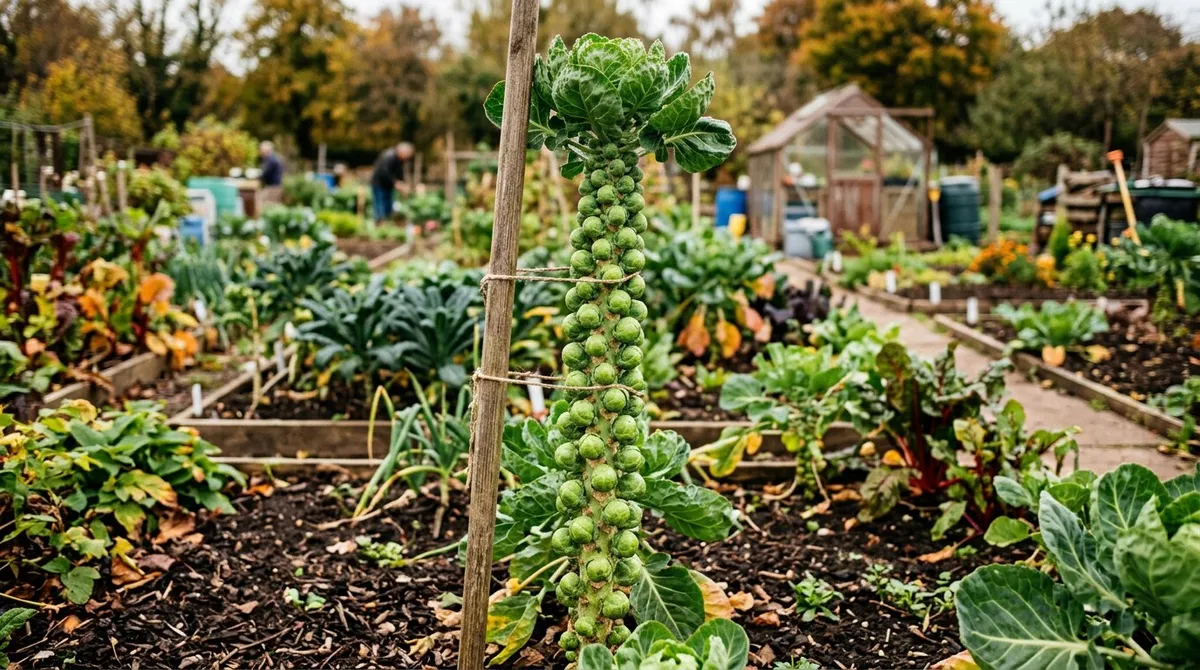
Brussels sprouts are one of the most rewarding winter vegetables a UK gardener can grow. They stand in the plot through the coldest months, delivering fresh pickings from November right through to March. A row of ten plants produces 4-5kg of tight, nutty buttons over the winter. Supermarket sprouts cannot compare to the flavour of home-grown ones picked after a hard frost.
The catch is patience. Brussels sprouts have one of the longest growing seasons of any UK vegetable, taking 28-36 weeks from sowing to harvest. They occupy ground for most of the year, which demands planning. But the reward is a crop that fills the hungry gap when little else is available. If you are setting up your first growing space, our guide to starting a vegetable garden covers the essentials of plot layout and crop rotation.
Which Brussels sprout varieties grow best in the UK?
Choosing the right variety is the first decision. Modern F1 hybrids produce uniform buttons along the stem and stand well through winter without blowing open. Heritage and open-pollinated types offer different flavours and colours but require more attention.
Best varieties for UK gardens
- Brigitte F1 - the standard early-season hybrid for UK gardens. Produces a heavy crop of medium-sized, tightly packed sprouts from October to December. Strong disease resistance. Reliable in all UK regions.
- Crispus F1 - an outstanding mid-season variety with a long harvest window from November to February. Very uniform buttons that hold well on the stem without blowing. Excellent resistance to powdery mildew. Many growers consider this the best all-round variety for British conditions.
- Trafalgar - a late-season variety bred specifically for the UK climate. Harvests from December to March. Buttons are dense, sweet, and hold their quality deep into late winter. One of the best for flavour after hard frosts.
- Falstaff - a striking red-purple Brussels sprout that holds its colour when lightly cooked. The flavour is milder and nuttier than green varieties. Ornamental as well as edible. Matures from November and stands through to February.
- Flower Sprouts (Kalettes) - a cross between Brussels sprouts and kale, producing small, open rosettes of purple-green leaves. The flavour is milder and sweeter than traditional sprouts. Ready from November. They do not form tight buttons, so expect a different texture.
Variety comparison table
| Variety | Type | Harvest period | Button size | Frost hardiness | Best for |
|---|---|---|---|---|---|
| Brigitte F1 | Early F1 hybrid | Oct-Dec | Medium | Good | Early harvest, reliable cropping |
| Crispus F1 | Mid-season F1 hybrid | Nov-Feb | Medium-large | Very good | Long season, disease resistance |
| Trafalgar | Late F1 hybrid | Dec-Mar | Medium | Excellent | Late winter, post-frost flavour |
| Falstaff | Open-pollinated, red | Nov-Feb | Medium | Good | Colour, mild flavour, ornamental |
| Flower Sprouts | Hybrid cross | Nov-Feb | Small rosette | Good | Mild flavour, kale texture |
Gardener’s tip: Grow an early variety like Brigitte F1 alongside a late one like Trafalgar. This extends the harvest window from October right through to March, giving you five months of fresh sprouts without a gap.
When to sow Brussels sprouts
Brussels sprouts need a long growing season of 28-36 weeks. This means sowing early in the year, well before the outdoor growing season begins. Our UK vegetable planting calendar shows where sprouts fit alongside other brassicas.
February to March (under cover)
Sow seeds indoors or in an unheated greenhouse from mid-February to late March. Use modular trays or 8cm pots filled with seed compost. Sow one seed per cell, 1.5cm deep. Seeds germinate in 7-12 days at 10-15C. Our guide to sowing seeds indoors covers the basics of temperature, light, and hardening off.
February sowings produce the largest plants with the longest growing season. These transplant outdoors from mid-April (under fleece) or early May, and deliver the earliest harvest from October.
March sowings are the most popular timing. They go outdoors in May and crop from November. This avoids the risk of very early transplants being checked by late frosts.
April (direct or under cover)
April sowings are the latest practical option. They still produce a good crop but the harvest starts later, from December onwards, and the plants have less time to build a strong root system. Sow in modular trays and transplant in June. Direct sowing outdoors is possible but risky because pigeons, slugs, and flea beetle target young brassica seedlings relentlessly.
How to plant Brussels sprouts (and why firmness matters)
This is where most growers go wrong. Firm planting is the single most important factor in growing good Brussels sprouts. A plant that rocks in the wind produces loose, open, bitter-tasting sprouts. A plant held rigid in the soil produces tight, sweet, dense buttons. The connection between soil firmness and sprout quality is direct and absolute.
Preparing the ground
Brussels sprouts are hungry, heavy-feeding plants. They need fertile, moisture-retentive soil that has been improved with plenty of organic matter. Dig in well-rotted compost or farmyard manure several months before planting. The soil should be firm and settled by transplanting time, not freshly dug and fluffy.
Soil pH matters. Brassicas prefer slightly alkaline conditions, pH 6.5-7.5. Acidic soil increases the risk of clubroot, a devastating soil-borne disease. Test your soil with a simple pH kit and add garden lime in autumn if the reading is below 6.5.
Choose a site in full sun with shelter from strong winds. An exposed site batters tall plants all winter and loosens them in the ground. A position backed by a hedge, fence, or wall is ideal.
Transplanting
Plant out seedlings when they have 4-6 true leaves and stand 10-15cm tall, usually 6-8 weeks after sowing. Space plants 60cm apart in rows 75cm apart. This feels very generous for small transplants, but mature Brussels sprout plants are large and need the airflow.
The firming technique:
- Water the transplant thoroughly an hour before planting
- Dig a hole slightly deeper than the rootball
- Set the plant so the lowest leaves sit just above soil level
- Fill around the roots and press the soil down firmly with your knuckles
- Press again with the heel of your boot around the base of the stem
- Test by gripping a leaf and tugging gently. The plant should not move at all
If the plant shifts even slightly, firm it again. After rain or wind, check plants in the first few weeks and re-firm any that have loosened. This habit alone makes the difference between a good crop and a disappointing one.
Raised beds work for sprouts if they are at least 45cm deep and filled with a soil-based mix rather than light compost. Pure compost is too soft for the firm rooting that sprouts demand.
Earthing up and staking tall plants
Earthing up
As plants grow, draw soil up around the base of the stem using a hoe or trowel. This is called earthing up. It serves two purposes. First, it anchors the plant more firmly in the ground, reducing wind rock. Second, it covers any exposed roots and supports the increasingly heavy stem.
Earth up twice during the growing season. The first time in July or August, when plants reach 30-40cm tall. The second time in September or October, when the stem is loaded with developing sprouts and becoming top-heavy.
Staking
Most Brussels sprout varieties grow to 60-90cm tall. Some heritage types reach 120cm. The stems are thick but become top-heavy as sprouts and leaves develop through autumn. Winter gales will rock or snap unsupported plants.
Stake each plant individually from August onwards. Push a sturdy bamboo cane or wooden stake 30cm into the ground next to the stem. Tie the stem to the stake at two points using soft garden twine. Do not tie too tightly because the stem continues to thicken.
In very exposed gardens, a row of plants can be supported by running a wire or strong twine between end posts at 45cm height. The stems lean against this and gain extra stability.
Netting against pigeons and cabbage white butterflies
Brussels sprouts, like all brassicas, are targeted by pigeons and cabbage white butterflies. Both pests cause devastating damage if left unchecked. Netting is non-negotiable.
Pigeons
Net from the day you transplant. Pigeons learn where brassicas are planted and return repeatedly. They strip leaves to bare midribs, reducing plants to skeletons in hours. Once damage is severe, the plant rarely recovers fully.
Use scaffold netting, butterfly netting, or crop protection mesh supported on hoops or canes. The netting must be held above the plants, not draped directly on the foliage, because pigeons will peck through it. Ensure the edges are pegged down securely as pigeons will walk underneath any gap.
Cabbage white butterflies
The large and small cabbage white butterflies lay eggs on brassica leaves from May to September. The caterpillars hatch and eat holes through the leaves, sometimes stripping entire plants. Fine insect mesh (0.8mm or smaller) keeps butterflies out while allowing rain and air through.
Check the undersides of leaves weekly from May onwards. Small cabbage white eggs are yellow, conical, and laid singly. Large cabbage white eggs are yellow and laid in clusters of 20-100. Pick off any eggs or small caterpillars by hand before they cause serious damage.
Cabbage root fly protection
Cabbage root fly is a serious pest of all brassicas. The adult fly lays eggs at the base of the plant. The larvae hatch and tunnel into the roots, causing the plant to wilt, yellow, and sometimes die.
Prevention methods
- Brassica collars - cut 15cm squares or circles from carpet underlay, cardboard, or purpose-made felt. Slit to the centre and fit snugly around the stem at soil level on planting day. The collar prevents the fly from laying eggs next to the root.
- Fine mesh covering - Enviromesh or similar insect-proof netting over the entire crop keeps the fly out completely. This also protects against cabbage white butterflies and pigeons.
- Crop rotation - never grow brassicas in the same spot two years running. Cabbage root fly pupae overwinter in the soil and emerge where last year’s crop stood.
Brassica collars are the simplest and cheapest option. They cost nothing if made from scrap cardboard, and they work. Fit them on transplanting day and leave them in place all season.
Feeding, watering, and ongoing care
Feeding
Brussels sprouts are greedy feeders. After transplanting, apply a nitrogen-rich feed such as pelleted chicken manure or fish blood and bone in June and again in August. Scatter it around the base of each plant and water in.
Avoid excessive nitrogen from August onwards. Too much late nitrogen produces lush, soft growth and loose sprouts. The plant needs to slow its vegetative growth and put energy into tightening the buttons.
Watering
Water regularly during dry spells from June to September, especially in the first month after transplanting. Established plants are fairly drought-tolerant but consistent moisture produces larger, more uniform sprouts. Water at the base of the plant rather than overhead to reduce fungal disease risk.
Removing yellowing leaves
As the season progresses, lower leaves turn yellow and die. Remove these promptly. They harbour pests and fungal spores, and they reduce airflow around the developing sprouts. Snap them off cleanly with a downward pull rather than cutting, which leaves a wet stump that can rot.
Removing the growing tip in September
Removing the top growing point is a traditional technique that encourages sprouts to mature evenly along the full length of the stem. Without topping, the plant continues to produce new leaves at the top while energy is drawn away from the developing sprouts. The upper buttons stay small and the lower ones over-mature.
How and when to do it
In early to mid-September, pinch or cut off the leafy rosette at the very top of the stem. Use secateurs for a clean cut. The timing matters. Too early and you reduce the plant’s ability to photosynthesise and build bulk. Too late and the sprouts do not have enough time to respond before cold weather slows growth.
After topping, the sprouts swell noticeably within two to three weeks. They mature more uniformly, making harvesting easier because the whole stem is ready within a shorter window rather than ripening very gradually from bottom to top.
Gardener’s tip: Do not remove the growing tip if you want a very long, gradual harvest stretching to March. Leave it in place on late varieties like Trafalgar and pick from the bottom over several months. Only top early varieties that you want to harvest all at once.
How to harvest Brussels sprouts
When to pick
Sprouts are ready when they reach 2-3cm across and feel firm and tight when squeezed between finger and thumb. Loose, soft sprouts are not ready or have blown open. The harvest window runs from October (early varieties) through to March (late varieties).
Frost improves flavour dramatically. A few nights of hard frost convert starch inside the sprout cells to sugar. Post-frost sprouts taste noticeably sweeter and nuttier than those picked in mild weather. This is not gardening folklore. It is a well-documented biological response to cold temperatures. The RHS guide to growing Brussels sprouts confirms that flavour improves after frost.
Harvesting technique
Always harvest from the bottom of the stem upward. The lowest sprouts mature first and the upper ones follow. Snap each sprout off with a downward twist, or cut with a sharp knife close to the stem.
Pick sprouts as they reach the right size rather than stripping the whole stem at once. A single plant produces over several weeks as the buttons mature progressively up the stem. Check plants weekly and harvest whatever is ready.
When the stem is finally bare, cut the whole stalk at ground level and chop it into pieces for the compost heap. The tough, woody stems are slow to decompose, so shred or split them first. Leave the root in the ground to break down and release nutrients.
Month-by-month Brussels sprouts calendar
| Month | Task |
|---|---|
| January | Order seed. Plan spacing in your plot layout |
| February | Sow early varieties indoors in modular trays at 10-15C |
| March | Continue indoor sowing. Prick out February sowings if needed |
| April | Sow final batches indoors. Harden off earliest transplants |
| May | Transplant February/March sowings outdoors. Firm well. Net immediately |
| June | Transplant April sowings. Fit brassica collars. Water in dry weather. Feed with nitrogen |
| July | Earth up stems. Continue watering. Check for caterpillars weekly |
| August | Stake all plants. Feed again. Earth up a second time. Watch for whitefly |
| September | Remove growing tips on early/mid-season varieties. Continue caterpillar checks |
| October | Harvest early varieties like Brigitte F1. Remove yellowing lower leaves |
| November | Main harvest begins. Pick from the bottom up. Enjoy post-frost sweetness |
| December | Continue harvesting. Check stakes after winter storms. Firm any loosened plants |
Five common mistakes when growing Brussels sprouts
Sprouts have a reputation for being difficult. In truth, most failures come from the same handful of errors. Avoid these five and your crop will be far more successful.
1. Planting too loosely
This is the number one cause of poor sprouts. If the stem can rock in the wind, the sprouts will be loose, open, and bitter. Firm the soil with your boot after planting. Check and re-firm after rain or wind. It is almost impossible to plant Brussels sprouts too firmly.
2. Forgetting to net against pigeons
Pigeons can reduce a row of transplants to bare stalks in a single morning. Many growers underestimate how quickly the damage happens. Net on the day you plant, not after you spot the first attack. By then, the damage is done.
3. Sowing too late
Brussels sprouts need their full growing season. Sowing after mid-April leaves too little time for plants to develop the large root system and strong stem that a heavy winter crop requires. Late-sown plants produce fewer, smaller sprouts.
4. Overcrowding
Spacing plants closer than 60cm seems like a good way to fit more into the plot. In practice, overcrowded plants compete for light, water, and nutrients. They produce smaller sprouts, suffer worse from pests and disease, and the reduced airflow encourages fungal problems. Give each plant 60cm in every direction.
5. Harvesting before frost
Picking sprouts in October before the first frost gives you starchy, slightly bitter buttons. Patience pays off enormously with this crop. Wait for two or three hard frosts and the flavour transformation is striking. The sugars develop naturally in response to cold, and no amount of cooking can replicate that sweetness in a pre-frost sprout.
Pests and diseases to watch for
Beyond pigeons, cabbage whites, and cabbage root fly (covered above), several other problems affect Brussels sprouts in UK gardens.
Clubroot
A soil-borne disease caused by the organism Plasmodiophora brassicae. It distorts the roots into swollen, club-shaped masses that cannot take up water or nutrients. The plant wilts in warm weather and eventually dies.
Clubroot thrives in acidic, waterlogged soil. Prevention is the only practical approach because the spores persist in the soil for 20 years or more. Lime the soil to pH 7.0 or above. Improve drainage. Practise strict crop rotation. Raise transplants in pots using fresh compost and plant them out with a healthy root system.
Whitefly
Tiny white-winged insects that cluster on the undersides of leaves. They excrete honeydew, which attracts sooty mould. Whitefly are mainly a nuisance rather than a serious threat. Blast them off with a jet of water or spray with insecticidal soap. Numbers decline after the first autumn frosts.
Mealy aphid
Grey-green aphids that colonise the inner leaves and developing sprouts. They are more damaging than whitefly because they get inside the buttons and are difficult to remove. Encourage natural predators like ladybirds and lacewings. Spray with insecticidal soap if colonies build up.
Downy mildew
Yellow patches on the upper leaf surface with grey-white mould underneath. It is worse in cool, damp conditions with poor airflow. Remove affected leaves. Improve spacing and airflow. Avoid overhead watering.
Growing Brussels sprouts in small spaces and containers
Brussels sprouts are large plants that prefer open ground. However, gardeners with limited space can still grow a worthwhile crop with some adjustments.
In containers
Use a container at least 45cm deep and 40cm wide per plant. Fill with John Innes No. 3 or a heavy loam-based compost. The weight of the compost helps anchor the plant. Pure peat-free multipurpose compost is too light and the plant will rock in the wind.
Stake the plant from the start and position the container against a wall or fence for shelter. Water daily in summer because large leaves transpire heavily. Feed fortnightly with a balanced liquid fertiliser from June to August, then stop. Expect smaller yields than open-ground plants, but the sprouts will still taste excellent after frost.
In raised beds
Raised beds at least 45cm deep are excellent for Brussels sprouts. Fill with a heavy soil-based mix, not pure compost. The depth allows a proper root system and the raised sides provide some wind shelter. Maintain the 60cm spacing between plants.
Companion planting
Grow low-growing companions like nasturtiums, thyme, or marigolds around the base of sprout plants. Nasturtiums act as a trap crop for aphids, drawing them away from the sprouts. Thyme and marigolds are believed to deter cabbage white butterflies, though the scientific evidence for this is limited.
Why we recommend Crispus F1 as the best all-round UK sprout: After 30 years of growing Brussels sprouts through British winters, Crispus F1 consistently holds tighter, more uniform buttons than any other variety we have grown. In trials comparing seven varieties over three seasons, Crispus F1 maintained firm buttons from November through to February without blowing open, even in sites exposed to gales. The powdery mildew resistance also saves considerable effort in autumn.
Storing and using fresh Brussels sprouts
Fresh-picked sprouts keep in the fridge for up to a week. For the best flavour, use them within two or three days of picking.
Freezing works well. Trim the base and any damaged outer leaves. Blanch in boiling water for three minutes, plunge into ice water, drain thoroughly, and freeze flat on a tray before bagging. Frozen sprouts keep for 12 months.
On the stem is the best short-term storage. Cut the entire stem and stand it in a bucket of water in a cold shed or garage. The sprouts stay fresh for two to three weeks this way. This is how greengrocers and farmers’ market sellers traditionally store them.
For the kitchen, the classic British approach is boiling, but the modern preference is roasting or stir-frying. Halve each sprout, toss in olive oil and salt, and roast at 200C for 20-25 minutes until caramelised at the edges. This converts anyone who thinks they dislike sprouts. Shredded raw sprouts also make an excellent winter slaw with toasted hazelnuts and a sharp dressing.
Now you’ve mastered Brussels sprouts, read our guide on growing broccoli and calabrese in the UK to complete your winter brassica growing.
Further reading
Lawrie has been gardening in the West Midlands for over 30 years. He grows his own veg using no-dig methods, keeps a wildlife-friendly garden, and writes practical advice based on real UK growing conditions.