How to Grow Cauliflower in the UK
Complete guide to growing cauliflower in UK gardens. Covers varieties, sowing times, soil prep, blanching curds, clubroot prevention, and harvesting.
Key takeaways
- Cauliflower needs rich, firm soil with a pH of 6.5-7.5 and consistent watering to prevent buttoning
- Summer varieties sow indoors from January to March, autumn types from March to May, and overwintering types in May to June
- Clapton F1 is the only widely available clubroot-resistant variety and essential on infected plots
- Blanch white curds by folding outer leaves over the head to block sunlight and prevent yellowing
- Harvest when the curd is tight and compact, before individual florets begin to separate and open
- Any interruption to steady growth causes buttoning, so never let plants dry out or become root-bound in modules
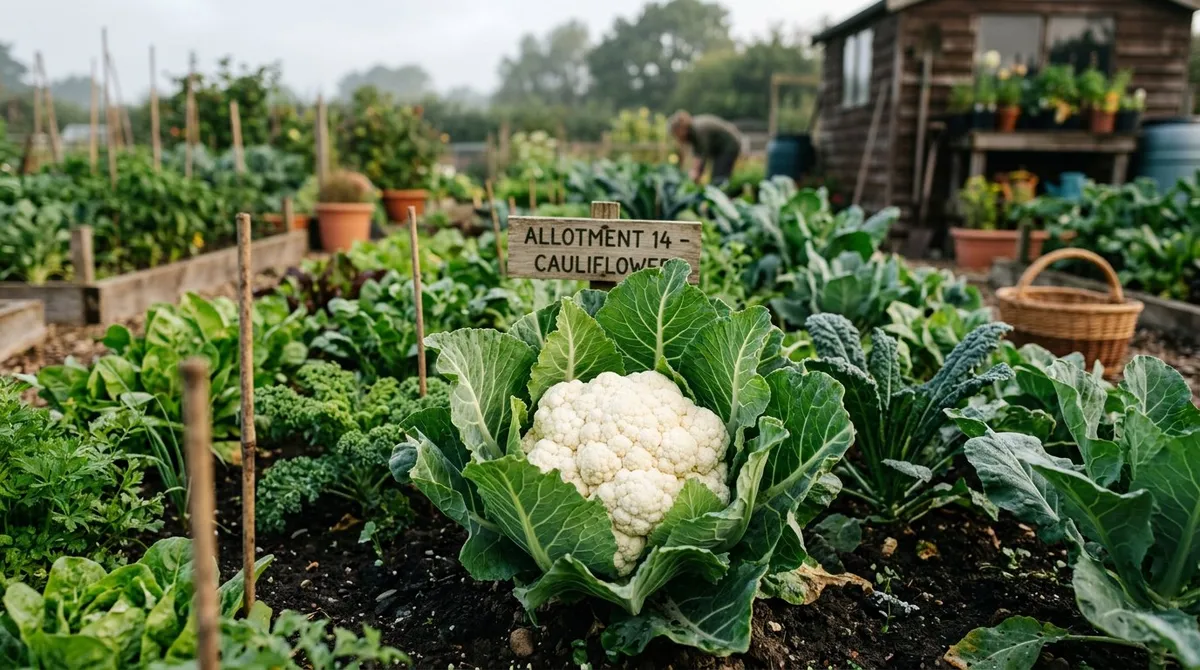
Cauliflower has a well-earned reputation as the trickiest brassica in the vegetable patch. It demands richer soil, more consistent moisture, and more precise timing than cabbage, broccoli, or Brussels sprouts. Get any of these wrong and the plant produces a tiny premature head the size of a golf ball instead of a dense, heavy curd.
The reward for getting it right is substantial. A well-grown cauliflower head weighs 700g to 1.2kg and tastes entirely different from the bland, cling-wrapped supermarket offering. By choosing summer, autumn, and overwintering varieties, UK growers can harvest cauliflower for nine months of the year. This guide covers variety selection, sowing schedules, soil preparation, blanching, pest control, and the common mistakes that trip up even experienced gardeners. If you are new to food growing, our guide to starting a vegetable garden covers the broader essentials first.
Which cauliflower varieties should I grow?
Cauliflower varieties fall into three groups based on when they mature. Choosing from each group extends your harvest from June right through to the following April.
Summer cauliflowers
Summer varieties sow indoors from January to March and crop from June to September. They are the fastest to mature, typically ready 16-20 weeks after sowing.
Snowball is a reliable, compact variety that produces tight white curds. It is one of the quickest to mature and suits smaller plots. All Year Round is the most flexible variety in this group. Despite its name, it performs best as a summer cauliflower. It tolerates a wider range of conditions than most and is the safest choice for beginners.
Autumn cauliflowers
Autumn types sow from March to May and crop from September to November. They produce larger heads than summer varieties and benefit from the cooler, damper weather of early autumn.
Autumn Giant types produce heavy curds up to 1.5kg. They need rich soil and generous spacing (75cm between plants) to reach full size. These are the classic varieties for freezing in bulk.
Overwintering cauliflowers
Overwintering varieties sow in May or June, grow through summer and autumn, then stand through winter to produce heads the following March to May. They are the most challenging type, requiring mild winters and well-drained soil.
Walcheren Winter types are the most common overwintering cauliflowers. They tolerate frost to around minus 5C but suffer in prolonged freezing spells. They work best in southern and coastal areas of the UK where winter temperatures stay relatively mild.
Coloured and speciality varieties
Graffiti is a striking purple cauliflower that holds its colour when cooked lightly. The purple pigment comes from anthocyanins, the same antioxidant compounds found in blueberries and red cabbage. It does not require blanching because the colour is the selling point.
Romanesco sits somewhere between cauliflower and broccoli. Its fractal, lime-green spirals are as ornamental as they are edible. It has a nuttier, sweeter flavour than standard white cauliflower. Sow from March to May for an autumn harvest.
Clapton F1 is the only widely available variety with genetic resistance to clubroot. If your soil has any history of this devastating disease, Clapton F1 is the variety to grow. It produces good-sized white curds and matures in about 18 weeks from transplanting.
Cauliflower variety comparison table
| Variety | Type | Sow | Harvest | Weeks to maturity | Curd colour | Key trait |
|---|---|---|---|---|---|---|
| All Year Round | Summer | Jan-Mar | Jun-Sep | 16-20 | White | Most forgiving variety |
| Snowball | Summer | Jan-Mar | Jun-Aug | 14-18 | White | Compact, quick to mature |
| Clapton F1 | Summer/Autumn | Feb-Apr | Jul-Oct | 18-22 | White | Clubroot resistant |
| Autumn Giant | Autumn | Mar-May | Sep-Nov | 20-26 | White | Large heads, heavy yield |
| Graffiti | Autumn | Mar-May | Aug-Oct | 18-22 | Purple | No blanching needed |
| Romanesco | Autumn | Mar-May | Sep-Nov | 20-24 | Lime green | Nutty flavour, fractal shape |
| Walcheren Winter | Overwintering | May-Jun | Mar-May | 40-46 | White | Stands through mild winters |
Gardener’s tip: Grow at least two types each year. A summer variety like All Year Round and an autumn type like Autumn Giant gives you curds from June to November without relying on overwintering varieties that can fail in harsh winters.
How to sow cauliflower seeds
Cauliflower seedlings are sensitive to root disturbance. Any check in growth at the seedling stage causes buttoning later, where the plant produces a premature miniature curd. Getting the sowing method right is critical.
Sowing indoors
Start seeds in modules or small pots rather than seed trays. This avoids the root disturbance caused by pricking out individual seedlings. Fill 7cm pots or modular trays with fresh seed compost. Sow two seeds per cell, 1cm deep. Remove the weaker seedling after germination.
Germination temperature is 15-20C. Seeds take 7-12 days to emerge. Keep modules on a warm windowsill, in a heated propagator, or in a greenhouse. Once seedlings emerge, move them to a bright, cooler spot at 10-15C. This prevents leggy, weak growth. Our guide to sowing seeds indoors covers the technique in detail.
Do not let seedlings become root-bound. If roots start circling the bottom of the module before the plant is ready to go outside, pot on into a 9cm pot immediately. Root-bound cauliflower seedlings almost always produce poor, undersized heads.
Hardening off
Move seedlings outside for increasing periods over 7-10 days before transplanting. Start with two hours in a sheltered spot and build up to full days. Cold frames are ideal for this stage. Avoid hardening off during cold snaps, as a sharp temperature drop can trigger premature curding.
Direct sowing
Cauliflower can be sown directly outdoors from April to May, but results are less reliable than transplanting module-grown seedlings. Direct-sown plants suffer more from slug damage, weed competition, and the difficulty of maintaining consistent moisture around tiny seedlings.
If you do sow direct, make drills 1cm deep and 60cm apart. Thin seedlings to 45-60cm apart once they have four true leaves.
Soil preparation for cauliflower
Cauliflower is the hungriest and most demanding brassica when it comes to soil. It needs rich, firm, moisture-retentive ground with a pH between 6.5 and 7.5. Thin, sandy, or acidic soils produce disappointing results.
Building fertile soil
Start preparing the bed the autumn before planting. Dig in generous quantities of well-rotted compost or farmyard manure. Aim for at least a wheelbarrow load per square metre. This adds nutrients and improves moisture retention, both of which are critical for cauliflower.
In spring, rake the bed level but do not fork it over again. Cauliflower needs firm soil. The roots anchor poorly in loose, freshly dug ground, and plants can rock in wind. Firm the soil by treading it down with your heels, then rake the surface smooth.
Testing and adjusting pH
Soil pH is important. Cauliflower performs best at pH 6.5-7.5. Below 6.5, growth slows and clubroot risk increases dramatically. Test your soil with a simple pH kit from any garden centre.
If your soil is acidic (below 6.5), apply garden lime in autumn at the rate recommended on the packet. On heavy clay soil, use calcified seaweed instead of ground limestone, as it also improves soil structure. Allow at least two months between liming and planting.
Feeding
Apply a general-purpose fertiliser such as Growmore at 100g per square metre two weeks before transplanting. Rake it into the top 5cm of soil. Cauliflower is a heavy feeder throughout its life. Side-dress with nitrogen-rich fertiliser (dried poultry manure pellets or blood, fish, and bone) every 3-4 weeks during the growing season.
When to plant cauliflower outside
Transplant module-raised seedlings when they have 4-6 true leaves and are 10-15cm tall. This is usually 4-6 weeks after sowing.
Spacing
Space plants 45-60cm apart in rows 60-75cm apart. Closer spacing produces smaller heads. Wider spacing allows maximum airflow, which reduces fungal disease. For the largest autumn cauliflowers, use 75cm spacing in both directions.
Planting technique
Water the modules thoroughly an hour before transplanting. Dig a hole slightly larger than the root ball. Drop the plant in so that the lowest true leaves sit just above soil level. Firm the soil around the stem with your knuckles. This is important. Loose planting causes plants to rock in the wind, damaging roots and triggering buttoning.
Water each plant in well with at least half a litre of water. If the weather is dry, water daily for the first week until the roots establish.
Crop protection
Cover newly planted cauliflowers with fine mesh netting (such as Enviromesh) immediately after transplanting. This keeps off cabbage white butterflies, cabbage moths, and pigeons. Support the mesh on hoops or stakes so it does not rest on the leaves. Leave the mesh in place for the entire growing season.
Month-by-month cauliflower growing calendar
| Month | Task |
|---|---|
| January | Sow early summer varieties indoors in a heated propagator at 15-20C |
| February | Continue indoor sowing of summer varieties. Pot on January sowings if root-bound |
| March | Sow summer and autumn varieties indoors. Harden off early sowings. Begin transplanting under fleece in mild areas |
| April | Transplant summer varieties outdoors. Start direct sowing if preferred. Apply Growmore to prepared beds |
| May | Transplant autumn varieties outdoors. Sow overwintering types indoors. Water transplants daily in dry spells |
| June | Transplant overwintering varieties to final positions. Begin liquid feeding summer cauliflowers fortnightly. Monitor for caterpillars |
| July | Water consistently. Side-dress with nitrogen fertiliser. Check summer varieties for curd formation. Start blanching when curds appear |
| August | Harvest first summer varieties. Continue watering and feeding autumn types. Inspect for whitefly and caterpillars |
| September | Harvest main autumn varieties. Earth up stems of overwintering types for stability |
| October | Harvest late autumn varieties. Clear spent summer plants. Lime acid soils for next year’s brassica bed |
| November | Protect overwintering varieties with fleece in exposed sites. Dig in manure for next year’s cauliflower bed |
| December | Check overwintering plants for wind rock. Re-firm any loosened plants. Plan next year’s varieties and order seed |
How to water and feed cauliflower
Consistent moisture is the single most important factor in growing good cauliflower. Any drought, even a few days without water in warm weather, can trigger buttoning. The plant interprets water stress as a survival threat and rushes to produce a premature curd before conditions worsen.
Watering
Water deeply once or twice a week rather than little and often. Each plant needs roughly 2-3 litres per watering session. In hot weather, increase to every other day. The goal is to keep the soil consistently moist to a depth of 15-20cm. Mulch around the base of plants with compost or well-rotted manure to hold moisture and suppress weeds.
Avoid overhead watering once curds have started to form. Water splashing onto the developing curd can cause brown spotting and fungal problems. Water at the base of the plant instead.
Feeding
Cauliflower is a heavy feeder that depletes soil nutrients quickly. Two weeks after transplanting, begin fortnightly feeds with a high-nitrogen liquid fertiliser. Alternatively, scatter dried poultry manure pellets around each plant every 3-4 weeks and water in. Nitrogen drives leafy growth, which in turn supports a larger curd.
Once the curd starts to form, switch to a balanced feed or stop feeding altogether. Excess nitrogen at this stage can cause the curd to become loose and ricey instead of tight and smooth.
How to blanch cauliflower curds
White cauliflower varieties need blanching to keep the curd white and mild-flavoured. Without blanching, sunlight turns the curd yellow and gives it a stronger, slightly bitter taste.
When to blanch
Start blanching when the curd is visible and roughly 5-7cm across. At this stage, the outer leaves are usually large enough to fold over the top.
How to blanch
Fold two or three of the largest outer leaves over the developing curd. Secure them with a rubber band, a wooden peg, or a length of soft string. The leaves should shade the curd completely without pressing down on it. Air still needs to circulate to prevent rot.
Check the curd every 2-3 days. Growth accelerates once the curd has formed, and a cauliflower can go from perfect to over-mature in under a week during warm weather.
Self-blanching varieties like some modern F1 hybrids have leaves that naturally curl inward to cover the curd. These need less intervention but still benefit from a check to ensure full coverage.
Coloured varieties (Graffiti purple, Romanesco, orange types) do not need blanching. Their colour develops best with full sun exposure.
Common cauliflower pests and diseases
Cabbage white caterpillars
The large and small cabbage white butterflies lay eggs on brassica leaves from May to September. The caterpillars eat through leaves rapidly, weakening the plant and contaminating curds with frass. Fine mesh netting is the most effective prevention. Inspect plants weekly and pick off any caterpillars that get through.
Whitefly
Cabbage whitefly clusters on the undersides of leaves, particularly in autumn. Heavy infestations weaken plants and coat leaves with sticky honeydew. Encourage natural predators like ladybirds and lacewings. Remove the worst-affected lower leaves. Whitefly rarely kills cauliflower but reduces vigour and curd size.
Clubroot
Clubroot (Plasmodiophora brassicae) is the most devastating disease of brassicas. It causes roots to swell into distorted, club-shaped galls. Infected plants wilt in warm weather and produce small, worthless heads. The pathogen survives in soil for 20 years or more.
Prevention is the only realistic strategy. Lime acidic soil to pH 7.0-7.5. Grow Clapton F1, the only widely available resistant variety. Raise seedlings in clean compost and transplant with intact root balls. Never compost infected plants. Rotate brassicas on a strict four-year cycle, though this alone does not eliminate the pathogen from contaminated ground. The RHS clubroot guide has further detail on identification and management.
Pigeons
Wood pigeons strip brassica leaves down to the midribs, particularly in winter and early spring when other food is scarce. Netting is the only reliable deterrent. Ensure the netting is supported on a frame so pigeons cannot push through and reach the plants.
Downy mildew
Yellow patches on upper leaf surfaces with grey-white fungal growth underneath indicate downy mildew. It is worse in damp, humid conditions. Improve airflow by spacing plants correctly and removing affected leaves promptly. Avoid overhead watering.
Why we recommend Clapton F1 for any garden with clubroot history: After 30 years of growing brassicas, Clapton F1 is the only variety that has allowed us to continue growing cauliflower on a plot with established clubroot infection. On ground where every other variety we tried produced distorted, wilting plants with near-zero yield, Clapton F1 delivered firm, full-sized curds averaging 900g each across two seasons. It will not eliminate clubroot from the soil, but it makes growing cauliflower possible where it would otherwise fail completely.
Five common cauliflower growing mistakes
Even experienced growers struggle with cauliflower. These five mistakes account for most failures.
1. Letting seedlings become root-bound
Cauliflower seedlings that sit too long in small modules develop circling roots. Once transplanted, the roots never spread properly into the surrounding soil. The plant cannot access enough water or nutrients, and buttoning follows. Transplant within 4-6 weeks of sowing, or pot on promptly if the weather delays planting.
2. Planting into loose or poor soil
Cauliflower needs firm, rich ground. Planting into freshly dug, loose soil means roots cannot anchor properly. Plants rock in the wind, roots break, and growth stalls. Always firm the bed by treading before planting. Add plenty of organic matter the previous autumn so it has time to settle and integrate.
3. Inconsistent watering
This is the single biggest cause of small, premature heads. Any drought triggers buttoning. Set up a watering schedule and stick to it, especially during June, July, and August. Mulch heavily to conserve moisture. If you cannot water regularly, cauliflower may not be the crop for you.
4. Ignoring soil pH
Cauliflower grows poorly in acidic soil (below pH 6.5). Growth is slow, leaves turn purple at the edges, and clubroot risk increases sharply. Test your soil pH annually and lime if necessary. Most UK garden soils are slightly acidic, so liming is often needed for brassicas. Our guide to the UK vegetable planting calendar includes a rotation plan that keeps brassicas on limed ground.
5. Harvesting too late
A cauliflower curd is at its peak for just 7-10 days. After that, the florets begin to separate and the surface becomes granular and uneven. The texture and flavour deteriorate rapidly once this happens. Check curds daily once they start to form. Cut as soon as the surface is smooth, dense, and compact. Waiting for it to grow just a little bigger is how most cauliflowers are ruined.
When and how to harvest cauliflower
Knowing when the curd is ready
A ready curd is firm, tight, and dense with a smooth surface. Press it gently with your thumb. It should feel solid with no give. The florets should be tightly packed with no visible gaps between them. Once gaps appear and individual florets start to separate, the curd is past its best.
Size is not the main indicator. Different varieties produce different-sized curds. All Year Round might give a 15cm head, while Autumn Giant can reach 25cm. Focus on firmness and tightness rather than size.
Cutting technique
Use a sharp knife to cut the stem about 5cm below the base of the curd. Leave two or three wrapper leaves attached. These protect the curd during handling and storage and keep it fresher for longer.
Harvest in the morning when the curd is cool. In warm weather, curds harvested in afternoon sun deteriorate faster.
What to do after harvest
Remove the spent plant and add it to the compost heap, unless it shows signs of clubroot. Leave the root ball in place for a week or two if possible. Brassica roots decompose and release nutrients back into the soil.
Use the cleared ground immediately for a follow-on crop. Fast-growing salad leaves, spinach, or spring onions fill the gap before winter. Check the vegetable planting calendar for ideas on what to sow after clearing brassicas.
How to store cauliflower
Whole cauliflower heads keep in the fridge for 7-10 days with the wrapper leaves intact. Stand the curd upright to prevent moisture pooling on the surface.
For longer storage, break the curd into florets and blanch in boiling water for 3 minutes. Plunge into ice water, drain thoroughly, and freeze in a single layer on a baking tray. Once frozen, transfer to bags. Frozen cauliflower keeps for up to 12 months and works well in soups, curries, and gratins.
Pickling is another excellent preservation method. Small florets pickled in spiced vinegar make a sharp, crunchy condiment that keeps for a year or more in sealed jars.
Autumn harvests store better than summer ones. Cooler temperatures at harvest time mean the curd stays fresh longer without refrigeration. In a cool garage or shed at 5-10C, whole heads with leaves attached keep for 2-3 weeks.
Growing cauliflower in raised beds
Raised beds offer several advantages for cauliflower. You control the soil mix completely, so you can create the rich, firm, slightly alkaline conditions that cauliflower demands. Drainage is better than open ground, reducing waterlogging and clubroot risk.
Fill beds with a mix of topsoil, well-rotted compost, and a handful of garden lime per square metre. Firm the mix down well. The depth should be at least 30cm for good root development.
Spacing in raised beds can be slightly tighter than in open ground. Try 45cm between plants in a staggered pattern. This gives each plant enough room while making efficient use of the bed.
The main challenge is watering. Raised beds drain faster and dry out more quickly than open ground. In summer, daily watering may be necessary. Install a drip irrigation line along the bed to deliver consistent moisture without wetting the foliage or developing curds.
Now you’ve mastered cauliflower, read our guide on growing Brussels sprouts in the UK to complete your winter brassica growing calendar.
Frequently asked questions
Lawrie has been gardening in the West Midlands for over 30 years. He grows his own veg using no-dig methods, keeps a wildlife-friendly garden, and writes practical advice based on real UK growing conditions.