How to Grow Cherry Trees in the UK
UK guide to growing cherry trees. Covers sweet and acid varieties, rootstocks, planting, pruning in summer to avoid silver leaf, and bird protection.
Key takeaways
- Gisela 5 rootstock limits trees to 2.5-3m, making garden cherry growing practical for the first time
- Self-fertile varieties like Stella and Sunburst need no pollination partner to set fruit
- Morello (acid) cherries grow on north-facing walls where no other fruit tree will thrive
- Prune cherry trees in June-August only to prevent fatal silver leaf disease
- Bird netting is the single biggest factor in a successful cherry harvest
- Plant bare-root trees from November to March for best root establishment
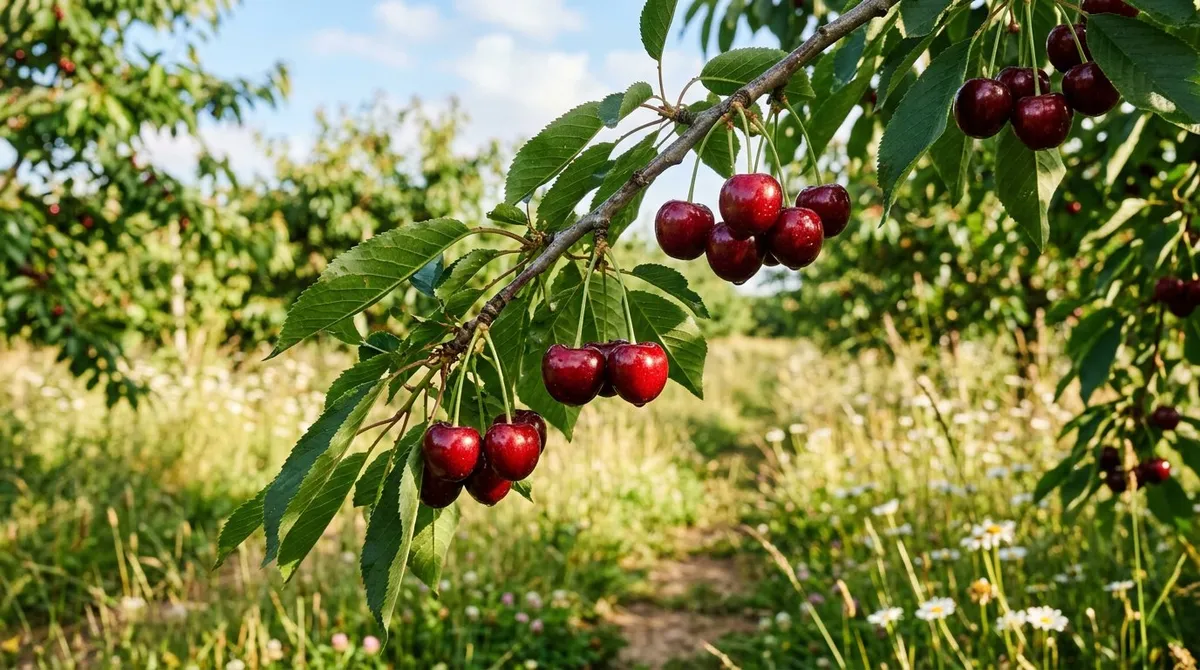
Cherry trees are one of the most beautiful and productive fruit trees for UK gardens. In spring, the blossom puts on a show that rivals any ornamental tree. In summer, the fruit is among the most expensive in supermarkets, yet it grows freely in British gardens from Cornwall to southern Scotland. A single mature tree on semi-dwarf rootstock produces 12-15kg of cherries per season.
Two developments changed cherry growing for home gardeners. The first was the arrival of self-fertile varieties like Stella in the 1960s, ending the need for pollination partners. The second was the introduction of Gisela 5 rootstock from Germany, which reduced tree height from 6-8m to a manageable 2.5-3m. Together, they mean any UK garden with a sunny wall or open spot can grow cherries. This guide covers sweet and acid varieties, rootstocks, planting, pruning, pest control, and harvesting. If you grow other fruit trees, see our guides to growing plum trees and growing apple trees.
Sweet cherries vs acid cherries
Understanding the difference between sweet and acid cherries is the first decision. They suit different positions, different uses, and different gardens.
Sweet cherries (Prunus avium) are the ones you eat fresh from the tree. They need a warm, sunny, sheltered spot facing south or west. The fruit is large, juicy, and high in sugar. Most modern garden varieties are self-fertile. Sweet cherries ripen from late June to August depending on variety. Kent has been the traditional centre of English cherry orcharding for centuries, and the county’s warm, dry summers show what these trees prefer.
Acid cherries (Prunus cerasus) are smaller, sharper, and used for cooking, jam, pies, and cherry brandy. The most important variety is Morello, which has a unique advantage: it thrives on north-facing walls. No other fruit tree performs well in this position. If you have a shady wall with nothing growing on it, a fan-trained Morello cherry will put it to productive use. Acid cherries are fully self-fertile and more tolerant of poor weather during flowering.
Gardener’s tip: If you have room for only one cherry tree, choose a self-fertile sweet variety on Gisela 5 rootstock. If you have a north-facing wall going to waste, add a Morello for cooking.
Which rootstock should I choose?
The rootstock controls the final size of the tree. Choosing the right one is more important than choosing the variety. All named cherry varieties are grafted onto a rootstock.
Gisela 5 is the rootstock that changed garden cherry growing. Bred in Germany, it limits trees to 2.5-3m tall. Trees start fruiting just 2-3 years after planting. This is the rootstock for small gardens, containers, and fan-trained trees against walls. It needs good soil and regular watering because the root system is small. Stake permanently, as trees on Gisela 5 never develop enough root anchorage to stand unaided. This is the rootstock to choose for most home gardeners.
Colt is a semi-vigorous rootstock producing trees of 4-5m. It suits larger gardens and allotments where you want a proper tree canopy. Trees on Colt are tougher and more drought-tolerant than those on Gisela 5, but they take 4-5 years to start fruiting. Colt was the standard garden rootstock before Gisela 5 arrived.
F12/1 is a vigorous rootstock that produces full-sized trees of 6-8m. It was the old orchard standard. Unless you have a paddock or large field, avoid this rootstock. The trees are too tall to net against birds and too large to prune safely from a ladder.
Rootstock comparison table
| Rootstock | Final height | Years to first fruit | Staking | Best for |
|---|---|---|---|---|
| Gisela 5 | 2.5-3m | 2-3 | Permanent stake needed | Small gardens, walls, containers |
| Colt | 4-5m | 4-5 | First 2-3 years | Medium to large gardens |
| F12/1 | 6-8m | 5-7 | First 2 years | Orchards, large spaces only |
Best sweet cherry varieties for UK gardens
Self-fertile varieties are the best choice for garden growing. You do not need a second tree. Older varieties that required pollination partners are now mainly grown in commercial orchards.
Stella is the most popular garden cherry in the UK, and for good reason. It was the first self-fertile sweet cherry, bred in British Columbia in 1968. The fruit is large, dark red, and full-flavoured. It crops heavily and reliably across most of the UK. Ripens mid-July. If you grow only one sweet cherry, this is the variety to pick.
Sunburst produces the largest fruit of any self-fertile variety. The cherries are nearly black when ripe, with firm flesh and excellent flavour. It ripens slightly earlier than Stella, in early to mid-July. A good choice for eating fresh and for freezing.
Lapins (also sold as Cherokee) is a late-season variety ripening in late July to early August. The fruit is very large, dark, and firm. It extends the harvest by 2-3 weeks beyond Stella. The tree is vigorous and upright.
Summer Sun ripens in mid-July alongside Stella. The fruit is large and bright red rather than dark. The flavour is sweet with a slight tang. The tree has a compact habit that suits smaller spaces.
Sweetheart is the latest-ripening self-fertile variety, picking in August. The fruit is medium-sized, firm, and stores well after picking. If you want fresh cherries in August when most varieties have finished, Sweetheart delivers.
Sweet cherry variety comparison
| Variety | Self-fertile | Ripening time | Fruit size | Colour | Vigour |
|---|---|---|---|---|---|
| Stella | Yes | Mid-July | Large | Dark red | Moderate |
| Sunburst | Yes | Early-mid July | Very large | Near black | Moderate |
| Lapins | Yes | Late July-Aug | Very large | Dark red | Vigorous |
| Summer Sun | Yes | Mid-July | Large | Bright red | Compact |
| Sweetheart | Yes | August | Medium | Red | Moderate |
Best acid cherry variety: Morello
Morello is the only acid cherry variety worth growing in UK gardens. It has been cultivated in Britain since at least the 16th century. The fruit is dark red, juicy, and too tart to eat raw, but it makes outstanding pies, jam, compote, and cherry brandy.
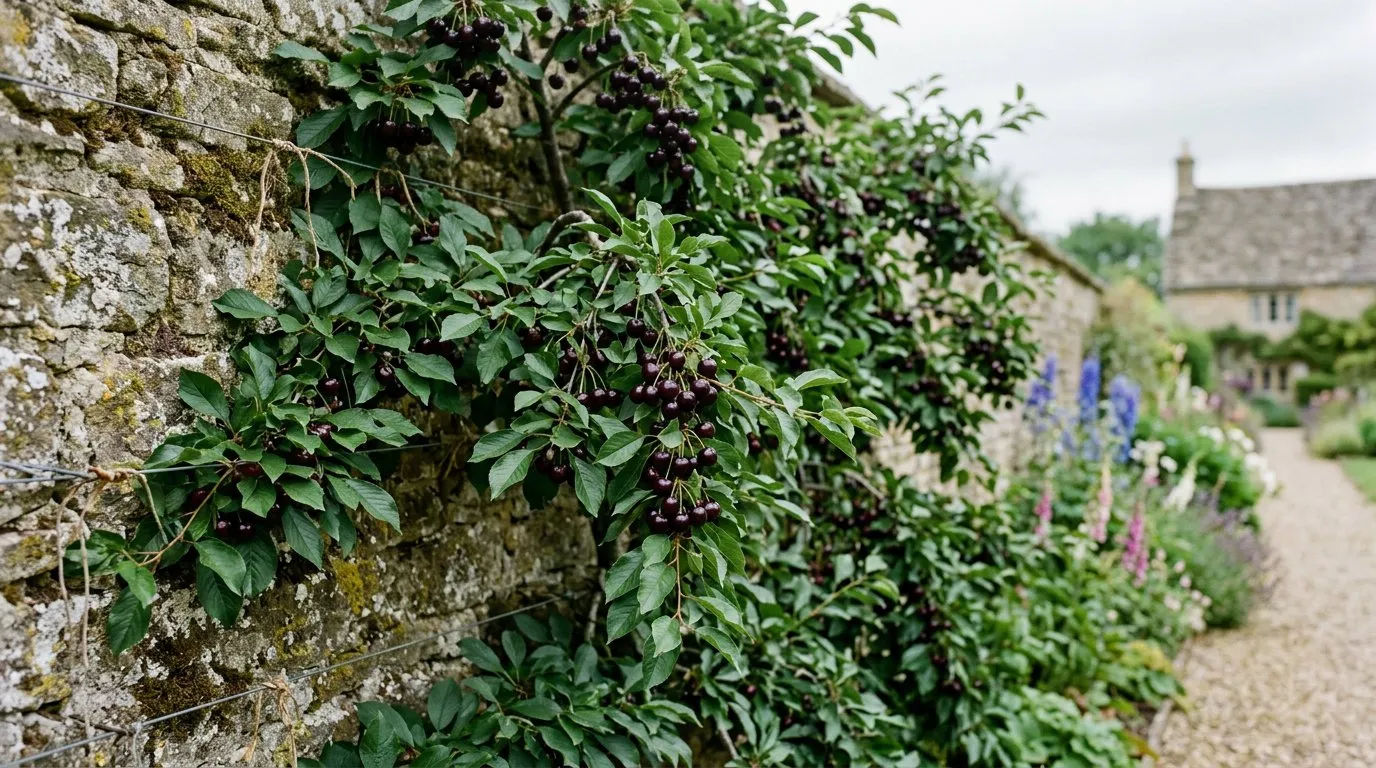 Morello cherries on a north wall. The only fruit tree that thrives facing north.
Morello’s great advantage is its tolerance of shade and north-facing walls. Fan-train it against a north or east-facing wall where no other fruit tree would produce a crop. The tree is naturally compact at 2.5-3.5m and always self-fertile. It flowers later than sweet cherries, reducing frost damage to blossom. If you have a trained fruit tree on your south wall already, put a Morello on the north side.
Morello cherries ripen from late July to September. Pick them as they darken and soften. They come away from the stalk easily when ready. For cherry brandy, pick slightly under-ripe when the flesh is still firm.
How to plant a cherry tree
When to plant
Plant bare-root cherry trees from November to March while the tree is dormant. November to December is ideal because autumn warmth and rain help roots establish before winter. Container-grown trees can go in at any time, but autumn and winter planting gives the best results. Avoid planting in waterlogged or frozen ground.
Choosing a site
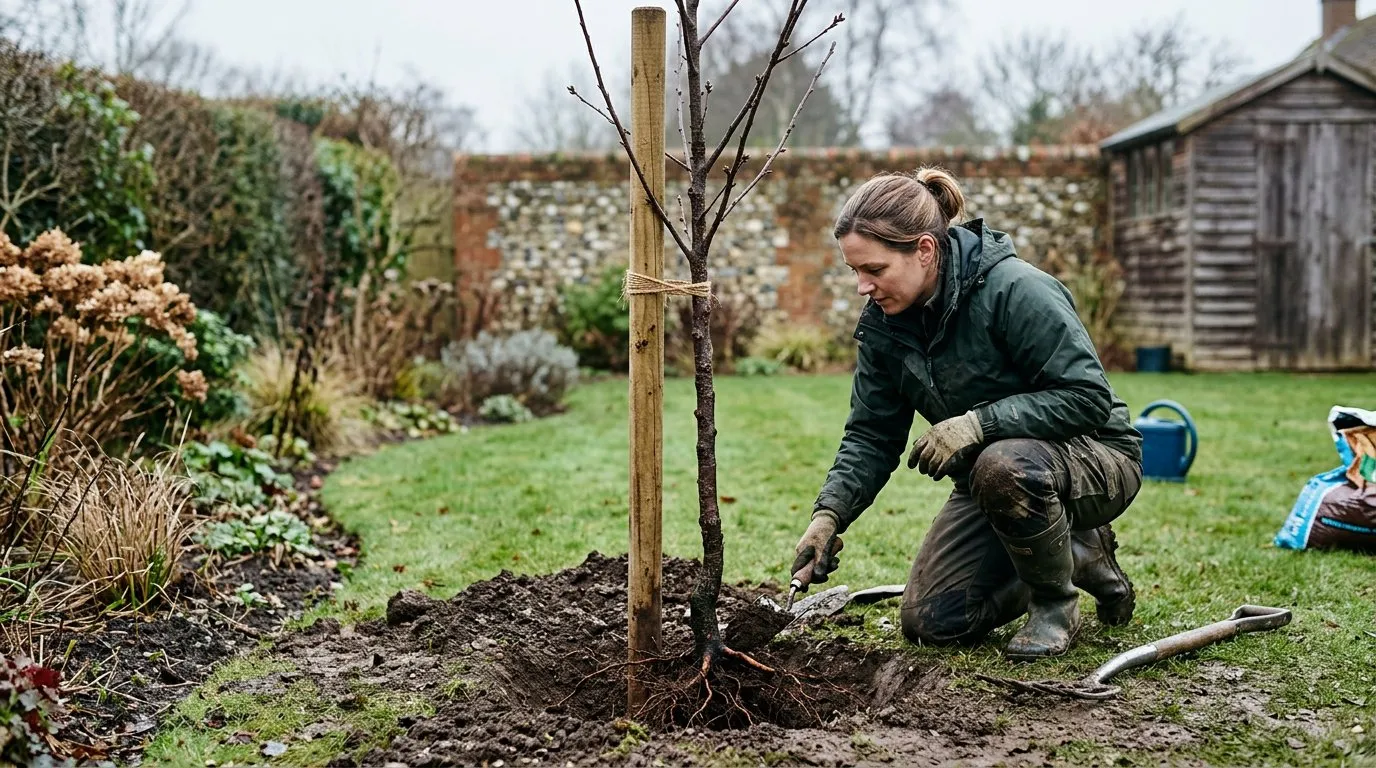 Planting a bare-root cherry tree with a supporting stake.
Sweet cherries need full sun and shelter from cold winds. A south or west-facing wall is ideal for fan training. Avoid frost pockets where cold air collects, as late April frosts kill open blossom. Well-drained soil is essential. Cherries hate waterlogged roots. If your soil is heavy clay, improve it with organic matter before planting, or grow in a large container.
Acid Morello cherries are the exception. They perform well on north and east-facing walls and in partial shade. This flexibility makes them uniquely valuable for gardens where sunny spots are already taken.
Planting steps
- Dig a hole twice the width of the root ball and the same depth
- Drive a stout stake into the hole before planting (essential for Gisela 5)
- Place the tree so the graft union (the bulge near the base) sits 10cm above soil level
- Backfill with the excavated soil mixed with garden compost
- Firm the soil gently with your heel to remove air pockets
- Water thoroughly with a full watering can (10 litres)
- Tie the trunk to the stake using a rubber tree tie with a spacer to prevent rubbing
- Mulch around the base with 8-10cm of bark chips or compost, keeping it 10cm away from the trunk
Gardener’s tip: If fan training against a wall, fix horizontal wires at 15cm intervals before planting. Use vine eyes and 2mm galvanised wire. Position the tree 20-25cm away from the wall so air circulates behind the branches.
Cherry tree care calendar
Use this month-by-month guide to keep your cherry tree healthy and productive through the year.
| Month | Task |
|---|---|
| January-February | Check stakes and ties. Firm in trees loosened by frost heave. |
| March | Apply general-purpose fertiliser (such as Growmore) at 70g per square metre around the root zone. |
| April | Protect blossom from late frost with horticultural fleece on cold nights. Water newly planted trees weekly. |
| May | Watch for cherry blackfly. Pinch out infested shoot tips by hand. Water in dry spells. |
| June | Begin summer pruning once fruit is harvested from early varieties. Net fruit as it colours. |
| July | Main harvest month. Pick sweet cherries when fully coloured. Continue summer pruning. |
| August | Harvest late sweet varieties and Morello cherries. Complete all pruning by end of August. |
| September | Clear fallen fruit to reduce brown rot. Remove netting. |
| October | Prepare planting sites for new trees. Dig in compost and well-rotted manure. |
| November-December | Plant bare-root trees. Mulch established trees with 8-10cm of well-rotted compost or bark. |
Why we recommend Stella on Gisela 5 rootstock for UK garden cherries: After 30 years of growing and observing fruit trees, this combination consistently produces the most practical and productive cherry for British home gardeners. A Stella on Gisela 5 in its third season delivered 8kg of dark red fruit in a single July, from a tree small enough to net completely with a standard roll of bird netting. No other variety-rootstock pairing we have grown has matched that combination of early cropping, manageable size, and reliable self-fertile yield.
How to prune cherry trees
Pruning is where cherry trees differ most from apples and pear trees. The critical rule is simple: prune only in summer, never in winter.
Why summer pruning matters
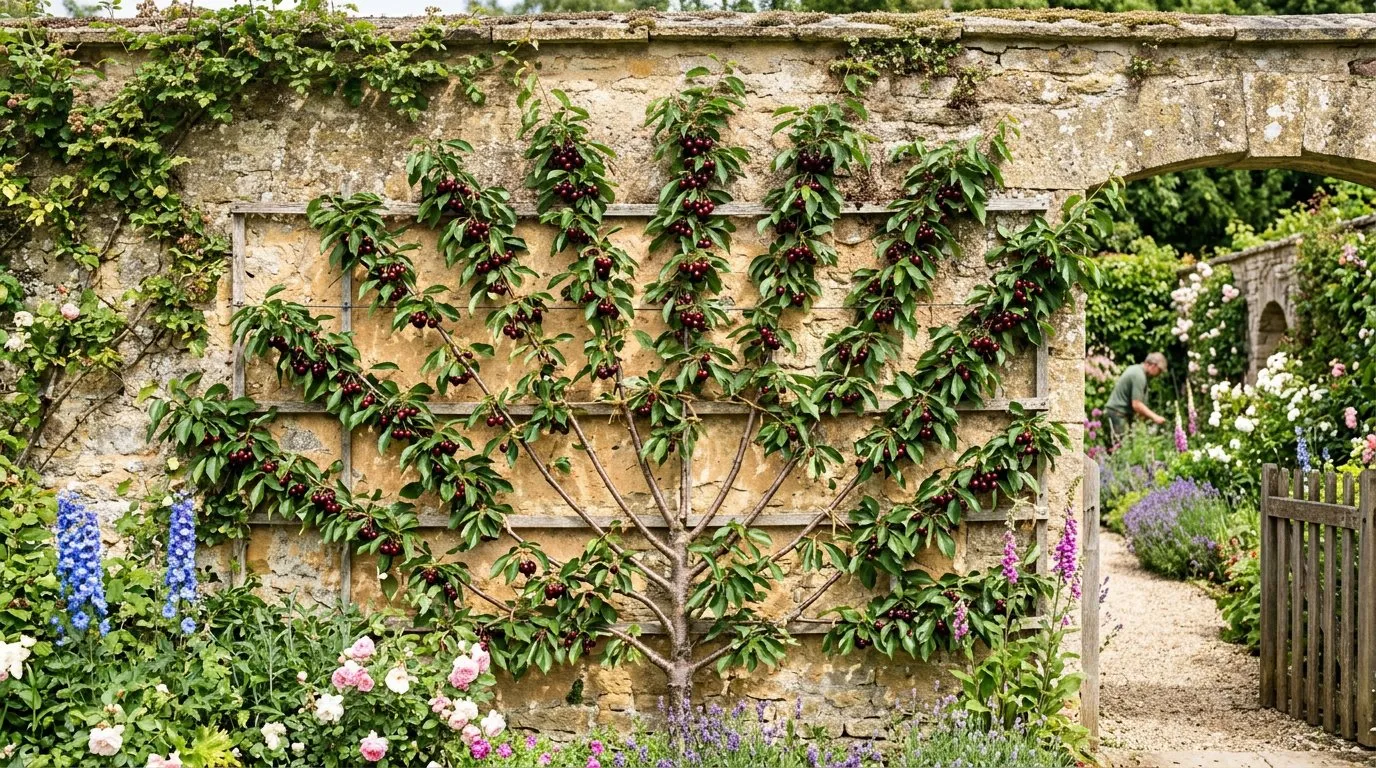 A fan-trained sweet cherry against a sunny wall. Fan training suits stone fruit well.
Cherry trees are highly susceptible to silver leaf disease (Chondrostereum purpureum). This fungus enters through pruning cuts and wounds during the damp months from September to May. It kills branches and eventually the entire tree. There is no chemical treatment. The only prevention is to prune between June and August when the tree is in active growth, wounds heal rapidly, and fungal spores are least active. This is the same rule that applies to plum trees.
Pruning a bush or pyramid cherry
In the first 3 years, shape the tree by selecting 4-5 well-spaced main branches. Remove crossing branches and any growing towards the centre. After the framework is established, annual pruning is light:
- Remove dead, diseased, or damaged wood first
- Cut out branches that cross or rub against each other
- Thin overcrowded areas to let light and air reach the fruit
- Shorten new side shoots to 6 leaves to encourage fruit bud formation
- Keep the centre of the tree open for air circulation
Pruning a fan-trained cherry
Fan-trained cherries against walls need regular summer pruning to maintain the shape. After harvest, cut back all shoots that have fruited to a younger replacement shoot. Tie in new shoots to fill gaps in the fan framework. Remove any shoots growing directly towards or away from the wall.
Pests, diseases, and problems
Bird damage
Birds are the single biggest challenge when growing cherries. Blackbirds, starlings, and pigeons will strip every ripe fruit from an unprotected tree within 2-3 days. Without netting, you will harvest nothing.
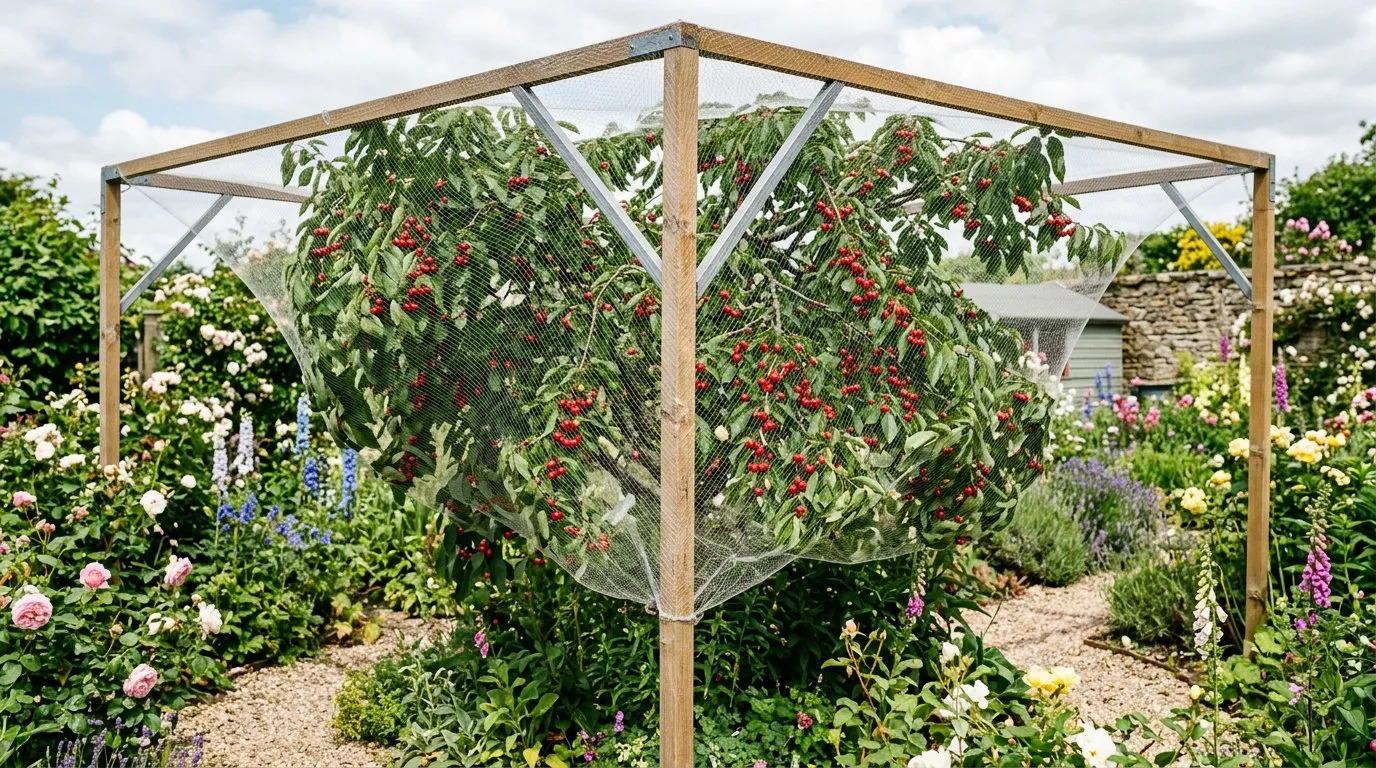 Bird netting is essential for cherries. Without it, birds take the entire crop.
Drape 15mm mesh bird netting over the entire tree from the moment fruit begins to change colour. On dwarf trees, a simple frame of bamboo canes with netting draped over works well. On larger trees, a permanent fruit cage is the best long-term solution. Remove netting after harvest to avoid trapping birds.
Scarecrows, reflective tape, and fake birds of prey give temporary results but birds habituate within days. Netting is the only reliable method.
Silver leaf disease
The most serious disease of cherry trees. Affected branches show a silvery sheen on the leaves, followed by brown staining in the internal wood when cut. There is no cure. Cut out infected branches at least 15cm below the visible staining, sterilising tools between each cut. Burn infected wood. Prevent it by pruning only in summer and avoiding damage to the bark.
Bacterial canker
Bacterial canker (Pseudomonas syriginosa) causes sunken, oozing patches on the bark and shothole damage in leaves. It is most active in autumn and winter. Prune out badly infected branches in summer. Copper-based sprays applied in autumn can reduce spread, but prevention through good pruning practice is more effective.
Cherry blackfly
Cherry blackfly (Myzus cerasi) clusters on young shoot tips in April and May, curling the leaves and stunting growth. The most effective organic control is to pinch out infested shoot tips by hand in May before the aphids spread. Encourage natural predators by planting flowers that attract ladybirds and hoverflies. Heavy infestations rarely kill the tree but reduce fruit quality and tree vigour.
Brown rot
Brown rot causes fruit to turn brown with concentric rings of white fungal spores. It spreads rapidly in wet summers. Remove and destroy affected fruit immediately. Do not leave mummified fruit on the tree or ground over winter, as it harbours spores for the following year. Good air circulation through pruning reduces infection risk.
Harvesting and storing cherries
When to pick
Sweet cherries are ready when they are fully coloured, slightly soft, and come away from the stalk easily. Taste one before picking the whole crop. Unlike pears, cherries do not ripen after picking. What you pick is what you get. If the fruit is still firm and tart, leave it another few days.
Pick in the morning when fruit is cool. Handle gently, as cherries bruise easily. Leave the stalk attached to reduce moisture loss and extend storage life.
Storing fresh cherries
Fresh cherries keep for 5-7 days in the fridge. Spread them in a single layer on a plate or tray lined with kitchen paper. Do not wash until you are ready to eat them, as moisture speeds decay. At room temperature, cherries last only 1-2 days.
Freezing
Sweet cherries freeze well. Remove stalks, wash, dry, and spread in a single layer on a tray. Freeze until solid, then transfer to freezer bags. Frozen cherries keep for 12 months. They soften on thawing, so are best used in cooking, smoothies, and baking rather than eating raw.
Cooking with Morello cherries
Morello cherries are outstanding for clafoutis, cherry pie, jam, compote, and cherry brandy. Stone the fruit using a cherry pitter or the tip of a knife. For cherry brandy, fill a jar one-third full with pricked Morello cherries, add 100g sugar, and top up with brandy. Leave for 3 months in a dark cupboard, shaking weekly.
Common mistakes when growing cherry trees
Avoiding these mistakes saves years of wasted effort. Each one is based on problems that catch gardeners out repeatedly.
Mistake 1: Pruning in winter
This is the most damaging mistake. Winter pruning exposes the tree to silver leaf disease, which is fatal and incurable. Every cut made between September and May is an entry point for fungal spores. Always prune in summer (June to August). Mark it in your calendar if needed.
Mistake 2: Not netting against birds
Many gardeners assume birds will only take some of the crop. They take all of it. A cherry tree without netting is a bird feeder, not a fruit tree. Budget for netting before you buy the tree.
Mistake 3: Choosing the wrong rootstock
A cherry tree on vigorous F12/1 rootstock grows to 6-8m. It cannot be netted, is dangerous to prune from a ladder, and takes 5-7 years to fruit. For gardens, Gisela 5 (2.5-3m) or Colt (4-5m) are the only sensible choices. Check the rootstock before buying.
Mistake 4: Planting in waterlogged soil
Cherry trees will not tolerate wet feet. Waterlogged soil causes root rot and kills the tree within 2-3 seasons. If your soil is heavy clay, plant on a mounded area, grow in a large container, or improve drainage before planting.
Mistake 5: Expecting fruit too soon
Trees on Gisela 5 fruit within 2-3 years. Trees on Colt take 4-5 years. On F12/1, you may wait 5-7 years. Do not panic if a young tree produces blossom but drops the fruit in its first year. The tree is conserving energy for root growth. Full cropping builds over several seasons.
Growing cherry trees in containers
Cherry trees on Gisela 5 rootstock grow well in large containers. This opens up cherry growing for patios, balconies, and small gardens with no open ground.
Use a container of at least 50 litres (a half-barrel works well). Fill with a mix of soil-based compost (John Innes No. 3) and multipurpose compost at a 50:50 ratio. The soil-based compost adds weight for stability and holds nutrients longer.
Water container-grown cherry trees daily in summer. Feed fortnightly with a high-potash liquid feed from flowering until harvest. Repot every 3-4 years, root-pruning if necessary to keep the tree in the same container.
Protect the pot from frost in winter. Wrap in bubble wrap or move to a sheltered position. The roots in a container are more exposed to cold than those in open ground.
Now you’ve mastered cherry trees, read our guide on growing plum trees in the UK, they share the same summer pruning rule and complement a cherry in a small orchard.
Further reading
Check our monthly harvest calendar to know exactly when your cherries and other fruit are ready for picking.
For detailed variety recommendations and disease identification, the RHS cherry growing guide is an excellent UK resource. The Garden Organic fruit guide covers organic pest and disease management.
Lawrie has been gardening in the West Midlands for over 30 years. He grows his own veg using no-dig methods, keeps a wildlife-friendly garden, and writes practical advice based on real UK growing conditions.