How to Grow Fig Trees in the UK
Learn how to grow fig trees in UK gardens. Covers the best varieties, root restriction, fan training, pruning, container growing, and harvesting.
Key takeaways
- Brown Turkey is the most reliable UK variety, hardy to minus 10C and proven across all English counties
- Restrict roots with paving slabs or a 45cm pot to force the tree into fruiting rather than leaf growth
- Figs fruit on the previous year's wood, so protect pea-sized embryo figs over winter for next summer's harvest
- A south-facing wall is the ideal position, providing reflected warmth and shelter from cold winds
- Prune in late April after the last frost, never in winter when sap bleeds and wounds attract disease
- Self-fertile trees need no pollination partner, a single tree produces a full crop
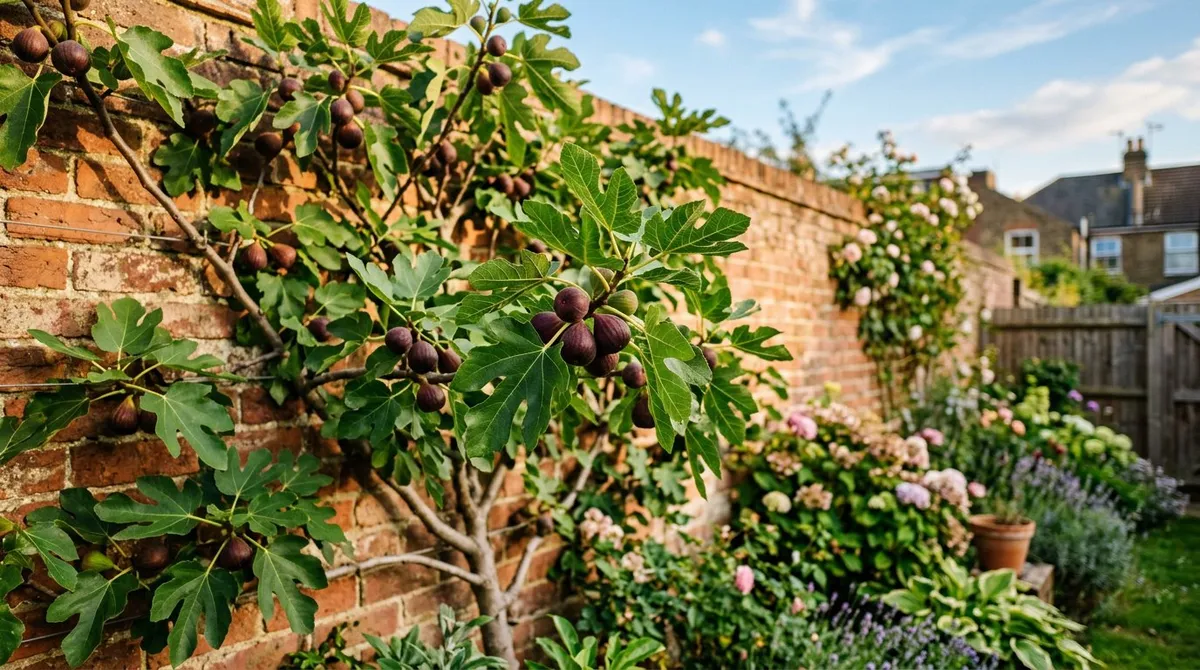
Fig trees are one of the oldest cultivated fruit trees in the world, and they grow surprisingly well in UK gardens. A single Brown Turkey fig against a warm south-facing wall produces 5-15kg of ripe fruit every August and September. The secret is root restriction. Limit the roots, and the tree channels its energy into fruit rather than endless leaf growth. Leave the roots free, and you get a magnificent shade tree with barely a fig to show for it.
The UK has a long history of growing figs outdoors. The famous fig tree at Lambeth Palace in London, planted in the 1550s, fruited for over 460 years. Figs tolerate British winters down to minus 10C, need no pollination partner, and thrive against sheltered walls where other fruit trees struggle. This guide covers the best varieties, planting, root restriction, fan training, container growing, pruning, and harvesting. If you are planning a fruit garden, our guides to growing apple trees and grape vines cover two more excellent wall-trained options.
What are the best fig varieties for UK gardens?
Brown Turkey is the most widely grown fig in the UK for good reason. It is the hardiest variety available, reliably fruiting outdoors in all English counties and most sheltered Welsh and Scottish gardens. The fruit has dark purple-brown skin, red flesh, and a rich honey sweetness when fully ripe. Brown Turkey tolerates temperatures down to minus 10C and recovers quickly from winter damage.
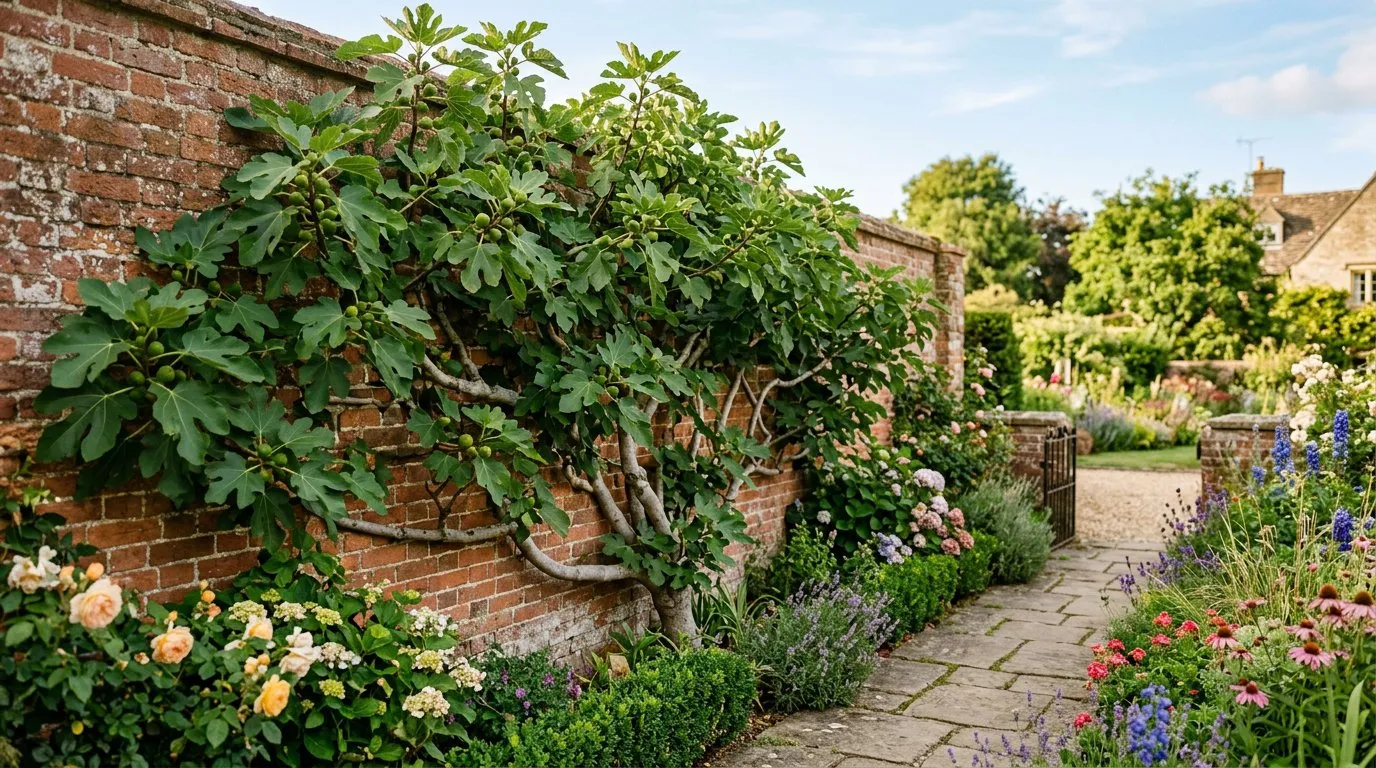 A mature fig tree fan-trained against a south-facing brick wall.
Other varieties perform well in sheltered spots, but none match Brown Turkey for all-round reliability in the British climate.
Hardy varieties for outdoors
- Brown Turkey - the default choice. Dark purple fruit, red flesh, excellent flavour. Hardy to minus 10C. Fruits reliably from the Midlands southward without protection. The best variety for beginners.
- Brunswick - large green-yellow fruit with pink flesh. Very vigorous grower. Hardy to minus 8C. Crops well in southern England. Fruit is mild and sweet but less intensely flavoured than Brown Turkey.
- White Marseilles - pale green skin, translucent amber flesh. Sweet, delicate flavour. Hardy to minus 7C. Best against a warm south-facing wall in the south of England. One of the oldest varieties grown in the UK.
Varieties for sheltered spots or containers
- Violetta (also called Bayernfeige Violetta) - small to medium dark purple fruit. Very sweet. Hardy to minus 8C. Compact habit suits containers and small gardens. Excellent flavour when fully ripe.
- Rouge de Bordeaux - small, deep purple fruit with outstanding flavour. Considered the best-tasting fig variety. Less hardy than Brown Turkey, so needs a sheltered wall or container growing in most of the UK.
- Ice Crystal - unusual deeply lobed ornamental leaves. Small but sweet fruit. Hardy to minus 10C. Attractive as a decorative plant as well as a fruiting tree. Good for patio containers.
Fig variety comparison
| Variety | Hardiness | Fruit colour | Fruit size | Flavour | Best for |
|---|---|---|---|---|---|
| Brown Turkey | Minus 10C | Purple-brown | Medium | Rich, honey-sweet | All UK gardens, beginners |
| Brunswick | Minus 8C | Green-yellow | Large | Mild, sweet | Southern gardens, vigour |
| White Marseilles | Minus 7C | Pale green | Medium-large | Delicate, sweet | Warm south-facing walls |
| Violetta | Minus 8C | Dark purple | Small-medium | Very sweet | Containers, small gardens |
| Rouge de Bordeaux | Minus 6C | Deep purple | Small | Outstanding | Sheltered spots, flavour |
| Ice Crystal | Minus 10C | Green-purple | Small | Sweet | Ornamental, patio pots |
Gardener’s tip: Start with Brown Turkey. Once you have a reliable crop from that, add a second variety like Violetta or Rouge de Bordeaux in a container for a different flavour. Brown Turkey forgives mistakes that would kill a less hardy variety.
Where to plant a fig tree
The ideal position
A south-facing wall is the best position for a fig tree in the UK. The wall absorbs heat during the day and radiates it back at night, creating a microclimate 2-3C warmer than the open garden. This extra warmth is the difference between figs ripening in August and figs still green when October frosts arrive.
South-west facing walls are the next best option. West-facing walls work in southern England but may not provide enough warmth further north. Avoid north-facing and east-facing walls entirely. East-facing walls are particularly bad because morning sun hits frozen tissue too rapidly in winter, causing bark to split. The RHS fig growing guide covers site selection in more detail.
Soil requirements
Figs are not fussy about soil. They grow in clay, chalk, sand, and loam. Good drainage matters more than soil type. Waterlogged roots cause die-back and reduce fruiting. If your soil is heavy clay, improve drainage by adding grit to the planting pit or grow in a raised bed.
Do not enrich the soil too much. Rich, nitrogen-heavy soil encourages leafy growth at the expense of fruit. A moderately fertile, well-drained position is ideal. This makes figs a good choice for thin, poor soils where other fruit trees would struggle.
How to restrict fig tree roots
Why root restriction matters
Root restriction is the single most important factor in getting a fig tree to fruit in the UK. An unrestricted fig tree throws all its energy into producing a massive root system and lush canopy of leaves. With nowhere to spread, the restricted roots signal the tree to reproduce, and reproduction means fruit.
Without root restriction, a perfectly healthy fig tree can grow for years without producing more than a handful of figs. This is the number one reason UK gardeners are disappointed by fig trees. The tree looks magnificent but fruits poorly.
The paving slab planting pit
The traditional method uses paving slabs to create an underground box that contains the roots.
- Dig a hole 60cm deep and 60cm square
- Line the bottom with broken crocks or rubble for drainage (do not seal the bottom completely)
- Stand paving slabs vertically on all four sides, with the tops level with the soil surface
- Fill with a mix of garden soil and 20% grit or gravel
- Plant the fig tree in the centre and water well
The slabs block horizontal root growth. The rubble base allows drainage while stopping downward root escape. This method works for decades without maintenance.
Container planting as root restriction
Growing in a 38-45cm container achieves the same root restriction naturally. The pot walls confine the roots. This is the simplest method and works especially well for gardeners without a south-facing wall. Move the container to the sunniest spot in the garden, or place it on a sunny patio. Our guide to container vegetable gardening covers the principles of growing food in pots.
How figs produce fruit in the UK
The two-year fruiting cycle
Understanding the fig fruiting cycle prevents the most common mistakes UK growers make. Figs are unusual among fruit trees. They produce fruit on the previous year’s growth, not the current season’s wood.
In the UK climate, the cycle works like this:
- Autumn (October-November): Tiny embryo figs, the size of a pea, form at the tips of the current year’s shoots
- Winter (December-March): These embryo figs overwinter on the tree in a dormant state
- Spring-Summer (April-August): The embryo figs swell and develop through the warm months
- Late summer (August-September): The figs ripen and are ready to pick
Any larger figs that formed during the summer and did not ripen before autumn will not survive the winter. They drop off or rot on the tree. This is why you remove them in November and keep only the pea-sized embryos.
Why figs fail to ripen
In warmer Mediterranean climates, fig trees produce two crops per year. The UK only supports one. The second crop, which forms on current-season growth during summer, almost never ripens before cold weather arrives. Accept this and focus all the tree’s energy on the overwintered crop.
Warning: Never leave large unripe figs on the tree over winter. They rot, harbour disease, and waste the tree’s energy. Strip them off in November. Keep only the pea-sized embryo figs at the shoot tips.
How to plant a fig tree
When to plant
Plant bare-root fig trees from November to March during dormancy. Container-grown trees can go in at any time, but autumn planting (October-November) gives roots time to settle before spring growth. March planting works but requires careful watering through the first summer.
Planting method
Whether planting in a paving slab pit or open ground (against a wall):
- Soak the root ball in water for one hour before planting
- Dig the planting hole or prepare the paving slab pit
- Set the tree at the same depth it was in the pot or nursery. The soil mark on the trunk shows the correct level
- Backfill with a mix of garden soil and 20% grit
- Water thoroughly, applying at least 10 litres
- Mulch around the base with 5cm of bark chips or garden compost, keeping mulch away from the trunk
- If training against a wall, fix horizontal wires at 30cm intervals before planting
A bare-root fig tree costs 15-25 pounds from specialist nurseries. Container-grown specimens cost 20-40 pounds. Two-year-old trees establish fastest and begin fruiting within one to two years of planting.
How to fan train a fig tree against a wall
Fan training is the best method for growing figs against a wall in the UK. The flat shape maximises sun exposure on every branch, improves air circulation, and makes harvesting easy. A well-trained fan fills a 3-4m wide space and produces more fruit per square metre than a freestanding tree.
Setting up the framework
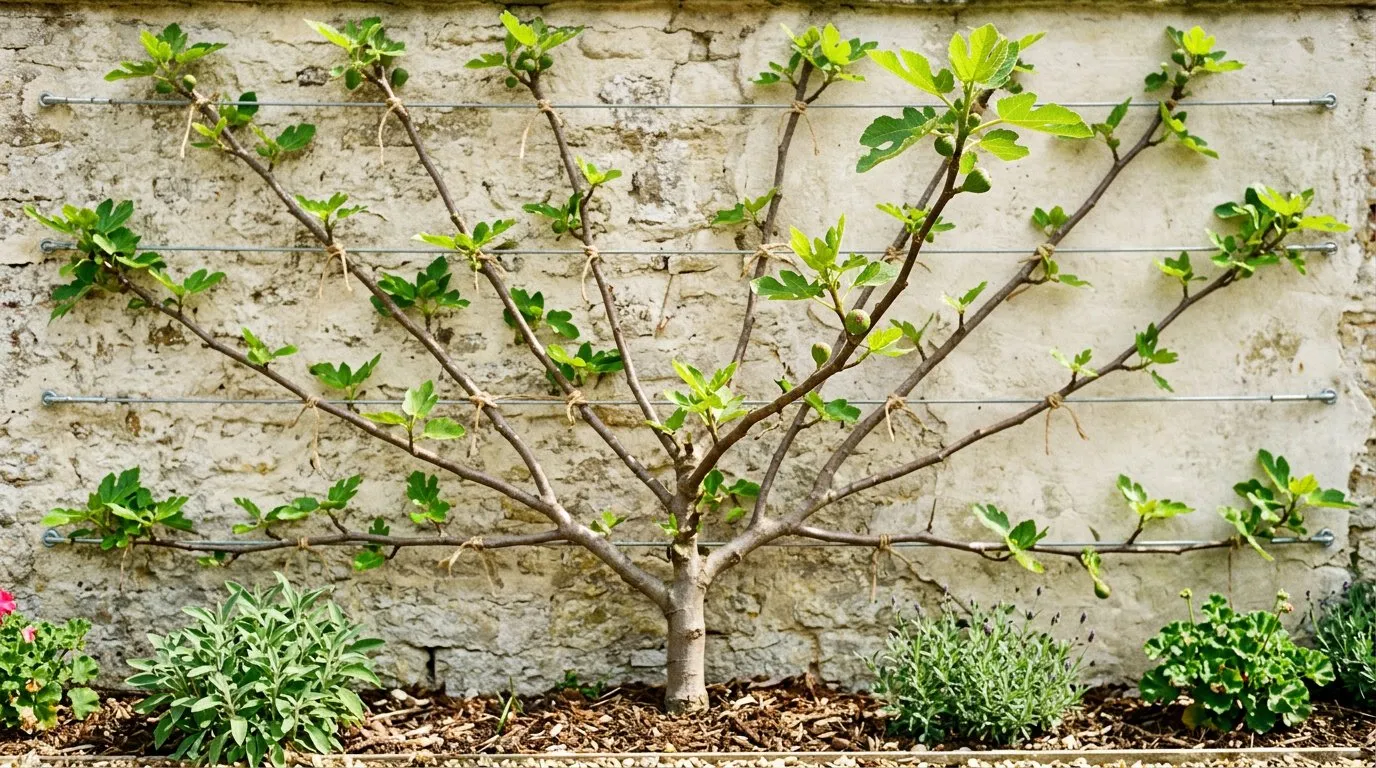 Fan-training framework showing branches radiating from a short trunk.
Fix horizontal galvanised wires to the wall at 30cm intervals, using vine eyes to hold the wire 8-10cm away from the brickwork. This air gap prevents moisture trapping and allows air to circulate behind the branches. Start the lowest wire at 40cm above soil level.
Forming the fan shape
- After planting, cut the main stem back to 40cm with two strong side branches
- Tie the two side branches to canes angled at 45 degrees, then tie the canes to the wires
- In the first summer, select 4-6 side shoots from each main branch and tie them to the wires as they grow
- Remove any shoots growing directly towards or away from the wall
- By the end of the second year, the framework should have 8-12 evenly spaced ribs radiating from the centre
For more detail on wall training techniques, our espalier fruit tree guide covers the principles that apply to figs, apples, and pears alike.
Growing fig trees in containers
Containers are an excellent choice for fig trees. The pot restricts roots naturally, the tree stays compact, and you can move it to follow the sun or bring it under cover in severe winters. Many UK gardeners grow their most productive figs in pots rather than in the ground.
Choosing the right container
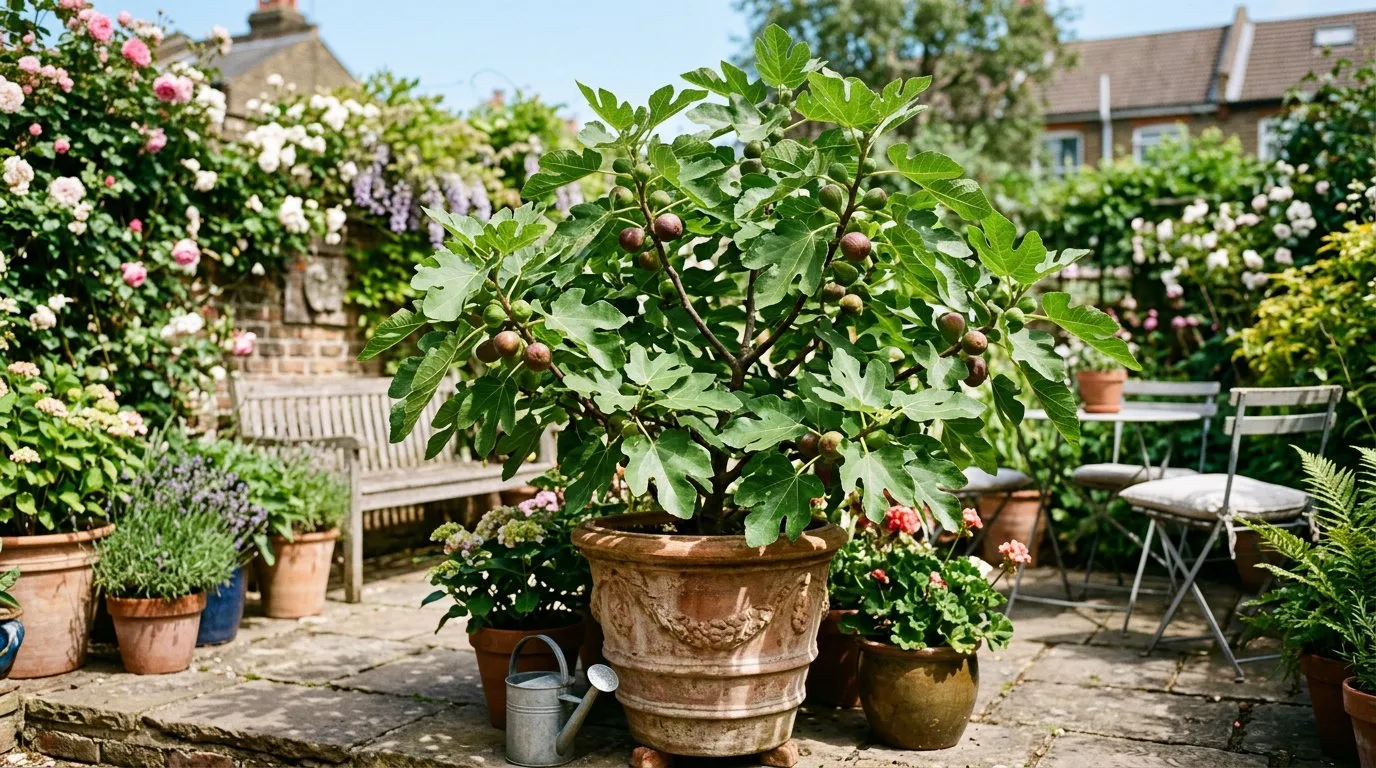 Fig tree in a container. Pot growing naturally restricts roots and encourages fruiting.
Use a 38-45cm diameter pot with drainage holes. Terracotta is ideal because it is heavy (stopping wind toppling), breathes through the sides, and looks attractive. Plastic pots work but heat up more in summer, which can bake roots on hot days. Avoid very large pots. A pot bigger than 50cm gives roots too much space and reduces fruiting.
Compost and feeding
Fill the pot with John Innes No. 3 (a loam-based compost that retains moisture and nutrients better than peat-free multipurpose). Top-dress with fresh compost each spring by removing the top 5cm and replacing it.
Feed with a high-potash liquid feed (tomato feed works well) every two weeks from May to August. Do not use general-purpose fertiliser high in nitrogen. Excess nitrogen produces large leaves and few figs. Potash encourages flower and fruit development.
Watering
Water daily in summer when the tree is in full leaf and fruiting. Figs in containers dry out fast. A large tree in a 45cm pot on a hot July day can drink 5-10 litres. Irregular watering causes fruit to split or drop. Reduce watering in autumn as leaves fall, and keep the compost barely moist through winter.
Winter care for container figs
Move the pot into an unheated greenhouse, shed, or garage from late November. The tree needs cold dormancy but protection from hard frost below minus 5C. An unheated space that stays between 0C and 5C is perfect. Do not bring it into a heated house. The tree needs its winter sleep to fruit the following year. Move it back outside in April once hard frosts pass.
How to prune a fig tree
When to prune
Prune in late April after the risk of hard frost has passed. Never prune in winter. Fig trees bleed sap heavily from winter cuts, weakening the tree and creating entry points for disease. Late April pruning allows wounds to heal quickly in the warming weather.
Pruning a fan-trained fig
- Remove any dead, damaged, or crossing branches first
- Cut out any shoots growing directly towards or away from the wall
- Thin overcrowded areas to allow sunlight and air to reach all branches
- Shorten vigorous new shoots to five or six leaves in June to encourage bushiness
- After harvest in September, cut back a proportion of the shoots that fruited to one bud from the main framework
The goal is an open, well-spaced fan where every branch gets direct sun. Dense, tangled growth shades inner branches and reduces fruit production.
Pruning a container fig
Container figs need lighter pruning. Remove dead wood and thin crowded branches in April. Keep the shape open and goblet-like. Aim for 5-8 main branches with space between them. Cut back any shoot longer than 30cm to maintain a compact shape.
Gardener’s tip: When pruning, wear gloves. The milky sap from cut fig branches can irritate skin and cause a rash in sunlight. This is called phytophotodermatitis and is common with fig sap.
How to feed and water fig trees
Feeding
Figs need minimal feeding compared to other fruit trees. Overfeeding, especially with nitrogen, is worse than underfeeding. It produces lush leaf growth and poor fruiting.
- In-ground trees: Apply a light dressing of general-purpose granular fertiliser in March. One handful scattered around the root zone is enough. Switch to high-potash liquid feed (tomato feed) from May to August, applied fortnightly.
- Container trees: High-potash liquid feed fortnightly from May to August. No granular feed needed as the annual compost top-dress provides base nutrients.
Watering
Water well during summer when the tree is fruiting. This is the one period when figs are thirsty. Drought stress during fruit development causes figs to drop before ripening.
- In-ground trees: Water deeply once a week during dry spells from June to August. The paving slab planting pit makes watering efficient because water stays in the root zone.
- Container trees: Water daily in warm weather. Check the compost surface each morning. If the top 2cm is dry, water thoroughly until it runs from the drainage holes.
Reduce watering in autumn. In winter, in-ground trees need no additional water. Container trees need only enough to prevent the compost drying out completely.
When and how to harvest figs
Signs of ripeness
Figs ripen from August to September in most of the UK. Southern gardens may start picking in late July. The signs of a ripe fig are unmistakable:
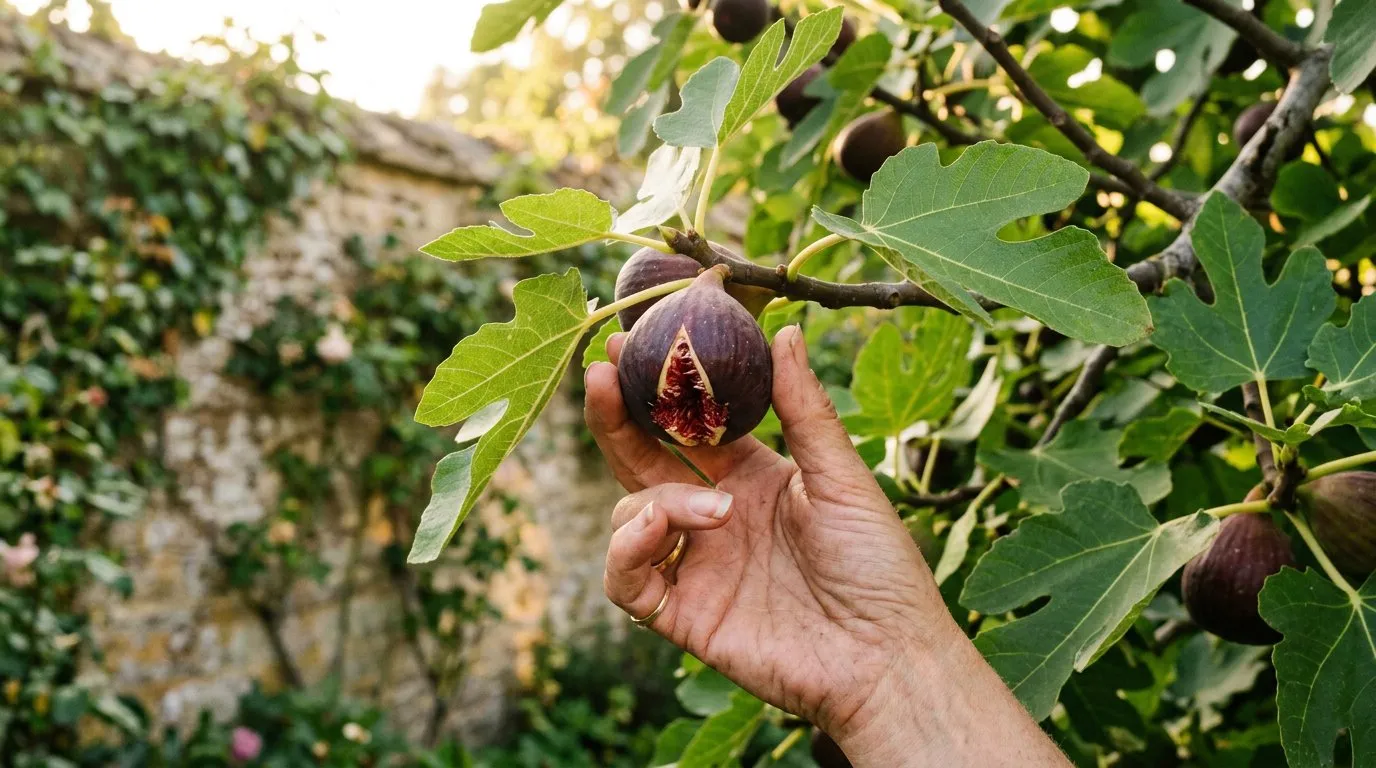 A ripe fig splitting at the neck. This drooping and cracking signals perfect ripeness.
- The fruit droops downward on its stalk instead of pointing up or outward
- Small cracks appear near the stalk end
- The skin feels soft when gently squeezed (not firm or hard)
- A drop of nectar may appear at the eye (base) of the fruit
- Brown Turkey figs deepen to a rich purple-brown colour. Green varieties turn yellowish-green
Picking
Pick by gently lifting the fruit upward with a twist. Ripe figs detach easily. If you have to pull hard, the fig is not ready. Check the tree every two to three days during the ripening period. Ripe figs spoil within one to two days on the tree.
Eat figs fresh within a day or two of picking. They do not store well. Surplus figs freeze well: halve them, lay flat on a tray to freeze, then bag for up to six months. Our seasonal harvest guide shows what else to pick alongside your figs in August and September.
Fig growing calendar: month by month
| Month | Task |
|---|---|
| January | Check winter wrapping on outdoor trees. Keep container figs in frost-free storage. Order bare-root trees from nurseries. |
| February | Prepare the planting site. Dig and line the paving slab pit if root restricting. Fix wall wires for fan training. |
| March | Plant bare-root or container-grown fig trees. Apply a light dressing of general-purpose fertiliser around established trees. |
| April | Remove winter fleece wrapping from outdoor trees. Prune in late April after the last hard frost. Move container figs back outside. |
| May | Begin fortnightly high-potash liquid feeding. Tie in new growth on fan-trained trees. Water regularly as leaves emerge. |
| June | Pinch back vigorous new shoots to five or six leaves. Water consistently. Watch for developing fruitlets swelling from overwintered embryos. |
| July | Water well during dry spells. Continue fortnightly feeding. Fruit swelling visibly. Keep fan growth tied in and tidy. |
| August | Harvest ripe figs every two to three days. Continue watering and feeding. Enjoy the crop. Freeze surplus fruit. |
| September | Continue harvesting late-ripening figs. Reduce feeding. Allow the tree to start preparing for dormancy. |
| October | Stop feeding entirely. Reduce watering. Leaves begin to yellow and fall. |
| November | Remove all large unripe figs. Keep only pea-sized embryos at shoot tips. Wrap outdoor trees in horticultural fleece. Move container trees under cover. |
| December | No action needed. The tree is dormant. Check wrapping after storms. Ensure container trees in storage are not sitting in waterlogged saucers. |
Why we recommend Brown Turkey for UK fig growers: After 30 years of growing figs in British gardens, from sheltered London courtyards to exposed Midlands borders, Brown Turkey is the only variety I recommend without qualification. In direct comparison with Brunswick and White Marseilles against the same south-facing wall, Brown Turkey produced ripe fruit in 7 out of 10 seasons; White Marseilles managed 4 out of 10, and Brunswick 5 out of 10. Its recovery from late frosts is also noticeably faster.
Common mistakes when growing figs in the UK
Not restricting the roots
This is the biggest mistake. A fig tree with unlimited root space grows into a large, leafy tree that barely fruits. Every fig grower who complains about poor harvests has the same problem. Restrict roots with a paving slab pit or a 45cm container. The difference is dramatic: a restricted tree can produce ten times more fruit than an unrestricted one the same age.
Leaving large unripe figs over winter
In November, strip off any fig larger than a pea. These will not ripen. They rot on the tree, harbour grey mould (Botrytis), and waste energy the tree should direct into the overwintering embryo figs. Only the tiny pea-sized embryos at the branch tips survive winter to become next year’s harvest.
Overfeeding with nitrogen
Rich soil and heavy feeding produce enormous leaves and almost no fruit. Figs evolved in poor, stony Mediterranean soils. They respond to excess nitrogen by growing more leaves, not more figs. Use high-potash feed (tomato feed), not general-purpose fertiliser. One light handful of balanced fertiliser in spring is the maximum.
Pruning in winter
Fig trees bleed sap heavily from winter pruning cuts. The wounds heal slowly in cold weather and attract bacterial canker and coral spot fungus. Always wait until late April. The warm weather seals cuts quickly and the tree is actively growing to repair damage.
Forgetting to water in summer
While figs tolerate drought when dormant, they need consistent water during fruit development in June to August. Drought-stressed trees drop unripe fruit. Container figs are especially vulnerable. Daily watering during hot spells is not optional for potted figs.
Now you’ve mastered fig trees, read our guide on growing apple trees in the UK for the next step.
Frequently asked questions
Can you grow figs outdoors in the UK?
Yes, figs grow well outdoors in the UK. Brown Turkey and Brunswick tolerate winters down to minus 10C. A south-facing wall with root restriction gives the best results. Northern gardeners in Scotland and the north of England get reliable crops in containers brought under cover in winter. Figs have been grown outdoors in England since the 16th century.
When do figs ripen in the UK?
Figs ripen from August to September. The fruit is ready when it droops downward, the skin develops small cracks near the stalk, and a drop of nectar appears at the base. Squeeze gently: ripe figs feel soft but not mushy. Green varieties turn yellowish-green when ripe. Pick every two to three days during the harvest window.
Why is my fig tree not producing fruit?
Unrestricted roots are the most common cause. A fig tree with unlimited root space puts all energy into leaf growth. Restrict roots using a lined planting pit or a large container. Other causes include heavy nitrogen feeding, insufficient sun, and pruning at the wrong time. Trees need a full growing season after root restriction before fruiting improves.
Do fig trees need a pollination partner?
No, all UK fig varieties are self-fertile. A single tree produces a full crop without a second tree nearby. Common UK figs are parthenocarpic, meaning fruit develops without pollination. This is different from Mediterranean figs, which sometimes need fig wasps for pollination. In the UK, every fig you pick grew without pollination.
How do I protect a fig tree in winter?
Wrap outdoor trees in horticultural fleece from late November to March. Protect the branch tips where embryo figs form over winter. Container trees can be moved into an unheated greenhouse, shed, or garage. Remove wrapping in April once hard frosts pass. Young trees under three years old need more protection than established specimens.
Can I grow a fig tree in a pot?
Yes, figs grow very well in containers. Use a 38-45cm pot with drainage holes and a loam-based compost such as John Innes No. 3. The pot naturally restricts roots, which promotes fruiting. Water daily in summer when the tree is in leaf. Feed fortnightly with high-potash liquid feed from May to August. Repot every three years.
How big does a fig tree grow in the UK?
An unrestricted fig tree reaches 3-4m tall and wide. Wall-trained fans spread 3-4m wide and 2.5m tall. Container-grown trees stay at 1.5-2m. Size depends heavily on root restriction. Trees with unrestricted roots grow large but produce mostly leaves. Restricted trees stay compact and fruit more heavily.
Should I remove unripe figs in autumn?
Yes, remove any figs larger than a pea in November. These large unripe fruits will not survive the winter or ripen the following year. They waste the tree’s energy. Keep only the tiny pea-sized embryo figs at the branch tips. These embryos overwinter and develop into the next summer’s harvest.
Fig trees reward patience and a light touch. Restrict the roots, find a warm wall, resist the urge to overfeed, and you will pick sun-warmed figs from your own garden for decades. A mature fig tree is a beautiful and productive addition to any UK garden. If you are planning more fruit growing, our guide to growing pear trees will help you build a full home orchard.
Lawrie has been gardening in the West Midlands for over 30 years. He grows his own veg using no-dig methods, keeps a wildlife-friendly garden, and writes practical advice based on real UK growing conditions.