How to Grow Gooseberries in the UK
Complete guide to growing gooseberries in UK gardens. Covers the best varieties, planting, pruning, training as cordons, pest control, and harvesting tips.
Key takeaways
- Each mature bush produces 3-5kg of fruit per year from June to July
- Self-fertile plants, so a single bush gives a full crop without a partner
- Cordons need only 30cm spacing, perfect for small gardens and fences
- Choose mildew-resistant varieties like Invicta or Hinnonmaki Red for easier growing
- Bushes stay productive for 15-20 years with annual winter pruning
- Thin fruit in late May for larger dessert berries and use thinnings for cooking
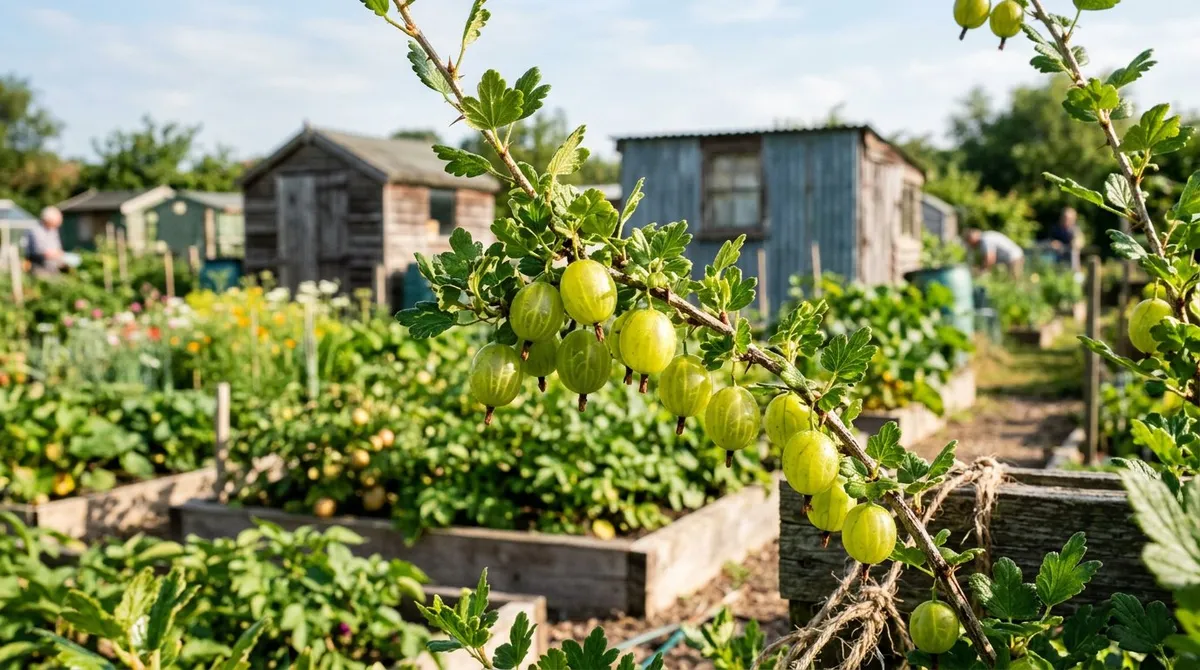
Gooseberries are a quintessentially British fruit that deserves a place in far more gardens than it currently occupies. They were a kitchen garden staple for centuries, prized for pies, crumbles, jams, and fools. Then they fell out of fashion. That is a shame, because few fruits are as forgiving or productive. A single bush produces 3-5kg of fruit per year and carries on doing so for 15-20 years.
The UK climate suits gooseberries perfectly. They tolerate cold winters, partial shade, and most soil types. They are self-fertile, so you only need one plant. This guide covers variety selection, planting, training methods including cordons, pruning, pest and disease management, and harvesting. If you grow redcurrants and blackcurrants already, gooseberries need a very similar approach.
Choosing gooseberry varieties
Gooseberry varieties fall into two broad groups: dessert (sweet enough to eat raw) and culinary (tart, best for cooking). Some varieties bridge both categories depending on when you pick them. Fruit colour ranges from green through yellow to deep red, and flavour varies from sharply acidic to honey-sweet.
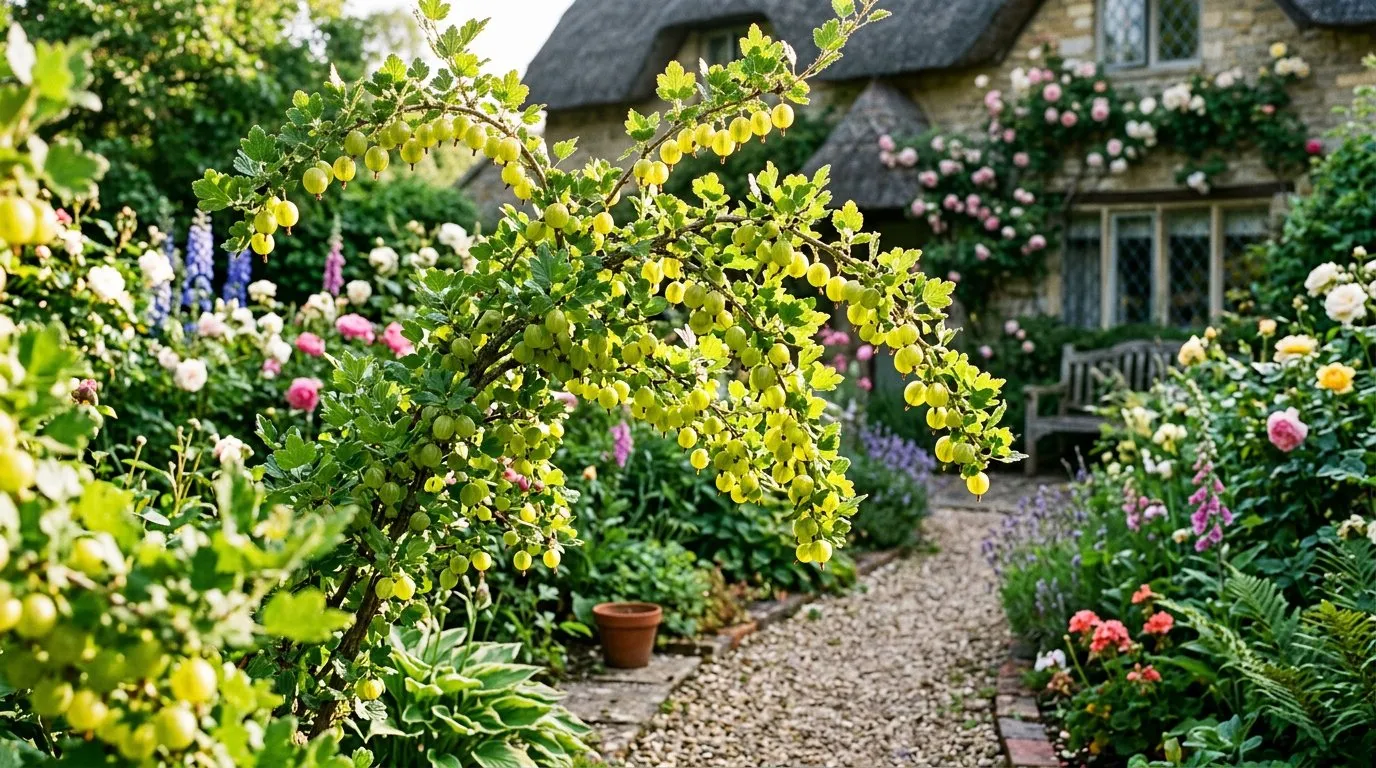 A mature gooseberry bush. The translucent berries glow when backlit by sunlight.
The single most important factor when choosing a variety is mildew resistance. American gooseberry mildew is the main disease affecting UK bushes. It coats shoots and fruit in white fungal growth. Choosing a resistant variety saves years of frustration. The RHS gooseberry growing guide lists current AGM award holders.
Thorniness is the other consideration. Traditional varieties have vicious thorns that make picking painful. Several modern varieties are nearly thornless, which makes a genuine difference at harvest time.
Variety comparison table
| Variety | Colour | Type | Flavour | Yield | Mildew resistance | Thorns |
|---|---|---|---|---|---|---|
| Invicta | Green | Culinary/dessert | Good | Very high | Excellent | Thorny |
| Hinnonmaki Red | Red | Dessert | Excellent | High | Very good | Moderate |
| Careless | Green | Culinary | Sharp | High | Low | Thorny |
| Leveller | Yellow | Dessert | Outstanding | Moderate | Low | Thorny |
| Pax | Red | Dessert | Very good | High | Good | Nearly thornless |
| Captivator | Red | Dessert | Good | Moderate | Good | Thornless |
Invicta is the most widely grown UK variety. It produces heavy crops of large green berries with strong mildew resistance. The fruit is good for cooking when picked green in June and sweet enough for eating raw when left to ripen fully in July. The main drawback is its thorns.
Hinnonmaki Red offers the best combination of flavour, yield, and disease resistance. The red fruit has a rich, aromatic sweetness. It was bred in Finland, so it handles cold UK winters without flinching.
Why we recommend Hinnonmaki Red as the best all-round UK gooseberry: After 30 years of growing gooseberries across a range of UK garden soils, Hinnonmaki Red consistently outperforms other varieties on the combination of metrics that matter most to home growers. In our beds it yields 4-5kg per bush annually, shows no mildew even in damp seasons without any spraying, and produces berries sweet enough to eat straight from the bush by mid-July. No other variety in our trials matched it on all three counts simultaneously.
Leveller produces yellow berries with the finest flavour of any gooseberry. Show-bench growers prize it. However, it is fussy about soil, prone to mildew, and lower-yielding than Invicta. Grow it if you want the best-tasting fruit and are prepared to manage the extra care.
Pax and Captivator are the thornless choices. Pax is nearly spine-free and crops well. Captivator is completely thornless but lower-yielding. Both are red dessert varieties.
Gardener’s tip: Plant at least two varieties, one for early cooking (Invicta, picked green in June) and one for dessert eating (Hinnonmaki Red, left to ripen in July). This way you get two distinct harvests from a small space.
Where to plant gooseberries
Gooseberries are remarkably tolerant of less-than-perfect positions. They are one of the few fruiting plants that crop reliably in partial shade. This makes them ideal for north-facing borders, shaded walls, and spots that are too gloomy for strawberries or raspberries.
Site requirements
- Sun: four hours of direct light minimum. Full sun gives sweeter dessert fruit, but partial shade produces good culinary crops.
- Soil: fertile, well-drained, slightly acidic to neutral (pH 6.0-6.5). They dislike waterlogged ground.
- Shelter: protect from strong winds, which damage blossom and dislodge fruit.
- Frost pockets: gooseberries flower early (March to April). Late frost damages blossom. Avoid low-lying areas where cold air pools. Covering bushes with fleece on frost nights protects the flowers.
Improve heavy clay or thin sandy soil by digging in generous amounts of garden compost before planting. This improves both drainage and moisture retention. A 5cm mulch of compost or bark each spring feeds the soil and suppresses weeds.
How to plant gooseberry bushes
When to plant
November to March is the planting window for bare-root gooseberry bushes. Bare-root plants are cheaper (typically three to five pounds each), establish faster, and give a wider choice of varieties than container-grown stock. Container plants can go in at any time, but autumn planting is still preferred.
Planting method
- Soak bare-root plants in a bucket of water for two hours before planting
- Dig a hole twice the width of the root spread and the same depth
- Fork the bottom of the hole to break up compacted soil
- Mix in a handful of blood, fish, and bone meal
- Spread the roots evenly in the hole
- Plant to the same depth as the soil mark on the stem
- Backfill with soil, firm gently with your heel, and water well
Spacing
- Bushes: 1.2-1.5m apart, rows 1.5m apart
- Cordons: 30cm apart, rows 1.5m apart
- Standards: 1.2m apart
Gooseberries are self-fertile. A single bush will set fruit without a pollination partner. However, planting two or more varieties often improves fruit set and gives you a longer harvest window.
Training methods: bush, cordon, and standard
Gooseberries adapt to several training forms. The right choice depends on your space, how many plants you want, and how you prefer to manage them.
Bush form
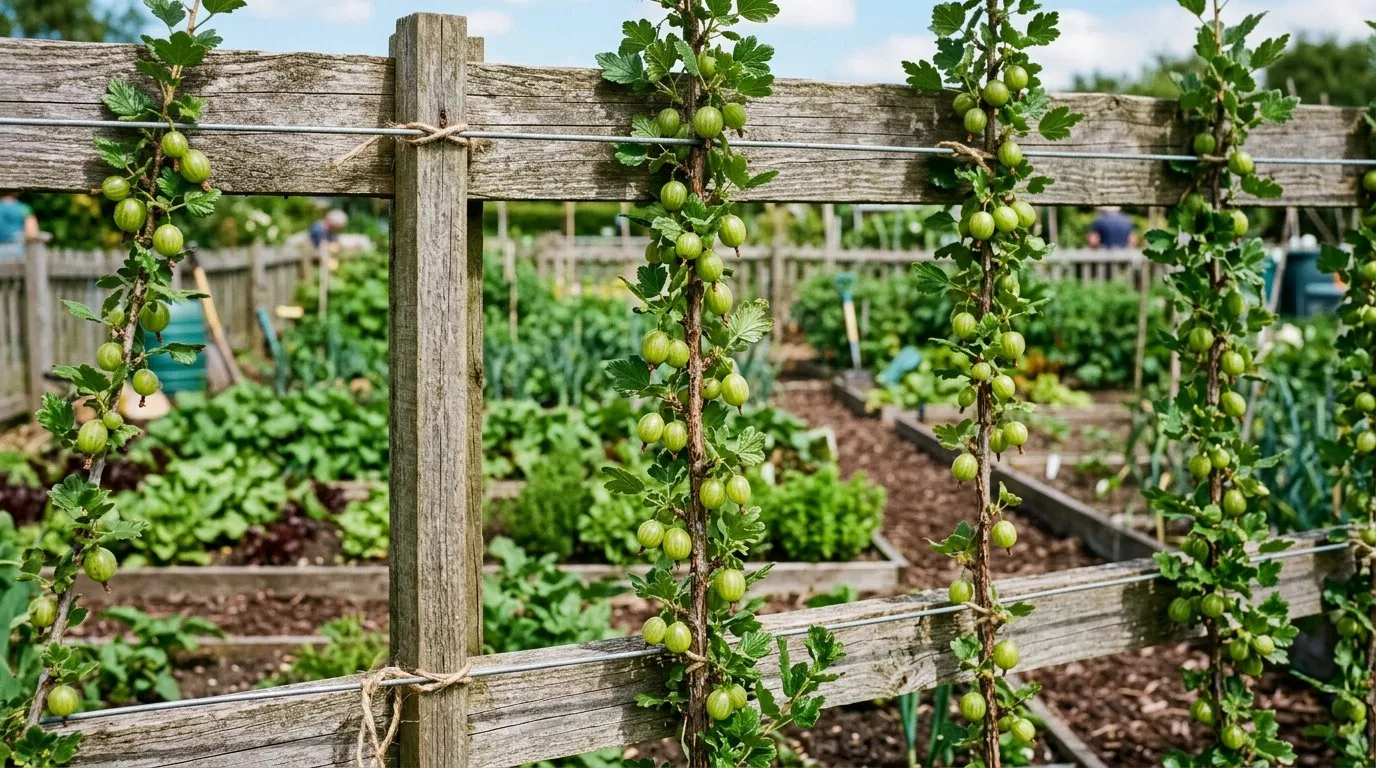 Gooseberry cordons at 30cm spacing. Ideal for small gardens and narrow borders.
The most common growing method. Allow the plant to develop an open goblet shape on a short 15-20cm leg (clear stem). This lifts branches off the ground, improves air circulation, and makes picking easier. A mature bush occupies about 1.5m x 1.5m.
Cordon form
Cordons are well suited to small gardens. A cordon is a single upright stem trained against a wall, fence, or system of wires. Because they take up so little space (just 30cm between plants), you can grow six different varieties in 1.8m of fence. This is ideal if you have a small garden or want to try multiple varieties.
To train a cordon:
- Plant against a wall or fence with horizontal support wires at 60cm and 120cm
- Tie the main stem to a vertical bamboo cane
- In summer (June), cut all side shoots back to five leaves
- In winter, cut those same side shoots back to two buds
- Allow the leader to extend by one-third each year until it reaches the top wire
Standard (lollipop) form
A standard gooseberry is grafted onto a tall straight rootstock, creating a lollipop-shaped tree at about 1m height. Standards look attractive in borders, potagers, and large containers. They make picking easy because the fruit hangs at waist height. The main downside is the higher price (fifteen to twenty pounds) and slightly shorter lifespan.
Monthly care calendar
This calendar covers the key tasks through the year. Check our monthly harvest guide for picking times across all your fruit and vegetables.
| Month | Task |
|---|---|
| January | Winter prune. Cut side shoots to two buds. Remove dead or crossing branches. |
| February | Apply sulphate of potash (35g per sq metre) around each bush. Mulch with compost. |
| March | Check for bird damage to buds. Net if bullfinches are active. |
| April | Watch for late frost during flowering. Cover with fleece on cold nights. |
| May | Thin fruit to 5cm apart. Use thinnings for cooking. Check for sawfly larvae on leaf undersides. |
| June | Pick green fruit for cooking. Water in dry spells. Summer prune cordons (cut side shoots to five leaves). |
| July | Harvest ripe dessert fruit. Continue watering. |
| August | After harvest, cut out any mildew-affected shoots. |
| September | Take hardwood cuttings for new plants. |
| October | Prepare planting sites with compost for bare-root planting next month. |
| November | Plant bare-root bushes. Apply a winter wash to established plants. |
| December | Continue planting bare-root stock in mild weather. |
Pruning gooseberry bushes
Annual winter pruning is the single most important task for healthy, productive gooseberry bushes. A well-pruned bush resists mildew, produces larger fruit, and is far easier to pick. Pruning gooseberries follows a similar approach to blackberries and other soft fruit, where keeping an open, uncluttered framework is the key.
Winter pruning (December to February)
Prune when the leaves have fallen and you can see the branch structure clearly.
- Remove all dead, damaged, and diseased branches first
- Cut out branches growing into the centre of the bush
- Remove low branches that touch the ground
- Shorten all side shoots (laterals) to two buds from the base
- Reduce branch leaders by one-third to an outward-facing bud
- Aim for an open goblet shape with 8-10 main branches and a clear centre
The open shape allows sunlight and air to reach all parts of the bush. Good air circulation is the best defence against American gooseberry mildew.
Summer pruning (June)
Summer pruning is optional for bushes but essential for cordons. Cut all new side shoots back to five leaves. This directs energy into fruit production and keeps cordons tidy. It also lets sunlight reach ripening fruit.
Gardener’s tip: Wear thick leather gloves when pruning thorny varieties. The thorns are as sharp as rose thorns and leave painful scratches. Pax and Captivator are much kinder on the hands.
Thinning fruit for bigger berries
Thinning in late May is a trick many gardeners overlook. When the fruit is marble-sized, remove every other berry by hand. Space the remaining fruit roughly 5cm apart along each branch.
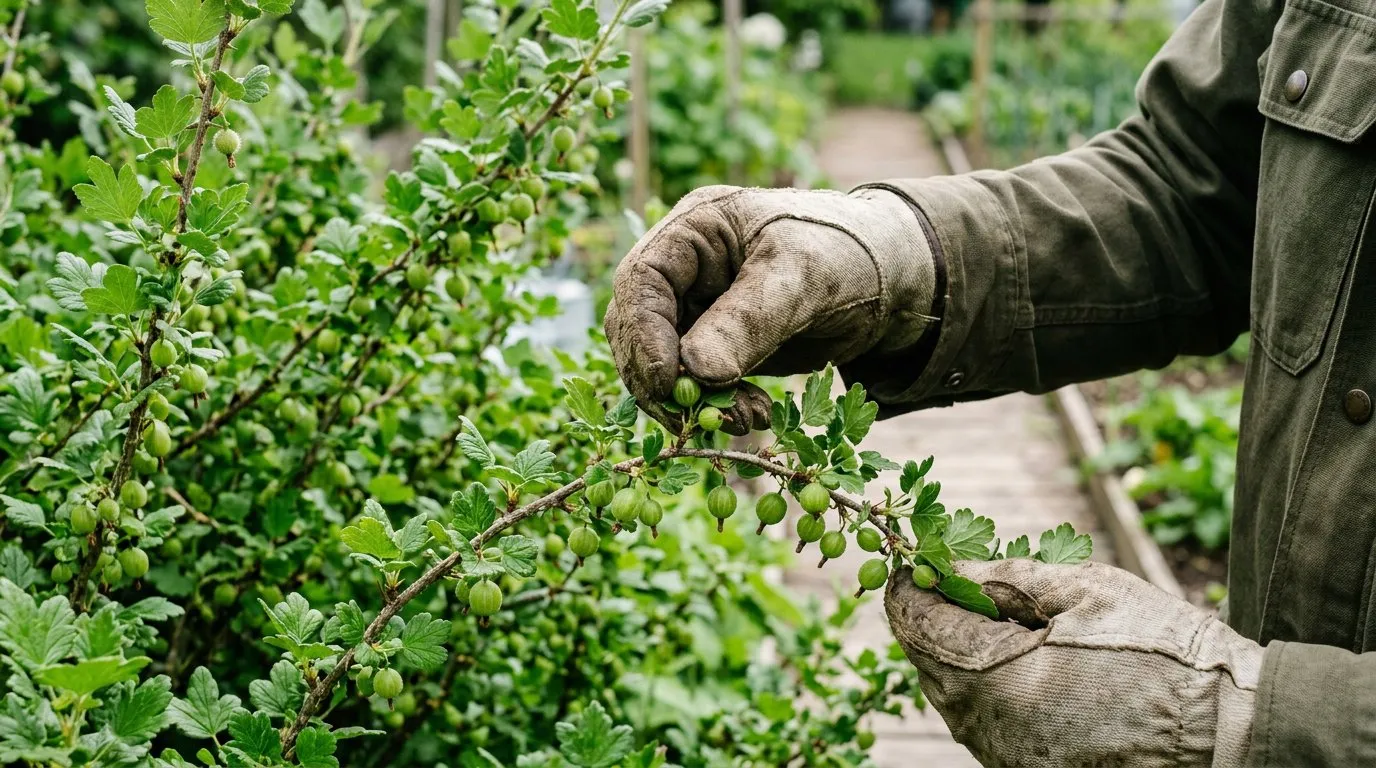 Thinning gooseberries in May. Use the thinnings for cooking and leave the rest to swell.
The thinned fruit is firm, tart, and well suited to cooking. These early green gooseberries make the best gooseberry fool, crumble, and jam. They contain more pectin than ripe fruit, so jam sets quickly and firmly.
The remaining fruit left on the bush grows much larger. By July, dessert varieties like Hinnonmaki Red and Leveller swell to full size, soften, and develop their characteristic sweetness. You effectively get two harvests from each bush: a cooking crop in May and a dessert crop in July.
Pests and diseases
American gooseberry mildew
This is the main disease of gooseberries in the UK. It appears as a white powdery coating on shoot tips and fruit from late spring. The coating later turns brown and felt-like. Badly affected fruit is inedible.
Prevention is better than cure:
- Choose resistant varieties (Invicta, Hinnonmaki Red, Pax)
- Prune to an open shape for maximum air circulation
- Avoid high-nitrogen feeds, which promote soft growth that mildew attacks
- Remove and destroy infected shoot tips as soon as you spot them
- Mulch with compost rather than fresh manure
Gooseberry sawfly
Gooseberry sawfly is the most damaging pest. The pale green larvae appear on leaf undersides from May onward. They work from the centre of the bush outward, stripping leaves to bare ribs within days. A severe attack weakens the bush and reduces next year’s crop.
Control measures:
- Check leaf undersides weekly from May to June. The caterpillars are well camouflaged.
- Pick off larvae by hand into soapy water. This is effective for small numbers.
- There can be three generations per year, so keep checking through to September.
- Spray with an organic pyrethrin-based product for heavy infestations.
Bird damage
Bullfinches eat gooseberry buds in late winter and early spring. A single bullfinch can strip hundreds of buds in a morning. This removes the following summer’s fruit before it forms. Netting is the only reliable protection. Use fine-mesh netting from December to April, then again from June to protect ripening fruit from blackbirds and thrushes.
Other problems
- Capsid bugs cause small brown spots on fruit. Damage is cosmetic and fruit is still edible.
- Grey mould (botrytis) affects fruit in wet summers. Improve air circulation by pruning.
- Leaf spot causes brown spots and early leaf drop. Rake up fallen leaves in autumn. Feed the bush well.
Harvesting and using gooseberries
When to pick
The harvest runs from late June to mid-July, depending on variety and region. Northern gardens are typically two weeks later than southern ones.
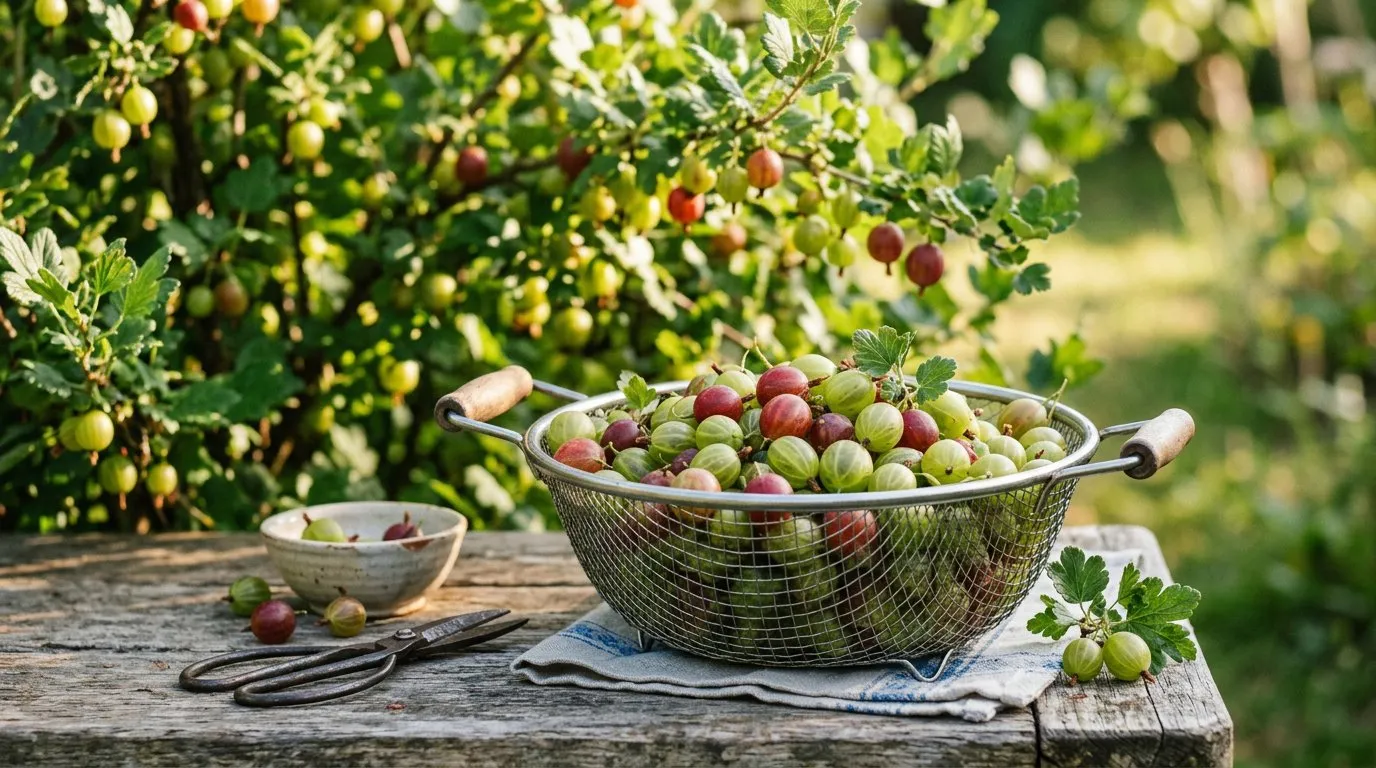 Freshly harvested gooseberries. Green for cooking, red and sweet for eating fresh.
- Cooking gooseberries: pick when firm, full-sized, and still green (late June). They should feel hard to the touch.
- Dessert gooseberries: leave on the bush until soft, fully coloured, and sweet (mid-July). Test by tasting. Ripe dessert gooseberries pop in the mouth with a sweet-tart juice.
Expected yields
A mature bush in good soil produces 3-5kg of fruit per year. Cordons yield less per plant (1-1.5kg) but produce more per metre of growing space because of the tight spacing. Six cordons in 1.8m of fence give a combined harvest of 6-9kg.
Storing and using
Fresh gooseberries keep for a week in the fridge. They freeze: spread on a tray, freeze until solid, then bag. Frozen gooseberries hold their shape for crumbles and pies.
Classic gooseberry recipes include gooseberry fool (the finest British dessert, bar none), gooseberry crumble, gooseberry jam, gooseberry chutney with elderflower, and gooseberry sauce with mackerel. The tartness of green cooking gooseberries cuts through rich oily fish perfectly.
Common mistakes when growing gooseberries
Even experienced gardeners trip up on a few points with gooseberries. Avoid these pitfalls for healthier bushes and bigger crops.
1. Skipping the annual prune
Gooseberries fruit on old wood and at the base of one-year-old side shoots. Without pruning, the bush becomes a dense, tangled mass. Air cannot circulate, mildew takes hold, and picking through thorny branches becomes miserable. Prune every winter without fail.
2. Ignoring sawfly until it is too late
Sawfly larvae work fast. By the time you notice the damage, half the leaves may already be gone. Make it a habit to turn over a few leaves every time you visit the bush from May onward. Catching the first generation early prevents the population from building.
3. Planting in a waterlogged spot
Gooseberries tolerate most soils but draw the line at sitting in water. Waterlogged roots rot. If your soil is heavy clay, plant on a mound or in a raised bed with added grit and compost.
4. Feeding too much nitrogen
High-nitrogen fertilisers and fresh manure push lots of soft leafy growth. This is exactly what American gooseberry mildew attacks. Use balanced feeds and well-rotted compost instead. A spring application of sulphate of potash encourages fruiting rather than foliage.
5. Not netting against birds
Bullfinches strip buds in spring. Blackbirds and thrushes eat ripening fruit in summer. Without netting, you will lose a significant portion of your crop. Net from December through to the end of harvest.
Growing gooseberries in containers
Gooseberries grow well in large pots, making them a good option for patios, balconies, and paved areas. Standards (lollipop forms) look particularly attractive in containers and produce fruit at a convenient height.
Choose a pot at least 40cm diameter and 40cm deep. Use peat-free multipurpose compost mixed with 20% perlite or grit for drainage. Feed fortnightly with a high-potash liquid feed from flowering through to harvest. Water regularly throughout the growing season, as pots dry out faster than open ground. Repot every two to three years, refreshing the compost. Container-grown bushes produce slightly smaller crops (2-3kg) than those in open ground, but the fruit quality is identical.
Browse our blueberry growing guide for another soft fruit that thrives in containers.
Propagation
Gooseberries are straightforward to propagate from hardwood cuttings taken in September or October.
- Select a healthy, straight shoot of this year’s growth, about 30cm long
- Cut just below a bud at the base and just above a bud at the tip
- Remove all buds except the top three or four (this creates the clear leg)
- Push the cutting 15cm deep into a trench of gritty compost in a sheltered spot
- Leave for a full year. By the following autumn, the cutting will have rooted and produced new growth.
- Transplant to its final position the following November
This costs nothing and is the simplest way to increase your stock.
Now you’ve mastered gooseberries, read our guide on growing redcurrants and blackcurrants for the next step in building a complete soft fruit garden with a harvest from June through to September.
Frequently asked questions
Lawrie has been gardening in the West Midlands for over 30 years. He grows his own veg using no-dig methods, keeps a wildlife-friendly garden, and writes practical advice based on real UK growing conditions.