How to Grow Parsley from Seed UK
How to grow parsley from seed in the UK. Covers flat-leaf and curly varieties, slow germination fixes, container growing and year-round harvesting tips.
Key takeaways
- Parsley seeds take 3-4 weeks to germinate — soaking overnight in warm water cuts this by 5-7 days
- Flat-leaf (Italian) parsley has a stronger, more peppery flavour than curly varieties
- Parsley is biennial: it flowers and dies in its second year, so re-sow annually
- Plants tolerate partial shade, making parsley ideal for north-facing patios and shaded borders
- Sow outdoors from April to June in drills 1cm deep with 15cm spacing
- Container-grown parsley needs pots at least 20cm deep to accommodate its long taproot
Parsley is one of the most useful herbs in the kitchen and one of the most frustrating to start from seed. Every gardener who has stared at a bare seed tray for three weeks knows the feeling. The secret is understanding that parsley plays by its own rules when it comes to germination.
Once past that slow start, parsley is genuinely easy to grow. It tolerates shade, handles cool temperatures, and keeps producing leaves from early summer right through to the first hard frosts. Whether you grow flat-leaf for cooking or curly for garnishing, a few plants keep any kitchen supplied for months.
How to sow parsley seed
Parsley has a reputation for being difficult to germinate. In truth, it is not difficult. It is just slow. Seeds contain natural germination inhibitors in their hard outer coating. These compounds prevent all seeds from sprouting at once in the wild, which is clever for survival but annoying for gardeners.
Expect germination to take 3-4 weeks at soil temperatures of 15-20°C. You can speed this up considerably by soaking seeds in warm water overnight before sowing. Some growers pour freshly boiled water along the seed drill before placing the seeds. Both methods soften the seed coat and break down inhibitors.
Sowing outdoors
Sow parsley outdoors from April to June once the soil has warmed above 10°C. Choose a spot in full sun or partial shade. Parsley is one of the few herbs that genuinely performs well without all-day sunshine.
Draw drills 1cm deep and 30cm apart. Sow seeds thinly along the drill. Cover lightly with fine soil and water with a gentle rose. Thin seedlings to 15cm apart once they have their first true leaves. Our seed sowing calendar has the full timeline for herbs and vegetables across the year.
Sowing indoors
Start seeds indoors from March using module trays or 9cm pots filled with peat-free seed compost. Sow 3-4 seeds per module at 1cm depth. Place in a propagator or on a warm windowsill at 18-20°C. Germination takes 14-21 days indoors, slightly faster than outside.
Thin to the strongest seedling per module once the first true leaves appear. Harden off for 7-10 days before transplanting outdoors from late April. Our guide to sowing seeds indoors covers the full technique.
Flat-leaf vs curly parsley
This is the first choice every grower faces. Both types are equally easy to cultivate, but they serve different purposes in the kitchen.
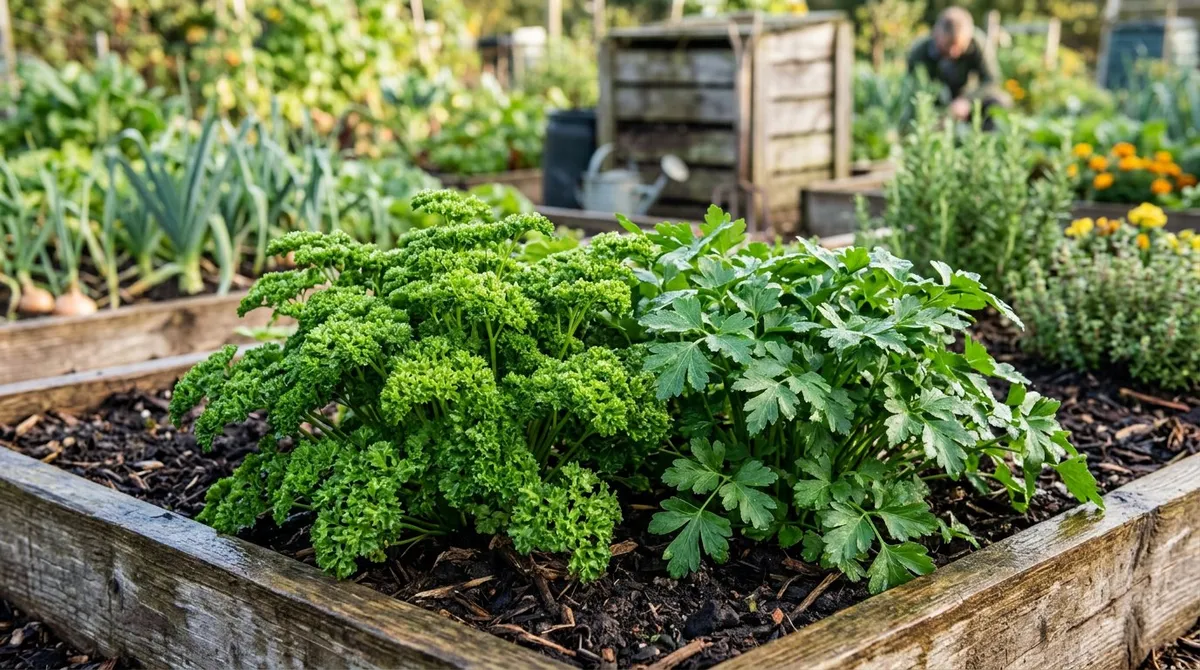
Flat-leaf parsley (also called Italian or French parsley) has broader, smoother leaves with a more intense, peppery flavour. It is the cook’s choice for sauces, pestos, tabbouleh, and anywhere parsley flavour needs to stand on its own. Italian Giant is the most popular flat-leaf variety in the UK.
Curly parsley has tightly ruffled leaves with a milder, slightly grassy taste. It holds its texture well in hot dishes and looks attractive as a garnish. Moss Curled remains the standard curly variety and has been grown in British gardens for centuries.
Here is how the main UK varieties compare:
| Variety | Type | Flavour | Height | Best for | Days to harvest |
|---|---|---|---|---|---|
| Italian Giant | Flat-leaf | Strong, peppery | 40-50cm | Cooking, salads, pesto | 70-80 |
| Moss Curled | Curly | Mild, grassy | 25-35cm | Garnish, soups, freezing | 70-80 |
| French | Flat-leaf | Delicate, aromatic | 30-40cm | Fine dining, sauces | 75-85 |
| Hamburg (root) | Root parsley | Parsnip-like root | 30-40cm | Soups, roasting root | 90-100 |
| Envy | Curly | Mild, sweet | 20-30cm | Containers, garnish | 65-75 |
Hamburg parsley is worth a special mention. This variety produces an edible root similar to a small parsnip. The leaves are usable but coarser than standard flat-leaf. Grow it like carrots in deep, stone-free soil for the best roots.
Why we recommend Italian Giant flat-leaf for kitchen use: After 30 years of growing parsley in UK gardens, Italian Giant consistently delivers 40-60% more harvestable stem weight per plant than Moss Curled across a full season. Its broader, smoother leaves carry roughly twice the concentration of aromatic oils compared to curly varieties, which translates directly into noticeably stronger flavour in sauces and salads. It also recovers faster after cutting, producing new outer stems within 10-12 days rather than the 14-18 days typical of curly types.
Growing parsley in pots and containers
Parsley takes to container growing. It is one of the best herbs for patios, balconies, and windowsills. The one critical requirement is pot depth.
Parsley develops a long taproot that reaches 15-20cm in its first season. Shallow pots restrict this root, stunting growth and causing plants to bolt prematurely. Use containers at least 20cm deep with drainage holes. Terracotta and fabric pots both work well.
Fill with a 70:30 mix of peat-free multipurpose compost and perlite. This gives the moisture retention parsley prefers without the waterlogging it hates. Water when the top 2cm of compost feels dry. Unlike Mediterranean herbs such as rosemary and thyme, parsley likes consistently moist (not wet) soil.
Feed container-grown parsley with a balanced liquid fertiliser every two weeks from June to September. A half-strength seaweed feed works well. Our container vegetable gardening guide covers the full technique for growing edibles in pots.
Place containers where they receive 4-6 hours of sunlight daily. A spot that gets morning sun and afternoon shade is ideal in summer. Parsley actually prefers these conditions to the baking full sun that basil and other Mediterranean herbs demand.
Why parsley is slow to germinate
Understanding the biology behind parsley’s slow germination helps manage expectations. It also explains why the old tricks actually work.
Parsley seeds contain furanocoumarins in their seed coat. These chemical compounds inhibit germination until the seed has experienced enough moisture and warmth to signal that growing conditions are suitable. In the wild, this prevents autumn-shed seeds from sprouting before winter kills them.
The compounds are water-soluble. Soaking seeds in warm water for 12-24 hours dissolves a portion of them, which is why pre-soaking cuts germination time from 28 days to about 18-21 days. Pouring boiled water over the seed drill achieves a similar effect by raising soil temperature and dissolving inhibitors in the soil around the seed.
Another old gardener’s trick is to sow parsley in a pot of compost and place the pot on a warm surface such as a heated propagator mat or the top of a fridge. The consistent bottom heat of 20°C makes a genuine difference. Cold, wet soil is the worst combination for parsley germination.
One reliable method is to fold seeds inside a damp paper towel, seal it in a plastic bag, and keep it in a warm spot. Check every few days. Once tiny root tips appear, transfer the sprouted seeds to compost. This bypasses the uncertainty of waiting for seedlings to appear.
Caring for parsley through the season
Parsley is low-maintenance once established. A few straightforward tasks keep plants productive from June until the first hard frosts.
Watering and feeding
Keep soil consistently moist but never waterlogged. Parsley is more thirsty than most herbs. In hot, dry spells, water every 2-3 days. Mulching around outdoor plants with garden compost reduces evaporation and feeds the soil slowly.
Feed fortnightly with a balanced liquid fertiliser from June onwards. Parsley is a moderately hungry plant compared to woody herbs. The extra nitrogen keeps leaf production strong through summer.
Companion planting
Parsley grows well alongside tomatoes, chives, and carrots. It is said to attract hoverflies, whose larvae devour aphids. Avoid planting parsley near lettuce, as both compete for moisture and nutrients in the same root zone. Our companion planting guide covers beneficial plant combinations.
Winter protection
Parsley tolerates light frost down to about -5°C. Covering plants with fleece or cloches from November extends the harvest well into December. In mild winters, parsley grown against a south-facing wall may produce pickable leaves right through to spring.
Harvesting parsley the right way
How you pick parsley determines how long the plant keeps producing. The wrong technique can exhaust a plant in weeks. The right technique keeps it going for months.
Always harvest outer stems first. Cut each stem at the base, right at soil level. This encourages the plant to push new growth from the centre. Never shear the whole plant flat or strip leaves from the top only.
Leave at least a third of the foliage intact at any one time. The remaining leaves fuel root growth and energy storage. A plant stripped below this threshold takes 3-4 weeks to recover fully.
The best flavour comes from stems harvested in the morning, after the dew has dried but before the midday heat. Flat-leaf parsley is at its most aromatic just before any flower stems begin to form. Once flowering starts, leaf flavour turns bitter.
For preserving, parsley freezes better than it dries. Chop leaves finely, pack into ice cube trays, cover with a little water, and freeze. Drop cubes straight into soups, stews and sauces. Dried parsley retains colour but loses around 70% of its flavour.
Common parsley problems and solutions
Parsley is generally trouble-free, but a few issues appear regularly in UK gardens.
Bolting in the first year
If first-year parsley sends up flower stems, a cold spell likely triggered it. Temperatures below 5°C for several consecutive days can trick the plant into behaving as though it has survived a winter. Remove flower stems immediately. The plant may continue producing usable leaves, though flavour declines.
Carrot fly
Parsley belongs to the same family as carrots (Apiaceae), making it susceptible to carrot fly. The larvae tunnel into roots and stems, causing wilting and yellowing. Grow parsley in raised containers at least 45cm above ground level, as carrot fly stays low. Fine mesh barriers also work. The RHS carrot fly guide covers prevention in detail.
Yellowing leaves
Lower leaves yellowing and dying is normal as the plant matures. If upper leaves yellow, suspect overwatering, nutrient deficiency, or root rot. Check drainage first. If the compost is sodden, repot into drier mix and reduce watering. A fortnightly liquid feed corrects most nutrient issues.
Parsley is biennial, plan for it
This is the single most important fact new growers miss. Parsley is a biennial plant. It produces leaves in year one, then flowers, sets seed, and dies in year two. No amount of care prevents this. The plant’s biology demands it.
The practical solution is simple: sow fresh parsley every year. If you sow in both spring and late summer, you create an overlapping supply. The spring sowing gives you summer and autumn leaves. The late summer sowing, protected with cloches, provides winter and early spring pickings before the spring batch takes over.
Month-by-month parsley calendar
This calendar covers the full growing cycle for UK gardens. Adjust timings by 1-2 weeks in Scotland and northern England.
| Month | Task |
|---|---|
| March | Sow indoors in modules at 18-20°C. Soak seeds overnight before sowing. |
| April | Main outdoor sowing month. Sow in drills 1cm deep once soil passes 10°C. |
| May | Thin outdoor seedlings to 15cm. Transplant indoor-raised plants after hardening off. |
| June | Begin harvesting outer stems. Start fortnightly liquid feeding. Mulch around plants. |
| July | Harvest regularly. Water every 2-3 days in dry spells. Watch for carrot fly. |
| August | Sow a second batch for winter and early spring harvests. Continue picking outer leaves. |
| September | Protect late-sown plants with cloches if nights turn cold. Harvest and freeze surplus. |
| October | Cover established plants with fleece for continued picking. Reduce watering. |
| November | Harvest from protected plants. First-year plants tolerate light frost to -5°C. |
| December | Final harvests from cloched plants. Plan seed orders for spring. |
Growing parsley alongside other kitchen staples makes the most of your growing space. Our guides to growing herbs and raised bed gardening cover the broader picture of productive home growing.
Now you’ve mastered growing parsley from seed, read our guide on how to grow herbs in the UK for the next step in establishing a productive kitchen herb collection.
Frequently asked questions
Why is my parsley so slow to germinate?
Parsley seeds contain germination inhibitors in their hard outer coating. This is normal and not a sign of poor seed quality. Soaking seeds overnight in warm water softens the coat and washes away some inhibitors. Even with this trick, expect 14-21 days minimum at 15-20°C.
Can I grow parsley indoors on a windowsill?
Yes, parsley grows well on a bright windowsill year-round. Use a pot at least 20cm deep with drainage holes. Indoor plants need 4-5 hours of direct light daily. South or east-facing windows give the best results. Rotate the pot regularly to prevent lopsided growth.
What is the difference between flat-leaf and curly parsley?
Flat-leaf parsley has a stronger, more peppery flavour. Curly parsley tastes milder and holds its texture better in hot dishes. Most cooks prefer flat-leaf for sauces, salads and fresh use. Curly is the better choice for garnishing and freezing.
When should I sow parsley seeds in the UK?
Sow outdoors from April to June once soil reaches 10°C. Indoor sowings can start in March at 18-20°C. A second sowing in August under cloches gives winter harvests. Fresh seed gives the best germination rates.
Why has my parsley started flowering?
Flowering means the plant has entered its second-year cycle. Parsley is a biennial that produces leaves in year one and flowers in year two. Cold snaps can trigger early bolting in first-year plants. Remove flower stems promptly to extend leaf production.
How do I harvest parsley without killing the plant?
Always pick outer stems first, cutting at the base of the stem. Leave the central growing point and at least one-third of foliage intact. This allows continuous regeneration from the centre. Regular outer-stem picking keeps the plant productive for months.
Is parsley frost hardy?
Parsley tolerates light frost down to about -5°C. It is hardier than most common herbs. A fleece cover or cloche extends harvests through December in southern England. Container plants are more vulnerable and benefit from a sheltered position near a south-facing wall.
Lawrie has been gardening in the West Midlands for over 30 years. He grows his own veg using no-dig methods, keeps a wildlife-friendly garden, and writes practical advice based on real UK growing conditions.