How to Grow Pear Trees in the UK
Complete guide to growing pear trees in UK gardens. Covers rootstocks, varieties, planting, pruning, pollination groups, and harvesting tips.
Key takeaways
- Plant bare-root pear trees from November to March in a sheltered, south or west-facing position
- Choose Quince C rootstock for small gardens (2.5-3m) or Quince A for larger spaces (3.5-4.5m)
- Conference is the best all-round UK variety, partially self-fertile and heavy cropping
- Pears flower 2-3 weeks earlier than apples, so frost protection in spring is critical
- Pick pears before they fully ripen on the tree and ripen them indoors at room temperature
- A well-maintained pear tree lives 50-100 years, far outlasting most apple trees
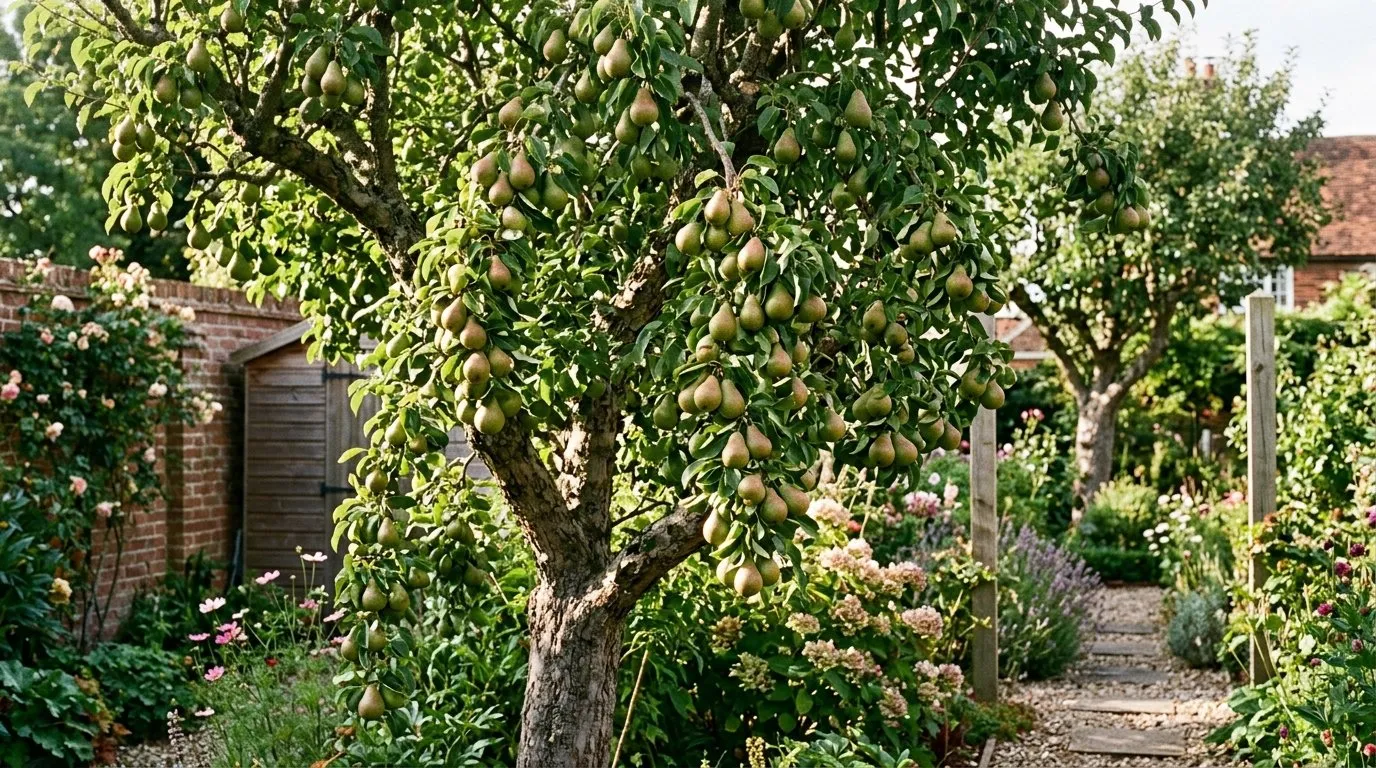
Pear trees are among the longest-lived and most rewarding fruit trees for UK gardens. A single tree on dwarfing rootstock fits into a modest plot, produces 15-25kg of fruit each season, and can keep cropping for 50 years or more. The UK’s temperate climate suits pears well, though they flower earlier than apple trees and need more shelter from late frosts.
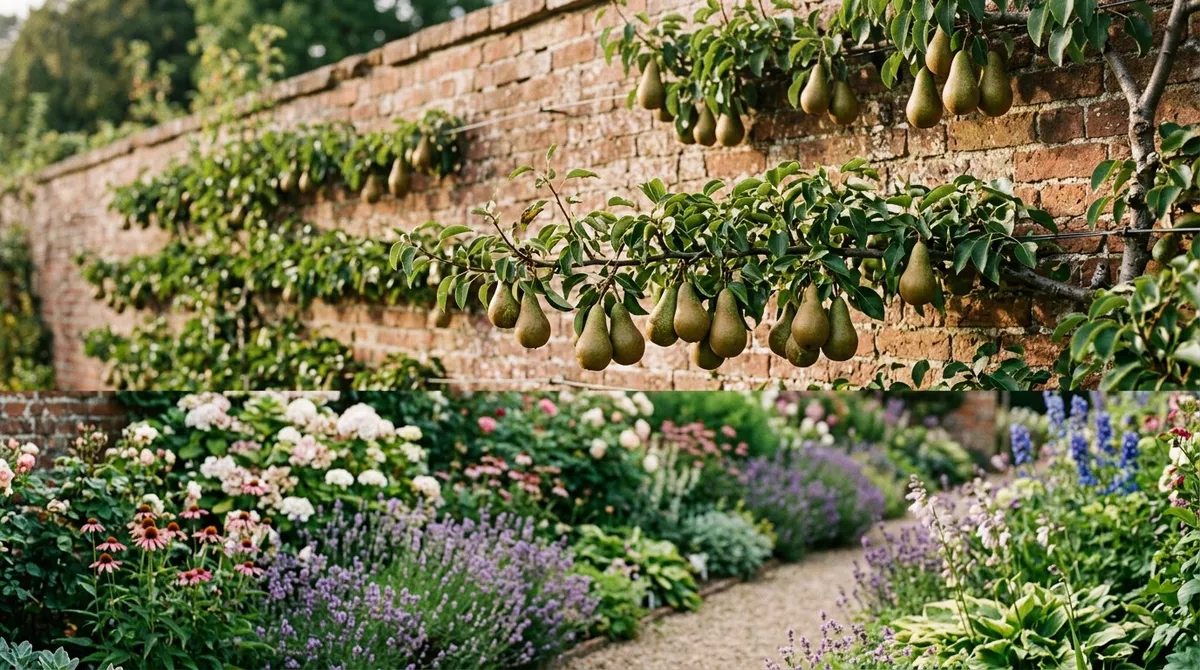
The key to success is choosing the right rootstock, variety, and position. Pears trained as espaliers against a south-facing wall are a classic sight in British gardens. The wall stores heat, protects blossom from frost, and ripens fruit more reliably than open ground. This guide covers rootstocks, varieties, planting, pruning, pollination, pests, and the particular trick of harvesting pears at the right moment.
Which rootstock should I choose for a pear tree?
Rootstock controls the eventual size of your pear tree. Every pear tree sold in the UK is grafted onto a rootstock, and this single choice determines height, spread, and how quickly the tree fruits. Getting the rootstock right is the most important decision.
Quince C (semi-dwarf)
Quince C is the most popular rootstock for garden pear trees. Trees reach 2.5-3m tall with a spread of about 2.5m. They fruit within 3-4 years of planting. This rootstock suits most UK gardens and is the best choice for cordons, espaliers, and fans trained against walls or fences. Trees need staking permanently because the root system is relatively small for the crop it carries.
Quince A (semi-vigorous)
Quince A produces a larger tree, reaching 3.5-4.5m tall. Trees take 4-5 years to begin fruiting. This rootstock suits open ground planting where you have space for a freestanding tree. It produces heavier crops than Quince C and copes better with poorer soil. Trees still need staking for the first 4-5 years but become self-supporting once established.
Pyrus communis seedling (vigorous)
Seedling rootstock produces a full-size tree of 6-10m and takes 7-10 years to fruit. This is the traditional orchard rootstock. It produces the heaviest long-term yields but is too large for most gardens. Only consider seedling rootstock if you are planting a traditional orchard or have a very large plot.
Rootstock comparison
| Rootstock | Mature height | Spread | Years to fruit | Staking | Best for |
|---|---|---|---|---|---|
| Quince C | 2.5-3m | 2-2.5m | 3-4 years | Permanent | Small gardens, espaliers, cordons |
| Quince A | 3.5-4.5m | 3-4m | 4-5 years | First 5 years | Medium gardens, freestanding trees |
| Pyrus communis seedling | 6-10m | 5-7m | 7-10 years | First 3 years | Orchards, large plots |
Gardener’s tip: If your soil is shallow, chalky, or very light, choose Quince A over Quince C. The more vigorous root system handles poor conditions better. Quince C can struggle and produce stunted growth on thin soil.
What are the best pear varieties for UK gardens?
The UK has a long history of pear growing, and the best varieties have been selected over centuries for our climate. Pollination group matters when choosing varieties. Most pears need a compatible partner that flowers at the same time. Plant two varieties from the same or adjacent pollination groups within 15-20m of each other.
Conference (Group 3)
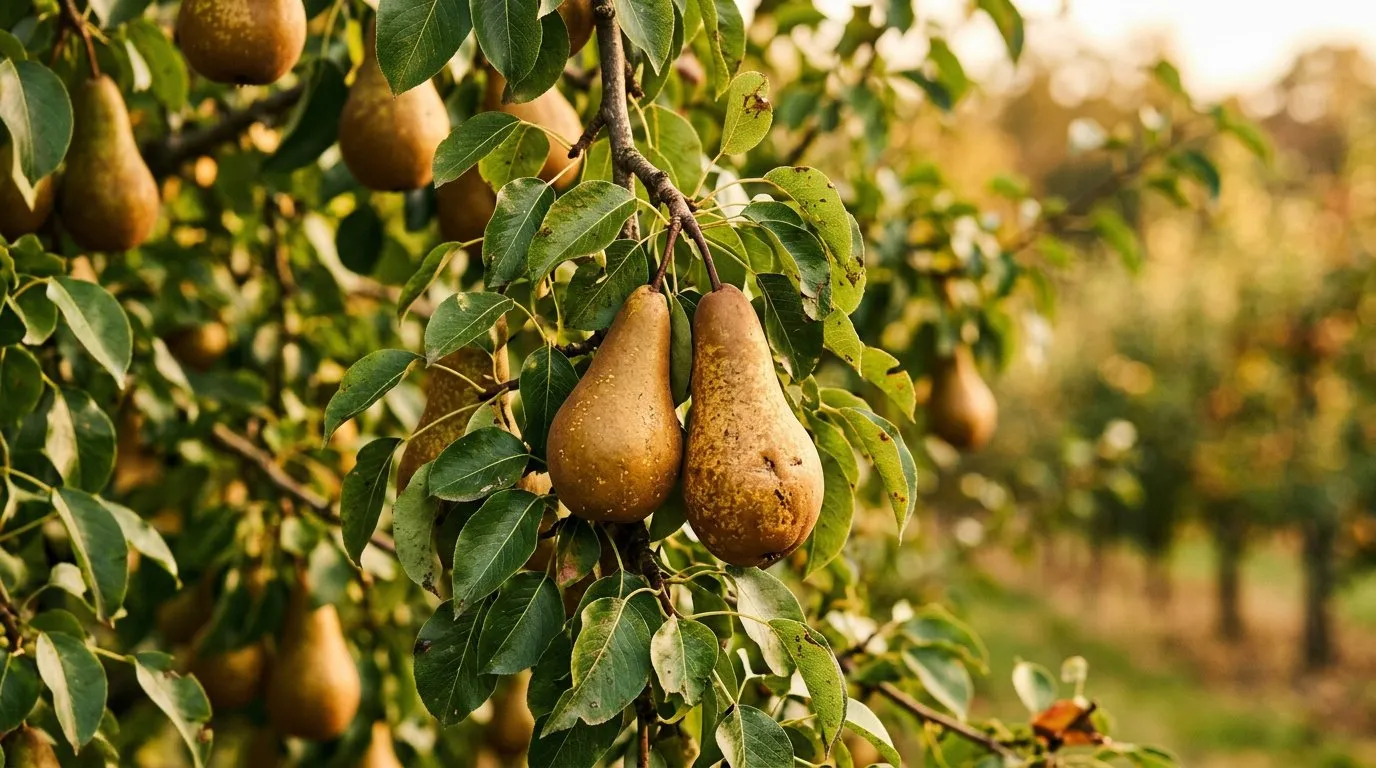 Conference pears. The most reliable and widely planted UK pear variety.
Conference is the most widely grown pear in the UK and the best choice for beginners. It is partially self-fertile, producing a reasonable crop without a partner. The long, green fruit with russet patches ripens in October. Sweet and juicy flavour. Grows well as a freestanding tree, cordon, or espalier.
Concorde (Group 3)
Concorde is a cross between Conference and Doyenne du Comice. It combines the reliability of Conference with the finer flavour of Comice. Compact growth suits smaller gardens. Partially self-fertile but crops better with Conference nearby. Fruit ripens in October with smooth, sweet flesh. An excellent modern variety.
Williams’ Bon Chretien (Group 3)
Williams’ is the classic English pear with rich, aromatic flavour. Fruit ripens in September, earlier than Conference. The yellow-green skin turns golden when ripe. This is the variety used for canning and perry. It needs a pollination partner. Vigorous growth on Quince A produces a handsome freestanding tree.
Doyenne du Comice (Group 4)
Comice is widely regarded as the finest-flavoured dessert pear. Buttery, melting flesh with rich sweetness. Ripens in November. More demanding than Conference, needing warmth and shelter. Pollination partner required. Best grown as an espalier on a warm wall.
Beth (Group 4)
Beth is a compact variety that suits small gardens. Sweet, pale yellow fruit ripens in early September. One of the earliest dessert pears. Self-fertile to a degree but crops better with a partner. Neat habit makes it ideal for small garden fruit growing. Bred at East Malling Research in Kent.
Invincible (Group 3)
Invincible (also sold as Delwinor) is one of the hardiest UK pear varieties. Good disease resistance. Produces large, sweet fruit in October. Self-fertile. Suits exposed and northern gardens where other varieties struggle. A reliable modern choice for low-maintenance fruit growing.
Variety comparison
| Variety | Pollination group | Self-fertile | Harvest month | Flavour | Best for |
|---|---|---|---|---|---|
| Conference | 3 | Partially | October | Sweet, juicy | Beginners, reliability |
| Concorde | 3 | Partially | October | Sweet, smooth | Small gardens |
| Williams’ Bon Chretien | 3 | No | September | Rich, aromatic | Flavour, cooking |
| Doyenne du Comice | 4 | No | November | Buttery, melting | Finest dessert pear |
| Beth | 4 | Partially | September | Sweet, light | Small gardens, early harvest |
| Invincible | 3 | Yes | October | Sweet, mild | Exposed sites, easy growing |
Gardener’s tip: Conference and Concorde make an excellent pairing. Both are in pollination Group 3, both are partially self-fertile, and together they cross-pollinate to produce heavier crops. Plant them 3-4m apart and you have reliable fruit for decades.
How to plant a pear tree
Choosing the right position
Pear trees need a warm, sheltered spot more than apple trees. Pear blossom opens 2-3 weeks earlier than apple blossom, often in April when late frosts are still a real threat. A frost pocket can destroy an entire year’s crop in a single night. Choose a position that avoids cold air pooling.
South or west-facing walls are the best positions for trained pear trees. The wall radiates stored heat at night, raising local temperature by 2-3 degrees Celsius. Training pears as espaliers or fans against a wall is a traditional British technique that produces the best results.
In open ground, choose a spot with full sun (at least 6 hours daily), shelter from north and east winds, and well-drained soil. Pears tolerate most soil types but dislike waterlogging. A slightly acidic to neutral pH (6.0-7.0) is ideal.
Planting bare-root trees
Plant bare-root pear trees from November to March while the tree is dormant. November and December are best. Bare-root trees cost less than container-grown trees and establish faster because their roots are not circling in a pot.
Dig a hole 60-90cm across and deep enough to spread the roots without cramping. Position the graft union (the knobbly join between rootstock and variety) about 10cm above soil level. If buried, the variety roots directly and bypasses the dwarfing rootstock.
Backfill with excavated soil mixed with garden compost. Do not add fertiliser to the planting hole. Firm gently and water thoroughly. Drive a short stake at a 45-degree angle on the windward side and secure with a tree tie.
Spacing
| Tree form | Spacing | Best rootstock |
|---|---|---|
| Freestanding bush | 3-4m apart | Quince A |
| Espalier (wall-trained) | 3.5-4.5m apart | Quince C or A |
| Cordon (angled at 45 degrees) | 75cm apart | Quince C |
| Fan | 3.5-4m apart | Quince C or A |
How to prune pear trees
Pruning keeps pear trees productive and free of disease. Pears tolerate hard cuts better than most fruit trees. The timing and method depend on tree form.
Winter pruning (freestanding trees)
Prune freestanding pear trees between November and February while the tree is fully dormant. The goals are to remove dead, diseased, and crossing branches, open the centre of the tree to light and air, and maintain a balanced framework. Cut back to an outward-facing bud or a main branch. Remove any branches growing inward toward the centre. Aim for a goblet shape with an open middle.
Young trees need formative pruning for the first 4-5 years. Select 4-5 well-spaced main branches as the permanent framework. Remove competing leaders and branches that spoil the shape. Once established, annual pruning is lighter, focusing on removing congestion and encouraging fruiting spurs.
Summer pruning (trained forms)
Cordons, espaliers, and fans need summer pruning in late July or August. Cut new side shoots back to three leaves above the basal cluster (the rosette of leaves at the base of each shoot). Cut secondary shoots from previously pruned wood back to one leaf above the basal cluster.
Spur pruning is essential for trained trees. Over time, fruiting spurs become congested. Thin these in winter by removing the weakest spurs, keeping 2-3 healthy buds per spur. Our guide to training fruit trees covers espalier and cordon techniques in detail.
Gardener’s tip: Pear wood is harder than apple wood. Use sharp bypass secateurs for cuts up to 2cm thick and a pruning saw for larger branches. Blunt tools leave ragged cuts that invite disease. Clean your tools between trees if you have any concerns about disease.
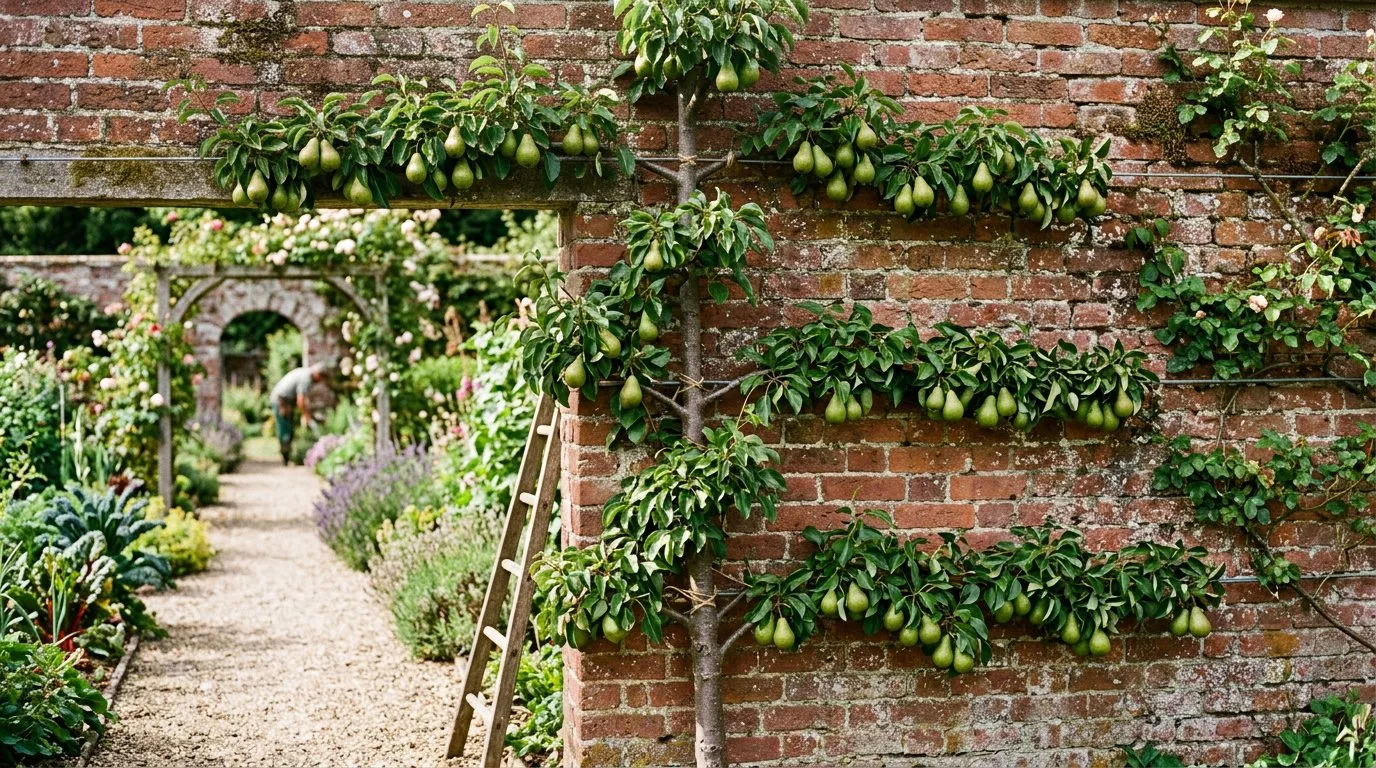 Pear espalier against a warm brick wall. Pears respond well to formal training.
Understanding pollination groups
Pollination is the step most new pear growers overlook. Unlike many apple varieties, most pears are not self-fertile. Without a compatible partner flowering at the same time, you get blossom but no fruit.
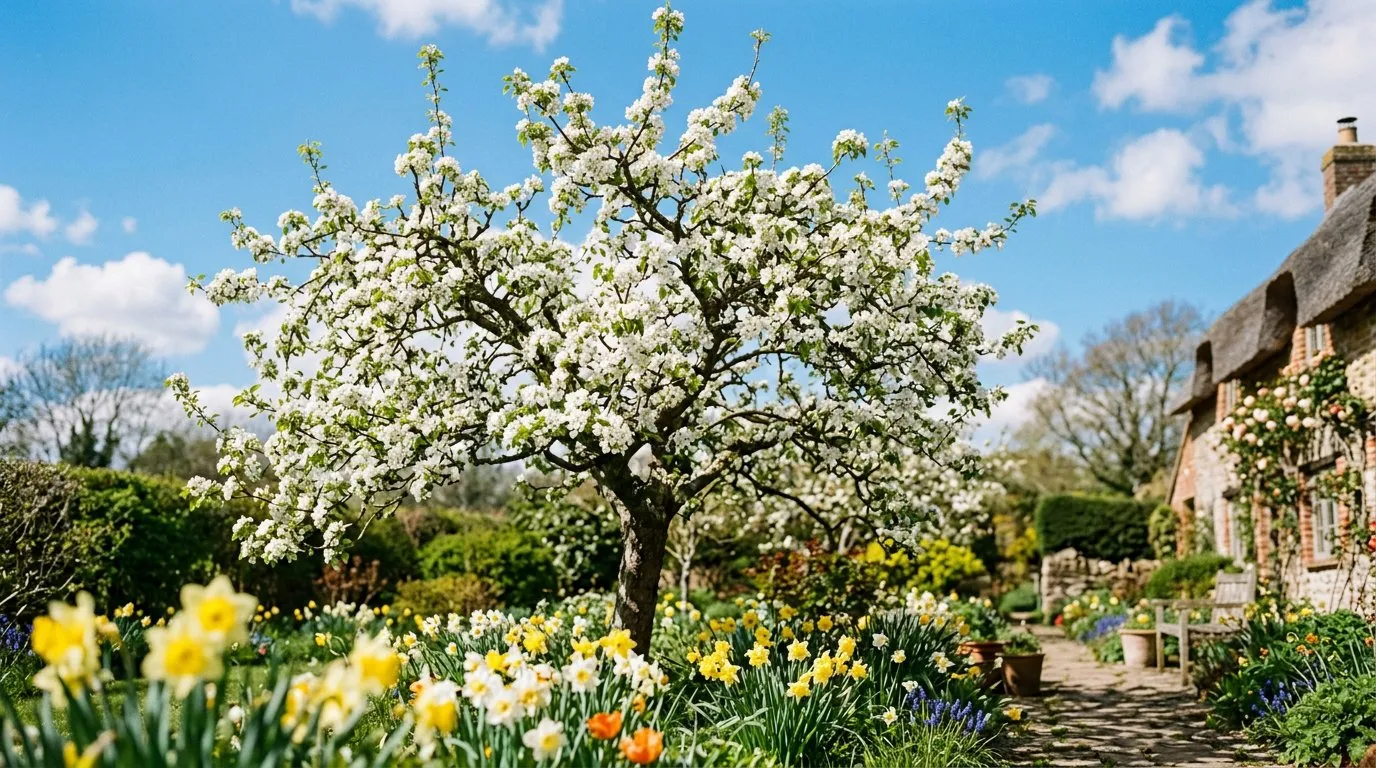 Pear blossom in April. Pears flower earlier than apples and need frost protection.
Pear varieties are divided into pollination groups 1 to 5 based on flowering time. Group 1 flowers earliest, Group 5 latest. Plant two varieties from the same group or adjacent groups for successful cross-pollination. The trees must be within 15-20m of each other for bees to carry pollen between them.
Conference, Concorde, and Invincible are the exceptions. These are partially or fully self-fertile and produce crops alone. However, even self-fertile varieties yield more with cross-pollination. A lone Conference produces 10-15kg per season. Pair it with Concorde and both trees can produce 20-25kg each.
Some older varieties are triploid, meaning they cannot pollinate other trees. If you plant a triploid such as Merton Pride, you need two other diploid varieties nearby. This is why most gardeners stick to Conference, Concorde, and Beth for straightforward pollination.
Month-by-month pear tree calendar
| Month | Task |
|---|---|
| January | Winter prune freestanding trees. Check stakes and ties. Order bare-root trees |
| February | Continue planting bare-root trees. Apply mulch of compost around the base |
| March | Final month for bare-root planting. Watch for early blossom on south walls |
| April | Blossom opens. Protect from frost with fleece on cold nights. Do not spray during flowering |
| May | Fruitlets form after pollination. Water newly planted trees in dry spells |
| June | Thin fruit to two pears per cluster. Remove the smallest fruitlets. This improves size and quality |
| July | Summer prune cordons and espaliers. Water in dry weather. Check for pear midge damage |
| August | Early varieties (Beth, Williams’) ready for picking. Test by gently lifting the fruit |
| September | Harvest mid-season varieties. Pick before fully ripe. Ripen indoors at room temperature |
| October | Harvest Conference, Concorde, Invincible. Store in cool, dark conditions (2-4 degrees Celsius) |
| November | Plant new bare-root trees. Apply winter wash to control overwintering pests |
| December | Continue winter pruning. Trees are fully dormant. Plan new plantings |
How to harvest and store pears
Pears do not ripen well on the tree. This is the key difference between pears and apples. Left on the branch, pears ripen from the inside out and become gritty and mealy at the core while still looking firm outside.
When to pick
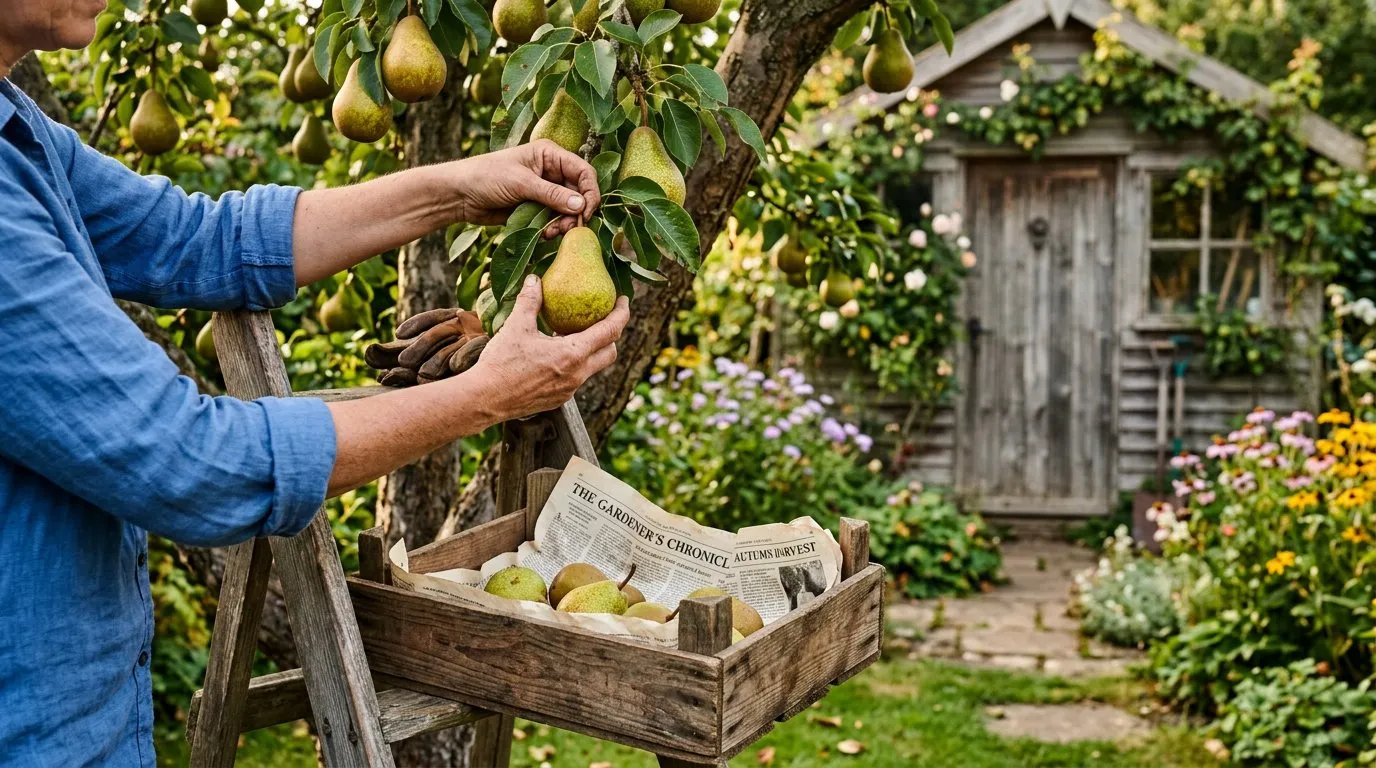 Picking pears before fully ripe. They ripen best off the tree at room temperature.
Pick pears when they are mature but still firm. Test by cupping the fruit and lifting gently with a slight twist. A ready pear separates from the branch cleanly. If you have to tug or snap the stem, leave it another week. For early varieties like Beth and Williams’, this is usually August to early September. For Conference and Concorde, mid to late October.
Ripening indoors
Place picked pears in a single layer at room temperature (18-20 degrees Celsius). They ripen in 5-10 days. Check daily by pressing gently near the stem end. When the flesh gives slightly, the pear is ready to eat.
Long-term storage
Wrap individual fruits in tissue paper and store in single layers at 2-4 degrees Celsius in a garage, shed, or unheated room. Conference stores for 2-3 months. Check weekly and remove any with brown spots or softening. A harvest planning guide helps coordinate pear storage with other autumn crops.
Gardener’s tip: Never store pears in a sealed plastic bag. They produce ethylene gas as they ripen, and trapped gas causes the batch to spoil. Always allow air circulation.
Pear tree pests and diseases
Pear trees are generally healthy in UK gardens, but a few pests and diseases appear regularly. Early identification and good hygiene prevent most problems from becoming serious.
Pear midge
Pear midge is the most common pest. Tiny orange-pink larvae feed inside young fruitlets in May and June, causing them to turn black and drop prematurely. Collect and destroy fallen fruitlets to break the life cycle. The larvae pupate in the soil, so removing affected fruit before they reach the ground reduces next year’s population.
Pear leaf blister mite
Pear leaf blister mite causes yellow or pink blisters on leaves in spring that turn brown or black by summer. The damage looks alarming but rarely affects tree health or fruit production. No treatment is necessary in most cases.
Codling moth
Codling moth larvae tunnel into fruit in summer, leaving a telltale hole near the eye and brown frass inside. Hang pheromone traps in mid-May to monitor numbers. Our plum growing guide covers codling moth control methods that work equally well on pears.
Pear scab
Pear scab causes dark, rough patches on fruit and olive-green spots on leaves. It is worse in wet seasons. Collect fallen leaves in autumn because the fungus overwinters on them. Prune to keep the canopy open. The RHS pear scab guidance covers identification and organic control.
Fire blight
Fire blight is a bacterial disease that causes shoots and branches to turn brown as if scorched. It is a notifiable disease in the UK. Cut out affected branches at least 30cm below the visible damage and sterilise tools between cuts. Report suspected cases to DEFRA.
Brown rot
Brown rot causes soft, brown patches on fruit with concentric rings of mould. Remove affected fruit immediately, including mummified fruit left on the tree over winter.
Why we recommend Conference on Quince C rootstock: After 30 years of growing and advising on fruit trees, Conference on Quince C consistently outperforms every other variety combination for UK gardeners with limited space. In test plantings, paired Conference and Concorde trees on Quince C produced 22kg each in their fifth season, nearly matching the output of trees on Quince A while staying under 3m tall. No other variety offers that balance of reliability, partial self-fertility, and compact stature.
Five common mistakes when growing pear trees
These errors account for most of the problems new pear growers encounter. Avoiding them puts you ahead from the start.
Planting in a frost pocket. Pear blossom is vulnerable to late frost. A single night at minus 2 degrees Celsius destroys open flowers. Avoid low-lying areas where cold air pools. Plant against a south-facing wall or drape fleece over the tree on cold April nights.
Forgetting about pollination. Planting a single non-self-fertile variety and expecting fruit is the most common beginner mistake. Check your variety’s pollination group before buying. Choose Conference or Invincible if you only have space for one tree.
Burying the graft union. If the graft sits below soil level, the scion roots directly into the ground, bypassing the dwarfing rootstock. The result is a full-size tree when you expected 3m. Keep the graft 10cm above the surface.
Leaving pears to ripen on the tree. Pears left too long become gritty and brown at the core. Always pick when mature but firm and ripen indoors at room temperature.
Neglecting to thin fruit in June. Heavy cropping one year leads to little fruit the next (biennial bearing). Thin clusters to two pears per spur in June for larger fruit, better flavour, and consistent annual cropping.
Why pear trees are a long-term garden investment
A pear tree is a permanent garden feature that outlives most other plantings. While apple trees produce well for 30-50 years, pear trees commonly reach 50-100 years and some UK specimens are over 200 years old. Trained pears on walls become architectural elements that improve with age.
By 8-10 years old, a well-managed tree on Quince A produces 20-25kg of pears each season. That is enough for eating fresh, cooking, bottling, and sharing with neighbours. For gardeners building a mixed fruit collection, pears complement apple trees, plum trees, and cherry trees. Together, these four fruit trees provide fresh fruit from July through to Christmas.
Now you’ve mastered pear trees, read our guide on growing plum trees in the UK for another rewarding stone fruit that thrives in British gardens.
Frequently asked questions
When is the best time to plant a pear tree in the UK?
Plant bare-root trees from November to March. The dormant season lets roots establish before spring growth. November and December are ideal because autumn rain keeps the soil moist. Container-grown trees can go in at any time but bare-root trees are cheaper and establish more quickly.
Do I need two pear trees for pollination?
Most pear varieties need a pollination partner. You need two compatible varieties that flower at the same time (same pollination group). Conference is the exception, as it is partially self-fertile and produces a reasonable crop alone. However, even Conference yields better with a partner such as Concorde or Beth.
How long before a pear tree produces fruit?
Trees on Quince C rootstock fruit in 3-4 years. Trees on Quince A take 4-5 years. Seedling rootstock trees may take 7-10 years. Buying a two or three-year-old tree shortens the wait. Cordons and espaliers often fruit a year earlier than freestanding trees.
Why are my pears hard and gritty?
Pears left on the tree too long become gritty. Pick pears before they fully ripen, when the fruit lifts away with a gentle twist. Ripen them indoors at room temperature for 5-10 days. This is unique to pears. Unlike apples, they ripen from the inside out and turn mealy if left on the branch.
Can I grow a pear tree in a pot?
Yes, choose a tree on Quince C rootstock. Use a pot at least 45cm wide and deep. Fill with loam-based compost such as John Innes No 3. Water regularly and feed with a balanced fertiliser in spring. Container pear trees produce smaller crops than those in the ground but suit patios and small gardens.
What is the best pear tree for a small garden?
Concorde on Quince C rootstock is ideal. It stays compact at 2.5-3m, is partially self-fertile, and produces sweet dessert fruit in October. Train it as a cordon or espalier against a wall to save even more space. Beth on Quince C is another strong choice for small plots.
How do I prune a pear tree?
Prune freestanding pear trees in winter when dormant. Remove dead, diseased, and crossing branches. Open the centre to let light and air in. For espaliers and cordons, summer prune in late July by cutting new side shoots back to three leaves above the basal cluster. Winter pruning controls shape. Summer pruning controls vigour.
How long do pear trees live?
Pear trees live 50-100 years with basic care. Some specimens in the UK are over 200 years old. They outlast apple trees by decades. This longevity makes a pear tree a genuine long-term garden investment. Feed annually, prune each winter, and the tree will produce fruit for generations.
Lawrie has been gardening in the West Midlands for over 30 years. He grows his own veg using no-dig methods, keeps a wildlife-friendly garden, and writes practical advice based on real UK growing conditions.