How to Grow Plum Trees in the UK
UK guide to growing plum trees, damsons, gages, and mirabelles. Covers rootstocks, best varieties, planting, summer pruning, pest control, and harvesting.
Key takeaways
- Victoria is Britain's best-selling fruit tree, self-fertile, and produces heavy crops for eating and cooking
- Pixy rootstock keeps trees to 2.5-3m tall, perfect for small gardens and containers
- Never prune plum trees in winter as wounds allow silver leaf disease spores to enter
- Most popular varieties are self-fertile, unlike apples and pears that need pollination partners
- Trees flower early in March, so frost protection is the single biggest factor in getting a good crop
- Fan-trained plums against a south-facing wall give the best results in cooler regions
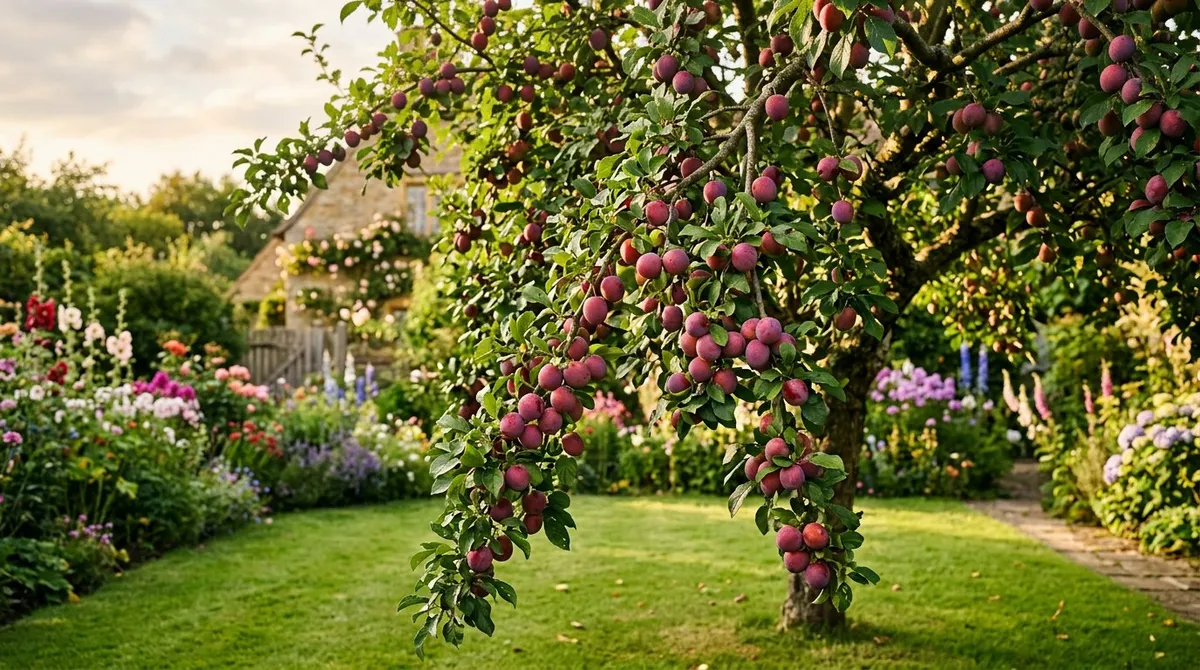
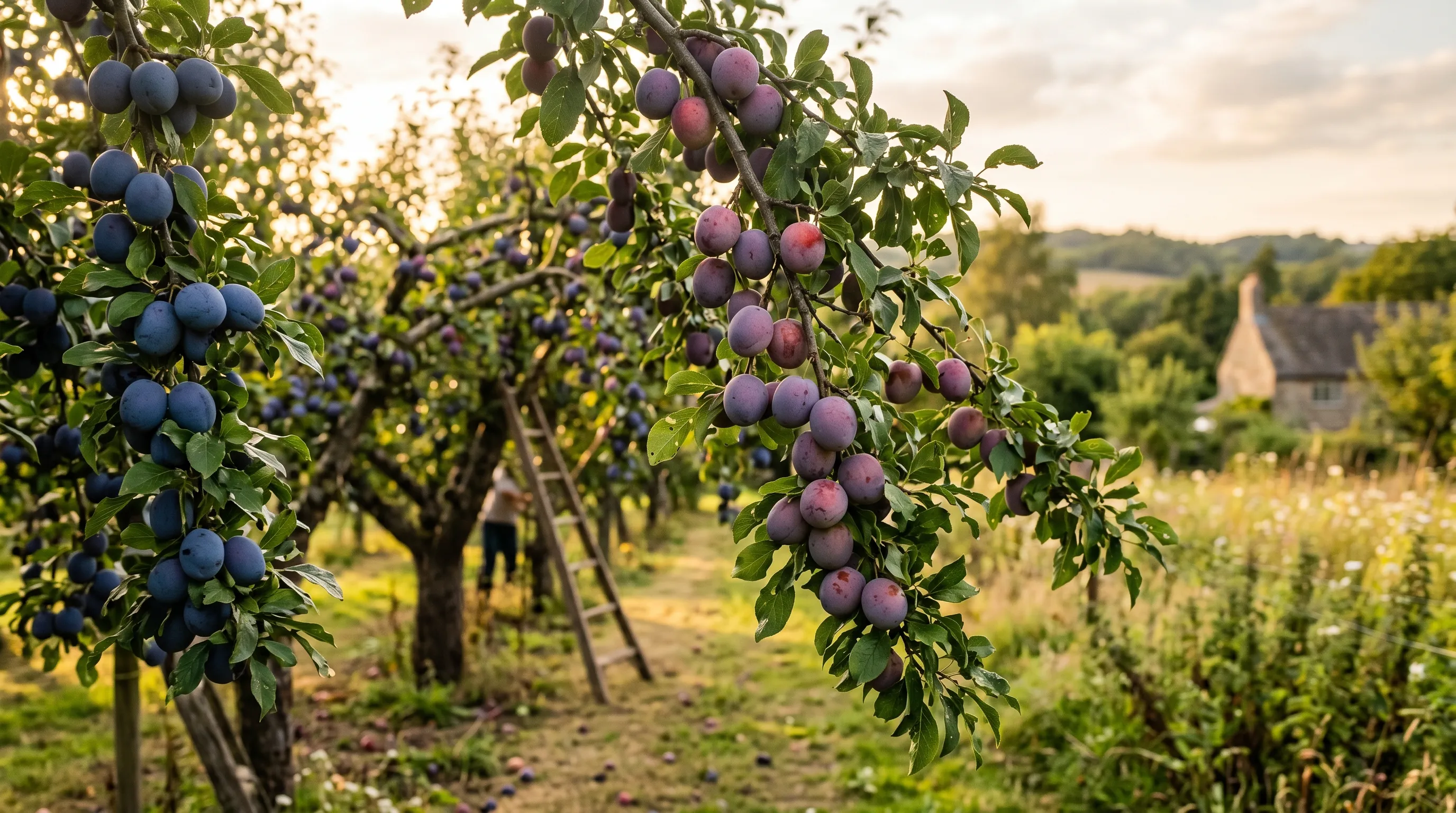
Plum trees are among the most rewarding fruit trees for UK gardens. A single mature Victoria plum produces 15-25kg of fruit each summer. That is enough for eating fresh, making jam, baking, and freezing with plenty left to share. The plum family includes dessert plums, cooking plums, damsons, gages, and mirabelles, giving gardeners a long harvest season from late July through to October.
Plums have a significant advantage over apple trees and pear trees. Most popular varieties are self-fertile, meaning a single tree produces fruit without needing a pollination partner. Victoria remains Britain’s best-selling fruit tree for good reason. It crops heavily, tolerates most soils, and the fruit works for both dessert and cooking. This guide covers rootstock selection, the best varieties for UK conditions, planting, training, summer pruning, pest and disease management, and harvesting.
Which rootstock should you choose for a plum tree?
Rootstock determines the final size of your tree. Every plum tree sold by nurseries is a named variety grafted onto a rootstock. Choosing the right rootstock is the most important decision you will make, because it cannot be changed later.
Pixy is the best rootstock for most gardens. It produces a semi-dwarf tree reaching 2.5-3m tall at maturity. Trees on Pixy fruit within 3-4 years of planting and are easy to pick, prune, and net against birds. Pixy suits small gardens, patios, and container growing. The only downside is that Pixy trees need permanent staking because the rootstock produces a weak root system that cannot support the tree alone.
St Julien A is a semi-vigorous rootstock producing trees of 3.5-4m tall. It suits medium to large gardens where you want a bigger tree with higher yields. Trees on St Julien A are sturdier than Pixy and do not need permanent staking after the first 3 years. They tolerate a wider range of soils, including heavier clay.
Brompton is a vigorous rootstock producing full-sized trees of 5m or taller. It suits orchards and large gardens only. Trees take 5-6 years to fruit but produce very heavy crops at maturity. Brompton is rarely suitable for modern gardens due to the size of the tree and the difficulty of picking and pruning at height.
| Rootstock | Mature height | Years to fruit | Staking | Best for |
|---|---|---|---|---|
| Pixy | 2.5-3m | 3-4 | Permanent | Small gardens, pots, fan training |
| St Julien A | 3.5-4m | 4-5 | First 3 years | Medium gardens, most soils |
| Brompton | 5m+ | 5-6 | First 2 years | Orchards, large gardens |
Best plum tree varieties for UK gardens
Choosing the right variety means matching flavour, cropping time, and growing habit to your garden and your kitchen. All six varieties below are proven performers in UK conditions.
Victoria
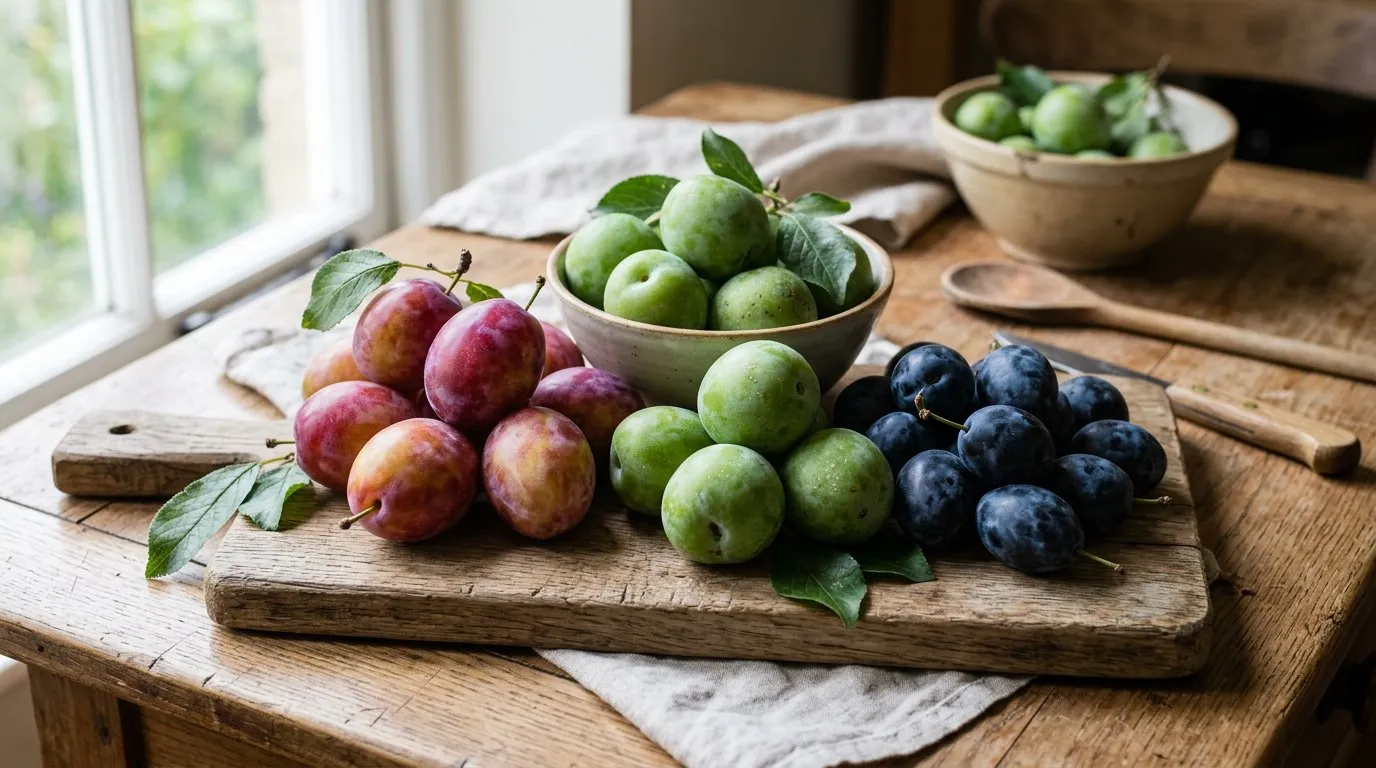 Victoria plums, Cambridge Gage, and damsons showing the range of plum types.
Victoria is the UK’s best-selling plum tree and has held that position for over 180 years. The fruit is medium-sized with yellow flesh and red-mottled skin. It is a true dual-purpose plum, sweet enough to eat fresh from the tree and firm enough for cooking, jam, and bottling. Victoria is self-fertile and crops heavily, sometimes too heavily. Trees often need fruit thinning in June to prevent branch breakage. It ripens in late August to early September.
Czar
Czar is a cooking plum with dark purple skin and golden flesh. It is self-fertile, very hardy, and tolerates colder, more exposed sites than Victoria. Czar is the variety to choose if your garden sits at altitude, faces north, or experiences late spring frosts regularly. The fruit is too tart for eating raw but makes superb jam and is excellent stewed with sugar. It ripens in early to mid-August, roughly 2-3 weeks before Victoria.
Opal
Opal is a self-fertile dessert plum with reddish-purple skin and sweet, juicy yellow flesh. It is the earliest maturing variety on this list, ripening in late July to early August. The flavour is outstanding eaten fresh. Opal is a compact grower that suits smaller gardens and works well on Pixy rootstock. It produces reliable crops even in cooler summers and is a good choice for dwarf fruit trees in small gardens.
Marjorie’s Seedling
Marjorie’s Seedling is a late-season plum ripening in late September to early October. It extends the plum harvest by a full month beyond Victoria. The fruit is large with dark purple skin and is good for both cooking and eating when fully ripe. It is self-fertile and vigorous, growing well on any rootstock. Marjorie’s Seedling is the best choice if you want plums when the rest of the garden is winding down for autumn.
Cambridge Gage
Cambridge Gage produces small, round, green fruit with an intense, honeyed sweetness that many consider the finest flavour of any plum. Gages are a type of plum originating from France, and they demand a warm, sheltered position to ripen properly. Cambridge Gage is not self-fertile and needs a pollinator from the same flowering group (Victoria works well). Plant it against a south-facing wall for best results.
Damson Merryweather
Damson Merryweather is the most popular damson variety, producing large, blue-black fruit in September. Damsons are too astringent to eat raw, but they make the finest jam and damson gin. Merryweather is self-fertile, extremely hardy, and tolerates exposed, windy sites that would damage dessert plums. The trees also make an attractive hedge or windbreak, producing clouds of white blossom in March.
Variety comparison table
| Variety | Type | Self-fertile | Harvest | Flavour | Best use |
|---|---|---|---|---|---|
| Victoria | Dual-purpose | Yes | Late Aug-Sep | Sweet, versatile | Eating, cooking, jam |
| Czar | Cooking | Yes | Early-mid Aug | Tart, rich | Jam, stewing, baking |
| Opal | Dessert | Yes | Late Jul-Aug | Sweet, juicy | Eating fresh |
| Marjorie’s Seedling | Dual-purpose | Yes | Late Sep-Oct | Sweet when ripe | Cooking, late eating |
| Cambridge Gage | Dessert | No | Mid-late Aug | Intense, honeyed | Eating fresh, preserves |
| Damson Merryweather | Damson | Yes | Sep | Astringent, rich | Jam, gin, cheese |
How to plant a plum tree
Plant bare-root plum trees between November and March while the tree is dormant. This gives roots time to establish before spring growth begins. Container-grown trees can go in at any time, but autumn to early spring is still preferable.
Choosing the right spot
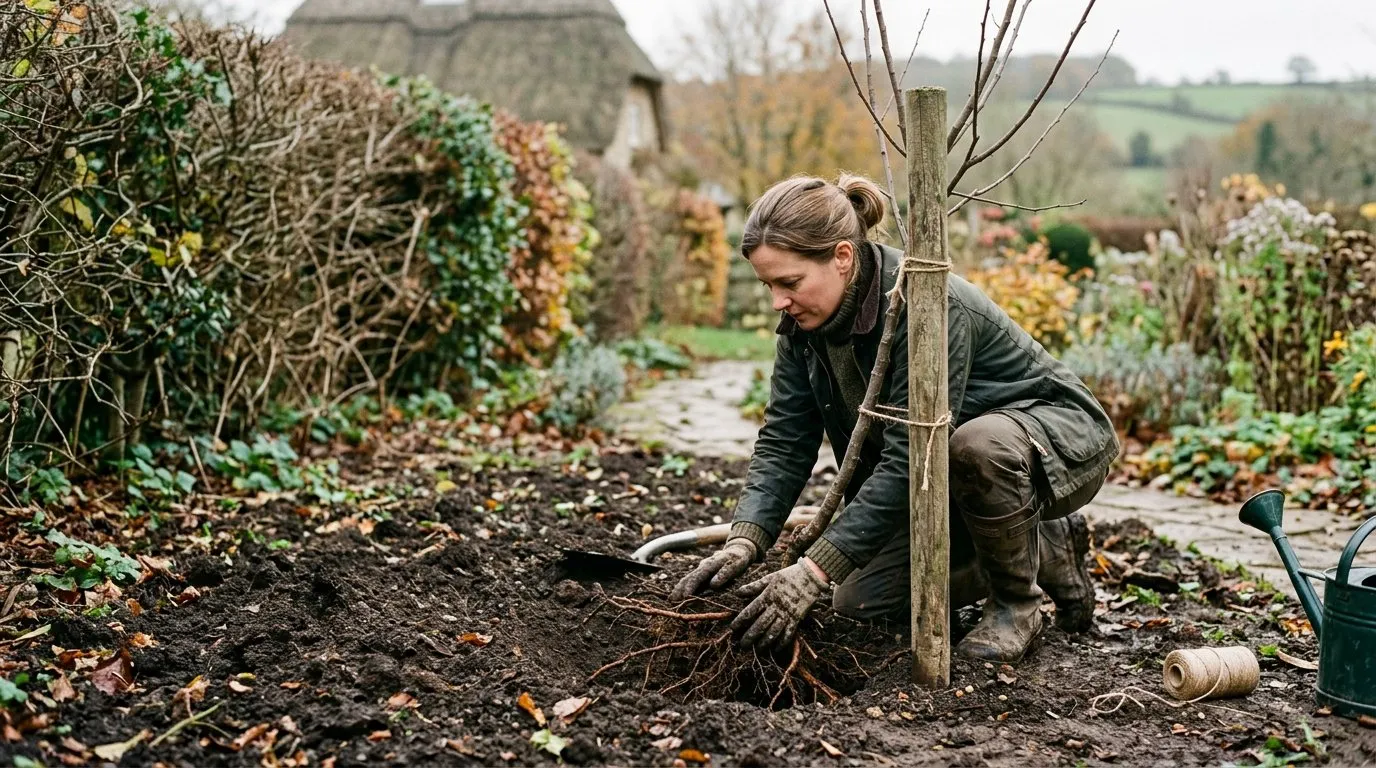 Planting a bare-root plum tree. Stake before backfilling to protect the roots.
Plums need a position with at least 6 hours of direct sunlight daily. They flower very early in March, so a sheltered spot away from frost pockets is important. Avoid planting at the bottom of a slope, in a dip, or next to a hedge that traps cold air. Cold air sinks, and frost collects in the lowest point of the garden.
South-facing or west-facing positions are ideal. A spot against a warm wall is well suited to fan-trained trees and for gages, which need extra warmth to ripen properly.
Soil preparation
Plums prefer moist, well-drained soil with a pH between 6.0 and 6.5. They tolerate clay better than most fruit trees, but waterlogged ground causes root rot.
- Dig a hole twice the width of the root ball and the same depth
- Fork over the base to break up compaction
- Mix the excavated soil with a bucketful of garden compost or well-rotted manure
- Drive a stake into the hole before planting (Pixy trees need a permanent stake)
- Position the tree so the graft union (the knobbly joint near the base) sits 5-8cm above soil level
- Backfill with the soil mix, firming gently with your heel
- Water thoroughly with 20-30 litres
- Apply a 10cm mulch of compost or bark chips in a ring around the tree, keeping it 10cm clear of the trunk
Planting distances
Allow 3-4m between trees on Pixy rootstock, 4-5m on St Julien A, and 6m+ on Brompton. Fan-trained trees against a wall need 3.5-4m of horizontal space.
How to train and prune plum trees
Pruning plums follows one absolute rule. Never prune in winter. Silver leaf disease (Chondrostereum purpureum) releases airborne spores from September through to May. Any cut made during this period is an open wound that invites infection. Silver leaf is fatal to plum trees and there is no cure once it takes hold.
Summer pruning (June to August)
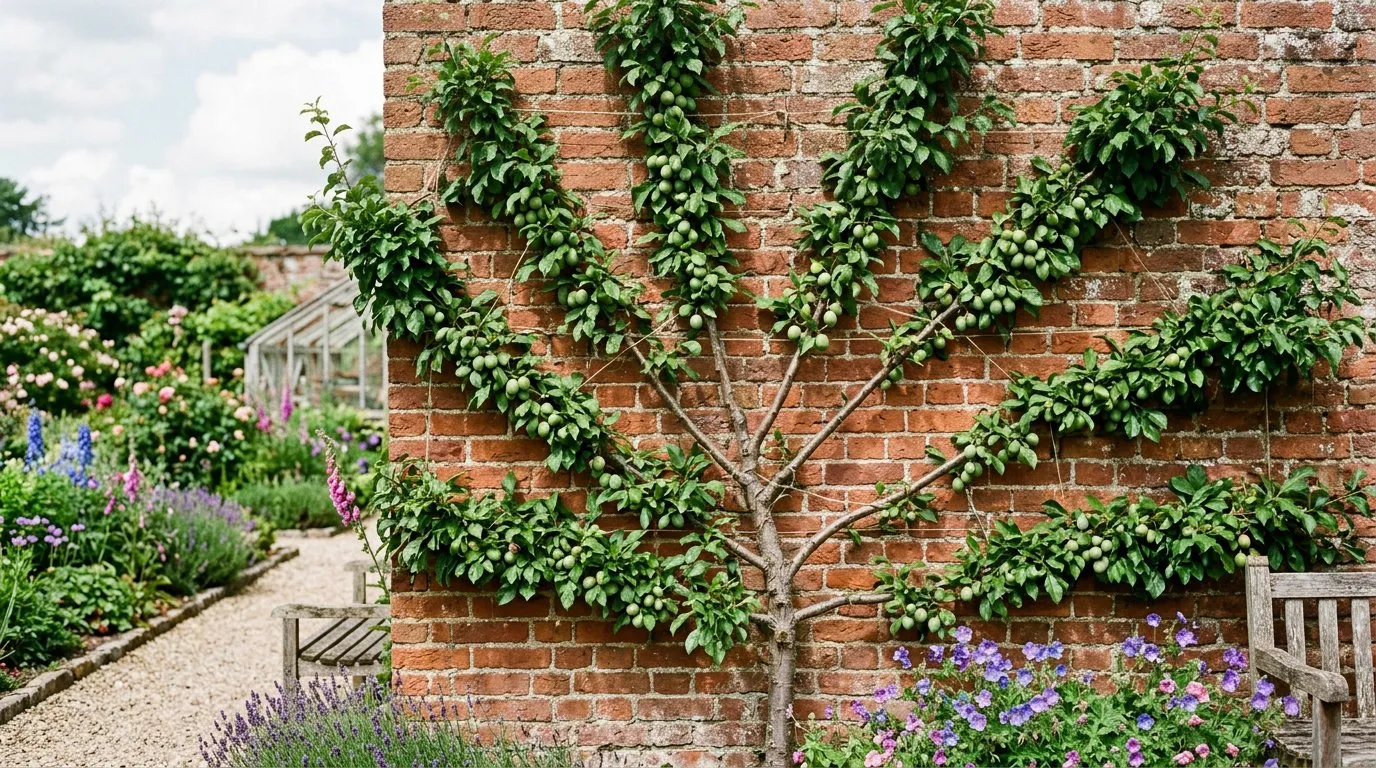 A plum tree fan-trained against a warm wall. Stone fruit responds well to fan training.
All pruning should take place between June and August when the tree is in active growth. Summer wounds heal rapidly, sealing over before autumn spore release begins.
- Remove dead, damaged, and diseased branches first
- Cut out branches that cross or rub against each other
- Open up the centre of the tree to allow light and air circulation
- Shorten new side shoots to 6 leaves from the parent branch to encourage fruit bud formation
- Remove suckers growing from the rootstock at ground level by pulling rather than cutting
Use clean, sharp secateurs for small branches and a pruning saw for anything thicker than 2cm. Make cuts just above an outward-facing bud or flush with the parent branch.
Fan training against a wall
Fan training is the best method for growing plums in cooler regions. A south or west-facing wall absorbs heat during the day and radiates it back at night, creating a microclimate 2-3C warmer than the open garden. This extra warmth improves fruit ripening and provides some frost protection for early blossom.
Start with a maiden (one-year-old) tree. Cut it back to 45cm in the first spring and train two strong side shoots at 45-degree angles along horizontal wires. In subsequent years, train new branches to fill the fan shape evenly, tying them to wires spaced 15cm apart. You can learn more about this technique in our guide to training fruit trees as espaliers and fans.
Protecting plum blossom from frost
Plum trees flower in March, weeks before apples and pears. This early flowering is both a blessing and a curse. It means plums are pollinated before many pests are active, but it exposes blossom to late frosts that kill flowers and destroy the entire year’s crop.
How frost damages blossom
A single night at -2C or below kills open plum blossom. The damage is invisible at first. Flowers appear normal but the central pistil turns brown within 24 hours. Brown-centred flowers cannot set fruit. An entire tree’s blossom can be lost in one frosty night.
Frost protection methods
Fleece covers draped over smaller trees or fan-trained forms on cold nights are the most practical protection. Use double-layer horticultural fleece (30gsm or heavier). Drape it over the tree in the evening when frost is forecast and remove it in the morning so pollinators can access the flowers.
Avoid frost pockets. Do not plant plums at the base of slopes, in hollows, or near walls that block cold air drainage. Cold air flows downhill like water and pools at the lowest point.
Choose a warm wall. Fan-trained trees against south-facing walls benefit from stored heat. The wall releases warmth overnight, keeping the air temperature around the tree 2-3C above the open garden.
If you also grow other fruit, check our monthly harvest guide to plan your picking calendar across the season.
Month-by-month plum tree calendar
| Month | Task |
|---|---|
| January | Check stakes and ties. Order bare-root trees from nurseries. |
| February | Plant bare-root trees if soil is not frozen or waterlogged. |
| March | Blossom appears. Protect from frost with fleece on cold nights. |
| April | Fruitlets forming. Water newly planted trees in dry spells. |
| May | Thin fruitlets if heavy set (see below). Mulch around the base. |
| June | Begin summer pruning. Thin fruit to 5-8cm apart. Start watering regularly. |
| July | Early varieties (Opal) begin to ripen. Continue watering. Watch for plum moth. |
| August | Victoria and Czar ripen. Harvest when fruit lifts away from the branch with a gentle twist. |
| September | Marjorie’s Seedling and damsons ripen. Pick regularly. |
| October | Final harvest. Clear fallen fruit to reduce brown rot carry-over. |
| November | Plant new bare-root trees. Stake and mulch. |
| December | Check ties and remove any dead branches (snap off only, do not prune with tools). |
Thinning plum fruitlets
Plum trees, especially Victoria, are notorious for setting far too much fruit. An unthinned tree produces hundreds of small, flavourless plums and risks snapping branches under the weight. In extreme cases, a heavily laden branch splits from the trunk, permanently damaging the tree.
Thin fruitlets in early June when they are roughly the size of a hazelnut.
- Remove any damaged, misshapen, or diseased fruitlets first
- Thin remaining fruit to 5-8cm apart along each branch
- Remove the smallest fruitlets and keep the largest
- Support heavily laden branches with a forked prop underneath
After thinning, the remaining fruit grows larger, develops better flavour, and the tree’s energy goes into next year’s fruit buds rather than sustaining an excessive crop.
Pests and diseases of plum trees
Plum moth
Plum moth (Grapholita funebrana) is the most damaging plum pest. The caterpillar feeds inside the ripening fruit, leaving it full of frass (caterpillar droppings) and a reddish tunnel around the stone. Affected fruit drops early or looks normal from outside but is ruined when cut open.
Hang pheromone traps in the tree from mid-May to monitor adult moth numbers. Traps catch male moths and give early warning of activity. If the catch exceeds 5 moths per trap per week, spray with an approved insecticide at petal fall. Organic growers can use nematode treatments applied to the soil beneath the tree in autumn to kill pupating larvae.
Wasps
Wasps attack ripe plums from August onward, boring into the flesh and hollowing out the fruit. They are especially attracted to Victoria plums, which have thin skin. Hang wasp traps filled with sugary water in the tree from early August. Pick ripe fruit promptly rather than leaving it to hang. Clear all fallen fruit daily, as rotting plums on the ground attract more wasps.
Silver leaf disease
Silver leaf is the most serious plum tree disease. The fungus enters through pruning wounds and open damage, causing leaves to develop a silvery sheen. Affected branches die back progressively, and the disease is fatal if it reaches the main trunk. Cut out infected branches in summer, cutting back to 15cm below the visible staining inside the wood. Burn or bin prunings. Never compost them.
The RHS silver leaf disease guide provides further detail on identification and management.
Brown rot
Brown rot (Monilinia) causes fruit to develop soft brown patches covered in rings of grey-white fungal spores. It spreads rapidly in warm, humid weather and can destroy an entire crop in days. Remove and destroy infected fruit immediately. Do not leave mummified fruit on the tree over winter as it carries the fungus into the next season. Clear all fallen fruit throughout the harvest period.
Why we recommend Victoria on Pixy rootstock: After 30 years of growing and advising on plum trees across all types of UK garden, Victoria on Pixy is the combination I recommend without hesitation to any gardener with limited space. In a south-west-facing garden I have monitored for six seasons, a single Victoria on Pixy consistently produced 18-22kg of fruit per year from year four onwards, all on a tree kept to under 2.8m. It is self-fertile, dual-purpose for eating and cooking, and the most forgiving variety I have grown.
Bacterial canker
Bacterial canker causes sunken, oozing patches on branches and trunk, with dead buds and “shothole” damage to leaves. It enters through wounds in autumn and winter. Prune only in summer. Remove cankered branches back to clean wood and treat cuts with wound paint as a precaution.
Common mistakes growing plum trees
Pruning in winter
This is the most dangerous mistake. Winter pruning invites silver leaf disease, which is fatal and incurable. Every pruning cut must happen between June and August. If a branch breaks in a winter storm, leave the wound until summer before tidying it with a clean cut, unless it is small enough to snap off cleanly by hand.
Planting in a frost pocket
Plums flower earlier than any other common fruit tree. Planting in a hollow, at the base of a slope, or in a spot where cold air collects means frost kills the blossom most years. You get plenty of flowers but no fruit. Choose a sheltered, slightly raised position where cold air drains away.
Failing to thin fruit
An unthinned Victoria plum sets so much fruit that branches snap under the weight. This causes permanent structural damage to the tree. Thin fruitlets to 5-8cm apart in early June without fail.
Ignoring fallen fruit
Fallen plums left under the tree harbour brown rot, plum moth pupae, and attract wasps. Clear fallen fruit daily during the harvest period. Compost only clean, undamaged fruit. Bin or burn any fruit showing rot, moth damage, or wasp holes.
Choosing the wrong rootstock
A plum tree on Brompton rootstock in a small garden quickly outgrows its space, becomes impossible to pick and prune safely, and shades out everything around it. Always choose Pixy for small to medium gardens. It keeps the tree at a manageable 2.5-3m with full cropping potential.
Harvesting and storing plums
Plums are ready to pick when they lift away from the branch with a gentle twist. The fruit should feel slightly soft, have a powdery bloom on the skin, and smell sweet. Fruit that needs pulling or tugging is not ripe.
Harvest timing by variety
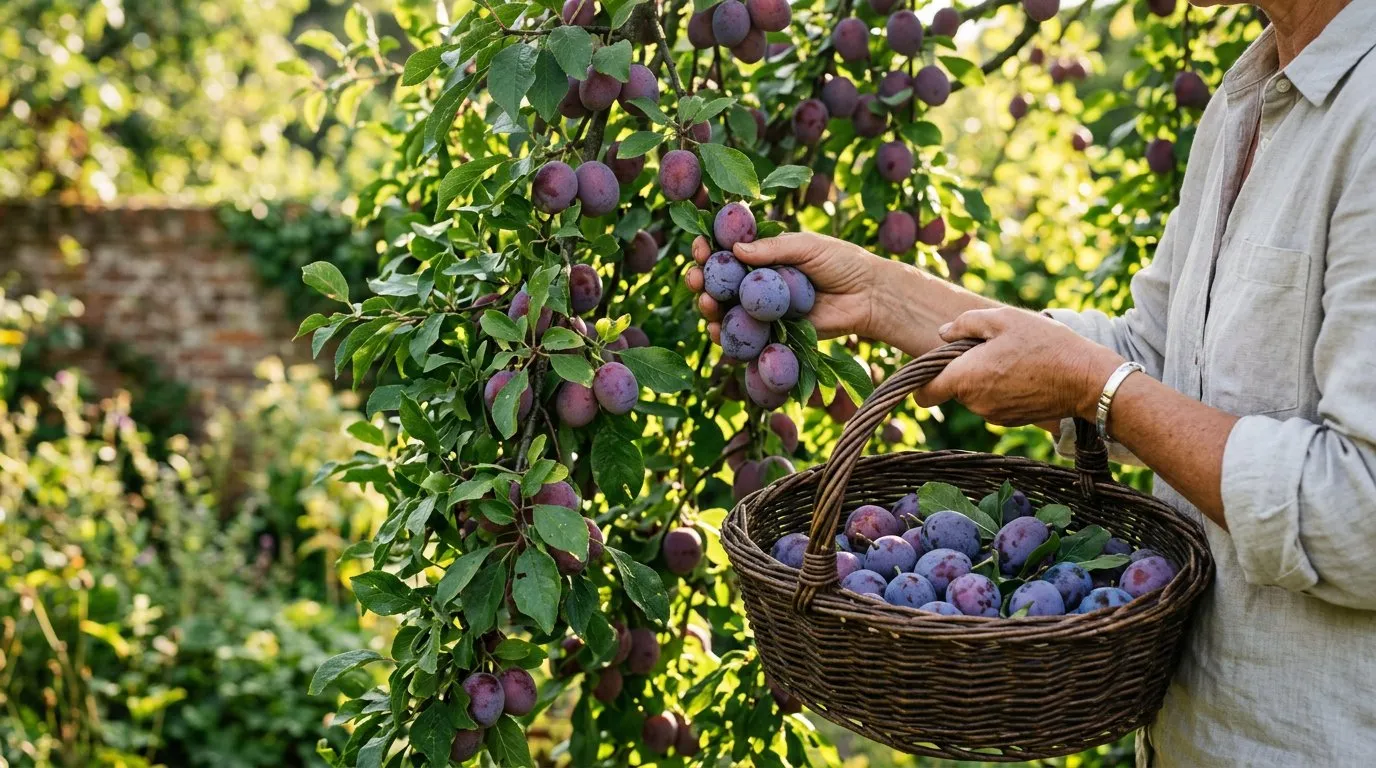 Harvesting Victoria plums. Pick when fruit gives slightly to gentle pressure.
| Variety | Harvest period |
|---|---|
| Opal | Late July to early August |
| Czar | Early to mid-August |
| Victoria | Late August to early September |
| Cambridge Gage | Mid to late August |
| Marjorie’s Seedling | Late September to early October |
| Damson Merryweather | September |
Storage
Fresh plums keep for 5-7 days in the fridge. Lay them in a single layer on a tray, not piled in a bag where they bruise. For longer storage, halve and stone the plums, lay them on a baking tray, and open freeze. Transfer frozen halves to bags. Frozen plums keep for 12 months and are well suited to crumbles, jam, and baking throughout winter.
Damsons make exceptional damson gin (500g damsons, 250g sugar, 1 litre gin, left for 3 months), damson jam (equal weight of fruit and sugar), and damson cheese (a firm, sliceable preserve). These are traditional British preserves that make excellent use of a heavy crop.
Now you’ve mastered plum trees, read our guide on growing pear trees in the UK for another rewarding fruit tree that thrives against a sheltered wall.
Frequently asked questions
Are plum trees self-fertile?
Most popular UK varieties are self-fertile. Victoria, Czar, Opal, Marjorie’s Seedling, and Damson Merryweather all set fruit without a pollination partner. Cambridge Gage and some heritage varieties need a pollinator from the same flowering group nearby. Self-fertile trees still produce heavier crops with a second tree present, as cross-pollination increases fruit set by 20-30%.
When do you prune a plum tree?
Prune plum trees in summer only, between June and August. Winter pruning exposes cuts to silver leaf disease spores, which are airborne from September to May. Summer wounds heal quickly and the risk of infection is low. Remove dead, crossing, or damaged branches and keep the centre of the tree open for airflow and light.
How long before a plum tree fruits?
A plum tree on Pixy rootstock fruits within 3-4 years of planting. Trees on St Julien A take 4-5 years to produce their first crop. The first harvest is usually light, with full production from year 5 onward. A mature Victoria on Pixy produces 15-25kg of fruit per season in a good year.
What is the best plum tree for a small garden?
Victoria on Pixy rootstock is the best choice for small gardens. It reaches just 2.5-3m tall, is self-fertile, and produces heavy crops of dual-purpose plums suitable for eating and cooking. Opal on Pixy is another strong option, fruiting 2-3 weeks earlier in late July. Both varieties also grow well in large containers of at least 50 litres.
Why is my plum tree not fruiting?
Late spring frost is the most common cause. Plums flower in March when frosts are frequent, and frozen blossom cannot set fruit. Other causes include heavy shade (plums need 6 hours of sun), drought stress during fruit set in May and June, bullfinch damage to flower buds in winter, and lack of a pollination partner for non-self-fertile varieties like Cambridge Gage.
Can you grow plum trees in pots?
Yes, grow plum trees in pots using Pixy rootstock. Use a container of at least 50 litres with good drainage holes in the base. Fill with John Innes No. 3 compost mixed with 20% perlite for drainage. Water daily in summer and feed fortnightly with high-potash liquid fertiliser from April to August. Repot every 3-4 years in fresh compost.
What is the difference between a plum and a damson?
Damsons are smaller and more astringent than dessert plums. They measure 2-3cm across compared to 5-7cm for a Victoria plum. Damsons are too tart to eat raw but they make outstanding jam, gin, and damson cheese. The trees are tougher than dessert plums, tolerating exposed sites and poorer soil conditions. Damson Merryweather is the most widely grown UK variety and is fully self-fertile.
Lawrie has been gardening in the West Midlands for over 30 years. He grows his own veg using no-dig methods, keeps a wildlife-friendly garden, and writes practical advice based on real UK growing conditions.