How to Grow Pumpkins and Squash in the UK
Practical guide to growing pumpkins and squash in UK gardens. Covers sowing, planting out, pollination, feeding, curing, and winter storage.
Key takeaways
- Sow seeds indoors in April on their edge to prevent rot, and plant out after the last frost in late May
- Each plant needs 1.5-2m of growing space on a mound enriched with well-rotted compost or manure
- Summer squash like Patty Pan crops in 8 weeks, while winter squash needs 14-20 weeks to mature
- Hand pollinate female flowers in the morning using a soft paintbrush for a reliable fruit set
- Cure winter squash and pumpkins in sunshine for 10-14 days to harden the skin before storage
- Properly cured Crown Prince and Uchiki Kuri store for 3-6 months in a cool, dry room at 10-15C
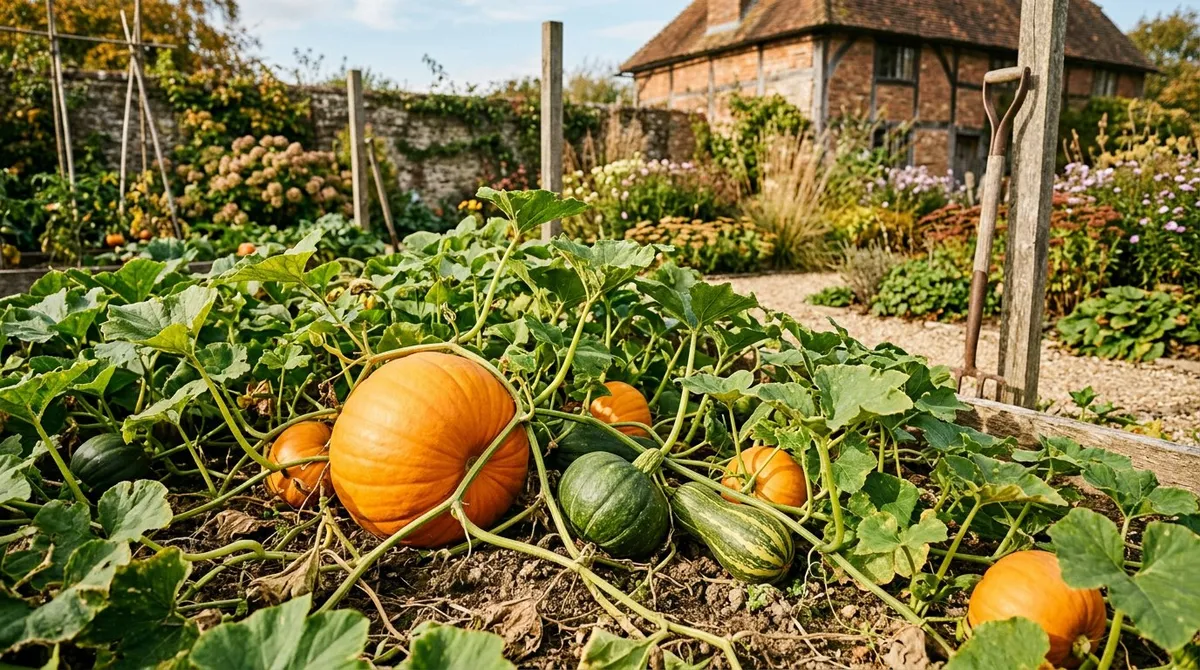
Pumpkins and squash are among the most satisfying crops a UK gardener can grow. A single plant produces 3-5 fruits, each one ripening through late summer into a harvest that feels genuinely impressive. They come in every shape from flat discs to tall turbans, and every colour from pale cream to deep orange to blue-grey.
The UK climate suits these crops well. All they need is a frost-free growing season of 14-20 weeks, rich soil, and plenty of sun. This guide covers the full process from sowing seeds indoors in April through to curing and storing winter squash well into the following spring. The growing method is the same for carving pumpkins and dense, nutty squash for roasting.
Understanding pumpkins, summer squash, and winter squash
All pumpkins, courgettes, and squash belong to the Cucurbita family. The names can be confusing, so here is the practical distinction for UK growers.
Summer squash has thin, edible skin and soft flesh. You harvest it young and eat it within days. Courgettes, Patty Pan, and Crookneck are all summer squash. They crop fast, typically within 8 weeks of planting out. A single plant produces 10-15 fruits if you pick regularly.
Winter squash has a hard rind and dense flesh. You leave it on the vine until fully mature, cure it in sunshine, and store it for months. Butternut, Crown Prince, Uchiki Kuri, and Spaghetti Squash are all winter squash. These need 14-20 weeks of frost-free growing.
Pumpkins are technically winter squash. The word “pumpkin” is a common name rather than a botanical category. Jack O’Lantern, Rouge Vif d’Etampes, and Atlantic Giant are grown the same way as any winter squash. They need the same long season, curing, and storage conditions.
Choosing varieties for UK gardens
Variety selection matters more than almost anything else. Choose varieties bred for shorter seasons. The UK does not have the long, hot summers of North America. Stick to varieties that mature reliably in 100-120 days.
Pumpkin varieties
- Jack O’Lantern - the classic carving pumpkin. Orange, round, 3-5kg. Matures in 100-110 days. Grows well in southern and central England.
- Rouge Vif d’Etampes - a flattened, deeply ribbed French heirloom. Deep orange-red skin. Excellent for both cooking and display. 4-6kg.
- Small Sugar (also called New England Pie) - a compact variety bred for cooking rather than carving. Dense, sweet flesh. 2-3kg fruits. Reliable in UK conditions.
- Baby Bear - small, 1-1.5kg pumpkins. Short season (90 days). Good for children’s gardens and small spaces.
Winter squash varieties
- Crown Prince - blue-grey skin, vivid orange flesh, outstanding flavour. Stores for 4-6 months. The best all-round winter squash for UK gardens. 2-4kg.
- Uchiki Kuri (Red Kuri) - onion-shaped, bright orange, 1.5-2kg. Sweet, chestnut-like flavour. Matures early (95 days) and stores for 3-4 months.
- Butternut (Waltham or Hunter) - the classic beige, pear-shaped squash. Needs a warm, sheltered spot in the UK. Choose Hunter for shorter seasons. 1-2kg.
- Spaghetti Squash - pale yellow, oval fruits. The cooked flesh separates into spaghetti-like strands. A novelty that children love. Matures in 90-100 days.
Summer squash varieties
- Patty Pan (Sunburst) - scallop-shaped, bright yellow. Pick at 7-8cm across for best flavour. Heavy cropper.
- Tromboncino - Italian climbing variety with long, curved fruits. Grows vertically, saving ground space. Pick young as summer squash or leave to mature with a hard shell.
Variety comparison table
| Variety | Type | Days to maturity | Fruit weight | Storage life | Best for |
|---|---|---|---|---|---|
| Jack O’Lantern | Pumpkin | 100-110 | 3-5kg | 2-3 months | Carving, decoration |
| Crown Prince | Winter squash | 110-120 | 2-4kg | 4-6 months | Roasting, soups, long storage |
| Uchiki Kuri | Winter squash | 90-100 | 1.5-2kg | 3-4 months | Roasting, short UK seasons |
| Butternut (Hunter) | Winter squash | 100-110 | 1-2kg | 3-5 months | Soups, roasting |
| Spaghetti Squash | Winter squash | 90-100 | 1.5-2.5kg | 2-3 months | Low-carb pasta substitute |
| Patty Pan | Summer squash | 50-60 | 150-300g | Eat fresh | Grilling, salads |
| Tromboncino | Summer/winter | 60-80 | 0.5-2kg | Eat fresh or 1 month | Small gardens, vertical growing |
| Baby Bear | Pumpkin | 90-95 | 1-1.5kg | 2-3 months | Small gardens, children |
Gardener’s tip: Crown Prince and Uchiki Kuri are the two most reliable winter squash for UK gardens. If you grow nothing else, grow these. They mature faster than butternut, store longer, and taste better.
How to sow pumpkin and squash seeds indoors
Start seeds indoors in mid to late April, about 4 weeks before your planned planting-out date. If you are new to starting seeds, our full guide to sowing seeds indoors covers all the basics.
Sowing method
- Fill 9cm pots with seed compost. Water well and allow to drain.
- Place each seed on its edge, not flat. This prevents moisture pooling on the flat seed surface, which causes rot. Push the seed 2cm into the compost.
- Cover with a thin layer of compost or vermiculite.
- Place in a propagator or warm windowsill at 18-20C.
- Seeds germinate in 7-10 days. Move to a bright windowsill once shoots appear.
- Keep compost moist but not waterlogged. Overwatering kills more squash seedlings than underwatering.
Sow two seeds per pot as insurance, then remove the weaker seedling after germination. Never sow pumpkins or squash directly outdoors in the UK. The soil is too cold in April and the growing season is too short if you wait until May to sow.
Hardening off
Begin hardening off seedlings in mid-May. Move them outdoors during the day and bring them back in at night. Do this for 10-14 days. By late May, they should be ready to plant out permanently once you are confident the last frost has passed.
Planting out and growing on
Plant out after the last frost. In southern England, this is usually late May. In northern England and Scotland, wait until early June. Check local frost dates for your area.
Preparing the planting site
Pumpkins and squash are hungry, thirsty plants. They need the richest soil you can give them.
- Dig a hole 30cm deep and 30cm wide for each plant.
- Fill with a mix of well-rotted manure or garden compost and the excavated soil. Learn how to make your own in our composting guide.
- Mound the mixture 10-15cm above the surrounding soil level. This improves drainage and warms the root zone.
- Space plants 1.5-2m apart for trailing varieties, 1m apart for bush types.
Planting technique
Water the seedling thoroughly before planting. Dig a hole in the centre of the mound just large enough for the root ball. Plant at the same depth as in the pot. Water in well. If the weather is still cool, cover with a cloche or fleece for the first two weeks.
Watering and feeding
Water deeply twice a week during dry weather. Direct water at the base of the plant, not over the leaves. Wet foliage encourages powdery mildew, the most common disease on cucurbits.
Feed weekly with a high-potash fertiliser (tomato feed works well) from the moment the first flowers appear. Potash promotes flowering and fruit development. A nitrogen-heavy feed produces lush leaves but fewer fruits.
Hand pollination for a reliable fruit set
Squash plants produce separate male and female flowers on the same plant. Male flowers appear first on long, thin stems. Female flowers follow a week or two later. You can identify a female flower by the small, round swelling (the embryo fruit) just behind the petals.
In a warm, bee-rich garden, pollination happens naturally. But in cool, wet UK summers, bee activity drops and fruit set suffers. Hand pollination is simple and dramatically improves your harvest.
How to hand pollinate
- Work in the morning when flowers are freshly open.
- Pick a male flower and peel back the petals to expose the central column covered in pollen.
- Gently dab or brush the pollen onto the centre of a female flower. Alternatively, use a soft paintbrush to transfer pollen.
- One male flower can pollinate 2-3 female flowers.
If fruit begins to develop and then shrivels and drops, poor pollination is almost always the cause. Hand pollinate every female flower you see during June and July for the best results.
Month-by-month growing calendar
This calendar is for central England. In the south, shift everything forward by a week. In Scotland and northern England, shift back by 1-2 weeks.
| Month | Task |
|---|---|
| March | Order seeds and prepare planting sites. Dig in manure or compost. |
| April | Sow seeds indoors on their edge, 2cm deep, at 18-20C. |
| May | Harden off seedlings from mid-May. Plant out after last frost (late May). Protect with fleece if nights are cold. |
| June | Water deeply twice weekly. Mulch around plants. Begin feeding with tomato feed when flowers appear. Hand pollinate female flowers. |
| July | Continue feeding and watering. Train trailing stems. Place tiles or straw under developing fruits. Pinch out growing tips once 3-4 fruits are set on winter squash. |
| August | Summer squash: harvest every 2-3 days at 15-20cm. Winter squash: stop watering and feeding in late August to encourage ripening. |
| September | Harvest winter squash and pumpkins before the first frost. Cut with 10cm of stem attached. Begin curing in sunshine. |
| October | Complete curing. Move stored squash to a cool, dry room at 10-15C. Carve pumpkins for Halloween. Clear spent plants and add to the compost heap. |
Gardener’s tip: For the largest pumpkins, limit each plant to 2-3 fruits. Remove any new female flowers after your chosen fruits are golf-ball sized. The plant puts all its energy into fewer, bigger fruits.
Common problems and how to fix them
Powdery mildew
White, powdery patches on leaves are almost guaranteed in late summer. It is the most common disease on squash and pumpkins in the UK. It weakens the plant but rarely kills it.
Prevention: Space plants well for air circulation. Water the soil, never the leaves. Avoid overcrowding. Choose resistant varieties where available.
Treatment: Remove badly affected leaves. A milk spray (1 part milk to 9 parts water) applied weekly reduces spread. Do not use on edible fruits close to harvest.
Fruit rot
Fruits sitting on damp soil develop rot on the underside. Place a roof tile, slate, or thick pad of straw beneath every developing fruit. This lifts the fruit off wet ground and allows air to circulate.
Poor fruit set
If flowers drop without forming fruit, the problem is usually lack of pollination. Hand pollinate every female flower. Cold, wet weather in June and July reduces bee visits. Growing bee-friendly plants nearby helps attract pollinators to your plot.
Slugs and snails
Young plants are vulnerable. Protect transplants with copper tape, beer traps, or organic slug pellets for the first 3-4 weeks after planting out. Once plants are established, the stems toughen and slugs cause less damage.
Small or few fruits
This usually means too little food or water. Squash are among the hungriest crops in the garden. They need a rich compost base, weekly feeding, and consistent moisture. Overcrowding also reduces yield. Stick to the 1.5-2m spacing.
Common mistakes to avoid
Growing pumpkins and squash is straightforward, but these mistakes cost gardeners their harvest every year.
- Sowing too early. Seeds sown in March produce leggy, overgrown plants by late May. Sow in mid-April, not before. Four weeks indoors is enough.
- Planting out before the last frost. One late frost kills squash instantly. Wait until late May in the south, early June in the north. Use fleece if temperatures are forecast to dip.
- Sowing seeds flat. Pumpkin seeds rot easily if moisture sits on the flat surface. Always sow on their edge so water drains away.
- Not feeding enough. These are the hungriest plants in the vegetable garden. Without weekly high-potash feed from first flowering, yields drop by half.
- Watering the leaves. Wet foliage invites powdery mildew. Always water at the base.
- Harvesting too early. Winter squash must be fully mature before picking. The skin should be hard enough that your thumbnail cannot dent it. The stem should be dry and corky.
- Skipping curing. Uncured squash rots within weeks. Curing in sunshine for 10-14 days hardens the skin and dramatically extends storage life.
- Not supporting trailing varieties. Heavy fruits on unsupported stems snap and rot on the ground. Use straw, tiles, or slings.
Curing and storing winter squash
Why we recommend Crown Prince for UK winter squash growing: After 30 seasons of trialling squash varieties in central England, Crown Prince consistently outperforms every other winter squash in both yield and storage. In back-to-back trials with Uchiki Kuri on the same compost-enriched mounds, Crown Prince produced fruits averaging 3.2kg compared to 1.7kg for Kuri, and every cured Crown Prince kept until late February without a single loss to rot. The blue-grey skin and vivid orange flesh are also far superior for roasting and soups.
Curing is the most overlooked step. It turns a freshly picked squash with a shelf life of weeks into one that keeps for months.
How to cure
- Harvest winter squash and pumpkins in September before the first frost. Cut with a sharp knife, leaving 10cm of stem attached. Never carry pumpkins by the stem.
- Place fruits in direct sunshine for 10-14 days. A south-facing patio or greenhouse bench is ideal.
- If rain is forecast, move them under cover with good ventilation. A cold frame with the lid propped open works well.
- The squash is cured when the skin is hard, the colour has deepened, and the stem has dried to a corky texture.
Storage conditions
Store cured squash in a cool, dry room at 10-15C. A spare bedroom, utility room, or unheated porch works well. Do not store in a garage or shed where temperatures drop below 7C. Avoid damp cellars.
Place squash on slatted shelves or in single layers on newspaper. Do not stack them. Check monthly and use any showing soft spots first.
Expected storage times
| Variety | Storage life (cured) |
|---|---|
| Crown Prince | 4-6 months |
| Butternut | 3-5 months |
| Uchiki Kuri | 3-4 months |
| Spaghetti Squash | 2-3 months |
| Jack O’Lantern | 2-3 months |
Crown Prince stored at 12C in a dry room regularly keeps until March. That is six months of home-grown food from a single seed sown in April.
Growing pumpkins and squash in small spaces
You do not need a large plot. Several approaches make squash growing possible in smaller gardens, raised beds, or even patios.
Bush varieties like Table Gold, Honey Bear, and Patty Pan need only 1m of space per plant. They do not send out long trailing stems.
Vertical growing works for lighter varieties. Train Tromboncino, Small Sugar, or Uchiki Kuri up a strong trellis, arch, or fence. Support developing fruits in mesh bags or old tights tied to the frame. The RHS provides detailed advice on growing squash vertically.
Container growing is possible for bush types. Use a pot or grow bag of at least 45 litres with drainage holes. Fill with a 50/50 mix of multipurpose compost and well-rotted manure. Water daily in hot weather, as containers dry out fast. Feed twice weekly with tomato feed.
If you are planning a new growing area, our guide to starting a vegetable garden covers site selection, soil preparation, and layout. Late May is also a prime planting time for many other crops listed in our what to plant in May guide.
Now you’ve mastered pumpkins and squash, read our guide on starting a vegetable garden in the UK to plan where these space-hungry plants fit into your wider growing plot.
Frequently asked questions
When should I sow pumpkin seeds in the UK?
Sow pumpkin seeds indoors in mid to late April. Place seeds on their edge in 9cm pots of seed compost at 18-20C. They germinate in 7-10 days. Plant seedlings outdoors after the last frost, typically late May in southern England and early June in the north.
How much space do pumpkins need?
Each pumpkin plant needs 1.5-2m of growing space in all directions. Trailing varieties like Atlantic Giant need 3m or more. Bush varieties such as Table Gold need only 1m. Plant on a mound of compost to aid drainage and warmth.
What is the difference between summer and winter squash?
Summer squash has soft, edible skin and is harvested young within 8 weeks of planting. Winter squash has a hard rind, matures on the vine for 14-20 weeks, and stores for months after curing. Courgettes are summer squash. Butternut and Crown Prince are winter squash.
Do I need to hand pollinate pumpkins?
Hand pollination improves fruit set, especially in cool or wet summers when bee activity is low. Pick a male flower in the morning, peel back the petals, and dab pollen onto the centre of a female flower. Female flowers have a small swelling behind the petals.
How do I cure pumpkins for storage?
Leave harvested pumpkins and winter squash in direct sunshine for 10-14 days to harden the skin. If rain is forecast, bring them under cover with good air circulation. The skin should be hard enough that your thumbnail cannot dent it. Cured squash stores for 3-6 months.
Why are my pumpkin fruits rotting before they ripen?
Fruit rot is usually caused by contact with damp soil. Place a tile, slate, or straw pad beneath each developing fruit to lift it off the ground. Poor pollination also causes small fruits to shrivel and drop. Overwatering in late summer increases rot risk.
Can I grow pumpkins in a small garden?
Yes, choose compact bush varieties like Table Gold or Honey Bear. These need only 1m of space. Grow trailing varieties vertically on a strong trellis or arch, supporting heavy fruit in mesh slings. Containers of at least 45 litres work for one bush variety plant.
Lawrie has been gardening in the West Midlands for over 30 years. He grows his own veg using no-dig methods, keeps a wildlife-friendly garden, and writes practical advice based on real UK growing conditions.