How to Grow Radishes in the UK
Practical guide to growing radishes in UK gardens. Covers varieties, sowing times, succession planting, intercropping, containers, and winter types.
Key takeaways
- Radishes are ready to harvest in just 4-6 weeks, making them the quickest vegetable crop in UK gardens
- Sow direct every 2-3 weeks from March to September for a continuous supply all season
- Thin seedlings to 2.5cm apart and harvest promptly before roots turn woody or pithy
- French Breakfast, Cherry Belle, and Scarlet Globe are the best summer varieties for UK conditions
- Winter radishes like Mooli and Black Spanish Round are sown in July-August and store for months
- Radishes grow well between rows of slower crops such as carrots, parsnips, and brassicas
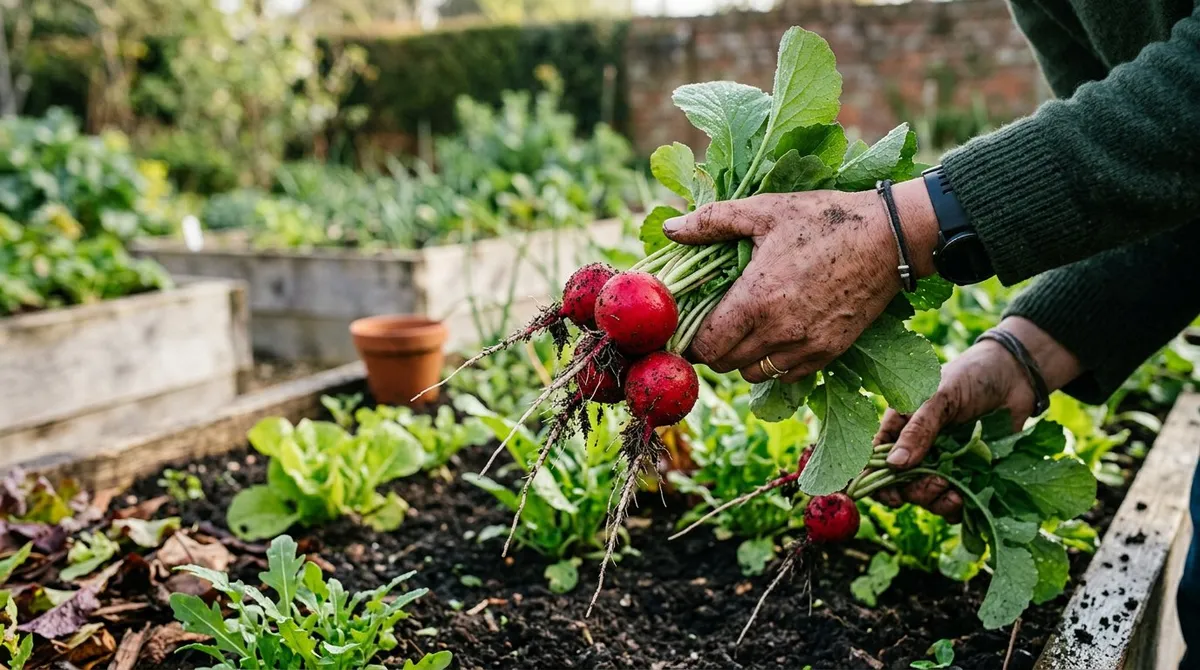
Radishes are the fastest vegetable you can grow. From seed to plate in four to six weeks, they reward impatient gardeners with crisp, peppery roots long before most other crops are ready. A single packet of seed costs under two pounds and produces dozens of harvests across the season.
The UK climate is ideal for radishes. They are a cool-season crop that germinates quickly in spring and autumn temperatures. Hot midsummer weather is their only weakness, causing bolting and bitter flavour. With the right timing, you can harvest fresh radishes from April right through to November. Radishes grow happily in a full vegetable garden, raised beds, or a window box on a balcony. This guide covers varieties, sowing, intercropping, containers, pest prevention, and the often-overlooked winter radish types.
What are the best radish varieties for UK gardens?
Radish varieties split into two main groups: summer radishes for quick spring and summer crops, and winter radishes for autumn sowing and long storage. Both grow well in British conditions, but they serve different purposes and have different sowing windows.
Summer varieties
French Breakfast is the classic British garden radish. The elongated, red-and-white roots are ready in 4-5 weeks and have a mild, slightly sweet peppery flavour. It is the most widely grown variety in UK allotments for good reason. Sow from March to August.
Cherry Belle produces perfectly round, bright red roots with crisp white flesh. Ready in just 3-4 weeks, it is the fastest variety commonly available. The flavour is milder than French Breakfast, making it popular with children and anyone who finds radishes too hot.
Scarlet Globe is similar to Cherry Belle but slightly larger at maturity. The round, deep red roots hold their quality in the ground for a few days longer before turning pithy. A reliable choice for beginners.
Sparkler has distinctive two-tone colouring, bright red at the top fading to white at the tip. The flavour is crisp and mild. Roots are round, ready in 4-5 weeks, and look striking in a salad bowl.
Winter varieties
Mooli (Daikon) produces long, white, cylindrical roots up to 30cm in length. Sow in July or August for autumn harvest. The flavour is milder than summer radishes, and the texture is firm and juicy. Used extensively in East Asian cooking, grated, pickled, or cooked in stir-fries. Mooli stores well for 2-3 months in a cool place.
Black Spanish Round is a traditional European winter radish with rough black skin and dense white flesh. The flavour is strong and peppery. Sow in July or August, harvest in October or November, and store in damp sand for up to 4 months. It was a staple winter vegetable in British gardens before the 20th century.
Summer vs winter radish comparison
| Feature | Summer radishes | Winter radishes |
|---|---|---|
| Examples | French Breakfast, Cherry Belle, Scarlet Globe, Sparkler | Mooli/Daikon, Black Spanish Round, China Rose |
| Root size | 2-4cm diameter | 8-30cm long, up to 8cm diameter |
| Sowing window | March to September | July to August only |
| Weeks to harvest | 3-6 | 8-12 |
| Flavour | Mild to medium peppery | Medium to strong peppery |
| Storage | Eat fresh within days | Stores 2-4 months in cool conditions |
| Growing depth | 15cm soil or compost | 25-30cm soil or compost |
| Best use | Salads, snacking, garnish | Stir-fries, pickling, grating, winter salads |
Gardener’s tip: Grow summer and winter types in the same season. Summer radishes fill the gap from April to September, and winter radishes take over from October to February. Between them, you can eat home-grown radishes for ten months of the year.
When and how to sow radishes
Radishes must be sown direct into the soil. They do not transplant well because disturbing the taproot causes distorted growth. The good news is that direct sowing is quick and simple. You can learn broader seed-starting principles in our guide to sowing seeds indoors, though radishes should always go straight into outdoor soil or containers.
Sowing method
- Rake the soil to a fine, crumbly surface and remove any large stones
- Draw a shallow drill 1cm deep using a stick or the edge of a trowel
- Water the drill lightly if the soil is dry
- Sow seeds thinly along the drill, spacing them roughly 2.5cm apart
- Cover with fine soil and firm gently with the back of a rake
- Space rows 15cm apart for summer varieties, 25-30cm for winter types
Radish seed germinates fast. Expect seedlings to appear within 4-7 days in spring and as little as 3-4 days in warm summer soil. This speed is one reason they work so well as row markers for slow-germinating crops like carrots and parsnips.
Thinning
Even with careful sowing, some thinning is usually needed. When seedlings reach 2cm tall, thin to 2.5cm apart for summer varieties. Winter radishes need more room. Thin Mooli to 15cm apart and Black Spanish Round to 10cm apart.
Crowded radishes produce small, misshapen roots or nothing but leaves. Thinning feels wasteful, but 30 well-spaced plants produce far more usable crop than 60 cramped ones. Use the thinnings in salads. They taste peppery and fresh.
Succession sowing for a continuous harvest
The single most important technique for growing radishes is succession sowing. A single sowing produces a glut of roots that all mature within the same week. Left in the ground beyond that point, they turn woody, pithy, and bitter within days.
Sow a short row every 2-3 weeks from March through to September. Each sowing gives a fresh batch of crisp roots as the previous one finishes. A row just 1 metre long produces roughly 30-40 radishes, which is plenty for most households.
Succession sowing schedule
| Sowing date | Variety | Expected harvest |
|---|---|---|
| Early March (under cloches) | French Breakfast, Cherry Belle | Late April |
| Late March | Scarlet Globe, Sparkler | Early May |
| Mid-April | French Breakfast, Cherry Belle | Late May |
| Early May | Any summer variety | Mid-June |
| Late May | Any summer variety | Early July |
| Mid-June | Cherry Belle, Sparkler | Late July |
| Early July (winter radish) | Mooli, Black Spanish Round | September-October |
| Mid-July | French Breakfast, Cherry Belle | Late August |
| Late July (winter radish) | Mooli, Black Spanish Round | October-November |
| Mid-August | Cherry Belle, Scarlet Globe | Late September |
| Early September | French Breakfast (under cloches) | Mid-October |
For a broader overview of when to sow everything in your plot, see our UK vegetable planting calendar.
Avoiding the midsummer gap
Radishes dislike hot weather. Temperatures above 25C cause bolting (flowering without forming roots) and make the flavour unpleasantly bitter. In most UK summers, July sowings can struggle during heatwaves.
The solution is to sow midsummer radishes in light shade. A row beside taller crops like runner beans or sweetcorn gets enough light to grow but stays cooler at soil level. Water consistently during hot spells. Mulching alongside the row with compost helps retain moisture and keeps the soil temperature down.
Growing radishes between other crops
Radishes are one of the best vegetables for intercropping. Their speed means they are sown, grown, and harvested before slower neighbours need the space. This makes use of ground that would otherwise sit empty for weeks.
Best intercropping combinations
Between carrots and parsnips. Sow radish seeds along the same row as carrots or parsnips. Radishes germinate in 4-5 days and mark the drill clearly, which helps when hoeing between rows of slow-germinating crops. The radishes are pulled within a month, leaving the space clear for the main crop.
Between brassicas. Young cabbage, broccoli, and cauliflower plants take weeks to fill their allotted space. Sow radishes in the gaps. They will be harvested long before the brassicas start to spread.
Between rows of onions and leeks. Both crops grow slowly and leave open soil between the rows for months. Radishes fit neatly into these gaps.
Between lettuce sowings. Radishes and lettuce share similar growing conditions. Alternate rows of each in a salad bed and harvest the radishes first as a quick crop while the lettuce hearts up.
Intercropping rules
Keep radish rows at least 10cm away from the base of neighbouring plants. Do not let radish foliage shade small seedlings of the main crop. Pull radishes as soon as they are ready. Leaving them too long defeats the purpose of intercropping and wastes the space.
Growing radishes in containers
Radishes are among the easiest vegetables to grow in containers. Their shallow root system needs only 15cm of compost depth for summer varieties. A standard window box, an old washing-up bowl with drainage holes, or a half-sized grow bag all work well.
Container setup
Fill with multipurpose compost. There is no need to add sand or grit for radishes, unlike carrots. Firm the surface lightly, then sow seeds 2.5cm apart in rows or scatter across the surface. Cover with 1cm of compost and water with a fine rose.
Container care
Water containers daily in warm weather. Radishes in pots dry out faster than those in open ground, and dry conditions produce woody, hollow roots. Feeding is rarely needed. Fresh compost has enough nutrients for a 4-6 week crop.
A single 40cm pot holds about 25 summer radishes. Succession sow into the same container every 2-3 weeks. Once a batch is harvested, top up the compost and sow again.
Balcony and patio growing
Radishes need at least 6 hours of direct sun. A south-facing or west-facing balcony is ideal. East-facing spots work in spring and summer when days are long. Avoid north-facing positions where radishes will produce only foliage.
Window boxes are well suited to a handful of radishes on a kitchen windowsill. Grow Cherry Belle or Sparkler, which have compact foliage and tidy root shapes.
Flea beetle prevention
Flea beetle is the most common pest affecting radishes in UK gardens. These tiny black or metallic blue beetles, 2-3mm long, create dozens of small round holes in radish leaves. The damage looks alarming but is rarely fatal to established plants. However, heavy attacks on young seedlings can kill them outright.
How flea beetle attacks
Flea beetles overwinter in soil and leaf litter. They become active in warm spring weather, typically from April onwards. The beetles jump when disturbed (hence the name) and feed on the leaves of all brassica-family plants, including radishes, rocket, turnips, and pak choi. Damage is worst in hot, dry weather when plants are already under stress.
Prevention methods
Cover with fleece or mesh. The most effective protection is a physical barrier. Cover rows with horticultural fleece or fine insect mesh (0.8mm gauge or smaller) immediately after sowing. Lay it loosely to allow growth underneath. Remove at harvest.
Water regularly. Flea beetles prefer dry conditions. Keeping the soil consistently moist makes plants less attractive to the beetles and helps seedlings grow through minor damage quickly. A strong seedling with a few holes recovers within days.
Clear debris. Remove old crop residues and weeds from around radish beds. Flea beetles shelter in dead plant material over winter. Clean beds reduce the overwintering population.
Companion planting. Growing radishes alongside lettuce or spinach can reduce flea beetle damage. The beetles are less attracted to mixed plantings than to monocultures of brassica-family crops.
Avoid dry spells on bare soil. Mulching around plants keeps the soil surface cool and moist, making it less attractive to flea beetles laying eggs.
Winter radishes: the overlooked crop
Most British gardeners think of radishes as a spring and summer salad vegetable. Winter radishes are a different class of crop entirely. They grow larger, take longer to mature, and store for months rather than days. They deserve far more attention than they currently get.
Mooli (Daikon)
Mooli produces long, white roots 20-30cm in length. Sow in July or early August into soil at least 25cm deep. Earlier sowings bolt before forming roots, as Mooli is triggered by the long days of June. Space seeds 15cm apart in rows 30cm apart.
Harvest from October onwards. The roots have a mild, slightly sweet flavour and a dense, juicy texture. Grate raw into salads, pickle in rice vinegar, add to soups, or use in stir-fries. Mooli is the base ingredient for Korean kimchi and Japanese pickled daikon.
Store in a cool, frost-free place for 2-3 months. Wrap individual roots in newspaper or layer in damp sand.
Black Spanish Round
This heritage variety produces globe-shaped roots 8-10cm across with rough black skin and dense white flesh. The flavour is stronger and more peppery than summer radishes. Sow in late July or August and harvest from October.
Black Spanish Round stores well. In boxes of damp sand at 1-4C, roots last 3-4 months. It was a common winter vegetable in Victorian and Edwardian kitchen gardens, eaten grated or sliced thinly with bread and butter.
China Rose
China Rose is a semi-winter radish with pink skin and white flesh. It is slightly faster than true winter types, ready in 8-9 weeks. Sow from July to early September. The flavour is medium-hot, milder than Black Spanish but stronger than Mooli.
Month-by-month radish growing calendar
| Month | Task |
|---|---|
| February | Order seed. Plan where radishes will fit into the plot. Prepare container compost |
| March | First sowings under cloches or fleece. Sow short rows of French Breakfast or Cherry Belle |
| April | Main sowing season begins. Sow every 2-3 weeks. First seedlings from March sowings appear |
| May | Continue succession sowing. Harvest first spring-sown radishes. Thin seedlings to 2.5cm |
| June | Sow in light shade if hot weather is forecast. Keep watering consistently. Watch for flea beetle |
| July | Sow winter radishes (Mooli, Black Spanish Round). Continue summer succession sowing |
| August | Last sowings of winter radish varieties. Harvest summer radishes regularly. Clear spent rows |
| September | Final summer sowings under cloches in mild areas. Thin winter radishes to final spacing |
| October | Harvest winter radishes. Store in damp sand. Last summer radishes from September sowings |
| November | Lift any remaining winter radishes before heavy frost. Store for winter use |
Harvesting and storing radishes
Summer radishes
Pull summer radishes as soon as roots reach 2-3cm diameter. This happens 4-6 weeks after sowing for most varieties. Check daily once you see root tops pushing above the soil surface.
Timing is critical. Summer radishes have a harvest window of just 5-7 days. Left in the ground beyond this point, the roots turn hollow, pithy, and unpleasantly bitter within a matter of days. Hot weather shortens this window further.
Pull a test radish first. Cut it in half. The flesh should be solid white with no hollow centre. If it looks good, harvest the rest of the row over the next few days.
Summer radishes do not store well. Eat within 3-4 days of pulling. They keep in the fridge for up to a week in a plastic bag, but flavour and crunch decline. For a continuous supply, rely on succession sowing rather than trying to store a single harvest.
Winter radishes
Winter radishes are more forgiving. Harvest from October onwards when roots have reached full size. Mooli roots should be 20-30cm long and 5-6cm in diameter. Black Spanish Round roots are ready at 8-10cm across.
Twist off the foliage. Brush off soil but do not wash. Store unwashed in boxes of damp sand in a cool, frost-free place at 1-4C. A garage, unheated shed, or cellar works well. Winter radishes stored this way keep for 2-4 months.
Mooli can also be pickled in rice vinegar with salt and sugar. Black Spanish Round grates well into winter salads and slaws.
Five common mistakes when growing radishes
Even experienced gardeners make these errors with radishes. Avoiding them guarantees better harvests.
1. Sowing everything at once. A full row of radishes all matures in the same week. You cannot eat 40 radishes in five days. Succession sow small batches every 2-3 weeks instead.
2. Forgetting to thin. Crowded radishes grow only foliage. The roots remain tiny and misshapen because each plant is fighting for the same patch of soil. Thin to 2.5cm apart without hesitation.
3. Leaving roots in the ground too long. This is the most common complaint. Radishes go from perfect to pithy in under a week. Check them daily once the tops appear above the soil surface. Pull promptly.
4. Sowing in too much shade. Radishes need at least 6 hours of direct sun. Shaded plants grow tall, leggy foliage and produce small or no roots. The exception is midsummer, when light shade prevents bolting in hot weather.
5. Sowing winter varieties too early. Mooli and Black Spanish Round bolt if sown before July. The long days of May and June trigger flowering. Wait until mid-July at the earliest. Late July to early August is the reliable window.
How to use radishes in the kitchen
Why we recommend French Breakfast for succession sowing: After 30 seasons of growing radishes in allotment and raised bed situations, French Breakfast is the variety I sow first every March and return to repeatedly through the season. In side-by-side trials with Cherry Belle and Scarlet Globe, French Breakfast produced consistently the longest harvest window, roots stayed crisp and mild in the ground for 8-9 days compared to 5-6 for Cherry Belle before turning pithy in warm weather. Its elongated shape is also far easier to pull cleanly from compacted soil.
Radishes are more versatile than most gardeners realise. They are not just a salad garnish.
Raw in salads. Slice thinly or quarter for green salads. French Breakfast and Cherry Belle hold their crunch and peppery bite well when mixed with milder leaves.
Radish butter. Slice fresh radishes, spread with good salted butter, and sprinkle with flaky sea salt. This is a classic French spring snack and one of the simplest ways to enjoy a fresh harvest.
Roasted. Halve summer radishes and roast at 200C for 15-20 minutes with olive oil and salt. Roasting mellows the peppery flavour and brings out sweetness. Winter radishes roast well too, cut into wedges like turnips.
Pickled. Quick-pickle thinly sliced radishes in rice vinegar, sugar, and salt for 30 minutes. They turn bright pink and add crunch and acidity to tacos, sandwiches, and rice bowls.
Radish leaves. The green tops are edible and nutritious. Young leaves taste peppery and work raw in salads. Older leaves can be wilted like spinach or blended into pesto. Do not waste them.
For more ideas on growing quick crops alongside radishes, see how compost improves soil for succession-sown vegetables. The RHS radish growing guide also provides useful variety trial results from UK test gardens.
Now you’ve mastered radishes, read our full UK vegetable planting calendar to see how succession sowing fits alongside all your other crops through the season.
Frequently asked questions
When should I sow radishes in the UK?
Sow outdoors from March to September. Early sowings in March benefit from cloche protection to warm the soil. The main sowing window runs from April to August, with successional sowings every 2-3 weeks. Winter radish varieties go in during July and August only, as earlier sowings bolt before forming large roots.
Why are my radishes all leaf and no root?
Leafy growth without root development is caused by too much nitrogen or too much shade. Radishes need at least 6 hours of direct sun. Avoid recently manured beds. Overcrowding also forces plants to compete for light, sending energy into foliage. Thin to 2.5cm apart and grow in open, sunny positions for the best roots.
How do I stop flea beetle on radishes?
Flea beetle creates tiny round holes in radish leaves. Cover rows with fine mesh or horticultural fleece immediately after sowing. Keep plants well watered, as flea beetles prefer dry conditions. Clear crop debris promptly. Strong, well-watered seedlings outgrow minor flea beetle damage within days.
Can I grow radishes in pots?
Radishes grow very well in containers. Use any pot or trough at least 15cm deep for summer varieties. Fill with multipurpose compost, sow seeds 2.5cm apart, and water regularly. A 30cm window box holds about 20 radishes. Containers on a patio or balcony produce perfectly good crops with minimal effort.
Why do my radishes taste woody or pithy?
Woody or pithy texture results from leaving radishes in the ground too long. Most summer varieties are at their best for only 5-7 days after reaching maturity. Check daily once roots reach 2cm diameter and pull promptly. Hot, dry weather also accelerates the decline. Water consistently and harvest without delay.
What is the difference between summer and winter radishes?
Summer radishes are small, fast-growing varieties ready in 4-6 weeks. They are eaten fresh and do not store. Winter radishes like Mooli and Black Spanish Round are sown in July-August, grow much larger over 8-12 weeks, and store for months in damp sand. Winter types have firmer flesh and stronger flavour.
Can I grow radishes between other crops?
Yes, radishes are one of the best intercropping vegetables. Sow them between rows of slow-growing crops like carrots, parsnips, or brassicas. The radishes will be harvested and out of the way before the main crop needs the space. This makes efficient use of every centimetre of your plot.
Lawrie has been gardening in the West Midlands for over 30 years. He grows his own veg using no-dig methods, keeps a wildlife-friendly garden, and writes practical advice based on real UK growing conditions.