How to Grow Rhubarb in the UK
Complete guide to growing rhubarb in UK gardens. Covers varieties, planting crowns, forcing for early stems, harvesting, dividing, and common mistakes.
Key takeaways
- Plant bare-root crowns from November to March in a sunny or partially shaded spot with rich, well-drained soil
- Never harvest stems in the first year after planting, let the crown build strength for future seasons
- Pull stems with a twist at the base rather than cutting, which leaves a stump that can rot
- Force crowns with an upturned bin or terracotta forcer from January for tender pink stems in February or March
- Divide established crowns every 5-6 years to prevent congestion and maintain strong harvests
- Rhubarb leaves contain oxalic acid and are poisonous, but the stems are perfectly safe to eat
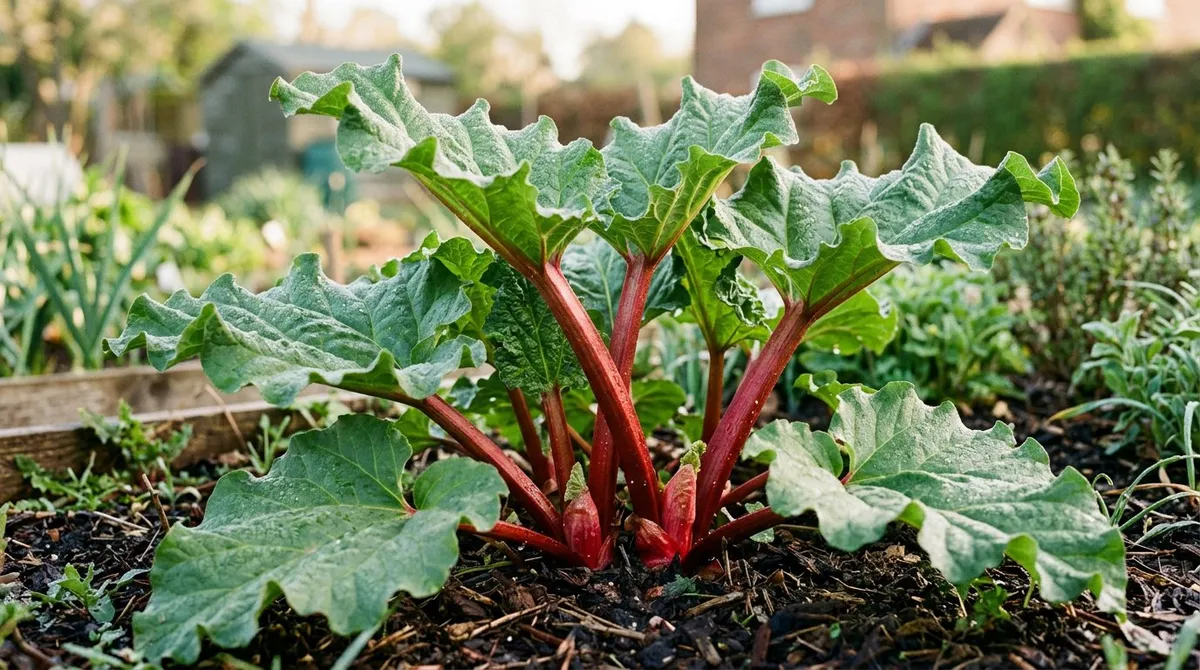
Rhubarb is one of the most reliable and long-lived crops a UK gardener can grow. Plant a single crown in a corner of the garden, and it will produce stalks every spring for a decade or more. It tolerates cold winters, wet weather, and partial shade. It needs almost no attention once established. A well-fed rhubarb crown produces 2-3kg of stems per season, enough for crumbles, jams, and a full freezer.
The UK climate is ideal for rhubarb. The plant needs a cold winter dormancy period to trigger strong spring growth, and British winters provide exactly that. The famous Yorkshire Rhubarb Triangle between Wakefield, Morley, and Rothwell once supplied 90% of the world’s forced rhubarb. That tradition continues today. This guide covers varieties, planting, forcing, harvesting, dividing, and the common mistakes that hold growers back. If you are building a kitchen garden, our guide to starting a vegetable garden covers the broader planning.
What are the best rhubarb varieties for UK gardens?
The five varieties below cover the full season from early March to late June. Planting an early and a mainstay variety together gives the longest possible harvest window.
Early varieties
- Timperley Early - the earliest variety for outdoor growing. Produces slender, green-and-red stems from late March. Light, tangy flavour. Good for forcing. The best choice for northern gardens and colder sites where the season starts later.
- Champagne (also called Champagne Early Rhubarb) - bright crimson stems with excellent flavour and lower acidity than most varieties. Ready from mid-April outdoors. Beautiful colour that holds when cooked. Produces fewer stems than Victoria but every one is worth it.
Mainstay varieties
- Victoria - the most widely grown variety in UK gardens. Thick, vigorous stems, green flushed with red at the base. Heavy cropper. Very reliable in all UK conditions. Ready from April. The standard against which other varieties are measured.
- Stockbridge Arrow - bred in Yorkshire specifically for forcing. Deep red stems with a rich, sweet flavour. Very upright growth habit. Less commonly available than Victoria but worth seeking out from specialist nurseries.
- Raspberry Red - vivid red stems throughout, not just at the base. Sweeter than Victoria with less need for added sugar in cooking. Compact growth suits smaller gardens. Ready from late April.
Rhubarb variety comparison
| Variety | Harvest period | Stem colour | Vigour | Flavour | Best for |
|---|---|---|---|---|---|
| Timperley Early | March-June | Green/red | Moderate | Tangy, light | Earliest outdoor harvest |
| Champagne | April-June | Deep crimson | Moderate | Sweet, low acidity | Flavour, appearance |
| Victoria | April-June | Green/red | Very strong | Classic, tart | Heavy cropping, beginners |
| Stockbridge Arrow | April-June | Deep red | Strong | Rich, sweet | Forcing, flavour |
| Raspberry Red | Late April-June | Vivid red | Moderate | Sweet | Small gardens, colour |
Gardener’s tip: The stem colour on the plant does not always indicate sweetness. Green-stemmed varieties like Victoria can taste as good as red ones when cooked with the right amount of sugar. Choose on flavour and vigour, not appearance alone.
When and how to plant rhubarb crowns
Planting time
Plant bare-root rhubarb crowns from November to March during the dormant season. This gives the roots time to establish in cool, moist soil before the burst of spring growth. November and December plantings settle in best because autumn rainfall keeps the soil consistently moist without waterlogging.
March planting works but the crown has less time to establish before it needs to push out stems. If planting in March, water regularly through the first spring and summer.
Container-grown rhubarb can go in at any time of year, but bare-root crowns are cheaper (typically 3-5 pounds each) and establish faster because they have not been circling in a pot.
Choosing the right position
Rhubarb grows in full sun or partial shade. A position with morning sun and afternoon shade is ideal. Full sun produces the heaviest crops, but partial shade is perfectly acceptable and the plant will still yield well. Avoid deep shade beneath trees, where the stems become thin and leggy.
The soil should be rich, moisture-retentive, and well-drained. Rhubarb hates sitting in waterlogged ground over winter, which rots the crown. If your soil is heavy clay, improve drainage before planting. Our guide to improving clay soil covers the techniques. Raised beds also work well for rhubarb in heavy ground.
Dig a generous planting hole and work in two or three buckets of well-rotted manure or garden compost. Rhubarb is a hungry, long-term plant. Investing in soil preparation at planting time pays dividends for years. If you make your own compost, our composting guide explains the process from start to finish.
How to plant
- Dig a hole 30cm wide and 30cm deep
- Fork well-rotted manure or compost into the base
- Set the crown so the buds sit just below the soil surface (no deeper than 2.5cm)
- Backfill with soil mixed with more compost
- Firm gently and water well
- Space multiple crowns 90cm apart
Planting depth matters. Burying the crown too deep causes it to rot. Too shallow and it dries out. The buds should be visible at or just below soil level.
Mulching around the crown after planting retains moisture and suppresses weeds. Use a 5-8cm layer of well-rotted manure, compost, or bark chips. Keep the mulch a few centimetres away from the buds themselves to prevent rotting.
Should I harvest rhubarb in the first year?
No. This is the golden rule of rhubarb growing. Do not harvest any stems in the first year after planting. The crown needs a full season to develop its root system and build energy reserves in the thick, fleshy roots. Taking stems in the first year weakens the plant and reduces harvests in future years.
In the second year, take a light harvest of no more than 3-4 stems per plant. Choose the thickest stems and leave the rest to feed the crown.
From the third year onwards, harvest freely. A mature crown supports regular picking from April to late June without any loss of vigour, provided you stop harvesting by the end of June and let the remaining leaves feed the roots for next year.
How do I harvest rhubarb stems?
Pulling, not cutting
Always pull rhubarb stems rather than cutting them. Grip the stem near the base and pull with a firm, twisting motion. The stem separates cleanly from the crown. Cutting with a knife leaves a stump attached to the crown that can rot, introducing disease into the plant.
Pulled stems come away with a clean break. The wound dries quickly and heals without problems. This pulling technique has been the standard method in the Yorkshire Rhubarb Triangle for generations.
When to stop harvesting
Stop picking by the end of June, or by mid-July at the very latest. The plant needs the remaining summer months to photosynthesise through its large leaves, building energy reserves in the roots for next year’s crop. Harvesting too late into summer weakens the crown progressively, leading to thinner stems and smaller harvests in following years.
A good rule is to never take more than a third of the stems at any one time. This keeps enough leaf area on the plant to maintain healthy growth.
What to do with the leaves
Trim the large leaves from the stems immediately after picking. Rhubarb leaves are poisonous because they contain high concentrations of oxalic acid. Never eat the leaves or feed them to livestock. The stems contain only trace amounts and are perfectly safe.
Add the leaves to the compost heap, where the oxalic acid breaks down harmlessly during decomposition. Some gardeners place them around the base of the plant as a temporary weed-suppressing mulch, though this looks untidy.
How do I force rhubarb for early stems?
Forcing produces tender, pale pink stems 3-4 weeks ahead of outdoor plants. Forced stems are sweeter, less fibrous, and more delicate in flavour than those grown in open light. The technique works by blocking all light, causing the stems to grow tall and blanched as they search for sunshine.
When to start forcing
Cover the crown in January or early February. The crown should be dormant, with no visible leaf growth. Forcing works best on established plants that have been in the ground for at least three years.
What to use
- Upturned dustbin or large bucket - the cheapest option. Must be completely lightproof. Block any drainage holes.
- Terracotta rhubarb forcer - the traditional choice. A tall, bell-shaped pot with a removable lid for checking progress. Attractive in the garden and effective.
- Large cardboard box lined with black plastic - a short-term alternative. Weigh down with bricks.
The covering must block all light completely. Any light leaking in causes the stems to green up and toughen, defeating the purpose.
How forcing works
- In late autumn, mulch around the crown with a thick layer of straw or well-rotted manure to insulate the roots
- In January, place the forcer or bin over the crown before any growth appears
- Check under the lid after 4 weeks
- Harvest forced stems when they reach 25-30cm tall, usually after 5-6 weeks
Forced stems are pale yellow-pink with small, crinkled yellow leaves at the top. They snap cleanly and taste noticeably sweeter than outdoor stems.
Resting after forcing
Rest forced crowns for at least one full season after forcing. The process exhausts the plant because it produces stems using only stored energy, with no photosynthesis to replenish the reserves. Grow the plant normally for a year (or two, for weaker plants) before forcing again.
If you want forced rhubarb every year, grow at least three crowns and rotate the forcing between them. Force one crown each year while the other two grow and recover.
How do I divide rhubarb crowns?
Established crowns become congested over time. The central portion goes woody and produces thin, spindly stems. Dividing every 5-6 years keeps the plant young, vigorous, and productive.
When to divide
Divide in late autumn or winter (November to February) while the plant is completely dormant. Avoid dividing in spring once growth has started, as the new divisions lose moisture rapidly through their emerging leaves.
Division method
- Lift the entire crown with a garden fork, working around the edges to free the roots
- Shake or wash off excess soil so you can see the buds clearly
- Use a sharp spade to split the crown into sections, each with at least one strong pink or red bud and a good portion of root
- Discard the old, woody centre of the crown, it will never produce well again
- Replant the outer divisions immediately in freshly prepared soil with added manure
- Water well and mulch
Each division typically produces a harvestable plant within two years. A single large crown can yield 4-6 good divisions. Share the extras with neighbours or plant them in different parts of the garden for a staggered harvest.
Why does my rhubarb produce flower stalks?
Rhubarb sometimes sends up a thick, central flower stalk topped with a cluster of small creamy-white flowers. This is called “bolting” and is more common in:
- Older, congested crowns that need dividing
- Stressed plants experiencing drought, poor soil, or temperature fluctuations
- Some varieties that are naturally more prone to flowering (Victoria bolts more readily than Timperley Early)
Cut flower stalks off at the base as soon as they appear. Flowering diverts significant energy away from stem production. Left to set seed, the plant puts most of its resources into reproduction rather than growing the thick, juicy stems you want to harvest.
Flowering does not make the stems poisonous or inedible. The plant is redirecting its energy. Removing the flower stalk and improving growing conditions (feeding, watering, dividing if needed) usually stops the problem.
What should I feed rhubarb?
Rhubarb is a heavy feeder. An unfed plant produces progressively thinner stems over the years. Annual feeding keeps the crown healthy and productive.
Annual feeding routine
- Late winter (February): Apply a thick mulch (8-10cm) of well-rotted farmyard manure or garden compost around the crown. This feeds the plant slowly through the growing season and improves soil structure.
- Spring (April): Scatter a handful of general-purpose fertiliser (such as Growmore at 70g per square metre) around the crown and water in. This gives a quick boost as the stems emerge.
- After harvest (July): Apply a second mulch of compost to replenish what the plant has used during cropping.
Avoid high-nitrogen feeds late in the season. These encourage soft, leafy growth that is vulnerable to frost damage over winter.
Gardener’s tip: If you only feed once, make it the late-winter manure mulch. This single application makes the biggest difference to stem thickness and overall plant health. Well-rotted horse manure is ideal.
Month-by-month rhubarb growing calendar
| Month | Task |
|---|---|
| January | Place forcers over crowns for early stems. Order bare-root crowns from nurseries |
| February | Plant bare-root crowns. Mulch established plants with well-rotted manure. Check forcers |
| March | Final month for planting crowns. Harvest forced stems. Timperley Early outdoor stems start |
| April | Main outdoor harvest begins. Feed with general-purpose fertiliser. Remove flower stalks |
| May | Continue harvesting. Water in dry spells. Keep beds weed-free |
| June | Final month of harvest. Stop picking by end of June. Let remaining leaves grow |
| July | No harvesting. The plant rebuilds reserves. Water deeply in drought. Apply compost mulch |
| August | Leaves are working hard to store energy. No intervention needed |
| September | Growth slows. Leaves begin to yellow naturally |
| October | Leaves die back. Clear dead foliage. Prepare planting sites for new crowns |
| November | Plant new crowns. Divide congested plants. Mulch with straw before winter |
| December | Plants are fully dormant. No action required. Plan next year’s forcing schedule |
Can I grow rhubarb in a container?
Yes, though container-grown rhubarb produces a smaller harvest than plants in open ground. Use a container at least 50cm diameter and 50cm deep. Rhubarb has a large root system and needs space to develop properly.
Fill with a mix of multipurpose compost and well-rotted manure (roughly 70:30). Plant one crown per pot with the buds just below the surface. Water regularly through the growing season, as containers dry out faster than open ground.
Feed container rhubarb with liquid tomato feed every two weeks from April to June. Repot or refresh the top 10cm of compost every autumn. Container plants need dividing or replanting after 3-4 years, sooner than those in the ground.
Choose compact varieties like Raspberry Red for containers. Victoria works but its vigorous growth can overwhelm a pot quickly.
Five common mistakes when growing rhubarb
Avoiding these errors makes the difference between a thriving, productive crown and a struggling one.
Harvesting in the first year. The most common mistake. New crowns need a full season to establish their root system. Taking stems in year one permanently weakens the plant. Wait until the second year for a light pick and the third year for a full harvest.
Cutting stems instead of pulling. Cutting leaves a stump that rots and invites disease into the crown. Always pull stems with a firm twist at the base. The clean break heals quickly.
Planting too deep. Burying the crown more than 2.5cm below soil level causes rot. The buds should sit at or just beneath the surface. Check after planting and adjust if needed.
Neglecting to feed. Rhubarb is a perennial that pulls nutrients from the same patch of soil year after year. Without annual feeding (a thick mulch of manure in February), stems become thinner and harvests decline. Think of the manure mulch as paying rent for the space the plant occupies.
Harvesting too late in the season. Picking stems into August or September robs the plant of the leaf area it needs to store energy for winter and next spring. Stop by the end of June. The leaves left on the plant after your final pick are not wasted. They are charging the batteries for next year.
Rhubarb pests and diseases
Rhubarb is remarkably trouble-free. Most plants grow for years without any pest or disease problems. The few issues that occur are usually manageable.
Crown rot
The most serious disease. Caused by bacteria or fungi entering the crown through wounds or waterlogged soil. The crown becomes soft and brown, and stems wilt and collapse. Prevention is the only real treatment: ensure good drainage, avoid damage when weeding around the crown, and pull stems rather than cutting. Remove and destroy affected crowns. Do not replant rhubarb in the same spot for several years.
Honey fungus
Rhubarb is susceptible to Armillaria (honey fungus), a soil-borne fungal disease that attacks the roots. Symptoms include poor growth, yellowing leaves, and white fungal threads beneath the bark of the crown. There is no chemical treatment. Remove and destroy affected plants, including as much root material as possible. The RHS honey fungus guidance covers identification and management in detail.
Slugs and snails
Young emerging stems in spring are vulnerable to slug damage. The tender new growth can be grazed overnight. Apply organic slug pellets around the crown in early spring, or set beer traps nearby. Established stems toughen quickly and become less attractive to slugs within a few weeks.
Rhubarb crown borer
A small moth whose larvae tunnel into rhubarb crowns. Rarely serious enough to warrant treatment in UK gardens. Signs include wilting stems and sawdust-like material around the base. Remove and burn any stems showing damage.
Growing rhubarb alongside other crops
Rhubarb’s large leaves and spreading habit make it a dominant plant. Give it 90cm of space in every direction. It works well at the end of a vegetable bed, along a boundary, or in a dedicated perennial corner alongside other long-term crops like asparagus and horseradish. Check our UK vegetable planting calendar for fitting rhubarb into a wider growing plan.
Avoid planting rhubarb in the middle of annual vegetable beds, where its permanent presence disrupts crop rotation. A dedicated spot at the edge of the plot, where it will not be disturbed, is ideal.
The large leaves provide useful ground shade in summer. Some gardeners plant shade-tolerant salads like lettuce or land cress beneath mature rhubarb plants, using the natural canopy to keep the salad leaves cool and slow-to-bolt during hot weather.
Why we recommend Timperley Early for UK gardeners who want the longest harvest window: After 30 seasons of growing rhubarb in both allotment and garden settings, Timperley Early consistently produces the first usable stems of the year and responds best to forcing. In three years of side-by-side comparisons with Victoria on the same plot, forced Timperley Early was harvestable on 14 February, a full four weeks ahead of forced Victoria under identical conditions. Its slender stems are also better suited to crumbles and cordials where texture matters.
Rhubarb is a garden investment worth making
Few crops offer as much return for as little ongoing effort as rhubarb. A single crown planted this winter will produce stems every spring for 10-15 years. It tolerates cold, copes with shade, and asks only for an annual feed of manure and the patience to leave it alone in the first year. The forced stems in February are the first fresh harvest of the year, arriving when the garden offers almost nothing else to eat. The outdoor crop from April to June supplies crumbles, cordials, jams, and chutneys. And when the crown eventually tires after a decade, you divide it, replant, and the cycle begins again.
Now you’ve mastered rhubarb, read our UK vegetable planting calendar to see how rhubarb fits alongside your other perennial and annual crops through the year.
Lawrie has been gardening in the West Midlands for over 30 years. He grows his own veg using no-dig methods, keeps a wildlife-friendly garden, and writes practical advice based on real UK growing conditions.