How to Grow Spinach in the UK
Complete UK guide to growing spinach. Covers true spinach, perpetual spinach, varieties, succession sowing, bolting prevention, and container growing.
Key takeaways
- Succession sow every 3 weeks from March to September for continuous spinach harvests
- True spinach bolts in long days and heat, so grow perpetual spinach or New Zealand spinach in summer
- Medania and Giant Winter are the most reliable true spinach varieties for UK gardens
- Sow in August or September for winter harvests under fleece from November to March
- Spinach needs rich, moisture-retentive soil with plenty of organic matter worked in
- 500g of raw spinach cooks down to roughly one adult serving, so grow more than you think
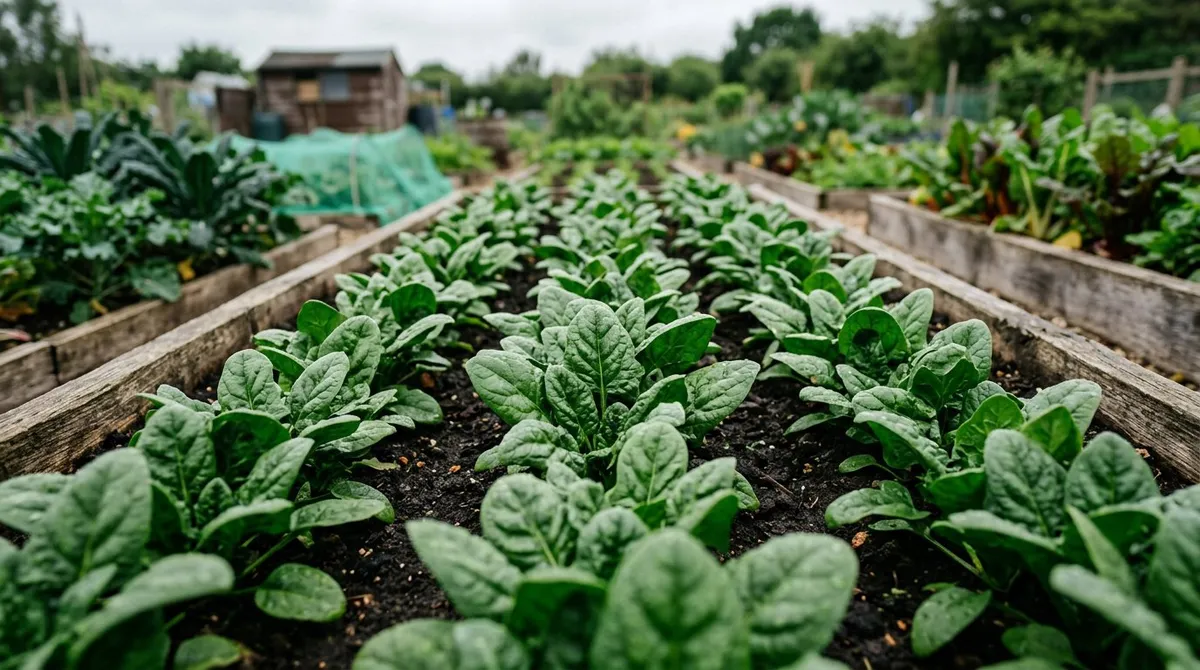
Spinach is one of the most nutritious leafy greens you can grow in a UK garden. It germinates in under two weeks, produces pickable leaves within six weeks, and thrives in the cooler temperatures that define British springs and autumns. It also happens to be one of the trickiest crops to keep going through summer, which is why understanding the different types is so important.
The challenge with true spinach is bolting. Long days and warm soil send it straight to flower before you have picked enough to fill a colander. The solution is simple. Grow true spinach in spring and autumn when it performs best. Fill the summer gap with perpetual spinach or New Zealand spinach. Sow in autumn for a winter crop under fleece. With succession sowing every three weeks from March to September, you can harvest spinach in every month of the year.
What types of spinach can you grow in the UK?
Three distinct plants go by the name “spinach” in British seed catalogues. They look different, taste different, and behave differently in the garden. Understanding which is which will save you frustration and keep your harvests going year-round.
True spinach (Spinacia oleracea)
True spinach is the classic dark green, smooth or crinkled-leaf crop sold in supermarkets. It has a rich, slightly metallic flavour and a silky texture when cooked. The leaves are packed with iron, folate, and vitamins A and C. It is the best-tasting spinach for cooking and the most nutritious.
The drawback is bolting. True spinach is a long-day plant. When daylight exceeds 14 hours (from mid-May onwards in most of the UK), the plant switches from leaf production to flowering. Hot weather above 20C accelerates the process. This means true spinach has two reliable seasons in Britain: spring (March to May) and autumn (August to October).
Perpetual spinach (Beta vulgaris var. cicla)
Perpetual spinach is not actually spinach. It is a type of leaf beet, closely related to chard and beetroot. The leaves are larger and thicker than true spinach, with a milder, slightly earthy flavour. It is far less prone to bolting and produces leaves for 9-12 months from a single sowing.
Perpetual spinach is the practical choice for most UK gardeners. It fills the summer gap when true spinach bolts. It tolerates heat, drought, poor soil, and light frost. A spring sowing in April crops from June right through to the following March if you keep picking. It is the variety to grow if you only have space for one type.
New Zealand spinach (Tetragonia tetragonioides)
New Zealand spinach is the least known of the three and not related to either of the others. It is a sprawling, ground-cover plant with thick, triangular leaves. The flavour is mild and slightly salty. It thrives in hot, dry conditions where true spinach bolts within days.
Sow New Zealand spinach indoors in April and plant out after the last frost in late May. It grows slowly at first but then spreads vigorously, covering 60-90cm per plant. Harvest the growing tips regularly to encourage bushy growth. It is the only “spinach” that genuinely enjoys summer heat.
Spinach type comparison
Choosing the right type depends on when you want to harvest and how much attention you can give the crop. This table compares all three types for UK growing conditions.
| Feature | True spinach | Perpetual spinach | New Zealand spinach |
|---|---|---|---|
| Botanical name | Spinacia oleracea | Beta vulgaris var. cicla | Tetragonia tetragonioides |
| Leaf type | Smooth or crinkled, dark green | Large, thick, mid-green | Small, thick, triangular |
| Flavour | Rich, slightly metallic | Mild, earthy | Mild, slightly salty |
| Sowing months | March-May, Aug-Sept | April-July | April (indoors) |
| Weeks to first harvest | 6-8 | 8-10 | 10-12 |
| Cropping period | 4-6 weeks per sowing | 9-12 months | June-October |
| Bolt resistance | Poor | Excellent | Excellent |
| Cold hardiness | Good (to minus 10C) | Good (to minus 8C) | None (frost kills it) |
| Best season | Spring and autumn | Year-round | Summer |
| Cooking volume loss | 80% | 70% | 75% |
| Best for | Flavour, nutrition | Reliability, low effort | Hot summers, dry gardens |
Gardener’s tip: Grow all three types for year-round spinach. True spinach for flavour in spring and autumn. Perpetual spinach for the main bulk of your harvest. New Zealand spinach for the summer weeks when everything else bolts.
Which spinach varieties grow best in the UK?
Within each type, certain varieties outperform others in British conditions. These are the most widely available and dependable choices from UK seed suppliers.
True spinach varieties
Medania is the standard variety for UK spring sowings. It has good bolt resistance for a true spinach, producing dark green, slightly crinkled leaves. Ready for first pickings in 6-8 weeks. It handles cooler spring temperatures well and stands for 2-3 weeks before bolting in early summer.
Giant Winter is bred specifically for autumn sowing and winter cropping. Sow in August or September and it produces large, thick leaves from November right through to March. Hardy to minus 12C. The leaves are bigger and darker than Medania, with a strong flavour suited to cooking.
Bloomsdale (also sold as Bloomsdale Long Standing) has heavily crinkled (savoyed) leaves with an intense flavour. It is an American heirloom variety that performs well in UK spring conditions. “Long Standing” means it resists bolting slightly longer than standard types. Ready in 6-8 weeks from sowing.
Palco F1 is a modern hybrid with excellent bolt resistance and vigorous growth. The smooth, dark leaves are easy to wash and have a clean flavour. It is the best choice if you want to push true spinach sowings into late May without immediate bolting.
Perpetual spinach varieties
Perpetual Spinach (often sold under this name) is the standard variety. Most seed companies offer it without further naming. Sow in April and it crops continuously until the following spring. Large, upright leaves with thick white midribs. Very easy to grow.
Erbette is an Italian leaf beet selection with narrower leaves and thinner stems than standard perpetual spinach. The flavour is closer to true spinach. It produces well in containers and looks attractive enough for ornamental borders.
Variety comparison table
| Variety | Type | Weeks to harvest | Best sowing months | Bolt resistance | Standout feature |
|---|---|---|---|---|---|
| Medania | True spinach | 6-8 | March-May | Good (for type) | Reliable spring variety |
| Giant Winter | True spinach | 8-10 | Aug-Sept | Excellent (cold) | Winter cropping to minus 12C |
| Bloomsdale | True spinach | 6-8 | March-May | Moderate | Strong flavour, savoyed leaves |
| Palco F1 | True spinach | 6-7 | March-late May | Very good | Modern hybrid, smooth leaves |
| Perpetual Spinach | Leaf beet | 8-10 | April-July | Excellent | 9-12 month cropping period |
| Erbette | Leaf beet | 8-10 | April-July | Excellent | Thin stems, closer to true spinach |
When and how to sow spinach
Spinach seed germinates in soil temperatures from 7C to 24C, with the sweet spot at 10-16C. It germinates in 7-14 days depending on soil warmth. The seeds are round and easy to handle, making them straightforward to sow at the correct spacing.
Sowing indoors
Start the earliest sowings indoors on a windowsill or in a propagator from late February. Sow into module trays filled with peat-free seed compost, placing one seed per cell at 2cm depth. Keep at 10-15C. Seedlings are ready to transplant 3-4 weeks after germination. Harden off for a week before planting outside from mid-March.
Module trays work far better than open trays for spinach. Each seedling develops its own root ball, which reduces transplant shock. Spinach dislikes root disturbance, so handle seedlings carefully and plant at the same depth they were growing in the module.
Sowing outdoors
From March onwards, sow directly into prepared ground. Make drills 2cm deep and 30cm apart. Water the drill before sowing, then place seeds 2-3cm apart along the row. Cover and firm gently. Thin seedlings to 15cm apart when they have 4 true leaves. Use the thinnings in salads.
For cut-and-come-again baby leaves, sow more densely in bands 15cm wide. Do not thin. Harvest the entire band at 5-8cm tall and resow immediately.
Check our UK vegetable planting calendar for exact regional sowing dates.
Succession sowing: the essential technique
Sow a short row every 3 weeks from March to September. This single technique is the difference between a constant supply and a frustrating boom-and-bust cycle. Each sowing of true spinach gives 4-6 weeks of picking before it bolts or exhausts itself. Without succession sowing, you get one glut followed by nothing.
A row just 1 metre long provides enough baby leaves for two people for 3-4 weeks. Scale up for larger households. Mark your calendar or set a phone reminder. The regularity matters more than the amount you sow each time.
Spacing summary
- True spinach (full-size leaves): 15cm between plants, 30cm between rows
- Perpetual spinach: 30cm between plants, 40cm between rows (it grows much larger)
- New Zealand spinach: 60cm between plants, 60cm between rows (it sprawls)
- Cut-and-come-again baby leaf: sow thickly in 15cm bands, no thinning
Month-by-month spinach calendar
This calendar covers all three spinach types across the full UK growing year. Adjust by 1-2 weeks for Scotland and northern England, where spring arrives later and autumn sets in earlier.
| Month | Sow | Harvest | Notes |
|---|---|---|---|
| January | - | Winter spinach (under fleece) | Order seeds for the new season |
| February | Indoors: true spinach in modules | Winter spinach | Start on a bright windowsill at 10-15C |
| March | Outdoors: true spinach under fleece | Winter spinach, early indoor sowings | First outdoor sowings. Soil needs to be 7C+ |
| April | Outdoors: true spinach, perpetual spinach | Spring sowings starting | Main sowing season begins. Sow New Zealand spinach indoors |
| May | Outdoors: perpetual spinach | True spinach from March sowings | Last true spinach sowing. Switch to perpetual |
| June | Perpetual spinach only | True spinach finishing, perpetual starting | True spinach bolts from this month |
| July | Perpetual spinach | Perpetual, New Zealand spinach | New Zealand spinach at full production |
| August | True spinach (autumn crop), perpetual | Perpetual, New Zealand spinach | Key month for winter spinach sowings |
| September | True spinach (winter crop) | Autumn true spinach starting | Final sowings for winter harvests |
| October | - | Autumn true spinach, perpetual | Cover winter sowings with fleece |
| November | - | Winter spinach (under cover) | Protect with cloches or fleece tunnels |
| December | - | Winter spinach (under cover) | Harvest sparingly to keep plants productive |
How to prevent spinach from bolting
Bolting is the biggest challenge with true spinach in the UK. The plant runs to seed, producing a tall flower stalk. The leaves shrink, turn tough, and develop a bitter taste. Once bolting starts, you cannot reverse it. Prevention is the only option.
What triggers bolting
True spinach bolts in response to two main signals. The first is day length. When days exceed 14 hours (mid-May in southern England), the plant switches from vegetative growth to reproduction. The second is heat stress. Soil temperatures above 20C and air temperatures above 24C accelerate the flowering response. Dry soil makes both triggers worse.
Prevention strategies
- Sow at the right time. Grow true spinach in spring (March to early May) and autumn (August to September). Avoid sowing it from late May through July.
- Choose bolt-resistant varieties. Medania and Palco F1 resist bolting longer than older varieties. They buy you an extra 1-2 weeks before flowering starts.
- Provide afternoon shade. From May onwards, grow spinach where taller crops like runner beans, sweetcorn, or peas cast shade from noon to 4pm. A length of 40% shade netting pegged over the row works too.
- Keep soil consistently moist. Drought stress is a powerful bolt trigger. Mulch around plants with garden compost or well-rotted organic matter to retain soil moisture. Water every 2-3 days in dry spells.
- Switch types for summer. Do not fight biology. Grow perpetual spinach or New Zealand spinach from June to August. They do not bolt in summer conditions.
Gardener’s tip: If you see a central stem starting to elongate above the leaf rosette, harvest the entire plant immediately. The outer leaves are still usable at this stage. Within 48 hours the leaves will turn bitter and woody.
How to grow spinach in rich, moist soil
Spinach is a hungry, thirsty crop. It needs more from the soil than most leafy greens. Getting the soil right is the single biggest factor in leaf quality and yield.
Soil preparation
Spinach performs best in fertile, moisture-retentive soil with a pH between 6.5 and 7.5. Dig in plenty of garden compost or well-rotted manure 2-4 weeks before sowing. Work in at least one full barrow of compost per 3 square metres. This improves both fertility and water-holding capacity.
Heavy clay soil holds moisture well but needs added organic matter to improve structure. Light sandy soil drains too fast and needs extra compost to retain water. In both cases, the solution is the same: add more organic matter. If you are building up soil for the first time, our guide to making compost covers the process step by step.
Watering
Water spinach every 2-3 days in dry weather. The leaves are roughly 90% water and show drought stress quickly. Wilted leaves that recover after watering still develop a tougher texture and stronger flavour than consistently watered plants.
- Water in the morning so foliage dries during the day
- Water at the base of plants to keep leaves clean
- Mulch between rows to reduce evaporation
- In hot weeks, check soil moisture daily by pushing a finger 3cm into the ground
Feeding
Well-composted soil provides all the nutrients spinach needs. If growth slows or leaves pale, apply a dilute liquid feed every 2 weeks. Use a balanced or nitrogen-rich formula. Avoid high-potash tomato fertilisers, as spinach is a leaf crop.
Perpetual spinach benefits from a top-dressing of garden compost around the base of each plant in midsummer. This feeds the plant for its second half of the cropping season.
How to harvest spinach using cut-and-come-again
Cut-and-come-again harvesting is the most productive method for spinach. It extends the harvest window, delays bolting, and gives you multiple pickings from each sowing.
The method
- Wait until leaves reach 5-10cm tall (roughly 4-6 weeks after sowing for true spinach)
- Cut outer leaves first with sharp scissors, snipping stems 2-3cm above soil level
- Leave the central growing point and at least 4-5 inner leaves completely untouched
- Water and feed with dilute liquid fertiliser after each harvest
- New leaves regrow in 10-14 days
- Repeat for 3-5 harvests before the plant tires or bolts
Full-size leaf harvesting
For larger leaves, let the plant grow for 6-8 weeks. Pick individual outer leaves by snapping the stem at the base. Work around the plant, always leaving the inner rosette intact. This method suits perpetual spinach particularly well, as the larger leaves have thick midribs well suited to cooking.
Baby leaf harvesting
For baby leaf spinach, sow thickly in bands and cut the entire crop at 5-8cm with scissors or a sharp knife. The stumps regrow once. Then clear the bed and resow immediately. Baby leaves are tender enough for raw salads and ready in just 4 weeks.
Gardener’s tip: Harvest in the early morning when leaves are fully hydrated and at their crispest. Evening-picked leaves wilt faster. Wash in cold water, spin dry, and store in a sealed bag in the fridge. Homegrown spinach keeps for 4-5 days this way.
Growing spinach over winter
Winter spinach is one of the most rewarding cold-weather crops you can grow. A single sowing in late summer provides fresh, nutritious leaves from November to March, when shop-bought spinach is expensive and often travels thousands of miles.
When to sow
Sow Giant Winter or Medania in August or September. The plants need 6-8 weeks of growing weather to establish strong root systems and a rosette of leaves before cold weather arrives. Earlier sowings (early August) produce larger plants entering winter. Later sowings (mid-September) are smaller but still crop reliably.
Winter protection
Cover plants with horticultural fleece or cloches from November. Winter-hardy spinach tolerates temperatures down to minus 10C without protection. But fleece keeps leaves clean, dry, and free from mud splash. Protected plants also grow faster during mild spells in January and February.
A simple fleece tunnel over a row costs very little and makes a noticeable difference to leaf quality. Lift the fleece to harvest and replace it afterwards. Ventilate on mild days above 10C to prevent fungal problems.
Winter harvesting technique
Pick outer leaves only, leaving the growing point and inner leaves intact. Winter spinach grows slowly, so restrained picking keeps the plant productive for months. Take 2-3 leaves per plant per week at most. In mild winters, plants may produce enough for a weekly harvest of cooking spinach right through until new spring sowings are ready.
The Royal Horticultural Society’s spinach growing guide provides additional detail on overwintering techniques and variety selection. Spinach is also one of the key crops in our winter salad harvesting guide, which covers sowing schedules and hardiness rankings for 18 cold-weather salad varieties.
Growing spinach in containers
Spinach is well suited to container growing. It has a shallow root system (15-20cm deep), grows quickly, and does not need full sun. Containers on a balcony, patio, or doorstep can supply fresh leaves for months.
Container setup
- Pots: 30cm diameter, 20cm deep minimum. Holds 3-4 full-size plants or a dense sowing of baby leaf
- Window boxes: 60cm long, 15cm deep. Best for cut-and-come-again baby leaves
- Grow bags: Standard size holds 6-8 plants. Cut a long slit in the top
- Troughs and planters: Large rectangular containers suit succession sowing across their length
Fill with peat-free multipurpose compost mixed 3:1 with garden compost. The extra compost improves moisture retention, which is critical for container spinach.
Container care
Water daily from May to September. Spinach in pots dries out far faster than ground-grown crops. Check twice daily in temperatures above 20C. Feed fortnightly with a balanced liquid fertiliser.
Place containers in partial shade from May to August. A spot that receives morning sun and afternoon shade is ideal. North-facing walls and the shadow of a fence or taller planter both work well. Full sun on a south-facing patio causes rapid bolting in summer.
Perpetual spinach is the best type for containers because it crops for months from a single sowing. True spinach bolts too quickly in the warmer microclimate of a patio. In winter, move containers to a sheltered south-facing spot to maximise light during short days.
Why does cooking spinach reduce the volume so dramatically?
This catches out every grower at least once. You harvest what looks like a generous bowl of spinach. You cook it. It shrinks to almost nothing.
Raw spinach is roughly 90% water by weight. Cooking drives off most of that water. A 500g bag of raw spinach reduces to about 100g when wilted in a pan. That is roughly one adult serving as a side dish. For a family of four, you need around 2kg of raw leaves for a single meal of cooked spinach.
This is why you should always grow more spinach than you think you need. Perpetual spinach produces heavier yields per plant than true spinach and is the more practical choice if you cook spinach regularly. Plan on at least 2 metres of row per person for cooked spinach, or double that if it is a regular part of your diet.
Baby leaf spinach for salads goes further. You use it raw, so there is no cooking loss. A short 1-metre row of cut-and-come-again baby leaf provides enough for salads for two people for 3-4 weeks.
Common mistakes when growing spinach
Sowing true spinach in midsummer
The most common spinach mistake. True spinach sown in June or July bolts within 3-4 weeks, often before you harvest a single leaf. The long days and warm soil trigger immediate flowering. Grow perpetual spinach or New Zealand spinach during these months instead. Reserve true spinach for spring and autumn.
Not watering consistently
Spinach needs even, consistent moisture. Erratic watering (dry for days, then soaked) causes tough, bitter leaves and accelerates bolting. Mulch around plants with compost, and water every 2-3 days in dry weather. Containers need daily attention.
Sowing too much at once
A full 3-metre row sown on one date produces far more baby leaves than a household can eat. Half of it bolts before you get to it. Sow short rows (60-100cm) every 3 weeks instead. You waste less and always have young, productive plants.
Ignoring soil preparation
Spinach grown in poor, dry, or compacted soil produces small, pale, bitter leaves. It is a hungry crop that needs rich, moisture-retentive ground. If you are working with an established plot, build up the soil with compost before each sowing. If you are starting a new growing area, a raised bed filled with quality topsoil and compost gives spinach exactly what it needs.
Harvesting too aggressively
Stripping all the leaves at once kills the plant. Always leave the central growing point and at least 4-5 inner leaves. Take outer leaves first. This allows the plant to keep producing for weeks. Gentle, regular harvesting outperforms a single heavy pick every time.
Why we recommend perpetual spinach as your main crop: After 30 years of growing leafy vegetables in UK gardens, perpetual spinach consistently delivers where true spinach disappoints. In my own plot, a single April sowing of perpetual spinach produced harvestable leaves from June through to the following March, a full nine months from one row, requiring no resowing. True spinach bolted in under four weeks during the same period. For any household that cooks spinach regularly, perpetual spinach gives three to four times the total yield per square metre over the year.
Pests and diseases
Spinach is relatively trouble-free compared with many vegetables. A handful of problems recur each season, and all are manageable with straightforward prevention.
Downy mildew
Yellow patches on the upper leaf surface with grey-purple fuzz underneath. This is the most common spinach disease in damp UK seasons. Improve air circulation by thinning plants to full spacing. Water at the base, not over the top. Remove affected leaves immediately. Resistant varieties like Palco F1 help in problem gardens.
Slugs and snails
Young spinach seedlings are vulnerable in their first 2-3 weeks. Apply nematode biological control to soil in March and again in late summer. Use copper tape around raised beds and containers. Hand-pick slugs after dark with a torch. Bottle cloches over individual seedlings provide physical protection.
Leaf miners
Tiny maggots tunnel between the upper and lower leaf surfaces, leaving visible silvery trails. Pick off and destroy affected leaves immediately. Cover rows with fine insect-proof mesh from sowing to harvest. This prevents the adult flies from laying eggs on the leaves. Mesh is the most reliable control method.
Aphids
Greenfly and blackfly sometimes colonise spinach in warm, dry weather. A strong jet of water from a hose knocks them off. Encourage natural predators like ladybirds and hoverflies by planting flowers nearby. Only heavy infestations affect the harvest.
Now you’ve mastered spinach, read our guide on how to grow chard in the UK for a closely related leaf crop that gives you colour and bulk through the same seasons.
Frequently asked questions
When should I sow spinach in the UK?
Sow true spinach from March to May for spring crops. Sow again in August and September for autumn and winter harvests. Avoid June and July sowings of true spinach, as long days trigger bolting within weeks. Sow perpetual spinach from April to July for continuous summer and autumn cropping. Indoor sowings on a windowsill can start from late February.
Why does my spinach keep bolting?
Bolting is triggered by long days and warm temperatures. True spinach starts flowering when daylight exceeds 14 hours and soil warms above 20C. Drought stress accelerates the response. Sow bolt-resistant varieties like Medania and Palco F1 in spring. Provide afternoon shade from May. Keep soil moist. For reliable summer harvests, grow perpetual spinach instead. It rarely bolts.
What is the difference between true spinach and perpetual spinach?
True spinach (Spinacia oleracea) produces dark, smooth or crinkled leaves with a rich flavour. It bolts rapidly in warm weather. Perpetual spinach is a leaf beet (Beta vulgaris), related to chard. It produces larger, thicker leaves with a milder taste and crops for 9-12 months without bolting. Perpetual spinach is easier to grow but lacks the intensity of true spinach.
Can I grow spinach in pots and containers?
Spinach grows well in pots at least 20cm deep and 30cm wide. Use peat-free compost mixed with garden compost for moisture retention. Water daily in warm weather. Place in partial shade from May to August. Baby leaf spinach suits window boxes as shallow as 15cm. Perpetual spinach is the best container type because it crops for months from one sowing.
Can I grow spinach over winter?
Winter spinach is a reliable cold-weather crop. Sow Giant Winter or Medania in August or September. The plants establish before temperatures drop and produce pickable leaves from November to March. Cover with horticultural fleece from November to keep leaves clean. Hardy to minus 10C or colder. Pick outer leaves sparingly and the plants crop all winter.
How do I harvest spinach without killing the plant?
Always pick outer leaves first, working inward around the rosette. Leave the central growing point and 4-5 inner leaves intact. Cut stems cleanly with scissors at the base. The plant pushes out fresh leaves within 10-14 days. This method gives 3-5 harvests from each plant. Stripping all leaves at once kills the plant outright.
How much spinach should I grow for a family?
Plan for more than you expect to eat. Cooking reduces spinach volume by roughly 80%. A 500g harvest of raw leaves cooks down to one adult serving. For a family of four eating spinach twice a week, sow a 2-metre row every 3 weeks through the season. Perpetual spinach produces more bulk per plant than true spinach and is better value for regular cookers.
Lawrie has been gardening in the West Midlands for over 30 years. He grows his own veg using no-dig methods, keeps a wildlife-friendly garden, and writes practical advice based on real UK growing conditions.