How to Grow Sweetcorn in the UK
UK guide to growing sweetcorn. Covers varieties, block planting for pollination, sowing indoors, spacing, the shake test, and peak-sweetness harvesting.
Key takeaways
- Sow indoors from mid-April at 18-21C and plant out after the last frost in late May
- Block planting in a 4x4 grid spaced 45cm apart is essential for wind pollination
- Swift F1 matures in 70-80 days and is the most reliable early variety for UK gardens
- Each plant produces 1-2 cobs, so grow at least 16 plants for a worthwhile harvest
- The thumbnail test confirms ripeness: milky juice from a pressed kernel means pick now
- Sweetcorn loses 50% of its sugar within 24 hours of picking, so eat it the same day
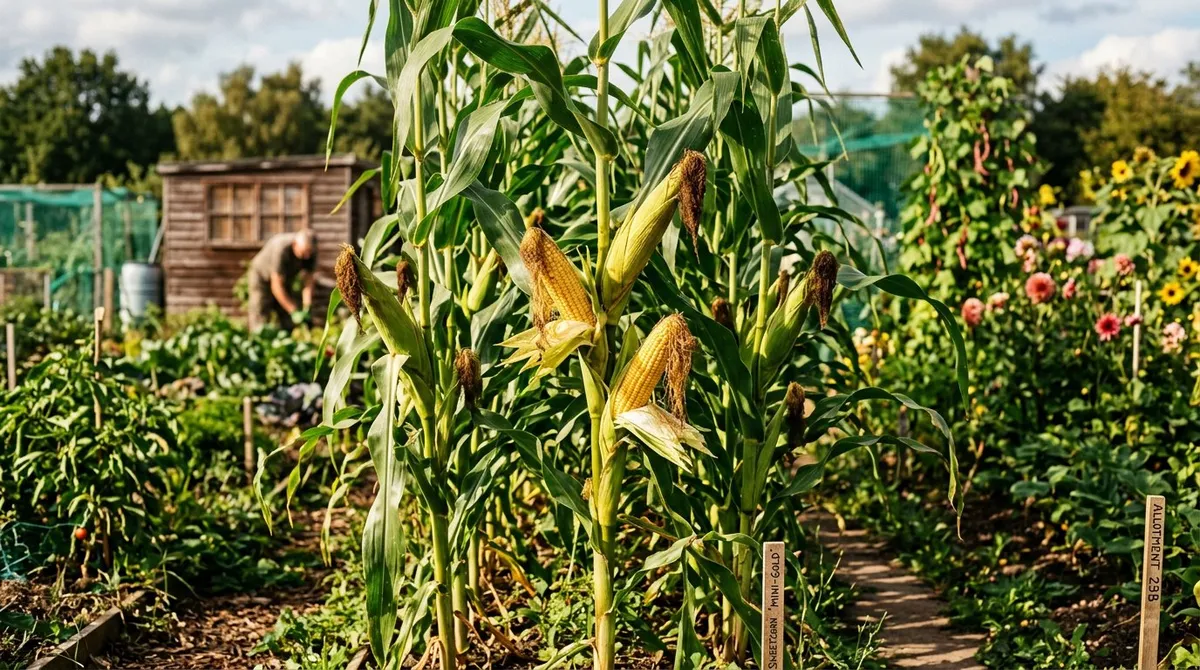
Sweetcorn picked fresh from your own garden tastes nothing like the supermarket version. The sugars start converting to starch within hours of harvest, so a cob cooked 10 minutes after picking is a different vegetable entirely. Growing sweetcorn in the UK is straightforward once you understand one critical rule: plant in blocks, never in rows.
The UK climate is warm enough for sweetcorn in most lowland areas south of the Scottish Highlands. Modern F1 hybrid varieties bred for shorter growing seasons mature in 70-90 days, making them reliable from Cornwall to Yorkshire. This guide covers variety selection, sowing indoors, block planting for pollination, spacing, feeding, the shake test, and harvesting at peak sweetness. If you are new to vegetable growing, start with our guide to starting a vegetable garden.
Best sweetcorn varieties for UK gardens
Choosing the right variety determines whether you get plump, sweet cobs or disappointing half-filled ears. UK growers need varieties that mature quickly in our shorter, cooler summers. There are three types of sweetcorn: normal, supersweet, and extra tender. Each handles the UK climate differently.
Normal (su) varieties have traditional corn flavour and are the most forgiving in cool conditions. Seeds germinate at lower soil temperatures (10-12C). The sugar content is moderate and converts to starch within hours of picking.
Supersweet (sh2) varieties contain roughly twice the sugar of normal types. They hold their sweetness longer after harvest. The trade-off is fussier germination: seeds need soil temperatures of at least 15C and rot easily in cold, wet ground. Never plant supersweet next to normal varieties. Cross-pollination makes supersweet kernels starchy and normal kernels tough.
Extra tender (se) varieties sit between the two. They have higher sugar than normal types, tender skins, and better cold tolerance than supersweet. These are the best compromise for most UK growers.
Recommended varieties
Swift F1 (extra tender) is the fastest-maturing variety for the UK, producing ripe cobs in 70-80 days. The plants reach 1.5-1.8m tall with good-sized cobs. This is the safest choice for northern gardens and cooler regions. If you only grow one variety, grow Swift.
Lark F1 (supersweet) matures in 80-85 days with exceptionally sweet, plump kernels. The cobs are large at 20-22cm. Lark needs warmer conditions than Swift and performs best in southern and central England.
Incredible F1 (supersweet) produces heavy yields of 20-25cm cobs with deep yellow kernels. It matures in 80-90 days. The flavour is outstanding. Incredible suits sheltered, warm gardens and is an excellent choice for south-facing plots.
Minipop is a dwarf variety grown specifically for baby corn. Pick the cobs at 8-10cm before pollination. The plants are compact at 1-1.2m tall, making them suitable for containers and small gardens. Minipop does not need block planting because you harvest before pollination matters.
Variety comparison table
| Variety | Type | Days to maturity | Cob size | Plant height | Min. soil temp | Best for |
|---|---|---|---|---|---|---|
| Swift F1 | Extra tender | 70-80 | 18-20cm | 1.5-1.8m | 10C | Northern UK, short seasons |
| Lark F1 | Supersweet | 80-85 | 20-22cm | 1.8-2m | 15C | Southern and central UK |
| Incredible F1 | Supersweet | 80-90 | 20-25cm | 1.8-2.2m | 15C | Warm, sheltered gardens |
| Minipop | Normal | 60-70 | 8-10cm (baby) | 1-1.2m | 10C | Baby corn, containers |
| Earlibird F1 | Normal | 75-85 | 18-20cm | 1.5-1.7m | 10C | Cooler areas, allotments |
Gardener’s tip: Keep supersweet and normal varieties at least 10m apart or stagger sowing times by 2 weeks. Cross-pollination ruins the texture of both types.
Sowing sweetcorn indoors
Starting sweetcorn indoors in April gives UK growers a 3-4 week head start over direct sowing. This extra time is often the difference between ripe cobs and unfinished ears caught by autumn frosts. Our guide to sowing seeds indoors covers the general technique in detail.
When to sow
Sow from mid-April to early May. Sweetcorn seedlings grow fast and become root-bound quickly. Aim to transplant 3-4 weeks after sowing. Count backwards from your expected last frost date. In southern England, that is typically mid-May. In northern England and Scotland, late May to early June.
How to sow
Sweetcorn has a long taproot and resents disturbance. Use deep modules, root trainers, or 8cm pots rather than seed trays. Sow one seed per cell, 2.5cm deep, in moist multipurpose compost. Place somewhere warm at 18-21C. A heated propagator, warm windowsill, or airing cupboard all work.
Seeds germinate in 7-10 days at 18C. Once shoots appear, move the pots to a bright windowsill or unheated greenhouse. Seedlings need maximum light to prevent them growing leggy and weak. Turn the pots daily to keep growth straight.
Hardening off
Before planting outdoors, harden off seedlings over 7-10 days. Place them outside during the day and bring inside at night. Gradually increase their exposure to wind and direct sun. Sweetcorn is frost-tender. A single late frost kills every plant. Do not rush this stage.
Planting out and block spacing
Transplant sweetcorn outdoors once all frost risk has passed and soil temperature reaches 10C at a depth of 10cm. In most of England, this means late May to early June. In Scotland and northern areas, wait until mid-June.
Why blocks matter
This is the single most important rule for growing sweetcorn. Plant in square or rectangular blocks, never in single rows. Sweetcorn is wind-pollinated. Each plant produces male flowers (tassels) at the top and female flowers (silks) partway down the stem. Pollen must fall from the tassels onto every silk thread. Each silk connects to one kernel. An unpollinated silk produces no kernel, leaving gaps on the cob.
A block formation catches pollen drifting from any direction. A single row only catches pollen from two sides, leaving 40-60% of silks unpollinated. The result is cobs dotted with empty spaces instead of full, plump rows of kernels.
Spacing and layout
Space plants 45cm apart in all directions within the block. A minimum 4x4 grid (16 plants) gives acceptable pollination. A 5x5 grid (25 plants) is better. Larger blocks produce the fullest cobs.
| Block size | Plants needed | Plot dimensions | Pollination quality |
|---|---|---|---|
| 3x3 | 9 | 1.35m x 1.35m | Poor, expect gaps |
| 4x4 | 16 | 1.8m x 1.8m | Acceptable minimum |
| 5x5 | 25 | 2.25m x 2.25m | Good |
| 4x6 | 24 | 1.8m x 2.7m | Good |
| 5x6 | 30 | 2.25m x 2.7m | Excellent |
How to plant
Dig a hole slightly larger than the root ball. Plant at the same depth as the seedling sat in its pot. Firm the soil gently and water in well. Adding a handful of garden compost to each planting hole improves moisture retention in sandy soils.
Sweetcorn roots spread wide rather than deep. In windy sites, earth up the base of each stem to 10-15cm height as the plants grow. This buries the brace roots (the aerial roots that appear at the base of the stem) and improves stability. Plants that topple in wind rarely recover fully.
Month-by-month growing calendar
This calendar covers the full sweetcorn season from March to October. Adjust timings by 2-3 weeks later for northern England and Scotland.
| Month | Task |
|---|---|
| March | Prepare the planting site. Dig in compost or well-rotted manure. Cover soil with black polythene to warm it |
| April | Sow seeds indoors from mid-April at 18-21C. Use deep pots or root trainers. One seed per cell, 2.5cm deep |
| May | Harden off seedlings over 7-10 days. Plant out in blocks after the last frost (late May in the south). Direct sow outdoors in warm areas |
| June | Earth up stems to 10-15cm as brace roots appear. Water regularly. Mulch around plants with 5cm of compost. Plant out in northern regions |
| July | Tassels appear. Shake plants gently in calm weather to spread pollen. Water deeply during tasselling and silking. Feed with high-potash fertiliser |
| August | Silks darken from pale green to brown as cobs develop. Continue watering. Monitor for earworm damage. Early varieties like Swift may be ready late August |
| September | Main harvest month. Test kernels with the thumbnail test. Pick cobs with milky juice. Cook within hours for best flavour |
| October | Clear spent plants. Add stems to the compost heap after chopping into short sections. Note which varieties performed best for next year |
Watering and feeding
Sweetcorn is a hungry, thirsty crop. The plants are large, grow fast, and produce grain, which demands significant water and nutrients. Getting the watering right during two critical growth stages makes the difference between full cobs and disappointing ones.
Watering
Water regularly throughout the growing season, but two periods are critical. The first is tasselling (when the male flowers appear at the top of the plant). The second is silking (when the female threads emerge from the developing cobs). Drought during either stage causes catastrophic pollination failure and shrivelled kernels.
During tasselling and silking, water deeply every 2-3 days, applying 25-30 litres per square metre per week. Shallow daily watering encourages surface roots that make plants more vulnerable to drought. Deep watering drives roots down into reliably moist subsoil.
Mulch the block with 5-8cm of garden compost, straw, or grass clippings after planting out. Mulch reduces water loss, suppresses weeds, and keeps roots cool. Sweetcorn competes poorly with weeds, so keeping the block clean is essential.
Feeding
Sweetcorn is a nitrogen-hungry crop. Before planting, dig in plenty of well-rotted manure or garden compost. This provides the bulk of the nitrogen the plants need. If your soil is poor, apply a balanced granular fertiliser (such as Growmore at 70g per square metre) before planting.
When tassels appear in July, switch to a high-potash liquid feed (such as tomato fertiliser) every 10-14 days. Potash supports cob development and kernel fill. Continue feeding until the silks turn brown.
Avoid heavy nitrogen feeding after tasselling. Late nitrogen promotes leafy growth at the expense of cob development. The plant should be putting its energy into filling kernels, not producing more leaves.
Pollination and the shake test
Understanding pollination is the key to full, satisfying cobs. Many first-time growers end up with sparsely filled ears, and poor pollination is almost always the cause.
How sweetcorn pollination works
Each tassel (the feathery structure at the top of the plant) releases millions of pollen grains over 5-7 days. The pollen is light and carried by wind. Each silk thread emerging from the husk connects to a single potential kernel on the cob. Every silk must catch at least one pollen grain to produce a kernel.
A single plant produces 2-5 million pollen grains. In a well-planted block, enough pollen reaches every silk to fill the cob completely. In a single row, pollen blows past and most silks never catch a grain.
The shake test
In calm, still weather, pollination can fail even in a well-planted block because the pollen is not dispersing. Walk through your sweetcorn patch in the morning (when pollen release peaks) and gently shake each plant by grasping the stem and giving it a firm wobble. You will see a visible cloud of yellow pollen drift down onto the silks below.
Do this every morning during the 5-7 day tasselling period. It takes 2-3 minutes for a block of 20 plants and dramatically improves kernel fill.
Signs of poor pollination
Peel back a husk carefully 3 weeks after silking. If you see gaps with no kernels forming, pollination has failed in those spots. There is nothing you can do to fix it after the fact. The lesson is for next year: more plants, tighter block, and daily shaking in calm weather.
Harvesting sweetcorn at the right moment
Timing the harvest is critical. Pick too early and the kernels are watery and flavourless. Pick too late and they turn starchy and doughy. The window of peak sweetness lasts only 3-5 days per cob.
When to harvest
Cobs are typically ready 6 weeks after the silks first appear, usually from late August to September for most UK-grown varieties. As the cob ripens, the silks change from pale green or white to dark brown. The husk turns from bright green to a slightly paler shade.
Dark silks alone do not confirm readiness. Use the thumbnail test for certainty.
The thumbnail test
This simple test tells you exactly when to pick.
- Peel back a small section of husk to expose a few kernels near the tip of the cob
- Press your thumbnail firmly into a kernel
- Check the juice:
- Watery clear liquid = too early, wait 5-7 more days
- Milky white liquid = perfect, harvest now
- Thick, doughy paste = overripe, still edible but starchier
Check one cob as a test. If it shows milky juice, harvest all cobs at a similar stage of silk browning. Work through the block over 7-10 days as cobs ripen at slightly different rates.
How to pick
Grasp the cob firmly and twist and pull downward in one motion. It should snap cleanly from the stem. Each plant produces 1-2 cobs. The top cob ripens first. The second cob (if present) follows 5-7 days later and is usually slightly smaller.
After picking
Sweetcorn loses up to 50% of its sugar within 24 hours of harvest at room temperature. For the sweetest flavour, cook within 30 minutes of picking. Boil for 4-5 minutes, steam for 6-7 minutes, or grill over hot coals for 10-12 minutes.
If you cannot cook immediately, refrigerate the cobs in their husks. Cold temperatures slow the sugar-to-starch conversion. Supersweet varieties hold their sweetness longer than normal types, but fresh is always best.
To freeze for later use, blanch husked cobs in boiling water for 4 minutes, plunge into ice water, dry, and freeze whole or cut the kernels from the cob. Frozen sweetcorn stores well for 8-10 months.
Growing sweetcorn in raised beds
Sweetcorn grows well in raised beds, which offer warmer soil, better drainage, and easier management. A standard 1.2m x 2.4m raised bed holds a 3x5 block of 15 plants at 45cm spacing. This is adequate for pollination, though a second bed alongside improves it.
Fill the bed with a mix of topsoil, garden compost, and well-rotted manure. Sweetcorn drains raised beds of nutrients fast, so replenish with fresh compost each spring. Water more frequently than ground-planted sweetcorn, as raised beds dry out faster.
Position the sweetcorn bed on the north side of the vegetable garden. The plants grow 1.5-2.2m tall and cast significant shade. Placing them to the north prevents them shading shorter crops like lettuce, carrots, and herbs.
Companion planting: the three sisters
The traditional Three Sisters method from Native American agriculture grows sweetcorn, climbing beans, and squash together. The sweetcorn provides a climbing frame for the beans. The beans fix nitrogen in the soil for the corn. The squash shades the ground, suppressing weeds and retaining moisture.
To try this in a UK garden, plant sweetcorn first and let it establish to 15-20cm tall. Then sow climbing French beans (not runner beans, which are too vigorous) at the base of every other corn plant. Sow squash or courgette seedlings between the corn blocks.
The Three Sisters method works best with normal (su) corn varieties that produce strong, thick stems. Supersweet varieties tend to be slimmer and may buckle under heavy bean growth.
Pests and problems
Sweetcorn in the UK suffers fewer pest problems than many vegetables. The main issues are environmental rather than pest-related.
Slugs and snails attack young transplants at ground level. Use organic slug pellets, beer traps, or copper tape around raised beds for the first 3-4 weeks after planting out. Once stems thicken, slug damage becomes negligible.
Birds (particularly pigeons and crows) pull up freshly planted seedlings and peck at ripening cobs. Cover newly planted blocks with netting or fleece for the first 2 weeks. As cobs ripen, individual cob bags or nets deter birds.
Earworm (corn earworm moth larvae) occasionally tunnels into the tip of ripening cobs. Damage is usually cosmetic. Cut away the affected tip and the rest of the cob is fine. There is no chemical control available to UK home gardeners. Early-maturing varieties often escape earworm damage.
Lodging (plants falling over in wind) is common in exposed sites. Earth up stems to 15cm height. Plant in a sheltered position or use a windbreak. Avoid high-nitrogen feeds late in the season, which produce tall, weak stems.
Poor germination affects supersweet varieties in cold soil. Wait until soil reaches 15C before direct sowing. Indoor sowing avoids this problem entirely. Normal and extra tender varieties germinate reliably at 10-12C.
Five common mistakes to avoid
1. Planting in a single row. This is the most common mistake and guarantees poor pollination. Always plant in blocks of at least 4x4. A single row of sweetcorn might look tidy, but the cobs will be half empty. Block planting is non-negotiable.
2. Sowing too early outdoors. Sweetcorn seeds rot in cold, wet soil below 10C. Direct sowing before late May in southern England (or early June in the north) usually fails. Check soil temperature with a thermometer rather than guessing from the calendar.
3. Not watering enough during tasselling. Drought during the 2-week pollination window ruins the entire harvest. The plants look fine, but the cobs fill poorly. Water deeply every 2-3 days when you see tassels and silks, even if the rest of the garden seems wet enough.
4. Harvesting too late. Once you miss the milky stage, the sugars convert to starch rapidly. Check cobs daily once the silks turn brown. The difference between a perfect cob and a starchy one is just 3-5 days. Use the thumbnail test on every batch.
5. Growing supersweet next to normal varieties. Cross-pollination between the two types ruins both. Supersweet kernels become tough and starchy. Normal kernels develop an unpleasant texture. Keep the types at least 10m apart or sow them 2 weeks apart so they tassel at different times.
Why we recommend Swift F1 sweetcorn: After 30 years of growing sweetcorn across different UK regions, Swift F1 consistently outperforms other varieties in cool, short summers. In trials on a north-facing Yorkshire plot, Swift F1 produced fully ripe cobs in 75 days when Incredible F1 was still 10 days from harvest as the first frosts arrived.
Now you’ve mastered sweetcorn, read our guide on starting a vegetable garden to plan your full plot layout and get the most from your growing space.
Growing sweetcorn from seed outdoors
Direct sowing outdoors works in warmer parts of the UK but carries more risk than indoor sowing. The advantage is simplicity: no transplanting, no hardening off, and no root disturbance.
Wait until the soil reaches 10-12C at 10cm depth for normal and extra tender varieties, or 15C for supersweet types. In most of southern England, this is late May to early June. Use a soil thermometer rather than relying on air temperature, which can be misleading.
Mark out your block with string lines at 45cm intervals. Sow two seeds per station, 4cm deep. Once both germinate, remove the weaker seedling. This avoids gaps from non-germinating seeds.
Cover the sown area with horticultural fleece or cloches for the first 3 weeks. This raises the soil temperature by 2-3C and protects from late cold snaps. Remove the covering once plants reach 15cm tall. For more sowing advice, check our UK vegetable planting calendar.
Storing and preserving the harvest
Fresh sweetcorn does not store well. The flavour drops noticeably within hours. However, two preservation methods capture the sweetness effectively.
Freezing is the best method. Husk the cobs, remove the silks, and blanch in boiling water for 4 minutes. Transfer to iced water for 4 minutes to stop cooking. Drain thoroughly. Freeze whole cobs in freezer bags, or stand the cob upright and slice the kernels off with a sharp knife. Frozen kernels store for 8-10 months and work well in soups, stir-fries, and fritters.
Drying is traditional but less common in the UK. Leave cobs on the plant until the husks are fully dry and papery. Shell the kernels and store in airtight jars. Dried corn is used for grinding into cornmeal rather than eating fresh.
For fresh eating, refrigerate unhusked cobs immediately after picking. The husk retains moisture and the cold slows sugar conversion. Eat within 48 hours for best results.
Frequently asked questions
The Royal Horticultural Society recommends sweetcorn as a rewarding crop for UK gardeners. The following questions address the most common challenges growers face.
When should I sow sweetcorn in the UK?
Sow indoors from mid-April at 18-21C. Use deep pots or root trainers because sweetcorn resents root disturbance. Plant outdoors after the last frost, typically late May in southern England and early June in northern regions. Direct sowing outdoors in late May works in warmer areas but gives a later harvest.
Why do I need to plant sweetcorn in a block?
Sweetcorn is wind-pollinated, not insect-pollinated. Pollen falls from the male tassels onto the female silks below. A block formation catches pollen from all directions. Single rows leave most silks unpollinated, producing cobs with missing kernels. A 4x4 block is the minimum for reliable pollination.
How much space does sweetcorn need?
Space plants 45cm apart in all directions. A 4x4 block of 16 plants needs a plot 1.8m x 1.8m. Each plant produces 1-2 cobs. For a family of four, grow 20-24 plants in a block roughly 2m x 2.5m.
Can I grow sweetcorn in containers?
Yes, but results are limited. Use pots at least 30cm diameter and 40cm deep. Group containers tightly together to form a block for pollination. Water daily in summer as pots dry out fast. Dwarf varieties like Minipop give the best container results.
How do I know when sweetcorn is ready to pick?
Use the thumbnail test on a kernel. Peel back the husk, press a kernel with your thumbnail. Watery juice means too early. Milky white juice means perfect. Doughy paste means overripe. The silks also turn dark brown when cobs are ready, usually 6 weeks after silks first appear.
What is the difference between supersweet and normal sweetcorn?
Supersweet varieties contain twice the sugar of normal types. They hold their sweetness longer after picking. However, supersweet seeds need warmer soil (15C minimum) and germinate less reliably in cool UK springs. Normal varieties are more forgiving and better for beginners.
Why does my sweetcorn have missing kernels?
Missing kernels mean poor pollination. The most common cause is planting in rows instead of blocks. Other causes include dry weather during pollination, insufficient plants, and physical barriers blocking wind flow. Shake the tassels by hand in calm weather to help distribute pollen.
Lawrie has been gardening in the West Midlands for over 30 years. He grows his own veg using no-dig methods, keeps a wildlife-friendly garden, and writes practical advice based on real UK growing conditions.