How to Grow Turnips and Swede in the UK
Complete UK guide to growing turnips and swede. Covers varieties, sowing times, soil preparation, pest prevention, harvesting, and storing root crops.
Key takeaways
- Turnips mature in just 6-8 weeks, making them one of the fastest root vegetables to grow in the UK
- Swede needs 20-26 weeks to mature and should be sown in May or June for autumn and winter harvests
- Harvest turnips young at golf-ball size (5-7cm) for the sweetest, most tender roots
- Swede tastes sweeter after the first autumn frosts, which convert starch to sugar in the roots
- Flea beetle is the most damaging pest on seedlings and is controlled with fleece or fine mesh
- Both crops store in the ground over winter or in boxes of damp sand for up to 4 months
Turnips and swede are two of the most reliable root vegetables for UK gardens. They belong to the same brassica family, grow in similar conditions, and both tolerate the cold, wet winters that defeat many other crops. Yet they differ significantly in growing speed, flavour, and use in the kitchen.
Turnips are fast. Sow in spring or summer and you can be pulling roots within six weeks. Swede is a long-season crop that needs five to six months in the ground but rewards patience with large, sweet roots that are at their best after the first frosts. Growing both gives you fresh root vegetables from May right through to the following March.
This guide covers everything from soil preparation and variety choice through to pest control, harvesting, and long-term storage, written for British growing conditions and seasons.
What is the difference between a turnip and a swede?
The two crops look similar in the ground but differ in almost every other way. Understanding these differences matters because it affects when you sow, how long you wait, and how you use the harvest.
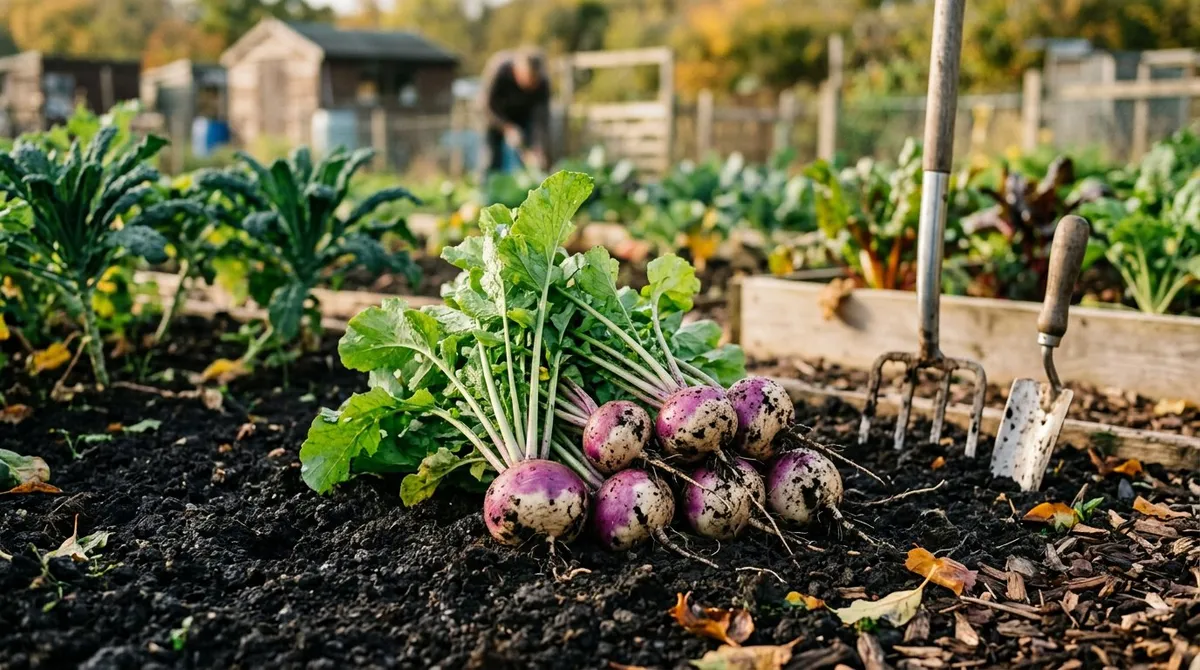
Turnips (Brassica rapa) are small, fast-growing roots with white flesh and a mild, slightly peppery flavour. Most varieties have a distinctive purple or red top where the root sits above the soil. They mature in just 6-8 weeks and are best eaten young, before the flesh turns woody and strong-tasting.
Swede (Brassica napus) is a larger, slower-growing root with dense yellow-orange flesh and a sweet, nutty flavour. It is botanically a hybrid between a turnip and a wild cabbage. Swede takes 20-26 weeks to mature, grows to 10-15cm in diameter, and improves in flavour after frost exposure.
In Scotland, what the English call a swede is called a “turnip” or “neep”. This causes endless confusion at Burns Night suppers. For clarity, this guide uses the English terminology throughout.
Turnip vs swede comparison
| Feature | Turnip | Swede |
|---|---|---|
| Botanical name | Brassica rapa | Brassica napus |
| Weeks to harvest | 6-8 | 20-26 |
| Sowing window | March to August | May to June |
| Harvest size | 5-7cm (golf ball) | 10-15cm |
| Flesh colour | White | Yellow-orange |
| Flavour | Mild, slightly peppery | Sweet, nutty |
| Frost tolerance | Moderate | Excellent |
| Best uses | Salads, stir-fries, roasting, greens | Mashing, soups, stews, roasting |
| Improves after frost | No | Yes |
| Tops edible | Yes (traditional greens) | Yes (but coarser) |
Gardener’s tip: Grow both crops together for year-round root vegetables. Sow turnips every few weeks from March for quick harvests, and put swede in the ground in May or June for winter supplies.
Best turnip varieties for UK gardens
Choosing the right turnip variety determines how quickly you harvest and what you use the roots for. All of the varieties below are widely available from UK seed suppliers and perform reliably in British conditions.
Purple Top Milan is the classic British turnip. It produces flattened, globe-shaped roots with a distinctive purple crown and white base. The flesh is fine-grained and mild when pulled young. Ready in 6-8 weeks. It is the standard variety for spring and summer sowings and has been grown in UK gardens for over a century.
Snowball is a quick-maturing white variety with round, smooth roots and exceptionally mild flavour. It matures in 5-6 weeks, making it the fastest turnip available. The pure white skin and flesh look attractive on the plate. Best for early sowings and succession planting through summer.
Tokyo Cross F1 is a Japanese hybrid that produces smooth, white, globe-shaped roots in just 5-6 weeks. The flavour is mild and sweet, with none of the bitterness that older varieties can develop. It is excellent raw in salads, sliced thinly. Tokyo Cross also has good bolt resistance, making it suitable for late summer sowings.
Atlantic is a reliable maincrop variety with purple-topped roots. Slightly larger than Purple Top Milan at maturity and with good storage quality. Ready in 7-8 weeks. A solid choice if you want roots for cooking rather than salads.
Market Express F1 is another fast hybrid with small, white roots ready in 7 weeks. It holds its quality well in the ground without becoming woody, giving a wider harvest window than most varieties.
Turnip tops varieties
Some turnip varieties are grown specifically for their leafy tops rather than their roots. Namenia and Topper produce abundant, tender greens harvested at 10-15cm tall. Sow thickly in rows 15cm apart and cut like a salad crop. The leaves regrow for multiple harvests.
Best swede varieties for UK gardens
Fewer swede varieties are available than turnip varieties, but the ones in cultivation are well-suited to British conditions. Swede breeding focuses on clubroot resistance, smooth skin, and dense, flavourful flesh.
Marian is the most widely grown swede in UK gardens and allotments. It has good resistance to clubroot and powdery mildew, two of the main diseases affecting swede in Britain. The roots are large, globe-shaped, and purple-topped with dense yellow flesh. Flavour is excellent, especially after frost. Ready in 22-24 weeks.
Best of All is an older heritage variety with good flavour and reliable performance. The roots are slightly smaller than Marian but with a finer texture. It lacks the clubroot resistance of modern varieties, so avoid growing it on land where brassicas have had clubroot problems.
Invitation F1 is a modern hybrid with strong clubroot resistance and smooth, uniform roots. The flesh is bright yellow and cooks to a creamy consistency. Ready in 20-22 weeks. It is the best choice for allotments or gardens where clubroot is known to be present in the soil.
Tweed F1 has some of the highest clubroot resistance available. The roots are large and store well. Flavour is good, though slightly less sweet than Marian. Choose Tweed if clubroot is your main concern.
Ruby has attractive reddish-purple skin and yellow flesh. It matures in 22-26 weeks and stores well. The flavour is sweet and smooth after frost.
Gardener’s tip: If you have never had clubroot on your plot, Marian or Best of All will give the best flavour. If clubroot is present or you are growing on an allotment with unknown history, choose Invitation F1 or Tweed F1 for their disease resistance.
When and how to sow turnips
Turnips are sown directly where they will grow. They dislike transplanting, as root disturbance causes forked or misshapen roots. The fast growth rate means you can sow multiple batches through the season for a continuous supply.
Sowing timetable for turnips
| Month | Action | Notes |
|---|---|---|
| March | First sowing under cloches | Use early varieties (Snowball, Tokyo Cross F1). Soil must be 5C+ |
| April | First outdoor sowing | Main season begins. All varieties suitable |
| May | Second succession sowing | Warm soil gives fastest germination |
| June | Third succession sowing | Continue for summer and early autumn harvest |
| July | Fourth succession sowing | Last sowing for maincrop varieties |
| August | Final sowing | Fast varieties only (Tokyo Cross F1, Snowball) for October harvest |
Check our UK vegetable planting calendar for regional timing adjustments.
Sowing method
- Rake the soil to a fine tilth and remove stones from the top few centimetres
- Draw a shallow drill 1-2cm deep using a cane or the edge of a hoe
- Water the drill if the soil is dry
- Sow seed thinly along the drill, aiming for one seed every 2-3cm
- Cover with fine soil and firm gently
- Space rows 23-30cm apart
Turnip seed is small and easy to sow too thickly. Sowing thinly reduces the amount of thinning needed later. Germination takes 7-14 days depending on soil temperature.
Thinning turnip seedlings
Thinning is essential for good-sized roots. When seedlings have two true leaves (beyond the initial seed leaves), thin to 10-15cm apart. Closer spacing produces baby turnips, which is fine if that is what you want. For full-sized roots at 5-7cm diameter, 15cm spacing gives each plant enough room.
Thin in the evening when flea beetles are less active. Water the row after thinning to resettle the soil around remaining plants.
When and how to sow swede
Swede has a much narrower sowing window than turnips. It needs a long, uninterrupted growing season of 20-26 weeks, and sowing too early risks bolting from cold exposure.
Sowing timetable for swede
| Month | Action | Notes |
|---|---|---|
| May | Sow in southern England | Soil temperature reliably above 10C |
| June | Sow in northern England and Scotland | Main sowing window for cooler regions |
That is the full sowing window. Earlier sowings bolt. Later sowings do not have enough growing time before winter.
Sowing method
- Prepare the soil as for turnips, raking to a fine tilth
- Draw drills 1-2cm deep, spacing rows 38-40cm apart (swede grows larger than turnips)
- Sow thinly along the drill
- Cover and firm gently
- Water well if conditions are dry
When seedlings have two true leaves, thin to 23-25cm apart. Swede needs more space than turnips because the roots grow much larger. Crowded plants produce small, tough roots.
Preparing the soil for turnips and swede
Both crops grow best in fertile, well-drained soil with a pH of 6.5-7.0. As brassicas, they prefer slightly alkaline conditions and struggle in very acidic soil.
Dig in well-rotted compost the autumn before sowing. This improves structure and moisture retention without the excess nitrogen that causes leafy growth at the expense of root development. Do not add fresh manure immediately before sowing. Fresh manure causes forked roots and can encourage disease.
Heavy clay soil needs extra preparation. Work in coarse grit and composted bark to improve drainage. Waterlogged soil causes roots to rot. Improving clay soil before planting makes a significant difference to root crop performance.
Light sandy soil drains too freely and dries out quickly. Add organic matter to improve water retention. Mulching around plants in summer prevents the soil surface from baking hard.
Raised beds filled with a loamy compost mix solve most soil problems for root crops. The controlled environment and improved drainage give excellent results.
Crop rotation
Turnips and swede are brassicas and must be included in your brassica rotation. Never grow them in the same spot two years running. Ideally, leave three years between brassica crops on the same ground. This reduces the risk of clubroot and other soil-borne diseases.
In a four-year rotation, follow legumes (peas and beans) with brassicas. The nitrogen fixed by legume roots benefits the following brassica crop.
How to care for turnips and swede through the season
Watering
Consistent moisture produces the best roots. Irregular watering causes woody texture, splitting, and a bitter or hot flavour in turnips. Water thoroughly during dry spells, aiming for a deep soak once or twice a week rather than light daily sprinkles.
Swede is slightly more drought-tolerant than turnips once established, but still needs regular water during dry summers. Mulching around plants with straw or grass clippings retains soil moisture and suppresses weeds.
Feeding
Neither crop is a heavy feeder. Well-prepared soil with composted organic matter provides enough nutrition. Avoid high-nitrogen feeds, which push leafy growth at the expense of the root. If growth seems slow, a light dressing of a balanced general-purpose fertiliser in midsummer helps swede along.
Weeding
Keep the bed weed-free, especially in the first four weeks. Young turnip and swede seedlings are small and easily overwhelmed by faster-growing weeds. Hand-weed carefully around seedlings to avoid root disturbance.
Dealing with flea beetle on turnip and swede seedlings
Flea beetle is the most serious pest of young turnip and swede plants in UK gardens. These tiny black beetles jump like fleas when disturbed and chew small, round holes in the leaves of seedlings. A heavy attack can destroy a row of seedlings within days, leaving nothing but skeletonised leaves.
Prevention
The most effective control is a physical barrier. Cover rows with horticultural fleece or fine mesh (Enviromesh or similar) immediately after sowing. Anchor the edges with soil or pegs so beetles cannot get underneath. Leave the cover in place until plants have at least four true leaves and are growing strongly.
Cultural controls
- Keep soil moist. Flea beetles thrive in hot, dry conditions. Water overhead in the evening to create a damp environment they dislike.
- Sow at the right time. Mid-spring and early summer sowings grow quickly through the vulnerable seedling stage. Very early or very late sowings grow slowly and are exposed to beetle damage for longer.
- Clear brassica debris. Flea beetles overwinter in old brassica stumps and leaf litter. Remove crop debris promptly after harvest.
Other pests and diseases
Clubroot is the most damaging disease of turnips and swede. It is a soil-borne pathogen that causes swollen, distorted roots and stunted growth. Once present in the soil, it persists for 20 years or more. Prevention is far better than cure.
To avoid clubroot:
- Maintain soil pH above 7.0 by liming in autumn
- Improve drainage, as clubroot thrives in wet, acidic soil
- Never transfer soil from infected ground on boots or tools
- Grow resistant varieties (Marian, Invitation F1, Tweed F1 for swede)
- Follow a strict brassica rotation of at least three years
Cabbage root fly lays eggs at the base of young plants. The larvae burrow into the root and cause tunnels and rot. Use brassica collars (15cm cardboard or carpet discs) around the base of each plant to prevent egg-laying.
Powdery mildew appears as white powdery patches on leaves in late summer. It weakens the plant but rarely kills it. Remove badly affected leaves. Good air circulation and adequate watering reduce the risk. The variety Marian has useful mildew resistance.
Eating turnip tops as greens
Turnip tops are a traditional British vegetable that has fallen out of fashion but deserves a revival. The young leaves are tender, nutritious, and taste like a mild, peppery version of spring greens.
When to harvest. Cut the tops when leaves are 10-15cm tall. Use a sharp knife to cut across the plant 3-5cm above the root. The plant regrows for a second and sometimes third harvest. Alternatively, pick individual outer leaves without removing the growing point.
How to cook. Wash the leaves and strip them from any tough central stems. Wilt in a pan with a small amount of water, butter, and a pinch of salt for 3-4 minutes. They reduce in volume like spinach. Serve as a side vegetable with roast meat, or chop into soups and pasta.
Nutritional value. Turnip tops are rich in vitamins A, C, and K, as well as calcium and iron. They contain more vitamin C per serving than the root itself.
Some gardeners grow fast-maturing turnip varieties specifically for their tops, sowing thickly in rows 15cm apart and cutting the greens repeatedly. This is a productive way to use a small space, especially in spring before other greens are available.
How to harvest turnips at the right time
Timing the turnip harvest is straightforward but important. Pull roots too late and they turn woody, fibrous, and unpleasantly hot in flavour.
Harvest turnips at golf-ball size, roughly 5-7cm in diameter. At this stage, the flesh is crisp, juicy, and mild. The skin is thin enough to eat without peeling. Smaller roots, pulled at 3-4cm, are even more tender and excellent raw in salads or sliced into stir-fries.
The top of the root pushes above the soil as it matures, making it easy to judge the size without digging. Grasp the foliage near the base and pull with a firm, steady motion. In heavy soil, loosen the ground with a fork first.
Do not leave turnips in the ground too long. Roots over 8cm become woody and develop a strong, almost bitter flavour that overwhelms cooking. Unlike swede, turnips do not improve with size. Small is better.
Spring and summer-sown turnips should be harvested as soon as they reach the right size. They do not store well in warm conditions and quickly turn pithy.
How to harvest swede
Swede is the opposite of turnips. Patience produces the best results. The roots need 20-26 weeks in the ground and taste significantly better after frost.
Harvest from late October onwards. The roots are ready when the top pushes above the soil and measures 10-15cm in diameter. There is no rush. Swede sits happily in the ground through autumn and winter, and each frost makes it sweeter.
The reason is simple: frost triggers the plant to convert starch reserves in the root into sugars as a natural antifreeze. This is why a swede pulled in November tastes markedly sweeter than one pulled in September.
To harvest, push a garden fork into the ground beside the root and lever it out. Swede roots sit deeply and firmly in the soil. Pulling by the foliage alone often snaps the leaves, leaving the root behind.
Swede can stay in the ground until February or March in most UK regions. In areas with severe, prolonged frost (consistently below -10C), cover the row with a thick layer of straw or bracken for protection.
The RHS vegetable growing guide confirms that swede is fully hardy across the UK and overwinters successfully in all but the coldest highland sites.
Storing turnips and swede over winter
Storing in the ground
The simplest storage method for both crops is to leave roots in the ground and lift them as needed. This works well for swede, which is fully frost-hardy and stays firm through winter. Cover the row with straw, bracken, or fleece for added frost protection.
Turnips are less frost-hardy than swede. Light frost is fine, but prolonged hard freezes (below -5C) damage the roots. In milder regions of southern England, turnips overwinter in the ground without problems. In colder areas, lift and store them before the first hard frost.
Storing in sand
For longer-term storage or where leaving roots in the ground is not practical, the sand-box method works well for both crops.
- Lift roots carefully with a fork
- Twist off the foliage 3cm above the crown (do not cut)
- Brush off loose soil but do not wash
- Layer roots in a box of damp (not wet) sand so they do not touch
- Store in a cool, dark, frost-free place at 1-5C
- A garage, unheated shed, or cellar is ideal
Swede stored this way keeps for 3-4 months. Turnips keep for 6-8 weeks before softening. Check stored roots monthly and remove any showing signs of rot.
Freezing
Both crops freeze well after blanching. Peel, dice into 2cm cubes, and blanch in boiling water for 2 minutes. Cool in iced water, drain, and freeze in portions. Frozen turnip and swede keep for 6-8 months and are ready to use directly in soups, stews, and mashes.
Month-by-month growing calendar
This calendar covers the full season for both turnips and swede. Adjust timings by two weeks later for northern England and Scotland.
| Month | Turnips | Swede |
|---|---|---|
| February | Order seeds. Plan crop rotation | Order seeds. Prepare beds with compost |
| March | First sowing under cloches (Snowball, Tokyo Cross F1) | Lime acidic soil if needed |
| April | First main outdoor sowing. Thin March sowings | Continue soil preparation |
| May | Second succession sowing. Harvest first early roots | Sow in southern England |
| June | Third succession sowing. Continue harvesting | Sow in northern England and Scotland. Thin May sowings |
| July | Fourth sowing. Keep harvesting spring crops | Thin June sowings. Water in dry weather |
| August | Final sowing (fast varieties). Harvest summer crops | Keep watered. Watch for mildew |
| September | Harvest late summer roots. Sow turnip tops for autumn greens | Roots swelling. Continue watering |
| October | Lift remaining roots before hard frost or protect with straw | Begin harvesting after first frost |
| November | Clear spent crops. Prepare beds for next year | Harvest as needed. Flavour improving with frost |
| December | Eat stored roots | Harvest as needed from the ground |
| January | Plan next season. Order seeds | Harvest as needed. Roots keep well in cold soil |
Five common mistakes when growing turnips and swede
Even experienced growers make these errors. Avoiding them is the difference between sweet, tender roots and woody, disappointing crops.
1. Leaving turnips too long before harvesting
The single most common mistake with turnips. Roots left past golf-ball size become woody, fibrous, and develop a hot, bitter flavour. The temptation to wait for larger roots always produces a worse result. Pull at 5-7cm and eat them promptly. If you want large roots for winter storage, grow swede instead.
2. Sowing swede too early
Swede bolts if exposed to prolonged cold temperatures during early growth. Sowing in March or April seems logical for a crop that needs 20-plus weeks, but the cold triggers flowering instead of root formation. Wait until May in the south and June in the north. There is no shortcut.
3. Ignoring flea beetle
New growers often do not recognise flea beetle damage until it is too late. The tiny holes in seedling leaves look harmless at first, but a heavy attack kills young plants within days. Cover with fleece at sowing time, not after you spot the damage. Prevention is the only reliable control.
4. Not thinning early enough
Crowded seedlings compete for light, water, and nutrients. The result is a row of small, tough, misshapen roots instead of a few well-spaced, large ones. Thin turnips to 10-15cm and swede to 23-25cm as soon as seedlings have two true leaves. Do not wait until the row looks overcrowded.
5. Growing on clubroot-infected soil without resistant varieties
Clubroot persists in soil for 20 years. If you see swollen, distorted roots on any brassica crop, the soil is infected. Growing susceptible turnip and swede varieties on that ground produces the same result year after year. Switch to clubroot-resistant varieties (Invitation F1 or Tweed F1 for swede) and lime the soil to push pH above 7.0.
Growing turnips and swede in raised beds and containers
Both crops grow well in raised beds, where you can control soil quality and drainage. Fill beds with a mix of topsoil, well-rotted compost, and coarse grit for an ideal root-growing medium.
Turnips suit containers at least 20cm deep. A 40cm-diameter pot holds 4-5 plants at 10cm spacing. Use fast-maturing varieties like Tokyo Cross F1 or Snowball for the best container results. Water regularly, as containers dry out faster than open ground.
Swede is less practical in containers because of its large root size and long growing season. It needs a deep container (30cm minimum) and occupies the space for five to six months. If you have limited space, prioritise turnips in containers and grow swede in the ground or in deep raised beds.
For both crops, use multipurpose compost mixed with a handful of perlite for drainage. Avoid compost with high nitrogen levels, which promotes leaf growth over root development.
Companion planting with turnips and swede
Both crops benefit from thoughtful companions in the vegetable garden.
Good companions include peas, lettuce, and nasturtiums. Peas fix nitrogen in the soil, which benefits the following season’s brassica crop. Lettuce provides a living mulch between rows. Nasturtiums attract aphids away from your root crops.
Avoid planting near other brassicas (cabbage, broccoli, cauliflower) in the same bed. Clustering brassicas increases the risk of clubroot spread and attracts cabbage root fly to the area. Space brassica crops across different parts of the plot.
If you are new to vegetable gardening, planning your layout with companion planting and crop rotation in mind prevents many common problems before they start.
Why we recommend Marian swede on allotment plots: After 30 years of growing swede on UK allotments, including plots with unknown disease history, Marian consistently delivers the best combination of flavour, size, and disease resistance. On a plot where clubroot was confirmed in the brassica beds, Marian produced clean, uniform roots of 12cm diameter while unprotected varieties failed completely.
Now you’ve mastered turnips and swede, read our guide on starting a vegetable garden to set up a proper crop rotation and get the most from your brassica beds year after year.
Frequently asked questions
What is the difference between a turnip and a swede?
Turnips are smaller, faster-growing, and milder in flavour. They mature in 6-8 weeks, have white flesh (sometimes with a purple top), and are best eaten young at golf-ball size. Swede takes 20-26 weeks, grows much larger with dense yellow-orange flesh, and has a sweeter, nuttier flavour that improves after frost. Botanically, swede is a hybrid between a turnip and a cabbage.
When should I sow turnips in the UK?
Sow turnips from March to August. Early sowings from March under cloches produce the first harvest in May. The main outdoor sowing window runs from April to July for full-sized roots. August sowings of fast varieties like Tokyo Cross F1 provide a late autumn crop. Turnips germinate in soil as cool as 5C, so spring starts are reliable across most of England.
When is the best time to sow swede?
Sow swede in May or June only. The crop needs 20-26 weeks in the ground, and earlier sowing risks bolting from exposure to cold temperatures. May sowings suit southern England, while June is better for northern England and Scotland. This timing produces roots ready for harvest from late October through to March.
How do I stop flea beetle on turnip seedlings?
Cover seedlings with horticultural fleece or fine mesh immediately after sowing. Flea beetle chews small round holes in young leaves and can destroy seedlings in days. Keep the soil moist, as beetles prefer hot, dry conditions. Water overhead in the evening to create a damp environment they dislike. Remove the fleece once plants have four or more true leaves.
Can I eat turnip tops as greens?
Yes, turnip tops are a traditional British green vegetable. Harvest the young leaves when 10-15cm tall and cook like spring greens by wilting in a pan for 3-4 minutes. They are rich in vitamins A, C, and K. Some gardeners grow fast varieties specifically for their tops, sowing thickly and cutting repeatedly. The leaves regrow for multiple harvests.
How do I know when swede is ready to harvest?
Swede is ready from late October onwards when roots reach 10-15cm in diameter. The tops push above the soil surface when mature. Wait until after the first autumn frost if possible, as frost converts starch to sugar and gives swede its characteristic sweet flavour. Roots left in the ground overwinter well and stay fresh until February or March.
How should I store turnips and swede over winter?
Both crops store well left in the ground with a covering of straw for frost protection. Alternatively, twist off the leaves 3cm above the root, brush off loose soil, and layer unwashed roots in boxes of damp sand at 1-5C. Swede keeps 3-4 months stored this way, turnips 6-8 weeks. A garage, unheated shed, or cellar at a steady cool temperature works well for both crops.
Lawrie has been gardening in the West Midlands for over 30 years. He grows his own veg using no-dig methods, keeps a wildlife-friendly garden, and writes practical advice based on real UK growing conditions.