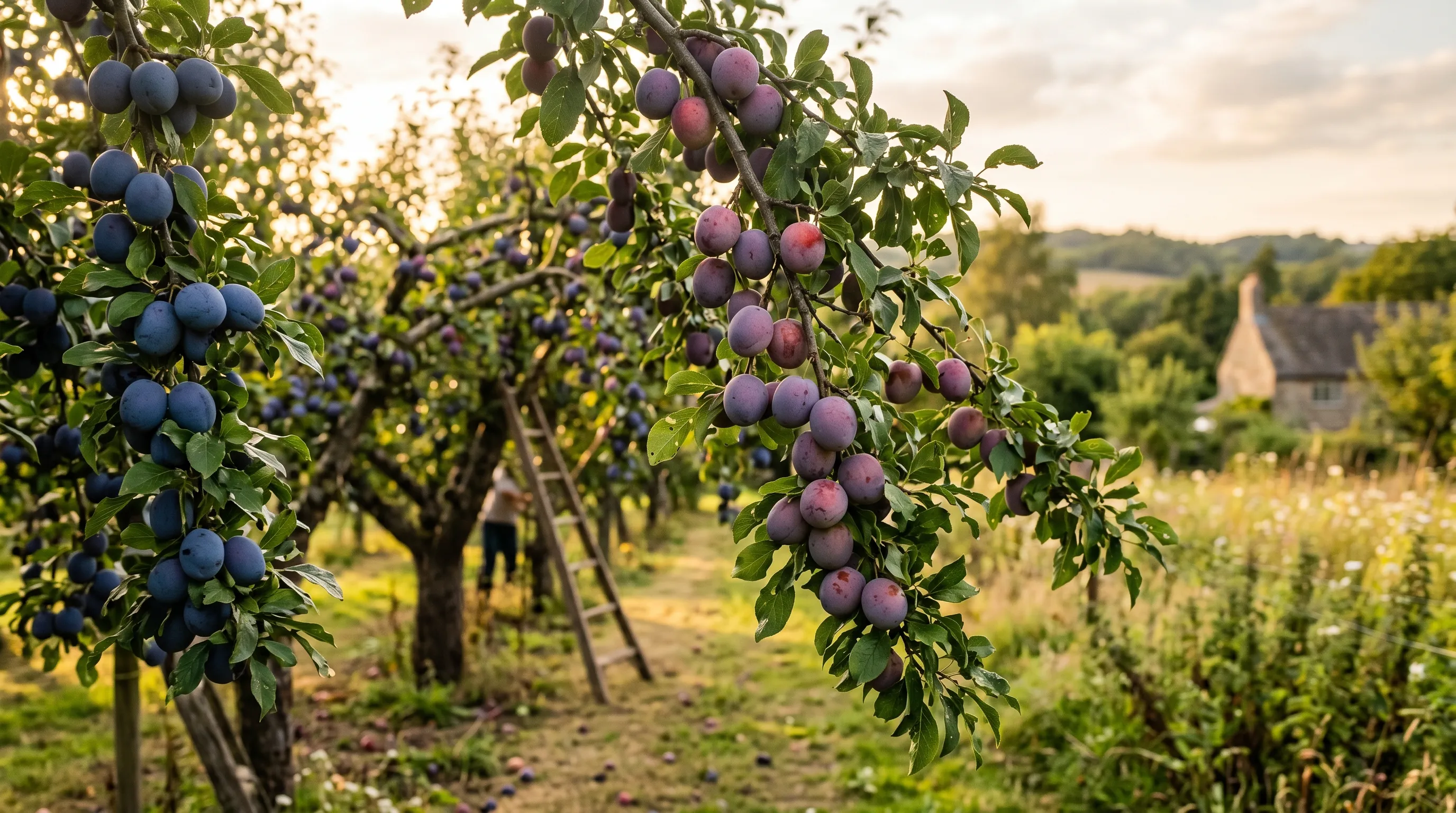
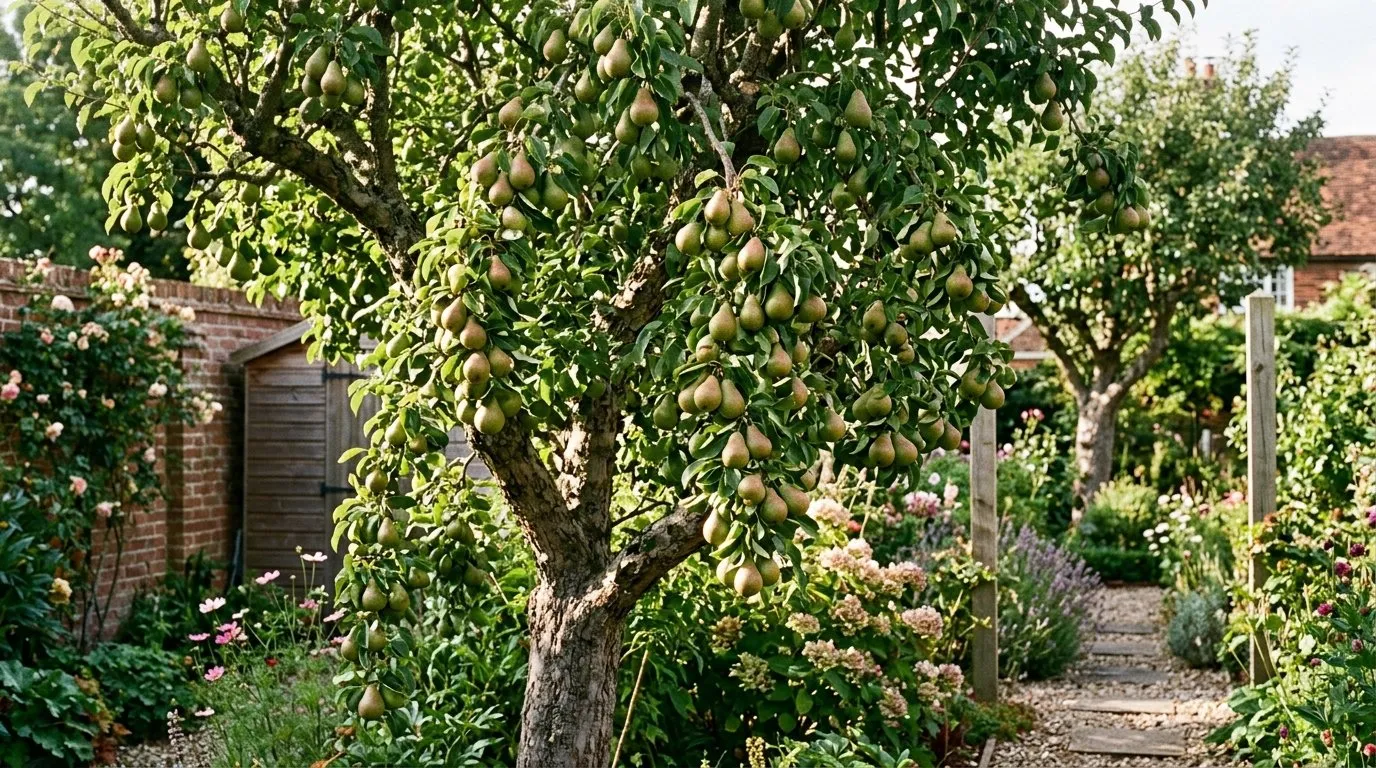
How to Store Apples and Pears at Home
UK guide to storing apples and pears long-term. Covers picking, wrapping, storage conditions, variety shelf life, rot prevention and ripening pears.
Key takeaways
- Late-season apples store longest: Bramley keeps 4-5 months, Cox 2-3 months, and Egremont Russet 3-4 months
- Ideal storage conditions are 2-4C, 85-90% humidity, darkness, and gentle air circulation
- Pick using the lift-and-twist test: ripe fruit detaches with a slight upward lift and quarter turn
- Wrap each apple individually in newspaper and lay on slatted wooden racks without touching
- Conference pears store 3-4 months in cold storage, then need 3-5 days at room temperature to ripen
- Check stored fruit monthly and remove any showing signs of brown rot, bitter pit or scald
Storing home-grown apples and pears properly means eating fresh fruit from your garden well into spring. A Bramley’s Seedling picked in October and wrapped in newspaper keeps until March in an unheated garage. A Conference pear stored in a cool shed lasts three to four months before ripening to perfection at room temperature. The difference between fruit that lasts and fruit that rots comes down to four things. Pick at the right moment. Choose the right varieties. Provide the correct storage conditions. Check regularly for disease.
Most UK gardeners grow more apples and pears than they can eat fresh at harvest time. Rather than letting surplus fruit rot on the ground, proper storage extends the season by months. This guide covers everything from the harvest window through to late-winter storage checks. We also cover which varieties store well, which do not, and what to do with fruit that will not keep. Our guides to making jam and freezing produce cover what to do with any surplus you cannot store fresh.
How to pick apples and pears for storage
Fruit picked at the wrong time stores badly. Pick too early and apples lack flavour and shrivel in storage. Pick too late and the flesh turns mealy within weeks. Timing matters more than any other factor.
The lift-and-twist test
The most reliable method for testing ripeness is the lift-and-twist test. Cup the fruit gently in your palm. Lift it upward with a slight quarter turn. A ripe apple parts from the branch cleanly, with the stalk still attached to the fruit. If you have to tug or snap the stalk, the apple is not ready. Leave it another week and test again.
This test works for both apples and pears. Pears, however, should be picked slightly underripe for storage. A pear left to ripen fully on the tree develops a gritty texture and browns from the core outward. Pick pears when the lift-and-twist test works but the fruit still feels firm.
Other ripeness signs
- Pip colour: Cut an apple open and check the pips. White or pale pips mean the fruit is immature. Dark brown pips indicate full ripeness. Aim for pips that are mid-brown, turning dark.
- Skin colour: The background colour of the apple changes from green to yellow-green as it ripens. Ignore the red flush, which develops with sun exposure, not ripeness.
- Windfalls: When the first healthy fruit drops naturally, the rest of the crop is close to ready. Do not store windfalls. Bruised fruit rots quickly and spreads decay.
- Flavour: Taste one. A ripe apple tastes sweet and aromatic. An unripe apple tastes starchy and sharp.
Picking technique for storage fruit
Handle every apple and pear as if it were an egg. Even a small bruise makes a point of entry for rot. Use a picking bag or a basket lined with soft cloth. Never drop fruit into a bucket. Pick on a dry day. Wet fruit is more prone to fungal infection in storage.
Gardener’s tip: Pick in the morning once the dew has dried but before the afternoon sun warms the fruit. Cool, dry fruit stores better than warm fruit picked in the heat of the day.
Which apple varieties store well?
Not all apples are storage apples. Early-season varieties like Discovery, Beauty of Bath and Worcester Pearmain are bred for eating straight from the tree. They deteriorate within one to two weeks regardless of storage conditions. Late-season varieties harvested in October and November store for months.
The general rule is simple: the later an apple ripens, the longer it stores. Late-season cookers and dual-purpose varieties store best of all. The RHS apple growing guide lists harvest dates for over 100 UK varieties.
Apple variety storage comparison
| Variety | Type | Harvest month | Storage life | Flavour notes |
|---|---|---|---|---|
| Bramley’s Seedling | Cooker | October | 4-5 months | Sharp, tangy. The classic UK cooking apple |
| Cox’s Orange Pippin | Dessert | October | 2-3 months | Rich, aromatic, complex. The benchmark British apple |
| Egremont Russet | Dessert | October | 3-4 months | Nutty, dry flesh. Excellent keeper for a dessert apple |
| Ashmead’s Kernel | Dessert | October | 4-5 months | Intense sweet-sharp flavour. Improves during storage |
| Blenheim Orange | Dual | October | 3-4 months | Nutty, honeyed. Large fruit. Good for cooking and eating |
| Winston | Dessert | November | 5-6 months | Firm, crisp, aromatic. One of the longest-keeping UK apples |
| Howgate Wonder | Cooker | October | 4-5 months | Very large fruit. Mild flavour. Cooks to a smooth puree |
| Discovery | Dessert | August | 1-2 weeks | Sweet, strawberry notes. Eat fresh. Does not store |
| Worcester Pearmain | Dessert | September | 2-3 weeks | Strawberry flavour. Eat within days of picking |
| James Grieve | Dual | September | 3-4 weeks | Sharp becoming sweet. Very short storage window |
Bramley’s Seedling is the best storage apple for UK gardens. Picked in mid-October and stored at 2-4C, it keeps until February or March. The flavour actually improves during the first month of storage as starches convert to sugars. A well-grown Bramley tree produces 50-100kg of fruit in a good year, making efficient storage essential.
Ashmead’s Kernel is the overlooked storage star. This 18th-century variety develops its best flavour after two months in storage. Freshly picked, it tastes sharp and unremarkable. By December, it turns into one of the finest dessert apples in existence.
Gardener’s tip: Grow at least one excellent keeper like Winston or Ashmead’s Kernel alongside your Bramley. Having dessert apples in storage through winter is a genuine luxury.
Which pear varieties store well?
Pears are trickier to store than apples. They ripen from the inside out. A pear that looks fine on the outside can be brown and mushy at the core. The key difference is that pears must be stored hard and ripened at room temperature before eating.
Pear variety storage comparison
| Variety | Harvest month | Storage life (cold) | Ripening time at room temp | Flavour |
|---|---|---|---|---|
| Conference | October | 3-4 months | 3-5 days | Sweet, juicy, reliable |
| Concorde | October | 2-3 months | 3-4 days | Sweet, buttery. Compact tree |
| Doyenne du Comice | October | 1-2 months | 4-5 days | Rich, melting. The finest flavour |
| Beth | September | 2-4 weeks | 2-3 days | Sweet, musky. Short storage |
| Williams Bon Chretien | September | 2-4 weeks | 3-4 days | Aromatic, classic pear flavour. Short storage |
| Catillac | November | 4-6 months | Not applicable (cooking pear) | Hard. Only for cooking. Turns pink when poached |
Conference is the most reliable storage pear for UK gardens. It stores for three to four months at 2-4C and ripens predictably at room temperature. The skin turns from green to greenish-yellow when ready. Conference is partially self-fertile, though cropping improves with a pollination partner.
Catillac is the long-term storage champion. This cooking pear lasts until April or May in cold storage. The flesh stays rock-hard. Poach or bake it rather than eating fresh. Catillac turns a striking pink colour when cooked slowly.
What are the ideal storage conditions for apples and pears?
The four requirements for successful fruit storage are temperature, humidity, darkness, and ventilation. Get all four right and late-season apples keep for months. Get any one wrong and rot spreads rapidly.
Temperature: 2-4C
This is the single most important factor. At 2-4C, respiration slows dramatically. The fruit uses less energy, produces less ethylene, and stays firm. Most unheated garages, outbuildings, sheds, and cellars in the UK stay within this range from late October to March.
Avoid temperatures above 10C. At 10C, apples ripen three to four times faster than at 3C. Avoid freezing temperatures below minus 2C. Frozen apple flesh turns brown and mushy when it thaws. A min-max thermometer in your storage area costs a few pounds and prevents problems.
Humidity: 85-90%
Apples and pears lose moisture through their skin during storage. Low humidity causes shrivelling. High humidity above 95% encourages mould. The target range is 85-90%. A stone or earth-floored storage area naturally maintains good humidity. Concrete garage floors are drier. Place a tray of damp sand near the stored fruit to raise humidity.
Darkness and ventilation
Light accelerates ripening. Store fruit in a dark space. If your garage has windows, cover the racks with breathable fabric. Avoid plastic covers, which trap moisture.
Gentle air circulation is equally important. Fruit releases ethylene gas and carbon dioxide as it respires. An outbuilding with natural air gaps under the eaves works well. A tightly sealed cupboard does not.
Warning: Never store fruit in the same space as strong-smelling chemicals, paints, or fuels. Apples absorb odours from their surroundings, and petroleum products taint the flavour even at low concentrations.
How to prepare and wrap apples for storage
Proper preparation before storage separates fruit that lasts all winter from fruit that rots within weeks. Take time to sort, inspect, and wrap your harvest carefully.
Sort your harvest
After picking, leave fruit on trays in a cool place for 24-48 hours. This sweating period allows any damage to show. Bruised areas darken. Insect damage becomes visible. Fruit with broken skin starts to weep.
Sort into three categories:
- Perfect fruit for long-term storage. No bruises, no cuts, no insect holes, stalk intact.
- Slightly damaged fruit for short-term use within two to four weeks, or for making chutney and preserving.
- Badly damaged or windfall fruit for immediate cooking, juicing, or the compost heap.
Only perfect fruit goes into long-term storage. A single rotten apple in a box infects every fruit it touches.
Wrapping technique
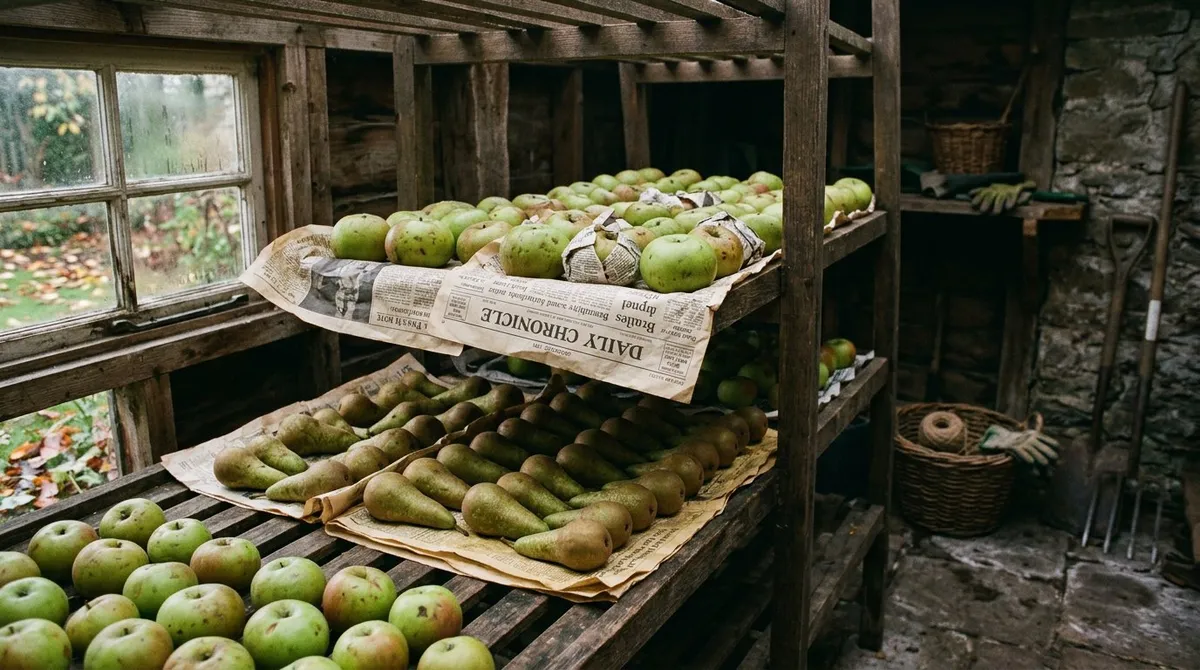
Wrap each apple individually in a sheet of newspaper (a quarter of a broadsheet page works well). The paper absorbs moisture from any fruit that starts to decay and prevents rot spreading to neighbouring fruit. Lay the wrapped apple with the stalk end upward on a slatted wooden rack.
Pears do not need wrapping. Lay them unwrapped on trays in a single layer. Pears are checked more frequently than apples and wrapping slows the inspection process.
Storage racks and containers
The traditional apple rack is a set of shallow wooden trays with slatted bases, stacked with spacing between each tray. Air circulates around every fruit. A simple alternative is stackable wooden crates with newspaper lining.
Avoid plastic bags, which trap moisture and ethylene. Avoid deep boxes where fruit stacks on fruit. Avoid sealed cardboard without ventilation holes.
Gardener’s tip: If you do not have apple racks, use clean wooden seed trays. Line with newspaper. Space fruit so nothing touches. Stack trays on bricks for airflow underneath.
Why we recommend slatted wooden apple racks: After 30 years of storing fruit from our own orchard and test plots, slatted wooden racks consistently outperform every alternative. Fruits stored on solid surfaces sweat and rot at the contact points. On slatted racks, air circulates beneath each fruit, and we typically see 15-20% less brown rot over a three-month storage period compared to box storage.
Month-by-month storage calendar
This calendar covers the full storage season from the September harvest through to March. Timings apply to most of England and Wales. Scottish gardeners should add one to two weeks to harvest dates.
| Month | Apples | Pears |
|---|---|---|
| September | Harvest early varieties (Discovery, Worcester Pearmain). Eat fresh. Begin harvesting Cox and Egremont Russet in the last week. | Harvest Beth and Williams. Eat fresh or store 2-4 weeks. Pick Conference late in the month. |
| October | Main harvest month. Pick Bramley, Cox, Egremont Russet, Blenheim Orange, Ashmead’s Kernel. Sort, sweat 48 hours, wrap, rack. | Pick Conference, Concorde, Doyenne du Comice. Store hard in cold conditions immediately. |
| November | Harvest Winston. Complete all storage by mid-month. First monthly check of October fruit. | Harvest Catillac (cooking pear). All pears in cold storage by now. First monthly check. |
| December | Monthly inspection. Remove brown rot and bitter pit. Storage temperatures should be stable at 2-4C. | Bring out Conference as needed. Allow 3-5 days at room temperature to ripen. |
| January | Mid-winter check. Egremont Russet may soften. Use first. Bramley and Ashmead’s Kernel in prime condition. | Continue bringing pears out in small batches. Concorde may soften by late January. |
| February | Cox reaching end of storage life. Use this month. Bramley still good. Ashmead’s Kernel at peak flavour. | Conference nearing end of storage. Catillac still keeps for cooking. |
| March | Final stocks. Bramley lasts until mid-month. Winston into April. Clean and disinfect racks for next season. | Catillac still usable. All other varieties finished. Clean storage for next autumn. |
How to ripen pears after cold storage
Pears must be ripened at room temperature before eating. A Conference pear taken straight from 3C storage is hard and flavourless. The same pear left on a kitchen worktop for three to five days turns into a sweet, juicy fruit.
The ripening process
- Remove pears from cold storage in small batches of three to five. This ensures a continuous supply rather than a glut.
- Place in a fruit bowl at room temperature (18-22C). Do not seal in a bag. Pears need air circulation during ripening.
- Check daily. Press gently near the stem end. The flesh yields slightly when ripe. Pears ripen from the stem down.
- Eat promptly. A ripe pear stays at peak condition for only one to two days before the flesh turns grainy.
Variety-specific ripening
- Conference: 3-5 days. Skin changes from green to greenish-yellow.
- Concorde: 3-4 days. Develops a buttery texture. Very short window between ripe and overripe.
- Doyenne du Comice: 4-5 days. When perfectly ripe, the flesh is melting and intensely flavoured.
- Williams Bon Chretien: 3-4 days. Skin turns golden with a strong, distinctive fragrance.
Gardener’s tip: Speed up ripening by placing pears in a paper bag with a ripe banana. The banana releases ethylene gas, which triggers faster ripening. Check daily to avoid overripening.
Common storage diseases and how to prevent them
Even well-stored fruit develops problems. Knowing what to look for during monthly checks prevents one diseased apple from spoiling an entire rack.
Brown rot (Monilinia fructigena)
Brown rot is the most common storage disease. It appears as expanding brown circles on the skin, often with concentric rings of white or grey mould spores. Brown rot enters through wounds, insect damage, or bird pecks. Only store undamaged fruit. Wrap individually in newspaper and space fruit so nothing touches. Remove infected fruit immediately during monthly checks.
Bitter pit
Bitter pit shows as small, dark, sunken spots on the apple skin, usually around the calyx end. Cut the apple open and you see brown, corky patches in the flesh. The cause is calcium deficiency, not infection. Water apple trees consistently during June to August and apply a calcium chloride foliar spray three times during summer. Bramley and Cox are the most susceptible varieties.
Storage scald
Storage scald appears as irregular brown or grey patches on the skin. It is a physiological disorder, not a disease. Scald develops when volatile compounds in the skin oxidise during storage. Early-picked fruit is more susceptible. Allow fruit to reach full maturity before picking and store in well-ventilated conditions.
Grey mould (Botrytis cinerea)
Grey mould appears as fuzzy grey-brown patches, more common on pears than apples. Botrytis thrives in cool, damp, still air and enters through wounds. Ensure adequate ventilation, do not store damaged fruit, and remove infected pears immediately.
Five common fruit storage mistakes
These mistakes account for the majority of fruit storage failures. Avoid them and your success rate improves dramatically.
1. Storing early-season varieties
Discovery, Worcester Pearmain, Beauty of Bath, and Beth are not storage fruit. They are bred for eating fresh. No amount of careful wrapping makes them keep. Eat early varieties immediately or process them into jam, juice, or chutney.
2. Storing bruised or damaged fruit
A single bruised apple becomes a source of brown rot spores within two weeks. Bruised tissue breaks down, fungi colonise the wound, and spores spread to neighbours. Always sort ruthlessly. If in doubt, eat it fresh or cook with it now.
3. Storing apples and pears together
Apples produce ethylene gas that triggers premature ripening in pears. Store them in separate rooms, or at minimum 2 metres apart with good ventilation between them.
4. Forgetting monthly checks
One rotting apple left unchecked for two months can spoil a dozen neighbours. Check every stored fruit monthly. Lift each apple, sniff for fermentation, and feel for soft spots.
5. Storing in plastic bags
Plastic traps moisture and ethylene. Condensation forms within days and mould follows within a week. Never use plastic bags, sealed tubs, or cling film.
What to do with fruit that will not store
Not every apple or pear makes it to the storage rack. Windfalls, bruised fruit, and early varieties all need using promptly.
- Cook immediately. Bramley apples that failed the storage inspection make excellent pies, crumbles, and sauces.
- Freeze. Peel, core, and slice apples. Blanch for one minute. Freeze flat on trays, then bag. Frozen slices keep for 12 months.
- Make jam or chutney. Apple jelly uses windfall fruit. Apple and pear chutneys improve with age. A batch made in October tastes best by Christmas.
- Press for juice. A domestic fruit press handles a garden’s worth of apples in an afternoon. Fresh apple juice freezes well.
- Compost. Badly diseased fruit should go in the municipal green waste bin, as home compost rarely reaches temperatures high enough to kill disease spores.
We also grow soft fruit alongside our apple and pear trees. Our guides to blueberries and raspberries cover varieties that extend the fresh fruit season from June to March.
Now you’ve mastered fruit storage, read our guide on growing apple trees in the UK for advice on choosing varieties, rootstocks, and getting reliable harvests to store.
Frequently asked questions
How long can you store apples at home?
Most late-season apples store for two to five months. Bramley’s Seedling keeps four to five months at 2-4C. Cox’s Orange Pippin lasts two to three months. Egremont Russet stores three to four months. Early varieties like Discovery and Worcester Pearmain do not store well and should be eaten within two weeks of picking.
What temperature should you store apples at?
Store apples at 2-4C for the longest shelf life. A garage, unheated shed, or cellar usually stays within this range from October to March in most of the UK. Temperatures above 10C cause rapid ripening and decay. Temperatures below minus 2C cause frost damage to the flesh.
Can you store apples and pears together?
No, store them separately. Apples produce ethylene gas as they ripen. This gas triggers premature ripening in pears and shortens their storage life. Keep at least 2 metres between the two fruits, or store them in separate rooms. This is especially important for early apple varieties that produce more ethylene.
How do you know when apples are ready to pick?
Use the lift-and-twist test. Cup the fruit gently and lift upward with a slight quarter turn. A ripe apple detaches from the branch without force. Other signs include pip colour changing from white to brown and the skin developing its full flush. The first windfalls beneath the tree also signal readiness.
Why do my stored apples go brown inside?
Internal browning is usually caused by bitter pit. This results from calcium deficiency in the fruit. Dry summers worsen it because trees cannot absorb enough calcium from the soil. Bramley and Cox are the most susceptible varieties. Watering consistently during June to August and applying calcium chloride spray in summer reduces the risk.
How do you ripen pears after storage?
Bring pears indoors to room temperature for three to five days. Place them in a fruit bowl, not sealed in a bag. Check daily by pressing gently near the stem. The flesh yields slightly when ripe. Conference pears turn from green to greenish-yellow. Williams pears develop a golden colour with a strong fragrance when ready to eat.
Do you need to wrap apples for storage?
Wrapping is recommended but not essential. Wrapping each apple individually in newspaper prevents one rotting fruit from spreading decay to its neighbours. Unwrapped apples store successfully on slatted racks if you space them so they do not touch. Wrapping also reduces moisture loss and slows shrivelling over long storage periods.
Storing apples and pears at home is one of the most satisfying parts of growing your own fruit. A few hours of picking, sorting, and wrapping in October pays back with fresh fruit through the darkest months. Start with reliable keepers like Bramley, Cox, and Conference. Master the basics of cool, dark, ventilated storage. Check monthly and act quickly when problems appear. The National Fruit Collection at Brogdale in Kent maintains over 4,000 varieties. It is well worth a visit for anyone serious about growing and storing British fruit.
Lawrie has been gardening in the West Midlands for over 30 years. He grows his own veg using no-dig methods, keeps a wildlife-friendly garden, and writes practical advice based on real UK growing conditions.