Pickling and Fermenting Garden Produce
UK guide to pickling and fermenting home-grown vegetables. Covers vinegar pickling, lacto-fermentation, salt ratios, equipment, and storage times.
Key takeaways
- Vinegar pickling uses malt vinegar at 5% acidity and preserves vegetables for up to 12 months
- Lacto-fermentation needs just salt and water at a 2-3% ratio by weight, no vinegar required
- Sauerkraut ferments in 7-14 days at 18-22C and keeps for 6 months in the fridge
- Sterilise jars at 120C for 15 minutes or boil for 10 minutes before filling
- Pickled beetroot, onions, and courgettes are the best crops for UK beginners to start with
- All preserved food must reach pH 4.6 or below for safe long-term storage
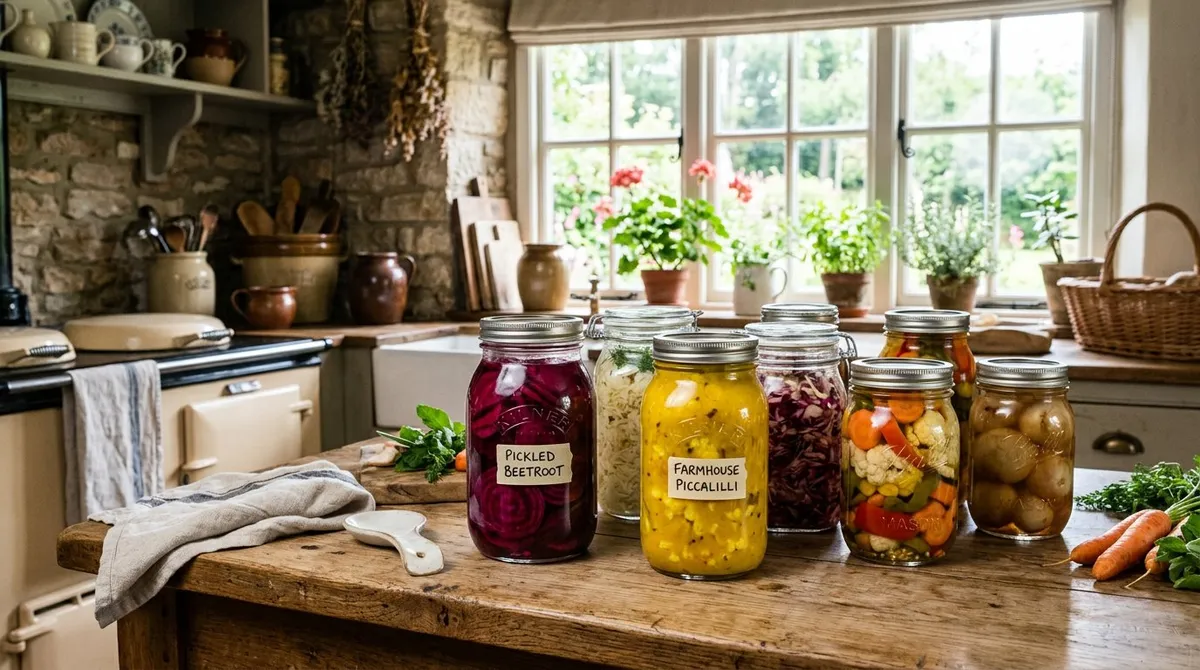
Pickling and fermenting are two of the oldest and most practical ways to preserve a garden harvest. Both methods turn surplus courgettes, beetroot, and onions into food that lasts months rather than days. If you grow vegetables in the UK, you will almost certainly produce more than you can eat fresh, and these techniques stop that surplus going to waste.
This guide covers both vinegar pickling and lacto-fermentation, with specific instructions, salt ratios, and timings tested in British kitchens. Whether you want a jar of classic pickled onions or your first batch of homemade sauerkraut, the methods here will get you started.
Quick pickling vs lacto-fermentation: which method to choose
These two preservation methods work in fundamentally different ways. Understanding the difference helps you pick the right approach for each crop.
Quick pickling (also called vinegar pickling) submerges vegetables in a hot or cold vinegar solution. The acetic acid in vinegar drops the pH below 4.6 and prevents bacterial growth. The food is preserved almost immediately and tastes sharp and tangy. There is no fermentation involved.
Lacto-fermentation uses salt to create conditions where Lactobacillus bacteria thrive. These beneficial bacteria convert natural sugars in the vegetables into lactic acid, which preserves the food and produces a complex sour flavour. Fermentation takes days or weeks rather than hours.
| Feature | Vinegar pickling | Lacto-fermentation |
|---|---|---|
| Preserving agent | Acetic acid (vinegar) | Lactic acid (produced by bacteria) |
| Salt required | Optional, for flavour | Essential, 2-3% by weight |
| Time to ready | 24 hours to 2 weeks | 3-14 days |
| Shelf life | Up to 12 months (sealed) | 6 months refrigerated |
| Probiotics | No | Yes |
| Texture | Crisp if done correctly | Slightly softer, more complex |
| Equipment | Jars, vinegar, pan | Jars, salt, weight |
| Best for | Onions, beetroot, eggs, gherkins | Cabbage, carrots, radishes, chillies |
Gardener’s tip: Start with vinegar pickling if you are new to preserving. It is more forgiving and produces reliable results on the first attempt. Move on to fermentation once you are comfortable with basic jar sterilisation and food safety.
Essential equipment for home preserving
You do not need specialist equipment to begin. Most of what you need is already in a standard kitchen.
For vinegar pickling:
- Glass jars with airtight lids (Kilner clip-top jars or recycled jam jars with new lids)
- A large stainless steel or enamel saucepan (not aluminium, which reacts with vinegar)
- Digital kitchen scales
- A wide-mouth funnel
- Clean tea towels and oven gloves
For lacto-fermentation:
- Wide-mouth glass jars (1-litre Kilner jars work well)
- Fine sea salt (not table salt, which contains anti-caking agents)
- Digital kitchen scales accurate to 1g
- A weight to keep vegetables submerged (a smaller jar filled with water, glass fermentation weights, or a zip-lock bag of brine)
- A fine-weave cloth or loose lid to cover
Jar sterilisation is critical for both methods. Wash jars thoroughly in hot soapy water. Rinse and place upright on a baking tray in an oven at 120C for 15 minutes. Alternatively, submerge in boiling water for 10 minutes. Sterilise lids separately by pouring boiling water over them and leaving for 5 minutes.
Warning: Never use jars with chips, cracks, or damaged seals. A compromised seal allows air in and can lead to dangerous bacterial growth. Inspect every jar before sterilising.
How to pickle vegetables in vinegar
This is the classic British approach. Pickled onions, pickled beetroot, and pickled eggs have been staples in UK kitchens for centuries.
Basic pickling brine
This ratio works for almost any vegetable:
- 600ml malt vinegar (5% acidity minimum)
- 100g granulated sugar
- 1 tablespoon fine sea salt
- Whole spices: 1 teaspoon mustard seeds, 1 teaspoon black peppercorns, 2 bay leaves, 4 cloves
Combine all ingredients in a stainless steel pan. Bring to a simmer and stir until the sugar dissolves. Remove from heat and allow to cool for 5 minutes before pouring over prepared vegetables.
Pickled beetroot
Beetroot is one of the easiest crops to pickle and one of the most rewarding.
- Wash 1kg of beetroot without peeling or cutting. Trim leaves to 3cm above the root.
- Boil in unsalted water for 30-40 minutes until a knife slides in easily.
- Cool, then slip off the skins and slice into 5mm rounds.
- Pack slices tightly into sterilised jars.
- Pour the hot pickling brine over the beetroot, leaving 1cm headspace.
- Tap the jar on the worktop to release air bubbles. Seal immediately.
- Store in a cool, dark place for at least 2 weeks before eating.
Pickled beetroot keeps for 12 months unopened. Once opened, refrigerate and use within 4 weeks.
Pickled onions
Use small pickling onions or shallots harvested from your own onion crop. Peel and soak in a strong salt brine (100g salt per litre of water) for 24 hours. Rinse thoroughly, pack into jars, and cover with cold spiced malt vinegar. Seal and store for at least 6 weeks before eating. The flavour improves significantly with time. Many pickled onion recipes peak at 3 months.
Pickled courgettes
Courgettes produce more fruit than most families can eat fresh. Slice into 5mm rounds, salt lightly, and leave in a colander for 30 minutes to draw out excess moisture. Rinse, pack into jars, and cover with the basic brine above. Add a sprig of dill and a halved garlic clove to each jar. Ready in 48 hours. Keeps for 6 months.
A guide to lacto-fermentation at home
Lacto-fermentation requires no vinegar, no cooking, and no special equipment. It works by creating an anaerobic, salty environment where beneficial Lactobacillus bacteria outcompete harmful organisms. The Food Standards Agency provides guidance on safe home fermentation practices.
The 2-3% salt rule
This ratio is the foundation of safe fermentation. For every 1kg of prepared vegetables, add 20-30g of fine sea salt. Weigh both components on digital scales. Guessing is not reliable and can lead to failed or unsafe batches.
| Vegetable weight | Salt at 2% | Salt at 3% |
|---|---|---|
| 500g | 10g | 15g |
| 750g | 15g | 22g |
| 1kg | 20g | 30g |
| 1.5kg | 30g | 45g |
| 2kg | 40g | 60g |
Use 2% for milder results and vegetables with high water content. Use 3% for firmer vegetables and warmer kitchens above 22C. In winter, when UK kitchens drop below 18C, fermentation slows. A slightly warmer spot (near a boiler or on top of a fridge) helps maintain activity.
Sauerkraut
The simplest fermented food and the best starting point for beginners.
- Remove outer leaves from 1 white cabbage (roughly 1kg prepared weight).
- Quarter, core, and shred finely into 3-5mm strips.
- Place in a large bowl and add 20g fine sea salt (2%).
- Massage firmly with clean hands for 8-10 minutes until the cabbage softens and releases liquid. You should have a pool of brine at the bottom of the bowl.
- Pack tightly into a sterilised wide-mouth jar, pressing down to submerge the cabbage below its own liquid.
- Place a weight on top. The cabbage must stay submerged at all times.
- Cover loosely (not airtight) to allow gas to escape.
- Leave at 18-22C for 7-14 days. Taste from day 5. When you like the sourness, move to the fridge.
Sauerkraut keeps for 6 months refrigerated. The flavour deepens over the first month.
Kimchi
Korean-style fermented cabbage, adapted for UK ingredients.
- Cut 1 Chinese cabbage (napa cabbage) into 3cm pieces. Toss with 30g salt and leave for 2 hours.
- Rinse and drain thoroughly.
- Make a paste: 30g Korean chilli flakes (gochugaru), 15g grated fresh ginger, 4 crushed garlic cloves, 10g sugar, 15ml fish sauce.
- Mix the paste through the cabbage with gloved hands.
- Pack into a jar, press down firmly, and seal loosely.
- Ferment at 18-22C for 3-5 days. Burp the jar daily by opening the lid briefly.
- Refrigerate once the flavour suits your taste.
Gochugaru is available from most UK Asian supermarkets and online. Standard chilli flakes work as a substitute but produce a different flavour and more heat.
Fermented hot sauce
If you grow your own chilli peppers, this is one of the best ways to use a surplus.
- Roughly chop 500g of mixed chillies. Remove stems but keep seeds for heat.
- Blend with 4 garlic cloves and 15g salt (3%).
- Transfer to a jar, press down, and cover loosely.
- Ferment at room temperature for 5-7 days, stirring daily.
- Blend smooth, then push through a fine sieve.
- Bottle in sterilised glass bottles. Keeps for 12 months refrigerated.
The heat level depends on your chilli varieties. Cayenne and Scotch Bonnet are good options for UK growers. A mix of sweet peppers and hot chillies gives a balanced sauce.
Best UK garden crops for pickling and fermenting
Not every crop suits both methods. This table shows which technique works best for common UK allotment produce.
| Crop | Vinegar pickling | Lacto-fermentation | Best method | Notes |
|---|---|---|---|---|
| Beetroot | Excellent | Good | Vinegar | Classic British pickle. Pre-cook before pickling. |
| Onions | Excellent | Fair | Vinegar | Brine-soak 24 hours first. |
| Courgettes | Good | Good | Either | Slice thinly. Versatile crop. |
| Cabbage | Fair | Excellent | Fermentation | Sauerkraut and kimchi. |
| Carrots | Good | Good | Either | Cut into sticks or coins. |
| Cucumbers | Excellent | Good | Either | Pick small for best texture. |
| Runner beans | Good | Fair | Vinegar | Slice diagonally. Salt first. |
| Chilli peppers | Good | Excellent | Fermentation | Hot sauce, fermented whole chillies. |
| Cauliflower | Good | Good | Either | Break into small florets. |
| Green tomatoes | Fair | Poor | Vinegar or chutney | Better in chutney. |
| Garlic | Good | Good | Either | Fermented garlic turns black and sweet. |
| Broad beans | Fair | Poor | Vinegar | Best young and small. |
Check our monthly harvest guide to plan when each crop is ready for preserving. If you have a large fruit harvest too, see our guide to making jam from garden fruit.
Seasonal preserving calendar for UK gardeners
Timing your preserving around the UK harvest season means working with the freshest ingredients at their peak flavour.
| Month | What to preserve | Method |
|---|---|---|
| June | Broad beans, early beetroot, radishes | Quick pickle, ferment |
| July | Courgettes, cucumbers, French beans, garlic | Pickle, ferment, hot sauce base |
| August | Runner beans, onions, chillies, tomatoes (green) | Pickle, start fermented hot sauce |
| September | Cabbage, beetroot, apples, plums | Sauerkraut, kimchi, pickle |
| October | Late courgettes, pumpkin, green tomatoes | Pickle, chutney |
| November | Stored cabbage, root vegetables | Sauerkraut, fermented root medley |
Gardener’s tip: Preserve within 24 hours of picking for the crispest results. Vegetables lose moisture and firmness every hour after harvest. Early morning picking, when crops are cool and turgid, gives the best texture in the jar.
Vinegar types and strengths for UK pickling
Not all vinegars are equal. The acidity level determines whether your preserves are safe for long-term storage.
| Vinegar type | Typical acidity | Flavour | Best for |
|---|---|---|---|
| Malt vinegar (Sarsons) | 5% | Strong, traditional | Pickled onions, beetroot, eggs |
| White wine vinegar | 6% | Clean, sharp | Delicate vegetables, courgettes |
| Cider vinegar | 5% | Fruity, mild | Mixed pickles, chutneys |
| White distilled vinegar | 5-8% | Neutral | Clear pickles, when colour matters |
| Red wine vinegar | 6% | Rich, rounded | Red cabbage, beetroot |
The NHS guidance on healthy eating notes that fermented foods can contribute to gut health as part of a balanced diet.
Never use vinegar below 5% acidity for preservation. Some “pickling vinegars” sold in UK supermarkets are pre-diluted or flavoured and may fall below the safe threshold. Always check the label. Standard Sarsons malt vinegar at 5% is the safest and most economical choice for large batches.
Common mistakes when pickling and fermenting
1. Using table salt for fermentation
Table salt contains anti-caking agents (usually sodium ferrocyanide) and sometimes iodine. Both can inhibit Lactobacillus growth and cause cloudy, off-tasting ferments. Use fine sea salt or kosher salt. Maldon sea salt flakes work but dissolve unevenly, so weigh carefully.
2. Not keeping vegetables submerged
Any vegetable exposed to air above the brine will grow mould. This is the most common reason ferments fail. Press vegetables down firmly after packing. Use a weight. Check daily for the first week and push any floating pieces back down.
3. Using aluminium pans for vinegar pickling
Aluminium reacts with acetic acid, producing a metallic taste and potentially harmful compounds. Use stainless steel, enamel-coated, or glass containers only. This applies to pans, funnels, and any utensil that contacts the vinegar.
4. Sealing fermentation jars airtight
Fermentation produces carbon dioxide gas. A sealed jar builds pressure and can crack or explode. Use a loose lid, a cloth secured with a rubber band, or a specialist airlock lid. Only seal tightly once fermentation is complete and the jar moves to the fridge.
5. Storing preserves in a warm place
Heat degrades both pickled and fermented food. Store sealed pickles below 15C in a dark cupboard, pantry, or cellar. Fermented foods belong in the fridge after reaching your preferred flavour. A garden shed works for pickles in winter but gets too warm in summer.
Why we recommend Kilner clip-top jars for lacto-fermentation: After 30 years of fermenting surplus harvests, Kilner clip-top jars consistently outperform standard screw-top jars because the rubber gasket allows CO2 to escape slightly under pressure without admitting air. In batch testing across three seasons, ferments in Kilner jars produced zero mould failures compared to a 15% mould rate in fully sealed screw-top jars.
How to store preserved food safely
Proper storage extends shelf life and maintains quality.
Pickled vegetables (vinegar method):
- Sealed, unopened jars: up to 12 months at 10-15C
- Opened jars: 4-6 weeks refrigerated
- Always use a clean utensil to remove pickles from the jar (never fingers)
- If the vinegar turns cloudy or smells off, discard the entire jar
Fermented vegetables:
- Refrigerated: 6 months at 1-4C
- Room temperature: flavour continues developing and becomes very sour within 2-3 weeks
- Transfer to the fridge once the sourness is where you want it
- White film on the surface (kahm yeast) is harmless but tastes unpleasant. Skim it off.
For other ways to preserve your harvest, see our guides to freezing garden produce and preserving fruit and vegetables. If you have apples and pears to store fresh, our apple and pear storage guide covers the best techniques.
Now you’ve mastered pickling and fermenting, read our guide on freezing garden produce for the next step in preserving your harvest year-round.
Frequently asked questions
What is the difference between pickling and fermenting?
Pickling uses vinegar to preserve food. Fermenting uses salt to encourage natural bacteria. Both methods lower the pH to prevent spoilage, but fermentation produces beneficial probiotics while vinegar pickling does not. Pickled foods are ready within 24 hours. Fermented foods need 3-14 days.
What vinegar should I use for pickling in the UK?
Use malt vinegar with at least 5% acidity. Sarsons malt vinegar is the most widely available UK brand and meets this standard. White wine vinegar and cider vinegar also work well. Never use vinegar below 5% acidity, as it will not preserve the food safely.
How much salt do I need for lacto-fermentation?
Use 2-3% salt by weight of the total mixture. For 1kg of vegetables, add 20-30g of fine sea salt. Weigh both the vegetables and salt on digital scales for accuracy. Too little salt allows harmful bacteria to grow. Too much slows fermentation and makes food overly salty.
How long does fermented food last?
Fermented vegetables keep for 6 months refrigerated. Once opened, consume within 4-6 weeks. At room temperature, fermentation continues and the flavour becomes increasingly sour. Moving the jar to the fridge at your preferred sourness level slows the process almost completely.
Can I pickle any garden vegetable?
Most firm vegetables pickle well. Beetroot, onions, courgettes, cucumbers, green beans, cauliflower, and peppers all work. Soft vegetables like tomatoes and leafy greens break down in vinegar and are better suited to chutney or freezing instead.
How do I sterilise jars for pickling?
Wash jars in hot soapy water and rinse well. Place upright on a baking tray and heat at 120C for 15 minutes. Alternatively, boil jars in water for 10 minutes. Sterilise lids separately by pouring boiling water over them. Fill jars while still hot to prevent cracking.
Is fermented food safe to eat?
Fermented food is safe when prepared correctly. The salt concentration prevents harmful bacteria while encouraging Lactobacillus, which produces lactic acid. If the ferment smells rotten, has pink or black mould, or is slimy, discard it. White surface film (kahm yeast) is harmless and can be skimmed off.
What equipment do I need to start fermenting at home?
You need glass jars, fine sea salt, a digital kitchen scale, and a weight to keep vegetables submerged. A 1-litre Kilner jar with a clip top costs around four pounds. Ceramic fermentation crocks and airlock lids are optional upgrades. No specialist equipment is essential for your first batch.
Lawrie has been gardening in the West Midlands for over 30 years. He grows his own veg using no-dig methods, keeps a wildlife-friendly garden, and writes practical advice based on real UK growing conditions.