When to Plant Broad Beans in the UK
Discover exactly when to plant broad beans across the UK. Covers autumn and spring sowing, best varieties, spacing, and regional timing advice.
Key takeaways
- Autumn sowing in October to November gives a harvest 4-6 weeks earlier than spring-sown crops
- Aquadulce Claudia is the standard autumn variety, surviving temperatures down to minus 10C
- Spring sowing from February to April suits all varieties and is more reliable in northern UK regions
- Sow seeds 5cm deep, 23cm apart in double rows with 60cm between each pair of rows
- Pinch out growing tips when the first pods appear to reduce blackfly infestation
- Broad beans fix nitrogen in the soil through root nodules, benefiting the next crop in a rotation
Broad beans are one of the most rewarding vegetables you can grow in a British garden. They are tough, productive, and almost impossible to kill once established. A single row of plants produces kilograms of plump, buttery beans from a handful of seeds pushed into the ground at the right time.
The UK climate suits broad beans perfectly. They germinate at soil temperatures as low as 5C, survive hard frosts, and actually produce better yields in our cool, damp conditions than in warmer countries. They are also one of the few vegetables that improve the soil they grow in, fixing nitrogen through their roots for the benefit of whatever follows in the rotation. This guide covers the two planting windows, the best varieties for each, and how to time your sowing for the longest, most productive harvest. For the full growing process from sowing to table, see our broad bean growing guide.
Autumn sowing: October to November
Autumn sowing is the secret to an early broad bean harvest. Seeds planted in October or November establish a root system before winter, then grow away strongly in spring. The result is a crop that matures 4-6 weeks earlier than spring-sown plants.
The ideal sowing window is early to mid-November in southern and central England. In the south-west, you can sow from late October. In northern England, early November is best. In Scotland, autumn sowing is less reliable due to harsher winters, and many Scottish growers prefer the spring window instead.
Autumn-sown broad beans spend winter as small, stocky seedlings 10-15cm tall. They barely grow above ground during the cold months, but below the surface their roots extend steadily. When temperatures rise in March, these overwintered plants surge into growth and reach flowering stage by April. The harvest begins in late May or early June, at least a month before spring-sown crops.
Is autumn sowing risky?
The main risk is prolonged cold below -10C combined with wet soil. Waterlogged roots freeze and die, even on hardy varieties. In most UK winters, this is not a problem. The years 2022-23, 2023-24, and 2024-25 all saw mild enough conditions for reliable overwinter crops across England and Wales.
If your garden sits on heavy clay that stays sodden through winter, autumn sowing in raised beds or containers is a safer approach. Good drainage matters more than the exact sowing date. Our raised bed gardening guide explains how to create free-draining beds.
Gardener’s tip: In exposed northern gardens, sow broad beans in deep modules indoors during November. Overwinter the seedlings in a cold frame or unheated greenhouse and transplant outside in February when the ground is workable. This gives the benefits of autumn sowing with less winter risk.
Spring sowing: February to April
Spring sowing is the more traditional approach and works reliably across the entire UK, from Cornwall to the Scottish Highlands. It suits a wider range of varieties and carries less risk of winter losses.
February sowing is possible once the soil is workable (not frozen or waterlogged). In mild southern gardens, you can start from early February in a sheltered spot. The soil temperature only needs to be above 5C for broad bean seeds to germinate, though 8-10C produces faster, more even emergence.
March is the main sowing month for most of the UK. By mid-March, soil conditions are suitable in all but the coldest Highland gardens. March-sown broad beans flower in May and produce a harvest from late June to July.
April sowing extends the season. A second sowing in April, 3-4 weeks after the first, staggers the harvest and gives you fresh beans over a longer period. April sowings are ready from July to August.
For a wider picture of what to plant alongside your spring broad beans, see our March planting guide and seed sowing calendar.
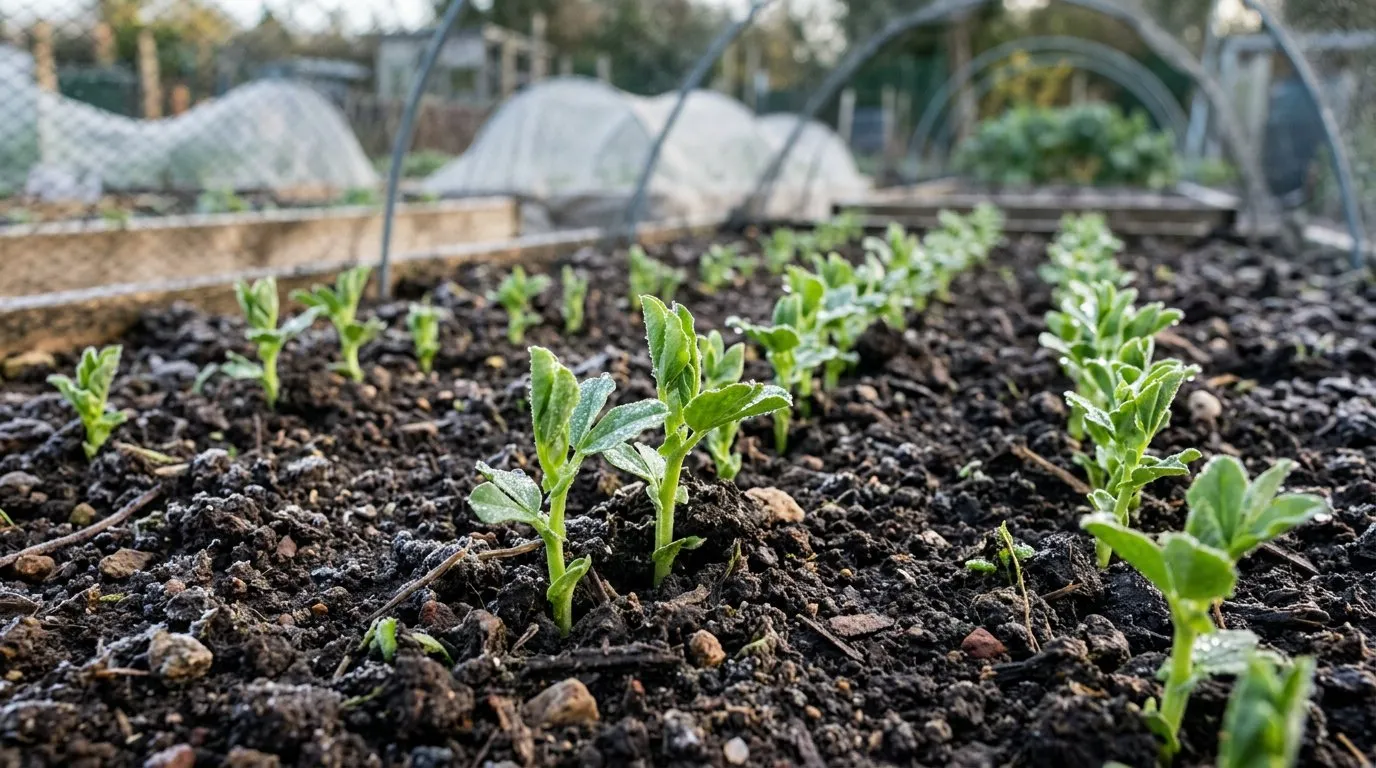 Broad bean seedlings pushing through the soil in early March. They tolerate cold better than almost any other vegetable.
Best broad bean varieties for UK gardens
Choosing the right variety for your sowing window is essential. Autumn varieties must withstand frost. Spring varieties can focus on yield and flavour.
Autumn sowing varieties
Aquadulce Claudia is the standard autumn broad bean. It has been grown in UK gardens for generations and remains the benchmark for overwintering. Plants reach 90-120cm tall and produce long pods with 5-7 beans. It survives temperatures down to -10C when established and is the most widely available autumn variety.
Super Aquadulce is a selected strain with improved cold tolerance and slightly longer pods. It matures a few days earlier than the original and produces marginally heavier yields. Available from most major seed companies.
The Sutton is a dwarf variety reaching just 30-45cm tall. It works for both autumn and spring sowing and is ideal for small gardens, containers, and exposed or windy sites where tall plants blow over. Pods are shorter (4-5 beans) but the compact plants need no support.
Spring sowing varieties
Masterpiece Green Longpod is a heritage variety with impressive pod length. Each pod contains 7-9 beans. Plants grow to 120cm and crop heavily from a single sowing. The beans have a classic, full broad bean flavour. Outstanding for the kitchen garden.
Witkiem Manita is early-maturing and quick to crop. From a February sowing, it can produce beans by late May in southern gardens. Pods contain 5-7 bright green beans. Compact enough for smaller plots.
Jubilee Hysor produces short, wide pods packed with 4-5 large beans. The beans are sweet and tender. Plants reach 90cm and rarely need support in sheltered positions. A reliable commercial variety that works equally well in home gardens.
Crimson Flowered is a heritage variety with striking red flowers instead of the usual black-and-white blooms. The beans are small but intensely flavoured. Plants reach 60-90cm. Mainly grown for ornamental value and flavour rather than heavy yields. A beautiful addition to a cottage garden.
Broad bean variety comparison table
| Variety | Sowing | Height | Beans per pod | Flavour | Support needed? | Best for |
|---|---|---|---|---|---|---|
| Aquadulce Claudia | Autumn | 90-120cm | 5-7 | Classic | Yes | Overwintering, reliability |
| Super Aquadulce | Autumn | 90-120cm | 5-7 | Classic | Yes | Colder gardens |
| The Sutton | Autumn/Spring | 30-45cm | 4-5 | Good | No | Containers, small spaces |
| Masterpiece Green Longpod | Spring | 120cm | 7-9 | Full, classic | Yes | Heavy yields |
| Witkiem Manita | Spring | 75-90cm | 5-7 | Sweet | Sometimes | Early spring sowing |
| Jubilee Hysor | Spring | 90cm | 4-5 | Sweet, tender | Rarely | Kitchen garden |
| Crimson Flowered | Spring | 60-90cm | 3-5 | Intense | Rarely | Ornamental, flavour |
How to sow broad beans
The sowing technique is identical for autumn and spring plantings. Broad beans are large seeds that are easy to handle, making them an ideal first vegetable for children and beginners.
Direct sowing outdoors
- Prepare the soil by removing weeds and raking to a fine tilth. Broad beans prefer fertile, well-drained soil with plenty of organic matter. Dig in garden compost or well-rotted manure a few weeks before sowing.
- Use a trowel or dibber to make holes 5cm deep.
- Space holes 23cm apart in a double row, with 23cm between the two rows.
- Leave 60cm between each pair of double rows for access.
- Drop one seed into each hole with the scar (the dark mark where the seed was attached) facing downward.
- Backfill and firm gently. Water if the soil is dry.
The double-row system is traditional and practical. It maximises the number of plants while allowing air to circulate and giving you room to walk between the paired rows for weeding, supporting, and picking.
Sowing in pots or modules
For an earlier start or in cold regions, sow broad beans in deep pots or root trainers filled with seed compost. Sow one seed per pot, 5cm deep. Keep in an unheated greenhouse, cold frame, or sheltered porch. Seedlings are ready to transplant when they are 10-15cm tall with a sturdy root system, typically 3-4 weeks after sowing.
Transplant on an overcast day and water well. Harden off seedlings for a week before planting out by moving them outdoors during the day and back under cover at night.
Warning: Mice love broad bean seeds. If you sow directly outdoors in autumn, cover the row with fine mesh or chicken wire until seedlings emerge. Alternatively, sow in modules indoors where mice cannot reach the seeds.
Broad bean sowing and growing calendar
This month-by-month guide covers the full growing cycle for both autumn and spring sowings.
| Month | Autumn sowing | Spring sowing |
|---|---|---|
| October | Sow outdoors (south-west England) | - |
| November | Sow outdoors (main autumn window) | - |
| December | Protect with fleece if severe frost forecast | - |
| January | Check plants; re-sow gaps if seeds failed | Sow indoors in modules (mild areas) |
| February | Overwintered plants start growing | Direct sow outdoors (southern UK) |
| March | Plants growing strongly; weed and water | Main sowing month (all UK regions) |
| April | First flowers appear; support tall varieties | Second sowing for succession |
| May | Pods forming; pinch out growing tips | First flowers appear |
| June | Harvest begins (autumn-sown crops) | Pods forming; pinch out tips |
| July | Harvest continues | Main harvest month |
| August | Clear spent plants; leave roots in soil | Late pickings; save seed from best pods |
Supporting broad bean plants
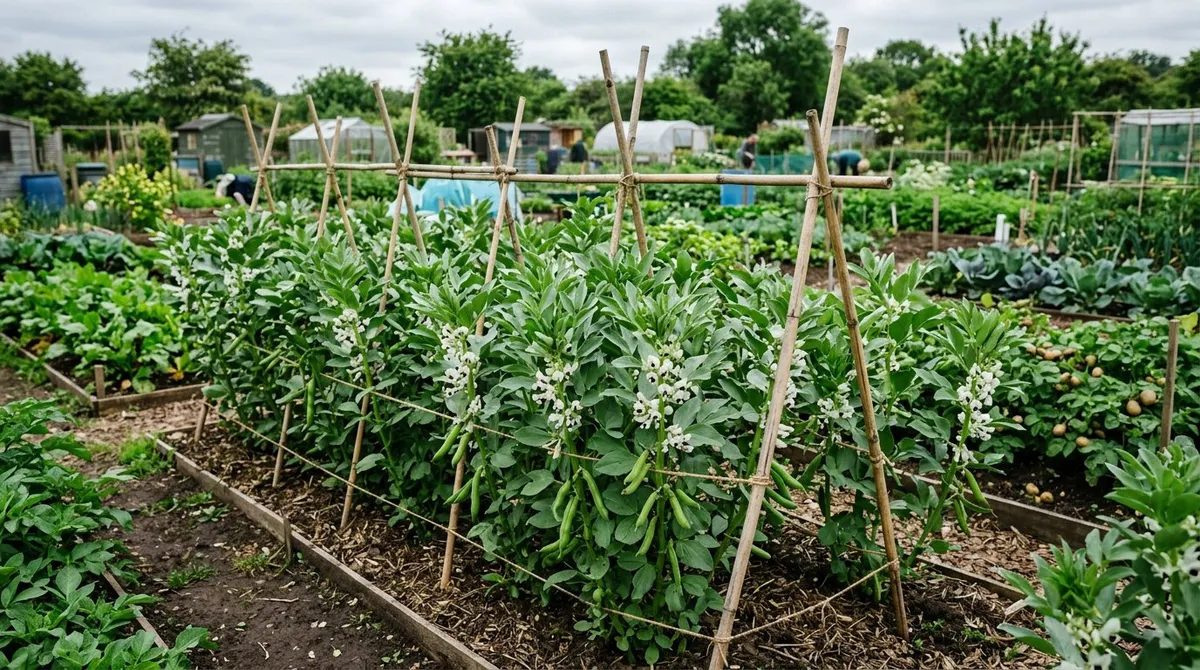
Dwarf varieties like The Sutton stand up on their own. Taller varieties (90cm and above) need support, particularly once the heavy pods develop. Without support, plants lean, splay outward, and snap in wind or rain.
The simplest method is the cane and string corral. Push sturdy canes or wooden stakes into the ground at each corner and at 1m intervals along the row. Run garden twine around the outside of the stakes at 30cm, 60cm, and 90cm heights as the plants grow. This makes a supportive fence that holds the row upright without restricting airflow.
In exposed or windy gardens, add cross-strings between the rows every 1m to prevent plants swaying sideways. The investment of ten minutes in support saves entire rows from collapsing after summer storms.
Dealing with blackfly on broad beans
Black bean aphid (Aphis fabae) is the most common pest of broad beans in the UK. Colonies appear on the soft growing tips in May and June, sucking sap and distorting new growth. Heavy infestations weaken plants and reduce pod formation.
Prevention
The single most effective action is to pinch out the top 10cm of each plant as soon as the first pods have set. This removes the soft, succulent growth that blackfly prefer. It also redirects the plant’s energy from producing more leaves into swelling the existing pods.
Pinched-out tips are edible. Steam or stir-fry them as a seasonal delicacy. They taste like a cross between spinach and broad beans.
Treatment
If blackfly arrive before you pinch out, blast colonies off with a strong jet of water from a hose. Repeat daily for three days. This dislodges the aphids and breaks the colony.
Encourage natural predators. Ladybirds, hoverfly larvae, and lacewing larvae all eat aphids voraciously. A single ladybird larva can consume 500 aphids during its development. Grow flowers among your vegetables to attract these allies. Our bee-friendly garden plants guide covers plants that also attract hoverflies and other beneficial insects.
Avoid chemical sprays. They kill predators along with the aphids and disrupt the natural balance that keeps pest populations in check over the long term.
Why we recommend Aquadulce Claudia for autumn sowing: After more than 30 years of overwintering broad beans in British gardens, Aquadulce Claudia is the only variety that performs reliably in all UK regions from October through to May. Newer “improved” strains are worth trying in southern gardens, but in northern England and Scotland, the original consistently survives temperatures below -8C without fleece protection. From a 3m double row sown in November, expect 6-8kg of podded beans by the third week of May.
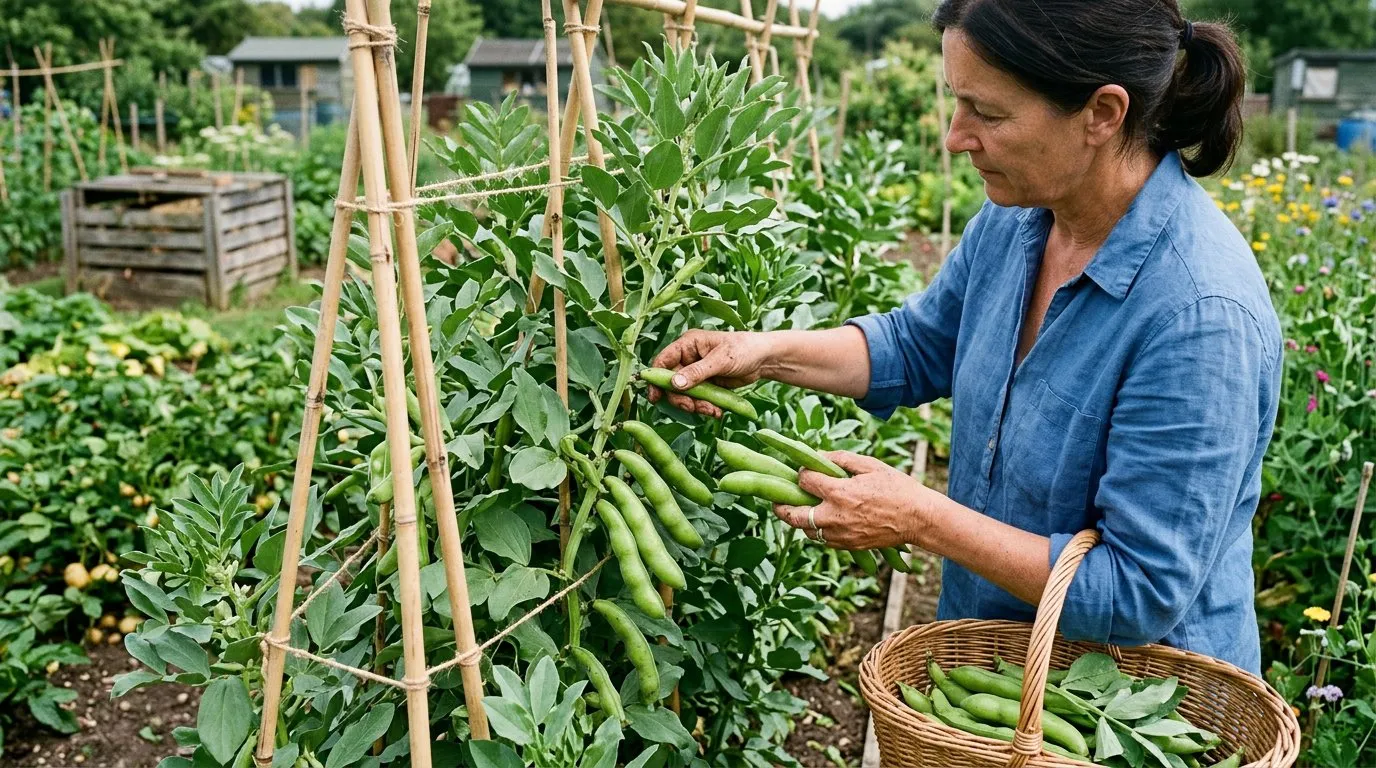 Broad bean pods ready for harvest. Pick when the beans inside are visible through the pod but still bright green.
Harvesting broad beans
The best broad beans are picked young, when the beans inside the pod are bright green and the skin is tender. Once the scar on each bean turns from green to brown or black, the beans are past their prime: starchy, mealy, and tough-skinned.
When to pick
Start checking pods from late May (autumn-sown) or late June (spring-sown). Press the pod gently. You should feel the beans inside, plump and well-defined. Open a test pod to check. The beans should be bright green, glossy, and about the size of your thumbnail.
Pick from the bottom of the plant upward. Lower pods mature first. Regular picking encourages the plant to produce more pods higher up the stem. Check every two to three days during peak harvest.
How much to expect
A well-grown plant produces 10-15 pods over the harvest period. Each pod contains 4-9 beans depending on variety. From a 3m double row (roughly 26 plants), expect around 5-8kg of podded beans. That is enough for a family of four to eat fresh broad beans weekly for 6-8 weeks, with surplus for freezing.
Freezing broad beans
Broad beans freeze exceptionally well. Shell the beans, blanch in boiling water for 2 minutes, plunge into ice water, drain, and freeze flat on a tray. Transfer to bags once frozen. They keep for 12 months in the freezer.
For the finest texture, slip the grey outer skin off each blanched bean to reveal the vivid green interior. This is called “double-podding” and turns even large, late-picked beans into something delicate and sweet.
Broad beans in crop rotation
Broad beans are a legume, and like all legumes, they fix atmospheric nitrogen through a symbiotic relationship with Rhizobium bacteria in their root nodules. This means they actively improve soil fertility while they grow.
After harvest, cut the plants at ground level rather than pulling them out. Leave the roots in the soil to decompose, releasing their stored nitrogen for the next crop. Follow broad beans with a nitrogen-hungry crop such as brassicas (cabbage, broccoli, kale) or leafy greens (lettuce, spinach, chard).
In a standard four-year rotation, broad beans sit in the legume bed alongside peas and runner beans. The following year, that bed becomes the brassica bed. This is the foundation of productive vegetable gardening and the reason broad beans appear in almost every allotment plan. See our allotment guide for a complete rotation schedule.
Common mistakes when growing broad beans
These five errors account for most failures. Avoid them and broad beans are among the most reliable crops you can grow.
-
Not pinching out the growing tips. Leaving the soft tips intact invites blackfly to colonise the plant. Pinch out when the first pods form. This single action prevents most aphid problems and improves yields.
-
Sowing autumn varieties too early. Sowing Aquadulce Claudia in September produces tall, leggy seedlings that are more vulnerable to winter frost. Wait until November for autumn sowing in most of England. Stocky, short plants overwinter best.
-
Forgetting to support tall varieties. A row of 120cm broad bean plants heavy with pods will collapse in the first summer storm without string or stake support. Set up the corral when you sow, not after the damage is done.
-
Picking too late. Broad beans left on the plant until the scar turns black are starchy and tough. Pick when the pods feel full but the beans inside are still bright green. Check every 2-3 days during harvest. Overripe beans are best dried for soup rather than eaten fresh.
-
Growing in the same spot every year. Broad beans are susceptible to chocolate spot (Botrytis fabae) and rust. Both diseases build up in soil where legumes are grown repeatedly. Rotate to a new bed each year as part of a four-year rotation plan.
Growing broad beans in containers
Broad beans are one of the few vegetables that crop well in pots, particularly the dwarf variety The Sutton. This opens up broad bean growing to anyone with a balcony, patio, or small courtyard garden.
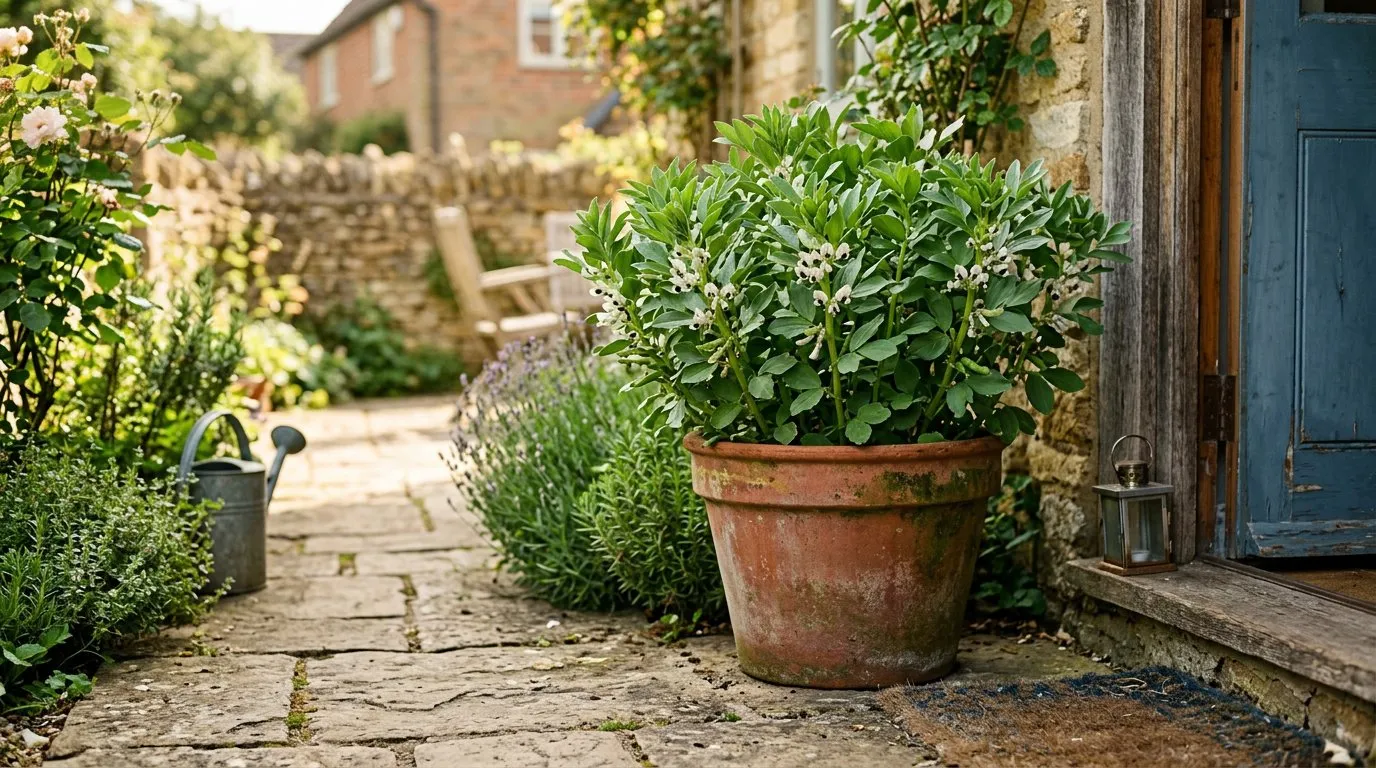 Broad beans thrive in large pots on a sunny patio. The dwarf variety The Sutton is ideal for container growing.
Use a pot at least 30cm wide and 30cm deep with drainage holes. Fill with peat-free multipurpose compost. Sow 3-4 seeds per pot, 5cm deep and evenly spaced. Thin to the strongest 2-3 seedlings once they emerge.
Keep pots in a sunny position. Water when the top 2cm of compost feels dry. Feed with a general liquid fertiliser every two weeks once flowers appear. The Sutton grows to just 30-45cm, so no support is needed in a sheltered spot.
Container-grown broad beans produce smaller yields than those in open ground, typically 6-8 pods per plant. But the convenience and freshness make it worthwhile. A few pots of broad beans beside a kitchen door, picked minutes before cooking, taste far better than anything you can buy.
For more ideas on growing vegetables in limited space, our container gardening guide covers the full range of crops that thrive in pots.
How to make compost from broad bean plants
After harvest, broad bean plants still have value. Their nitrogen-rich stems and leaves make excellent green material for the compost heap. Chop the stems into 10-15cm sections with secateurs and add to your compost bin alongside carbon-rich browns (cardboard, straw, dry leaves).
Leave the roots in the ground where they grew. The nodules on the roots contain nitrogen that releases slowly as they decompose, feeding the soil and the following crop. This is free fertiliser, courtesy of the bacteria that broad beans host in their roots.
The combination of composting the tops and leaving the roots makes broad beans one of the most soil-friendly crops in any garden. They take from the air and give to the earth.
Now you’ve mastered broad bean sowing, read our guide on when to plant garlic in the UK for another essential autumn crop that uses the same cold-season planting window.
Frequently asked questions
When should I sow broad beans in the UK?
October to November for autumn sowing, February to April for spring. Autumn sowing produces earlier harvests in May to June. Spring sowing gives a main crop from June to August. Both windows work well, but spring is more reliable in colder northern regions.
Can I sow broad beans in January?
January sowing works indoors in pots or modules. Sow in deep pots (root trainers are ideal) in an unheated greenhouse or cold frame. Transplant seedlings outside in March when they are 10-15cm tall. Direct sowing outdoors in January risks rot in cold, wet soil.
Why do my broad beans get blackfly every year?
Black bean aphids are attracted to the soft growing tips. Pinch out the top 10cm of each plant as soon as the first pods form. This removes the tissue blackfly prefer and redirects energy into the pods. Companion planting with summer savory may also reduce infestations.
How far apart should I plant broad beans?
Space plants 23cm apart in double rows 23cm apart. Leave 60cm between each pair of double rows for access and airflow. This spacing gives each plant enough room to develop while allowing you to walk between the rows for picking and support.
Do broad beans need support?
Taller varieties over 90cm benefit from support. Push canes or stakes at each corner and end of the row. Run string around the outside at 30cm intervals as plants grow. Dwarf varieties like The Sutton (30-45cm) rarely need any support.
What is the best broad bean variety for beginners?
Aquadulce Claudia is the most reliable all-round variety. It tolerates autumn and spring sowing, survives cold winters, and produces long pods with 5-7 beans. For spring sowing, Masterpiece Green Longpod is equally straightforward and crops heavily.
Can I save broad bean seeds for next year?
Saving seed from broad beans is simple and reliable. Leave a few pods on the plant until they turn black and papery. Shell the dried beans and store in paper envelopes in a cool, dry place. Broad beans are self-pollinating, so saved seed comes true to type.
Are broad beans good for the soil?
Broad beans fix nitrogen from the air into the soil. Bacteria in root nodules convert atmospheric nitrogen into a form plants can use. After harvesting, cut plants at ground level and leave the roots in the soil. The nitrogen they fixed benefits the following crop, making broad beans excellent in a rotation.
Broad beans have earned their place as a staple of British kitchen gardens for centuries. They grow in conditions that defeat most other vegetables, they feed the soil while they feed you, and a handful of seeds costs less than a single bag of supermarket beans. Sow them in November or February, give them something to lean on, pinch out the tips when the pods form, and you will have one of the finest harvests any garden can produce.
Lawrie has been gardening in the West Midlands for over 30 years. He grows his own veg using no-dig methods, keeps a wildlife-friendly garden, and writes practical advice based on real UK growing conditions.