When to Plant Daffodil Bulbs in the UK
Practical UK guide to planting daffodil bulbs. Covers best planting times, depth, naturalising in grass, top varieties, and aftercare for repeat flowering.
Key takeaways
- Plant daffodil bulbs September to October, earlier than tulips, for 14-16 weeks of root development
- Plant 10-15cm deep (2-3x bulb height) and 10-15cm apart, pointy end facing upward
- Daffodils naturalise well in grass when planted in drifts, returning and multiplying for decades
- Leave foliage for at least 6 weeks after flowering to feed the bulb for next year
- Tete-a-tete, Ice Follies, Carlton, and February Gold are among the most reliable UK varieties
- Daffodils prefer well-drained, slightly acidic to neutral soil with a pH of 6.0-7.0
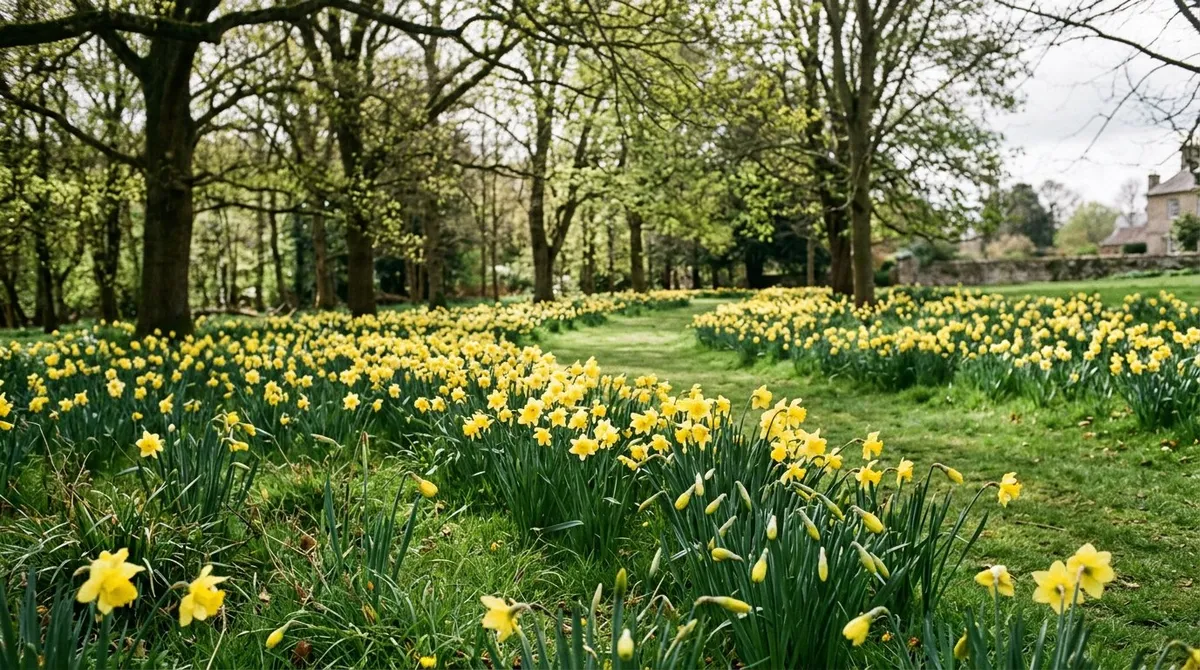
Daffodils are the most dependable spring bulbs in British gardens. They flower reliably year after year, multiply naturally, and tolerate a wider range of conditions than almost any other bulb. From the first miniature Tete-a-tete blooms in February to tall trumpet daffodils in late April, they provide up to 10 weeks of spring colour with minimal effort.
Planting daffodil bulbs at the right time and depth is the foundation of success. For the full growing guide including aftercare, division, and naturalising, see how to grow daffodils. This guide covers when to plant across UK regions, correct planting technique, the best varieties for different situations, and the aftercare that keeps daffodils flowering for decades. If you are planning a full spring bulb display, see our companion guide on when to plant tulip bulbs. For broader autumn planting, check our October planting guide.
When to plant daffodil bulbs
Plant daffodil bulbs from September to October. This is earlier than tulips, which go in from late October. Daffodils need a longer rooting period: 14-16 weeks of cold ground before they flower. Early planting gives bulbs the maximum time to establish roots before the soil cools further in winter.
Why plant daffodils earlier than tulips?
Daffodils produce roots slowly and steadily through autumn and winter. A bulb planted in September has developed a dense root system by December, anchoring it firmly and giving it access to water and nutrients throughout the cold months. This strong root network supports vigorous spring growth and larger flowers.
Late-planted daffodils (November or December) often produce smaller flowers on shorter stems in their first spring. They catch up in subsequent years, but the first season’s display is noticeably weaker. Unlike tulips, daffodils do not benefit from late planting because they are not susceptible to tulip fire disease.
Regional planting times
| Region | Best planting window | Soil temperature | Notes |
|---|---|---|---|
| Scotland and Northern England | Early September to mid-October | Below 15C by early September | Earliest planting window in the UK |
| Midlands and Wales | Mid-September to late October | Below 15C by mid-September | Standard timing |
| Southern England | Late September to late October | Below 15C by late September | Slightly later start |
| South-west and coastal areas | Early October to early November | Below 15C by early October | Warmest soils, latest timing |
The key soil temperature threshold for daffodil planting is below 15C. Above this, bulbs can develop fungal problems. A soil thermometer pushed 10cm into the ground gives an accurate reading. In practice, most UK gardens reach this temperature by mid-September.
Can I plant daffodils in November?
November planting is possible but not ideal. The bulbs have less time to root before the ground becomes very cold in December and January. First-year flowers may be smaller. If you receive bulbs late, plant them as soon as possible rather than storing them. A late-planted bulb is always better than one left in a bag.
Warning: Do not store daffodil bulbs for months. They dry out and lose vigour. Unlike tulips, which tolerate several weeks of dry storage, daffodil bulbs deteriorate quickly once out of the ground. Plant within 2-3 weeks of purchase.
How to plant daffodil bulbs
Correct depth and orientation are simple but important. Getting these right ensures strong flowers and good perennialisation.
 Planting daffodil bulbs in autumn gives them the longest rooting period before spring.
Planting depth
Plant daffodil bulbs 10-15cm deep, measured from the base of the bulb to the soil surface. This is roughly 2-3 times the height of the bulb. Larger bulbs (trumpet daffodils, large-cupped types) go deeper at 15cm. Smaller bulbs (miniatures like Tete-a-tete) need only 10cm.
Deep planting:
- Anchors the bulb against wind and frost heave
- Protects it from temperature extremes
- Reduces the chance of “blind” (non-flowering) bulbs in future years
- Discourages squirrels, though squirrels rarely bother daffodils because the bulbs contain toxic alkaloids
Spacing
Space standard daffodil bulbs 10-15cm apart in borders. For naturalised plantings in grass, scatter bulbs randomly across the area and plant each one where it falls. This creates the casual, drift-like effect that looks natural.
In containers, plant bulbs closer together at 5-8cm apart for a dense display.
Planting method
- Dig a hole to the correct depth using a trowel or bulb planter
- Place the bulb pointy end up, flat base down
- If the soil is heavy clay, add a handful of horticultural grit beneath the bulb
- Backfill with soil and firm gently
- Water once to settle the soil
For planting many bulbs in borders, dig a wide trench to the correct depth, place all bulbs, and backfill. This is faster than making individual holes.
Gardener’s tip: A long-handled bulb planter is the best tool for planting daffodils in grass. It cuts a neat core of turf, you drop the bulb in, and replace the turf plug on top. A standard hand trowel works in borders. For large quantities, rent or buy a mechanical bulb planter that attaches to a cordless drill.
Soil and position
Daffodils are adaptable. They grow in most UK soil types, from light sand to heavy clay, provided drainage is reasonable. They prefer slightly acidic to neutral soil with a pH of 6.0-7.0.
Full sun produces the best flowers, but daffodils also perform well in partial shade. They are one of the few spring bulbs that flower reliably under deciduous trees. The bulbs take advantage of the light that reaches the ground before the tree canopy fills in April and May.
Avoid planting in waterlogged sites. Standing water around bulbs in winter causes rot. If your soil is heavy and wet, raise the planting area or improve drainage by digging in coarse grit and organic matter. Our how to improve clay soil guide covers drainage improvements in detail.
Best daffodil varieties for UK gardens
Over 27,000 daffodil cultivars are registered with the Royal Horticultural Society across 13 official divisions. These are the most reliable performers for British gardens.
Variety comparison
| Variety | Division | Height | Flowering | Colour | Best for |
|---|---|---|---|---|---|
| Tete-a-tete | Cyclamineus (6) | 15-20cm | Feb-March | Golden yellow | Pots, front of border, rockeries |
| February Gold | Cyclamineus (6) | 25-30cm | Feb-March | Deep yellow | Early colour, naturalising |
| Carlton | Large-cupped (2) | 40-45cm | March-April | Yellow | Borders, cutting, naturalising |
| Ice Follies | Large-cupped (2) | 35-40cm | March-April | White with lemon cup | Borders, formal displays |
| Thalia | Triandrus (5) | 30-35cm | April-May | Pure white, multi-headed | Shade, cottage gardens, cutting |
| King Alfred type | Trumpet (1) | 40-45cm | March-April | Deep golden yellow | Classic border daffodil |
| Cheerfulness | Double (4) | 35-40cm | April-May | Cream and yellow, scented | Cutting, late colour |
| Hawera | Triandrus (5) | 20-25cm | April-May | Pale lemon, multi-headed | Pots, rockeries, naturalising |
| Pheasant’s Eye | Poeticus (9) | 35-40cm | May | White with red-rimmed eye | Naturalising, late flowering |
| Jetfire | Cyclamineus (6) | 20-25cm | Feb-March | Yellow with orange trumpet | Early colour, front of border |
Early-flowering varieties (February to March)
Tete-a-tete is the UK’s best-selling daffodil for good reason. It flowers from late February, grows just 15-20cm tall, and performs brilliantly in pots, window boxes, and the front of borders. Each bulb produces 2-3 stems with 1-3 flowers per stem. It multiplies rapidly and is almost indestructible.
February Gold is one of the earliest full-sized daffodils, flowering from late February in mild years. Its deep yellow flowers on 25-30cm stems naturalise well in grass and return strongly every year.
Jetfire combines a yellow perianth with a vivid orange trumpet. It flowers in late February to March at 20-25cm and is excellent for pots and the front of borders.
Mid-season varieties (March to April)
Why we recommend Tete-a-tete for container growing: After 30 years of planting daffodils in pots, borders, and naturalised grass, Tete-a-tete is the variety that never disappoints. Each bulb reliably produces two to three stems with one to three flowers, flowering from late February regardless of winter severity. In trials across free-draining terracotta and plastic containers, it maintained consistent flowering for five consecutive years from the same bulbs without division. No other miniature daffodil matches that repeat performance.
Carlton is the workhorse of the daffodil world. Its large, soft yellow flowers on 40cm stems are well suited to borders, cutting, and naturalising. It multiplies well and tolerates poor soil.
Ice Follies opens with a white perianth and lemon-yellow cup that fades to cream as the flower matures. At 35-40cm, it creates elegant drifts in borders and looks particularly good beside blue forget-me-nots or muscari.
The classic trumpet daffodil (Division 1), often sold under the heritage name King Alfred, is the archetypical British daffodil. Deep golden yellow, 40-45cm tall, and vigorous. Modern selections marketed as King Alfred types are reliably perennial.
Late-flowering varieties (April to May)
Thalia is one of the finest late daffodils. Each stem carries 2-3 pure white, nodding flowers with a delicate sweet fragrance. At 30-35cm, it is elegant in cottage garden borders and beautiful as a cut flower. It thrives in partial shade under deciduous trees.
Pheasant’s Eye (Narcissus poeticus var. recurvus) is the latest daffodil to flower, opening in May when most others have finished. Its small white flowers have a distinctive red-rimmed yellow eye. It naturalises wonderfully in meadow grass and damp ground. For wildflower meadow ideas, see our mini meadow guide.
Cheerfulness is a double-flowered, multi-headed variety with a sweet scent. Its cream and yellow flowers appear in late April and May on 35-40cm stems. An excellent cut flower.
Naturalising daffodils in grass
Daffodils are the finest bulbs for naturalising in grass. Unlike tulips, which decline in turf, daffodils thrive in it. A well-planted drift of daffodils in a lawn or orchard will return and multiply for 30 years or more.
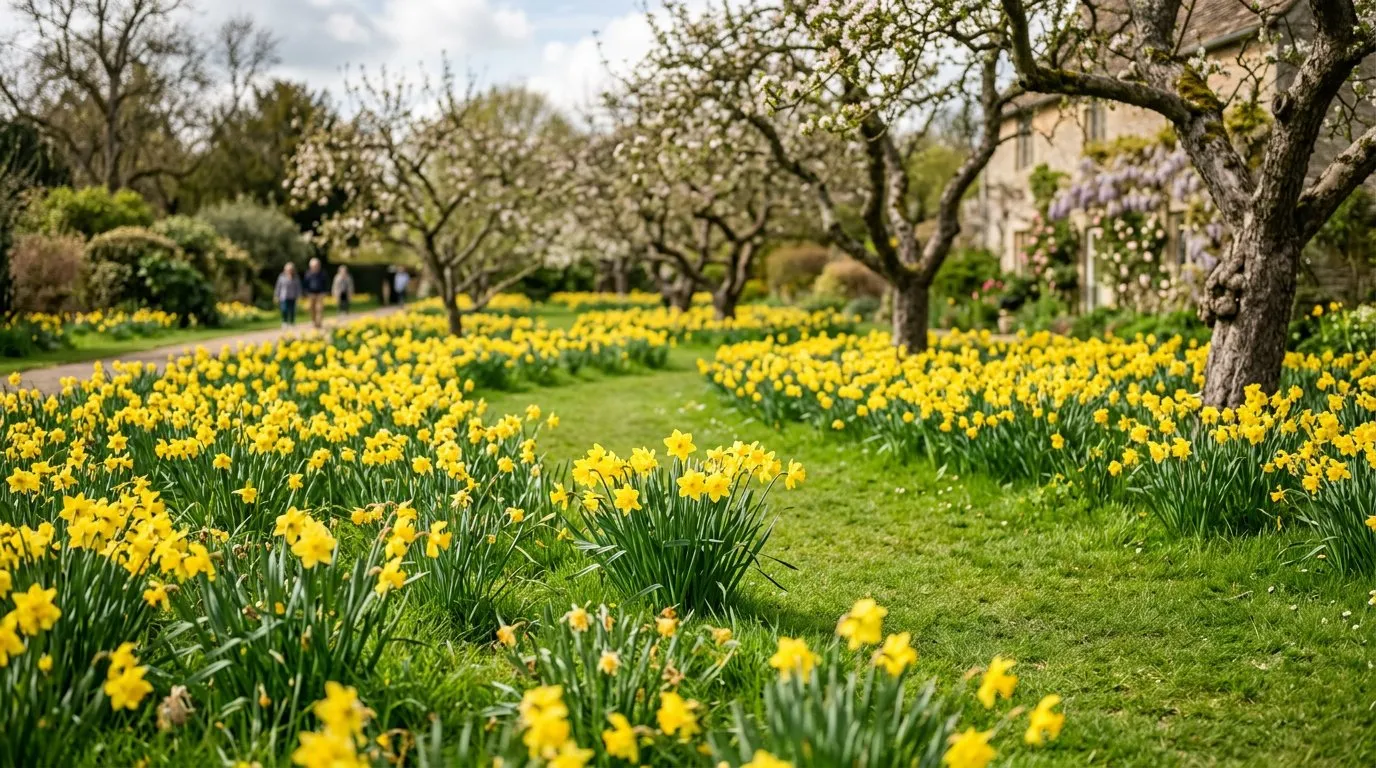 Daffodils naturalised in grass return and multiply for decades with no replanting needed.
How to plant in grass
- Choose an area of lawn or rough grass that you can leave unmown until mid-June
- Scatter bulbs across the area by hand, aiming for a natural, random pattern
- Plant each bulb where it falls using a long-handled bulb planter
- Replace the turf plug on top and tread it down firmly
- Water if the weather is dry
Plant in drifts and clusters, not straight lines or geometric patterns. Natural-looking plantings have dense groups that thin out at the edges, like a river flowing through grass. Odd numbers (groups of 7, 11, 15) look more natural than even numbers.
Best varieties for naturalising
Not all daffodils naturalise equally well. The best for grass are vigorous, early-to-mid season types that complete their foliage cycle quickly.
| Variety | Height | Why it works in grass |
|---|---|---|
| February Gold | 25-30cm | Early flowering, short foliage, very vigorous |
| Carlton | 40-45cm | Tough, multiplies fast, tolerates competition |
| Tete-a-tete | 15-20cm | Low growing, finishes early, suits small lawns |
| Ice Follies | 35-40cm | Reliable, spreads well, attractive in drifts |
| Pheasant’s Eye | 35-40cm | Late, loves damp grass, true wildflower look |
| Lent Lily (N. pseudonarcissus) | 20-30cm | Native UK species, ideal for meadows |
The Lent Lily (Narcissus pseudonarcissus) is Britain’s only native wild daffodil. It is smaller and more delicate than garden hybrids, with pale lemon petals and a deeper yellow trumpet. It thrives in damp, slightly acidic grassland and is the perfect choice for a wildflower lawn or meadow area.
Mowing around naturalised daffodils
The critical rule: do not mow until at least 6 weeks after the last daffodil flowers fade. The foliage must be left to photosynthesise and feed the bulbs for next year. In practice, this means no mowing in the daffodil area until mid to late June for most varieties.
Options for managing the unmown area:
- Mow paths through the daffodil area so it looks intentional
- Choose early-flowering varieties (February Gold, Tete-a-tete) that finish sooner
- Plant daffodils in areas of rough grass that you mow infrequently anyway
Month-by-month daffodil calendar
| Month | Task |
|---|---|
| January | Check stored bulbs. Watch for earliest indoor-forced bulbs flowering on windowsills |
| February | First outdoor daffodils appear (Tete-a-tete, February Gold) in sheltered southern gardens |
| March | Main daffodil season begins. Enjoy the display. No feeding needed yet |
| April | Peak flowering for mid-season and late varieties. Deadhead spent flowers |
| May | Late varieties (Thalia, Pheasant’s Eye) flower. Feed all daffodils with tomato fertiliser |
| June | Foliage yellows and dies back. Mark positions in borders. Begin mowing naturalised areas |
| July | Lift and divide overcrowded clumps if needed. Replant immediately or store briefly |
| August | Order new varieties from autumn catalogues. Plan new planting areas |
| September | Plant daffodil bulbs as soon as they are available. The earlier the better |
| October | Continue planting. Main planting window for most UK gardens |
| November | Last chance planting. Plant any remaining bulbs without delay |
| December | Bulbs are rooting underground. No action needed. Mulch beds if not already done |
Growing daffodils in containers
Daffodils are excellent container plants, especially compact and miniature varieties. Pots of daffodils by the front door or on a patio bring early spring colour to paved areas where there is no soil.
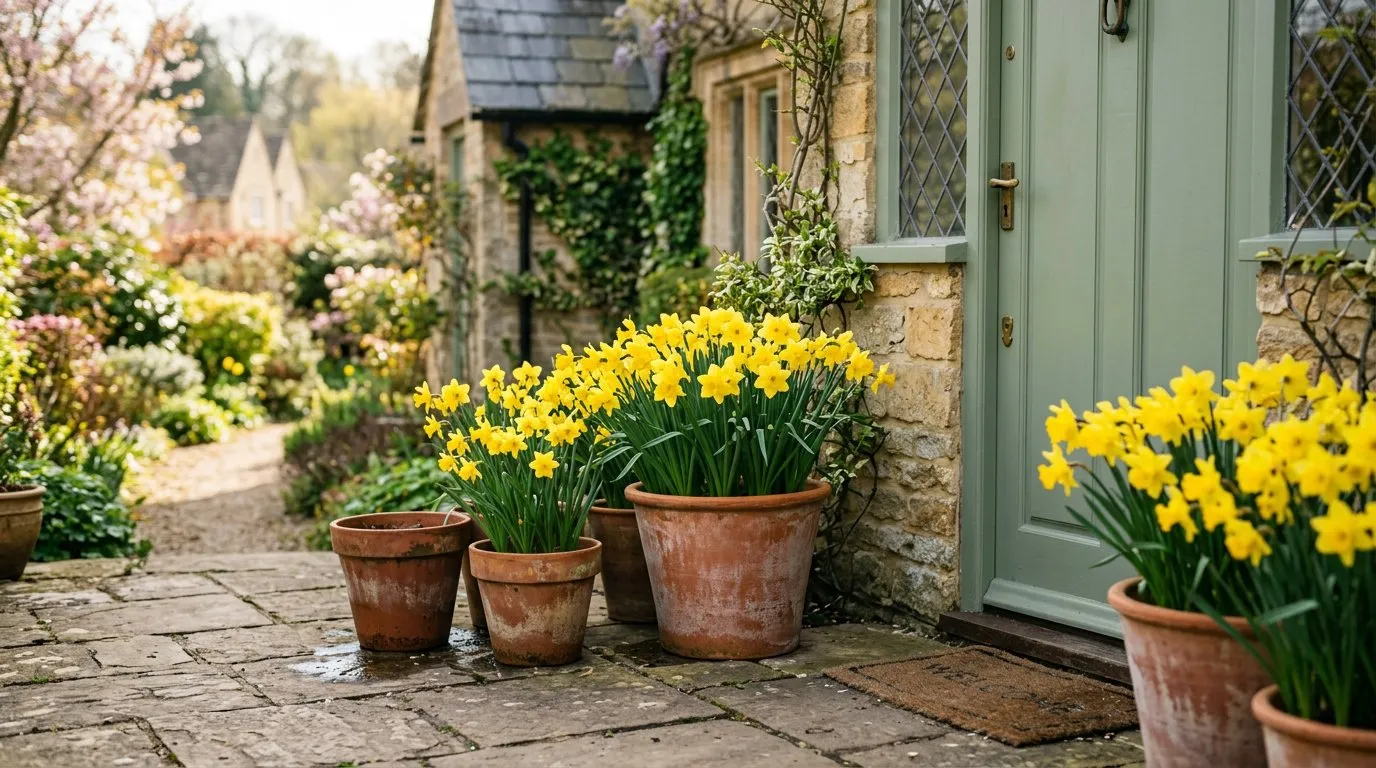 Compact daffodil varieties like Tete-a-tete are ideal for pots and containers on patios and doorsteps.
Container selection
Use pots at least 20cm deep for miniature varieties and 25-30cm deep for standard types. Any material works: terracotta, ceramic, plastic, or metal. Ensure adequate drainage holes. Raise containers on pot feet to prevent waterlogging.
Compost and planting
Fill containers with multipurpose compost mixed with a handful of grit per pot. Plant bulbs at the correct depth (10-15cm), spaced 5-8cm apart for a full display. Water once after planting.
Best container varieties
Tete-a-tete is the outstanding choice for pots at 15-20cm tall. Minnow (10-15cm, multi-headed, cream and yellow) and Hawera (20-25cm, pale lemon, multi-headed) are also excellent. Avoid tall varieties over 40cm in exposed positions because the wind catches them.
For a layered display, combine daffodils with crocuses and hyacinths in a lasagne planting. Place daffodil bulbs at 10-12cm depth, hyacinths at 8cm, and crocuses at 5cm. Each layer flowers in turn, giving weeks of colour. Our September planting guide covers autumn container planting in full.
Aftercare for container daffodils
After flowering, feed fortnightly with tomato fertiliser and let the foliage die back naturally. Move the pot to an out-of-the-way spot while the leaves yellow. When foliage is fully dead, you can either leave the bulbs in the pot (top-dress with fresh compost in autumn) or tip them out and plant in the garden.
Feeding and aftercare for repeat flowering
Daffodils are low-maintenance once established, but a few simple aftercare steps keep them flowering strongly year after year.
Deadheading
Snap off spent flower heads as soon as petals wither. This prevents the plant wasting energy on seed production. Leave the flower stem intact. It continues to photosynthesise alongside the leaves.
The 6-week rule
Leave all daffodil foliage for at least 6 weeks after flowering. This is the single most important thing you can do for future flowering. The leaves manufacture food that is stored in the bulb for next year’s flowers.
Do not cut, tie in bundles, braid, or rubber-band the foliage. All of these reduce the leaf surface area available for photosynthesis. If the dying foliage bothers you, plant daffodils among perennials or ground cover plants that expand as the daffodil leaves fade.
Feeding
Feed daffodils with a potassium-rich liquid fertiliser (tomato feed) after flowering, not before. Apply every 2 weeks from when petals drop until the foliage yellows. Potassium helps the bulb store energy. Avoid high-nitrogen feeds, which promote soft, leafy growth susceptible to disease.
A light top-dressing of bone meal or general-purpose granular fertiliser in autumn (when planting or in established beds) also supports root development. Sprinkle a handful per square metre and rake it in lightly. For gardeners interested in supporting pollinators, daffodils are visited by early bumblebees and solitary bees. See our guide on bee-friendly garden plants for more early-flowering species.
Dividing overcrowded clumps
Daffodil clumps that have been in the ground for 3-5 years often become overcrowded. Bulbs multiply and compete for space, leading to smaller flowers and eventually “blind” bulbs that produce leaves but no flowers.
Divide in September, as new roots are just starting to grow:
- Lift the entire clump with a garden fork
- Shake off loose soil
- Separate individual bulbs by hand, twisting gently
- Discard any that are soft, mouldy, or very small
- Replant healthy bulbs immediately at the correct depth and spacing
After dividing, flowering is usually reduced in the first spring as bulbs re-establish. By the second year, they return to full flower production.
Daffodil problems and solutions
Narcissus bulb fly
The large narcissus fly (Merodon equestris) lays eggs near daffodil foliage in late spring. The larva burrows into the bulb and eats the centre, destroying it. Affected bulbs feel soft and light when lifted in autumn.
Prevention: firm the soil around daffodil bases in June after foliage dies back. The fly lays eggs in loose soil near the bulb neck. Covering the area with fleece from May to June prevents egg-laying.
Basal rot
Basal rot (Fusarium oxysporum) causes the base plate of the bulb to soften and rot. It spreads in warm, wet soil and is worst in heavy clay. Improve drainage, avoid planting in recently affected areas, and discard any soft or discoloured bulbs at planting time.
Daffodil blindness
“Blind” daffodils produce leaves but no flowers. Common causes include:
- Overcrowded clumps (divide every 3-5 years)
- Foliage cut too early the previous year
- Too much shade
- Shallow planting (less than 10cm deep)
- Poor drainage causing partial bulb rot
Address the underlying cause and most blind daffodils recover within 1-2 seasons.
Common mistakes
Cutting foliage too early
This is the most frequent mistake with daffodils. Mowing or cutting leaves before they have yellowed naturally (6 weeks after flowering) starves the bulb. It leads to progressively weaker flowers and eventually blind bulbs. Let the leaves look untidy. They are feeding next year’s display.
Planting too late
Daffodils planted in November or December miss their best rooting window. They still flower, but first-year displays are weaker than September or October plantings. Buy and plant bulbs as early in autumn as possible. If bulbs arrive late, plant them the same day.
Planting in straight lines
Formal rows of daffodils look unnatural, especially in grass. Scatter bulbs by hand and plant where they land. Nature does not plant in rows. Odd-numbered groups (7, 11, 15) with irregular spacing look convincing. This applies to borders as well as lawns.
Ignoring overcrowding
A clump of daffodils that flowered five years ago may now produce mainly leaves. This is overcrowding. The original bulbs have multiplied into a dense mass competing for nutrients. Lift, divide, and replant with proper spacing every 3-5 years. Our spring gardening jobs guide includes a full bulb care checklist.
Tying or braiding foliage
Some gardeners tie daffodil leaves in neat knots or braid them to reduce untidiness. This reduces the leaf area exposed to sunlight and weakens the bulb. Leave foliage loose and natural. Plant hostas, geraniums, or other expanding perennials nearby to disguise the dying leaves.
Now you’ve mastered daffodil planting, read our guide on when to plant tulip bulbs for the perfect companion crop that extends your spring colour display through to May.
Daffodils and the Royal Horticultural Society Award of Garden Merit
The RHS Award of Garden Merit (AGM) identifies plants that perform reliably in UK conditions. Over 180 daffodil cultivars hold the AGM. When choosing varieties, AGM status is a dependable indicator that the plant will grow well in a British garden without fuss.
All varieties recommended in this guide hold or have held the AGM. When browsing catalogues, look for the AGM symbol (a stylised trophy) as a shortcut to reliable performers.
Frequently asked questions
When should I plant daffodil bulbs in the UK?
Plant from September to October for best results. Daffodils need 14-16 weeks in cold ground before flowering. September planting gives the longest rooting period. October planting works well. November is getting late for daffodils, unlike tulips which prefer late planting.
How deep should I plant daffodil bulbs?
Plant 10-15cm deep, roughly 2-3 times the bulb height. Measure from the base of the bulb to the soil surface. Deep planting anchors the bulb, protects it from frost, and reduces the chance of blind (non-flowering) bulbs in future years. Add grit beneath the bulb on heavy clay.
Can I plant daffodils in grass?
Yes, daffodils are one of the best bulbs for naturalising in grass. Scatter bulbs randomly and plant where they land for a natural look. Use a long-handled bulb planter to cut holes in turf to the correct depth. Do not mow the grass until 6 weeks after the last daffodil flowers fade.
Why are my daffodils not flowering?
Cutting foliage too early is the most common cause. Daffodil leaves must remain for 6 weeks after flowering to feed the bulb. Other causes include overcrowding (divide clumps every 3-5 years), planting too shallow, too much shade, and poor drainage causing partial bulb rot.
When should I divide daffodil clumps?
Divide overcrowded clumps in September. Lift the entire clump with a garden fork, separate the bulbs by hand, discard any soft or damaged ones, and replant immediately at the correct depth and spacing. Dividing every 3-5 years maintains strong flowering and prevents blindness.
Can I plant daffodils in pots?
Yes, daffodils grow well in containers at least 20cm deep. Use multipurpose compost with added grit for drainage. Plant bulbs 10cm deep and 5cm apart for a dense display. Miniature varieties like Tete-a-tete and Hawera are ideal for pots, window boxes, and small containers.
Do daffodils come back every year?
Yes, daffodils are perennial and return reliably for many years. Well-planted daffodils in suitable conditions multiply and spread, forming larger clumps over time. Some naturalised plantings have lasted for decades. They are among the most dependable spring bulbs for UK gardens.
What should I do with daffodils after they finish flowering?
Deadhead spent flowers but leave all foliage intact for 6 weeks. The leaves photosynthesise and rebuild the bulb’s energy reserves for next spring. Feed with tomato fertiliser fortnightly after flowering. Do not tie, braid, or cut the leaves until they have turned fully yellow and collapsed.
Lawrie has been gardening in the West Midlands for over 30 years. He grows his own veg using no-dig methods, keeps a wildlife-friendly garden, and writes practical advice based on real UK growing conditions.