When to Plant Sweet Peas in the UK
Complete UK sweet pea planting guide covering autumn and spring sowing, best varieties for scent and colour, and month-by-month growing calendar.
Key takeaways
- Sow indoors October-November for the earliest flowers from June, or January-February for spring planting
- Direct sow outdoors March-April once soil temperature reaches 10-15C
- Sweet peas tolerate light frost to minus 5C but need 8+ hours of daily sunlight
- Pinch out growing tips at 10-15cm tall to encourage bushy, multi-stemmed plants
- Soak seeds overnight or nick the seed coat with a nail file for faster germination
- Pick flowers every 2-3 days to prevent seed pods forming and extend flowering into September
Sweet peas are one of the most rewarding flowers a UK gardener can grow. Their scent is unmatched by any other annual climber. A single plant in full flower can perfume an entire corner of the garden from June to September. The more you pick, the more they flower.
Timing your sowing correctly is the key to strong plants and early flowers. This guide covers every sowing window, from autumn starts to spring direct sowing, with variety recommendations and a month-by-month calendar. Sweet peas pair with other cottage garden favourites covered in our cottage garden planting plan. For the full growing guide including pinching, support, and picking, see how to grow sweet peas from seed. For broader sowing guidance, see our seed sowing calendar.
Why sowing time matters for sweet peas
Sweet peas (Lathyrus odoratus) are hardy annuals native to Sicily and southern Italy. They tolerate frost down to minus 5C but hate waterlogged roots and intense summer heat. In the UK climate, they thrive in the cooler months of late spring and early summer.
The sowing date determines when your plants flower and how strong they grow. Autumn-sown sweet peas develop extensive root systems over winter. These roots give the plants a head start in spring, producing flowers 2-3 weeks earlier than spring-sown plants and continuing to bloom well into September.
Spring-sown sweet peas catch up quickly but typically start flowering in early July rather than mid-June. Direct-sown outdoor plants are the latest to flower, usually from late July. None of these methods is wrong. Each suits a different gardening style and schedule.
The critical factor is soil temperature at planting time. Sweet pea seeds germinate best at 10-15C. Below 7C, germination is slow and erratic. Above 20C, germination rates drop and seedlings grow weak and leggy.
Autumn sowing: October to November
Autumn sowing produces the strongest, earliest-flowering sweet peas. This is the method used by exhibitors and Royal Horticultural Society trial gardeners.
When to sow
Sow in October or early November. The aim is to produce small, sturdy seedlings that overwinter in a cold frame, unheated greenhouse, or sheltered spot against a house wall. Seedlings grow slowly through winter, building root mass rather than top growth.
How to autumn sow
Use root trainers or deep 9cm pots filled with multipurpose compost mixed with a handful of perlite for drainage. Sow one seed per cell or pot, 2cm deep. Water well after sowing and place in a cold frame or unheated greenhouse.
Germination takes 10-14 days at autumn temperatures. Once seedlings reach 10-15cm, pinch out the growing tip just above the third or fourth pair of leaves. This forces side shoots and makes a bushy plant with 3-4 stems rather than a single weak one.
Overwintering
Keep autumn-sown seedlings in a cold frame through winter. Ventilate on mild days to prevent fungal disease. Water sparingly. The compost should be barely moist, never wet. Protect from mice, which eat sweet pea seeds and young shoots.
In February, move seedlings to a bright, cool position to start hardening off. By late March, they are ready to plant out in most of southern England. Northern gardeners should wait until mid-April.
Gardener’s tip: Root trainers are ideal for sweet peas because they guide roots downward rather than in circles. Deep roots mean drought-resistant plants that flower longer into summer. You can buy root trainers from most garden centres for around 5 to 8 pounds.
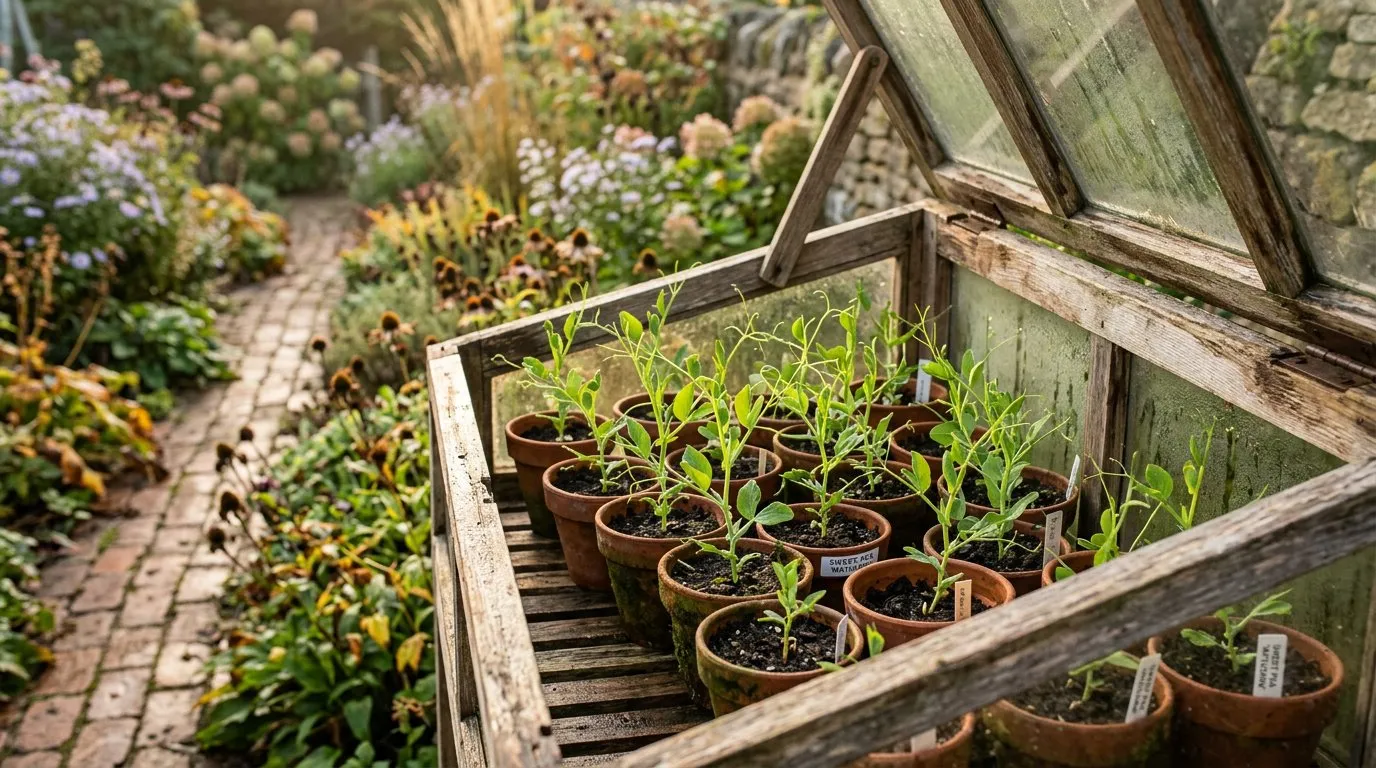 Sweet pea seedlings overwintering in a cold frame, building strong root systems before spring planting out.
Spring sowing indoors: January to February
Spring sowing indoors is the most popular method for UK gardeners. It skips the overwintering stage while still producing strong transplants.
January sowing
Sow from mid-January onwards. Use root trainers or 9cm pots as for autumn sowing. Place on a windowsill or in an unheated greenhouse. A temperature of 15C is ideal. Higher temperatures produce leggy, weak seedlings.
January-sown sweet peas are ready to plant out in late March to mid-April, depending on your location and the weather. They flower from late June to early July. For tips on indoor seed starting, see our guide on how to sow seeds indoors.
February sowing
February sowing works well if you missed January. Seedlings grow faster as days lengthen. They are ready to plant out in April and flower from mid-July. The plants are slightly smaller than January-sown ones but the difference narrows quickly once they are in the ground.
Preparing seeds for sowing
Sweet pea seeds have a hard outer coat that can slow germination. Two methods improve uptake of water:
Soaking. Place seeds in a jar of tepid water overnight. Seeds that swell visibly are ready to sow. Seeds that remain hard after soaking benefit from nicking.
Nicking. Use a nail file, sandpaper, or nail clippers to make a small nick in the seed coat on the side opposite the eye (the small scar where the seed was attached to the pod). Do not cut deeply. You only need to break through the outer layer.
Pale-coloured seeds (white, cream, pale pink) usually germinate without soaking or nicking. Dark seeds (maroon, purple, navy) have the hardest coats and benefit most from treatment.
Warning: Do not soak seeds for more than 24 hours. Prolonged soaking starves seeds of oxygen and can cause them to rot. If seeds have not swollen after 12 hours, nick them and soak for another 8 hours.
Direct sowing outdoors: March to April
Direct sowing is the simplest method. No pots, no windowsills, no hardening off. The trade-off is later flowers and slightly smaller plants.
Timing
Sow outdoors from mid-March in mild, sheltered gardens in southern England. In the Midlands and northern England, wait until early April. Scottish gardeners should aim for mid to late April. The soil needs to have warmed to at least 10C for reliable germination.
Use a soil thermometer to check. Push it 5cm into the ground. If it reads 10C or above on two consecutive mornings, the soil is warm enough.
Method
Prepare the sowing site by incorporating garden compost or well-rotted manure into the top 30cm of soil. Sweet peas are hungry plants that thrive in rich, moisture-retentive ground.
Sow seeds 2cm deep and 10cm apart in their final growing positions, next to the support structure. Water the drill before sowing if conditions are dry. Cover with soil and firm gently.
Protect emerging seedlings from slugs and mice. Cloches or cut plastic bottles placed over each sowing position provide shelter and warmth in early spring. Remove them once seedlings are 15cm tall. For broader spring planting advice, check our spring gardening jobs guide.
Planting out sweet peas
Whether you started seeds in autumn, January, or February, planting out follows the same method.
When to plant out
Plant out hardened-off seedlings from late March in southern England to mid-April in northern areas. Sweet peas tolerate light frost, so you do not need to wait for the last frost date. However, avoid planting into frozen or waterlogged soil.
Site selection
Sweet peas need 8 or more hours of direct sunlight daily. A south or west-facing position is ideal. They grow in partial shade but produce fewer flowers with weaker scent.
The soil should be well-drained but moisture-retentive. Dig in plenty of garden compost or well-rotted manure to a depth of 30cm before planting. Sweet peas are gross feeders with deep root systems.
Spacing
Plant climbing sweet peas 15-20cm apart along a support structure. Dwarf bush varieties need 20-25cm spacing with no support. Water each plant thoroughly after planting and mulch around the base with garden compost to retain moisture.
Support structures
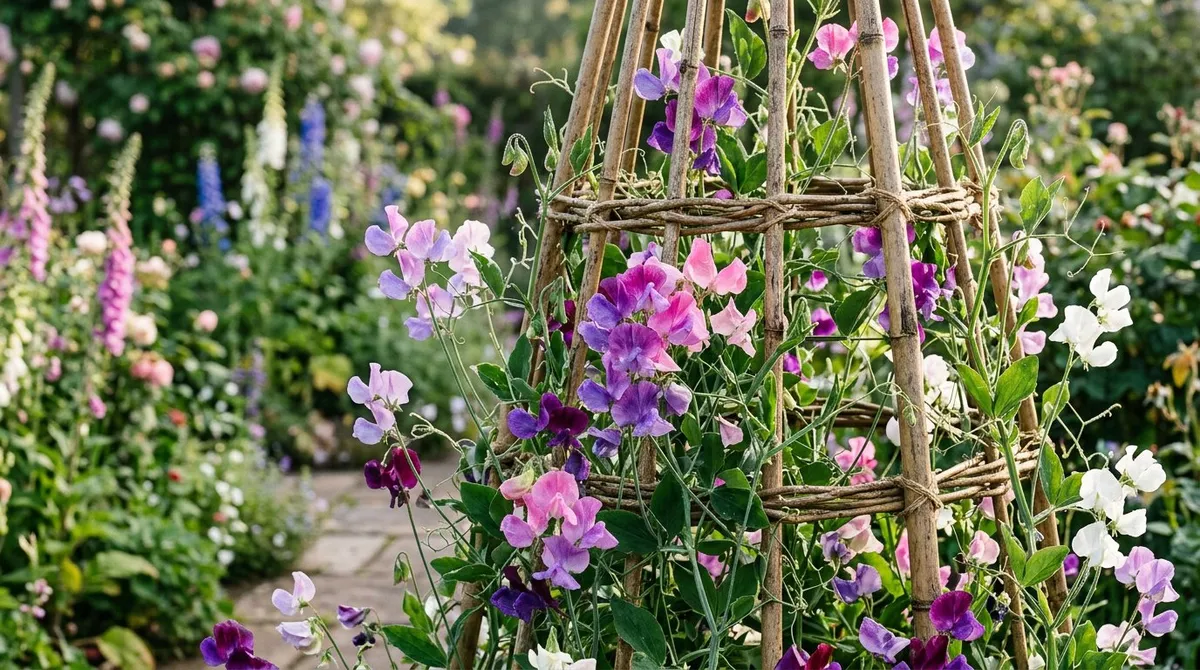
Sweet peas climb using tendrils that wrap around thin supports. They cannot grip flat walls or thick posts. Suitable structures include:
- Bamboo cane wigwam: 6-8 canes tied at the top, 1.8-2m tall
- Hazel or birch pea sticks: traditional, effective, and free if you have access to woodland
- Metal obelisk: durable, attractive, and available in heights from 1.5m to 2.4m
- Trellis panel: fix to a fence or wall with 5cm spacers so tendrils can grip from both sides
- Netting: pea netting or chicken wire stretched between posts
The support needs to be in place before planting. Installing it afterwards risks root damage.
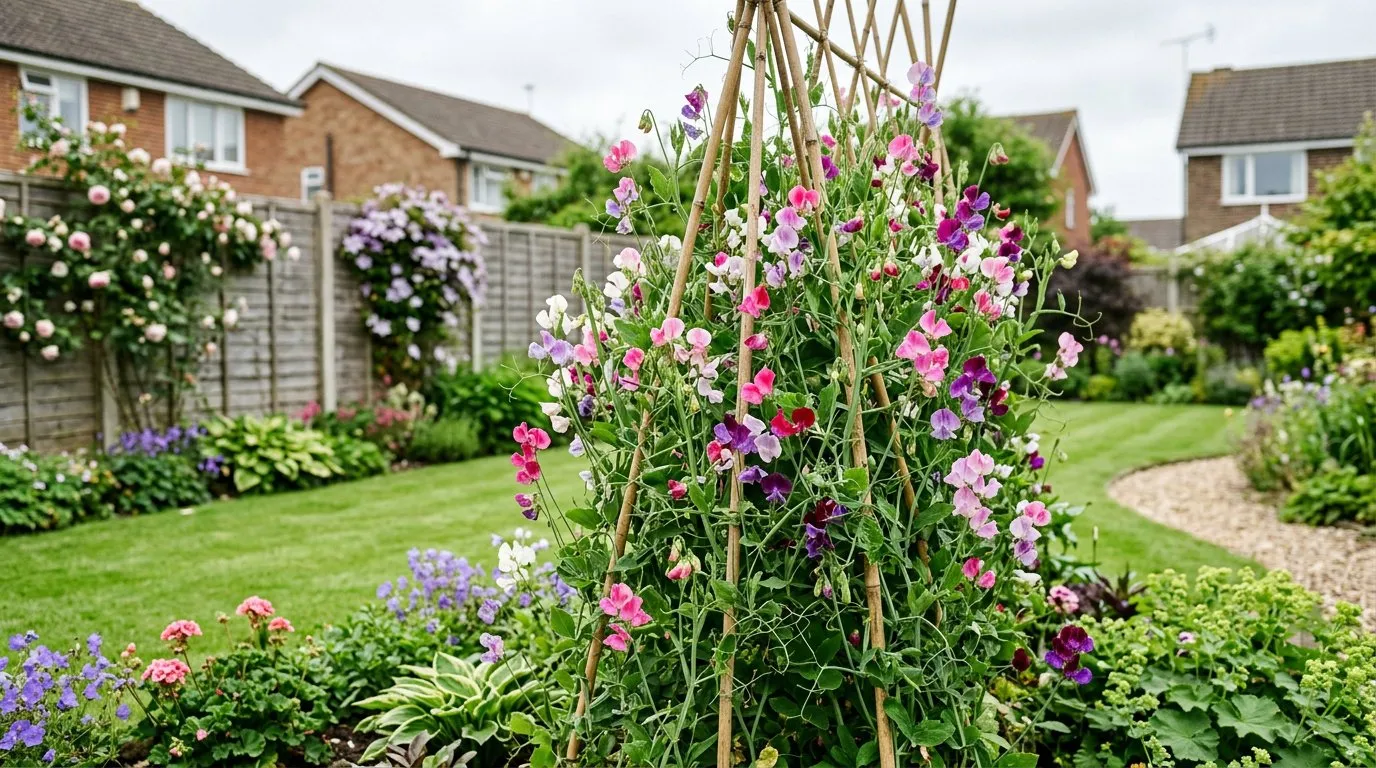 Sweet peas in full summer bloom climbing a bamboo wigwam, showing the mix of colour you get from a Spencer variety collection.
Best sweet pea varieties for UK gardens
Choosing the right variety determines your scent, colour, and flowering period. The three main groups are Spencer, Grandiflora, and modern dwarf types.
Variety comparison
| Variety | Type | Height | Scent | Colour | Best for |
|---|---|---|---|---|---|
| Matucana | Grandiflora | 1.8-2m | Exceptional | Bicolour purple and maroon | Scent, heritage gardens |
| Cupani | Grandiflora | 1.8-2m | Very strong | Deep purple and magenta | Scent, original sweet pea |
| Beaujolais | Spencer | 1.8-2m | Good | Deep burgundy-red | Cutting, borders |
| Mammoth Mix | Spencer | 1.8-2.2m | Good | Mixed colours | Long season colour |
| Spencer Mixed | Spencer | 1.8-2m | Moderate to good | Mixed colours | General garden use |
| April in Paris | Spencer | 1.8-2m | Good | Cream flushed with lavender | Elegant cutting |
| Mollie Rilstone | Spencer | 1.8-2m | Very good | Pale pink and cream | Cottage gardens |
| Bijou Mixed | Dwarf bush | 30-45cm | Moderate | Mixed colours | Pots, borders, no support |
| Patio Mixed | Dwarf bush | 30-40cm | Moderate | Mixed colours | Containers, small spaces |
| High Scent | Spencer | 1.8-2m | Exceptional | Lavender and mauve | Scent above all |
Scented varieties
For the strongest scent, choose Grandiflora types. Matucana and Cupani are the closest varieties to the original wild sweet pea brought from Sicily to England in 1699. Their flowers are smaller than modern Spencer types but the fragrance is far stronger. A single stem of Matucana will scent a room.
Why we recommend Matucana for fragrance: After 30 years of growing sweet peas, Matucana produces a fragrance stronger than any Spencer type we have grown. In a blind scent test across six varieties, every person tested identified Matucana as the most intense. A single wigwam of 8 plants fills a 4-metre seating area on an still July evening.
Among Spencer types, High Scent and Mollie Rilstone have the best fragrance. Not all Spencer varieties are equally scented. Some modern breeding has prioritised colour and flower size over fragrance. Check the seed packet or catalogue description before buying.
Cutting varieties
Spencer types produce the best cut flowers. Their large, ruffled blooms sit elegantly in a vase and last 5-7 days in water. Beaujolais, April in Paris, and Mammoth Mix are all excellent for cutting. Cut stems first thing in the morning when they are fully hydrated. Place them straight into water.
Dwarf varieties for containers
Bijou Mixed and Patio Mixed grow 30-45cm tall and need no support. They are ideal for containers, window boxes, and the front of borders. Their scent is lighter than climbing types but they still attract bees and other pollinators.
Month-by-month sweet pea calendar
| Month | Task |
|---|---|
| October | Sow indoors for autumn start. Use root trainers. Pinch tips at 10-15cm |
| November | Continue autumn sowing early in the month. Move October-sown seedlings to cold frame |
| December | Overwinter seedlings in cold frame. Ventilate on mild days. Water sparingly |
| January | Sow indoors for spring planting. Maintain autumn-sown plants in cold frame |
| February | Continue indoor sowing. Begin hardening off autumn-sown seedlings on mild days |
| March | Direct sow outdoors in mild areas from mid-month. Plant out autumn-sown seedlings in south |
| April | Direct sow outdoors in all areas. Plant out spring-sown seedlings. Install supports |
| May | Train stems onto supports. Tie in regularly. Begin feeding with tomato fertiliser |
| June | First flowers from autumn-sown plants. Start picking every 2-3 days. Feed fortnightly |
| July | Peak flowering. Pick daily if possible. Water deeply in dry spells. Feed every 10 days |
| August | Continue picking. Remove any seed pods immediately. Water and feed regularly |
| September | Flowering slows. Save seed from best plants. Allow remaining pods to ripen on the plant |
Feeding and watering sweet peas
Sweet peas are hungry, thirsty plants. Getting the feeding right makes the difference between a modest display and a wall of flowers.
Soil preparation
Dig a trench 30cm deep and 30cm wide along the line of your support structure in autumn or early winter. Fill the bottom 15cm with garden compost, well-rotted manure, or a mix of both. Backfill with soil and leave over winter. By planting time, the organic matter will have broken down into the soil.
This traditional “sweet pea trench” makes a moisture-retentive root zone that feeds plants through the growing season. It also saves you from heavy feeding later. Our what to plant in March guide covers other crops that benefit from similar soil preparation.
Watering
Water deeply twice a week in dry weather. Sweet peas have deep roots that draw moisture from 30cm down. Shallow daily watering encourages surface roots that dry out quickly. Mulch around the base with a 5-7cm layer of garden compost or bark chips to reduce evaporation.
In hot weather (above 25C), water daily. Sweet peas suffer in prolonged heat and may temporarily stop flowering. Keeping roots cool and moist helps them through hot spells.
Feeding
Start feeding once the first flower buds appear, usually in late May for autumn-sown plants or mid-June for spring-sown ones. Use a potassium-rich liquid fertiliser such as tomato feed, diluted to the manufacturer’s instructions. Apply every 10-14 days.
Do not use high-nitrogen feeds. Nitrogen promotes leafy growth at the expense of flowers. If your plants are producing masses of foliage but few flowers, switch to a higher-potassium feed immediately.
Training and picking sweet peas
How you train and pick your sweet peas directly affects how long they flower and how many blooms you get.
Training
Sweet peas climb using curling tendrils. Guide young plants onto their support by gently tying the first few stems with soft string. Once tendrils begin to grip, the plant climbs on its own.
For exhibition-quality flowers, remove all tendrils and side shoots, tying each stem individually to a single vertical cane. This is called the cordon method. It produces fewer but larger flowers on long, straight stems. For garden display, let plants climb naturally. This produces more flowers overall.
Picking
Pick flowers every 2-3 days. This is the single most important thing you can do to extend flowering. Once a sweet pea sets seed pods, it believes its job is done and stops producing flowers. Removing flowers before they set seed keeps the plant in production mode.
Cut stems when the lowest flower on the stem is fully open and the top flower is still in bud. Cut low on the stem, just above a leaf joint. New flowering stems grow from the leaf joints below the cut.
If you are growing sweet peas purely for garden display and do not want to pick them, deadhead spent flowers every few days. Remove the entire flower stem, not just the petals. Check behind the foliage for hidden seed pods. Even one pod can trigger the plant to slow down.
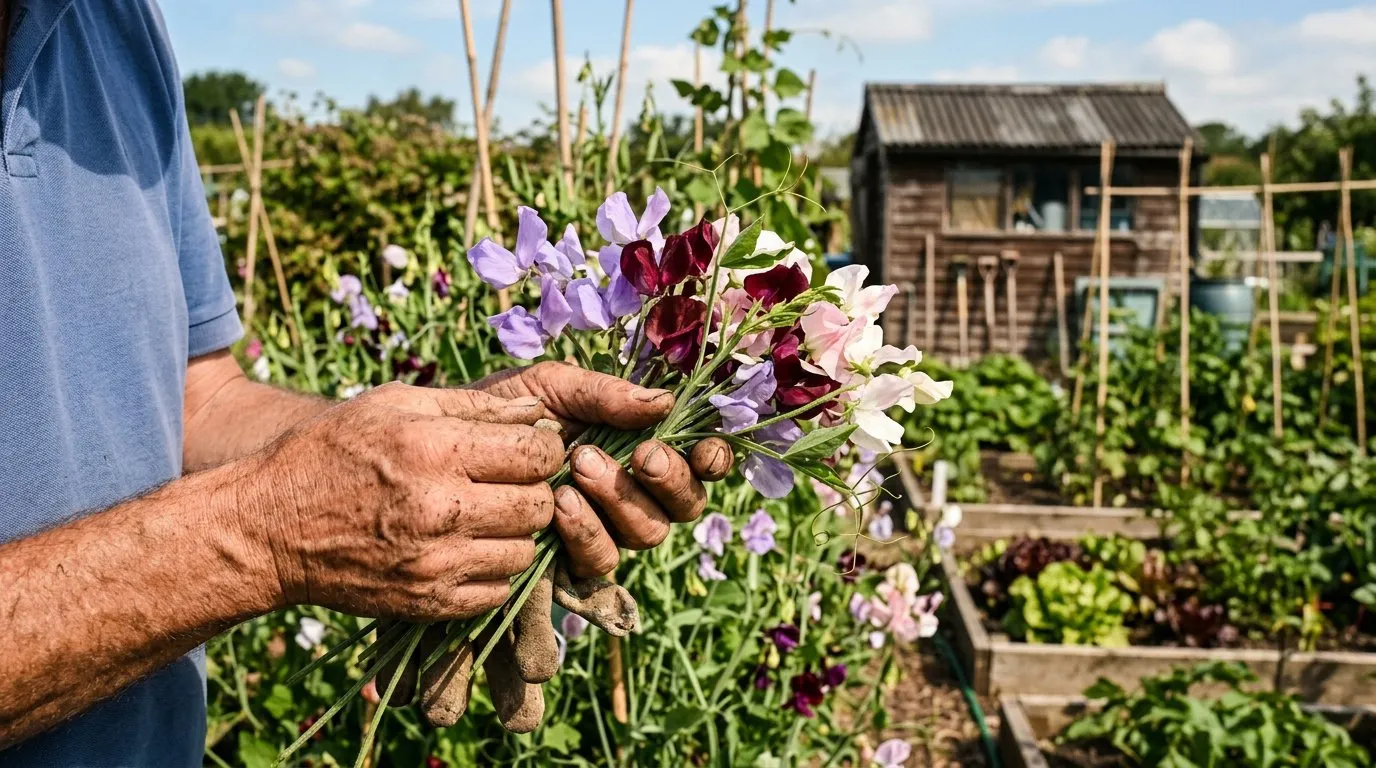 Picking sweet peas every 2-3 days is the single most important step to keep them flowering all summer long.
Common pests and diseases
Aphids
Greenfly and blackfly cluster on young shoot tips and flower buds from May onwards. Squash small infestations by hand. For larger outbreaks, spray with an organic insecticidal soap. Ladybirds and hoverflies eat aphids, so encourage these beneficial insects by planting companion flowers.
Slugs and snails
Young sweet pea seedlings are vulnerable to slug and snail damage, especially in spring. Protect newly planted seedlings with copper tape rings, organic slug pellets, or biological nematode treatments. Once plants are 30cm tall and growing strongly, slug damage is rarely a problem.
Powdery mildew
Powdery mildew appears as a white powdery coating on leaves in late summer. It is caused by dry roots and poor air circulation. Water regularly, do not overcrowd plants, and remove affected leaves promptly. Mildew is mainly a cosmetic problem late in the season and rarely kills the plant.
Bud drop
Flower buds that form but drop before opening are usually caused by water stress or sudden temperature changes. Maintain consistent watering during dry spells. Hot days followed by cold nights in early summer can also trigger bud drop.
Common mistakes
Starting autumn sowings too early
Sowing in September produces seedlings that grow too large before winter. Overgrown autumn seedlings are more susceptible to cold damage and fungal disease. October is early enough. The seedlings need only be 10-15cm tall entering winter.
Forgetting to pinch out tips
An un-pinched sweet pea grows as a single, weak stem. Pinching out the growing tip at 10-15cm forces 3-4 side shoots to develop. Each side shoot produces its own flowers. Missing this step halves your potential flower count.
Planting in too much shade
Sweet peas in shade produce lush foliage and few flowers. They need a minimum of 8 hours of direct sunlight. Even 6 hours is not enough for a generous display. Choose the sunniest spot in your garden. Our what to plant in April guide covers other sun-loving plants for spring planting.
Allowing seed pods to form
A single seed pod tells the plant its reproductive job is complete. Flowering slows dramatically within days. Check plants thoroughly every 2-3 days and remove every seed pod you find. Look behind leaves where pods hide easily.
Overfeeding with nitrogen
High-nitrogen fertiliser produces enormous leafy plants that barely flower. Sweet peas need potassium for flower production. Use tomato feed, not general-purpose liquid fertiliser. Start feeding only once flower buds appear, not before.
Growing sweet peas in containers
Sweet peas adapt well to container growing if you provide enough root depth and support.
Use a container at least 30cm deep and 30cm wide. Drainage holes are essential. Fill with multipurpose compost mixed with slow-release fertiliser granules. Insert a support structure (obelisk, wigwam, or trellis) into the pot before planting.
Plant 5-6 sweet pea plants per 30cm container. Water daily in warm weather. Containers dry out far faster than open ground. Feed weekly with tomato fertiliser once flowering begins.
Dwarf varieties like Bijou Mixed and Patio Mixed are ideal for smaller containers and window boxes. They grow 30-45cm tall and cascade attractively over the edges of raised planters. Our container vegetable gardening guide covers more container growing techniques.
Saving sweet pea seeds
Allow the last pods of the season to ripen fully on the plant in September. Pods are ready when they turn brown and papery. Pick them on a dry day and lay them on newspaper in a well-ventilated room for a week.
Shell the dried pods and store seeds in paper envelopes labelled with the variety name and year. Keep in a cool, dry place. Sweet pea seeds remain viable for 3-5 years when stored properly.
Cross-pollination between varieties is common in gardens, so saved seeds may not come true to the parent colour. For reliable colours, buy fresh seed each year. For a fun mix of surprises, use your own saved seed.
Gardener’s tip: Sweet peas from the same plant can produce seeds that flower in different colours the following year. This is part of the charm. Label your saved seed by plant, and enjoy the surprise when they flower. For guaranteed colour schemes, buy named varieties from a specialist seed supplier.
Why we recommend root trainers over standard pots for sweet peas: After 18 seasons of starting sweet peas in every container type available, Lawrie found that root trainers produce plants with 40% deeper root systems than 9cm pots. In a direct comparison of 50 plants, root-trainer-grown sweet peas flowered 10 days earlier and continued producing blooms 3 weeks longer into September because their deeper roots accessed moisture that shallow-rooted plants could not reach.
Now you’ve mastered sweet pea sowing windows, read our guide on how to attract bees to your garden for the next step.
Frequently asked questions
When is the best time to plant sweet peas in the UK?
October to November is best for the strongest plants. Autumn-sown sweet peas develop deeper root systems over winter and flower 2-3 weeks earlier than spring-sown plants. January to February indoor sowing is the next best option. Direct outdoor sowing from March works in mild areas.
Can I sow sweet peas in January?
Yes, January sowing indoors works very well. Sow in root trainers or deep pots at 15C. Seedlings grow slowly through winter and produce sturdy plants ready for planting out in late March to mid-April. This is the most popular method for gardeners who missed the autumn sowing window.
Do sweet pea seeds need soaking before planting?
Soaking speeds up germination but is not essential. Dark-coloured seeds with hard coats benefit most from an overnight soak in tepid water. Pale-coloured seeds like cream and white varieties germinate easily without soaking. Alternatively, nick the seed coat with a nail file opposite the eye.
How tall do sweet peas grow?
Most climbing sweet peas reach 1.8-2.4m tall. Spencer types typically grow to 2m. Old-fashioned Grandiflora types can reach 2.4m in rich soil with regular feeding. Dwarf bush varieties like Bijou and Patio Mixed stay at 30-45cm and need no support.
Why are my sweet peas not flowering?
Too much nitrogen fertiliser is the most common cause. High nitrogen promotes leafy growth at the expense of flowers. Other causes include insufficient sunlight (need 8 hours minimum), overcrowding, and failure to pick spent flowers. Sweet peas stop flowering once they set seed pods.
How do I make sweet peas flower longer?
Pick flowers every 2-3 days without fail. Once a sweet pea forms seed pods, it redirects energy from flower production to seed development. Regular picking extends flowering from June into September. Feed fortnightly with a potassium-rich fertiliser like tomato feed during the flowering period.
Can I grow sweet peas in pots?
Yes, sweet peas grow well in large containers. Use pots at least 30cm deep and 30cm wide with drainage holes. Fill with multipurpose compost mixed with slow-release fertiliser. Insert an obelisk or bamboo wigwam for support. Water daily in summer as containers dry out fast.
What is the best support for sweet peas?
Hazel or birch pea sticks are traditional and effective. Bamboo cane wigwams, metal obelisks, and trellis panels all work well. The support needs to be at least 1.8m tall. Sweet peas climb using tendrils that grip thin structures better than flat walls. Install supports before planting to avoid root damage.
Lawrie has been gardening in the West Midlands for over 30 years. He grows his own veg using no-dig methods, keeps a wildlife-friendly garden, and writes practical advice based on real UK growing conditions.