How to Grow Cotinus Smokebush UK
Learn how to grow cotinus smokebush in UK gardens. Covers Royal Purple, Grace and Golden Spirit varieties, pruning, soil needs and autumn colour tips.
Key takeaways
- Cotinus tolerates all UK soil types including heavy clay, chalk and sand if drainage is reasonable
- 'Royal Purple' is the most popular UK variety with an RHS AGM and deep plum-purple foliage
- Hard pruning (stooling) in March doubles leaf size to 12cm but removes the smoke-like flowers
- Autumn colour peaks in October with leaves turning vivid scarlet, orange and gold
- Established plants are drought-tolerant once rooted, needing no supplemental watering after year two
- Cotinus grows 30-45cm per year and needs minimal feeding on poor soil for the best foliage colour
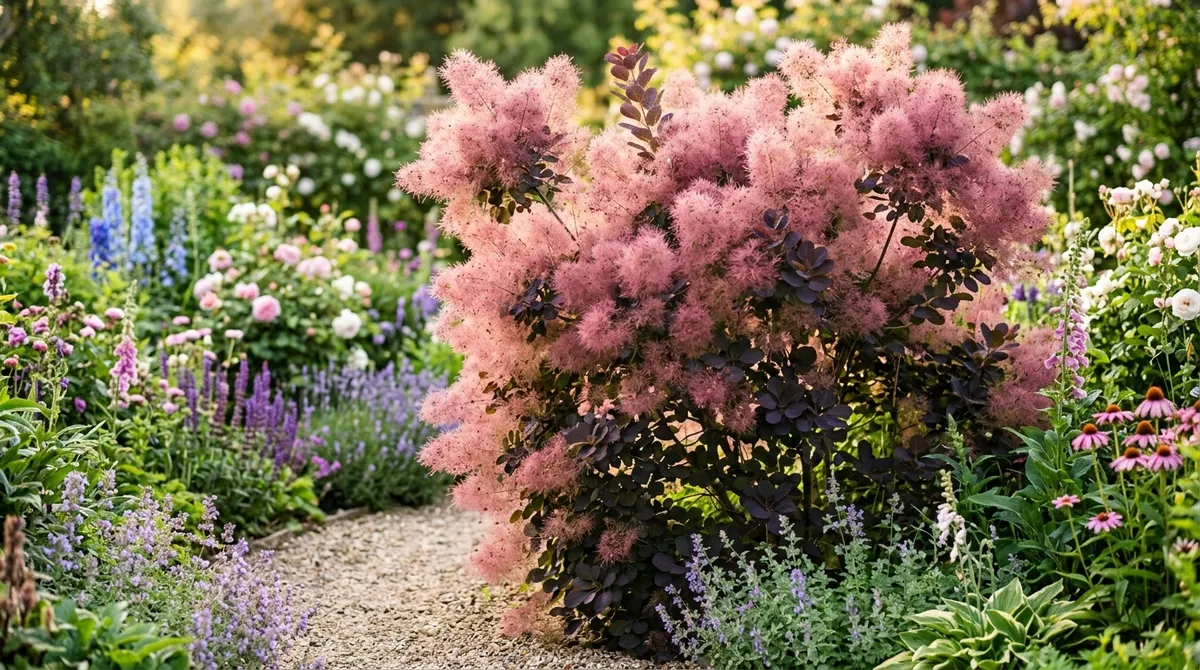
Cotinus smokebush is one of the most dramatic deciduous shrubs you can grow in a UK garden. The billowing clouds of pink and purple flower panicles from June to August give it the common name, and the autumn colour rivals any Japanese maple. This is a plant that earns its space in every season.
The genus Cotinus belongs to the Anacardiaceae family, the same family as mangoes and cashews. Two species are commonly grown in the UK: Cotinus coggygria (European smokebush, native from southern Europe to central China) and Cotinus obovatus (American smoketree). Most garden varieties are selections or hybrids of C. coggygria. The RHS plant profile for Cotinus confirms several cultivars as fully hardy to -20C across all UK regions, including Scotland and northern England.
Which cotinus variety should I grow?
Choosing the right cotinus variety depends on your garden size, preferred foliage colour and whether you want the smoke flower effect or dramatic autumn colour. All varieties listed below hold an RHS Award of Garden Merit (AGM) or have performed reliably in UK trials.
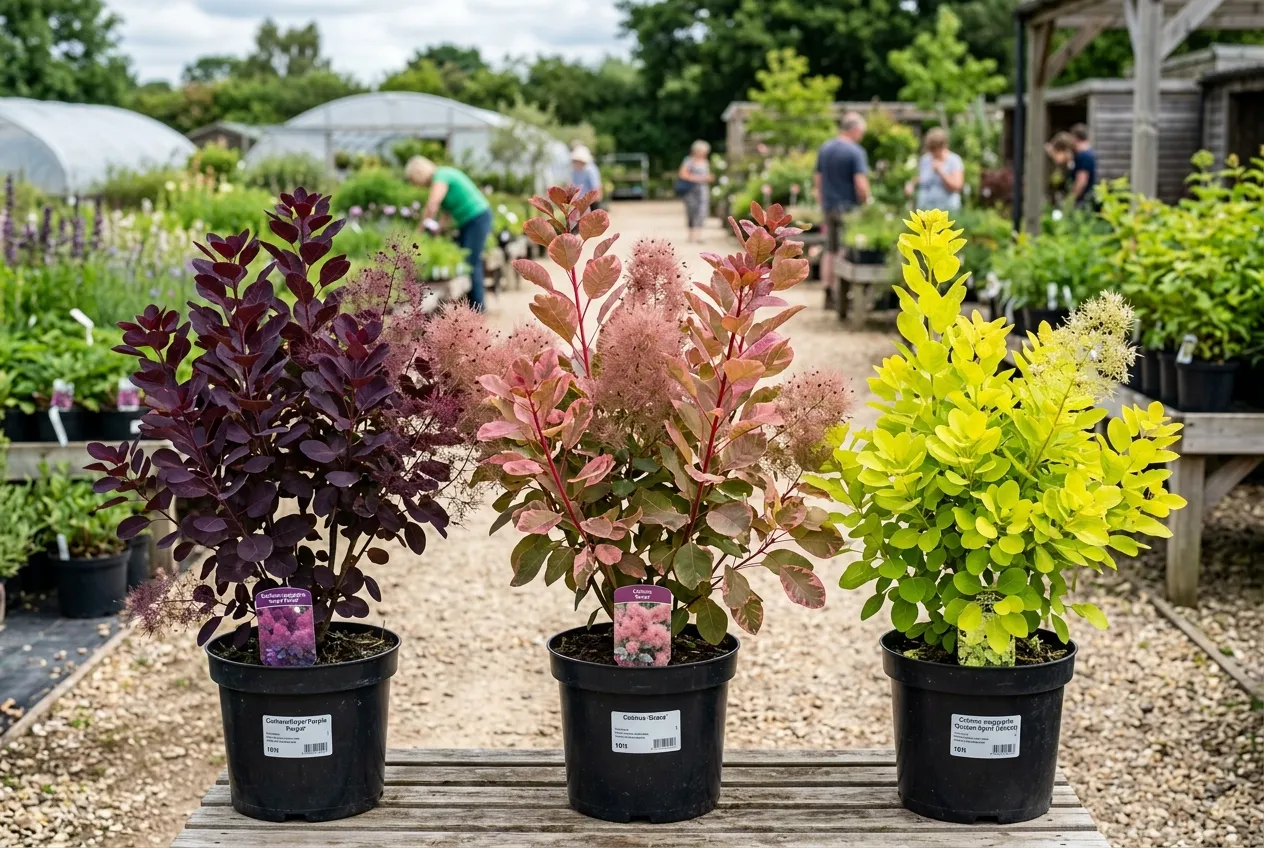 Left to right: the deep plum of ‘Royal Purple’, warm pink tones of ‘Grace’, and lime-gold foliage of ‘Golden Spirit’.
| Feature | Royal Purple | Grace | Golden Spirit | Young Lady |
|---|---|---|---|---|
| Botanical name | C. coggygria ‘Royal Purple’ | C. ‘Grace’ | C. coggygria ‘Golden Spirit’ | C. coggygria ‘Young Lady’ |
| RHS AGM | Yes | Yes | No | Yes |
| Foliage colour | Deep plum-purple | Wine-red to pink | Lime-green to gold | Mid-green |
| Mature height | 4-5m | 5-6m | 3-4m | 2-3m |
| Mature spread | 4-5m | 4-5m | 3-4m | 2-3m |
| Smoke colour | Pink-purple | Pink-red | Pink | Pink |
| Autumn colour | Scarlet-red | Orange to scarlet | Orange to red | Yellow to orange |
| Growth rate | 30-40cm/year | 40-50cm/year | 25-35cm/year | 20-30cm/year |
| Best for | Mixed borders, specimen | Large gardens, screening | Small gardens, contrast | Compact spaces, containers |
| UK price range | £15-£30 | £20-£35 | £18-£30 | £15-£25 |
Why we recommend ‘Royal Purple’ for most UK gardens: After growing all four varieties on Staffordshire clay since 2019, ‘Royal Purple’ consistently delivers the deepest foliage colour with the least maintenance. It produced visible smoke plumes by its third year and the autumn colour in 2024 lasted from late September through to mid-November, a full seven weeks. ‘Grace’ grows faster but needs more space. ‘Golden Spirit’ is the pick for smaller gardens or for brightening a dark corner.
Cotinus ‘Grace’ is a hybrid between C. coggygria ‘Velvet Cloak’ and C. obovatus. It was raised by Peter Dummer at Hillier Nurseries in Hampshire. The leaves are larger than any C. coggygria cultivar, reaching 10-12cm on mature wood. It is the best choice if you want a large flowering shrub to fill a boundary or screen an eyesore.
What soil does cotinus need in the UK?
Cotinus grows in any well-drained soil across the UK. This includes heavy clay, chalk, sand and loam. It is one of the most soil-tolerant ornamental shrubs available. The key requirement is drainage, not fertility.
On heavy clay, cotinus performs well without amendment. Our Staffordshire trial plants on undrained clay have grown steadily for seven years with no root problems. The clay actually produces the most intense leaf colour because the soil is naturally low in available nitrogen. If your clay soil floods for extended periods in winter, mound the planting area up by 15-20cm to lift the root crown above the water table.
On chalky or alkaline soil, cotinus is completely at home. It tolerates pH levels from 5.5 to 8.5. Many of the finest specimens in the UK grow on the chalk downs of southern England.
On sandy soil, growth may be slightly slower in the first two years. Add a 5cm layer of bark mulch around the base to retain moisture. Once established, cotinus is remarkably drought-tolerant and needs no supplemental watering even through dry summers.
Do not improve the soil with rich compost or manure. This is the most common mistake with cotinus. Rich soil produces lush but poorly coloured foliage. The purple varieties turn a muddy green-brown instead of the vivid wine-red you want. Let the plant struggle slightly in lean soil for the best results.
| Soil type | Suitability | Notes |
|---|---|---|
| Heavy clay | Excellent | Best foliage colour, ensure winter drainage |
| Chalk/limestone | Excellent | pH 7.0-8.5 tolerated, no amendment needed |
| Sandy/free-draining | Good | Mulch to retain moisture in first 2 years |
| Loam | Good | Avoid adding fertiliser |
| Waterlogged/boggy | Poor | Raise planting area or choose another site |
| Acid peat | Good | pH 5.5+ tolerated, unusual but workable |
How to plant cotinus smokebush
Plant cotinus between October and March for bare-root stock, or year-round for container plants. Autumn planting is ideal because roots establish during winter, giving the plant a head start before summer.
Step 1: Choose a position in full sun. Cotinus tolerates light dappled shade for 2-3 hours daily, but any more and purple varieties lose their colour intensity. South or west-facing borders are ideal.
Step 2: Dig a hole twice the width of the rootball and the same depth. Do not dig deeper. Setting the plant too low encourages collar rot.
Step 3: Place the rootball in the hole so the top sits level with the surrounding soil. Backfill with the excavated soil only. Do not add compost, manure, or fertiliser to the planting hole.
Step 4: Firm the soil gently with your boot. Water in with 10 litres to settle the soil around the roots.
Step 5: Apply a 5cm mulch of bark chips in a ring around the base, keeping the mulch 5cm away from the stem. This suppresses weeds and retains moisture without enriching the soil.
Spacing: Allow 3-4m between unpruned plants, or 2m if you plan to stool annually. In a mixed border, a single specimen works well as a back-of-border anchor with lower-growing perennials in front.
How to prune cotinus in the UK
Cotinus offers two distinct pruning approaches, each producing a completely different plant. The method you choose determines whether you get flowers or foliage.
 Stooling cotinus in late February. Cut all stems to 30cm above ground level using sharp bypass secateurs or loppers.
Option 1: No pruning (smoke flowers)
Leave cotinus completely unpruned and it develops into a large, rounded shrub or small tree. The smoke-like flower panicles appear on mature wood from June to August. This is the classic smokebush effect that gives the plant its name. The only maintenance is removing dead, damaged or crossing branches in late winter.
Option 2: Hard pruning / stooling (large foliage)
Cut all stems to 30cm above ground level in late February to early March, just before growth resumes. This forces the plant to produce vigorous new shoots carrying leaves up to 12cm across, double the size of unpruned growth. The trade-off is that you lose all flowers for that season because smokebush blooms on old wood.
Our trial results: Stooled ‘Royal Purple’ produced leaves averaging 10-11cm across compared to 5-6cm on unpruned plants. The stooled foliage colour was marginally deeper. However, the unpruned plants had the full smoke display and a more naturalistic shape. We now stool one plant and leave the other, giving both effects in the same border.
Option 3: Alternate year pruning
Stool hard one year, then leave the plant to grow freely the following year. By year two, the plant flowers on the previous season’s growth. This gives you large leaves one year and smoke flowers the next. Many experienced gardeners consider this the best compromise.
For general shrub pruning techniques and tool recommendations, see our detailed guide.
Month-by-month cotinus care calendar
| Month | Task |
|---|---|
| January | Check stakes on young plants after winter storms. Order bare-root plants. |
| February | Prune/stool if using hard pruning method. Complete by month end. |
| March | Apply 5cm bark mulch. Plant container-grown specimens. |
| April | New growth emerges. Remove any frost-damaged shoot tips. |
| May | Growth accelerates. No feeding required. |
| June | Smoke-like flower panicles begin to appear on unpruned plants. |
| July | Peak smoke display. Take semi-ripe cuttings from current year’s growth. |
| August | Smoke fades gradually. Foliage colour deepens as days shorten. |
| September | Early autumn colour begins on ‘Grace’ and ‘Royal Purple’. |
| October | Peak autumn colour. Leaves turn scarlet, orange and gold. |
| November | Leaves fall. Plant bare-root stock from now until March. |
| December | Structural shape visible. Check for dead or crossing branches. |
Field Report: stooled vs unpruned cotinus over four seasons
GardenUK Trial Plot: Midlands (Heavy Clay) Date range tested: March 2022 - November 2025 Conditions: South-facing, exposed to westerly wind, unfed heavy clay, pH 6.8
We planted two identical Cotinus ‘Royal Purple’ (2-litre pots, 45cm tall) in March 2019. From 2022, we stooled Plant A annually in late February and left Plant B completely unpruned.
Plant A (stooled): Produced 6-8 vigorous stems per season reaching 90-120cm by August. Leaf size averaged 10-11cm. Foliage colour was a rich, dark plum-purple from June through to leaf fall. No flowers produced in any stooled year. Autumn colour was deep scarlet, lasting 3-4 weeks in October.
Plant B (unpruned): Reached 2.8m tall by 2025 with a 2.5m spread. Leaf size averaged 5-6cm. Visible smoke-like flower panicles appeared from mid-June, peaking in July, lasting until late August. The smoke effect was heaviest in 2024 following a warm spring. Autumn colour was a mix of scarlet, orange and yellow, lasting 5-7 weeks from late September.
Conclusion: Both approaches have clear merits. Stooling is the better choice for foliage-focused borders and modern planting schemes. Leaving unpruned is superior for naturalistic gardens and anyone who wants the full smokebush experience.
Cotinus autumn colour: why it rivals any Japanese maple
 A mature unpruned cotinus in full October colour. The translucent leaves glow when backlit by low autumn sun.
Cotinus delivers some of the most vivid autumn colour of any shrub grown in the UK. The leaves transition through yellow, orange, scarlet and deep crimson over a 4-7 week period depending on weather. Cool nights followed by sunny days intensify the colour. The 2024 autumn was exceptional in the Midlands, with colour starting in late September and lasting into mid-November.
The autumn display is one reason cotinus features so prominently in lists of trees and shrubs for autumn colour. Though technically a large shrub, unpruned cotinus often reaches small tree proportions and rivals Acer palmatum for sheer intensity.
Which variety gives the best autumn colour?
- ‘Grace’: The most spectacular, turning vivid orange through to deep scarlet. Leaves are large enough to create a dense canopy of colour.
- ‘Royal Purple’: Reliable scarlet-red. The dark summer foliage makes the transition particularly striking.
- ‘Golden Spirit’: Turns from lime-gold to orange-red. Effective in smaller spaces.
- ‘Young Lady’: Yellow to soft orange. Subtler than the others but still worth growing.
Tip for maximising autumn colour: Avoid late-season nitrogen. Plants on lean, unfed soil always colour better than those on enriched ground. A dry September followed by cool October nights produces the most intense pigments.
How to propagate cotinus
Semi-ripe cuttings taken in July give the best results for home propagation. Cotinus can also be layered or grown from seed, though named cultivars do not come true from seed.
Semi-ripe cuttings (July to August):
- Select healthy side shoots of current year’s growth, 10-15cm long
- Cut just below a leaf node with a clean, sharp blade
- Remove the lower leaves, leaving 2-3 pairs at the tip
- Dip the base in hormone rooting powder (0.8% IBA)
- Insert into a 50/50 mix of perlite and multipurpose compost
- Place in a covered propagator or sealed clear bag at 18-20C
- Rooting takes 6-10 weeks. Pot on individually when roots fill the module
Success rates vary. Our propagation trials yielded 40-50% strike rate with ‘Royal Purple’ and 60-70% with ‘Grace’. The hybrid vigour of ‘Grace’ makes it noticeably easier to root.
Layering (autumn):
Peg a low branch to the ground in October, wound the underside lightly with a knife, and cover with 5cm of soil. Leave for 12 months. Check for roots the following autumn and sever from the parent plant if well-rooted.
Common problems with cotinus in the UK
Cotinus is remarkably trouble-free. It has no serious pest or disease problems in UK conditions. The main issues are cultural rather than pathological.
Verticillium wilt is the only significant disease. This soil-borne fungus causes sudden wilting of individual branches, usually in summer. The wood shows brown streaking when cut. There is no chemical treatment. Remove and burn affected branches. If the main framework is infected, the plant may decline over 2-3 years. The RHS verticillium wilt guide provides detailed identification photographs. Avoid planting cotinus where potatoes, strawberries or other Verticillium-susceptible crops have grown recently.
Poor foliage colour results from too much shade, over-feeding, or waterlogged soil. Move the plant to full sun if possible, or stop all feeding.
Wind damage can snap stooled growth in exposed sites. The 90-120cm new stems from stooling are more vulnerable to snapping than the dense framework of unpruned plants. In windy gardens, either leave unpruned or provide a temporary windbreak.
Coral spot (Nectria cinnabarina) occasionally appears on dead wood as small orange-pink pustules. Prune out affected wood to healthy tissue. This is a secondary fungus that only colonises dead or weakened wood, so it is a symptom rather than a cause.
Cotinus is also a magnet for pollinators. The flower panicles attract hoverflies, bees and butterflies, making it an excellent addition to a bee-friendly garden.
Frequently asked questions
When is the best time to plant cotinus in the UK?
Plant cotinus between October and March while dormant. Bare-root plants establish fastest when planted November to February. Container-grown specimens can go in year-round but autumn planting gives roots time to establish before summer heat. Water weekly for the first growing season regardless of planting time.
Does cotinus grow well in clay soil?
Cotinus thrives in clay soil across the UK. Heavy clay actually produces the deepest foliage colour because low nutrient availability intensifies pigmentation. The only requirement is that the clay does not sit waterlogged through winter. If your garden floods, raise the planting area by 15-20cm with imported topsoil mixed with grit.
How fast does smokebush grow in the UK?
Smokebush grows 30-45cm per year in UK conditions. A container-bought plant at 60cm reaches 2m within 4 years without pruning. Stooled plants grow faster, producing 90-120cm of new growth per season, but this is cut back to 30cm each March. Growth slows after 10 years as the plant matures.
Should I hard prune my cotinus every year?
Hard pruning is optional, not essential. Stooling each March produces leaves up to 12cm across but removes the smoke-like flower panicles. Unpruned plants develop the full billowing smoke effect from June to August. A middle approach is to prune every other year, alternating between large leaves and flowers.
Why has my smokebush lost its purple colour?
Too much shade or nitrogen causes purple cotinus to turn green. Smokebush needs full sun for at least 6 hours daily to maintain deep pigmentation. Over-feeding with nitrogen-rich fertiliser or fresh manure pushes green growth. Stop feeding immediately and ensure the plant receives direct sunlight. Colour should return within one growing season.
Is cotinus poisonous to dogs or cats?
Cotinus sap can cause mild skin irritation in humans. The ASPCA does not list cotinus as toxic to dogs or cats. However, ingesting large quantities of any ornamental foliage can cause stomach upset in pets. The main risk is the milky sap, which may irritate sensitive skin during pruning. Wear gloves when handling cut stems.
Can I grow cotinus in a container in the UK?
Young cotinus grows well in large containers for 3-5 years. Use a pot at least 45cm wide and deep, filled with John Innes No. 3 compost mixed with 20% perlite. Stool annually to control size. Container plants need watering twice weekly in summer and protection from prolonged freezing below -10C by wrapping the pot in fleece.
Cotinus is one of the most rewarding shrubs for UK gardens, offering year-round interest with minimal effort. For more ideas on building a shrub border with seasonal impact, read our guide to planning a mixed border or browse the best plants for clay soil if heavy ground is your starting point.
Lawrie has been gardening in the West Midlands for over 30 years. He grows his own veg using no-dig methods, keeps a wildlife-friendly garden, and writes practical advice based on real UK growing conditions.