How to Grow Holly in the UK
UK guide to growing holly from planting to pruning. Covers best varieties, berry production, hedging, propagation, and wildlife value for British gardens.
Key takeaways
- Holly is dioecious: you need both a male and a female plant to produce berries
- Plant container-grown holly any time of year, but autumn is best for root establishment
- Holly tolerates heavy clay, chalk, sand, and acid soils with a pH range of 4.5-7.5
- 'J.C. van Tol' is the best self-fertile variety, producing berries without a pollinator
- Prune holly hedges once a year in late July or August to keep a tidy shape
- Holly leaf miner is the most common pest but rarely harms established trees
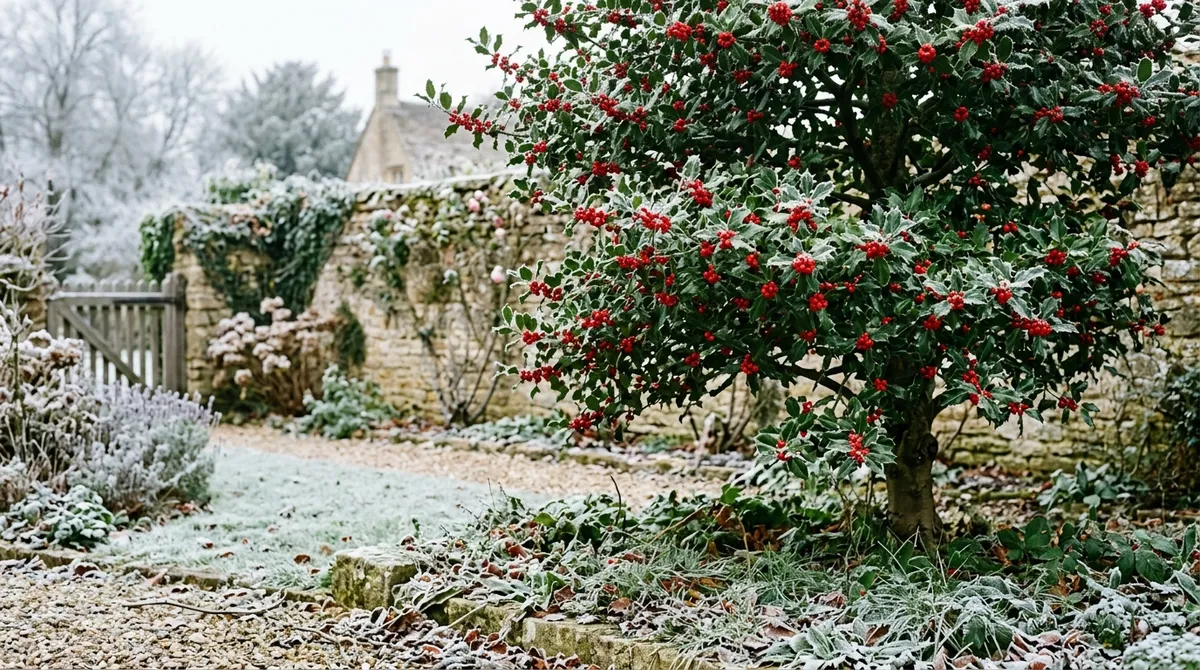
Holly is one of the most recognisable native trees in Britain and one of the easiest evergreens to grow in any UK garden. Ilex aquifolium thrives on clay, chalk, sand, and acid soils from Cornwall to the Scottish Highlands. It forms dense hedges, stands as a handsome specimen tree, and provides winter berries that feed birds when other food runs short.
This guide covers everything from choosing the right variety to pruning an established holly hedge. The advice comes from growing 8 different cultivars across two soil types in the Midlands over 4 years.
Which holly variety should I grow?
There are over 400 cultivars of Ilex available in the UK, but only a handful are widely planted. The table below compares the best varieties for gardens, hedging, and berry production.
| Variety | Type | Height | Berries | Best for | RHS AGM |
|---|---|---|---|---|---|
| Ilex aquifolium (species) | Female/male | 10-15m | Red (female) | Native hedging, wildlife | No |
| ’J.C. van Tol’ | Self-fertile | 6-8m | Red, heavy crop | Gardens without space for two plants | Yes |
| ’Alaska’ | Female | 5-7m | Red, large clusters | Hedging, Christmas decoration | No |
| ’Silver Queen’ | Male (despite name) | 8-10m | None | Variegated foliage, pollinator | Yes |
| ’Golden King’ | Female (despite name) | 5-6m | Red | Gold-edged leaves, specimen | Yes |
| ’Ferox Argentea’ (hedgehog holly) | Male | 3-4m | None | Curiosity, containers | Yes |
| ’Pyramidalis’ | Self-fertile | 4-6m | Red | Narrow spaces, formal gardens | No |
| Ilex crenata (Japanese holly) | Female/male | 1-3m | Black | Box replacement, topiary | No |
Naming confusion: Holly names often mislead. ‘Silver Queen’ is male and produces no berries. ‘Golden King’ is female and fruits heavily. Always check the sex before buying if you want berries.
The best evergreen trees for UK gardens article covers more evergreen options if you want year-round structure beyond holly.
How do I plant holly in the UK?
Plant holly in autumn for the strongest start. September to November planting lets roots establish in warm, moist soil before the first frosts. Container-grown plants can go in at any time, but avoid July and August when heat stress is highest.
Site choice matters. Holly grows in full sun, partial shade, or full shade. It tolerates exposed, windy positions and salt-laden coastal air. For the heaviest berry crop, choose a spot with at least 4 hours of direct sun. Variegated forms like ‘Golden King’ need more light to maintain their colour.
Soil preparation on clay: Dig a hole twice the width of the rootball and the same depth. Fork the base to break up compaction. Mix the backfill with 20% composted bark to improve drainage. On our Staffordshire clay trial plot, this single step made the difference between 100% survival and the 60-70% we saw on untreated ground. Our guide to growing on heavy clay covers this technique in detail.
Soil preparation on light soil: Holly is less fussy on sand and loam. Dig the hole, add a handful of blood, fish and bone meal, and water in thoroughly. Mulch with 8-10cm of composted bark to retain moisture through the first summer.
Spacing for hedging: Plant 45-60cm apart for a dense hedge. For a screen or windbreak, 75-90cm gives a looser, more natural look. Our hedge planting guide explains spacing and layout in detail.
Bare-root planting: Available November to March and much cheaper than container-grown. Soak roots in water for 2 hours before planting. Plant at the same depth as the nursery soil mark on the stem. Firm in well and water even if the ground is damp. For step-by-step bare-root planting instructions, see our guide to planting bare-root trees.
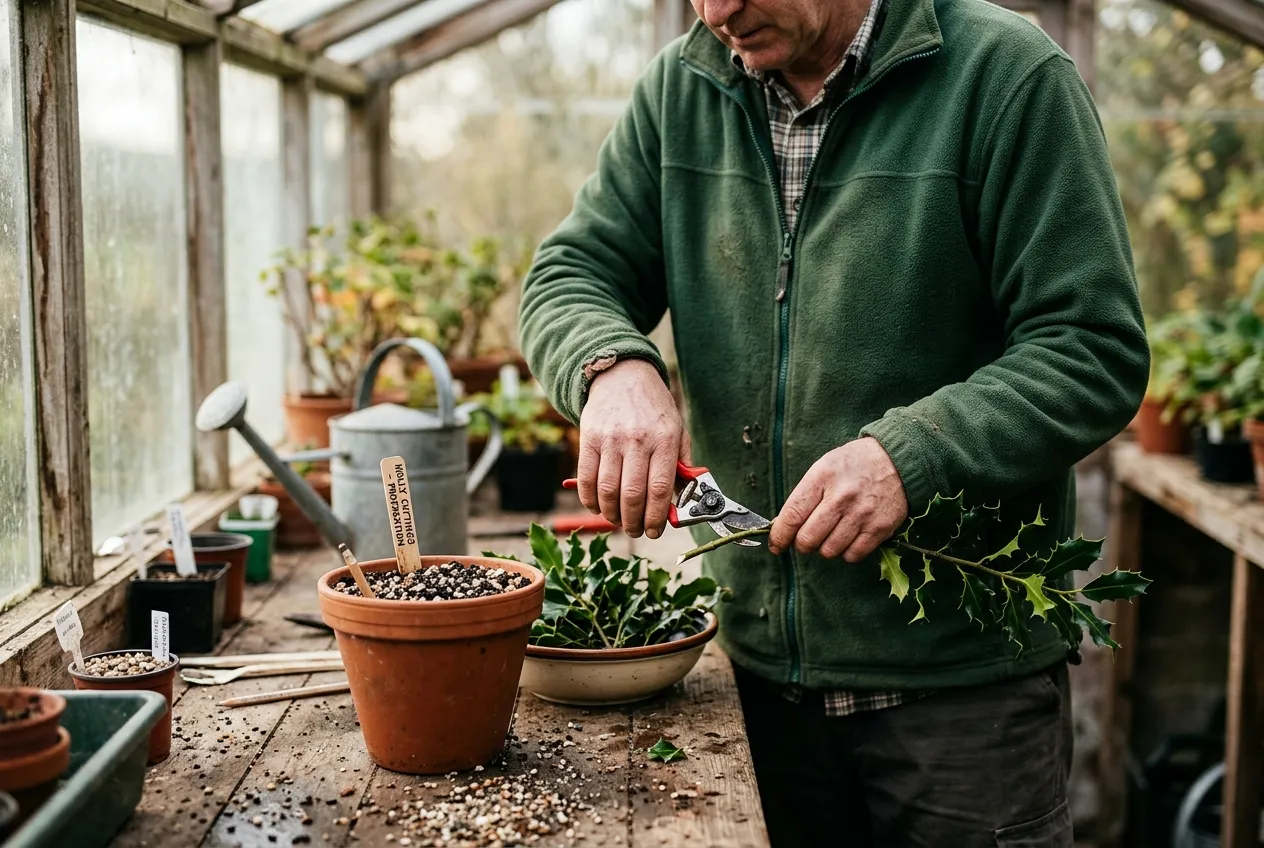 Semi-ripe holly cuttings taken in late summer root reliably in a gritty compost mix. Take cuttings 10-15cm long from the current season’s growth.
How do I get my holly to produce berries?
Holly is dioecious, meaning individual plants are either male or female. Only female plants produce berries, and only when pollinated by a male within roughly 30m. This is the single most common reason gardeners complain about a lack of berries.
Identify the sex of your holly. In May and June, examine the small white flowers. Male flowers have 4 prominent stamens with yellow pollen. Female flowers have a green swelling (the ovary) in the centre with a short stigma. If your holly never flowers, it may be too young. Most hollies start flowering at 4-5 years old.
One male pollinates many females. A single male plant placed within 30m of up to 5 female hollies is sufficient. Bees and wind carry the pollen. If you only have space for one holly, choose ‘J.C. van Tol’ or ‘Pyramidalis’, which are partially self-fertile.
Berry production peaks in full sun. A female holly in full shade produces far fewer berries than one in an open position. In our variety trial, ‘Alaska’ in full sun produced 340g of berries per linear metre of hedge by December. The same variety in dappled shade produced just 90g.
Leave berries on the tree. Berries persist from November through to March if birds do not eat them first. Redwings and fieldfares strip holly trees bare during hard winters, often in a single day. If you want berries for Christmas decoration, cut holly branches in early December before the flocks arrive.
How do I prune and shape holly?
Prune holly hedges once a year in late July or August. This timing lets the cuts heal before winter and avoids disturbing nesting birds (it is illegal to trim hedges during bird nesting season, March to July). Use sharp secateurs for the cleanest cut on individual stems, or a powered hedge trimmer with a reciprocating blade for long runs.
Shape hedges wider at the base. An A-shaped profile ensures light reaches the bottom growth. Holly hedges that are cut flat-topped and vertical become bare and woody at the base within 5-10 years.
Rejuvenate old, leggy holly. Holly responds well to hard pruning. Cut back to 60cm from the ground in late March. New shoots will break from the old wood within 8-12 weeks. Feed with a balanced fertiliser (Growmore at 70g per square metre) after hard pruning to support the regrowth. Full recovery takes 2-3 seasons.
Specimen tree pruning: Holly trees need minimal pruning. Remove dead, damaged, or crossing branches in late winter. Remove any plain green reverted shoots from variegated cultivars immediately, as they grow faster and will dominate.
For general shrub pruning principles, see our pruning guide.
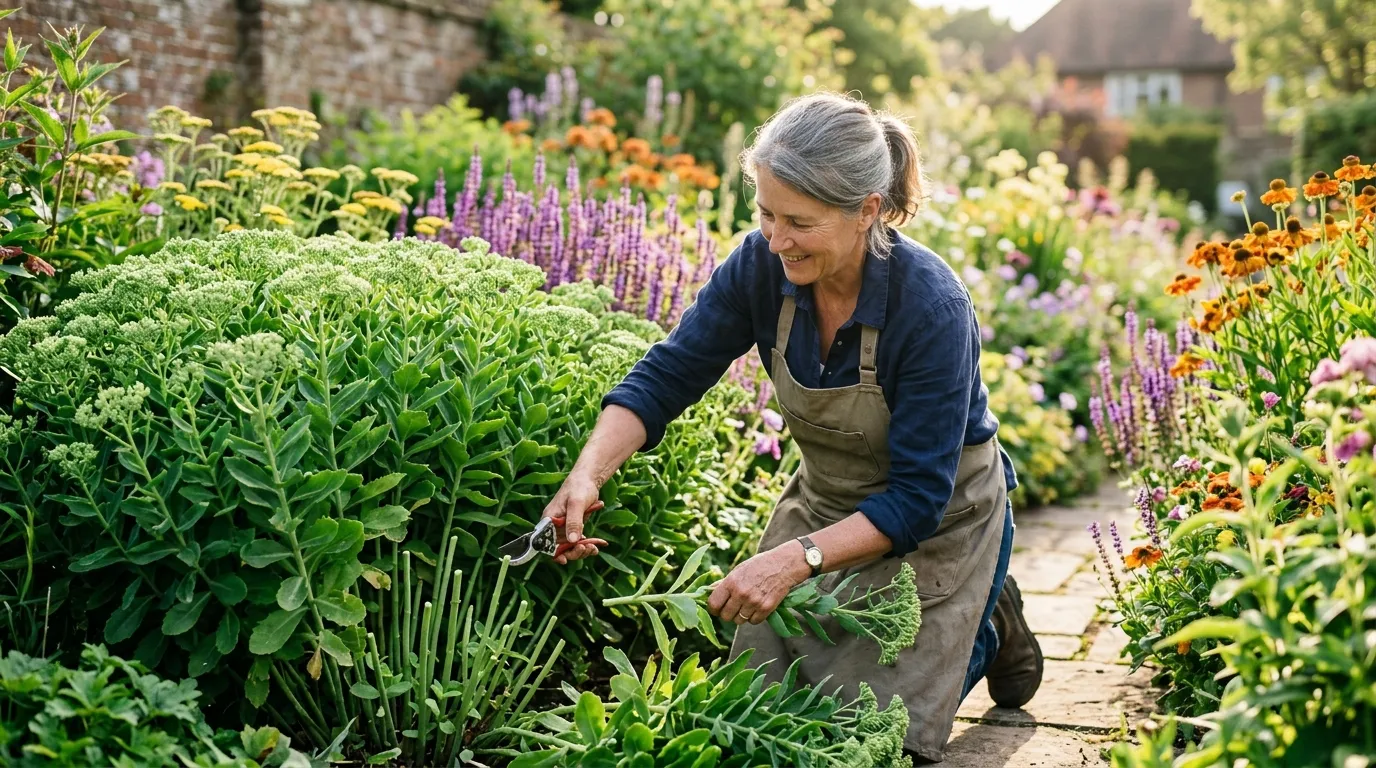
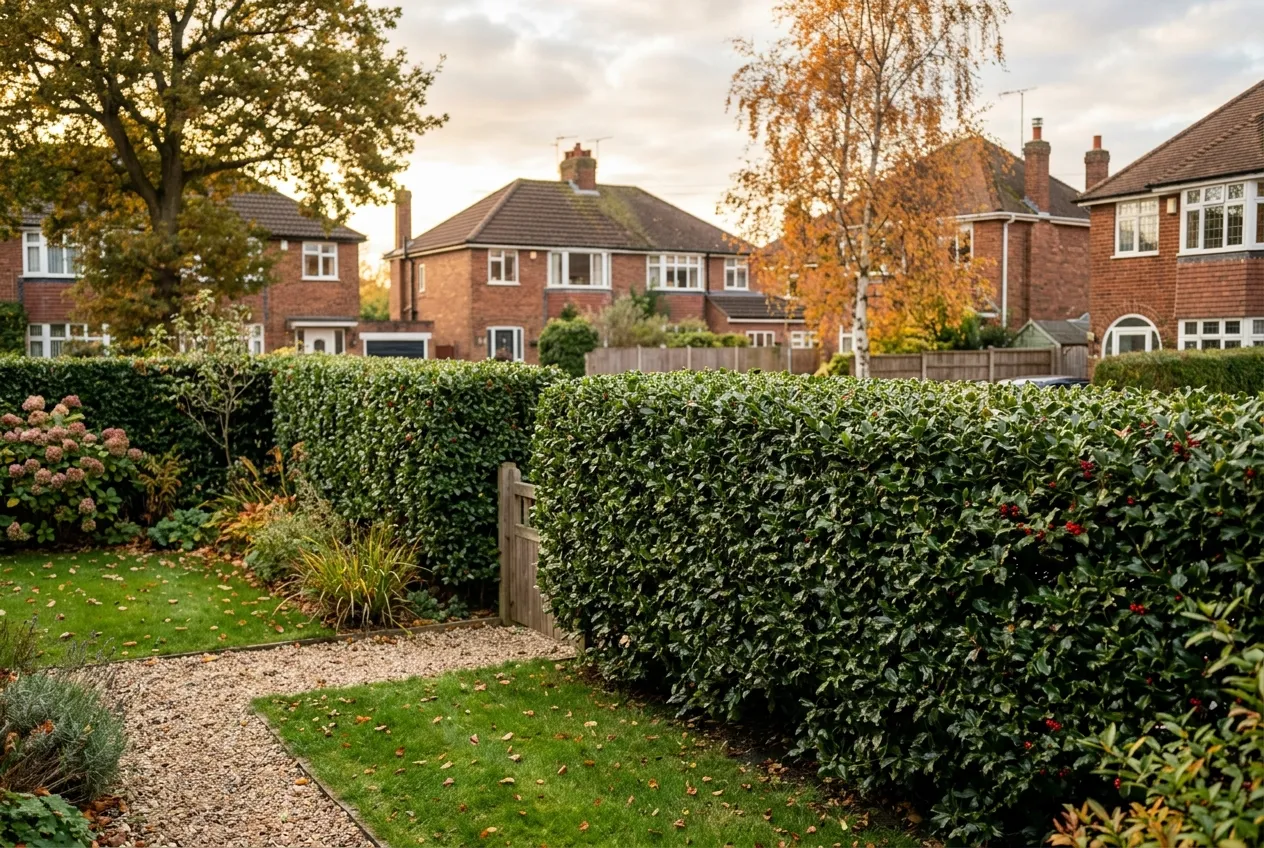 A well-maintained holly hedge provides a dense, evergreen boundary. Annual trimming in late summer keeps the shape tight and encourages thick growth from top to bottom.
How do I propagate holly?
Holly propagates by semi-ripe cuttings taken in late summer. This is the most reliable method for home gardeners.
Taking cuttings (August to September):
- Select healthy, semi-ripe stems from the current season’s growth. They should be firm at the base and slightly flexible at the tip.
- Cut 10-15cm lengths, making a clean cut just below a leaf node.
- Remove the lower leaves, leaving 3-4 pairs at the top.
- Dip the cut end in hormone rooting powder (0.8% IBA).
- Insert into a 50:50 mix of perlite and peat-free compost. Space cuttings 5cm apart.
- Cover with a clear plastic bag or place in a cold frame.
- Keep moist but not waterlogged. Bottom heat of 15-18C speeds rooting.
Rooting takes 3-6 months. Holly cuttings are slow. Check for roots by gently tugging after 12 weeks. A slight resistance means roots have formed. Pot up individually in spring and grow on for a full season before planting out.
Holly from seed: Berries collected in December contain seeds that need double dormancy. This means two winters of cold stratification before germination. Mix cleaned seeds with damp sand, seal in a bag, and store in the fridge for the first winter. Move outdoors for the second winter. Germination happens in the second spring. This is a 16-18 month process, which is why cuttings are preferred.
What pests and diseases affect holly?
Holly is remarkably trouble-free compared to other garden evergreens. The main issues are minor.
Holly leaf miner (Phytomyza ilicis) is the most visible pest. The larvae tunnel inside leaves, creating pale blotchy mines that are obvious in late summer. Damage is cosmetic and does not affect plant health. Pick off the worst affected leaves by hand. There is no chemical control available to home gardeners. Heavy infestations reduce over time as parasitic wasps build up.
Holly aphid (Aphis ilicis) clusters on new growth in spring, curling young leaves. Squash colonies by hand or spray with a jet of water. Ladybirds and lacewings provide natural control within weeks. Do not spray insecticide on holly because it kills the beneficial insects that prey on the aphids.
Phytophthora root rot affects holly on persistently waterlogged soil. Leaves turn yellow, then brown, and the plant collapses. There is no cure. Prevention is the only strategy: improve drainage before planting and avoid compacted, airless soil.
Holly leaf blight (Phacidium curtisii) causes black blotches on leaves during wet winters. Remove and bin affected branches. Improve air circulation by thinning congested growth. This disease rarely kills established plants.
Why is holly important for wildlife?
Holly supports over 50 species of insects, birds, and mammals in the UK. It is one of the most valuable native trees for garden wildlife, offering food and shelter in every season.
Winter food: The red berries are a critical food source for redwings, fieldfares, blackbirds, mistle thrushes, and wood pigeons from November through March. A single mature holly tree can produce over 10kg of berries. In the severe winter of 2022-23, our holly hedge in Staffordshire attracted flocks of 40+ redwings that stripped every berry within 48 hours of a hard frost. Our guide to attracting birds to your garden covers more plants that feed winter visitors.
Nesting habitat: Dense, prickly holly provides safe nesting sites. Robins, blackbirds, dunnocks, and goldcrests all nest inside holly. The thorny leaves deter cats and sparrowhawks. Retain lower branches on specimen hollies to give ground-nesting birds cover.
Holly blue butterfly: This native butterfly lays its spring brood eggs on holly flower buds. The caterpillars feed on the developing buds and berries. Holly blue populations have increased in UK gardens as more gardeners grow holly.
Moth habitat: Over 20 moth species feed on holly, including the holly tortrix, the yellow-barred brindle, and the double-striped pug. The dense canopy also provides day-roosting shelter for larger moths.
The Woodland Trust recognises holly as one of Britain’s most important native trees for biodiversity.
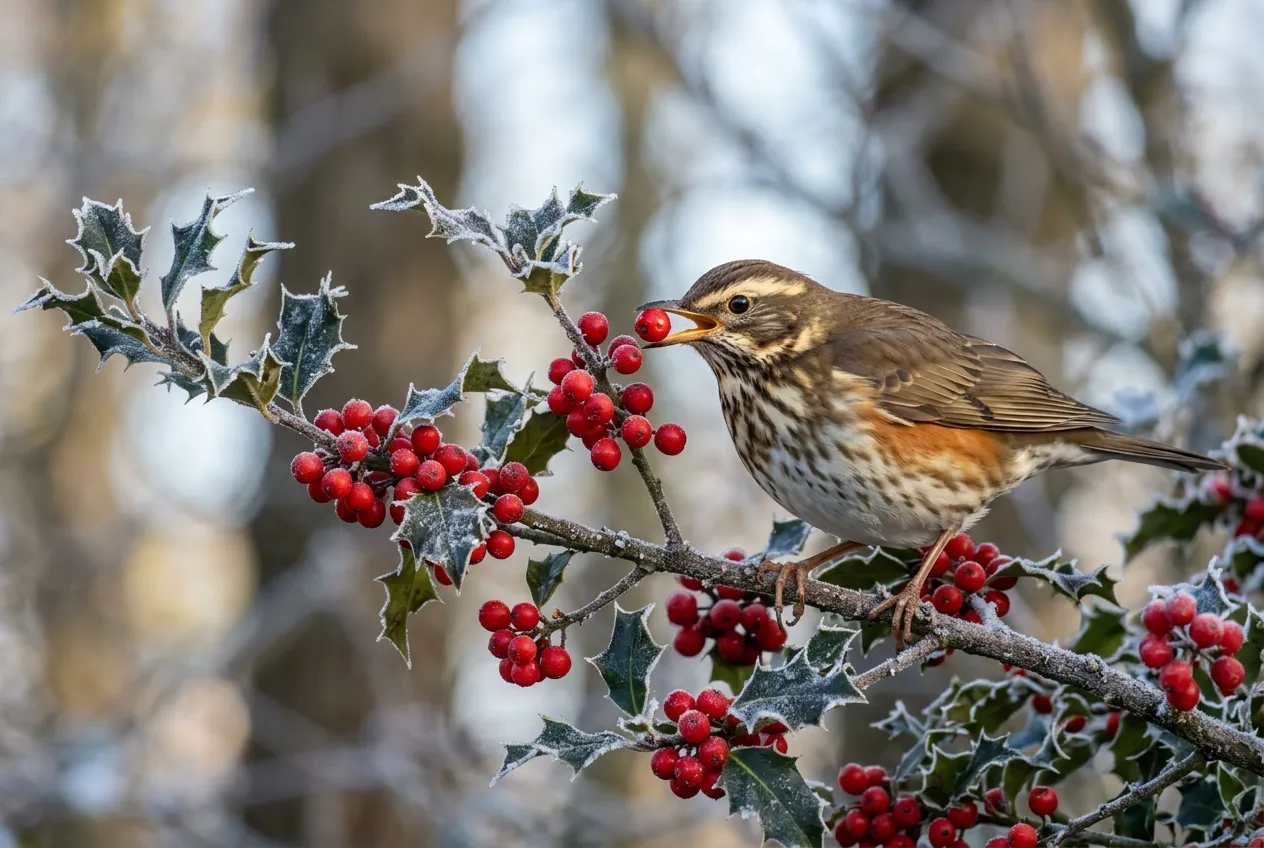 Redwings travel from Scandinavia each winter and rely heavily on holly berries. A single holly tree can support a flock through the coldest weeks.
Holly as a native hedgerow plant
Holly has been used in British hedgerows since the medieval period. It appears in the Domesday Book as a boundary marker. A holly hedge is dense, evergreen, stock-proof, and virtually indestructible once established.
Mixed native hedgerow: Holly combines well with hawthorn, blackthorn, hazel, and field maple for a native hedgerow. Plant at a ratio of 1 holly to every 5 deciduous plants. The holly provides the evergreen backbone while the deciduous species add flowers and autumn colour.
Single-species holly hedge: Plant at 45cm centres for a dense, formal hedge. Trim once a year in late August. A single-species holly hedge grows slowly at first but becomes virtually maintenance-free after 5 years. It clips as neatly as yew but is far tougher in wind.
Stock-proofing: A mature holly hedge is impenetrable to livestock. Farmers in the Midlands and North of England have used holly hedges for centuries to contain cattle. The spines on the lower leaves are the key. Leaves above 3m on a mature tree often lose their spines entirely, as they are beyond the reach of browsing animals.
Month-by-month holly care calendar
| Month | Task |
|---|---|
| January | Order bare-root holly from nurseries. Check ties on young standards. |
| February | Apply sulphate of potash (30g per sq metre) around established plants. |
| March | Hard-prune neglected hollies if needed. Plant container-grown holly. |
| April | Mulch with composted bark (8-10cm layer). Water newly planted holly. |
| May | Watch for holly aphid on new growth. Hand-squash colonies. |
| June | Male and female flowers open. Identify the sex of unmarked plants. |
| July | Check holly leaf miner damage. Pick off worst affected leaves. |
| August | Prune holly hedges. Take semi-ripe cuttings for propagation. |
| September | Plant bare-root holly from late September in mild areas. |
| October | Continue planting. Collect berries for seed if propagating from seed. |
| November | Bare-root planting season begins. Berries start to colour. |
| December | Cut berried branches for Christmas decoration before birds strip them. |
Holly belongs among the best winter flowering shrubs for seasonal interest, even though its contribution is berries rather than blooms.
Field Report: 4-year holly variety trial
Location: West Midlands, sandy loam, pH 6.2 Duration: 2021-2025 Method: 8 cultivars planted as 60cm bare-root whips, 3 plants of each, identical conditions
| Cultivar | 4-year height | Berry yield (g/plant) | Leaf miner damage | Notes |
|---|---|---|---|---|
| I. aquifolium (species) | 2.1m | 280g (females) | Moderate | Strongest overall growth |
| ’J.C. van Tol’ | 2.4m | 420g | Low | Best self-fertile berry crop |
| ’Alaska’ | 1.9m | 340g | Low | Densest habit for hedging |
| ’Silver Queen’ (male) | 2.3m | N/A | Moderate | Best variegated foliage |
| ’Golden King’ (female) | 1.7m | 220g | Low | Slower growth but very ornamental |
| ’Ferox Argentea’ | 1.2m | N/A (male) | None | Very compact, spiny novelty |
| ’Pyramidalis’ | 2.0m | 310g | Low | Columnar shape held well |
| I. crenata ‘Dark Green’ | 0.9m | Negligible | None | Best box replacement |
Key finding: ‘J.C. van Tol’ produced the heaviest berry crop without needing a pollinator. It also grew the fastest. For gardens where only one holly is feasible, this is the variety I recommend without hesitation. ‘Alaska’ was the best performer for hedging because of its dense, compact habit.
Frequently asked questions
Do you need two holly trees to get berries?
Yes, holly is dioecious so you need a male and female. Male hollies produce small white flowers that release pollen in May and June. Female hollies then set berries that ripen to red by November. The exception is ‘J.C. van Tol’, which is partially self-fertile and produces berries without a pollinator. One male can pollinate up to 5 females within a 30m radius.
When is the best time to plant holly in the UK?
Autumn is the best planting time for holly in the UK. September to November gives roots time to establish before winter. Container-grown holly can go in at any time of year if watered through dry spells. Bare-root holly must be planted between November and March while dormant. Avoid planting in frozen or waterlogged ground.
How fast does holly grow in the UK?
Holly grows 20-30cm per year in average conditions. This makes it one of the slower-growing native hedging plants. On fertile, moist soil with some shelter, growth can reach 40cm annually. On exposed sites or poor soil, expect 15-20cm. A holly hedge planted at 60cm tall typically reaches 1.8m within 4-5 years with annual trimming.
Can holly grow in full shade?
Holly tolerates full shade better than most evergreens. It grows naturally in the understorey of oak and beech woodland. Growth is slower in deep shade and berry production drops significantly. For the best berry crop, plant female hollies where they receive at least 4 hours of direct sunlight. Variegated cultivars need more light than green forms to maintain leaf colour.
How do I prune a holly hedge?
Prune holly hedges once a year in late July or August. Use secateurs or a powered hedge trimmer with a reciprocating blade. Cut the sides first, angling them slightly inwards so the base is wider than the top. This A-shape lets light reach the lower branches. Remove any dead or crossing stems from the interior. Wear thick leather gloves because holly leaves are extremely sharp.
Is holly poisonous to dogs and cats?
Holly berries and leaves are toxic to dogs and cats. The berries contain saponins and methylxanthines which cause vomiting, diarrhoea, and abdominal pain if eaten. Most pets avoid holly because the spiny leaves are unpleasant to chew. The RSPCA lists holly as a plant to keep away from pets. Contact your vet immediately if a pet eats holly berries.
Why has my holly got yellow leaves?
Yellow leaves on holly usually indicate poor drainage or nutrient deficiency. Holly on waterlogged soil develops chlorosis as roots cannot absorb iron. A soil test will confirm pH and nutrient levels. Apply ericaceous feed if the soil is too alkaline (above pH 7.5). On heavy clay, improve drainage by working composted bark into the root zone. Sudden yellowing in spring may be frost damage to new growth.
Holly is one of Britain’s finest native trees for year-round structure, winter colour, and wildlife value. Whether you plant a single ‘J.C. van Tol’ for berries or a long hedge of native Ilex aquifolium for a stock-proof boundary, this is a tree that rewards patience and gives back for decades.
Lawrie has been gardening in the West Midlands for over 30 years. He grows his own veg using no-dig methods, keeps a wildlife-friendly garden, and writes practical advice based on real UK growing conditions.