Key takeaways
- Sarcococca flowers in deep winter (December-March) with disproportionately powerful scent
- Sarcococca confusa is the standard 1.5m upright form for screens or backs of borders
- Sarcococca hookeriana var humilis is the 60cm spreading form for low hedges and ground cover
- Plant in dappled to deep shade - struggles in full sun in southern UK summers
- Tolerates dry shade once established - one of the few scented shrubs that does
- No regular pruning needed - light shape after flowering only if necessary
- Plant beside a doorway or path within 3 metres of where you walk to enjoy the scent
A Sarcococca flowering on a January morning catches you out. The shrub itself is small, dark, glossy, and visually forgettable. The scent that hits you when you walk past it is powerful enough to stop you mid-step. By the time you find the source, the smell has already done its job. Most people who plant their first Sarcococca did so because they walked past someone else’s by accident.
What Sarcococca actually is
Sarcococca is a small genus of about 14 evergreen shrubs in the Buxaceae (box) family. They are native to woodland edges from the Himalayas through China to Southeast Asia. The common UK name “Christmas Box” reflects two things: the winter flowering season, often peaking around late December, and the box-like glossy evergreen leaves.
The flowers are tiny and white-cream, clustered in the leaf axils. From two metres away you might not see them at all. The scent, by contrast, carries up to 5 metres in still air - a sweet vanilla-honey fragrance that perfumes a whole corner of the garden. This combination of forgettable flower and powerful scent is what makes Sarcococca distinctive among UK shrubs.
The genus includes:
| Species | Mature size | Habit | UK availability |
|---|---|---|---|
| S. confusa | 1.5m x 1m | Upright, vase-shaped | Very common |
| S. hookeriana var humilis | 60cm x 1m | Spreading, low | Common |
| S. hookeriana var digyna | 1m x 1m | Upright, narrow leaves | Common |
| S. ruscifolia | 1m x 1m | Upright, red berries | Less common |
| S. saligna | 1.2m x 1m | Willow-leaved, longer flowers | Specialist nurseries |
S. confusa is the workhorse - the species sold in most garden centres and the right choice for most UK gardens. S. hookeriana var humilis is the second most-planted because it makes excellent low ground cover under deciduous trees.
Where to plant for maximum impact
The single biggest decision with Sarcococca is location. The plant is naturally a woodland-edge species and reflects that in its preferences.
Light: Dappled to deep shade is ideal. Tolerates north-facing and east-facing aspects, woodland borders, and shaded courtyards. Struggles in full summer sun, particularly in southern UK gardens where the leaves can scorch and the plant produces fewer flowers. A spot under deciduous trees gets winter sun (when the trees are bare) and summer shade - perfect Sarcococca conditions.
Soil: Fertile, moisture-retentive, well-drained. Tolerates a wide pH range from 5.5 to 7.5. Heavy clay improved with garden compost works well. Sandy soils need extra organic matter and mulching.
Aspect: North-facing front doorways are the classic Sarcococca position. The shrub gets shade most of the day, gets visited regularly by people walking to and from the house, and benefits from the warm wall heat that opens its flowers slightly earlier in winter.
Proximity to people: Plant within 3 metres of a path, doorway, seating area, or window that opens. Sarcococca’s scent is powerful but the carrying distance in cold still air is limited to about 5 metres. Plant it 20 metres away and you will rarely smell it. Plant it 2 metres from your front door and it greets every visitor between Christmas and St Patrick’s Day.
Companion planting: Sarcococca looks good with snowdrops, hellebores, hardy cyclamen (Cyclamen coum), winter aconites, ferns, hostas, and woodland perennials. Avoid placing it with vigorous spreaders like Vinca or aggressive ground covers that will smother the lower stems.
For more on shade-tolerant planting, our best plants for shade UK guide covers companions and design.
The two species worth planting first
Most UK gardens want one of two Sarcococca species.
Sarcococca confusa - the standard upright form
This is the species most people picture when they think of Sarcococca. Upright vase-shaped habit reaching 1.5m tall and 1m wide over 8-10 years. Dark glossy lance-shaped leaves up to 5cm long. Tiny clusters of cream-white flowers in the leaf axils from December to March, followed by black berries from late summer through autumn.
Why it wins: The most reliable winter scent of any UK shrub. Tough on dry shade once established. Long flowering period (8-10 weeks on mature plants). Easy to source.
Where to plant: Backs of shaded borders, north-facing walls, beside front doors, woodland edges, in a row as a 1.2m informal hedge.
Drawbacks: Slow to establish - first 2-3 years produce sparse flowers. Best planted as a 2-3L pot rather than a small 9cm pot to skip the slow start.
Sarcococca hookeriana var humilis - the dwarf spreader
A different growth habit. Reaches only 60cm tall but spreads 1-1.5m wide via underground runners. Forms a low informal mat. Flowers are similar to S. confusa but slightly smaller and slightly later (February-March peak).
Why it wins: The best low ground-cover for shaded borders. Spreads steadily into useful patches. Looks beautiful in mass plantings.
Where to plant: Under deciduous trees, along shaded paths, as a low hedge below a wall, in mass plantings under shrub layer.
Drawbacks: Spreads over time - allow 1m+ width per plant or be prepared to dig up runners. Slightly less spectacular flower display per plant than S. confusa, though mass planting compensates.
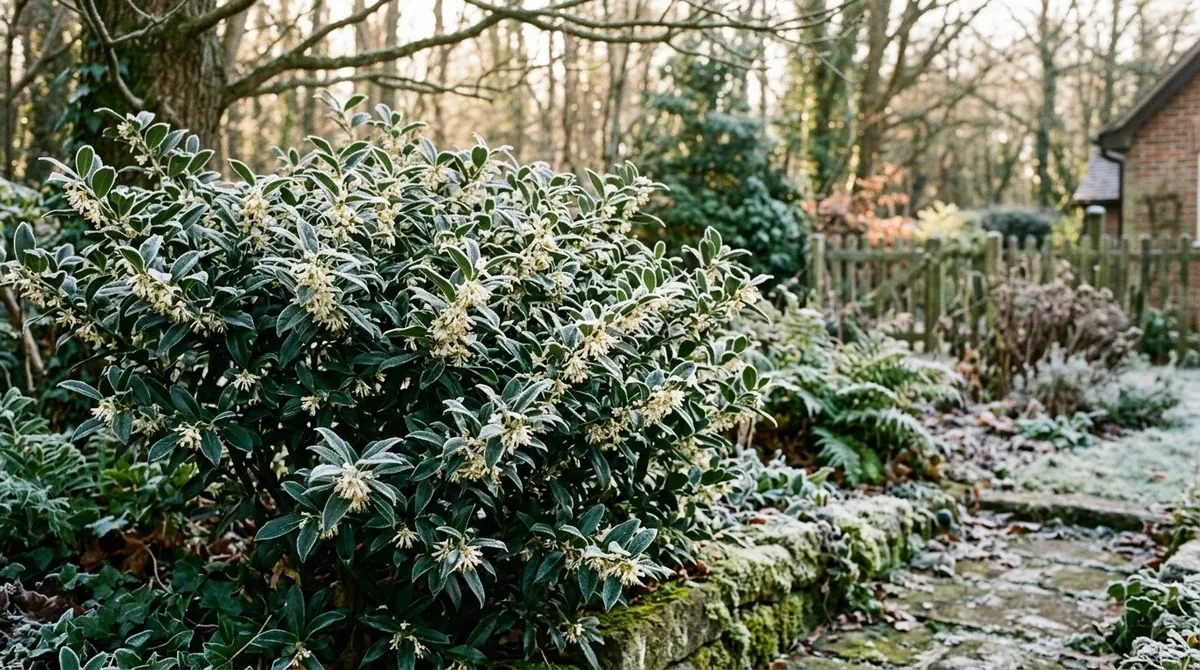
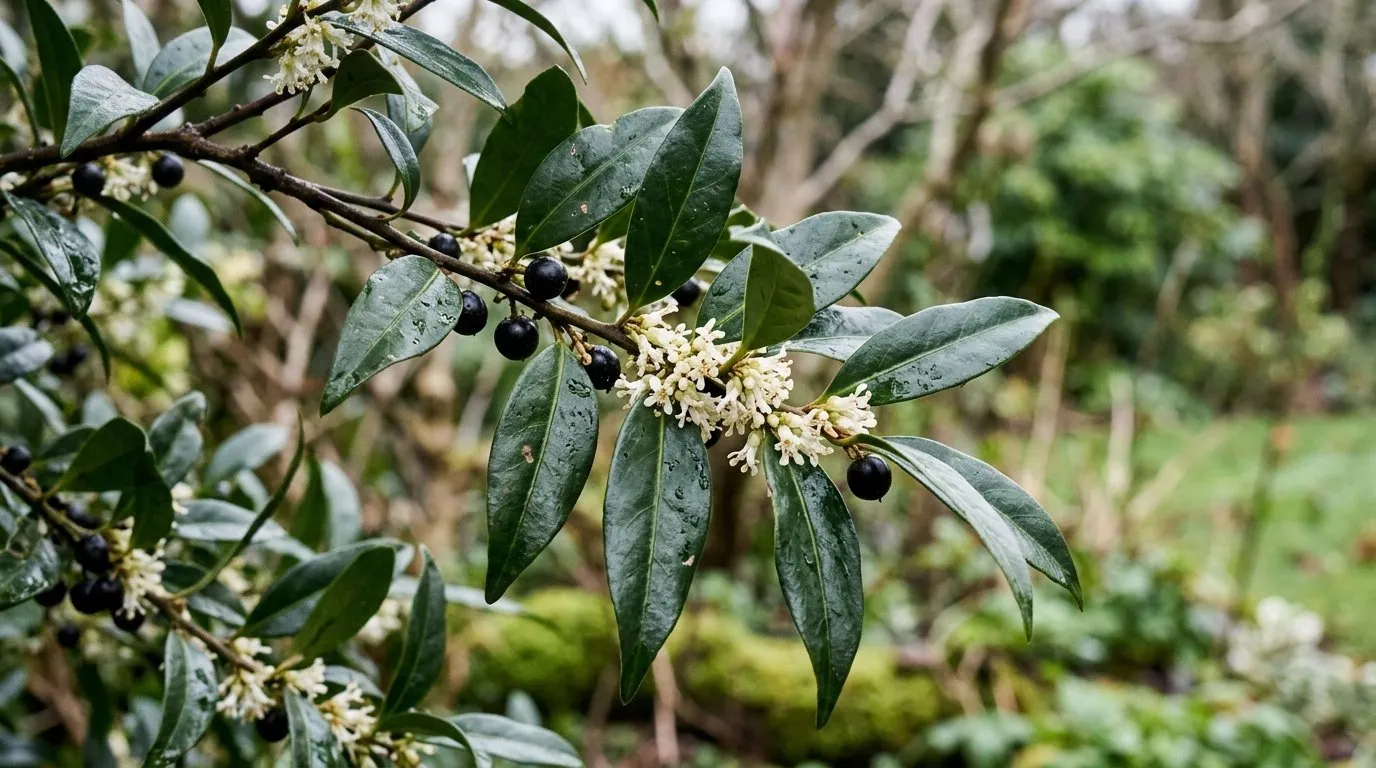 Sarcococca confusa is the standard upright UK form, reaching 1.5m tall over a decade. Dark glossy lance-shaped leaves and tiny clusters of cream-white flowers in the leaf axils from December to March. The most reliable winter-scent shrub for UK gardens.
Other species worth considering
S. hookeriana var digyna has narrower, willow-like leaves and produces purple-tinged flowers slightly later than S. confusa. Useful for textural contrast in shaded plantings. The named cultivar ‘Purple Stem’ has dark purple young stems and is a notably architectural plant.
S. ruscifolia produces red berries (not black) and is slightly less hardy than S. confusa - best in southern UK. Useful for collectors but rarely a first-choice species.
S. saligna has the longest flowers of any Sarcococca, with a more visible flower display. Hardy to about -10°C - safe in southern and mid-UK gardens but marginal in northern Scotland. Specialist nurseries only.
When and how to plant
Best window: September to October or March to April. Cool conditions allow root establishment before active growth. Avoid planting in the height of summer or in frozen ground.
Pot size to buy: A 2-3L pot establishes faster than a 9cm pot and starts flowering within 1-2 years. A 5-7L pot is even faster but expensive. Avoid bare-root - Sarcococca does not transplant well bare-rooted.
Planting:
- Dig a hole twice the diameter of the pot and the same depth.
- Amend the soil with garden compost or leaf mould - around 50:50 with native soil.
- Set the plant at the same depth as in the pot, no deeper.
- Backfill, firm gently with the heel.
- Water in well even if the soil is moist.
- Mulch 5cm deep with leaf mould or wood chip, leaving 5cm clear of the stem.
Spacing:
| Species | Single specimen | Hedge / mass |
|---|---|---|
| S. confusa | 1m+ from other shrubs | 60cm apart for low hedge |
| S. hookeriana var humilis | 1m+ from path edge | 50cm apart for ground cover |
| S. hookeriana var digyna | 80cm+ from other plants | 60cm apart for hedge |
A row of 3-5 S. confusa makes a beautiful informal screen 1.2m tall by year 5. Five plants for a 3m run is the typical garden quantity.
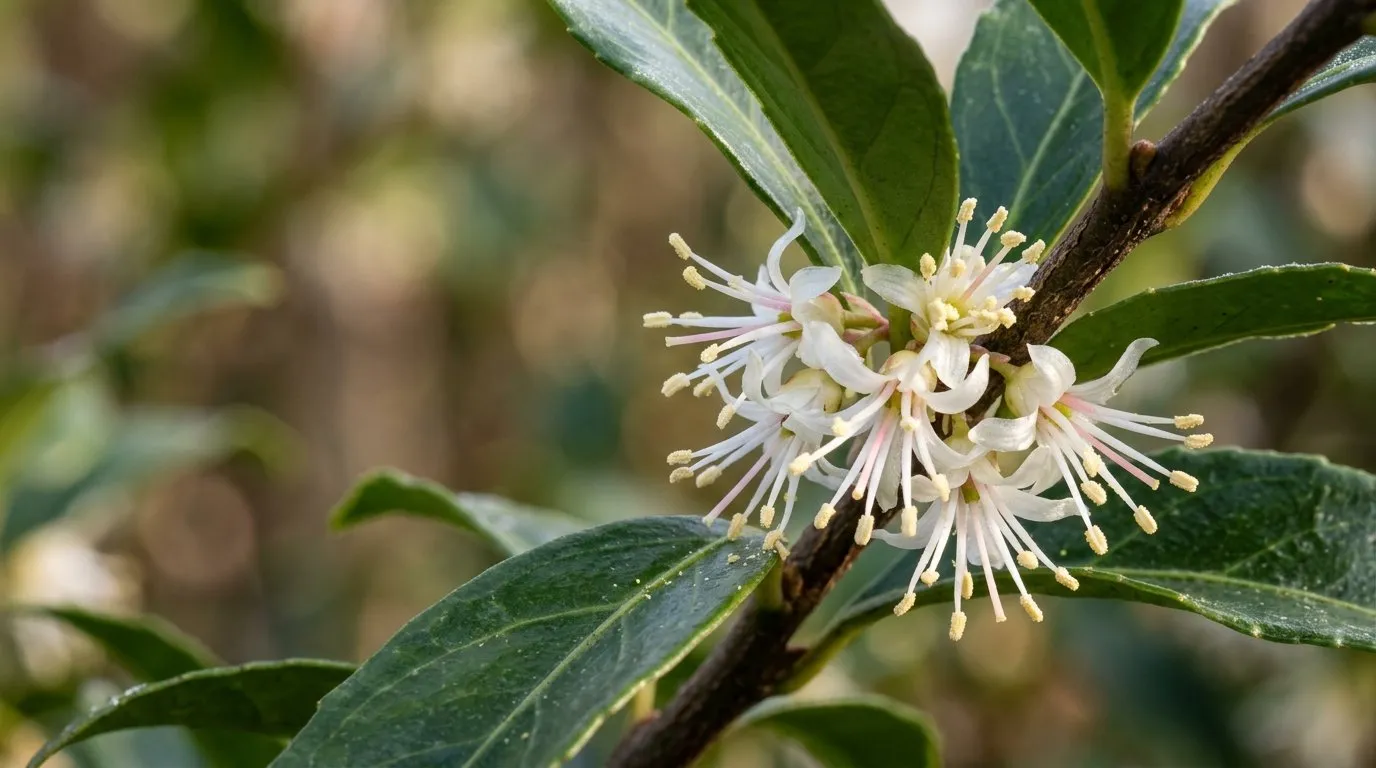 Sarcococca flowers are small (5-8mm) but produce a scent powerful enough to fill a garden corner. The white-cream flowers emerge from the leaf axils in clusters of 3-5. Each flower lasts 2-3 weeks; a healthy mature plant produces flushes over 8-10 weeks from late December to mid-March.
Care through the year
Sarcococca is one of the lowest-maintenance flowering shrubs in UK gardening. The annual jobs are short.
Spring (March-April): Light shape pruning if needed (see below). Top up mulch with 3-5cm of leaf mould or compost. No feeding required - the mulch provides what the plant needs.
Summer (June-August): Water during dry spells in the first 2-3 years. Once established, watering is rarely needed even in dry summers - Sarcococca is one of the most drought-tolerant evergreen flowering shrubs in dry shade.
Autumn (September-October): This is the planting window for new specimens. Light tidying of older plants - remove any dead or damaged branches.
Winter (November-March): The flowering season. No work needed beyond enjoyment. Snow can damage extended branches occasionally - shake heavy snow off after a fall.
Pruning: less is more
Sarcococca rarely needs significant pruning. The natural shape is attractive and self-maintaining.
When to prune: After flowering, in March or April. Pruning at other times removes flower buds for the following year.
What to do: Light shaping only. Remove any dead, damaged, or crossing branches. Cut back overlong stems by no more than one-third to a strong outward bud. Maintain the natural vase or domed shape - do not shear into geometric forms.
What to avoid: Heavy pruning of old wood. Sarcococca regenerates slowly from old bare wood and may take several years to recover from severe cuts. If a plant has become bare at the base, layer the lower branches by pinning a section of stem to the ground in spring - it will root within a year and can be separated from the parent.
Renovation pruning: For neglected plants, cut back one-third of the oldest stems to ground level over three successive springs. Avoid cutting all stems back at once - the plant may not recover.
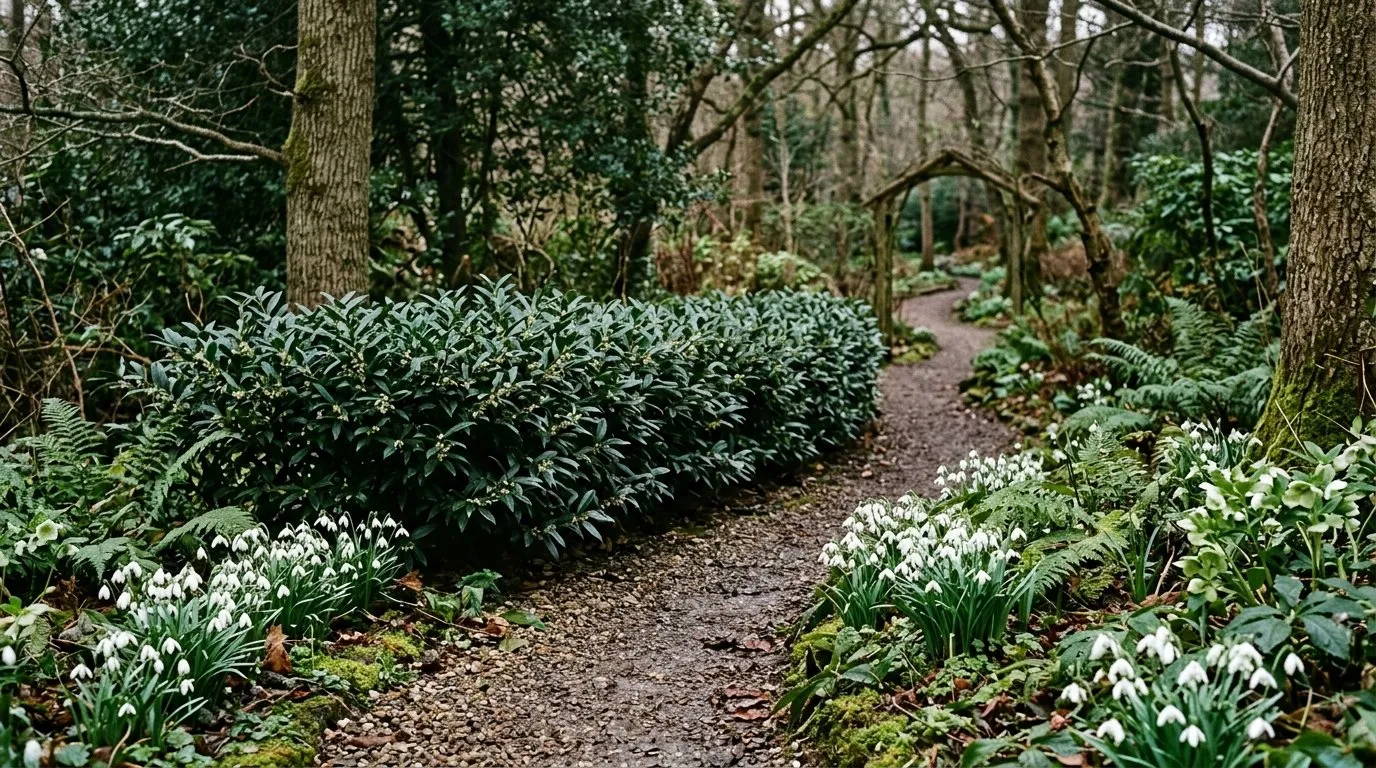 Sarcococca hookeriana var humilis is the dwarf spreading form, ideal for low hedges and ground cover under deciduous trees. Plant 50cm apart for a 60cm-tall mat that fills in within 3-4 years. Spreads slowly via underground runners and looks beautiful with snowdrops, hellebores, and hardy cyclamen.
Pests and problems
Sarcococca is rarely troubled in UK gardens. The few problems that occur:
Box blight (Cylindrocladium buxicola). Sarcococca is in the box family and can occasionally suffer from box blight, though it is far more resistant than Buxus. Symptoms: brown leaf spots, black streaks on stems. Action: prune out affected shoots, dispose in household waste (not compost), disinfect tools.
Box tree caterpillar. Affects Buxus far more than Sarcococca but the caterpillar can occasionally feed on Sarcococca leaves. Hand-picking is sufficient on small plants. See our box tree moth treatment UK guide for full identification.
Frost damage to early flowers. A severe cold snap below -8°C may damage the earliest flowers, but the shrub continues flowering through later weather. Recovery is automatic - no intervention needed.
Slow first 2-3 years. Common but not a problem. Patience is the answer. By year 4 a Sarcococca confusa is producing 8-10 weeks of flowering. Year 1-2 plants typically produce only 2-3 weeks.
Where to buy in the UK
Sarcococca is widely available but quality varies.
Specialist nurseries (best choice):
- Bluebell Cottage Gardens (Cheshire)
- Burncoose Nurseries (Cornwall - mail order)
- Crocus (online national)
- Hopes Grove Nurseries (Kent - hedging)
Garden centres: Most stock S. confusa in 2-3L pots from October. Some stock S. hookeriana var humilis. Specialist species require ordering from a nursery.
RHS plant centres: Stock Sarcococca varieties at peak times of year - autumn and early spring. Worth visiting for established plants.
Pricing (2026):
- 9cm pot: £6-10
- 2-3L pot: £15-25
- 5-7L pot: £35-55
For a doorway entrance, three 2-3L plants at £20 each (£60 total) gives a 3m run that flowers within 2-3 years. For a longer hedge, 9cm liners are more economical but take 4-5 years to establish.
Why Sarcococca matters in a UK garden
There are not many flowering shrubs that flower in deep midwinter. There are even fewer that smell powerful enough to be noticed from across a garden. Sarcococca is one of the very small group that does both, alongside growing wintersweet, whose waxy yellow flowers carry the same powerful scent on bare winter stems.
For most UK gardens the winter months are visually quiet. Sarcococca, hellebores, snowdrops, and hardy cyclamen between them produce one of the most rewarding seasons of the year - low key visually, but full of scent and life if you walk past at the right moment.
A single Sarcococca confusa is enough to start. Plant it within 3 metres of your front door, leave it alone for three years, and let it earn its place. By year four you will be planting another. By year ten the doorway smells of vanilla every cold morning between Christmas and the start of spring.
For the broader winter-shrub picture, see our best winter flowering shrubs UK guide.
 Sarcococca confusa flanking a UK front doorway. The scent in still cold air carries to anyone walking past, making it one of the most rewarding garden investments for the winter months. A 3-metre run takes three plants and within 4 years produces 8-10 weeks of flowering each year.
Quick checklist
Before buying your first Sarcococca:
- Site has dappled to deep shade ✓
- Within 3 metres of a path, doorway, or window ✓
- Soil is fertile and moisture-retentive (or amended with compost) ✓
- Pot size of 2-3L for fastest establishment ✓
- Mulch (leaf mould or compost) ready for autumn ✓
- Allowance for slow first 2-3 years ✓
- Companions (snowdrops, hellebores, hardy cyclamen) ready ✓
Done in autumn, your first Sarcococca confusa is in by November and producing token flowers by January. By year four you have one of the great UK winter pleasures - a corner of the garden that smells of vanilla every still cold morning.
Related articles
Our team produces practical UK gardening guidance from source research, contributor records and established horticultural practice. Editorial standards are overseen by Matt W.