How to Grow Asparagus Fern Indoors
Asparagus fern care guide for UK homes covering light, humidity, watering, and toxicity warnings. With species comparison and monthly calendar.
Key takeaways
- Asparagus ferns need bright indirect light of 10,000-20,000 lux — east or west-facing UK windowsills are ideal
- Humidity must stay above 50%, but UK central heating drops rooms to 30-40% in winter — mist daily or use a pebble tray
- All parts are toxic to cats, dogs, and children — the red berries are the most dangerous, causing vomiting and diarrhoea
- They are not true ferns but belong to the Asparagaceae family, closely related to edible asparagus
- Water when the top 2-3cm of compost dries out — roughly every 5-7 days in summer, every 10-14 days in winter
- A. setaceus trails elegantly for shelves, A. densiflorus 'Sprengeri' works in hanging baskets, and 'Myers' grows upright
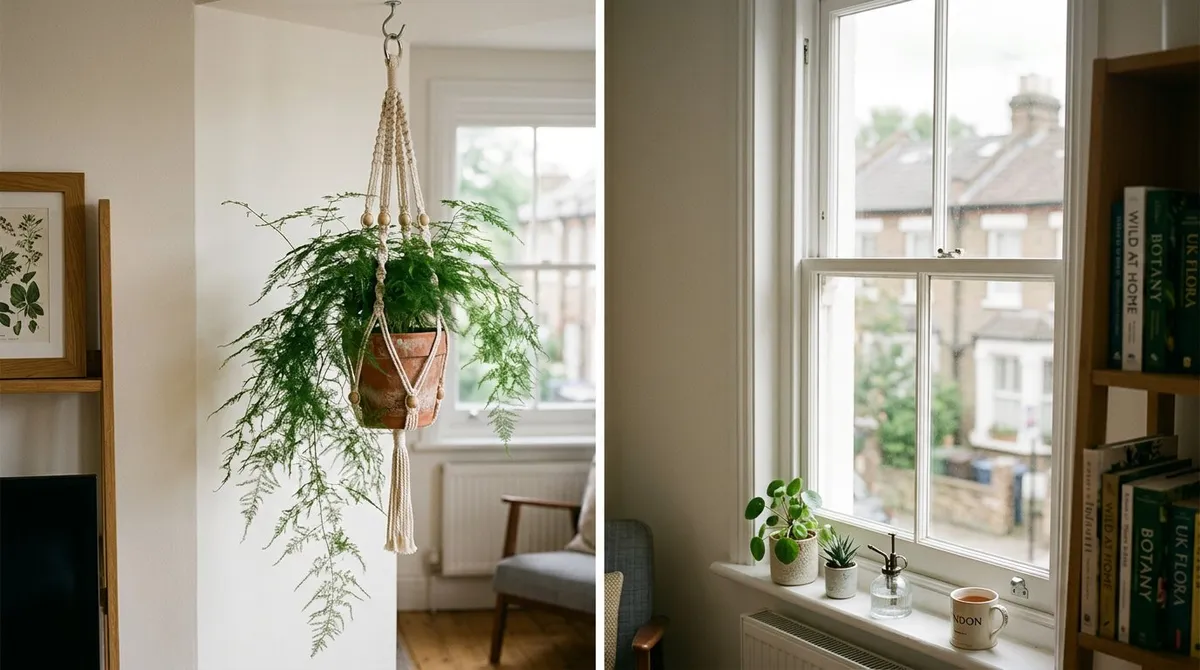
The asparagus fern is one of the most graceful houseplants you can grow in a UK home, with soft, feathery foliage that trails from shelves and hanging baskets. Despite its common name, it is not a fern at all. It belongs to the Asparagaceae family, making it a close relative of the edible asparagus you grow in the garden.
This guide covers the three species most commonly sold in UK garden centres, with specific data on light, humidity, and temperature. It also addresses an important safety point: asparagus ferns are toxic to cats, dogs, and children.
Lawrie’s growing note: I picked up my first asparagus fern from a reduced shelf at a garden centre. It was half bare. Within two months of daily misting and a spot on my east-facing bathroom windowsill, every stem had filled out with dense, bright green cladodes. These plants recover fast once you give them the humidity they crave.
What are the technical requirements for asparagus fern?
Getting the growing conditions right from day one prevents the most common problems. Asparagus ferns are not difficult, but they have specific needs that differ from most popular indoor plants. The table below gives exact figures rather than vague labels.
| Parameter | Requirement | Notes |
|---|---|---|
| Light | 10,000-20,000 lux (bright indirect) | East or west-facing UK windows ideal |
| Temperature | 13-24C | Below 7C causes damage, frost is fatal |
| Humidity | Above 50% | UK homes drop to 30-40% in winter |
| Soil pH | 6.5-6.8 (slightly acidic) | Standard houseplant compost works |
| Toxicity | Mildly toxic | Sapogenins in all parts, berries most dangerous |
Asparagus ferns are toxic to cats, dogs, and children. The red berries contain sapogenins that cause vomiting, diarrhoea, and abdominal pain if ingested. Repeated skin contact with the stems can trigger contact dermatitis. If you have pets, read our full guide to plants toxic to cats before choosing where to place this plant. The RHS lists asparagus fern with a toxicity warning for its berries.
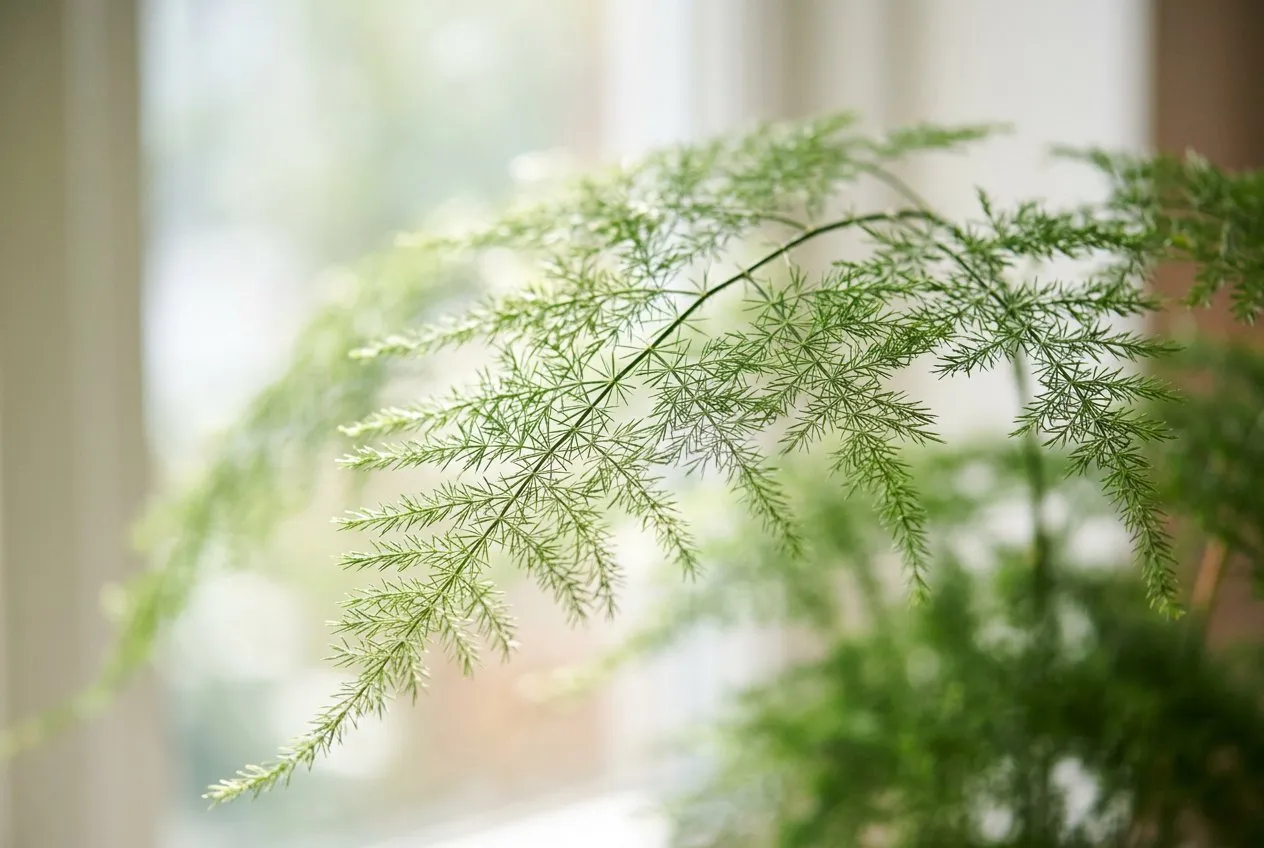 The delicate, layered cladodes of Asparagus setaceus give asparagus fern its distinctive feathery appearance.
Which asparagus fern species should you choose?
Three species dominate UK garden centres. Each has a distinct growth habit, so the right choice depends on where you plan to put it. All three share the same care requirements for light, water, and humidity.
| Species | Common name | Growth habit | Max size (indoors) | Light needs | Difficulty |
|---|---|---|---|---|---|
| A. setaceus (plumosus) | Lace fern | Climbing/trailing | 1.5-2m trails | 10,000-15,000 lux | Easy |
| A. densiflorus ‘Sprengeri’ | Sprengeri fern | Arching/trailing | 60-90cm spread | 15,000-20,000 lux | Easy |
| A. densiflorus ‘Myers’ | Foxtail fern | Upright plumes | 60cm tall | 15,000-20,000 lux | Moderate |
A. setaceus has the finest, most delicate foliage. Its flat, horizontal sprays of needle-like cladodes create a layered, almost cloud-like effect. It is the best choice for trailing from a high shelf or hanging basket. Florists use the cut fronds in bouquets because they hold their shape for days.
A. densiflorus ‘Sprengeri’ is the toughest of the three. Its arching stems carry longer, coarser cladodes and it tolerates lower humidity better than setaceus. It produces small white flowers in summer followed by red berries. This is the variety most likely to survive a beginner’s mistakes.
A. densiflorus ‘Myers’ grows in distinctive bottlebrush-shaped plumes that stand upright. It looks architectural rather than trailing, so it works on tabletops and windowsills where a trailing habit would be impractical. It demands slightly brighter light than the other two.
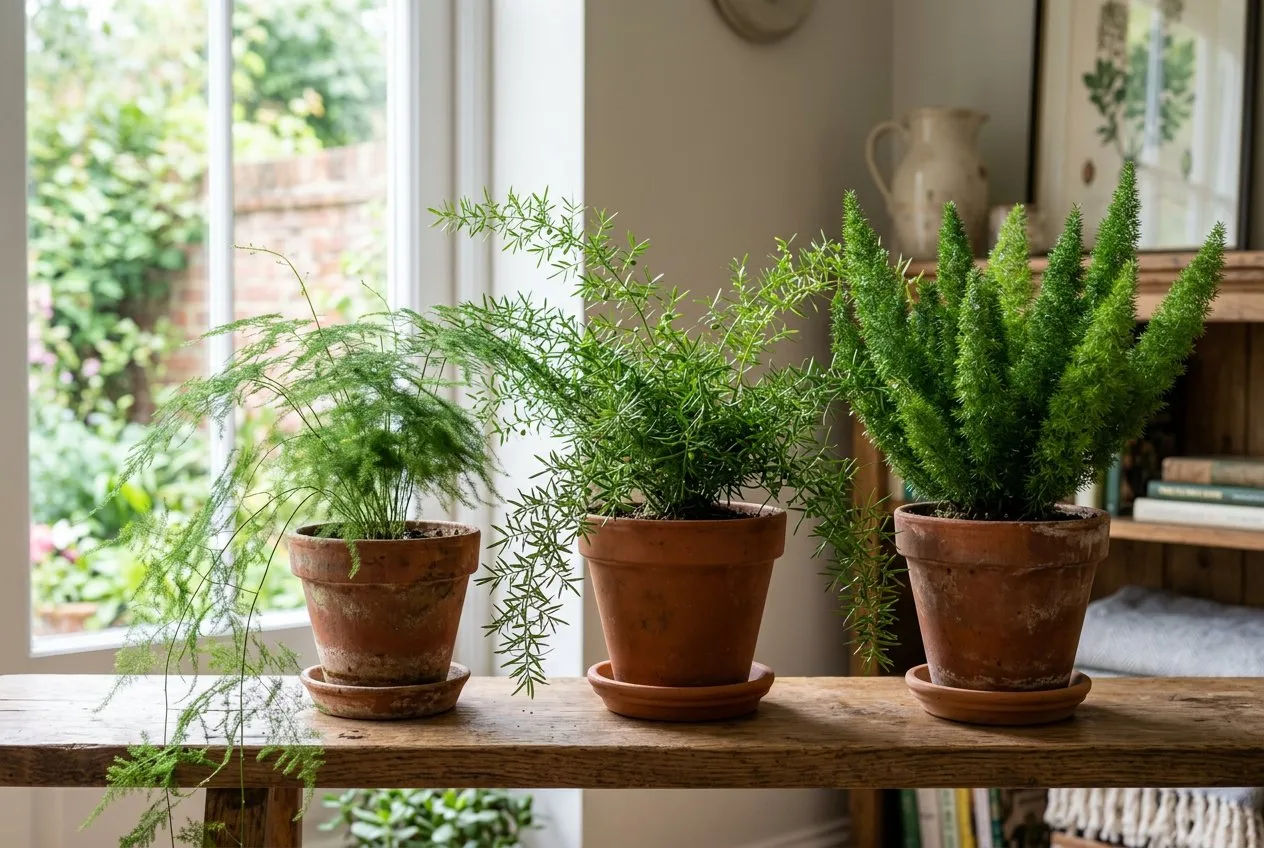 Left to right: A. setaceus (fine trailing fronds), Sprengeri (arching stems), and Myers foxtail fern (upright plumes).
Why we recommend A. densiflorus ‘Sprengeri’ for beginner UK houseplant growers: After 30 years of growing houseplants in a range of British home environments, Sprengeri is the most forgiving of the three asparagus fern species. It tolerates humidity dipping to 35% for short periods without dropping its cladodes, handles occasional underwatering, and recovers quickly after repotting. In my north-facing spare room, a Sprengeri has maintained dense, healthy growth for four years with only weekly misting and no supplemental lighting.
What light does asparagus fern need in UK homes?
Asparagus ferns evolved in the dappled shade beneath trees in southern and eastern Africa. They need bright indirect light between 10,000 and 20,000 lux. Direct midday sun from a south-facing window reaches 30,000-50,000 lux in a UK summer and scorches the foliage within days.
East-facing and west-facing windowsills are the best positions in a UK home. East windows provide gentle morning light. West windows offer warm afternoon light without the intensity of midday. Both orientations deliver 10,000-20,000 lux at the glass during the growing season.
North-facing windows rarely provide enough light, especially between October and February when the UK receives only 7-8 hours of daylight. If north-facing is your only option, supplement with a grow light providing at least 10,000 lux for 10-12 hours daily. Unlike a low light houseplant such as a ZZ plant, asparagus ferns will not tolerate deep shade. They grow leggy and bare within weeks.
How should you water asparagus fern?
Asparagus ferns store moisture in swollen, tuberous roots beneath the soil surface. This gives them more drought tolerance than true ferns, but they still prefer consistently moist compost. The key word is moist, not wet.
Water when the top 2-3cm of compost feels dry. Push your finger into the soil. If it feels dry at fingertip depth, water thoroughly until it drains from the base. Empty the saucer after 30 minutes. Standing water causes root rot, the most common killer of asparagus ferns in UK homes.
In summer, this means watering roughly every 5-7 days. In winter, central heating dries compost faster from the surface, but cooler roots absorb less. Water every 10-14 days and always check with a finger test first. Use tepid water rather than cold from the tap, which can shock the roots. Collected rainwater is ideal.
How do you maintain humidity for asparagus fern?
Humidity is where most UK growers fail with asparagus ferns. Central heating drops indoor humidity to 30-40% between October and March. Asparagus ferns need a minimum of 50%, and 60-70% is better. Below 40%, the needle-like cladodes dry out and drop, leaving bare stems.
Four reliable methods raise humidity around your plant:
- Daily misting. Use a fine-mist spray bottle every morning. This raises local humidity temporarily. It works but needs consistency.
- Pebble tray. Fill a tray with pebbles and water to just below the stone tops. Set the pot on the pebbles. As the water evaporates, it makes a humid zone around the foliage.
- Grouping plants. Cluster your asparagus fern with other humidity-loving species. Collective transpiration raises the moisture level for all of them.
- Bathroom placement. A bathroom with natural light provides naturally higher humidity from showers and baths. Many asparagus ferns thrive on bathroom windowsills.
A digital hygrometer placed near the plant removes guesswork. They cost under £10 and let you monitor conditions day by day.
How to feed and repot asparagus fern
Feed with a balanced liquid houseplant fertiliser (NPK 10-10-10 or similar) every two weeks from April to September. Dilute to half the recommended strength. Asparagus ferns are light feeders and excess fertiliser burns the fine root hairs. Stop feeding entirely from October to March when growth slows.
Repot every 2-3 years in spring. Asparagus ferns are vigorous growers. Their tuberous roots fill pots quickly, and when pot-bound they push the soil level upward and crack plastic containers. Move to a pot one size larger using standard houseplant compost mixed with 20-30% perlite for drainage. For a step-by-step approach, see our guide to how to repot houseplants.
Wear gloves when repotting. Mature stems carry small, sharp thorns that are easy to miss until they prick you.
How to propagate asparagus fern
Division is the simplest and most reliable method. In spring, remove the plant from its pot and use a clean, sharp knife to divide the root mass into sections. Each section needs at least 3-4 stems and a good cluster of tuberous roots. Pot each division into fresh compost and water well.
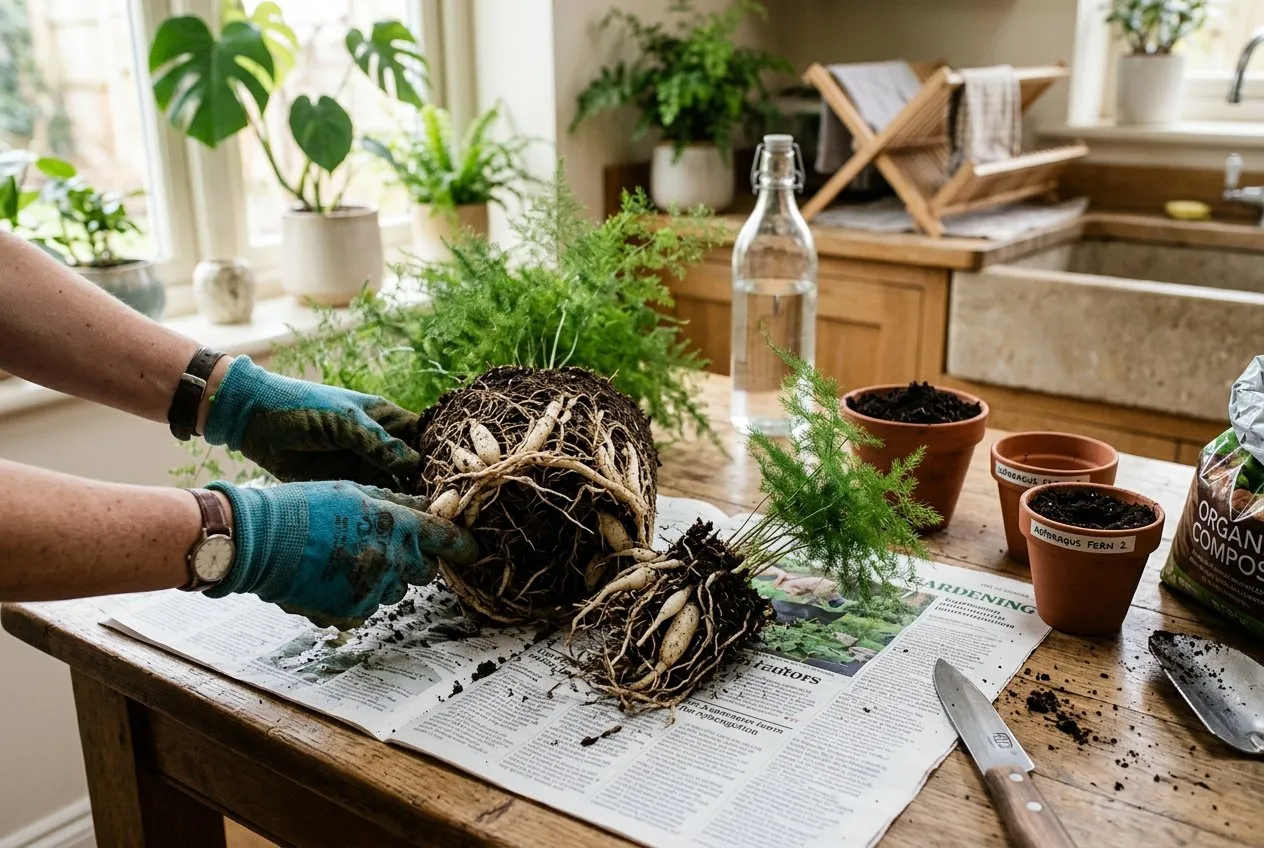 Dividing an asparagus fern in spring, separate the tuberous root mass into sections with at least 3-4 stems each.
Seed propagation is possible but slow. The red berries each contain 1-3 seeds. Soak seeds in warm water for 24 hours, then sow 1cm deep in moist compost at 20-25C. Germination takes 3-6 weeks and is unreliable. Division gives you established plants in a fraction of the time. Our guide to how to propagate houseplants covers both methods in more detail.
A safety reminder: if your asparagus fern produces berries, remove them immediately in homes with children or pets. The berries are the most toxic part of the plant.
Troubleshooting common asparagus fern problems
Most problems trace back to light, humidity, or watering. Use this table to diagnose and fix the four most common issues.
| Problem | Cause | Fix |
|---|---|---|
| Yellowing cladodes | Too much direct sunlight or overwatering | Move to bright indirect light; check drainage |
| Dropping needles | Humidity below 40% | Mist daily, use pebble tray, move to bathroom |
| Leggy, bare stems | Insufficient light (below 5,000 lux) | Move to brighter position; prune bare stems to base |
| Brown, crispy tips | Underwatering or fertiliser burn | Water more frequently; flush soil with plain water |
Yellowing is the most frequently misdiagnosed issue. Growers assume the plant needs more light and move it into direct sun, which makes the problem worse. Asparagus ferns yellow from too much light, not too little. Move the plant further from the window or add a sheer curtain.
Dropping needles account for most complaints about asparagus ferns being difficult. They are not difficult. They cannot tolerate the arid conditions that UK central heating creates. Solve the humidity problem and the needle drop stops within a week.
Month-by-month asparagus fern care calendar
| Month | Task | Detail |
|---|---|---|
| January | Monitor humidity | Central heating at peak; mist daily, check hygrometer stays above 50% |
| February | Check for pests | Scale insects and spider mites appear in warm, dry air |
| March | Start feeding | Half-strength liquid feed every two weeks |
| April | Repot if needed | Move to one size larger pot if roots are crowded |
| May | Increase watering | Every 5-7 days as temperatures rise |
| June | Move outdoors (optional) | Place in sheltered shade; never direct sun |
| July | Watch for berries | Remove berries in homes with pets or children |
| August | Take divisions | Divide congested plants; pot into fresh compost |
| September | Bring indoors | Before night temperatures drop below 10C |
| October | Reduce watering | Every 10-14 days; central heating starting |
| November | Increase misting | Humidity drops sharply with heating; mist daily |
| December | Rest period | No feeding; minimal watering; bright indirect light |
This calendar suits most of England and Wales. Gardeners in Scotland and northern England should bring plants indoors by late August, as night temperatures fall earlier. The RHS seasonal care advice provides additional context for adjusting schedules by region.
Now you’ve mastered asparagus fern care, read our guide on the best indoor plants for UK homes for more low-maintenance houseplants that thrive in British light levels and central-heated rooms.
Frequently asked questions
Is asparagus fern toxic to cats?
Asparagus fern is toxic to cats. The berries contain sapogenins that cause vomiting, diarrhoea, and abdominal pain if ingested. Repeated skin contact with the foliage can cause dermatitis in both cats and humans. Keep the plant on a high shelf or in a room cats cannot access. If your cat chews any part, contact your vet immediately.
Why is my asparagus fern turning yellow?
Yellowing usually means too much direct sunlight. Asparagus ferns scorch in light above 25,000 lux, which south-facing UK windows reach in summer. Move the plant to an east or west-facing position. Overwatering also causes yellowing, check that the compost is not waterlogged and that the pot drains freely.
How often should I water an asparagus fern?
Water when the top 2-3cm of compost dries out. In summer, this means roughly every 5-7 days. In winter, every 10-14 days. Asparagus ferns store moisture in their tuberous roots, so they tolerate brief dry spells better than sitting in wet soil. Always drain excess water from the saucer.
Can asparagus fern grow outside in the UK?
Asparagus ferns cannot survive UK winters outdoors. They are tender plants rated USDA zone 9-11 and suffer damage below 7C. Frost kills them outright. You can move pots outside to a sheltered, shaded spot from June to September, but bring them in before night temperatures drop in autumn.
How do I stop my asparagus fern dropping needles?
Needle drop is caused by low humidity. UK homes fall to 30-40% humidity in winter due to central heating. Mist the foliage daily, place the pot on a pebble tray filled with water, or group it with other plants to create a humid microclimate. A bathroom with natural light is another good option.
Is asparagus fern a real fern?
Asparagus fern is not a true fern. It belongs to the Asparagaceae family, the same family as edible asparagus. True ferns reproduce by spores and belong to the Polypodiopsida class. Asparagus ferns produce flowers and berries, which true ferns never do. The common name refers to the feathery, fern-like appearance of the foliage.
Should I prune my asparagus fern?
Prune asparagus ferns in early spring before new growth appears. Cut back dead, yellowed, or bare stems to the base. This encourages fresh shoots from the crown. Use gloves to avoid the small thorns hidden along older stems. Regular pruning keeps the plant compact and prevents it from becoming leggy.
Lawrie has been gardening in the West Midlands for over 30 years. He grows his own veg using no-dig methods, keeps a wildlife-friendly garden, and writes practical advice based on real UK growing conditions.