How to Grow Buddleja in the UK
Grow buddleja (butterfly bush) anywhere in the UK, including poor soil. Prune hard to 30-60cm in March. Attracts 20 butterfly species July to September.
Key takeaways
- Prune buddleja hard in March, cutting to 30-60cm — flowers form on new wood each year
- A single buddleja attracts up to 20 UK butterfly species, more than almost any other garden plant
- Without pruning, plants grow 3-4m tall, become leggy, and produce fewer, smaller flowers
- Buddleja grows in poor, rubble-filled, and chalk soils where little else thrives
- Deadhead spent spikes to prevent aggressive self-seeding — it is listed as invasive in some areas
- Take semi-ripe cuttings in July to September for free new plants with near-100% success rate
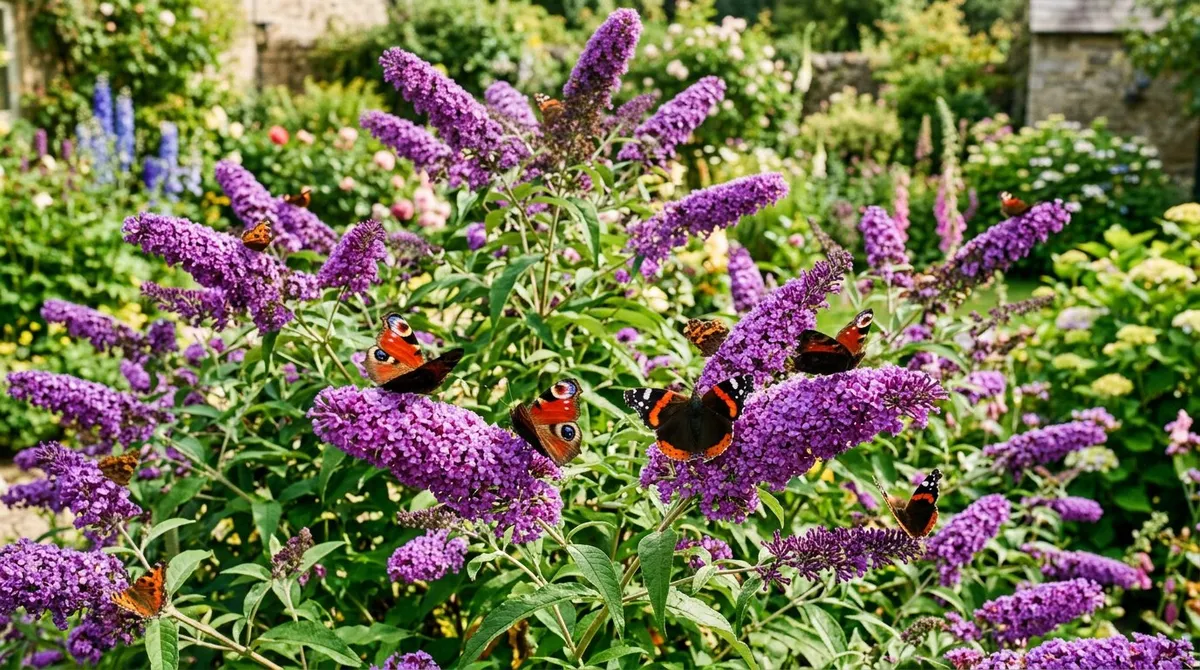
Buddleja davidii is one of the most forgiving and rewarding shrubs for UK gardens. Plant it in rubble, chalk, or compacted clay soil and it will still reward you with 30cm flower spikes covered in butterflies from July to September. No other commonly grown garden shrub attracts more butterfly species. Up to 20 species visit a single plant at peak flowering, including peacocks, red admirals, painted ladies, small tortoiseshells, and commas.
The plant has one firm requirement: annual pruning in March. Cut it hard back to 30-60cm and it regrows 2-3m in a season, producing its best flowers on that new wood. Skip the pruning and within a few years you have a towering, leggy shrub with flowers out of sight at the top and a bare tangle of stems at eye level. This guide covers everything from choosing varieties and planting to pruning, propagation, and managing self-seeding. For more on building a garden that supports UK wildlife, see our guide to best plants for butterflies.
What soil and position does buddleja need?
Buddleja davidii grows in almost any soil. This is one of its defining characteristics and the reason you see it colonising railway embankments, demolition sites, and rubble-filled ground across the UK. It is not fussy about drainage, pH, or fertility in the way that more refined shrubs are.
That said, buddleja produces its best growth and most abundant flowers in a sunny, open position. It needs a minimum of 5 hours of direct sunlight per day. South and west-facing positions are ideal. In heavy shade, plants produce leafy growth but fewer flowers, and the butterfly-attracting quality drops significantly.
On chalk or thin soils where little else thrives, buddleja excels. It has evolved to grow in disturbed, open ground and tolerates drought well once established. In very rich, fertile soil it produces excessive leafy growth and can become even more vigorous than usual, making it harder to keep within bounds.
Best buddleja varieties for UK gardens
Choosing a named variety rather than an unnamed seedling from a garden centre gives you a plant with known size, colour, and habit. The species Buddleja davidii also includes a close relation worth knowing: Buddleja alternifolia, which has entirely different pruning requirements.
Buddleja davidii varieties
Black Knight produces the deepest, darkest purple flowers of any buddleja. The near-violet spikes grow to 30-40cm and create a striking contrast against the silvery-green foliage. A classic choice for formal gardens and cottage garden schemes alike. It reaches 2.5-3m unpruned but responds well to hard pruning.
Royal Red delivers rich red-purple flower spikes that attract butterflies as effectively as purple varieties. Slightly more compact than Black Knight at 2-2.5m. One of the most popular varieties in the UK and an RHS Award of Garden Merit holder.
White Profusion is the best white buddleja for UK gardens. Large, pure white spikes with a faint honey fragrance. Attractive to moths as well as butterflies, making it particularly useful for evening wildlife interest. Grows to 2.5-3m and benefits from the same hard March pruning as coloured varieties.
Nanho Blue is a naturally smaller variety, reaching 1.5-2m without hard pruning. The narrow foliage and slender lavender-blue spikes give it a lighter, more graceful appearance than standard varieties. Well suited to smaller gardens where the bulk of Black Knight or Royal Red would be too much.
Buzz series (Buzz Ivory, Buzz Lavender, Buzz Purple, Buzz Sky Blue) are compact dwarf varieties reaching just 1.2m. Bred specifically for smaller gardens, pots, and patios. They produce proportionally large flower spikes for their size and respond to hard pruning in the same way as larger types. Ideal if you want butterfly interest without the space demands of a full-sized shrub. For more compact shrubs suited to smaller spaces, see our guide to best flowering shrubs for UK gardens.
Buddleja alternifolia
Buddleja alternifolia is a different species entirely. It has an elegant, arching, weeping habit and produces clusters of small fragrant lilac-purple flowers along the length of the previous year’s stems in June, not on new growth like B. davidii. This distinction is critical for pruning. Never prune B. alternifolia in March or you will cut off every flower bud. Instead, prune immediately after flowering in late June or July, cutting back flowered stems to healthy new shoots. Grow it as a standard (trained to a single clear stem) or as a large weeping shrub.
Variety comparison table
| Variety | Height (pruned) | Flower colour | Flowering period | Best use |
|---|---|---|---|---|
| Black Knight | 2-2.5m | Dark purple | July-September | Large borders, statement shrub |
| Royal Red | 2-2.5m | Red-purple | July-September | Borders, wildlife garden |
| White Profusion | 2-2.5m | White | July-September | Evening gardens, mixed borders |
| Nanho Blue | 1.5-2m | Lavender-blue | July-September | Smaller gardens |
| Buzz series | 1.2m | Various | July-September | Pots, small gardens |
| B. alternifolia | 3-4m | Lilac-purple | June | Weeping specimen, wall shrub |
How and when to prune buddleja davidii
Pruning is the single most important job for buddleja and the one most gardeners get wrong. Cut all stems back to 30-60cm above ground level in March. Use loppers or a pruning saw for thick stems. This sounds drastic, but buddleja flowers on wood grown in the current season. Hard pruning produces vigorous new stems 2-3m long, each tipped with a 30-40cm flower spike. A lightly pruned or unpruned plant produces far more but much shorter flower spikes on secondary growth.
March timing matters. Pruning earlier risks frost damage to the fresh new growth. Pruning later shortens the growing season and reduces the size of the flower display.
After pruning, apply a balanced slow-release fertiliser around the base and mulch with well-rotted garden compost. Buddleja is hungry after such hard pruning and benefits from the extra feed. For more detail on pruning other garden shrubs, see our guide to how to prune shrubs in the UK.
What about autumn pruning?
Many gardeners cut buddleja back in autumn to tidy the garden. This is not ideal but is not catastrophic. The main risk is that cutting in October or November removes the old stems that help protect the crown from frost. In most UK regions this is not a serious concern, but in colder northern gardens or exposed sites it is safer to leave the old growth in place through winter and cut in March. If you have cut in autumn, cut again in March to the same 30-60cm framework before growth starts.
Pruning buddleja alternifolia
B. alternifolia needs a completely different approach. It flowers on the previous year’s wood, so prune only after flowering, in late June or early July. Cut back each flowered stem to a strong new shoot lower down. Do not prune in spring. The more you understand the difference between these two types, the better your results. For a broader introduction to spring tasks, see our guide to spring gardening jobs in the UK.
Month-by-month buddleja care calendar
| Month | Task |
|---|---|
| January | No action needed. Leave old stems to protect the crown. |
| February | Plan where to plant new buddlejas. Order named varieties from specialist nurseries. |
| March | Hard prune all B. davidii stems to 30-60cm. Feed with slow-release fertiliser. Mulch base. |
| April | New growth emerges rapidly. Plant new bare-root or container plants from April onwards. |
| May | Growth accelerates. No action needed beyond weeding around the base. |
| June | B. alternifolia in full flower. Prune it after flowering this month or in July. |
| July | B. davidii begins flowering. Butterflies arrive. Take semi-ripe cuttings July-September. |
| August | Peak flowering. Deadhead spent spikes to extend the season and prevent self-seeding. |
| September | Continue deadheading. Take cuttings. Flowering continues into September in mild years. |
| October | Flowering ends. Leave old stems in place through winter. Do not prune now. |
| November | No action needed. Check cuttings taken in summer for root development. |
| December | Pot on rooted cuttings into individual pots. Overwinter in a cold frame or sheltered spot. |
How to plant buddleja
Buddleja is simple to plant and tolerates a wide range of conditions. Container-grown plants are available from April to October and can be planted at any point in the growing season with good results. Spring planting (April to May) gives roots the full season to establish before winter.
Dig a hole twice the width of the pot. In most soils no further preparation is needed. In very compacted ground, break up the soil at the base of the hole to allow roots to penetrate. Set the plant so the top of the root ball sits at soil level. Backfill, firm in, and water well. Water once a week through the first summer if rainfall is low. After the first year, established buddlejas are effectively drought tolerant and need no supplementary watering in most UK regions.
If your garden has very few flowers on poor soil, buddleja is an excellent starting point. Pair it with other drought-tolerant plants such as lavender, rosemary, and sedum for a border that requires almost no maintenance. Our guide to drought-tolerant plants for UK gardens covers the best companions.
Managing self-seeding and invasive spread
Buddleja davidii self-seeds prolifically. A single plant produces thousands of seeds each year, which are small and wind-dispersed. In gardens this means seedlings appearing in paths, walls, and borders. In the wider environment it means buddleja colonises railway lines, brownfield sites, and river banks, sometimes to the detriment of native species.
Deadhead spent flower spikes as soon as flowering ends. This is the most effective way to prevent self-seeding. Cut each spike back to the next pair of leaves or side shoots once the flowers fade and before the seed heads ripen. Regular deadheading also encourages secondary flower spikes, extending the display into September.
Some UK councils and conservation organisations request that gardeners deadhead buddleja diligently, particularly near waterways. The plant is not listed under Schedule 9 of the Wildlife and Countryside Act, so growing it is legal, but responsible management is important. For more on building a wildlife-friendly garden that works with native plants, see our guide to bee-friendly garden plants.
How to take buddleja cuttings
Buddleja cuttings are among the easiest to root in the garden. Success rates above 90% are typical, making it an excellent choice for gardeners new to propagation.
Take semi-ripe cuttings from July to September. Choose non-flowering side shoots 10-15cm long. The wood should be firm and slightly hard at the base but still flexible at the tip. Cut just below a leaf node and strip all the lower leaves, leaving only the top two or three pairs. Pinch out the soft growing tip.
Insert cuttings 3-4cm deep into small pots filled with 50/50 multipurpose compost and perlite. Water in and cover with a propagator lid or a clear plastic bag secured with an elastic band. Place on a windowsill or in a cold greenhouse, out of direct midday sun.
Roots form in 4-6 weeks. Remove the cover once rooting is confirmed (gently tug the cutting, resistance means roots are developing). Pot on individually into 9cm pots using standard multipurpose compost. Overwinter in a cold frame or sheltered spot. Plant out the following April. New plants from summer cuttings will flower in their first summer, usually to a more modest display than an established plant. For more on propagating shrubs from seed and cuttings, our guide to how to sow seeds indoors covers the basics of starting plants from scratch.
Why we recommend Black Knight for wildlife gardens: After 30 years of growing buddlejas, Black Knight consistently attracts more butterflies per plant than any pale-flowered variety we have grown. In a count during one August peak, a single mature Black Knight recorded 14 butterfly species in a single afternoon, including three species of fritillary we had never previously seen in the garden. The depth of colour appears to signal higher nectar concentrations to butterflies from greater distances.
Buddleja and butterflies
No other commonly grown garden shrub attracts as many butterfly species as buddleja. Its popularity among UK butterflies is the reason for the common name “butterfly bush”. The flat-topped flower spikes produce large quantities of nectar and are easily accessible to butterflies, which can land on the florets and feed for extended periods.
Peacocks, red admirals, painted ladies, small tortoiseshells, commas, brimstones, and gatekeepers all visit regularly. Large whites, small whites, green-veined whites, and holly blues also feed on buddleja. In warm Augusts, silver-washed fritillaries appear in gardens with buddleja for the first time.
To maximise butterfly value, prune hard each March to ensure the largest possible flower spikes. Position the plant in full sun, butterflies are cold-blooded and favour warm, sheltered spots. Avoid all insecticide use near buddleja. A wildlife garden built around buddleja, lavender, and verbena bonariensis offers outstanding butterfly interest from June through to October. For a full seasonal planting scheme, see our cottage garden planting plan.
Now you’ve mastered buddleja, read our guide on the best plants for butterflies in the UK for a complete wildlife-friendly planting scheme.
Frequently asked questions
When should I prune buddleja in the UK?
Prune buddleja in March, cutting all stems hard back to 30-60cm above ground. This is the single most important job for a productive plant. Buddleja flowers on wood grown in the current season, so hard pruning in March produces vigorous new stems that flower from July to September. Do not prune in autumn, leave the old stems to protect the crown through winter.
How big does buddleja grow in one year?
A hard-pruned buddleja typically regrows 2-3m in a single season. This is unusually fast for a garden shrub and is why annual pruning is so important. Without cutting back, plants quickly outgrow their space and the flowering wood moves to the top of a leggy framework beyond easy reach.
Is buddleja invasive in the UK?
Buddleja davidii self-seeds aggressively and colonises disturbed ground, roadsides, railway embankments, and demolition sites. Some UK councils list it as invasive. It is not on Schedule 9 of the Wildlife and Countryside Act, so it is not illegal to grow, but responsible gardeners should deadhead all spent flower spikes before seeds ripen to prevent spread into the wild.
Can I grow buddleja in a pot?
Yes, dwarf varieties such as the Buzz series (1.2m) grow well in large containers of 40-50cm diameter. Use a loam-based compost like John Innes No. 3 and ensure excellent drainage. Prune hard each March as you would a garden-grown plant. Container buddlejas dry out quickly in summer and may need daily watering during hot spells.
What is the difference between Buddleja davidii and Buddleja alternifolia?
Buddleja davidii is the common butterfly bush, pruned hard in March and flowering July to September on new wood. Buddleja alternifolia is the weeping or fountain buddleja, which flowers in June on the previous year’s wood. Never prune B. alternifolia in spring or you remove all the flower buds. Instead, cut back flowered stems immediately after flowering in June or July.
Why is my buddleja not flowering?
The two most common causes are insufficient sun and incorrect pruning. Buddleja needs at least 5 hours of direct sun per day. If growing in shade, it puts energy into leafy growth rather than flowers. If you pruned in autumn rather than spring, the plant may not have developed enough vigorous new growth to support flowering. Move shaded plants or prune hard in March and wait one full season.
How do I take buddleja cuttings?
Take semi-ripe cuttings 10-15cm long from July to September. Cut just below a leaf node and strip the lower leaves, leaving only the top two or three pairs. Insert into pots of 50/50 perlite and multipurpose compost, water in, and cover with a propagator lid or clear plastic bag. Place in a warm bright spot out of direct sun. Roots form within 4-6 weeks. Success rates are very high, often above 90%.
Lawrie has been gardening in the West Midlands for over 30 years. He grows his own veg using no-dig methods, keeps a wildlife-friendly garden, and writes practical advice based on real UK growing conditions.