How to Grow Calla Lilies in the UK
Calla lilies thrive in UK gardens when you match species to hardiness. Covers hardy vs tender types, planting, containers, and winter care.
Key takeaways
- Z. aethiopica (white) is hardy to minus 10 Celsius and survives UK winters outdoors in most regions
- Coloured hybrids are tender (H2, minus 1 Celsius) and must be lifted in autumn or grown in pots
- Plant rhizomes 10cm deep in spring once soil temperature reaches 15 Celsius
- Calla lilies thrive in moist, humus-rich soil with a pH of 6.0 to 6.5
- Container-grown plants need a minimum 5-litre pot with loam-based compost and regular feeding
- Z. aethiopica grows superbly as a marginal pond plant in up to 30cm of water
Calla lilies are among the most striking flowering plants you can grow in a British garden. Their sculptural, funnel-shaped spathes appear from late spring through summer in white, pink, yellow, orange, deep purple, and near-black. The genus Zantedeschia contains eight species, all native to southern and eastern Africa, but only one is reliably hardy in UK conditions. Understanding which species tolerate British winters and which need lifting is the single most important factor in growing them successfully.
The white calla lily, Zantedeschia aethiopica, has naturalised along stream banks and in damp meadows across south-west England, Wales, and Ireland. It holds an RHS Award of Garden Merit and thrives in conditions that would kill its coloured cousins. The tender hybrids bred from Z. rehmannii and Z. elliottiana produce the vivid pinks, yellows, and dark shades found in garden centres, but they demand frost-free storage over winter. This guide covers both groups in detail, from planting and feeding through to overwintering and pond growing.
What species and varieties can I grow?
The hardiness divide is the first thing to grasp. Z. aethiopica is rated RHS H4 (hardy to minus 10 Celsius). It survives outdoors year-round in RHS hardiness zones 8 to 10, covering most of lowland England, Wales, and sheltered coastal Scotland. The coloured species and their hybrids are rated H2 (hardy only to minus 1 Celsius). A single November frost kills their foliage and damages the rhizome beneath. This distinction shapes every decision about planting, position, and winter care.
Modern breeding has produced dozens of named cultivars with specific colours, heights, and flowering periods. The table below compares the main species and hybrid groups available to UK gardeners.
Calla lily species and variety comparison
| Species / Group | Colour | UK Hardiness | Height | Flowering period | Best position |
|---|---|---|---|---|---|
| Z. aethiopica | White with yellow spadix | H4 (to -10°C) | 60-100cm | May - July | Pond margin, bog garden, moist border |
| Z. aethiopica ‘Crowborough’ | White, slightly smaller spathe | H4 (to -10°C) | 60-80cm | May - July | Border, drier soil than species |
| Z. rehmannii | Pink to rose-pink | H2 (to -1°C) | 30-40cm | June - August | Sheltered border, container |
| Z. elliottiana | Golden yellow, spotted leaves | H2 (to -1°C) | 40-60cm | June - August | Container, warm border |
| Modern hybrids (e.g. ‘Picasso’, ‘Black Star’, ‘Captain Safari’) | Purple, near-black, orange, bicolour | H2 (to -1°C) | 30-60cm | June - September | Container, conservatory, sheltered patio |
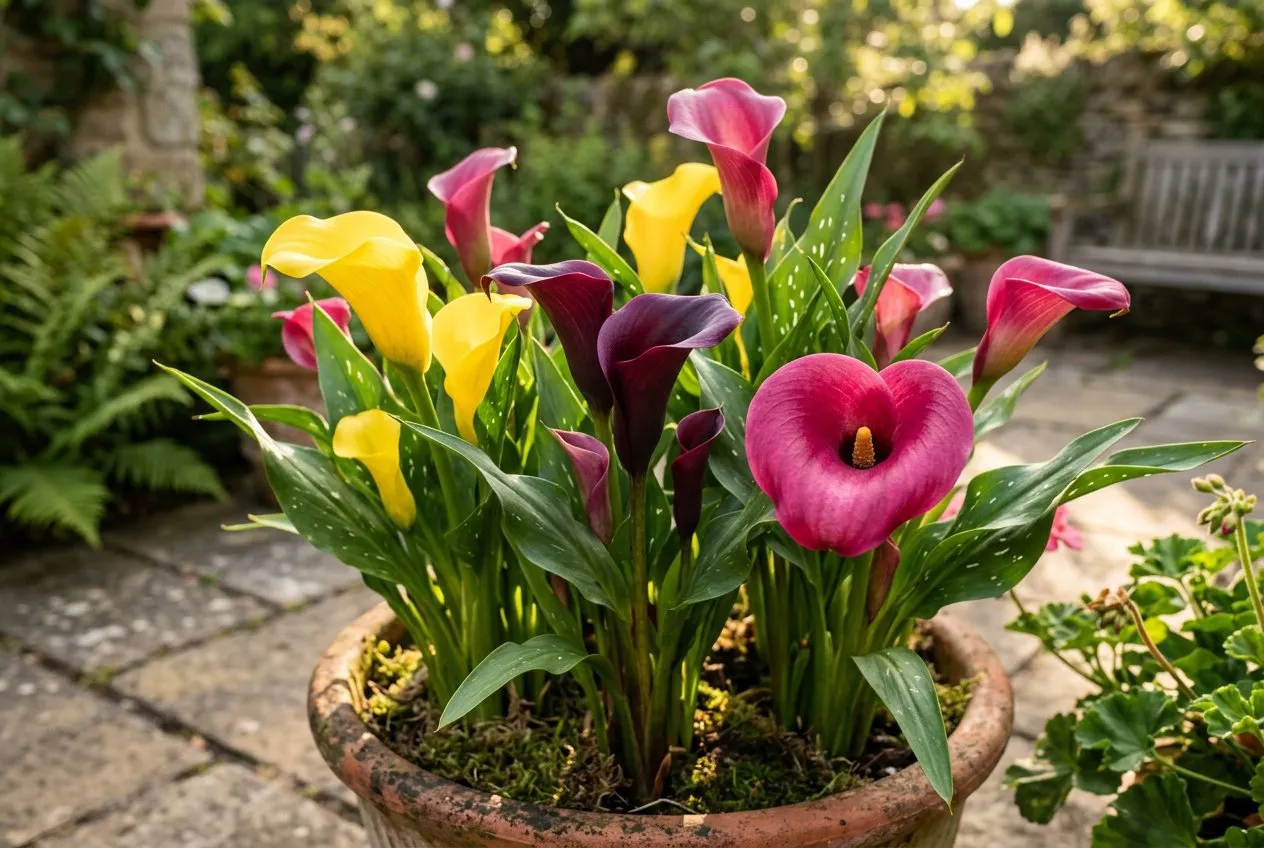
Coloured calla lily hybrids in pink, yellow, and dark purple make a bold display in containers but need lifting before the first frost.
‘Crowborough’ deserves special mention. It was selected from a garden in Crowborough, East Sussex, and tolerates drier soil than the straight species. It is the best choice for a standard mixed border where the ground is not permanently moist.
What growing conditions do calla lilies need?
Getting the fundamentals right prevents most failures. Calla lilies have specific requirements for soil, moisture, light, and temperature. The table below summarises the key constraints.
Technical growing constraints
| Factor | Requirement | Notes |
|---|---|---|
| Planting depth | 10cm from top of rhizome to soil surface | Shallower planting risks frost damage on hardy types |
| Soil pH | 6.0 - 6.5 (slightly acidic to neutral) | Alkaline soil above 7.0 causes chlorosis (yellowing leaves) |
| Minimum temperature | -10°C (Z. aethiopica) / -1°C (coloured hybrids) | Measured at rhizome depth, not air temperature |
| Water requirements | Consistently moist during growth, drier in winter dormancy | Z. aethiopica tolerates waterlogged soil; hybrids need drainage |
| Sunlight | 5-6 hours direct sun, tolerates partial shade | Morning sun with afternoon shade is ideal in southern England |
Soil preparation matters. Dig in generous amounts of garden compost or well-rotted manure before planting. Calla lilies are heavy feeders that thrive in humus-rich ground. On heavy clay, adding organic matter improves both drainage for tender hybrids and moisture retention for the hardy species. On light, sandy soil, organic matter helps hold the moisture that all Zantedeschia species prefer.
How do I plant calla lily rhizomes?
Plant in spring once the soil reaches 15 Celsius. In southern England, this is typically late April. In the Midlands and north, mid to late May is more reliable. Planting into cold, wet ground below this threshold causes the rhizome to sit dormant and rot.
Dig a hole 15cm deep and wide. Mix a handful of blood, fish, and bone into the excavated soil. Place the rhizome horizontally with any visible growing points facing upward. Cover with 10cm of soil. Space plants 30-45cm apart. Water in thoroughly after planting.

Plant calla lily rhizomes 10cm deep in spring once the soil temperature reaches 15 Celsius.
For a head start, pot up rhizomes indoors in March. Use 2-litre pots of multipurpose compost and keep at 15 to 18 Celsius on a bright windowsill or in a frost-free greenhouse. Shoots appear within two to three weeks. Harden off plants for 7 to 10 days before planting out after the last frost. This method is especially valuable for the tender hybrids, giving them a longer flowering season outdoors.
Z. aethiopica can also be planted in autumn in mild areas. Set rhizomes 15cm deep and cover with a 10cm mulch of bark or straw to insulate against winter cold. Autumn planting gives the rhizome time to establish roots before spring growth begins.
Month-by-month calla lily care calendar
| Month | Hardy Z. aethiopica | Tender coloured hybrids |
|---|---|---|
| January | No action. Dormant underground | Check stored rhizomes for rot |
| February | No action | Check stored rhizomes. Order new varieties |
| March | New shoots may appear in mild areas | Start rhizomes indoors in pots at 15-18°C |
| April | Apply balanced fertiliser as shoots emerge | Continue growing indoors. Harden off late month (south) |
| May | Feed fortnightly. Stake tall stems if exposed | Plant outdoors after last frost (south). Continue indoors (north) |
| June | Flowering begins. Deadhead spent spathes | Plant outdoors (north). Flowering starts. Feed fortnightly |
| July | Peak flowering. Keep soil moist | Peak flowering. Water and feed regularly |
| August | Flowering continues. Reduce watering if in border | Flowering continues. Watch for first signs of autumn |
| September | Foliage begins to yellow. Stop feeding | Stop feeding. Reduce watering as foliage yellows |
| October | Cut back dead foliage. Apply winter mulch | Lift rhizomes before first frost. Dry for one week |
| November | Mulch established plants with 10cm bark or straw | Store in dry compost at 10-15°C. Check monthly |
| December | No action. Dormant underground | Check stored rhizomes. Discard any with soft rot |
How do I grow calla lilies in containers?
Container growing is the most practical method for tender hybrids. It lets you move plants under cover before frost, control soil moisture precisely, and display them on patios, terraces, and courtyard gardens where they make a bold architectural statement.
Choose a pot at least 5 litres in volume for a single rhizome, or a 10 to 15-litre pot for a group of three. Use loam-based compost such as John Innes No. 2 mixed with 20 percent perlite for drainage. Plant rhizomes 10cm deep. Water sparingly until shoots appear, then keep the compost consistently moist throughout the growing season. The principles of container growing apply here: regular watering, good drainage, and consistent feeding are the keys.
Feed fortnightly from June to September with a high-potash liquid fertiliser such as tomato feed. This promotes flower production over leaf growth. Deadhead spent spathes promptly to direct energy into new blooms.
In autumn, once foliage yellows, stop watering and allow the compost to dry out. Move pots into a frost-free greenhouse, garage, or shed. The rhizomes rest dormant through winter and resprout when you resume watering in spring.
Z. aethiopica also grows well in large containers. Use a pot at least 20 litres in volume. In mild areas it can stay outdoors year-round in its pot, but protect with bubble wrap or move to a sheltered spot in severe cold, as container-grown roots are more exposed to frost than those in the ground.
Can I grow calla lilies in a pond?
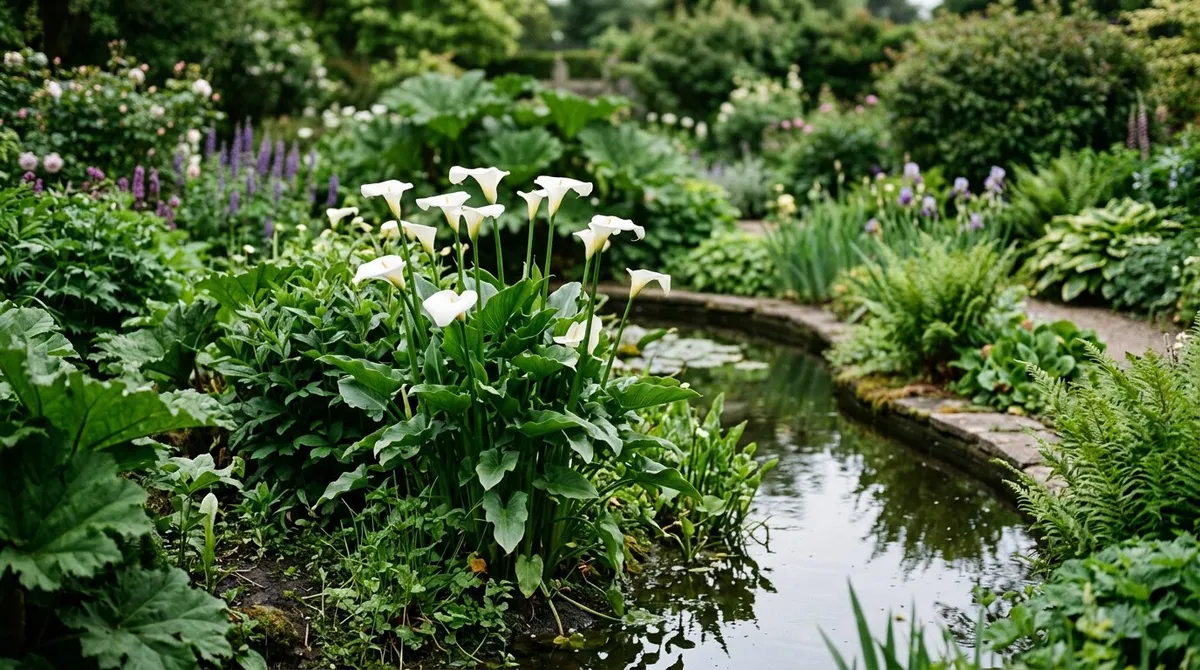
Z. aethiopica is one of the finest marginal pond plants available to UK gardeners. It thrives in waterlogged conditions that would rot most garden plants. Position it at the pond edge in an aquatic basket filled with heavy loam, with the crown submerged under 10 to 30cm of water. The large, arrow-shaped leaves create lush green cover from April, and the white spathes flower from May to July.
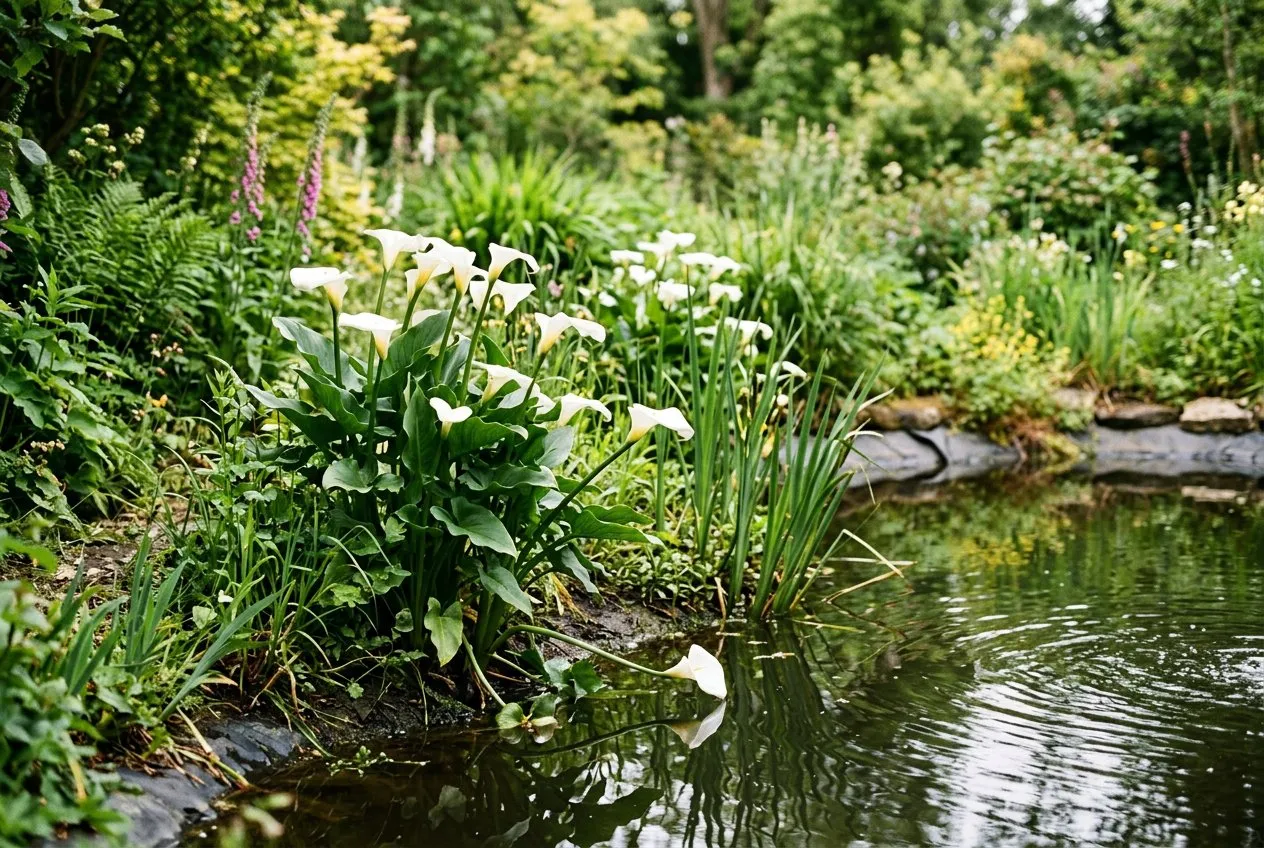
Zantedeschia aethiopica thrives as a marginal pond plant in up to 30cm of water, providing excellent wildlife cover.
In a wildlife pond, calla lily foliage provides shelter for newts, frogs, and aquatic invertebrates. The dense root system helps filter nutrients from the water, reducing algae growth. For more on planting pond margins, see our guides on the best pond plants for UK gardens and how to build a garden pond.
Plant in spring or early summer. Topdress the aquatic basket with gravel to prevent soil washing into the water. Z. aethiopica spreads steadily by rhizome and may need dividing every three to four years to prevent it dominating the pond margin. Lift the basket in spring, split the rhizome clump with a sharp spade, and replant sections in fresh loam.
Only the hardy white species suits pond planting. Tender coloured hybrids cannot tolerate permanent waterlogging and should never be planted in or beside a pond.
How do I overwinter calla lilies?
Winter care depends entirely on which species you grow. The hardy and tender groups need opposite treatment, and confusing the two is the most common cause of losses.
Hardy Z. aethiopica
Leave rhizomes in the ground. Cut back dead foliage in late October. Apply a 10 to 15cm mulch of bark chips, straw, or garden compost over the planting area. This insulates the rhizome against the coldest nights. In RHS hardiness zones 8 to 10, covering most of lowland England and Wales, established plants survive winters without mulch, but new plantings benefit from protection in their first two years.
In colder areas of northern England and Scotland (zones 7 and below), consider growing Z. aethiopica in a large container that you can move to a frost-free spot, or plant against a warm south-facing wall where residual heat from the building raises the microclimate.
Tender coloured hybrids
Lift before the first frost. In most of the UK, this means early to mid-October. Do not wait until foliage is blackened, as by that point frost may have already damaged the rhizome.
Cut back foliage to 5cm. Lift rhizomes carefully with a fork. Brush off soil and check for signs of rot or damage. Discard any soft or discoloured rhizomes. Dry in a well-ventilated spot for five to seven days. Store in trays of dry compost, vermiculite, or dry sand at 10 to 15 Celsius. A frost-free garage, shed, or spare room is ideal. Check monthly throughout winter and remove any rhizomes showing decay.
How do I feed and maintain calla lilies?
Regular feeding drives strong flowering. Apply a balanced granular fertiliser (such as Growmore at 70g per square metre) when new shoots appear in spring. Switch to a high-potash liquid feed (tomato fertiliser) fortnightly from late May through to September. Potassium promotes flower production and strengthens cell walls against disease.
Remove spent spathes by cutting the stem back to its base. This prevents energy going into seed production and encourages further blooms. On Z. aethiopica, removing old spathes promptly often extends the flowering period into August.
Watch for aphids on new growth in spring. A strong jet of water dislodges them, or use a spray of diluted washing-up liquid (5ml per litre of water). Red spider mite can affect plants in dry, sheltered positions. Increasing humidity by misting foliage in the morning reduces the problem. Slugs attack emerging shoots, particularly on the tender hybrids. The same control methods used for dahlias work well here: beer traps, copper tape, and nematode drenches applied in April.
How do I propagate calla lilies?
Division is the simplest and most reliable method. Lift established clumps in spring (hardy types) or at the end of the growing season (tender types). Separate the rhizome into sections, each with at least one growing point. Replant divisions immediately at the same depth as the parent. Water in well. Divisions flower in their first or second season.
Z. aethiopica can also be grown from seed, though it is slow. Collect ripe berries in late summer, extract the seeds, and sow fresh in trays of damp compost at 20 Celsius. Germination takes four to eight weeks. Seed-raised plants take two to three years to reach flowering size. Named cultivars do not come true from seed, so division or tissue culture is the only way to reproduce a specific variety.
Calla lilies also respond well to offsets. As rhizomes mature, they produce small side growths that can be detached and potted individually. Pot offsets into 1-litre pots of loam-based compost and grow on in a sheltered spot for one season before planting out.
What should I plant with calla lilies?
Calla lilies pair naturally with other moisture-loving plants. In a bog garden or pond margin, combine Z. aethiopica with iris sibirica, ligularia, astilbe, and rodgersia for a lush, textural display. Hostas provide bold foliage contrast at the front of the planting. Our guide to the best pond plants covers other marginal species that thrive in the same conditions.
In a border setting, ‘Crowborough’ works well alongside dahlias, hemerocallis (daylilies), and ornamental grasses. The upright, architectural form of calla lilies contrasts effectively with the rounded shapes of hardy geraniums and the feathery texture of grasses like Stipa tenuissima.
Tender hybrids in containers look striking grouped with other patio plants. Combine them with trailing verbena, argyranthemum, or small ornamental grasses in a courtyard garden setting. The bold spathe shapes provide a centre piece among softer planting. For spring bulb combinations before calla lilies emerge, tulips fill the gap perfectly in the same containers, flowering from March to May before you replant with Zantedeschia rhizomes.
Why we recommend Z. aethiopica ‘Crowborough’ for UK borders: After 30 seasons of trialling calla lilies in British conditions, ‘Crowborough’ consistently performs where the straight species fails. In three consecutive dry summers, ‘Crowborough’ held its foliage and flowered reliably in a south-facing mixed border with normal garden soil, while the species struggled without bog conditions. It produced an average of 18 spathes per established clump across four years with no additional watering beyond rainfall.
Common mistakes when growing calla lilies
Avoiding these errors saves plants and frustration.
Treating all calla lilies as hardy
The single biggest mistake UK gardeners make. Buying a coloured calla lily from a garden centre, planting it in the ground, and expecting it to survive winter leads to disappointment. Always check the label for the species. If it is anything other than Z. aethiopica or ‘Crowborough’, treat it as tender and plan for winter lifting or container growing.
Planting too early in cold soil
Rhizomes planted into soil below 15 Celsius sit dormant and are vulnerable to rot. Patience pays off. Wait until the soil has warmed in late April (south) or mid-May (north). A soil thermometer removes all guesswork.
Overwatering tender hybrids in winter storage
Stored rhizomes need dry conditions. Even slightly damp compost during winter dormancy causes fungal rot. Keep storage material dry to the touch and ventilate the storage area.
Planting in heavy shade
Calla lilies tolerate partial shade but need five to six hours of direct sun for strong flowering. In deep shade they produce large leaves but few or no spathes. Choose a south or west-facing position for the best results.
Forgetting to feed
Calla lilies are hungry plants. Without regular feeding, flower size and quantity drop sharply after the first flush. The switch from balanced feed in spring to high-potash feed from late May is critical for sustained blooming.
Now you’ve mastered calla lilies, read our guide on the best pond plants for UK gardens to create the ideal waterside setting for your zantedeschia.
Frequently asked questions
Are calla lilies hardy in the UK?
Only the white species is fully hardy. Zantedeschia aethiopica survives temperatures down to minus 10 Celsius and grows outdoors year-round across most of England and Wales. Coloured hybrids are rated H2 (to minus 1 Celsius) and must be lifted before frost or grown in containers moved under cover for winter.
When should I plant calla lily rhizomes?
Plant in spring once soil reaches 15 Celsius. In southern England this is typically late April. In the Midlands and north, wait until mid-May. Starting rhizomes indoors in pots from March gives a four to six-week head start on the season.
Can I grow calla lilies in pots?
Calla lilies grow very well in containers. Use a 5-litre pot minimum with loam-based compost and 20 percent perlite for drainage. Feed fortnightly with tomato fertiliser from June. Container growing is the most practical method for tender hybrids because pots can be moved to frost-free storage in autumn.
How do I overwinter tender calla lilies?
Lift rhizomes before the first frost in October. Cut back foliage, dry for one week, and store in trays of dry compost at 10 to 15 Celsius. A frost-free garage or shed works well. Check monthly for rot throughout winter. Replant in spring when soil warms to 15 Celsius.
Can I grow calla lilies in a pond?
Z. aethiopica is an outstanding marginal pond plant. Plant in an aquatic basket with heavy loam and position in 10 to 30cm of water at the pond edge. It flowers from May to July and provides excellent wildlife cover. Only the hardy white species suits pond conditions.
Why are my calla lilies not flowering?
The most common causes are too much shade and poor feeding. Calla lilies need five to six hours of direct sun and fortnightly high-potash feeding from late May. Overfeeding with nitrogen produces lush leaves at the expense of flowers. Newly planted rhizomes may also take a full season to establish before flowering strongly.
Are calla lilies toxic to pets?
Yes, all parts contain calcium oxalate crystals. Ingestion causes mouth and throat swelling, drooling, and digestive distress in cats, dogs, and horses. Wear gloves when handling rhizomes. Plant away from areas where pets dig or graze, and seek veterinary advice immediately if ingestion is suspected.
Lawrie has been gardening in the West Midlands for over 30 years. He grows his own veg using no-dig methods, keeps a wildlife-friendly garden, and writes practical advice based on real UK growing conditions.