How to Grow Clematis: Pruning Groups
How to grow clematis in UK gardens with pruning groups explained. Covers planting, group 1, 2, and 3 types, training, and seasonal care.
Key takeaways
- Plant clematis 10cm deeper than the pot level to encourage new shoots from below the soil
- Group 1 clematis flowers in spring on old wood and needs no routine pruning
- Group 2 produces large flowers in late spring and summer with a light prune after the first flush
- Group 3 flowers on new growth from late summer and is cut hard to 30cm in February
- Clematis wilt affects large-flowered hybrids but deep planting helps plants recover from the base
- Shade the roots with companion plants or tiles while keeping the top growth in sun
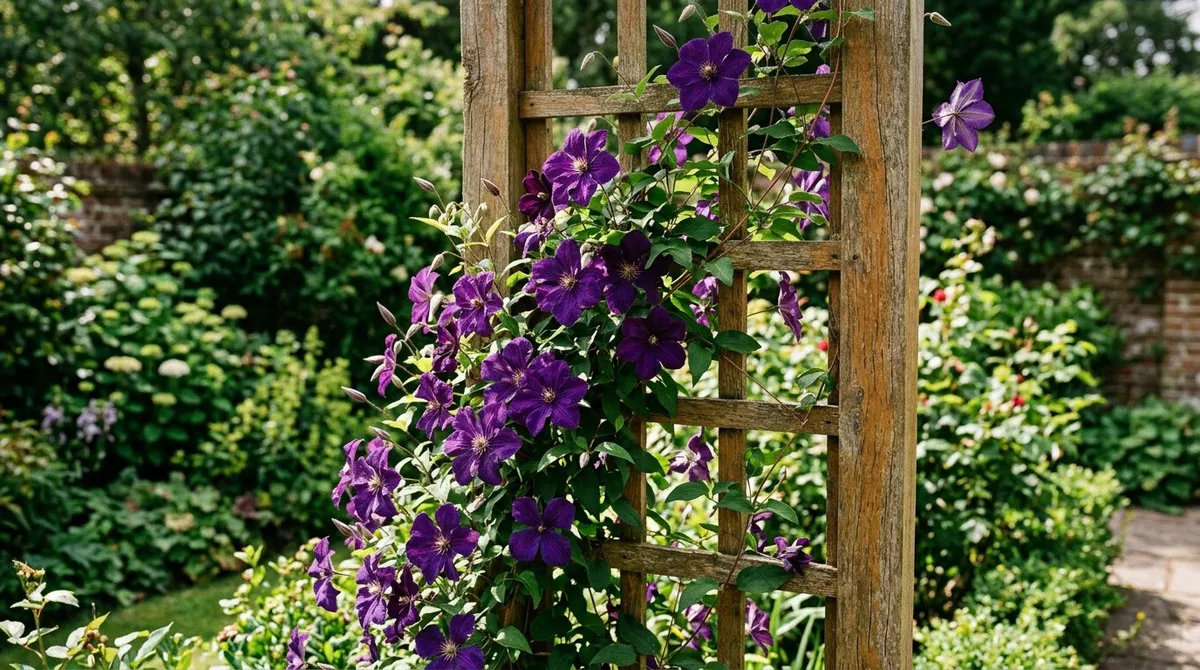
Clematis is the most popular climbing plant in UK gardens, and for good reason. No other climber offers such variety of flower size, colour, and season. With the right selection, you can have a clematis in bloom from January to November. They clothe fences, scramble through trees, cover pergolas, and cascade from containers.
The one thing that puts gardeners off clematis is pruning. It should not. Once you understand the three pruning groups, the whole thing becomes simple. This guide explains each group clearly and covers planting, training, and aftercare. For more climbing plants that change vertical spaces, see our guide to the best climbing plants for UK gardens.
How should I plant clematis?
Correct planting gives clematis the best start and protects against clematis wilt. The golden rule is to plant 10cm deeper than the pot level. This buries the lowest pair of leaf nodes, which then produce new shoots from underground. If wilt strikes the top growth, the plant regenerates from these buried buds.
Step by step planting
- Dig a hole 45cm wide and 45cm deep, at least 30cm away from a fence or wall base where soil tends to be dry.
- Mix the excavated soil with a bucketful of well-rotted compost or composted bark.
- Add a handful of blood, fish, and bone to the bottom of the hole.
- Soak the clematis rootball in water for 30 minutes before planting.
- Remove the plant from its pot and tease out circling roots gently.
- Position the plant so the top of the rootball sits 10cm below the finished soil surface.
- Backfill with the improved soil mix, firm gently, and water thoroughly.
- Apply a 5cm mulch around the base, keeping it 5cm from the stems.
Where to plant
Clematis prefer their roots in cool, moist shade with the top growth reaching into sunlight. Plant on the shady side of a fence, wall, or arch with the stems trained up and over into sun. North and east-facing aspects suit many species, especially Group 1 and Group 3 types. Use a slate, tile, or low-growing companion plant to shade the root zone.
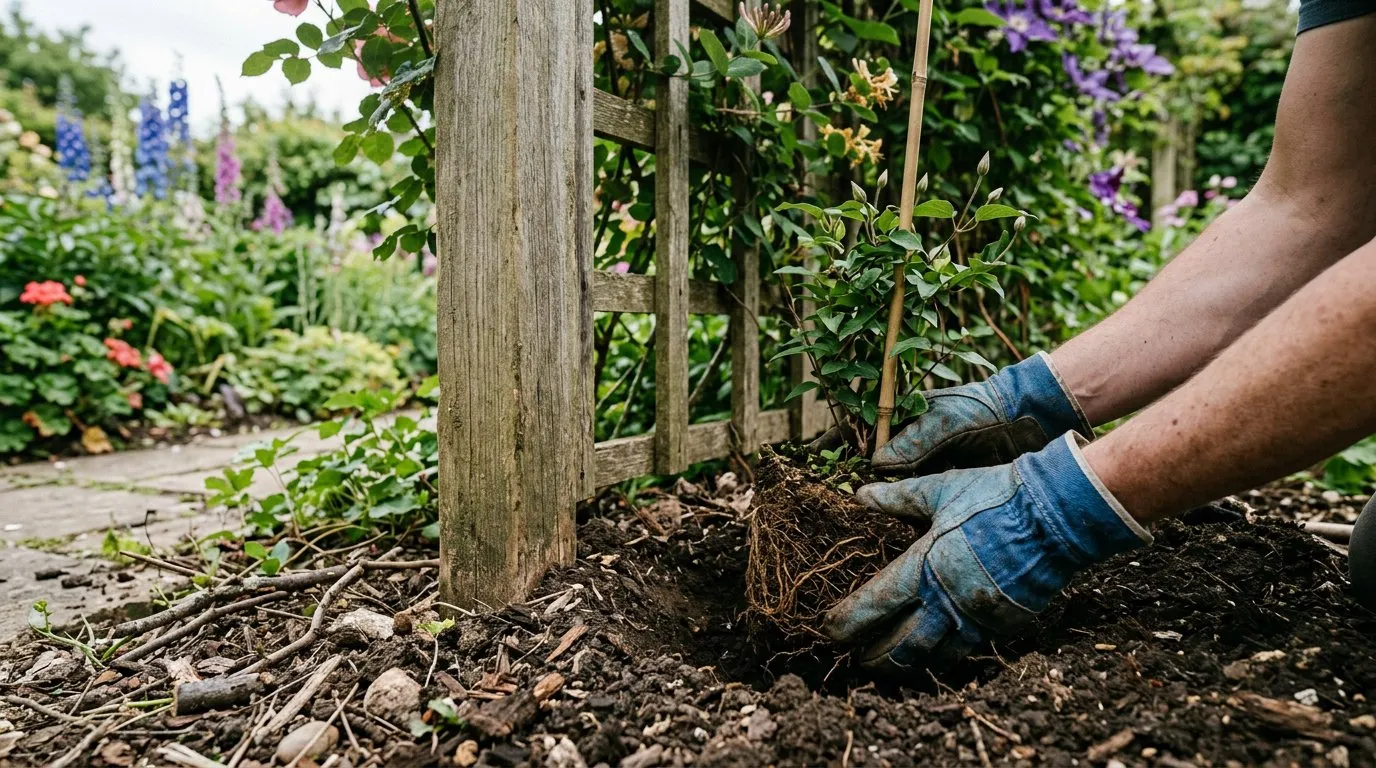
Plant clematis 10cm deeper than the pot level, at least 30cm away from the fence or wall base
What are the three clematis pruning groups?
Every clematis falls into one of three pruning groups based on when it flowers and whether it blooms on old or new wood. Getting the pruning group right is essential. Prune a Group 1 clematis like a Group 3 and you remove all the flower buds.
Group 1, early-flowering (no pruning needed)
When they flower: January to May, on wood produced the previous year.
How to prune: No routine pruning required. If the plant outgrows its space, cut back immediately after flowering to allow time for new growth that carries next year’s blooms.
Popular Group 1 varieties:
- C. montana, vigorous, covering 8-12 metres, white or pink flowers in May
- C. armandii, evergreen, scented white flowers in March, needs a sheltered wall
- C. alpina, compact (2-3m), nodding blue, pink, or white bells in April
- C. macropetala, similar to alpina, double nodding flowers in April-May
- C. cirrhosa, evergreen, cream bells from November to February
Group 2, large-flowered hybrids (light prune)
When they flower: Late May to June on old wood, often with a second flush on new wood in late summer.
How to prune: In February, remove dead and weak stems. Cut remaining stems back to the highest pair of strong, healthy buds. After the first flowering flush in June, cut flowered stems back by one third to encourage the second flush. This group is the most susceptible to clematis wilt, which is why deep planting is especially important.
Popular Group 2 varieties:
- ‘Nelly Moser’, pale mauve-pink with darker bars, 15cm flowers
- ‘The President’, rich purple, one of the most reliable large-flowered types
- ‘Niobe’, deep ruby-red, compact (2.5m), excellent in containers
- ‘Henryi’, large white flowers with chocolate anthers
- ‘Multi Blue’, double blue-purple, compact (2-3m)
Group 3, late-flowering (hard prune)
When they flower: July to October, on growth produced in the current season.
How to prune: In February, cut all stems back to 30cm above ground level, just above a pair of strong buds. This sounds brutal, but Group 3 clematis grows its entire framework each year from near the base. Hard pruning produces the strongest growth and most flowers.
Popular Group 3 varieties:
- C. viticella ‘Étoile Violette’, small purple flowers in profusion, July to September
- C. viticella ‘Polish Spirit’, deep purple, incredibly vigorous and reliable
- ‘Jackmanii’, the classic large purple clematis, 3-4m
- C. tangutica, yellow bell-shaped flowers followed by silky seedheads
- C. ‘Bill MacKenzie’, yellow bells, tolerates shade, vigorous to 6m
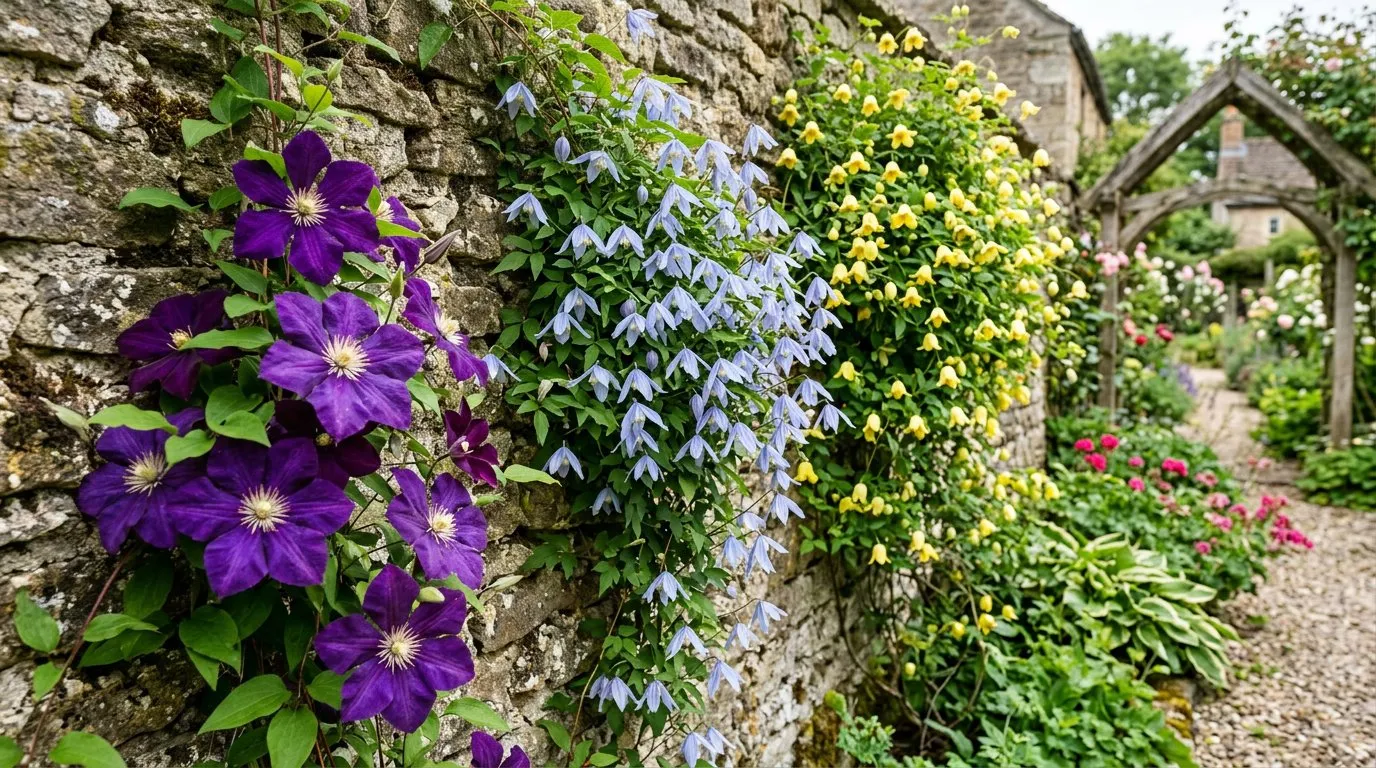
Understanding the three pruning groups is the key to successful clematis care
How do I train clematis?
Young clematis stems are fragile and need tying in regularly until they develop twining leaf stalks that grip the support naturally. Use soft garden twine tied loosely in a figure-of-eight.
Training on a trellis or fence
Fix trellis panels 3-5cm away from the wall or fence using spacer blocks. This allows air circulation behind the plant and gives the leaf stalks space to grip. Fan out the main stems evenly across the support, tying in as they grow. Aim for broad coverage rather than a single column of stems. Garden fence ideas often look their best when softened with a well-trained clematis.
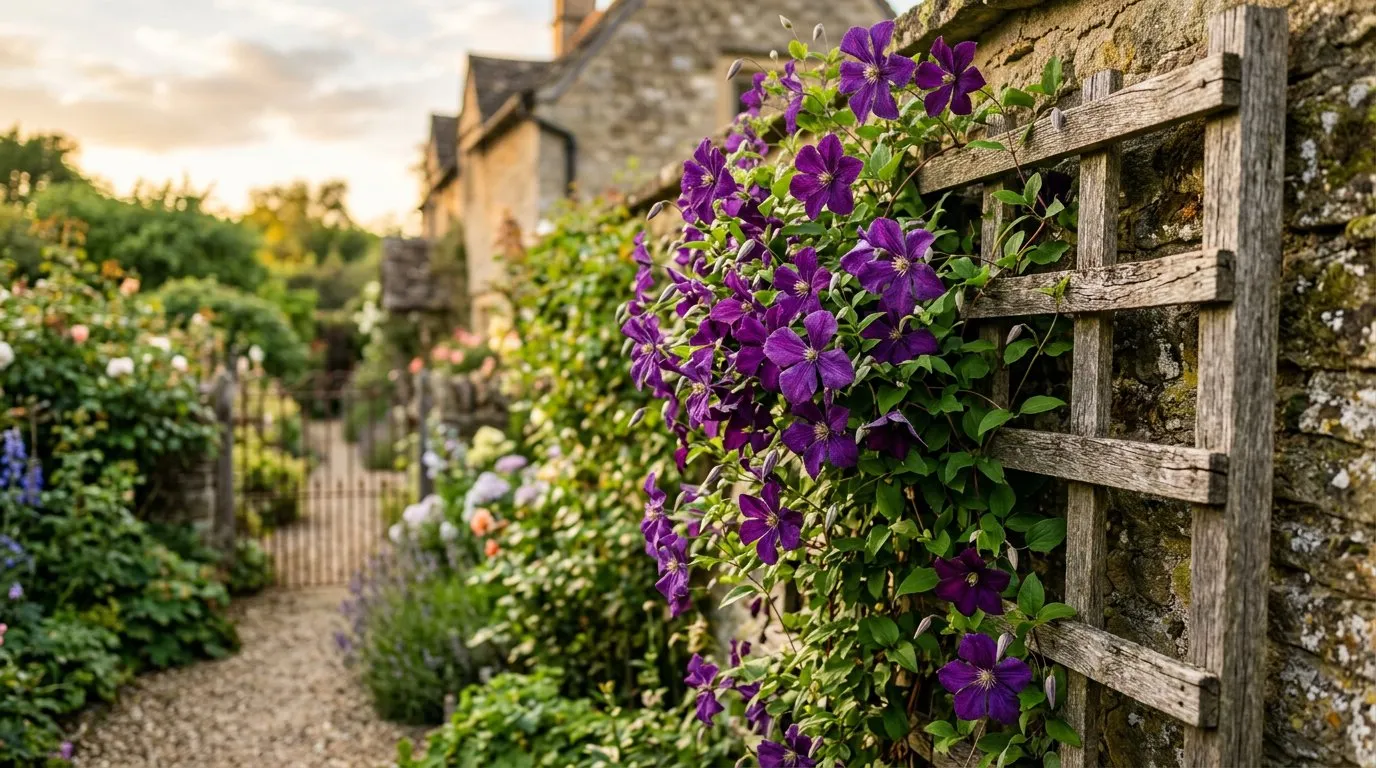
Fan clematis stems across the trellis for broad coverage rather than a single narrow column
Training through trees and shrubs
Group 1 and Group 3 clematis grow through established trees and large shrubs. Plant the clematis on the windward side, 60cm from the trunk, and lean a cane from the clematis to the lowest branch. The clematis climbs the cane and then scrambles through the canopy naturally. C. viticella varieties are especially good for this.
Training on an obelisk or arch
Wrap stems in a spiral around the support rather than letting them grow straight up. Spiralling encourages more side shoots and produces flowers all the way up rather than only at the top.
Common clematis problems
Clematis wilt
A fungal disease causing sudden wilting and browning of stems, mainly affecting large-flowered Group 2 hybrids. Deep planting is the best insurance. Cut all affected stems to soil level. The plant usually regrows from buried buds the following year. Small-flowered species (Groups 1 and 3) rarely suffer from wilt.
Slugs and snails
Slugs attack young shoots emerging at the base in spring. Protect with copper tape, organic slug control, or a collar of sharp grit around the base. Clematis sap contains irritants that can cause drooling and mouth irritation in dogs and cats if chewed - see our guide to plants toxic to dogs for a full list of common garden climbers to be aware of.
Earwigs
Earwigs chew ragged holes in petals, especially on large-flowered types. Trap them with upturned pots stuffed with straw placed on top of canes near the flowers. Check and empty daily.
Why we recommend C. viticella ‘Polish Spirit’ for reliable UK growing: After 30 years of growing clematis in gardens from Devon to Yorkshire, ‘Polish Spirit’ consistently performs where more glamorous Group 2 hybrids disappoint. It is completely immune to clematis wilt, grows 4m from a February hard prune, and produces hundreds of deep purple flowers from July to September without disbudding, feeding regimes, or specialist care. In a garden where a prized ‘Nelly Moser’ repeatedly collapsed with wilt, the neighbouring ‘Polish Spirit’ has flowered without a single problem for twelve consecutive seasons.
Clematis for every situation
| Situation | Best types |
|---|---|
| North-facing wall | C. montana, C. alpina, C. viticella, ‘Bill MacKenzie’ |
| Hot south-facing wall | C. armandii, ‘Nelly Moser’ (fades less in shade), C. cirrhosa |
| Small garden or container | ’Niobe’, ‘Multi Blue’, C. alpina, C. macropetala |
| Growing through a tree | C. montana, C. viticella ‘Étoile Violette’, C. tangutica |
| Pergola or arch | ’Jackmanii’, ‘The President’, C. viticella ‘Polish Spirit’ |
| Year-round interest | C. cirrhosa (winter) + Group 2 (spring) + Group 3 (summer) |
Clematis combine with climbing roses. Plant a Group 3 clematis at the base of an established rose and let them intertwine. The clematis flowers extend the season after the rose has finished, and the hard February prune keeps it from overwhelming the rose. For more on growing and pruning roses, see our dedicated guide.
Now you’ve mastered clematis, read our guide on the best climbing plants for UK gardens to find the right companions for your clematis on walls, fences, and pergolas.
Frequently asked questions
The RHS clematis pruning guide provides detailed information on identifying and pruning all three groups.
Lawrie has been gardening in the West Midlands for over 30 years. He grows his own veg using no-dig methods, keeps a wildlife-friendly garden, and writes practical advice based on real UK growing conditions.