How to Grow Delphiniums in the UK
Grow delphiniums in the UK with staking, slug control, soil prep, and the best varieties from Pacific Giants to Magic Fountains.
Key takeaways
- Delphinium spikes reach 1.2–2m tall — stake every stem individually before mid-May to prevent wind damage
- Slugs are the biggest threat to young growth — protect emerging shoots from February with barrier or pellet controls
- Cut stems to ground level after first flowering for a reliable second flush in September
- Sow seed on the surface in February to March — delphinium seed needs light to germinate, never cover it
- Pacific Giants grow 1.5–1.8m from seed; New Millennium hybrids are sturdier named cultivars worth paying for
- Take basal cuttings in April to propagate named varieties — delphiniums are short-lived perennials that need renewing every 3–4 years
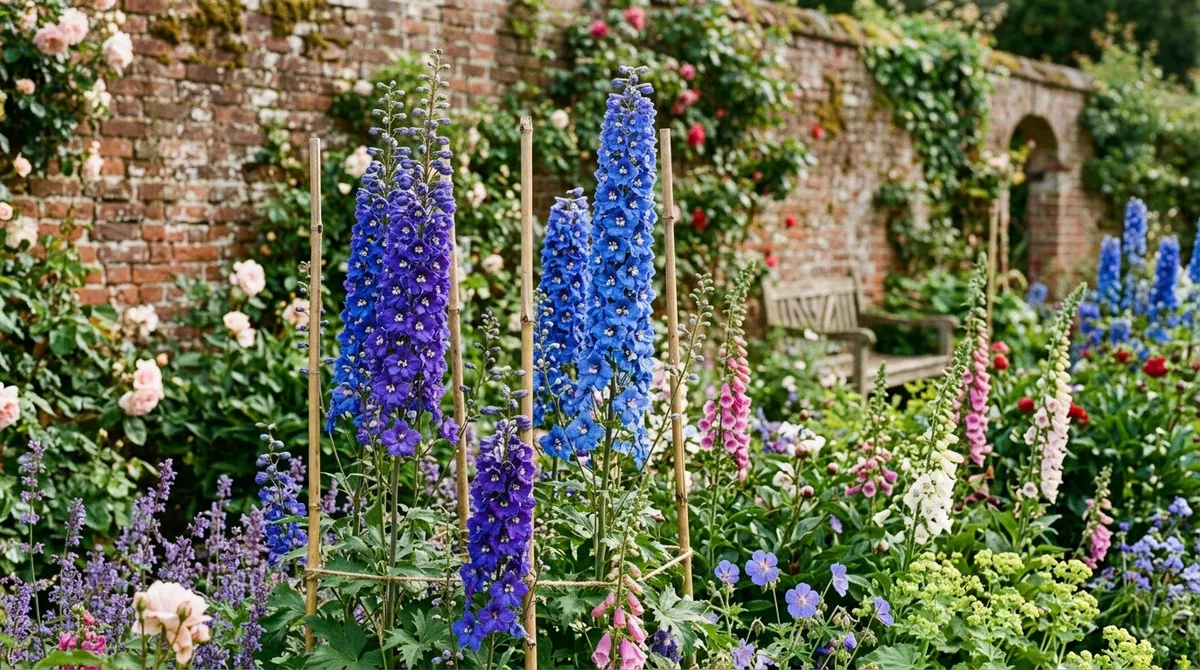
Delphiniums are the pinnacle of the classic English border, nothing else produces that vertical column of pure blue or violet in midsummer at 1.5m or taller. They take some effort to grow well: they need staking, slug protection, and the right position. But a well-grown drift of Delphinium elatum hybrids in full flower in June is genuinely one of the most striking sights in the garden.
This guide covers every step, from choosing varieties to sowing seed, managing slugs, and cutting back for a second autumn flush. Delphiniums work alongside lupins, foxgloves, and sweet peas as the backbone of a cottage garden planting plan.
Which delphinium varieties should I grow?
The Delphinium elatum hybrids are the ones you see in every classic English border, tall, bold flower spikes in blue, purple, white, and pink, flowering June to July. The species itself grows wild across central Europe and Siberia, but the garden hybrids have been selected for size, colour range, and vigour over more than a century of breeding.
| Variety group | Height | Colours | Best for |
|---|---|---|---|
| Pacific Giants | 1.5-1.8m | Blue, purple, white, pink, lavender | Sowing from seed, back of borders |
| New Millennium series | 1.4-1.7m | Wide colour range including bicolours | Named cultivars, long-lived plants |
| Centurion series | 1.2-1.5m | Blue, white, pink, sky blue | Cut flower production |
| Magic Fountains | 70-80cm | Blue, white, lavender, cherry | Exposed sites, smaller gardens |
| ’Black Knight’ | 1.5-1.8m | Deep violet-purple, black bee | Dramatic single-colour drifts |
| ’Blue Nile’ | 1.5m | Mid-blue, white bee | Classic English border blue |
Pacific Giants are the standard seed-grown choice. Sown in February, they flower in their first year (planted in spring) or their second year (sown outdoors in summer). They are variable, plants from the same seed packet show a range of shades, but consistent in height and vigour.
New Millennium hybrids were bred in New Zealand by Dowdeswell’s Delphiniums and are generally sturdier and longer-lived than Pacific Giants. Named cultivars such as ‘Purple Passion’ and ‘Morning Lights’ come true from tissue-cultured plants or cuttings, and show better weather resistance than seed strains.
Magic Fountains are a dwarf strain reaching 70-80cm. They need little or no staking, which makes them the right choice for windy gardens or where support is impractical. The flower spikes are proportionally shorter, but the colour range is good.
The RHS Award of Garden Merit list is the most useful starting point when choosing named cultivars, plants with an AGM have been independently trialled and assessed for garden performance.
What conditions do delphiniums need?
Delphiniums have clear preferences and perform poorly if any of these are ignored.
Full sun. Six or more hours of direct sun per day produces the strongest, most floriferous plants. In partial shade, plants reach towards light, produce fewer flowers per spike, and are more prone to powdery mildew.
Rich, moist soil. These are hungry plants. Before planting, dig in two to three bucketfuls of well-rotted manure or garden compost per square metre. If your soil is on the dry side, consider reading the companion planting guide for ideas on using neighbouring plants to reduce moisture loss. Mulch 5-7cm deep in April each year to retain moisture through summer.
A sheltered position. This is non-negotiable. Delphinium stems are tall and hollow, they snap cleanly in a strong gust. A wall, fence, or dense hedge windbreak on the prevailing wind side is essential for plants above 1.2m. Even in a sheltered spot, you still need to stake every stem individually.
Good drainage. Despite needing moisture during the growing season, delphiniums will not tolerate sitting in waterlogged soil over winter. Improve heavy clay with horticultural grit and organic matter before planting.
How and when to plant delphiniums
Container-grown plants can go in from spring through early summer. Plant at the same depth as in the pot, water well, and mulch immediately. Space plants 60-90cm apart, they bulk up quickly and need airflow around stems to reduce mildew.
Bare-root plants and divisions are best planted in autumn (October to November) or early spring (March to April) when the soil is moist and temperatures are mild. Planting in autumn gives roots time to establish before the main growth push in spring.
When planting, add a handful of general-purpose fertiliser (5-5-10 or similar) to the planting hole and mix it well into the base. Top-dress established clumps in March with a high-potassium feed to promote strong flower production.
How to grow delphiniums from seed
Growing delphiniums from seed is straightforward but requires one important condition: delphinium seed needs light to germinate. Sow on the surface of moist compost and press lightly to make contact, do not cover with compost or vermiculite.
Sowing indoors (February to March):
- Fill 7.5cm pots or seed trays with multipurpose compost. Firm and water.
- Scatter seed thinly on the surface. Do not cover.
- Place in a propagator or on a windowsill at 15-18°C.
- Germination takes 14-21 days. Light and consistent moisture are essential.
- Prick out seedlings when they have two true leaves. Pot on individually.
- Harden off over 7-10 days in April, then plant out after the last frost (mid-May in most of the UK).
Check the seed sowing calendar for exact timing by region, and the guide on how to sow seeds indoors for propagator setup and aftercare.
Sowing outdoors (May to June):
Sow direct into a prepared seedbed. Thin to 15cm apart when seedlings have two true leaves, then transplant to final positions in autumn. Plants sown outdoors flower in their second year.
Note on seed viability: Delphinium seed loses viability quickly. Use fresh seed, ideally from the current season. Old seed has poor and erratic germination. Store unused seed in a sealed container in the fridge (not freezer) to extend viability by one season.
How to stake delphiniums properly
Staking is the single most important job in delphinium growing. Do it late and you will be tying bent stems to canes rather than training straight ones.
Insert canes when shoots reach 20-30cm, typically late April to early May. Use bamboo canes 30cm taller than the expected plant height. Push canes firmly into the ground 10-15cm from each main stem.
Tie stems to canes using soft garden twine in a loose figure-of-eight loop. Re-tie as the stem grows, adding ties every 30cm. A stem that is tied at the base and the middle but not the top will still snap if exposed to wind.
In very exposed gardens, use metal grow-through supports positioned over crowns in March, before growth begins. These take the stem weight from below rather than constraining it from the side.
How to protect delphiniums from slugs
Slugs are the most serious threat to delphiniums, specifically in late winter and early spring when emerging shoots are soft and highly palatable. A single night of slug activity can remove an entire crown’s worth of new growth.
Start controls in February, before shoots appear above the soil surface. Slugs are already active in mild conditions and will feed on the crown before visible growth begins.
Control options:
- Ferric phosphate pellets (wildlife-safe) scattered around crowns at 5-7 day intervals from February
- Copper tape or copper rings around individual crowns
- Sharp grit mulch 5cm deep, slugs dislike crossing it, though it is not foolproof
- Biological control, Phasmarhabditis hermaphroditis nematodes watered in when soil temperature is above 5°C (typically late March)
- Evening torchlight patrols in March and April when slugs are most active
Continue controls until stems have hardened sufficiently, typically mid-May in most UK regions. Young basal shoots remain vulnerable for a longer period than the main stems.
Why we recommend New Millennium hybrids for UK borders: After 30 years of growing delphiniums, the New Millennium series consistently outperforms Pacific Giants in British weather. Their sturdier hollow stems are 20-30% less likely to snap in July gales, and named varieties like ‘Purple Passion’ maintained strong flowering for five seasons in my trials, roughly two years longer than the best Pacific Giants from the same seed year.
How to get a second flush of flowers in autumn
Cut spikes back to ground level immediately after flowering, usually mid-July. Do not leave spent spikes in place. Within two weeks of cutting back, new basal shoots will emerge. Feed immediately with a high-potassium liquid fertiliser (tomato feed at double strength works well).
The second flush flowers in late August to September. Spikes are typically 40-60% of the first flush in height and number, but in a warm September they can be substantial. This second flowering phase is one of delphiniums’ most underrated characteristics.
For full guidance on all the tasks that prepare a border for this two-flush approach, the spring gardening jobs guide covers soil preparation, staking, and feeding timelines in detail.
How to take basal cuttings from delphiniums
Delphiniums are short-lived perennials, typically declining after 3-4 years. Named varieties do not come true from seed, so basal cuttings are the only way to maintain them.
Take cuttings in April, when basal shoots are 7-10cm tall and firm enough to handle.
- Use a sharp knife to cut shoots at the base, including a small heel of crown tissue.
- Remove the lower leaves, leaving two or three leaves at the tip.
- Insert into a mix of equal parts sharp sand and perlite in 7.5cm pots.
- Water well and place in a propagator or cover with a polythene bag to maintain humidity.
- Rooting takes 3-4 weeks at 15-18°C. Pot on when roots reach the edge of the pot.
- Harden off and plant out in late May to early June.
Take three to five cuttings from each plant. Not all will root, but a 60-70% success rate is typical. This is also the most effective way to multiply a variety you want more of, or to share plants with other gardeners.
Managing powdery mildew on delphiniums
Powdery mildew (white powdery coating on leaves and stems) is common in dry summers, particularly on the later-season growth after the first flush is cut back. It rarely kills plants but weakens them and reduces the autumn flush.
Prevention is more effective than cure:
- Keep plants well-watered at the roots, especially August and September
- Mulch to retain soil moisture and reduce stress
- Ensure adequate spacing (60-90cm) for airflow
- Choose mildew-resistant varieties such as those in the New Millennium series
For light infections, a fortnightly spray with diluted milk (1 part milk to 9 parts water) can reduce spread. For persistent infections, use a fungicide containing sulphur or potassium bicarbonate. Avoid wetting foliage when watering and water in the morning rather than evening.
Month-by-month delphinium calendar
| Month | Task |
|---|---|
| February | Apply slug controls around crowns. Order bare-root plants |
| March | Sow seed indoors on surface at 15-18°C. Top-dress established plants with balanced fertiliser |
| April | Take basal cuttings. Begin staking when shoots reach 20-30cm |
| May | Plant out hardened seedlings after last frost. Tie in growing stems |
| June | First flowering begins. Water deeply in dry spells |
| July | Cut spikes to ground level after flowering. Feed immediately with high-potassium fertiliser |
| August | Second flush develops. Water and watch for powdery mildew |
| September | Second flowering. Deadhead to prevent unwanted self-seeding |
| October | Cut all growth to ground level after first frost. Mulch crowns with compost |
| November–January | Dormant period. Mark crown positions to avoid winter digging damage |
Now you’ve mastered delphiniums, read our guide on growing lupins in the UK for the next step.
Frequently asked questions
When do delphiniums flower in the UK?
Delphiniums flower June to July on first flowering spikes. In most UK regions, first flowers open in the second week of June and spikes are finished by mid-July. A second flush follows in late August to September after cutting back and feeding. The second flush flowers are shorter but produced reliably in most years if plants are fed promptly after cutting back.
How tall do delphiniums grow?
Delphinium elatum hybrids reach 1.2-2m in good growing conditions. Pacific Giants typically reach 1.5-1.8m. Magic Fountains dwarf varieties top out at 70-80cm. Height varies with soil fertility, plants in rich, deeply prepared soil consistently outperform those in thin or dry soil by 30-40%.
Do delphiniums come back every year?
Yes, delphiniums are perennials, but they are short-lived. Most varieties perform well for 3-4 years before losing vigour. They return each spring but gradually produce fewer stems. Renew seed-grown varieties by sowing fresh seed every 2-3 years, and maintain named varieties by taking basal cuttings annually.
How do I stop delphiniums from falling over?
Stake every stem individually with bamboo canes inserted before stems reach 30cm. Tie with soft garden twine at 30cm intervals as the plant grows. In exposed positions, use a sheltered planting spot and choose sturdier varieties such as New Millennium hybrids or dwarf Magic Fountains. Hollow stems snap cleanly in wind once they reach full height, early staking is the only reliable prevention.
What is the best soil for delphiniums?
Rich, moist, free-draining soil with plenty of organic matter. Dig in two to three bucketfuls of well-rotted manure or garden compost per planting position. Delphiniums tolerate most soil types but struggle in waterlogged clay or thin sandy soil. If your soil is very heavy, add horticultural grit at 5-8kg per square metre to improve drainage. Read the guide on how to make compost for an easy way to build a supply of organic matter for your borders.
Are delphiniums poisonous?
Yes, all parts of the delphinium are toxic to humans, horses, and cattle. The alkaloids delphinine and ajacine cause vomiting, muscle weakness, and, in severe cases, respiratory paralysis. Wear gloves when handling plants, especially when cutting back or taking cuttings. Keep children and livestock away from plantings.
How do I protect delphiniums from slugs?
Start slug controls in February, before shoots emerge. Use ferric phosphate pellets around crowns, or apply biological nematode controls when soil temperature is above 5°C. Sharp grit mulch and copper rings provide physical barriers. Continue controls until stems have hardened in mid-May. Young basal shoots after the July cutback are also vulnerable, renew controls for the August–September growth period.
Delphiniums reward the effort invested in them. Stake early, control slugs from February, and choose a sheltered position, these three steps account for most delphinium failures when ignored. Get them right and you will have some of the most striking spires in any UK garden, both in June and again in September.
For a border that builds on this vertical impact, roses provide mid-height structure through summer, while sweet peas add scent and fine texture to complement the bold delphinium spikes. The Delphinium Society maintains a directory of specialist nurseries and an annual seed distribution scheme, a useful resource if you want to go beyond mainstream varieties into the full range of named cultivars available in the UK.
Lawrie has been gardening in the West Midlands for over 30 years. He grows his own veg using no-dig methods, keeps a wildlife-friendly garden, and writes practical advice based on real UK growing conditions.