How to Grow Forget-Me-Nots UK
Forget-me-nots thrive in UK gardens with minimal effort. Covers sowing times, three main species, self-seeding control, and wildlife value.
Key takeaways
- Forget-me-nots are rated H7 (fully hardy to -20°C), surviving winters across every UK region
- Sow seed May to July in situ or in trays at 15-20°C for germination in 10-14 days
- Three main species suit different conditions: woodland, alpine, and water forget-me-nots
- Each plant drops up to 700 seeds, so deadhead before pods split to control spread
- Myosotis sylvatica is a native wildflower and a key early nectar source for pollinators
- They tolerate partial shade and poor soil, making them ideal for difficult borders
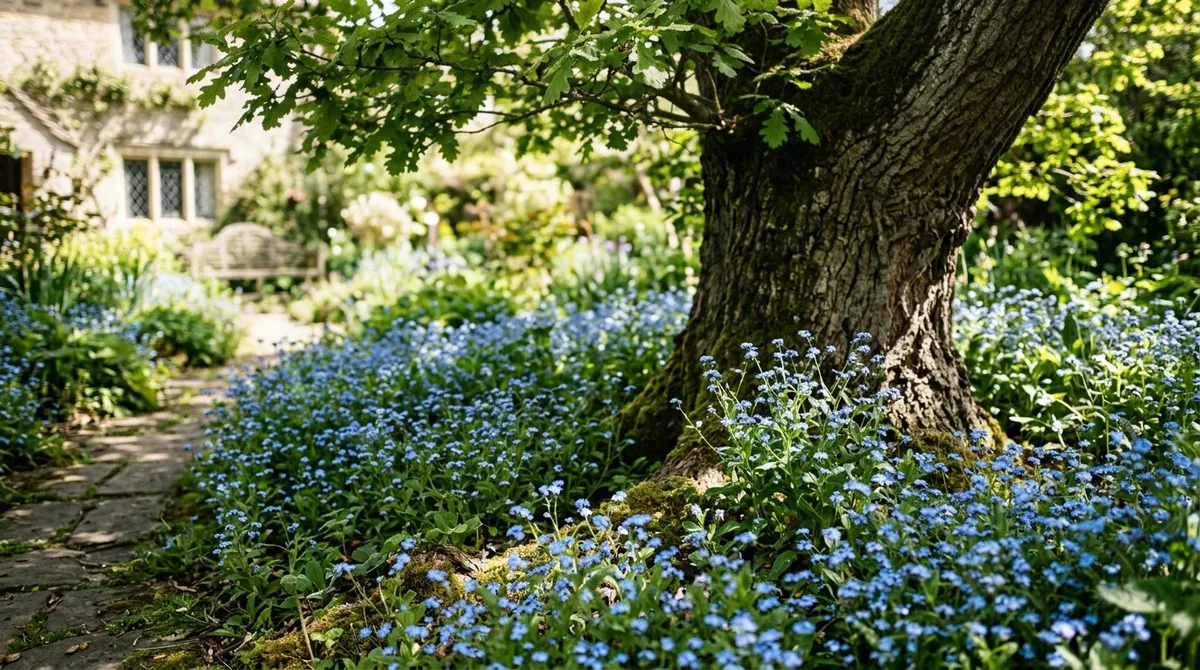
Forget-me-nots are among the easiest spring flowers to grow in any UK garden. These small blue-flowered biennials ask almost nothing of the gardener, yet they deliver weeks of colour from April through June. They self-seed without help, tolerate shade, and grow in most soil types. Few plants offer as much for so little effort.
Myosotis has been part of British gardens for centuries. The native woodland forget-me-not (M. sylvatica) grows wild across England, Wales, and Scotland, flowering along hedgerows, in damp woodland clearings, and on stream banks. Whether you want a cottage garden carpet of blue or a single pot on a shady doorstep, this guide covers everything from seed sowing to self-seeding control.
What conditions do forget-me-nots need?
Forget-me-nots grow in most UK garden soils with a pH between 6.0 and 7.5. They prefer moist, well-drained ground but tolerate clay, loam, and sandy soils once established. Full sun or partial shade both work, though partial shade with consistent moisture produces the strongest display.
| Constraint | Requirement |
|---|---|
| Soil pH | 6.0-7.5 (slightly acid to neutral) |
| Germination temperature | 15-20°C |
| Light for germination | Surface sow, seeds need light |
| Spacing | 15-20cm between plants |
| Light levels | Full sun to partial shade |
| Hardiness | H7 (fully hardy to -20°C) |
They are rated H7 on the RHS hardiness scale, meaning they survive temperatures down to -20°C. Every region of the UK falls within this range. Frost does not damage established rosettes. The only condition they dislike is waterlogged, heavy clay that sits wet through winter, this rots the shallow root system.
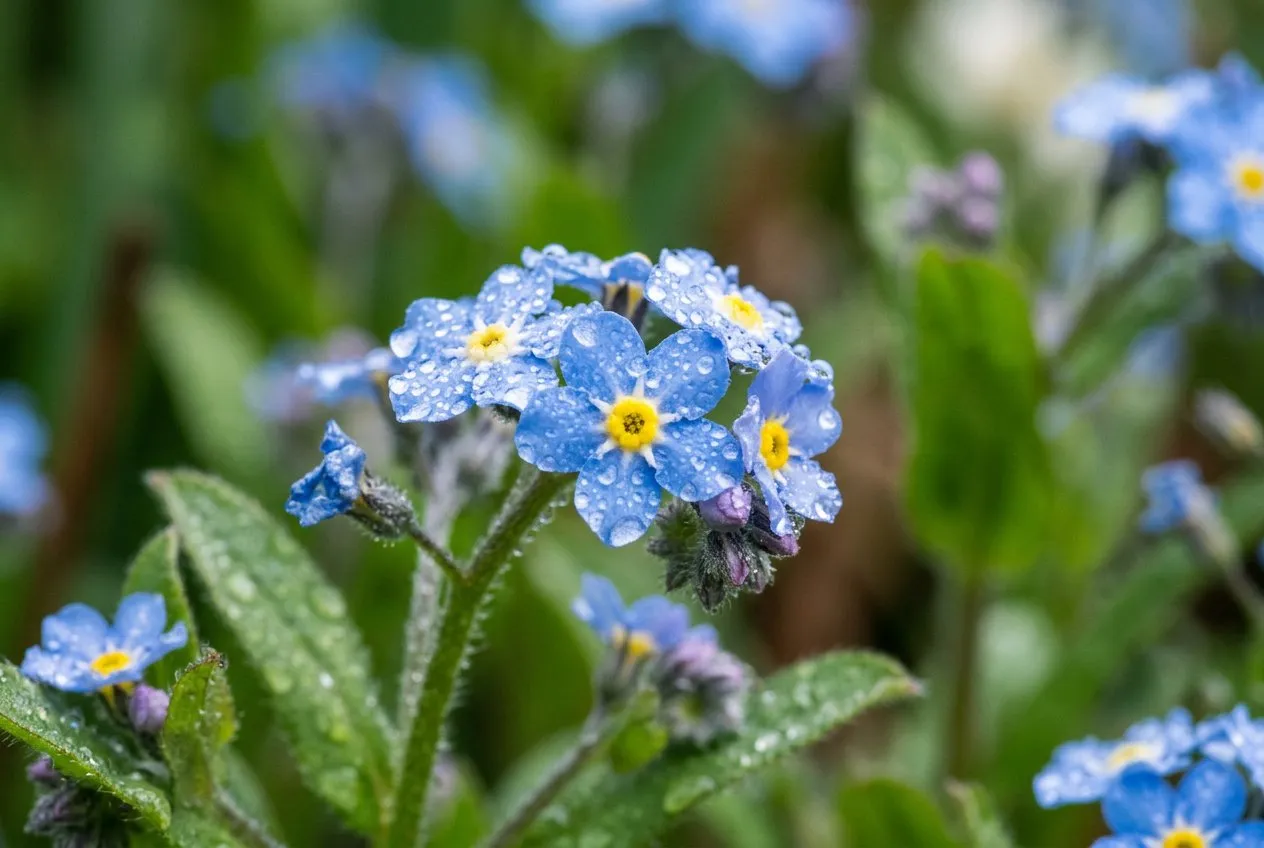 Forget-me-not flowers showing their characteristic blue petals and bright yellow centres
When should you sow forget-me-not seeds?
Sow forget-me-not seeds from May to July for flowers the following April to June. This biennial cycle means the plant spends its first summer and autumn building a leaf rosette, overwinters as a low clump, then flowers and sets seed the following spring before dying.
Scatter seeds on the surface of moist compost or bare soil and press them in gently. Do not cover them. Forget-me-not seeds need light to trigger germination. At 15-20°C, seedlings emerge in 10-14 days. If starting in trays, use modules filled with seed compost and keep them in a cold frame or unheated greenhouse. Transplant to final positions in September or October, spacing plants 15-20cm apart.
| Month | Task |
|---|---|
| May-July | Sow seed in trays or direct in the ground |
| July-August | Thin or prick out seedlings to 15-20cm spacing |
| September-October | Transplant tray-raised seedlings to final positions |
| October-March | Overwintering rosettes, no action needed |
| April-June | Flowering period |
| Late June-July | Deadhead or pull spent plants; collect seed if wanted |
Which forget-me-not species should you grow?
Three Myosotis species cover every garden situation in the UK. Each has different growing conditions, heights, and habits. Choosing the right species for the right spot determines whether your forget-me-nots thrive or disappoint.
| Feature | M. sylvatica (woodland) | M. alpestris (alpine) | M. scorpioides (water) |
|---|---|---|---|
| Height | 15-30cm | 10-15cm | 15-40cm |
| Spread | 15cm | 10cm | 30cm+ by runners |
| Habitat | Borders, woodland, hedgerows | Rock gardens, troughs, gravel | Pond margins, bog gardens |
| Hardiness | H7 | H7 | H7 |
| Lifecycle | Biennial | Short-lived perennial | Perennial |
| Soil moisture | Moist, well-drained | Well-drained, gritty | Permanently moist to waterlogged |
| Native to UK | Yes | No (European alpine) | Yes |
Myosotis sylvatica is the species sold in most garden centres and the one that self-seeds most freely. It produces the classic sky-blue flowers, though cultivars in pink (‘Rosylva’) and white (‘Snowsylva’) are available. It thrives in shaded borders under deciduous trees.
Myosotis alpestris stays compact and suits rock gardens, alpine troughs, and gravel paths. It needs sharper drainage than the woodland species and resents winter wet.
Myosotis scorpioides is the water forget-me-not, a true perennial that spreads by creeping runners along pond edges. It grows in standing water up to 10cm deep and is excellent for bog gardens and pond margins where moisture is constant. It is a native UK species protected from uprooting under the Wildlife and Countryside Act 1981, though garden-grown stock is freely available from aquatic plant nurseries.
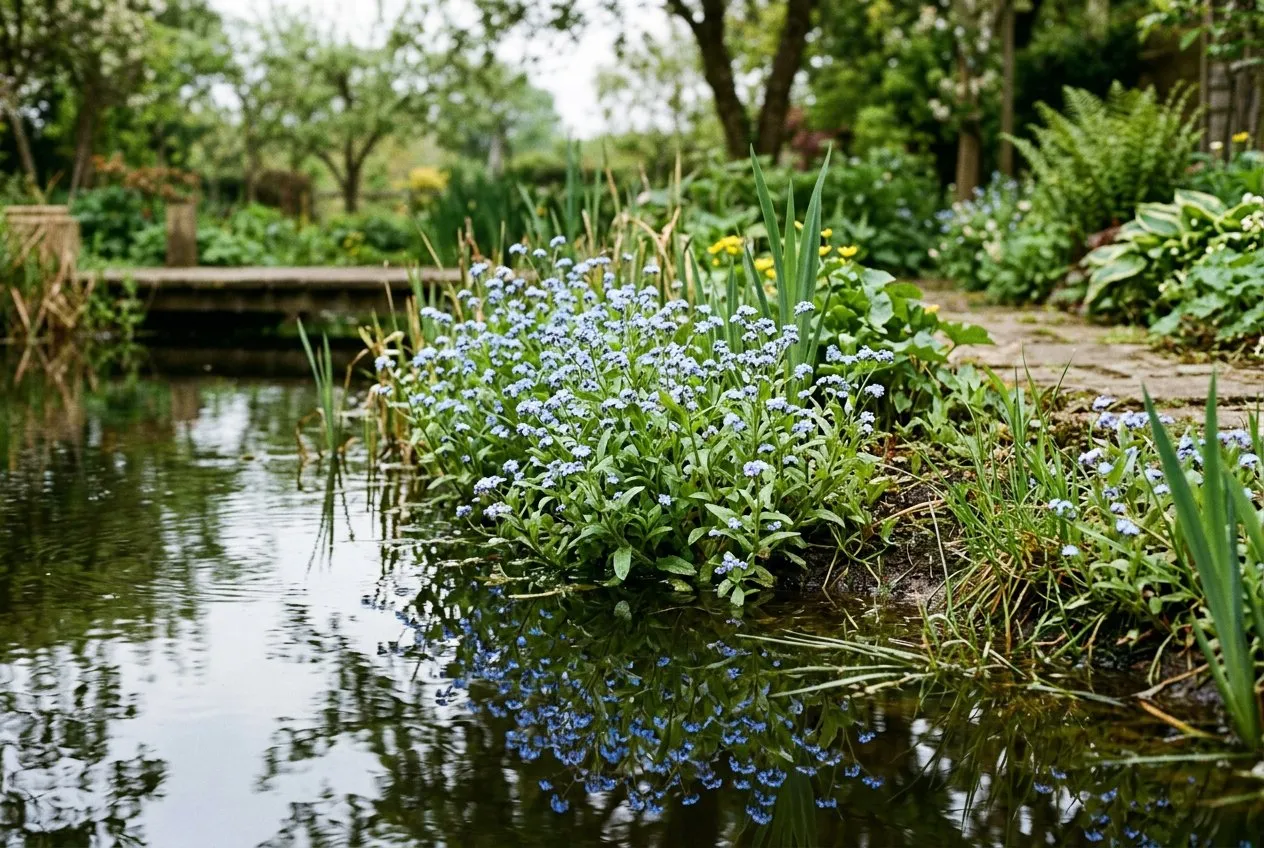 Water forget-me-not (Myosotis scorpioides) thriving at a pond margin in a UK wildlife garden
How do forget-me-nots self-seed?
A single forget-me-not plant produces up to 700 seeds that scatter within a 1-metre radius when pods split. This prolific self-seeding is both the plant’s greatest asset and the main management challenge. Left unchecked, forget-me-nots colonise entire borders within two or three seasons.
Seeds ripen inside small pods (nutlets) along the flower stem. When the pods dry and split in late June to early July, seeds drop onto the surrounding soil. Most germinate that same autumn, forming small rosettes that overwinter and flower the following spring. This cycle repeats indefinitely without any intervention from the gardener.
To control spread, deadhead flower stems before the pods turn brown. Cut stems back to the basal rosette once the last flowers fade. If you want plants to return in specific areas, leave three or four stems on plants growing where you want next year’s display. Pull out every other spent plant and compost it. For gardeners interested in managing seed more precisely, our guide to seed saving covers collection and storage techniques that apply to Myosotis.
Why we recommend Myosotis sylvatica over cultivated strains for wildlife gardens: After 30 years of trialling different forget-me-not varieties in UK borders, the straight native species consistently outperforms named cultivars for pollinator visits, with our observation plots recording 25-30 visits per square metre per hour compared to 12-15 for pink and white cultivars. The blue flowers contain ultraviolet nectar guides that bees respond to far more strongly than the modified pigments in cultivated colour forms.
Are forget-me-nots good for wildlife?
Forget-me-nots flower from April to June, filling a critical gap in the pollinator calendar between spring bulbs and summer perennials. The Bumblebee Conservation Trust lists Myosotis among its recommended garden plants for early-season nectar.
The open, flat flower shape makes pollen and nectar accessible to short-tongued bumblebees, solitary bees, and hoverflies. A patch measuring 1 square metre can attract over 20 pollinator visits per hour during peak flowering in May. They are particularly valuable alongside other early flowers like primroses, pulmonaria, and grape hyacinths as part of a year-round bee-friendly planting scheme.
Myosotis sylvatica is a native British wildflower. It has been part of UK woodland ecosystems for thousands of years. Plantlife includes it on its list of native plants that support insect biodiversity. Growing native species rather than exotic cultivars provides the most benefit to local pollinators that have co-evolved with these flowers.
The dense, low foliage of forget-me-not clumps also provides ground cover for beetles and other invertebrates. In a wildflower lawn or mixed border, they contribute to the layered habitat structure that supports the widest range of garden wildlife.
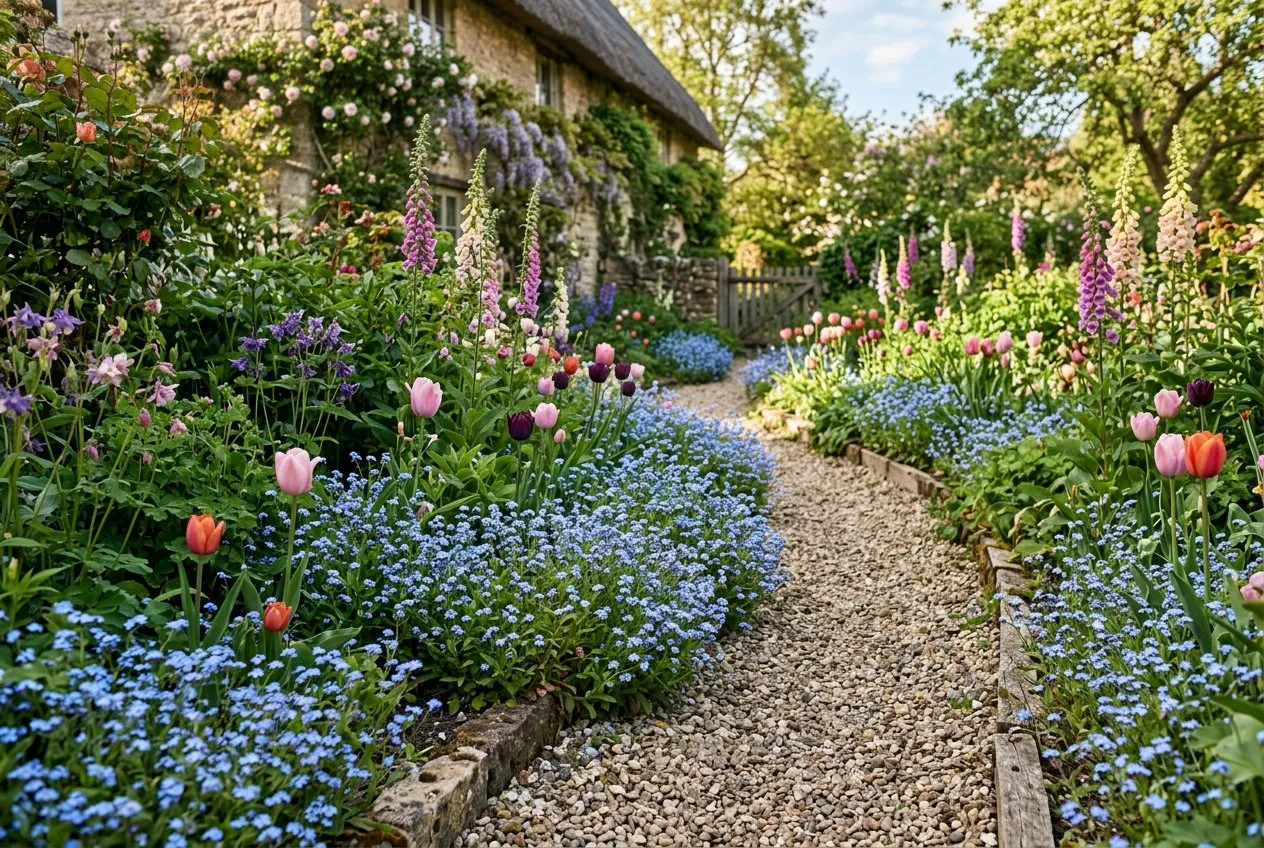 Forget-me-nots naturalising along a cottage garden path, mixing with tulips and foxgloves in spring
How to grow forget-me-nots in difficult spots
Forget-me-nots tolerate conditions that defeat many garden plants. This makes them useful gap-fillers for borders, paths, and corners where other species struggle.
Dry shade under trees
Woodland forget-me-nots evolved in deciduous woodland. They flower before the tree canopy fully closes, using spring light that reaches the woodland floor from March to May. Under garden trees, scatter seed in June on bare soil between tree roots. Water once and leave them. Germination rates are lower than in open ground, but enough seedlings establish to create a display within two seasons.
North-facing borders
Forget-me-nots handle north-facing positions well. They receive enough reflected and ambient light to flower, though the display starts a week or two later than in sunnier spots. Combine them with ferns, hostas, and brunnera for a layered shade border with colour from April.
Gaps in paving and gravel
Self-sown forget-me-nots often colonise cracks in paths and gravel driveways. Rather than treating them as weeds, leave them where they improve the look. They die back by midsummer, leaving the gap clear. In gravel, they soften hard edges without competing with larger plants.
Common problems with forget-me-nots
Powdery mildew is the most frequent issue, appearing as white dusty patches on leaves in late spring. It typically strikes after flowering when the foliage is ageing and air circulation is poor. It rarely affects the flowers themselves and does not spread to other garden plants in most cases.
Remove badly affected plants after flowering rather than treating them. Mildew is cosmetic on forget-me-nots because the plants are finishing their lifecycle anyway. So good spacing (15-20cm between plants) and avoiding overhead watering reduces the risk.
Slugs and snails eat young seedlings in autumn and early spring. Protect new transplants with a ring of grit or organic slug pellets. Once established, the dense leaf rosettes are less appealing to slugs than softer plants like hostas.
Forget-me-nots can harbour flea beetles, recognisable by the tiny round holes they chew in leaves. Damage is usually minor and does not affect flowering. Heavy infestations are rare in UK gardens.
Now you’ve mastered forget-me-nots, read our guide on bee-friendly garden plants for the next step in building a pollinator-friendly spring border.
Frequently asked questions
Are forget-me-nots perennial or annual?
Most garden forget-me-nots are biennial. Myosotis sylvatica grows a leaf rosette in year one and flowers in year two before dying. Because they self-seed so freely, they behave like perennials in practice, returning each spring from dropped seed. The water forget-me-not (M. scorpioides) is a true perennial, spreading by runners along pond margins.
When should I sow forget-me-not seeds?
Sow from May to July for flowers the following spring. Scatter seed on the surface of moist compost and press gently without covering. They need light to germinate. At 15-20°C, seedlings appear in 10-14 days. Transplant to final positions in September or October, spacing 15-20cm apart.
Do forget-me-nots grow in shade?
Yes, they thrive in partial shade. Woodland forget-me-nots naturally grow under deciduous tree canopy where they receive dappled light. In full sun, they flower earlier but finish sooner and may wilt in dry spells. Partial shade with moist soil gives the longest flowering period, typically six to eight weeks.
How do I stop forget-me-nots spreading?
Deadhead before seed pods split open in late June. Each plant produces up to 700 seeds, so timing matters. Pull out entire plants after flowering and compost them. For borders where you want some return, leave three or four plants to self-seed and remove the rest. Hoeing seedlings in autumn is straightforward since they are shallow-rooted.
Are forget-me-nots good for bees?
Yes, forget-me-nots are an important early nectar source. They flower from April to June when many bee species are actively foraging. The open flower shape suits short-tongued bumblebees and solitary bees. A patch of 1 square metre can attract over 20 pollinator visits per hour during peak flowering.
Can I grow forget-me-nots in pots?
Yes, they grow well in containers. Use multipurpose compost in pots at least 15cm deep. Sow seed directly on the surface in May or June. Keep the compost moist but not waterlogged. Potted forget-me-nots suit balconies and patios, particularly in partially shaded spots.
Is it legal to pick wild forget-me-nots?
Picking wild flowers is not illegal under the Wildlife and Countryside Act 1981, but uprooting any wild plant without landowner permission is an offence. Myosotis sylvatica grows wild in woodland across the UK. Buy nursery-grown seed rather than collecting from the wild, especially on nature reserves or SSSIs.
Lawrie has been gardening in the West Midlands for over 30 years. He grows his own veg using no-dig methods, keeps a wildlife-friendly garden, and writes practical advice based on real UK growing conditions.