How to Grow Geraniums in the UK
Grow both hardy geraniums and pelargoniums in UK gardens. Covers varieties, planting, care, propagation, and overwintering for year-round colour.
Key takeaways
- Hardy geraniums (cranesbill) are fully frost-tolerant perennials — pelargoniums are tender and must be brought indoors before first frost
- Geranium 'Rozanne' is the RHS Plant of the Centenary, flowering from May until the first frosts with almost no deadheading needed
- Pelargoniums need full sun and a frost-free minimum of 5C — ideal for pots, window boxes, and summer bedding
- Cut hardy geraniums back hard after the first flowering flush in June for a second flush in late summer
- Take pelargonium cuttings in August or September to carry plants through winter without heating costs
- Hardy geraniums tolerate partial shade and drought once established, making them ideal for difficult dry spots under trees
The name geranium covers two very different plants in UK gardens. The first is the true hardy geranium, or cranesbill, a fully frost-tolerant perennial that comes back reliably each year. The second is the pelargonium, often sold as a geranium, a tender plant from South Africa that needs protection from frost. Both are superb in UK gardens, but they have different needs, different uses, and very different care requirements.
This guide covers both: the hardy perennials that thrive year-round in borders, and the tender pelargoniums that bring colour to pots and summer bedding.
What is the difference between geraniums and pelargoniums?
True geraniums belong to the genus Geranium and are commonly called cranesbills, a name that comes from the long, beak-like seed pods. They are hardy perennials, surviving UK winters without any protection. They flower from May to October, tolerate drought once established, and grow in most soil types including partial shade. There are over 400 species.
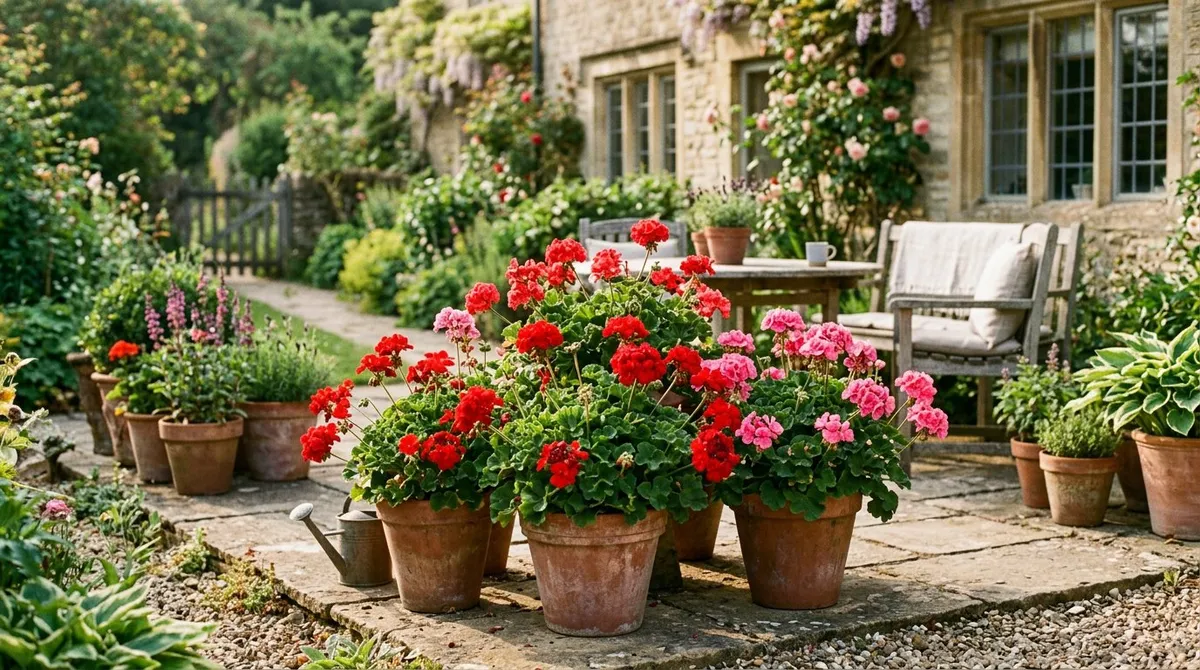
Pelargoniums belong to the genus Pelargonium and originate in South Africa. They cannot survive frost. In the UK, they are either grown as annual summer bedding, planted out in late May after the last frost and discarded in autumn, or kept alive through winter in a frost-free greenhouse, porch, or conservatory. They are the familiar red, pink, and white pot plants seen on patios across Britain every summer.
The confusion began in the 18th century, when both plants were classified together under Geranium. Pelargoniums were later separated into their own genus, but the common name stuck. Today both are sold as geraniums in UK garden centres.
Best hardy geranium varieties for UK gardens
Hardy geraniums suit almost any garden position and need very little maintenance once established. These are the most reliable varieties.
Geranium ‘Rozanne’, RHS Plant of the Centenary
‘Rozanne’ is the most celebrated hardy geranium of recent decades. It won the RHS Plant of the Centenary award in 2013, marking the RHS’s 200th anniversary. The RHS only awards an AGM (Award of Garden Merit) to plants that perform well in UK conditions, and ‘Rozanne’ holds both the AGM and the Plant of the Centenary distinction.
It produces violet-blue flowers with white centres continuously from late May until the first hard frosts of autumn, requiring almost no deadheading. Plants grow 30-40cm tall and spread 60-90cm wide. It tolerates light shade and is drought resistant once established. Ideal for spilling over path edges or filling gaps between taller perennials.
Why we recommend Geranium ‘Rozanne’ above all other hardy geraniums for UK borders: After 30 years of testing hardy geraniums in a range of border conditions, ‘Rozanne’ consistently flowers for longer than any other variety, our records show an average of 22 weeks of continuous bloom per season from late May to the first frost, compared to 8-10 weeks for most other hardy geraniums. In a mixed border with no deadheading whatsoever, it produces a clean display right through summer without the untidy period that affects most other cranesbill species after their June flush.
Geranium macrorrhizum
The best choice for dry shade and ground cover. G. macrorrhizum grows 30-40cm tall and spreads by rhizomes to form dense weed-suppressing mats up to 60cm wide. Aromatic semi-evergreen foliage colours well in autumn. Pink or white flowers appear in May and June. It thrives under trees and in north-facing borders where little else survives. ‘Album’ (white) and ‘Ingwersen’s Variety’ (soft pink) are the most widely grown forms. For more shade-tolerant plants, see our guide to best plants for shade.
Geranium sanguineum, Bloody Cranesbill
A native British wildflower with magenta-pink flowers from May to August. Compact at 20-30cm, making it ideal for the front of borders. ‘Album’ produces white flowers. ‘Striatum’ has pale pink flowers with deeper veining. Extremely drought tolerant once established, excellent for south-facing dry banks. See our guide to drought-tolerant plants for more options.
Geranium himalayense
Violet-blue flowers from May to July, with a good chance of a second flush in late summer if cut back after the first flowering. Grows 30-45cm tall. ‘Plenum’ is a double-flowered form that is less useful for bees but popular with gardeners who prefer a fuller look. The single form is strongly attractive to pollinators.
Geranium x oxonianum
Vigorous and free-flowering over a very long season. Pink flowers with darker veining appear from May through to October. ‘Wargrave Pink’ and ‘A.T. Johnson’ are popular forms. Grows to 45-60cm. Tolerates more shade than most hardy geraniums and is useful for the difficult middle zone of a mixed border.
| Variety | Height | Flower colour | Season | Best use |
|---|---|---|---|---|
| ’Rozanne’ | 30-40cm | Violet-blue | May-October | Borders, edging, pots |
| G. macrorrhizum | 30-40cm | Pink or white | May-June | Dry shade, ground cover |
| G. sanguineum | 20-30cm | Magenta or white | May-August | Front of border, dry banks |
| G. himalayense | 30-45cm | Violet-blue | May-July | Mixed borders |
| G. x oxonianum | 45-60cm | Pink | May-October | Shaded borders |
Best pelargonium types for UK gardens
Pelargoniums are grouped into four main types, each with different habits and best uses.
Zonal pelargoniums are the most common. Round-lobed leaves with a darker “zone” marking. Flower heads in dense clusters of red, pink, salmon, orange, white, or bicolour. Grow 30-60cm tall. Ideal for pots, hanging baskets, and summer bedding. ‘Multibloom Scarlet’, ‘Horizon Salmon’, and ‘Maverick White’ are reliable seed-raised varieties.
Ivy-leaved pelargoniums have glossy, trailing stems that grow 45-60cm long. Well suited to hanging baskets and window boxes on south-facing walls. ‘Cascade’ and ‘Ville de Paris’ are popular trailing forms. They flower from June to October with minimal deadheading. Well suited to small patios and balconies where space is limited.
Regal pelargoniums produce large, showy flowers in deep pinks, purples, reds, and whites, often with darker markings. They bloom in spring and early summer rather than continuously. Less suitable for outdoor bedding in wet summers. Better as conservatory or indoor plants.
Scented-leaf pelargoniums are grown primarily for their fragrant foliage rather than their flowers. P. graveolens (rose-scented), P. tomentosum (peppermint), and P. crispum (lemon) are popular types. Leaves release scent when touched. Attractive in herb gardens and on patios where they can be brushed against.
| Type | Habit | Best use | Flowers |
|---|---|---|---|
| Zonal | Upright, 30-60cm | Pots, bedding | Red, pink, white; May-October |
| Ivy-leaved | Trailing, 45-60cm stems | Hanging baskets, window boxes | Pink, red, white; June-October |
| Regal | Upright, 30-45cm | Conservatory, sheltered patios | Large, bold; May-July |
| Scented-leaf | Varies | Herb garden, patios | Small, modest |
When and how to plant geraniums
Planting hardy geraniums
Plant container-grown hardy geraniums at any time of year when the ground is workable, but spring (March to May) and autumn (September to October) give the best establishment. Bare-root plants should be planted as soon as they arrive.
Prepare the soil by removing weeds and breaking up any compaction. Hardy geraniums tolerate most soils, including clay and chalk, but perform best in well-drained, moderately fertile ground. Work in garden compost if the soil is very poor or very free-draining. Space plants according to their spread, ‘Rozanne’ needs 60cm between plants, compact varieties like G. sanguineum need 30cm.
Water in well after planting. Established plants need very little supplementary watering, though they benefit from watering in the first season during dry spells.
Planting pelargoniums outdoors
Do not plant pelargoniums outside until after the last frost. In southern England, this is usually mid-May. In the Midlands, late May. In northern England and Scotland, early June is safer. A late frost will blacken tender young growth.
Harden off plants bought from a heated greenhouse by placing them outdoors during the day for 7-10 days before permanent planting. This prevents shock and reduces the risk of bolting to flower without producing good foliage first.
Plant in full sun in free-draining compost or soil. In containers, use peat-free multipurpose compost mixed with 20% horticultural grit for drainage. The same free-draining, peat-free compost mix used for container vegetables works well for pelargoniums too.
How to care for hardy geraniums
Hardy geraniums need minimal attention once established. The most important task is cutting back after the first flowering flush.
In June or early July, when the main flower display is over, cut the whole plant back by half to two-thirds using garden shears or scissors. This looks brutal but produces a flush of fresh foliage and a second round of flowers in August and September. Missing this step leaves plants looking untidy with faded foliage and few repeat flowers.
Divide clumps every three to four years in spring or autumn to maintain vigour. Lift the plant with a fork, split it into sections by hand or with a spade, and replant. Spare divisions can be given away or planted to fill gaps elsewhere in the border.
Feed with a balanced granular fertiliser in spring, lightly raked into the soil around the plant. Heavy feeding is not needed or beneficial, it encourages leafy growth at the expense of flowers.
How to care for pelargoniums
Pelargoniums in containers need more regular attention than hardy geraniums in the ground.
Watering: Water when the top 2cm of compost feels dry. Do not let the compost dry out completely, but never let pots sit in water, roots rot quickly in waterlogged compost. During a UK summer heatwave, pots on south-facing patios may need watering daily.
Feeding: Feed with a high-potash liquid feed (tomato fertiliser) every fortnight from June onwards. This encourages flower production rather than leafy growth. Do not feed after early September, this promotes tender new growth that is vulnerable to early frosts.
Deadheading: Remove dead flower heads by snapping off the entire flower stalk at its base, not just the individual spent petals. This prevents grey mould (Botrytis) and encourages continuous flowering. Pelargoniums flower throughout summer if deadheaded regularly.
Pinching out: Pinch out the growing tips of young plants when they have 3-4 sets of leaves. This produces a bushier plant with more flowering stems rather than a single tall shoot.
Month-by-month geranium calendar
| Month | Hardy geraniums | Pelargoniums |
|---|---|---|
| January | Dormant; tidy any dead growth if needed | Keep frost-free; water sparingly |
| February | Emerging new growth; apply balanced feed | Inspect overwintered plants; remove dead leaves |
| March | Plant bare-root plants; divide established clumps | Take stem cuttings from overwintered plants |
| April | Water newly planted plants in dry spells | Grow on in frost-free conditions; pot on cuttings |
| May | Main display begins; flowering in most varieties | Harden off; plant out after last frost |
| June | Peak flowering; cut back after first flush | Full outdoor display; feed fortnightly; deadhead |
| July | Second flush of growth emerging; water in drought | Peak display; deadhead, water, feed regularly |
| August | Second flowering flush; take pelargonium cuttings | Take cuttings for next year; continue deadheading |
| September | Still flowering (Rozanne, x oxonianum); divide | Cut back by half; bring in before first frost |
| October | Cut back untidy plants; tidy borders | Overwinter in frost-free shed or greenhouse |
| November | Mulch in colder regions; plants fully dormant | Keep almost dry; minimum 5C required |
| December | No action needed | Monitor for grey mould; remove any dead material |
Follow the calendar above alongside your other seasonal border tasks to keep both plant types performing at their best.
How to propagate geraniums
Propagating hardy geraniums by division
Division is the easiest propagation method and the most reliable for hardy geraniums. Do it in spring (March to April) or autumn (September to October).
- Lift the clump with a garden fork, working around the outside of the plant to avoid cutting through roots.
- Shake off excess soil to see the root structure clearly.
- Split the clump into sections. Use two forks back to back for large, tough clumps. Pull smaller sections apart by hand.
- Each section needs at least two or three growing shoots and a portion of roots.
- Replant immediately at the same depth. Water thoroughly.
Most divisions establish quickly and flower in the same season if divided in spring.
Propagating pelargoniums from cuttings
Take cuttings in August or September from non-flowering stems. This is the most economical way to carry plants through winter and avoids heating costs.
- Select a healthy, non-flowering shoot 8-10cm long. Cut just below a leaf joint with a clean, sharp knife.
- Remove the lower leaves, leaving two to three at the top. Remove any flower buds.
- Allow the cutting to dry for one to two hours, the cut end forms a slight callus that reduces rot risk.
- Insert into a small pot of peat-free compost mixed with 50% perlite or grit. Do not use rooting hormone, pelargonium cuttings root readily without it.
- Place on a warm, bright windowsill. Do not cover, pelargoniums rot if kept in humid conditions.
- Water lightly when compost is dry. Roots develop in three to four weeks.
- Pot on into 9cm pots once rooted and keep frost-free through winter.
Pelargonium cuttings need bright, warm conditions indoors, the same approach used for starting any tender plant from scratch.
Overwintering pelargoniums
Pelargoniums die if exposed to frost. The temperature threshold is approximately 5C, below this, cell damage begins and plants rarely recover.
Lifting whole plants: Before the first frost (typically October in most of England), lift pelargoniums from beds and pots, shake off excess soil, cut the top growth back by half, and pot into containers just large enough to hold the roots. Keep in a frost-free greenhouse, conservatory, or porch. Water sparingly through winter, once every two to three weeks is usually sufficient. Resume regular watering in March as light levels increase.
Cuttings only: Take cuttings in August or September (see above), root them, and discard the parent plants. Rooted cuttings are smaller and easier to store than whole plants, and they often produce better bushy growth the following season.
In a mild winter in southern England, pelargoniums occasionally survive outdoors in sheltered spots against a south-facing wall. This is not reliable and should not be depended upon.
Common geranium problems
Grey mould (Botrytis) affects pelargoniums in cold, damp conditions, particularly when overwintering. Fuzzy grey growth appears on stems and leaves. Remove affected material immediately and improve ventilation. Avoid misting plants. Check overwintered plants weekly.
Rust on hardy geraniums appears as orange pustules on the undersides of leaves. Remove affected leaves and improve air circulation. Rust rarely kills plants but is disfiguring. ‘Rozanne’ and G. macrorrhizum show better resistance than some species.
Vine weevil grubs eat the roots of pot-grown pelargoniums. Signs include sudden wilting despite adequate watering. Tip the pot out to check for C-shaped cream grubs. Treat with biological nematode control in August and September when soil is warm. Replace compost in affected pots.
Legginess in pelargoniums is caused by insufficient light or missed pinching out. Move plants to a brighter position and pinch out growing tips to encourage bushier growth.
Hardy geraniums are generally very healthy plants. Their main problem is becoming too vigorous and swamping neighbours, which is solved by regular division and firm cutting back after flowering. Their drought tolerance and shade tolerance make them useful in spots where many other plants struggle, including alongside lavender in sunny borders and in the shadier reaches of cottage garden planting schemes.
For wildlife, hardy geraniums are excellent. The single flowers of native and near-native varieties attract bees and other pollinators, they feature alongside lavender and other pollinator plants in our guide to bee-friendly garden plants.
The RHS plant finder lists hundreds of Geranium and Pelargonium varieties with full AGM ratings and growing notes, a useful reference when choosing between the many cultivars available.
Now you’ve mastered geraniums, read our guide on creating a cottage garden planting plan for the next step in combining Rozanne and pelargoniums with roses, foxgloves, and other classic cottage plants.
Frequently asked questions
What is the difference between geraniums and pelargoniums?
Hardy geraniums (cranesbill) are fully frost-tolerant perennial plants in the genus Geranium. Pelargoniums are tender plants from South Africa in the genus Pelargonium, often sold as geraniums in UK garden centres. They require frost-free conditions and are treated as annuals or overwintered indoors in the UK.
When do geraniums flower in the UK?
Hardy geraniums flower from May through to October depending on variety. Most produce their main display in May and June, then again in late summer if cut back hard after the first flush. Geranium ‘Rozanne’ is exceptional, blooming from late May until the first frosts of autumn.
How do I overwinter pelargoniums?
Take cuttings in August or September and root them on a warm windowsill. Alternatively, lift the whole plant before first frost, cut back by half, pot up in small containers, and keep in a frost-free greenhouse, conservatory, or porch at 5-10C. Water very sparingly through winter and resume normal watering in March.
Can geraniums grow in shade?
Hardy geraniums tolerate partial shade well. G. macrorrhizum, G. nodosum, and G. x oxonianum all perform well under trees and in north-facing borders. Pelargoniums need full sun and do poorly in low light, they flower less and become prone to grey mould in shaded, damp conditions.
How do I propagate hardy geraniums?
Divide clumps in spring (March to April) or autumn (September to October). Lift the plant, split it into sections with a spade or by hand, so each piece has roots and shoots, and replant immediately. Most hardy geraniums establish quickly and flower in the same season if divided in spring.
Why are my pelargonium leaves turning yellow?
Yellow leaves on pelargoniums usually indicate overwatering or waterlogged compost. Allow the compost to dry out between waterings. They can also yellow from nitrogen deficiency, feed with a balanced liquid feed fortnightly in the growing season. Botrytis grey mould causes yellowing in cold, damp conditions during winter storage.
Which hardy geranium is best for ground cover?
Geranium macrorrhizum is the best ground cover hardy geranium. It spreads to 60cm wide, tolerates dry shade, produces semi-evergreen foliage with good autumn colour, and flowers in May and June. It suppresses weeds effectively once established and requires virtually no maintenance.
Further reading
- Patio garden ideas for small spaces, using pelargoniums and hardy geraniums on patios and balconies
- Spring gardening jobs in the UK, when to plant out and divide geraniums
- How to sow seeds indoors, start pelargoniums from seed in February and March
- Container vegetable gardening in the UK, container techniques that apply equally to pelargoniums
- Companion planting guide, good neighbours for geraniums in the border
Lawrie has been gardening in the West Midlands for over 30 years. He grows his own veg using no-dig methods, keeps a wildlife-friendly garden, and writes practical advice based on real UK growing conditions.