How to Grow Hollyhocks in the UK
Grow hollyhocks in UK gardens — sowing, varieties, rust prevention, and how to place these 2m cottage garden giants for maximum summer impact.
Key takeaways
- Hollyhocks are biennials — sow May to July for flowers the following summer from July to September
- They reach 1.5–2.5m tall and need a sunny, sheltered spot against a wall, fence, or by a doorway
- Hollyhock rust is the main problem — treat early with fungicide or remove affected leaves promptly
- Chater's Double and Nigra are classic varieties; Spring Celebrities flower in their first year from seed
- The Fig-Leaved hollyhock (A. ficifolia) is significantly more resistant to rust than common hollyhocks
- Hollyhocks self-seed freely and attract bees and hoverflies — excellent for a wildlife-friendly garden
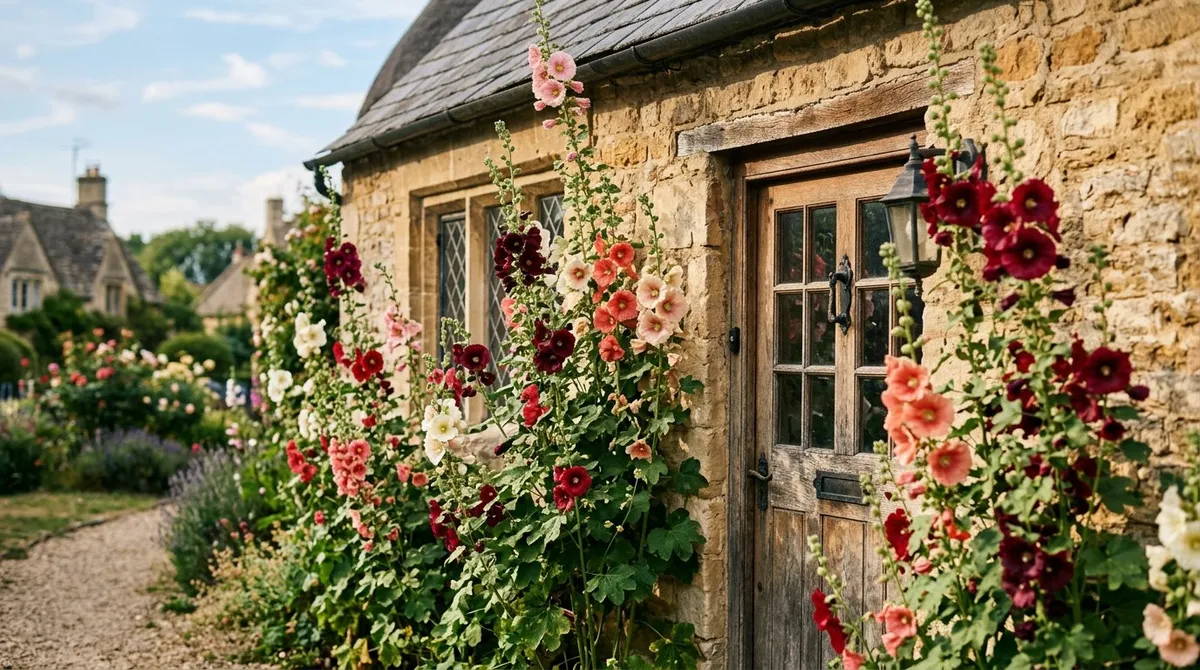
Hollyhocks are one of the defining plants of the English cottage garden. Alcea rosea grows 1.5-2.5m tall, sending flower-covered stems skyward from July to September, blooms opening progressively up the spike in shades from white through pink, red, and near-black. Plant them against a stone wall, by a farmhouse door, or at the back of a sunny border and they immediately give a garden a sense of permanence and abundance that few other plants can match.
They are biennials in most cases: sown one summer, flowering the next, and then dying after setting seed. But because they self-seed freely and some cultivars persist as short-lived perennials, a well-established hollyhock patch can sustain itself indefinitely with almost no input. Combined with foxgloves and delphiniums, they form the tall back-of-border layer in a traditional cottage garden planting plan.
There is one significant challenge. Hollyhock rust, orange pustules on the undersides of leaves, affects most plants grown in the UK, often by mid-summer. It disfigures foliage without killing the plant, but knowing how to manage it separates gardeners who enjoy hollyhocks every year from those who give up after one season.
When and how to sow hollyhock seeds
Sow hollyhocks May to July for flowers the following summer. This is the standard approach for treating them as biennials, which is how most gardeners grow them in the UK.
Sowing indoors
- Fill 9cm pots or module trays with seed compost.
- Press one or two seeds per cell lightly into the surface.
- Cover with a thin layer of vermiculite, about 3-5mm.
- Water gently and place somewhere warm at 18-21°C.
- Germination takes 10-14 days.
- Prick out into 9cm individual pots once the first true leaves appear.
For the full technique on raising plants from seed inside, see the guide on how to sow seeds indoors. For a full overview of what to sow each month, the seed sowing calendar for UK gardens shows hollyhocks alongside other biennial and annual flowers.
Sowing outdoors
Hollyhock seeds can be sown directly into prepared soil from May to July. Sow 6mm deep, spacing seeds 30cm apart, then thin to 45-60cm once seedlings are established. Direct sowing suits gardeners who want plants in a specific position, hollyhocks dislike transplanting once they are large, so direct-sown plants often establish better than those moved from pots.
First-year flowering
The Spring Celebrities series is bred to flower in the first year from seed when sown early, January to February under glass at 18°C. This bridges the biennial gap for gardeners who want results in their first season. Plants reach 90-120cm rather than the full species height, but the flowers are well-formed and appear from July.
Planting out
Pot-raised plants should go into their final positions in September or October, or in spring after the last frost. Autumn planting gives hollyhocks time to develop a good root system before winter, producing stronger plants that flower earlier the following summer. Space at 45-60cm to allow airflow, crowding worsens the rust problem.
What conditions do hollyhocks need?
Hollyhocks are not demanding plants, but position is critical. Get this right and they thrive with minimal attention.
Sun: Full sun is essential. Six or more hours of direct sun per day produces the most upright, floriferous plants. In partial shade, hollyhocks grow taller and leggier as they reach for light, and flowering is reduced.
Soil: Well-drained, moderately fertile soil suits them best. They grow in clay, loam, and sandy soils but struggle in waterlogged ground, standing water over winter is fatal. On heavy clay, incorporate grit and organic matter to improve drainage. On poor sandy soil, add garden compost to improve moisture retention.
Shelter: Tall hollyhock stems are vulnerable to wind. A south or west-facing wall, a fence, a hedge backdrop, or a sheltered courtyard all work well. In exposed positions, canes are essential, individual bamboo stakes at 1.5-2m, tied loosely at two or three points up the stem.
pH: Neutral to slightly alkaline soil (pH 6.5-7.5) suits hollyhocks. They grow on acid soils but perform less vigorously.
Watering: Water regularly during the first growing season to establish roots. Once established, hollyhocks are reasonably drought-tolerant. Always water at the base, overhead watering wets the foliage and encourages rust.
Hollyhock varieties to grow in the UK
| Variety | Flower type | Height | Notes |
|---|---|---|---|
| Chater’s Double | Fully double, mixed colours | 1.8-2.0m | Classic cottage garden variety; ball-shaped flowers |
| Halo Series | Single with dark centre | 1.5-1.8m | Clean, eye-catching bicolour; excellent for bees |
| Nigra | Single, near-black | 1.5-2.0m | Deep maroon-black; dramatic in combination with pale pinks |
| Spring Celebrities | Single, mixed colours | 90-120cm | First-year flowering from early sowing; compact habit |
| Majorette Mix | Semi-double, mixed | 75-90cm | Dwarf variety; good for exposed or smaller gardens |
| A. ficifolia (Fig-Leaved) | Single, warm yellows/oranges | 1.5-2.0m | Significantly more rust-resistant than A. rosea; ornamental leaves |
| Queeny Mix | Single, mixed | 60cm | Very compact; bred for containers and small spaces |
For maximum rust resistance, the Fig-Leaved hollyhock (Alcea ficifolia) is the best choice. Its deeply lobed leaves are also ornamental, and the warm ochre and orange flower tones are less common than the typical pink-red range of A. rosea.
For wildlife value, single and semi-double varieties such as the Halo Series and Nigra provide better access to nectar and pollen than fully double forms. Bees can enter a single flower and collect efficiently; very full doubles slow them down.
For a classic cottage garden look, Chater’s Double in a mixed planting alongside roses and sweet peas is hard to beat.
Month-by-month care calendar
| Month | Task |
|---|---|
| January | Sow Spring Celebrities under glass at 18°C for first-year flowers |
| February | Check stored seed for viability; prepare sowing area |
| March | Sow Spring Celebrities indoors if not done in January |
| April | Prick out and pot on seedlings from earlier sowings |
| May | Sow outdoors or in pots; harden off spring-sown seedlings |
| June | Plant out hardened seedlings; stake tall plants in exposed positions |
| July | Plants in flower; remove rust-affected leaves; water at base only |
| August | Continue deadheading; allow some spikes to set seed for self-seeding |
| September | Plant out autumn seedlings; collect and store seed for next year |
| October | Plant out remaining seedlings in final positions |
| November | Clear spent plants; leave some self-sown seedlings to overwinter |
| December | No action needed; overwintering rosettes are fully hardy |
How to deal with hollyhock rust
Hollyhock rust (Phragmidium althaeanum) is the most common problem with Alcea rosea in UK gardens. Orange-yellow pustules appear on the undersides of leaves from early summer, usually July onwards. The upper leaf surface shows pale yellow patches directly above the pustules. In severe cases, entire leaves yellow and fall prematurely.
Rust disfigures plants but rarely kills them. Well-nourished plants with good airflow tolerate it better than stressed or overcrowded ones.
Managing rust without chemicals
- Remove affected leaves immediately. Cut them off and bin them, do not compost. This slows spread.
- Water at the base. Wet foliage speeds spore germination. Use a watering can aimed at the roots.
- Space plants generously. 45-60cm between plants allows airflow that reduces humidity around leaves.
- Clear spent plants in autumn. The rust fungus overwinters on debris. Remove and dispose of all plant material once flowering ends.
- Start fresh each year. Because hollyhocks are biennials, growing new plants from seed each year (rather than relying on the same rootstock) reduces carryover rust infection.
Using fungicides
At the first sign of rust, a copper-based fungicide (such as Bordeaux mixture) or a systemic product containing triticonazole can slow the spread. The RHS guidance on hollyhock rust covers approved products for home garden use. Apply in dry conditions and repeat every 10-14 days through the risk period.
Why we recommend Alcea ficifolia (the Fig-Leaved hollyhock) for gardens with persistent rust: After 30 years of growing hollyhocks in British conditions, A. ficifolia consistently reaches August in far better condition than A. rosea in the same bed. In trial plantings where A. rosea showed rust by mid-July, A. ficifolia grown alongside it reached the same date with negligible infection. Its flowering season and height match A. rosea closely, but you spend half the time managing disease.
Growing A. ficifolia instead
The Fig-Leaved hollyhock is the practical long-term answer for gardens where rust is a persistent problem. It flowers in the same period, reaches a similar height, and carries the same cottage garden character, but the different leaf structure makes it substantially harder for the rust fungus to colonise. Growing A. ficifolia alongside A. rosea spreads the visual effect while reducing overall rust pressure.
Hollyhocks as pollinator plants
Hollyhocks are excellent for bees and hoverflies. The large, open flowers are accessible to a wide range of species, including bumblebees, honeybees, and solitary bees, providing nectar and pollen across a long flowering season from July to September, a period when early summer flush plants have finished and late summer plants have not yet peaked.
Single and semi-double varieties are the most effective for wildlife. Fully double forms such as Chater’s Double still attract bees but reduce access to the pollen-bearing stamens. If your priority is supporting pollinators, mix single-flowered varieties such as Nigra, the Halo Series, or A. ficifolia with one or two double forms for visual variety.
Hoverflies are particularly associated with hollyhocks, the flat or gently cupped flowers make landing and feeding straightforward. Including hollyhocks alongside other bee-friendly garden plants extends the pollinator season into late summer.
For a spring gardening jobs checklist that includes preparing hollyhock sowing spots and timing, see the full seasonal guide.
Encouraging hollyhocks to self-seed
One of the great pleasures of growing hollyhocks is allowing them to self-seed and fill gaps they choose themselves. A hollyhock that plants itself at the base of a wall or in a crack between paving looks more convincing than one placed there deliberately.
Allow some seed pods to ripen fully after flowering. The round, disc-shaped seeds, sometimes called “cheeses” because of their shape, are easy to collect by hand once the papery pods dry out, or leave them to fall where they choose. Hollyhock seed germinates readily on bare soil the following spring.
To guide where seedlings establish, prepare small patches of bare, cultivated soil at the base of walls or fences in September. Seeds landing on prepared ground germinate more reliably than those landing on grass or established ground cover.
Once hollyhocks are naturalised in a garden, they maintain themselves with almost no effort, a defining feature of the relaxed, plant-led style of gardening that makes cottage gardens feel so alive. For pairing ideas, the companion planting guide covers which plants work well alongside tall biennials and how to plan for seasonal succession year after year.
Now you’ve mastered hollyhocks, read our guide on how to grow foxgloves in the UK for another tall biennial that pairs perfectly with hollyhocks at the back of a cottage garden border.
Frequently asked questions
When should I sow hollyhock seeds in the UK?
Sow hollyhock seeds May to July for flowers the following year. Press seeds into seed compost in small pots or modules and cover lightly with vermiculite. Germination takes 10-14 days at 18-21°C. Plant out in autumn or spring, spacing 45-60cm apart in their final position.
How tall do hollyhocks grow?
Hollyhocks typically grow 1.5-2.5m tall, depending on variety and soil conditions. Chater’s Double and single-flowered types reach the upper end of this range in rich, moist soil. Compact varieties such as Spring Celebrities stay closer to 90-120cm. Stake all varieties in exposed positions.
What causes orange spots on hollyhock leaves?
Orange pustules on hollyhock leaves are caused by hollyhock rust (Phragmidium althaeanum), a fungal disease. It disfigures foliage but rarely kills plants. Remove and bin affected leaves promptly, water at the base only, and apply copper-based fungicide at the first sign of infection to slow the spread.
Do hollyhocks come back every year?
Most hollyhocks are biennials, foliage in year one, flowers in year two, then they die. They appear to return annually because they self-seed prolifically. A. ficifolia and some cultivars behave as short-lived perennials, returning for two or three years from the same rootstock.
Where is the best place to plant hollyhocks?
The best position is a sunny, sheltered spot against a warm south or west-facing wall, fence, or beside a doorway. Full sun is essential. Hollyhocks need protection from wind, tall stems snap in exposed positions. Well-drained soil is critical; they rot in waterlogged ground.
Are hollyhocks good for wildlife?
Yes, hollyhocks are excellent for bumblebees, honeybees, and hoverflies from July to September. Single-flowered and semi-double varieties offer the best access to nectar and pollen. The long flowering season fills a gap after early summer plants have finished, making hollyhocks a valuable addition to any wildlife-friendly garden.
Can hollyhocks grow in pots?
Hollyhocks can grow in large pots but are not ideal container plants. Use a minimum 30-litre container with free-draining compost. Compact varieties such as Spring Celebrities or Queeny Mix suit containers far better than tall species types, which require heavy staking and frequent watering to perform well in pots.
Lawrie has been gardening in the West Midlands for over 30 years. He grows his own veg using no-dig methods, keeps a wildlife-friendly garden, and writes practical advice based on real UK growing conditions.