How to Grow Jasmine in the UK
How to grow jasmine in UK gardens. Covers summer jasmine, winter jasmine, and star jasmine with planting, pruning, and variety advice.
Key takeaways
- Common jasmine (Jasminum officinale) grows to 10m and flowers June to September with strong evening fragrance
- Winter jasmine (J. nudiflorum) is fully hardy, self-clinging, and flowers December to March on bare stems
- Star jasmine (Trachelospermum jasminoides) is evergreen and hardy to -10°C, ideal for sheltered walls
- Pink jasmine (J. polyanthum) is tender and must be grown as a conservatory or indoor plant in the UK
- Prune summer jasmine immediately after flowering; prune winter jasmine in March after flowers finish
- Propagate from semi-ripe cuttings taken July to September for free new plants
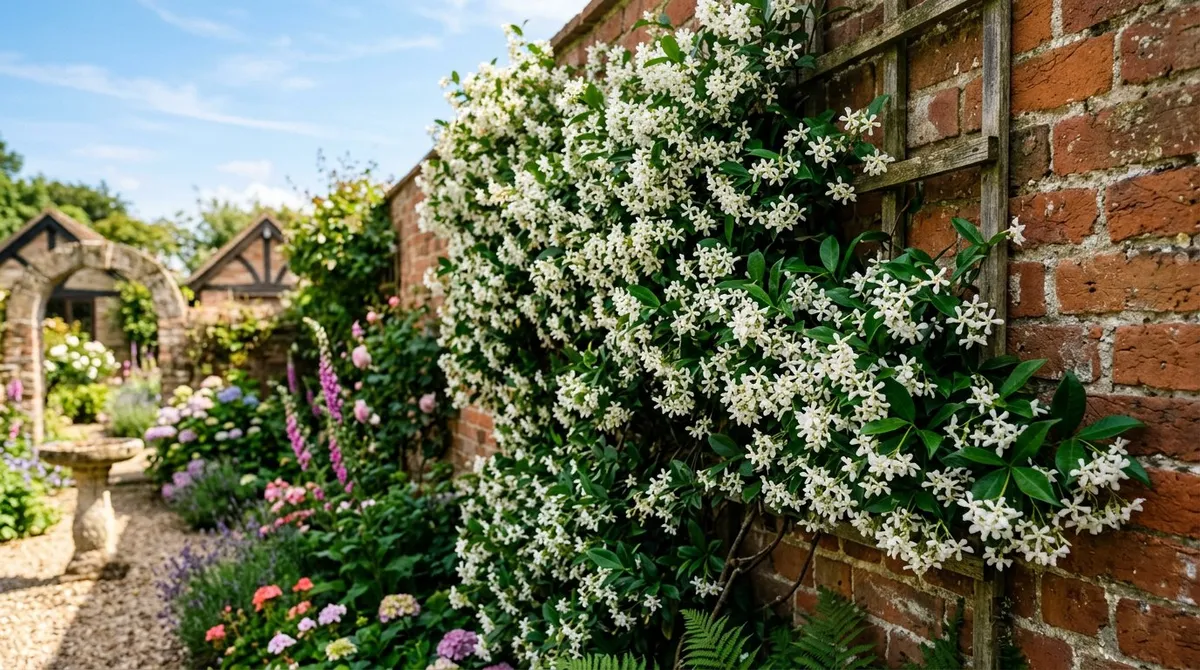
Jasmine is one of the most rewarding climbers you can grow in a UK garden. The scent of common jasmine on a warm July evening is unmistakable, and there is almost nothing that equals it for fragrance on a pergola or arch. Winter jasmine brings bright yellow flowers to a bare north-facing wall in the darkest months of the year. Choose the right type for your situation and jasmine is easy to grow, long-lived, and genuinely useful for wildlife.
This guide covers the four main jasmine types grown in the UK, how to plant and care for each, and how to propagate new plants for free. For more climbers that change vertical spaces, see our guide to the best climbing plants for UK gardens.
Which jasmine should I grow in the UK?
The four types you are likely to encounter in UK garden centres behave very differently. Buying the wrong one, particularly the tender pink jasmine, is the main reason gardeners end up disappointed.
Common jasmine (Jasminum officinale)
The classic fragrant jasmine. A vigorous, deciduous to semi-evergreen climber that reaches 10 metres on a pergola, arch, or trellis. Clusters of small white flowers appear from June to September with a powerful, sweet scent that intensifies in the evening. Hardy to around -15°C, which means it survives reliably anywhere in the UK.
J. officinale ‘Inverleith’ has pink-flushed flowers and is slightly more compact. ‘Clotted Cream’ has creamy white flowers and slightly less vigour. The straight species is vigorous enough to cover a large structure in three to four years.
Winter jasmine (Jasminum nudiflorum)
Completely different from common jasmine. A wall shrub rather than a twining climber, it does not grip supports, but can be tied in. Bright yellow flowers appear on bare green stems from December to March, providing one of the few genuine splashes of colour in a winter garden. No meaningful fragrance.
Winter jasmine is fully hardy, tolerates north-facing and east-facing walls, and asks very little of the gardener. It is possibly the best plant available for a difficult, shaded, cold wall. Reaches 3 metres in height with a similar spread.
Star jasmine (Trachelospermum jasminoides)
Despite the common name, star jasmine is not a true jasmine, it belongs to the Apocynaceae family. That said, it earns its name with highly fragrant, creamy white star-shaped flowers that appear from June to August. An evergreen climber with glossy dark leaves that colour bronze in cold weather.
Hardy to approximately -10°C, star jasmine suits sheltered gardens in most of the UK. In colder parts of Scotland, it needs a south or west-facing wall with good drainage. Reaches 4-5 metres. Self-clings to walls and needs minimal maintenance. The RHS recommends star jasmine as one of the best fragrant evergreen climbers for UK gardens.
Pink jasmine (Jasminum polyanthum)
Tender, frost-sensitive, and unsuited to outdoor growing anywhere in the UK. Sold widely in supermarkets and garden centres in winter as a houseplant in flower. Highly fragrant pink-white flowers appear from late winter onwards indoors. In summer it can go outside in a sheltered spot, but it must come back inside before autumn temperatures drop below 5°C. Treat it as a conservatory or indoor plant.
| Type | Hardy | Fragrant | Evergreen | Wall aspect | Flowers |
|---|---|---|---|---|---|
| Common jasmine | Yes (-15°C) | Strong | Semi | South, west, east | Jun-Sep |
| Winter jasmine | Yes (fully) | None | No | Any, inc. north | Dec-Mar |
| Star jasmine | Yes (-10°C) | Moderate | Yes | South, west | Jun-Aug |
| Pink jasmine | No (tender) | Very strong | Yes | Indoors only | Feb-Apr |
Where to plant jasmine
Common jasmine thrives on a south or west-facing wall, fence, pergola, or arch. It needs support, a trellis fixed 3-5cm from the wall with spacer blocks, or horizontal wires at 30cm intervals. Full sun produces the most flowers and the strongest scent, though it tolerates partial shade. Avoid exposed, wind-blasted positions.
Winter jasmine is the exception. It suits any aspect including north-facing walls where other plants struggle. This makes it invaluable in difficult positions. It grows as a loose arching shrub and can be tied to a wall or left to sprawl over a bank.
Star jasmine needs a warm, sheltered position. A south or west-facing wall with good drainage is ideal. In colder regions, plant against a house wall to benefit from the residual heat. Container growing works well, a 40cm pot in a sheltered corner allows you to move it inside if a very cold winter threatens.
Both common jasmine and star jasmine work on arches and pergolas alongside other climbers. Climbing roses and clematis make natural partners, jasmine fills the gaps and extends the season. If you have a pergola or arch you want to cover quickly, wisteria and jasmine planted together create dense cover within a few years.
How to plant jasmine
Plant container-grown jasmine from October to April. Autumn planting allows roots to establish while the soil is still warm. Spring planting works well if you water through the first summer.
Step by step
- Dig a planting hole 45cm wide and 45cm deep, at least 30cm from the base of the wall where soil tends to be dry.
- Add a generous amount of well-rotted garden compost or composted bark to the excavated soil.
- Soak the rootball in water for 30 minutes before planting.
- Set the plant at the same depth it was growing in its pot, do not plant jasmine deeply as you would clematis.
- Backfill, firm gently, and water thoroughly.
- Apply a 5cm mulch of bark chippings around the base, keeping it clear of the stems.
- Tie in the main shoots to the support with soft garden twine.
Water regularly through the first season, particularly in dry spells. Once established, common jasmine and star jasmine are reasonably drought tolerant. Winter jasmine is the most tolerant of dry conditions once settled.
If you are making a new bed at the same time, this is a good moment to tackle any spring gardening jobs in the surrounding area, soil preparation, mulching adjacent borders, and installing support structures are all easier before the jasmine grows away.
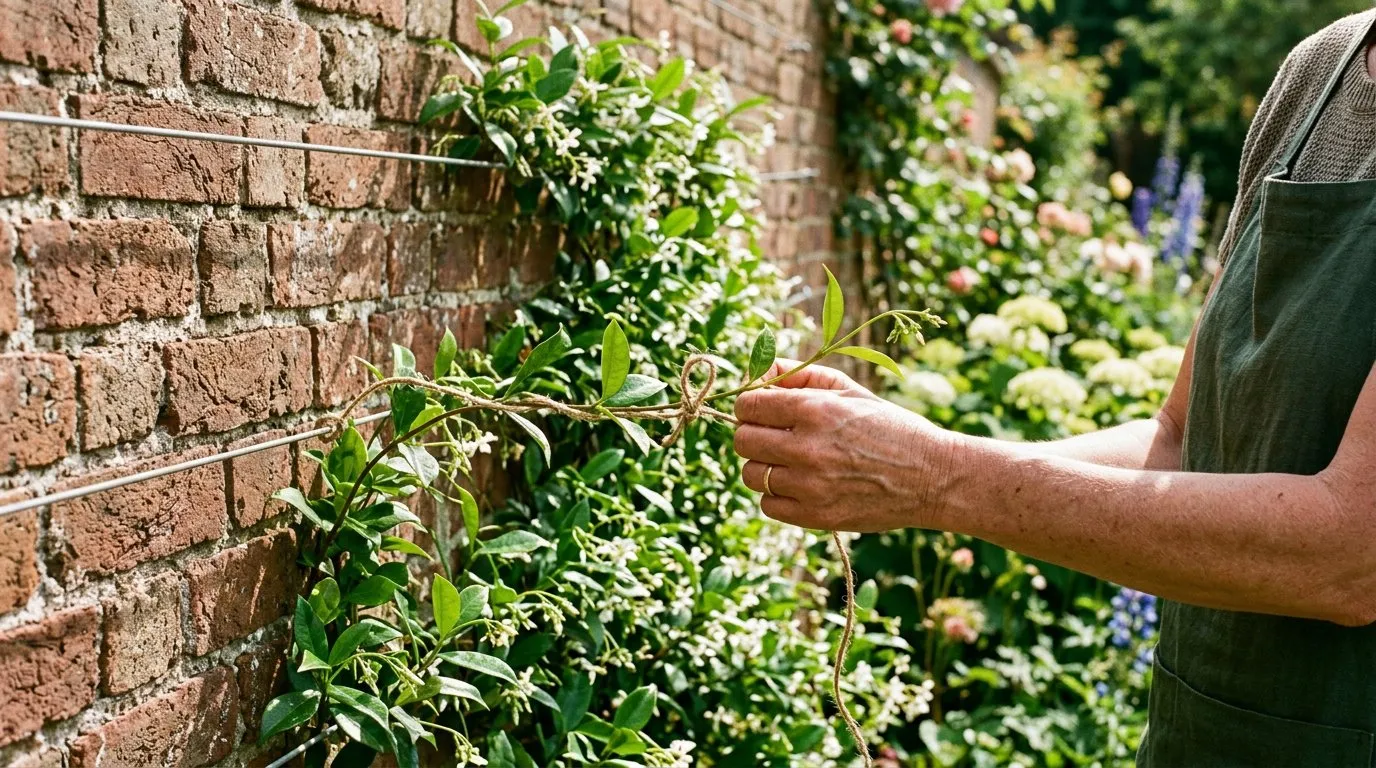 Common jasmine trained along horizontal wires on a south-facing wall. Space wires 30cm apart for good coverage.
When and how to prune jasmine
Pruning is where most gardeners go wrong with jasmine. The timing differs completely between types, and pruning at the wrong time removes the following season’s flowers.
Pruning common jasmine (Jasminum officinale)
Prune immediately after flowering, typically in August or early September. Remove the shoots that have just flowered, cutting back to strong new growth. Thin out crowded growth and remove any dead or weak stems. Do not prune in spring or autumn, spring pruning removes forming buds, autumn pruning achieves nothing useful and removes growth that hardened stems over winter.
A well-established common jasmine on a large structure can be pruned more aggressively every few years to renovate it. Cut a third of the oldest stems down to near ground level in late summer. This encourages vigorous new growth from the base.
Pruning winter jasmine (Jasminum nudiflorum)
Prune in March, as soon as the flowers finish. Cut all flowered shoots back to two or three buds from the base of the previous year’s growth. This sounds severe but is exactly what winter jasmine needs, it flowers on the previous season’s young green stems, so cutting back hard after flowering gives the maximum time to produce new shoots that carry next winter’s flowers.
Never prune winter jasmine in autumn. The green stems you see in late summer and autumn are the flower buds for December and January. Cutting them off gives you no flowers.
For guidance on pruning other wall shrubs and climbers alongside your jasmine, our guide to how to prune shrubs covers timing and technique for the most common garden plants.
Pruning star jasmine
Star jasmine requires minimal pruning. Tidy up after flowering in August, trim any shoots that have gone beyond the allocated space and remove dead or damaged growth. Avoid hard pruning unless necessary.
How to propagate jasmine
Taking cuttings is the easiest way to produce new jasmine plants for free. Semi-ripe cuttings taken in summer root reliably with minimal equipment.
Semi-ripe cuttings (July to September)
- Select a healthy, non-flowering shoot from the current season’s growth, it should be firm at the base but still slightly soft at the tip.
- Cut a 10cm length just below a leaf node with a clean, sharp knife.
- Remove the leaves from the lower half of the cutting, leaving two to three pairs at the top.
- Insert into a pot filled with equal parts peat-free compost and perlite, making a hole first with a pencil so you do not strip the base of the cutting.
- Cover the pot with a clear polythene bag to maintain humidity and place in a warm spot out of direct sun.
- Roots form in six to eight weeks. Pot on into individual containers once rooted.
- Overwinter young plants in a frost-free greenhouse or cold frame for the first winter.
If you are new to taking cuttings, our guide to sowing seeds indoors covers the same basic propagation principles and equipment needed.
Jasmine month-by-month care
| Month | What to do |
|---|---|
| January | Check ties on winter jasmine, storms can loosen stems. Enjoy flowers. |
| February | Winter jasmine continues flowering. No pruning yet. |
| March | Prune winter jasmine hard once flowers finish. Feed all established jasmine with a slow-release fertiliser. |
| April | Check for new growth. Tie in new shoots to support. Remove any frost-damaged tips. |
| May | Common jasmine and star jasmine start into active growth. Tie in regularly. |
| June | Common jasmine and star jasmine begin to flower. Feed with a high-potash liquid feed. |
| July | Peak flowering for common jasmine. Take semi-ripe cuttings for propagation. |
| August | Prune common jasmine and star jasmine after flowering. Continue taking cuttings. |
| September | Common jasmine finishes. Last chance for cuttings. Mulch base of plants. |
| October | Winter jasmine starts forming flower buds on young green stems. Do not prune. |
| November | Plant new container-grown jasmine while soil is still workable. |
| December | Winter jasmine flowers begin to open on mild days. Enjoy. |
Growing jasmine for wildlife
Common jasmine is a useful wildlife plant, particularly for moths. The scent intensifies after dusk, this is an adaptation to attract night-flying moths rather than bees, which navigate by sight. Privet hawk-moths and white-lined sphinx moths visit fragrant white flowers after dark, making common jasmine a good choice for a wildlife garden.
During the day, hoverflies and some bumblebee species visit the flowers. Star jasmine draws bees reliably during its June to August flowering period. For other bee-friendly plants that pair well with jasmine on a sunny wall, see our dedicated guide.
Winter jasmine produces early nectar in mild spells and is occasionally visited by queen bumblebees seeking food during warm winter days.
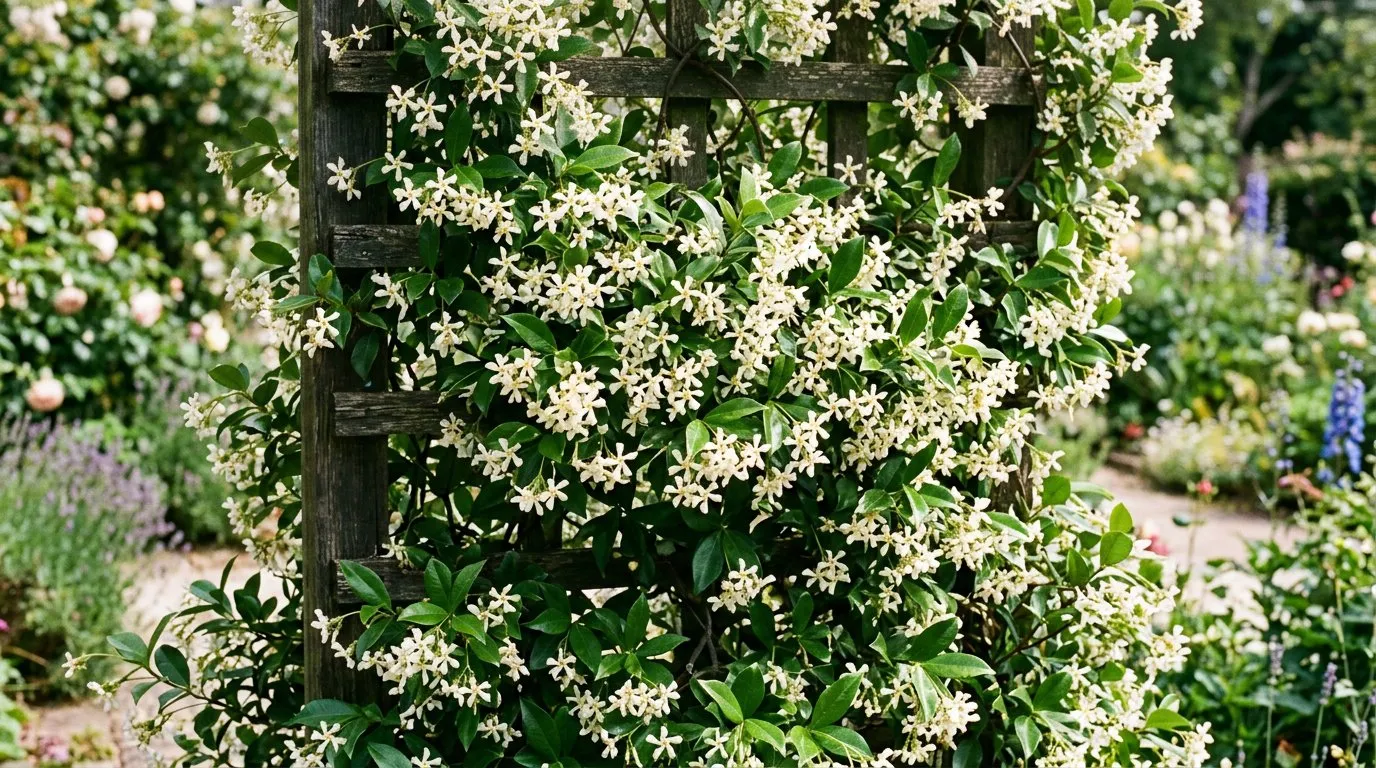 Star jasmine (Trachelospermum jasminoides) attracts bees during its June to August flowering period. Hardy to -10°C, it suits most UK regions on a sheltered wall.
Why we recommend Trachelospermum jasminoides (star jasmine) for a sheltered UK wall: After 30 years of growing fragrant climbers in British gardens, star jasmine stands out for the combination of scent, evergreen foliage, and genuine low maintenance. Common jasmine provides stronger scent, but star jasmine gives you fragrance AND year-round structure. Planted against a south-facing brick wall in a Surrey garden, an established star jasmine we monitored covered a 3m x 3m section within 8 years and produced flowers every single June from year four onwards with no pruning beyond annual light tidying.
Common jasmine problems
Slow to establish
Common jasmine and star jasmine can seem reluctant in their first year, producing little visible growth. Both are building root systems and will grow strongly from the second year. Water regularly through the first summer and do not be tempted to feed heavily with nitrogen, which promotes leaf growth at the expense of roots.
No flowers on common jasmine
Usually caused by too much nitrogen fertiliser, which promotes leafy growth but suppresses flowering. Switch to a high-potash feed (tomato fertiliser) from May onwards. Alternatively, insufficient sun, if the plant is in too much shade, it produces foliage but few flowers. Poor pruning timing also causes this: pruning in spring removes the buds that would have flowered.
Winter jasmine not flowering in winter
This almost always means the stems were pruned at the wrong time. If you or a previous occupant cut back winter jasmine in autumn, the flower-bearing young growth was removed. Leave it alone this year and prune hard in March only, after flowering. You should get flowers the following winter.
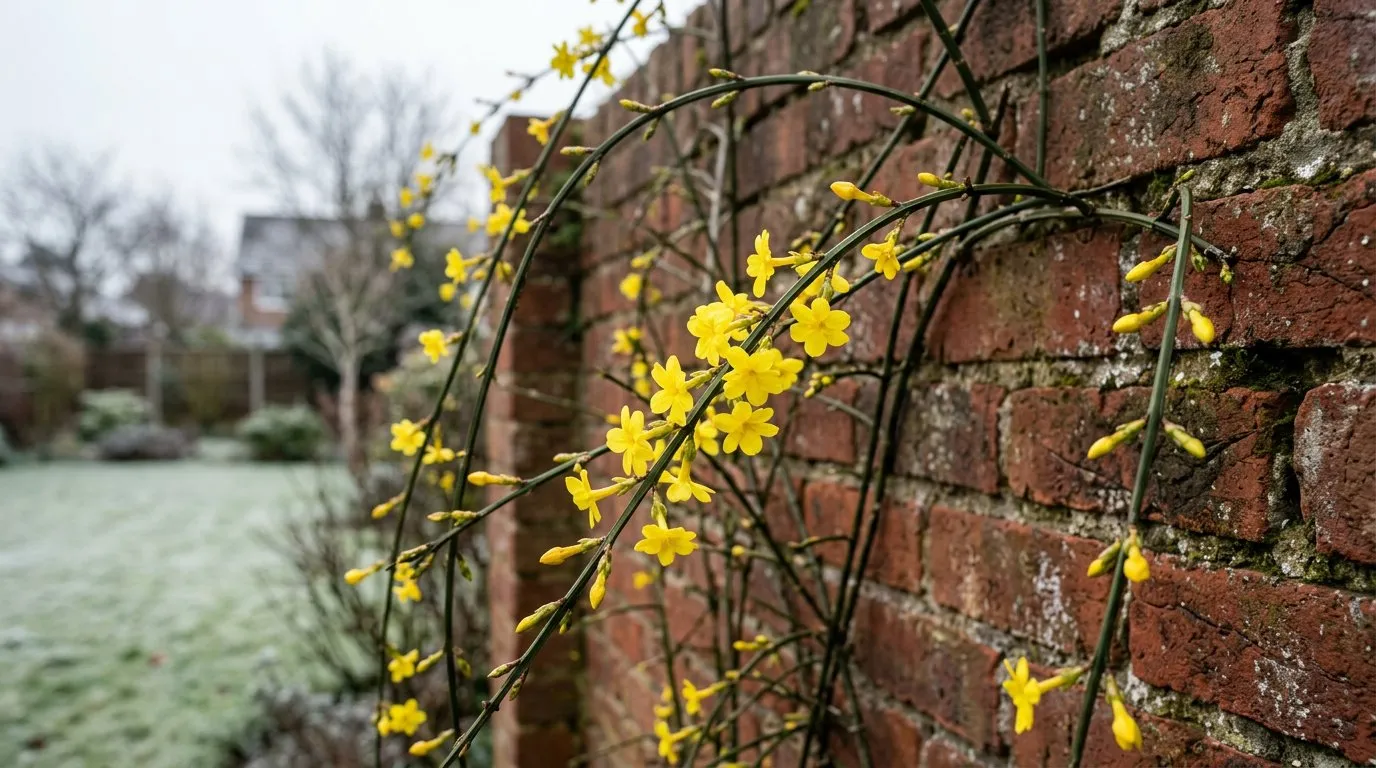 Winter jasmine (J. nudiflorum) flowering on bare stems in January. Leave young green shoots unpruned in autumn, they carry next winter’s flowers.
Frost damage on star jasmine
Young star jasmine plants are more frost-sensitive than established ones. In very cold winters, leaf scorch and browning of new growth can occur. Cut back affected shoots in April to healthy wood. An established star jasmine in a sheltered position usually shrugs off -10°C frosts with minimal damage, though it may lose some leaves temporarily.
Now you’ve mastered growing jasmine, read our guide on the best climbing plants for UK gardens to find the right companions for jasmine on a sunny wall, arch, or pergola.
Frequently asked questions
When does jasmine flower in the UK?
It depends on the type. Common jasmine (Jasminum officinale) flowers June to September. Winter jasmine (J. nudiflorum) flowers December to March. Star jasmine (Trachelospermum jasminoides) flowers June to August. Pink jasmine (J. polyanthum) flowers late winter to spring indoors.
Is jasmine hardy in the UK?
Most UK-grown jasmine types are hardy. Common jasmine tolerates temperatures down to -15°C and grows reliably across Britain. Winter jasmine survives anything the UK climate produces. Star jasmine is hardy to -10°C and suits sheltered walls in most regions. Pink jasmine is tender and cannot survive outdoors in winter anywhere in the UK.
How do I prune jasmine?
Pruning method depends on the type. Prune summer jasmine (J. officinale) immediately after flowering in late summer, removing flowered shoots back to strong new growth. Prune winter jasmine in March, as soon as flowers fade, cutting flowered stems back to two or three buds. Star jasmine only needs light tidying after flowering. Never prune winter jasmine in autumn, you remove the flower buds for next winter.
Does jasmine need full sun?
Most jasmine prefers full sun but tolerates partial shade. Common jasmine flowers best in full sun but grows in part shade with reduced flowering. Winter jasmine is exceptional, it thrives on north-facing walls, one of very few climbers to produce flowers reliably in this position through December and January. Star jasmine needs a warm, sheltered wall and full sun to flower well.
How do I propagate jasmine?
Take semi-ripe cuttings from July to September. Select a healthy non-flowering shoot, cut a 10cm length just below a leaf node, remove the lower leaves, and insert into equal parts peat-free compost and perlite. Cover with a polythene bag to retain humidity. Roots form in six to eight weeks. Overwinter young plants in a frost-free greenhouse or cold frame.
Which jasmine smells strongest?
Common jasmine (Jasminum officinale) has the strongest fragrance of any UK-hardy jasmine. The scent is most intense in the evening from July to August and carries several metres on still air. Star jasmine has a sweet, vanilla-like fragrance, milder than common jasmine. Winter jasmine (J. nudiflorum) has no meaningful scent. Pink jasmine (J. polyanthum) is very fragrant when grown indoors.
Is jasmine good for wildlife?
Yes, jasmine supports UK wildlife. Common jasmine attracts hoverflies, moths, and some bumblebee species, with the flowers especially attractive to night-flying moths because the scent intensifies after dusk. Star jasmine attracts bees and hoverflies from June to August. Winter jasmine provides early nectar during mild spells when very few other plants are flowering.
Lawrie has been gardening in the West Midlands for over 30 years. He grows his own veg using no-dig methods, keeps a wildlife-friendly garden, and writes practical advice based on real UK growing conditions.