How to Grow Osteospermum in the UK
Osteospermum growing guide for UK gardens. Covers hardy varieties, planting, overwintering, propagation from cuttings, and month-by-month care.
Key takeaways
- Osteospermum is rated RHS H3 (hardy to -5C) — most varieties need frost protection or indoor overwintering in UK zones north of London
- Osteospermum jucundum is the hardiest species and can survive outdoors year-round in sheltered southern UK gardens with well-drained soil
- Plants need at least 6 hours of direct sunlight and free-draining soil with a pH of 6.0-7.5 to flower reliably
- Taking semi-ripe cuttings in August gives an 85-90% success rate and is the most reliable way to keep named varieties through winter
- Do not plant out until soil temperature reaches 12C — typically late May in southern England and mid-June in northern England and Scotland
- Several RHS Award of Garden Merit varieties including 'Serenity Purple', '3D Purple', and O. jucundum 'Langtrees' are proven performers in UK conditions
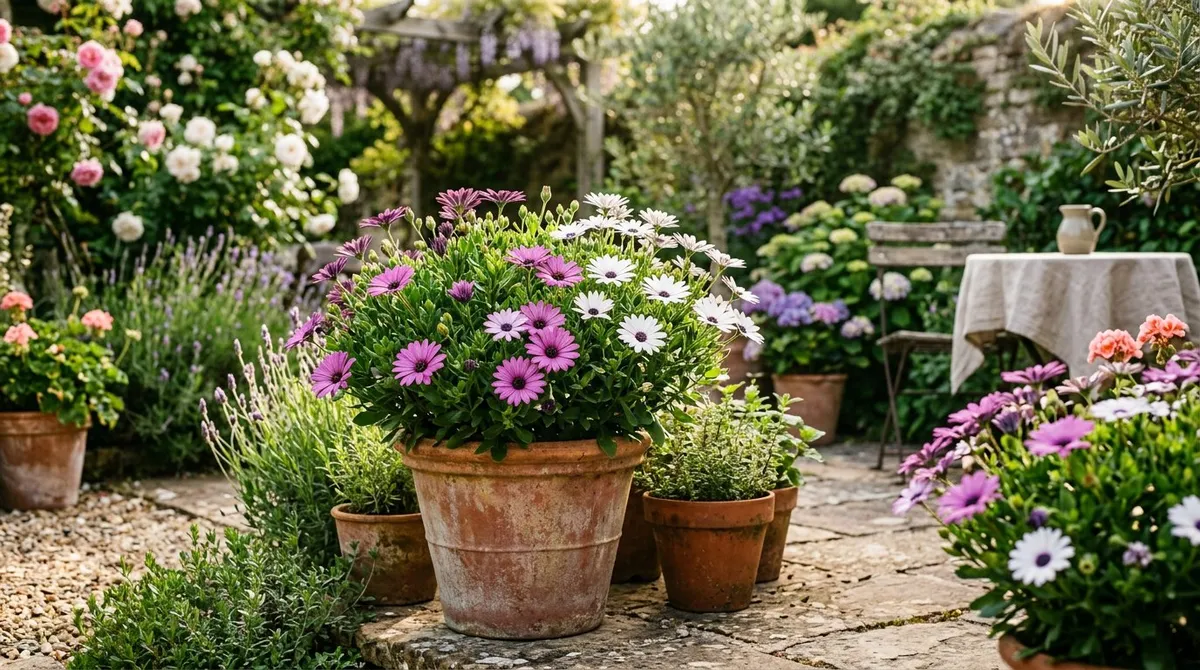
Osteospermum, commonly known as African daisy or Cape daisy, is one of the longest-flowering plants available to UK gardeners. From late May until the first hard frosts, a single plant can produce hundreds of daisy-like flowers in shades of purple, pink, white, yellow, and orange. Native to southern Africa, osteospermum thrives in the warm, dry conditions of a UK summer but needs careful handling through winter.
This guide covers everything needed to grow osteospermum successfully in UK conditions: the right varieties, planting technique, overwintering strategies, and a month-by-month care calendar.
What growing conditions do osteospermum need?
Osteospermum demands full sun and sharp drainage above all else. The RHS classifies most varieties as H3, meaning they tolerate temperatures down to -5C but no lower. In practice, wet cold kills them faster than dry cold. A damp, waterlogged winter does more damage than a brief sharp frost on well-drained soil.
The table below sets out the precise technical requirements for successful osteospermum growing in the UK.
| Requirement | Detail |
|---|---|
| Minimum temperature | -5C (RHS H3 rating) |
| Soil pH | 6.0-7.5 (neutral to slightly acid) |
| Light hours | Minimum 6 hours direct sun daily |
| Drainage | Free-draining; dies in waterlogged soil |
| Soil type | Sandy loam ideal; add grit to clay |
| Planting out temperature | Soil at 12C or above |
| Watering | Moderate; drought-tolerant once established |
| Feed | High-potash liquid feed fortnightly, June-September |
Most failures come from planting in heavy clay without improving drainage, or from choosing a shaded position. Osteospermum closes its flowers in low light and cool conditions, so a shady spot produces a disappointing display even if the plant survives. For ideas on sunny planting schemes, see our guide to Mediterranean garden planting.
Which osteospermum varieties grow best in the UK?
Osteospermum jucundum is the hardiest species available and survives UK winters outdoors in sheltered southern gardens. Several named varieties hold the RHS Award of Garden Merit (AGM), confirming reliable performance in UK conditions. The variety comparison below covers the most widely available types.
| Variety | Hardiness | Flower size | Height | Spread | Best use |
|---|---|---|---|---|---|
| O. jucundum | Hardiest (H4 in sheltered spots) | 5cm | 30cm | 45cm | Borders, rockeries; overwinters outdoors |
| ’Serenity’ series | H3, standard | 6-7cm | 25-30cm | 30-40cm | Containers, bedding; compact habit |
| ’3D’ series | H3, standard | 5-6cm | 25-35cm | 30-40cm | Overcast areas; flowers stay open in low light |
| ’Soprano’ series | H3, standard | 7-8cm | 30-40cm | 40-50cm | Large containers, borders; biggest blooms |
Osteospermum jucundum, the hardy one
O. jucundum is the species to choose if you want an osteospermum that stays in the ground year-round. It survives down to approximately -10C on well-drained soil, making it the only species that reliably overwinters outdoors across most of southern and central England. ‘Langtrees’ is the most widely available AGM form, producing soft lilac-pink flowers from May to October. Plants spread steadily by underground runners to form low, ground-covering mats 45cm wide.
‘Serenity’ series, neat and reliable
The ‘Serenity’ range offers a compact, uniform habit that suits containers and formal bedding. Plants grow 25-30cm tall with a tidy, mounded shape that does not sprawl. Colours include purple, white, pink, rose, and bronze. ‘Serenity Purple’ holds an RHS AGM. The compact habit makes these ideal for patio gardens and window boxes.
‘3D’ series, bred for British weather
Standard osteospermum flowers close on dull days, which limits their appeal in the north and west of the UK. The ‘3D’ series was specifically bred to keep flowers open in overcast conditions. ‘3D Purple’ holds an RHS AGM. The semi-double flowers have a distinctive raised central cone. These are the best choice for gardens that do not get unbroken sunshine.
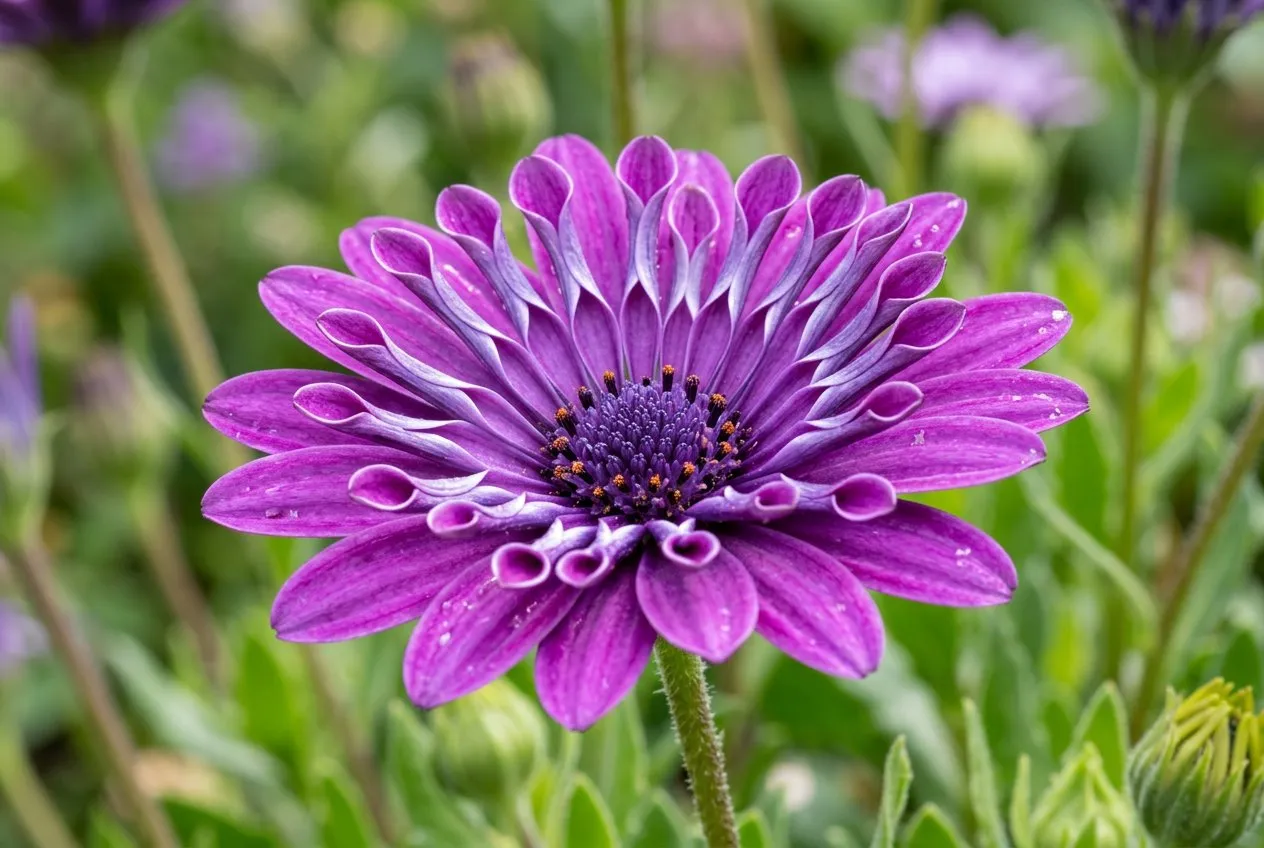 The ‘3D Purple’ osteospermum has a distinctive raised central cone and stays open on overcast days.
‘Soprano’ series, the showstopper
The largest flowers of any widely available osteospermum, reaching 7-8cm across. ‘Soprano Purple’ produces deep violet blooms that contrast well with silver foliage plants. Plants grow taller (30-40cm) and wider (40-50cm) than other series, so they need more space. Best in large pots or at the front of a sunny border.
How to plant osteospermum in the UK
Wait until after the last frost and check that soil temperature has reached 12C before planting out. In southern England, this is typically late May. In the Midlands, early June. In northern England and Scotland, mid-June is a safer bet. A soil thermometer pushed 10cm into the ground gives an accurate reading.
Harden off plants bought from a heated greenhouse or garden centre. Stand them outdoors in a sheltered spot during the day for 7-10 days, bringing them in at night. This acclimatisation prevents the shock that stalls growth and delays flowering.
For border planting, dig a hole twice the width of the root ball. Mix in a generous handful of horticultural grit on heavy soils. Set the plant at the same depth it was growing in its pot, planting too deep invites stem rot. Space plants 30-40cm apart for the smaller series, 40-50cm for ‘Soprano’. Water in well and mulch with gravel rather than bark, which holds moisture against the stems.
For container planting, use peat-free multipurpose compost mixed with 20-30% grit or perlite. A pot at least 30cm wide gives one plant room to spread. Ensure the pot has drainage holes, sitting in a saucer of water kills osteospermum faster than frost. Container growing is particularly effective on balconies where the warmth from building walls offers extra frost protection.
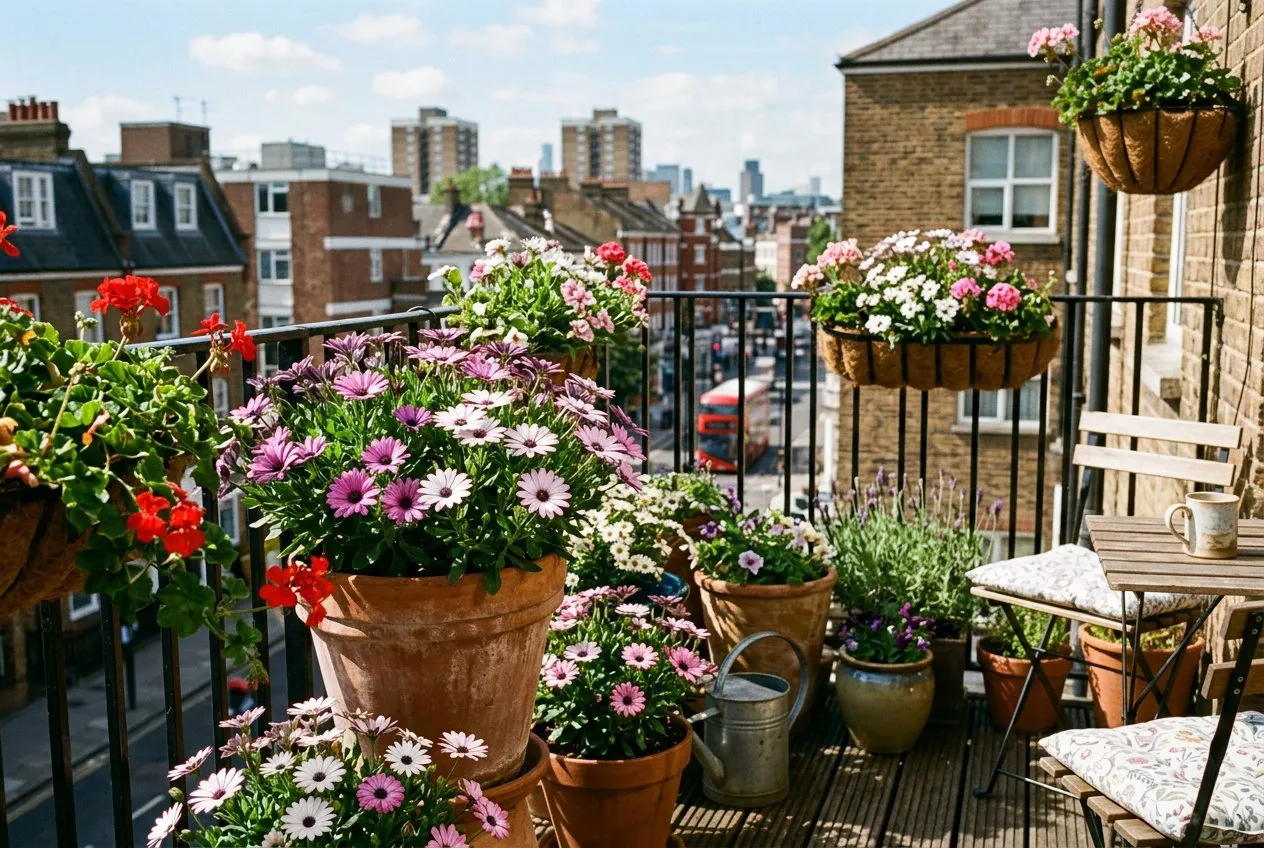 Osteospermum thrives in containers on sunny balconies, paired here with trailing geraniums for a summer-long display.
How to care for osteospermum through the season
Deadheading is the single most important task for continuous flowering. Remove spent flower stems by pinching or cutting back to a leaf joint. This redirects energy from seed production into new flower buds.
Feed container-grown plants with a high-potash liquid fertiliser (tomato feed works well) every two weeks from June to September. Border-grown plants in reasonable soil need less feeding, a single application of balanced granular feed in late spring is sufficient. Avoid high-nitrogen feeds, which produce leafy growth at the expense of flowers.
Water moderately. Osteospermum is drought tolerant once established and resents constantly wet roots. In containers, water when the top 2-3cm of compost feels dry. In borders, supplementary watering is only needed during prolonged dry spells in the first season.
Pinch out the growing tips of young plants when they have 4-5 sets of leaves. This encourages branching and produces a bushier, more floriferous plant. Without pinching, osteospermum tends to grow tall and leggy with fewer flower stems.
How to overwinter osteospermum in the UK
Most UK gardeners need to protect osteospermum from winter cold, wet, or both. The method you choose depends on your location, facilities, and how much effort you want to invest. The table below compares the three main approaches.
| Method | Success rate | Min temp required | Effort level | Best for |
|---|---|---|---|---|
| Bring indoors | 70-80% | 5-10C frost-free | Medium | Favourite plants; large specimens |
| Fleece protection (in-ground) | 50-60% | Above -5C; needs free-draining soil | Low | O. jucundum; sheltered southern gardens |
| Take cuttings | 85-90% | 10-15C (windowsill) | Medium-high | Named varieties; limited indoor space |
Bringing plants indoors
Lift potted plants or dig up border specimens before the first frost, typically mid-October in the south, early October further north. Cut back by one-third to reduce water demand and remove any dead or yellowing leaves. Place in a bright, frost-free location: an unheated conservatory, cool greenhouse, or bright porch at 5-10C. Water sparingly, just enough to prevent the compost drying out completely. Resume normal watering and feeding in late March as new growth appears.
Fleece protection outdoors
This works only for O. jucundum and only in the mildest UK areas: the south-west, south coast, and sheltered urban gardens. Cut plants back to 10-15cm in late autumn. Apply a thick gravel mulch around the crown to keep moisture away from the stems. Cover with two layers of horticultural fleece when frost is forecast. Remove the fleece on mild days to prevent grey mould building up underneath. This method relies on sharp drainage, on clay soil, winter wet kills the roots regardless of temperature.
Taking cuttings
The most reliable method and the best way to keep named varieties true to type. Take semi-ripe cuttings in August, when stems are firm but not woody. For detailed technique, see our guide to plant propagation from cuttings.
 Taking semi-ripe osteospermum cuttings in August gives an 85-90% success rate, the most reliable way to keep named varieties through winter.
- Select non-flowering shoot tips 8-10cm long. Cut just below a leaf node with a clean, sharp blade.
- Remove the lower leaves, keeping two to three pairs at the top. Pinch out any flower buds.
- Insert cuttings into small pots filled with a 50:50 mix of peat-free compost and perlite. Water lightly.
- Place on a bright windowsill at 15-20C. Do not cover with a bag, osteospermum cuttings rot in humid conditions.
- Roots form in 3-4 weeks. Pot on into 9cm pots once new growth appears.
- Keep on a bright windowsill through winter, watering sparingly. Plant out the following May after hardening off.
Cuttings take up far less space than full-sized plants, making this the practical choice for gardeners without a greenhouse or conservatory.
Why we recommend August semi-ripe cuttings over indoor overwintering: After 30 seasons of growing osteospermum in UK gardens, semi-ripe cuttings taken in August consistently give an 85-90% success rate compared to 70-80% for full plants brought indoors. Cuttings take up less than one tenth of the bench space of a mature plant, require almost no watering through winter, and produce stronger, bushier plants the following May than overwintered specimens that have been cut back and stressed through months of reduced light.
Month-by-month osteospermum care calendar
| Month | Task |
|---|---|
| January | Overwintered plants: keep frost-free at 5-10C; water sparingly; check for grey mould |
| February | Inspect overwintered plants; remove dead leaves; increase watering slightly as light levels rise |
| March | Prune overwintered plants to shape; begin fortnightly feeding; pot on rooted cuttings |
| April | Harden off indoor plants; pinch out growing tips for bushier growth; buy new plants from garden centres |
| May | Plant out in southern England after last frost; soil must be 12C minimum; water in well |
| June | Plant out in the Midlands and north; start fortnightly high-potash feeding; deadhead spent blooms |
| July | Peak flowering; deadhead regularly; water containers when top 2-3cm dry; watch for aphids |
| August | Take semi-ripe cuttings for next year; continue feeding and deadheading; order grit for autumn drainage work |
| September | Stop feeding; take final cuttings if needed; bring tender varieties indoors before first forecast frost |
| October | Lift remaining plants before frost; cut back by one-third; store frost-free; apply fleece to O. jucundum outdoors |
| November | Overwintered plants: water sparingly; keep at 5-10C; ensure good ventilation to prevent botrytis |
| December | Check stored plants monthly; remove any dead or rotting material; maintain frost-free conditions |
Common problems and how to fix them
Flowers closing during the day usually means insufficient sunlight. Move containers to a sunnier position or, for border plants, consider transplanting. If the problem persists in a sunny spot, the ‘3D’ series is bred to stay open in overcast weather.
Leggy, stretched growth results from too little light or too much nitrogen. Move to full sun and switch to a high-potash feed. Pinch out growing tips to encourage branching. Cut back leggy plants by half in early summer, they recover and flower within four to six weeks.
Grey mould (Botrytis) attacks in cool, damp conditions, particularly on overwintered plants indoors. Improve air circulation, reduce watering, and remove affected material promptly. Avoid wetting the foliage when watering.
Aphids cluster on young shoot tips from May onwards. A strong jet of water dislodges light infestations. For heavier attacks, use an organic insecticidal soap spray. Ladybirds and hoverfly larvae are effective natural predators, encourage them by growing companion plants nearby.
Root rot from waterlogged soil is the most common killer. Prevention is the only reliable cure: ensure sharp drainage, add grit to heavy soil, and never let containers sit in water.
Growing osteospermum with other plants
Osteospermum combines well with other sun-loving, drought-tolerant plants. In borders, pair them with lavender, geraniums, salvias, and ornamental grasses such as Stipa tenuissima. The daisy flowers contrast well with the upright spikes of salvia and the airy texture of grasses.
In containers, plant osteospermum with trailing verbena, lobelia, or bidens for a display that flowers from June until October. Silver-foliaged plants like helichrysum or senecio make effective foils for the bright daisy blooms. A 45cm pot can hold one osteospermum with two or three trailing companions around the edge.
For a dedicated sun-baked border, combine osteospermum with lavender, sedum, eryngium, and perovskia to create a planting scheme that needs minimal watering after the first season.
Now you’ve mastered growing osteospermum, read our guide on how to grow geraniums in the UK for another sun-loving container plant that pairs with African daisies.
Frequently asked questions
Are osteospermum perennial in the UK?
Osteospermum is a half-hardy perennial rated H3 by the RHS. In sheltered southern gardens with well-drained soil, the hardiest species (O. jucundum) survives outdoors year-round. Most named varieties need frost-free storage or indoor overwintering north of London. Taking cuttings in August is the most reliable way to keep plants going from year to year.
When should I plant osteospermum outside?
Plant out after the last frost when soil reaches 12C. In southern England this is typically late May. In the Midlands and Wales, early June. In northern England and Scotland, mid-June is safer. Harden off plants for 7-10 days before planting by placing them outdoors during the day and bringing them in at night.
Why do osteospermum flowers close at night?
Osteospermum flowers close in low light and cool temperatures. This is a natural response from their South African origins, where closing protects pollen from dew and cold night air. The ‘3D’ series has been bred to stay open longer in overcast UK conditions, making it a better choice for gardens that do not get unbroken sunshine.
How do I overwinter osteospermum in the UK?
Bring potted plants indoors before the first frost, typically by mid-October. Cut back by one-third, place in a bright frost-free spot at 5-10C, and water sparingly through winter. Alternatively, take semi-ripe cuttings in August, these root in 3-4 weeks and need far less space than full-sized plants over winter.
Can osteospermum grow in pots?
Osteospermum grows well in pots and containers. Use peat-free multipurpose compost mixed with 20-30% horticultural grit for drainage. Choose a pot at least 30cm wide with drainage holes. Feed fortnightly with high-potash liquid fertiliser from June onwards. Pots on south-facing patios produce the best flowering display.
Do osteospermum come back every year?
Plants come back reliably in mild coastal and southern UK areas with well-drained soil. Inland and further north, most gardeners treat them as tender perennials, overwintering indoors or replacing from cuttings each spring. O. jucundum is the exception and returns year after year in most of England with minimal protection.
What is the difference between osteospermum and dimorphotheca?
Both are African daisies in the family Asteraceae. Dimorphotheca species are true annuals, completing their life cycle in one season and dying after setting seed. Osteospermum species are perennials that live for several years given frost protection. In garden centres, most plants sold as African daisies are osteospermum.
Lawrie has been gardening in the West Midlands for over 30 years. He grows his own veg using no-dig methods, keeps a wildlife-friendly garden, and writes practical advice based on real UK growing conditions.